
The Shield
I have fought a good fight, I have finished my course, I have kept the faith.—2 Timothy 4:7
Tavis Smiley, the late night talk show host for PBS, always ends his program with three simple words: “Keep the faith.” It is one thing to have faith; it is another thing to keep it. Keeping the faith is not merely holding on to it, but it is obeying it and living a life of faith.
An Unequal Battle
In the battle described in the text for this issue (Ephesians 6:11-17)* the struggle is an unequal one. The Christian soldier fights with a sword, a weapon designed for close-in fighting, while the enemy uses a long-range approach, throwing fiery darts. The word translated “darts” (Strong’s 956) means “arrows.” Therefore the opponent of the Christian fights at very long range — far enough to make the sword of little effect. While the word translated “fiery” (Strong’s 4448) literally means “combustible” and probably refers to arrows that were encased in flammable material that were set on fire before being shot, they may also include poisonous arrows which would have an effect far beyond penetrating the skin.
The shield, which was made of wood probably covered with hides anointed with olive oil, was not highly flammable and would have the effect of quenching the fiery missiles. Similarly our own thoughts, like wood, are not enough to meet the fiery darts of the Adversary. They must be covered with the robe of righteousness provided through the blood of the slain Christ, much like the coats God provided Adam and Eve when expelling them from the Garden of Eden. Then this shield must be continually anointed with the oil of the holy spirit. The interaction of the holy spirit is well described in [Jesus’ words], “But the Comforter, even the Holy Spirit, whom the Father will send in my name, he shall teach you all things, and bring to your remembrance all that I said unto you” (John 14:26, ASV).
The Christian is clearly at a disadvantage. His sole protection is the shield. He needs to be adept at using it. For most soldiers, who were naturally right-handed,
* See also “The Church Militant” on pp. 404–405 for a description of the Christian soldier’s armor
the shield was wielded while strapped to the left arm. It would take many hours of training to become agile enough to use the left hand so accurately and so quickly as to be able to fend off an incoming barrage of arrows.
These full-length body shields were used by a phalanx of soldiers forming a moving human wall. As a soldier in the front line would fall, he would be replaced by one in the second line. Thus, the entire troop, marching in lock step, would force the enemy to either flee or to be backed up into a tight spot. This is well illustrated in the ancient battle of Thermopylae where three hundred Spartan soldiers held off the entire Persian force of thousands at a narrow pass between the mountains and the sea. In the case of Roman soldiers, those behind the front-line would hold their shields up horizontally over their head and that of the soldier immediately in front of them. This would protect the entire phalanx from spears and arrows raining down upon the soldiers from above. So the Christian’s faith is not meant to be entirely independent, but is supported by the faith of his fellow Christians. We need each other to properly “keep the faith.”
The Shield and the Sword
A soldier has two arms. One holds the shield and the other wields the sword. These must be used in perfect concord. Picture before your eyes a soldier putting his entire force into a sword thrust. Where is the shield? It is off to one side. All the enemy has to do is to jump back and throw a dart. On the other hand, picture a soldier using a sword only as hard as he can and still keep his shield before him. This soldier is well protected against the enemy. So the Christian relies on complete truth from his “sword of the spirit,” the Bible, only to the extent to which he keeps his faith in front of him. 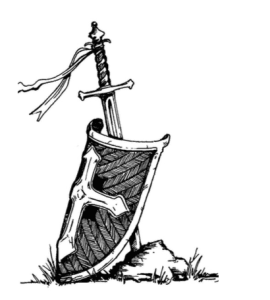
Often he finds himself challenged with doubts. But a Christian with faith in front of him, and knowing he cannot positively prove all things, but must accept many things by faith, is a well-protected Christian.
The Christian’s Shield
There is no question as to what the Christian shield is composed of: it is his faith. But what is faith?
Faith is not proof. The sword of the spirit is proof. When we have a direct scripture, we have proof of a matter. Where we do not have a direct scripture, we have an interpretation. It might be right, or it might be wrong.
However, faith is not guesswork. It is not belief in the unbelievable. Faith is a conviction based on evidence as the apostle wrote: “Now faith is the substance of things hoped for, the evidence of things not seen” (Hebrews 11:1). Faith is based on two elements. One element is passive, the evidence or conviction of things not seen (Strong’s 1650). The other element is active. The word “substance” (Strong’s 5287, Greek hupostasis) means “a firm or active standing.” The substance of our faith is what we do with it.
In our illustration, a soldier needs both the shield of strong material (“evidence”) and the ability to use it well (“substance”).
Our faith is made up of the strong evidence of God’s plan of salvation that harmonizes all the available material on a subject. Many hours went into the making of strong shields. Likewise, many hours of studying must go into the accumulation of evidence for our interpretation of scriptures that do not directly spell out their own interpretation.
It is not enough, however, to have the correct interpretation. As soldiers of yore put many hours into learning how to use a shield, today’s Christian soldier must spend many hours in learning how to use his faith in multiple applications.
Fiery Darts
What are the darts a Christian must quench? They are darts of doubt. The Adversary attacks our faith structure with doubts. “You may be right,” he says, “but then again you may be wrong.” He goes on to say, “consider this,” and then gives another possible interpretation. These doubts must be quenched.
But all doubts are not necessarily bad doubts. There are good doubts and there are bad doubts. If, for instance, Galileo had not doubted that the earth was the center of the universe, a fundamental error would have continued for many more years. If Martin Luther had not doubted the concept of indulgences, salvation would have been sold for much longer. If Pastor Russell and those before him had not doubted the doctrine of hell fire, we might still be worshipping a terrorist god.
The Growth of Faith
It is interesting to understand how bones grow. As we get older, our bones grow and yet maintain their original shape. They simply get bigger. How? There are two types of cells that do the work: osteoblasts and osteoclasts. First, the osteoblast digs into the bone structure and, with a tiny explosion, carves a crater in the bone which is filled immediately with an osteoclast, which, like a tiny amount of cement, fills the hole and expands it. This occurs millions of times a day, especially in the young.
Doctrines, like bones, form the infrastructure for the body of Christ. As bones grow, so do doctrines. They are challenged, like osteoblasts. A doubt arises. It is met, like an osteoclast, with an even stronger faith, or possibly with a change of faith.
However, many doubts are bad and tend to destroy, or at least weaken one’s faith structure. Most things we believe we cannot empirically prove, but base our concept on a string of interpretations. Each attack on our faith requires a studious re- examination of why we believe what we believe. The Apostle Paul wrote: “Examine yourselves, whether ye be in the faith; prove your own selves” (2 Corinthians 13:5). The Apostle John adds: “Beloved, believe not every spirit, but prove the spirits, whether they are of God; because many false prophets are gone out into the world” (1 John 4:1, ASV).
We, at this end of the age, have been greatly blessed with an outpouring of truth, especially through the writings of Pastor Russell, but it is not enough just to believe something because he wrote it. As he himself advised, we are to prove his words by the Word of God.
How do we assess whether doubts are good or bad? Each must be examined on a case-by-case basis.
Weighing the Evidence
Doubts arise from the thinking process. A thought is merely a line connecting two facts. Most of us will recall our childhood years when we played with connect-the- dot puzzles, connecting numbered dots to form a picture. But what if the dots were not numbered? We would make some right connections and some wrong ones. So it is with our interpretation of many scriptures. The Scriptures are factual, our connections may or may not be.
It is when we connect scriptures that we arrive at theories or interpretations. If we thought up a theory or interpretation ourselves, we tend to treasure it. We form our doubts about our earlier interpretations, but rarely do we ever doubt our doubts.
A Christian needs to learn that many right interpretations do not come quickly. Unresolved questions need to be left open and laid on a shelf for a while as we gather more evidence. We all need big shelves.
The Gathering of Evidence
But what constitutes evidence and how do we gather it? All evidence is not of the same quality. Some evidence is so strong that it is almost proof. Other evidence is “circumstantial.” How do we know which is which? Here are a few helpful rules:
1) The simplest interpretation of a text is usually the right one.
2) What did the audience understand by the words when they heard it?
3) Do we have a New Testament example of how to interpret it?
4) How does the text fit into its context?
5) In the case of types, can we be sure it’s a type? If it is referenced in the New Testament, we may be sure it If it is not so referenced, it might not be.
6) How does our understanding of a text affect our beliefs on other matters that we know to be true?
Personal Faith
Far more important than our faith in doctrines and prophecies is our personal faith in God’s providential overruling of our daily welfare. Here the Adversary’s arrows are not doubts but are the fiery trials of which Peter spoke: “That the trial of your faith, being much more precious than of gold that perisheth, though it be tried with fire, might be found unto praise and honour and glory at the appearing of Jesus Christ” (1 Peter 1:7). These trials may include discouragement or severe physical or mental stress. But no matter how hard or how hot the trials are, they are meant for our spiritual good and for the development of the new creature for its future work.
It is only after we have lived such a life and learned to fully trust God that we can, with the Apostle Paul, say: “I have fought a good fight, I have finished my course, I have kept the faith: henceforth there is laid up for me a crown of righteousness” (2 Timothy 4:7,8). The simple couplet is still true:
Trials small or trials great,
Romans 8 and 28.
Each Christian is an individual and is dealt with individually by God. As no two parts of the human body or no two stones in Solomon’s temple were exactly alike, neither are two Christians exactly alike. They are dealt with individually and uniquely under the kind, but sometimes stern, hand of God: “For whom the Lord loveth he chasteneth, and scourgeth every son whom he receiveth” (Hebrews 12:6). Because of his faith, a Christian need fear no harm from whatever trial the Adversary may present. As the old adage put it, “Fear knocked on the door; Faith answered; No one was there.”
Thus, let us all “keep the faith” remembering that “this is the victory that overcometh the world, even our faith” (1 John 5:4).
–– The Herald of Christ’s Kingdom
Printed after his death,
2009/1