
The Sixth Millennium
Let no man deceive you by any means: for that day shall not come, except there come a falling away first, and that man of sin be revealed, the son of perdition.–– 2 Thessalonians 2:3
Christianity was at its lowest ebb in the ninth and tenth centuries. Corruption was rife in both the church and the Empire. Immorality was rampant amongst both priests and nuns. The right to wear the papal tiara was blatantlysold to the highest bidder. In truth, the church-state entity called the Holy Roman Empire was neither holy nor Roman nor an empire. It was the darkest of the dark ages. As Baron Acton so aptly phrased it, “Power tends to corrupt, and absolute power corrupts absolutely.” The church had reached its nadir; there was no place to go but up.
This corruption had not taken Jehovah by surprise. He anticipated it, and the apostles predicted that there would be such an apostasy. Even in the very early days of the church Paul had written that “the mystery of iniquity doth already work” (2 Thessalonians 2:7) and John stated, “ye have heard that antichrist shall come, even now are there many antichrists” (1 John 2:18). Many details of the rise of this system were predicted in the Pergamos and Thyatira periods of the church (Revelation 2).
During man’s sixth millennium on the earth, it was time to expose this system, weaken its underpinnings, and prepare it for its judgment and removal. The early beginnings of this activity by God can be traced as far back as the ninth century of the Christian era.
Schisms
The unity of the Roman Catholic church received a shattering blow in 867 when Photius, patriarch of Constantinople, deposed the sitting pope, Nicholas I, laying the foundations for the Eastern Orthodox, or Byzantine church. This division was not only administrative, but it also had doctrinal connotations as well. Influenced by Frankish missionaries to Bulgaria, Photius favored a revised adaptation of the Nicene Creed. The words of the original creed, “from the Father,” were replaced with the more Arian sounding, “from the Father and the Son.” Although a reconciliation was eventually affected, this laid the basis for the permanent schism of 1054.
A second schism took place in the Western, or Romish church, in a rivalry between the papal claimants at Avignon, under French influence, and those in Rome. The papal throne had been in Avignon since 1308, but it was not until 1378 that a rift openly developed which was not settled until the Council of Constance (1414-18) when all claimants to the papal throne were displaced and near-unanimous consent was given to the election of Pope Martin V on November 11, 1417. Still, one more short-term schism occurred shortly thereafter with the election of the “antipope,” Felix V. This was short-lived however, and Felix abdicated the throne in 1449.
The Bible in the Vernacular
A major source of the clergy’s power over the laity came from a refusal to have the Bible translated into the native languages of parishioners. All versions were in Latin which only the educated could read. This enabled the clergy to control the interpretation of the text and formulate a united creed for the church. Independent Bible study was impossible. The Revelator poetically refers to this as a time when God’s two witnesses, the Old and New Testament, “shall prophesy a thousand two hundred and threescore days, clothed in sackcloth” (Revelation 11:3).
The first native language into which the Bible was translated was Slavic. Since there was no written Slavic language at the time, one had to be invented. Two Greek missionaries, brothers in the flesh, Cyril, and Methodius, developed a written alphabet based on the Greek, called Glagolictic. Later this was refined into the Cyrillic alphabet, widely used today in Russia and the Ukraine. This Slavic translation was completed in about 864. Widespread opposition from the German clerics to translating into the vernacular led to Cyril’s imprisonment in 870.
The Church in the Wilderness
The same time period that the two witnesses prophesy in the sackcloth of dead languages (1260 days, or symbolically, 1260 years) is mentioned repeatedly in the Bible. It is generally agreed by many students of the Bible that this period extends from the political establishment of the papacy (as a result of the battle of Ravena in 539) to the collapse of that political power when the pope died as a prisoner of Napoleonic France in 1799.
One of the places where this time period appears is Revelation 12:6. The true church of God is described as a woman fleeing a dragon (the pagan Roman empire). “And the woman fled into the wilderness, where she hath a place prepared of God, that they should feed her there a thousand two hundred and threescore days.”
During the sixth millennium, various groups of Christians were literally forced to do just that in order to avoid persecution and death by the reigning church. These included the Albigenses and Waldenses in the thirteenth century and the Anabaptists in the sixteenth.
Opposition to the wilderness church led to the instigation of harsh punish- ments against heretical Christians. At first, under the Episcopal Inquisition authorized by the Lateran Councils of 1139, 1179, and 1215, the penalty for heresy was confined to imprisonment and confiscation of property. This soon was superseded by the Papal Inquisition instituted by Pope Gregory IX in 1231 which mandated that heretics be seized by the secular authorities and burned.
Still harsher methods of torture were incorporated in the special Spanish Inquisition endorsed by Pope SIXT IV in 1483 under the infamous grand inquisitor Torquemada. These excesses seem to be the “depths of Satan” referred to in the Thyatira period of the church (Revelation 2:24).
The Morning Star
To the church at Thyatira is granted the promise: “I will give him the morning star” (Revelation 2:28). John Wycliffe (1328-1384) is widely known as “the morning star of the Reformation.” Certainly, his reforms in England and northern Europe, along with those of John Huss (1372-1415) in Eastern Europe were the precursors of the Great Reformation.
Both reformers owed their disenchantment of the established church to the political debates arising from the Great Schism in Catholicism. Both rejected the authority of the Roman See. In 1378, Wycliffe published a strong denunciation of Rome in his paper De Protestate Papea (On Papal Power). Here he laid the foundations on which the Reformation would be built — the lack of biblical basis for papal authority, the primacy of scripture, and the need for extensive theological reform. Although he died a natural death, his views were condemned in 1415 and his bones were ordered exhumed and burned.
The Great Reformation
On October 31, 1517, Martin Luther nailed his famous Ninety-Five Theses to the church door in Wittenberg, Germany. This was the clarion call that hailed the Great Reformation. For the next 131 years, until the Peace of Westphalia under the Thirty Years War in 1648, Protestants openly rebelled against the teachings and practices of the Roman Catholic Church.
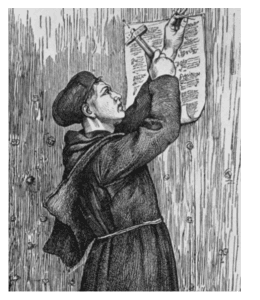
The Reformation call was not only one for correction of church doctrines and practices, it was also a cry for simple justice for those who had been mercilessly slain and burned at the stake for their religious beliefs. It is well captured in the fifth seal of Revelation: “How long, O Lord, holy and true, dost thou not judge and avenge our blood on them that dwell on the earth?” (Revelation 6:10).
While there were many challenges that reformation doctrine presented to the established church, three stand out as most prominent:
1) Justification by faith was a direct attack on the system of indulgences which declared that donations to the Mother Church were efficacious in shortening the time a soul must spend in purgatory after death. The abuse of this system by such “religious salesmen” as Johann Tetzel (1465-1519) made this the main object of attack by Luther.
2) The primacy of the Bible, along with the encouragement of translations of the Scriptures into native languages, undermined the authority of the church as the sole interpreter of the Word of God.
3) The priesthood of all believers further undercut the clerical office of the ordained priesthood and opened the way for deeper individual probing into the message of the Bible.
One of the first doctrines to be openly debated was a central one to the Romish theology — the Mass. The concept of transubstantiation — teaching that the actual body and blood of Christ were miraculously replicated in the Eucharist — had gone unchallenged for centuries and been affirmed by every ecumenical council from 325 to 787 (History of the Christian Church, Phillip Schaaf).
While Schaaf dates the challenging of the real presence of Christ in the Eucharist as early as the ninth century with the writings of Paschasius Radbert (ibid. Volume 3, p. 381), it was not until the Reformation that the matter was openly discussed. Luther’s position of consubstantiation, which holds that Christ is present not in but along with the memorial emblems, was only marginally different from the traditional doctrine of the Mass. A Swiss reformer, Ulrich Zwingli, contested both opinions with the view that the bread and wine of the Eucharist were merely symbols of Christ’s body and blood.
The Augsburg Confession
The winds of reform quickly swept throughout Europe. Such notable figures as John Calvin and Zwingli in Switzerland, John Knox in Scotland, and Philip Melanchthon soon took up the cause. There was as much rivalry as there was cooperation among the reformers and brotherly love was not widely manifest. Emperors were likewise brought into the fray. In 1530, Charles V called the Diet of Augsburg to attempt to bring peace to Europe. Melanchthon, one of the more moderate reformers, drafted the Augsburg Confession as the credo for the reformist churches. He so designed it to be relatively open to the Roman Catholic churches on the right and the non-Lutheran princes on the left.
Peace was not obtained. The Catholic church began its counter-reformation to squelch the burgeoning Protestant movement. The Index of Forbidden Books was published, and the Inquisition took on renewed vigor in hunting down and persecuting the dissidents. New religious orders, such as the Jesuits, were approved and the Council of Trent (1545-63) was called to deal with the doctrinal and disciplinary questions raised by the reformers.
Still, the conflict persisted. In 1618 a war broke out in Prague between the Catholics and the Protestants. This war lasted for thirty years and finally ended with an uneasy truce in 1648, the Treaty of Westphalia, effectively dividing Europe into Catholic and Protestant domains.
Pietism
Much of the ritual of Catholicism was adopted by the various Protestant denominations. The dissidents followed the Mother Church by uniting with warring princes for secular protection. Preaching was confined to theological hairsplitting and spirituality waned in the nascent Protestant movement. Time had again come for reform. Philip Jacob Spener (1635-1705) issued a manifesto from his Frankfurt pulpit for a return to piety. The Pietist movement was to set the stage for still further debates on the nature of salvation.
A century later John Wesley and the newly formed Methodist church began combating the Calvinist doctrine of predestination (fixing one’s eternal destiny at birth on the arbitrary choice of God) with the concept of free grace (God’s mercies being open to all who would respond). It was this softer, gentler, doctrine that introduced a spirit of brotherhood into the Christian church.
A Mighty Flood
“And to the woman were given two wings of a great eagle, that she might fly into the wilderness, into her place, where she is nourished for a time, and times, and half a time, from the face of the serpent. And the serpent cast out of his mouth water as a flood after the woman, that he might cause her to be carried away of the flood. And the earth helped the woman, and the earth opened her mouth, and swallowed up the flood which the dragon cast out of his mouth” (Revelation 12:14-16).
The floods of truth spawned by the Reformation had political as well as religious overtones. The exposure of corruption in both church and empire gave rise to humanism and the doctrine of the rights of man. As the doctrines of Protestantism weakened the clerical power of the church of Rome, so rising concerns for human rights undermined the political power of the church-state system.
The philosophy of deism, viewing God as an “absentee landlord,” was the foundation for the waves of revolution that would beset the world in the late eighteenth and early nineteenth centuries. Thomas Paine’s treatise, Common Sense, spurred on the American deists, Thomas Jefferson, Benjamin Franklin, and George Washington in their pursuit of the American Revolution.
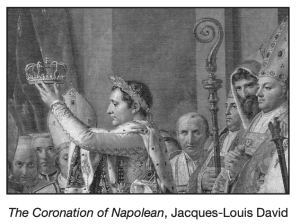
The French Revolution with its call for “Liberty, Fraternity, Equality,” introduced a new era in Europe. In 1793 Napoleon assumed command of a French revolutionary artillery brigade and soon rose to become commander of the army. His Italian and Egyptian campaigns soon established him with sufficient power to declare himself emperor. Disdaining tradition, Napoleon crowned himself as emperor in the presence of the pope. The pope had been previously imprisoned by General Berthier for non-payment of levies or fines. He died as a prisoner in France in 1799. These acts proved to be the turning point in the decline of temporal power for the Papal system.
Power shifted back and forth between the populace and the royalty until 1830 when the July Revolution in France was quickly followed by revolutions throughout Europe, effectively weakening the premise of empire — the doctrine of the Divine Right of Kings.
The Industrial Revolution saw the development of a new type of working class. Ancient craftsmen’s guilds were replaced by labor unions whose goal was to lift the working class from being virtually slave laborers to sharing in the profits of their labors. These movements gave rise to the Communist Manifesto of Karl Marx with its ringing call, “Workers of the world, Unite!” The call of James 5:4 was heard loud and clear: “Behold, the hire of the laborers who have reaped down your fields, which is of you kept back by fraud, crieth: and the cries of them which have reaped are entered into the ears of the Lord of Sabaoth.”
The battle for social justice raged across America as the anti-slavery forces combated the slave trade from Africa, finally resulting in the Civil War (1861-1865) and the Emancipation Proclamation of Abraham Lincoln.
Anticipation
As the religious world entered the last century of the sixth millennium, personal Bible study intensified. Of special note was the rise in studies on the second advent of Christ. Prominent missionaries, such as J. A. Bengel in Europe and Joseph Wolfe in Asia, made this message central in their ministries. The issue became so prominent that it was discussed at various times in the British parliament.
However, the intensity of Adventist fervor was most pronounced with the work of William Miller from 1829 to 1844. As many as one in twenty American Christians had become followers of the predictions of Miller that Jesus would return in 1844. When their anticipations failed to be realized, many continued to hold to their prophetic vision, repeatedly predicting various dates until the year 1874 was settled upon by many Bible students.
Charles Taze Russell felt that this date was correct, but that the earlier Adventists had misinterpreted both the manner and the object of this event. Russell taught that the return was to be invisible, unnoticed by the world at large, and would be for the immediate purpose of leveling society for the eventual establishment of peace upon the earth.
The great disappointment of 1844 had two effects. For some, it encouraged even deeper probing into the Bible’s message. The nature of God, the nature of man, the condition of the dead, the ransom, and salvation in heaven as well as on earth, all came under scrutiny. Monumental research projects resulted in the publication of exhaustive Bible concordances and lexicons. Sincere Bible scholars produced extensive verse-by-verse commentaries on the Bible. The stage was set for the rediscovery of long-hidden truths. The groundwork was laid for the climactic seventh millennium of man, beginning in 1874.
–– The Herald of Christ’s Kingdom
2000/1