
Revelation 16
And I saw another sign in heaven, great and marvelous, seven angels having the seven last plagues; for in them is filled up the wrath of God. –– Revelation 15:1
The most fearful symbology in Revelation is that of the “seven last plagues” which mark the consummation of the age. As ancient Egypt was decimated by ten plagues which fulfilled Moses’ repetitive request to “Let my people go,” these seven last plagues destroy symbolic Babylon and permit all mankind to go forth from the prison house of sin and death into the glories of Christ’s kingdom.
The term “seven last plagues” suggests that they are part of a larger group and thus suggests a natural connection with the ten plagues of Egypt. This connection is further strengthened by the fact that the plagues of Egypt were separated into two portions: the first three came upon all the people including the Israelites while the seven last came upon the Egyptians only. The first three were also duplicated by Pharaoh’s magicians while the last seven were not. Table 1 contains a description of the Egyptian plagues.
Table 1: The Ten Plagues of Exodus 7:8 to 11:10
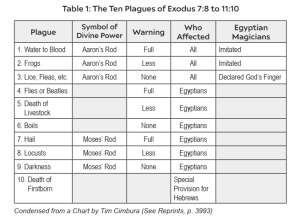
Below is a comparison of those plagues with the woes and plagues in Revelation:
Table 2: Comparing Plagues with Trumpets
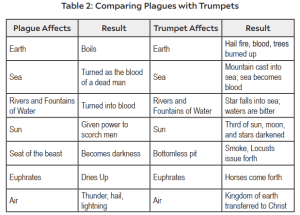
Trumpets and Plagues
Revelation is built upon a series of sevens: seven churches, seven seals, seven trumpets, seven thunders, and seven plagues. The churches, seals, and trumpets are different viewpoints of the same seven time periods while the seven plagues all occur during the last of these time periods, the Laodicean period.
There does appear, however, to be a unique relationship between the seven trumpets and the seven plagues. Each of these successively affects the same area of society (described in symbolic terms) as shown in Table 2. That each plague is thus related to the trumpet of the same number suggests the fact that the plagues are retributive in nature — each plague being specific against a given sin of Babylon through the Christian age. In an article entitled “The Ten Plagues of Egypt,” Pastor Charles Russell makes this suggestion:
“And as Pharaoh and his people received a severe retributive punishment for every evil they had inflicted upon the Israelites, and as their first-born became retributive representatives of the Israelitish babes they had caused to be drowned in the Nile, so their flocks and herds, and the crops that were destroyed by the locusts and insects, etc., and all the troubles upon them were retributive punishments, for the unjust exactions made of the Israelites. So we may suppose that the great troubles and losses which will come upon “the powers that be” of the present time, in the approaching trouble, will, in some sense or degree, be a retributive requirement, an offset for a not sufficiently benevolent and just treatment of many under their control in the present time, when the blessings and inventions of our day should be accruing more generally to the benefit of the masses.” (Reprints, p. 2910).
This is confirmed by the sentence pronounced in Revelation 19:2, “For true and righteous are his judgments: for he hath judged the great whore, which did corrupt the earth with her fornication, and hath avenged the blood of his servants at her hand.”
Two Old Testament Parallels
Detailed judgments of the Lord against Babylon are found both in Isaiah (chapter 13) and in Jeremiah (chapters 50 and 51). In the latter condemnation, a series of seven successive judgments are predicted which parallel those in Revelation. “A sword is upon the Chaldeans, saith the LORD, and upon the inhabitants of Babylon, and upon her princes, and upon her wise men. A sword is upon the liars; and they shall dote: a sword is upon her mighty men; and they shall be dismayed. A sword is upon their horses, and upon their chariots, and upon all the mingled people that are in the midst of her; and they shall become as women: a sword is upon her treasures; and they shall be robbed. A drought is upon her waters; and they shall be dried up: for it is the land of graven images, and they are mad upon their idols. Therefore the wild beasts of the desert with the wild beasts of the islands shall dwell there, and the owls shall dwell therein: and it shall be no more inhabited for ever; neither shall it be dwelt in from generation to generation. As God overthrew Sodom and Gomorrah and the neighbor cities thereof, saith the LORD; so shall no man abide there, neither shall any son of man dwell therein” (Jeremiah 50:35-40 (see Table 3).
The value of this text is not so much to identify what the plagues are, but upon whom they are poured. However, the last two — the plague of drought and the utter desolation of the final condemnation — do support the contents of the sixth and seventh vials.
1 Corinthians 15:52 speaks of the resurrection of the saints as being “at the last trump.” The term “last trump” implies the last of a series. Since the first letter to the church in Corinth was written long before Revelation described the “seven trumpets,” which series of trumpets did Paul have in mind? The only precedent for a series of trumpets in Paul’s day was the sounding of the seven trumpets in the battle of Jericho (Joshua 6). In that battle the Israelites marched around the city for six successive days, concluding with a daily trumpet blast; on the seventh day they marched about the city seven times and concluded with a shout and seven trumpet blasts. It was then that the walls of Jericho fell. This implies that the “seventh trump” was itself composed of seven trumpets, implying that the seventh trumpet of Revelation may well be the “seven last plagues.”
Table 3: Comparing Plagues with Swords
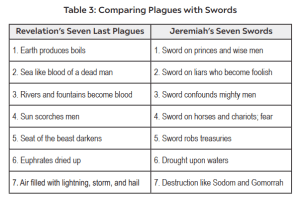
There is general concord among students of the Bible that these plagues refer to the concluding troubles which remove the old social and religious orders. In Revelation 18:4 we read, “I heard another voice from heaven, saying, Come out of her, my people, that ye be not partakers of her sins, and that ye receive not of her plagues.” The strong implication is that all who hear and reject the call to “Come out of her” are in danger of receiving her plagues. If this call was issued in the latter part of the nineteenth century, as most Bible Students believe, then the plagues would have had to begin within the average life span of a person living at that time.
Note also that in the illustration of the fall of Jericho, there was no introductory trumpet to the final seven which brought down the wall, but that the main cause of Jericho’s fall was the seven trumpets on the seventh day. Thus the seventh trumpet of Revelation and therefore the third woe (Revelation 11:14) comprise “the seven last plagues.”
The plagues are destructive forces that bring down symbolic Babylon. In Revelation 18:8 we read: “Therefore shall her plagues come in one day, death, and mourning, and famine; and she shall be utterly burned with fire: for strong is the Lord God who judgeth her.” This is definitive of the results of the seven last plagues.
In agreement with this thought are the words of Pastor Russell: “This catastrophe — sectarian destruction, the fall of Babylon — is what is referred to in the Book of Revelation under the symbol of the seven last plagues (Revelation 15-18). The pain from these will consist largely of mental chagrin, the disappointment of sectarian hopes and plans, and the wounding of sectarian pride. When the Master said, ‘Watch ye, that ye may be accounted worthy to escape all these things coming upon the world,’ it included the pain of these plagues, as well as other annoyances to which the world will be subject because of ignorance of the real plan of God. It is of escape from these plagues that the Revelator (our Lord — Revelation 1:1) speaks to us, saying, ‘Come out of her, my people, that ye be not partakers of her sins, and that ye receive not of her plagues’ ” (Revelation 18:4; Reprints, p. 1573).
The Three Woes and First Three Plagues
Just as three plagues preceded the final seven in Egypt prior to the exodus, so the plagues of Revelation are preceded by three “woes” (Revelation 8:13) which precede the more destructive judgments of the plagues. The first of these “woes,” identified during the sounding of the fifth trumpet (Revelation 9:12), are the twin dogmas of Rationalism and Humanism that followed the great Reformation. These had the effect of undermining the legitimacy of the Papal hierarchy. The second woe (Revelation 11:14), during the sixth trumpet, occurred during the political revolutions in Europe which removed the foundation for the concept of the divine right of kings. The third woe deals with the Lord’s return and its mission to remove the present social order prior to establishing the kingdom. This is the work of the seven last plagues.
“And the first went, and poured out his vial upon the earth; and there fell a noisome and grievous sore upon the men which had the mark of the beast, and upon them which worshiped his image” (Revelation 16:2). The first plague is poured upon the dry ground, organized society, the “princes and wise men” of the Jeremiah text. The sores, more literally “ulcers,” which it produced proceed from an inner infection and correspond to the challenging of religious authority by the late nineteenth-century modernists on the one hand and serious Bible scholars on the other. The works of both attacked the superstitious dogmas by which both Papal and Protestant church hierarchies held the laity in subjection.
“And the second angel poured out his vial upon the sea; and it became as the blood of a dead man: and every living soul died in the sea” (Revelation 16:3). The scene now moves to the sea, a picture of unstable and restless society. Jeremiah identifies this class as the “liars” in Babylon. The sea does not just turn into blood, but into “the blood of a dead man.” After death, human blood putrefies, separating the clot from the serum. At the end of the nineteenth century, the dogmas of both the modernists (that the Bible was not inspired) and the fundamentalists (still holding fast to such ancient creedal mythologies as eternal torment and the Trinity) so polarized the people that both groups lost credibility — they were separated into two opposing camps “like the blood of a dead man.”
“And the third angel poured out his vial upon the rivers and fountains of waters; and they became blood” (Revelation 16:4). Water and blood are still the symbols of the third plague, but here it is not on the sea, but on the sources of water: rivers and fountains of waters. The blood is not the blood of a dead man but flowing vital blood. The fountainheads of gospel teachings for centuries have been the college and seminary systems that produced those who would minister the gospel. By the early twentieth century, modernistic thought had entered these fountainheads of learning, leading many to believe that the Old Testament, with its wars and its sacrifices, was only an account of dead men’s blood. Professor Delitzch renders the cognate passage from Jeremiah 50:36, “A sword is against her heroes and they shall be confounded.” These first three plagues, like those in Exodus, form a group and the Revelator summarizes the net effect of the three by affirming that these three judgments were deserved and righteously administered (Revelation 16:5-7).
The Fourth and Fifth Plagues
“And the fourth angel poured out his vial upon the sun; and power was given unto him to scorch men with fire. And men were scorched with great heat, and blasphemed the name of God, which hath power over these plagues: and they repented not to give him glory” (Revelation 16:8,9). The effect of the fourth plague, poured on the sun, is not so much to enlighten as to scorch men with its heat. Once again a reference to the corresponding “sword” in Jeremiah is helpful: “A sword is upon their horses, and upon their chariots, and upon all the mingled people that are in the midst of her, and they shall become as women” (Jeremiah 50:37). While this plague is directed at the sun, its ultimate effect is on the “horses and chariots,” or doctrines and the organizations which they drive.
A direct outgrowth of World War I was the establishment of investigative reporting as a standard journalistic practice. Although this mode of journalism had been started by the Pulitzer Papers 50 years earlier, it attained legitimacy and was no longer regarded as “muckraking” when the major media of the day began exposing the forces behind the war. Even as these reporters began disclosing the hidden machinations behind the war efforts, some sincere theologians began re-examining old creedal concepts and challenging them. Prominent along this line was the movement away from inherent immortality to the biblical doctrine of conditional immortality. The effect of this two-pronged plague was to further remove creedal fences and leave the mingled and confused religious peoples “as women,” defenseless.
“And the fifth angel poured out his vial upon the seat of the beast; and his kingdom was full of darkness; and they gnawed their tongues for pain, And blasphemed the God of heaven because of their pains and their sores, and repented not of their deeds” (Revelation 16:10,11). Most Protestant expositors agree that the “seat of the beast” refers to Rome and its authoritative Roman Catholic Church. The basis for this dominance has been the concept of the supreme apostolic authority of the Bishop of Rome, the Pope. In matters of dogma, when speaking ex-cathedra, he was considered infallible. This foundation doctrine of the Papal church has been severely challenged in the past century, particularly since the last Vatican Council. No longer do official Papal pronouncements go unchallenged. This is particularly illustrated in such concepts as the sanctity of human life. The laity, for example, regularly ignores repeated statements against the sins of birth control and abortion.
Note that the corresponding “sword” in Jeremiah is against her “treasures.” While the Hebrew owtsar is usually translated “treasures,” it is also translated “storehouses” and “wine cellars” in 1 Chronicles 27:26-28. The “treasures” of Papacy, while including immense financial wealth, have also been its control over its doctrines, often indicated by the biblical symbol of wine. It is these doctrines based on the outdated creeds of yore, that are particularly decimated by the fifth plague.
The Sixth and Seventh Plagues
In Revelation 16:12-21 we have much greater detail about the last two plagues than we were given for the first five. We are standing today at the close of the fifth plague. The sixth and seventh plagues are fast approaching. In the sixth plague, we see:
1) The river Euphrates which ran through Babylon and was its main source of commerce, dried up, preparing the way for the “kings of the east”.
2) The “beast,” the “dragon,” and the “false prophet” (a term which applies to the image of the beast after it gains life), unitedly issued “unclean spirits,” or harmful messages with the effect of gathering the nations to war.
3) The nations are successfully  gathered into the yet future “Battle of ” This “drying up” of the Euphrates is described in Jeremiah 50:38 as a “drought upon her waters.” This refers to the drying up of the traditional sources of revenue for antitypical Babylon. This has the effect of severely straining her resources which weakens her as the “beast” so that she must seek an alliance with “the dragon” (civil power) and the “false prophet” (an energetic Protestant union of churches).
Then comes the final battle of the ages, or “Battle of Armageddon,” pictured by the seventh and last plague. Like the last plague in Exodus, it will have the effect of letting God’s people, the entire redeemed human race, go free from the bondage of sin and death. It is this final plague that brings utter destruction, such as rained on Sodom and Gomorrah, to Babylon the Great (Jeremiah 50:39,40; compare Isaiah 34).
These details are given in Revelation 16 about the final plague:
1) Poured upon the air, the vial has the effect of producing a ferocious storm of lightning (enlightenment) and thunder (the controversies that come from such enlightening).
2) A great earthquake (revolution), much greater than the earthquake (French Revolution) found during the sixth seal (Revelation 6:12; 8:5; 11:13).
3) The dissolution of the tripartite union of the beast, dragon, and false prophet formed during the sixth plague, entailing the final collapse of great Babylon.
4) The fleeing away of every island (former mountains or kingdoms, now surrounded by the sea of humanity (compare Psalm 46:2).
5) A plague of hail (hardened water, or truth) that causes men to blaspheme the name of God as they face the harsh realities of all rights restrained by the benevolent kingdom of Christ.
When these judgments are complete, then shall be fulfilled the promise of Revelation 18:21, “And a mighty angel took up a stone like a great millstone, and cast it into the sea, saying, Thus with violence shall that great city Babylon be thrown down, and shall be found no more at all.”
The judgments of these “seven last plagues” will be great indeed, but they are only the necessary precursor for a glorious Kingdom in which all men shall learn the ways of the Lord so that a restored human race may live together in eternal harmony.
–– The Herald of Christ’s Kingdom 2001/4