
–– Acts 3:19-21; Matthew 19:28; John 5:25-29
I would much rather be sitting in the audience today listening to Br. Carl present his thoughts. He had hoped to make it even up to last week, but last Sunday he came down to our meeting, and he realized that it was just too difficult, he was too worn out. For the most part he is bed-ridden. He is having thyroid problems, and [the doctors] believe he may have had a small stroke at the base of his skull which is affecting his speech. Even when he is feeling stronger, his speech is slightly slurred, so it is a little difficult to understand him. But he is still the same Carl. He is still the same indominable spirit who still has a sense of humor, who still finds laughter in his life even in his condition. He and Sr. Marge send their special love to each of you. You know that he loves to be with the brethren. It is very difficult for him not to be here because you are a great source of joy for him. He is definitely a “people-person,” and when the people are the brethren, he is especially a “brethren-person.”
Br. Carl told me that he would try to listen to the convention as much as possible on the internet, so if you are listening, Br. Carl, the brethren here miss you and pray for you and Sr. Marge in these difficult times. We know that the Lord will be with you and strengthen you as always. Please be assured of our love and our deep appreciation for all that you have done for the Lord and for the brethren and especially, I have to say, for myself and for my family. It is a great tribute that not only do I love him because he was one of my elders growing up, but my children love him because he still exerted such a good influence even on the next generation. Carl, you are a wonderful example to me, and you are a dear friend and a dear brother in Christ.
I was speaking to Br. Carl a few weeks ago, and he said to me that he would like his legacy to be that he was a unifying influence among the brethren. I assured him that I thought he had been an excellent example of loving all the brethren and that he was truly a peacemaker in Zion. It is in this spirit of not wanting to divide the brethren but to build them up that he wanted me to present these thoughts to you today. Some of you will undoubtedly have a different view of the subject we will discuss, but you know Brother Carl: he always shares his thoughts with an open mind and an open heart.
With this brief introduction, let us consider his subject: The Three R’s of The Kingdom ….
–– Br. Tom Ruggirello
When we were in school, we learned the three “R’s” of education: Reading, ‘Riting, and ‘Rithmatic.” In the school of Christ, we will consider three “genuine R’s,” the three “R’s” associated with the Kingdom: Restitution, Regeneration, and Resurrection. There are, of course, other “R’s” associated with the Kingdom such as Ransom, Restoration, and Resuscitation, but these subjects will be considered another time. Our thoughts here will concentrate on Restitution, Regeneration, and Resurrection.
RESTITUTION
When we consider the scriptural concept of Restitution, we naturally think of the text in Acts 3:19-21: “Repent ye therefore, and be converted, that your sins may be blotted out, when the times of refreshing shall come from the presence of the Lord; And he shall send Jesus Christ, which before was preached unto you: Whom the heaven must receive until the times of restitution of all things, which God hath spoken by the mouth of all his holy prophets since the world began.”
It is important, first, to examine the context of the whole third chapter of Acts. When we look closely, we discover that there is a Jewish context. Earlier in the chapter we see that Peter was speaking to the Jews who were assembled at the Temple in Jerusalem.
- In verse 13, Peter refers to “the God of our fathers,” meaning, “the fathers of Israel.”
- In verse 15, he says, “You killed the Prince of Life,” referring to the Jewish participation in the crucifixion of Christ.
- In verse 17, Peter continues speaking to the Jewish audience about “your rulers.”
- Then in verse 19, he says to the Jews, “Repent ye therefore so that your sins may be blotted out.” Contextually, this verse refers to Israel’s sins under the Law Covenant, and their involvement in the death of our Lord.
- In verse 20 Peter goes on to say, “Which before Jesus preached unto ” Again, the “you” here is the nation of Israel. Therefore, the next phrase could easily and properly be interpreted as the times of (your) restitution –– i.e., the restitution of Israel. So, when we talk about the Times of Restitution we have to keep in mind how the nation of Israel is part of that work.
- Verse 22 continues with the same Jewish “Moses said unto (your) fathers” –– i.e., the fathers of Israel.”
- In verse 25, Peter refers to his audience as “the children of the prophets”
- And in verse 26, he says, “Unto you first … God raised up Jesus.” Again, we see that Jesus was first sent to the house of Israel.
Notice in this passage, there are two requirements that must be met in order for the “times of refreshing” to occur. Peter says, “repent and be converted.”
These two requirements precede the next statement, “so that your sins may be blotted out, so that seasons of refreshing may come.”
Notice the order: first comes repentance, and then comes conversion. Only then can the sins be blotted out; only then can the seasons of refreshing come. The seasons of refreshing cannot come until the sins are blotted out. The sins cannot be blotted out until there is repentance and conversion.
Looking closer at the first requirement, we see that the “blotting out of sin” in this passage is conditional upon repentance and conversion. Therefore, the sin that is blotted out here cannot be Adamic sin. The blotting out of Adamic sin is not conditional upon man’s repentance and conversion. It is conditional upon the ransom that Jesus paid. Mankind needs to do nothing in order to receive the benefits of the ransom.
The resurrection comes through free grace and the ransom –– not through repentance and conversion –– not that there won’t be repentance and conversion in the kingdom, but these things come later after the Adamic curse is removed. What sins, then, does Peter refer to as being blotted out?
The phrase “blotted out” is used one other time in the Bible referring to sins. In Colossians 2:14 Paul speaks of “blotting out the handwriting of ordinances that was against us, which was contrary to us, and took it out of the way, nailing it to his cross.” These are the sins under the Law that are blotted out in our text –– not Adamic sin.
The repentance and conversion of the Jews listening to Peter would bring them “times of refreshing.” The blotting out of sin (against the Law) by nailing it to the cross for believers was the prerequisite then for the times of refreshing in Acts 3. Therefore, the context of Acts 3:19 shows that Peter is referring to the first Advent work amongst Jewish believers and not to the second Advent.
What is the source of the Times of Refreshing? Peter speaks of these times as coming “from the presence of the Lord.” It is obvious that the Lord in verse 19 is not Jesus but Jehovah because as earlier stated, verse 20 reads, “He shall send Jesus Christ.” The Lord who is doing the sending of Jesus then must refer to Jehovah. Rotherham translates the phrase in verse 19 as: “from the face of the Lord.” According to Strong’s Concordance, the Greek word for the word presence is prosopon which means “to turn the face (with favor) toward another person.”
This verse, then, is showing us that Jews at the first advent who accepted Jesus as their Savior and consecrated their lives received the benefit of having God’s favor turn toward them. His favor resulted in the refreshing of their lives through justification. What a blessing for them, to have the burden of the law lifted from their shoulders and the gift of justification bestowed upon them by God.
Looking closer at the word refreshing, we see that it is from Strong’s number 403, the Greek word anapsuxis, which means “a recovery of breath” –– literally, a new, or renewed breath. The picture that is being drawn is illustrating that Israel had run out of breath. The burden of the Law was so oppressive that they suffocated under it. But Jesus offered the breath of life to those repentant and converted Jews. The new breath was the high calling, a new life style, an opportunity to obtain everlasting life.
Peter then jumps to the second advent. Verse 20 reads “And (i.e. “In addition to the high calling at the first advent there will come a time when”) he shall send Jesus Christ, whom, the heavens must retain until the times of restitution of all things.” As we saw earlier, there is a Jewish application to national restitution at the second advent, but Peter now adds the words restitution of “all things.” This verse cannot refer to the presence of Christ with the Church. That event comes later because He does not send THE Christ (Head and Body), but He sends JESUS Christ. Jesus is retained in heaven until the second advent which Peter here describes as the Times of Restitution. Let us look closely at the word restitution. The Greek word translated “restitution” is from Strong’s number 605, apokastasis. Thayer defines this word as the “restoration of a true theocracy.” This definition is important because it ties restitution into the establishment of the heavenly government. The root of the word is taken from Strong’s number 600, apokathistemi. This word is also used in Acts 1:6, and again it is in reference to Israel: “Wilt thou at this time restore again the Kingdom to Israel?” In the minds of the disciples, restitution was linked to the rebirth of the nation of Israel.
The root word for restitution is a compound word made up of two Greek words: apo meaning “again” and Strong’s number 2525, kathistemi, which means “to set in order, or appoint.” So, it literally means to set in order again. It is also translated “make ruler” six times, “ordain” three times and “appoint” one time.
Even in these other translations we get the hint of rulership. In Acts 3:22 and 23 Peter quotes Deuteronomy 18:15-19 to show us that Moses predicted that establishing the government would be a part of the restitution work.
Acts 3:22, 23 says, “For Moses truly said unto the fathers, A prophet shall the Lord your God raise up unto you of your brethren, like unto me; him shall ye hear in all things whatsoever he shall say unto you. And it shall come to pass, that every soul, which will not hear that prophet, shall be destroyed from among the people.” In other words, Peter is making the point that the raising up of the new ruler, the “prophet like unto Moses,” would be part of the restitution work. Establishing rulership then is a part of the work of restitution. This began with the return of the Lord, followed by the resurrection of the sleeping saints and then by all the saints, as one by one, they are raised in the twinkling of an eye. These will make up the new government that will be established as the work of restitution progresses.
Beginning the work of regathering Israel is also part of laying the earthly foundation for the new government. It is also important to understand that restitution includes destitution. Some may argue that the times we are living in now are more destructive than constructive, so how can we be in the restitution phase of God’s plan? Just as the building of a new structure begins with the demolition of the old building, so the establishment of a new government and new social order begins with the removal of the old man-made systems. Remember Thayer’s definition of restitution, that it is the restoration of a true theocracy. The governments of man are being removed so that the government of God can be established.
Let us summarize our text in Acts 3:19-21: The Times of Refreshing happen during the Gospel Age when winded Israel gets a second breath. The refreshing is the new breath of life offered to individual Jews, bringing freedom from the law and the opportunity of the high calling. The Times of Restitution in contrast began in 1874 with the return of the Lord. The process of restitution begins as the saints are raised and become part of the heavenly government.
Restitution also has its early beginnings with Israel’s return to the land, setting the stage for the earthly kingdom. So Peter is speaking of two distinct events: (1) The Times of Refreshing –– dependent upon Israel’s repentance and conversion, and the offer of the high calling at the first advent, and (2) The Times of Restitution which are not dependent upon repentance or conversion and begin at the second advent.
REGENERATION
The second Kingdom “R” is Regeneration. Our scripture in Matthew 19:28 says: “And Jesus said unto them, Verily I say unto you, that ye which have followed me, in the regeneration when the Son of man shall sit in the throne of his glory, ye also shall sit upon twelve thrones, judging the twelve tribes of Israel.”
The Greek word for regeneration is Strong’s 3824 “paliggenesia.” It is a compound word from palin (Strong’s 3825) translated “again;” and genesis (Strong’s 1078) translated “source, origin or nativity.”
The word is describing a new beginning, or as Brother Russell expresses it in Reprint 1096, it is a “new birthday.” Notice the time features mentioned in this verse. “ … in the regeneration, when the Son of man shall sit in the throne of his glory, ye also shall sit upon twelve thrones, judging the twelve tribes of Israel.”
This time is pinpointed further for us in Matthew 25:30,31 when Jesus said, “When the Son of man shall come in his glory, and all the holy angels with him, then shall he sit upon the throne of his glory; and before him shall be gathered all nations: and he shall separate them one from another, as a shepherd divideth his sheep from the goats.”
In other words, Jesus does not sit on his throne of glory until all the holy angels, the Church, are with him. And so, together they begin the work of separating the sheep from the goats. Regeneration then is a future event.
On page 165 of the Overland Monthly Brother Russell wrote that the regeneration is “Not yet. He is waiting for the development of the Church, his saintly Bride class, which is to sit with him in his throne and share his glory.” And again in Reprint 2303, “The first event of the second advent is not the manifestation of glory but the thief-like gathering of the Church, unknown to the world.” And yet again in Volume 5 [of Studies in the Scriptures] on page 138 he writes, “Accordingly, the work of the future, the work of the age, the grand object of which Messiah will reign, is expressed in the word ‘regeneration.’ ”
Turning back to Matthew 19:28, we notice one more thing. Jesus said that “ … when the Son of man shall sit in the throne of his glory, ye also shall sit upon twelve thrones, judging the twelve tribes of Israel.”
Commenting on this verse Brother Russell wrote in Reprint 1283, “This gives every apostle a throne. Not that the number of thrones is restricted to twelve, or that he who is to occupy a throne must be of necessity an apostle. Luke speaks of ‘thrones’ without restricting them to twelve or any definite number.”
“Ye are they which have continued with me in my temptations. And I ap- point unto you a kingdom, as my Father hath appointed unto me; That ye may eat and drink at my table in my kingdom, and sit on thrones judging the twelve tribes of Israel.” (Luke 22:28-30).
Brethren, it will be the blessed privilege of all the saints to sit at the Lord’s table, occupying thrones where we will reign over the earth, and to share in the work of regeneration, the rebirthing of mankind, a new genesis, a new beginning for our race. That’s something to live for, something to devote ourselves to with the full force and vigor of our lives.
Let’s summarize the points we’ve made so far:
- Restitution began with the work of establishing a new social order, starting in 1874.
- Regeneration, e. the raising of mankind from the tomb, begins in the future.
- Restitution begins when Christ returns secretly, FOR his Church.
- Regeneration begins when Christ returns in glory, WITH his Church and [includes] the work of separating the sheep from the goats.
RESURRECTION
Our scripture for the third “R” of the kingdom, is John 5:25-29 (ASV). “Verily, verily, I say unto you, The hour cometh, and now is, when the dead shall hear the voice of the Son of God; and they that hear shall live. For as the Father hath life in himself, even so gave he to the Son also to have life in himself, and he gave him authority to execute judgment, because he is a son of man. Marvel not at this: for the hour cometh, in which all that are in the tombs shall hear his voice, and shall come forth; they that have done good, unto the resurrection of life; and they that have done evil, unto the resurrection of judgment.”
An excellent quote from an article that appeared in the Herald Magazine entitled “Six Witnesses of the Messiah” says, “In this chapter Jesus talks of two different resurrections. The first group consists of a select group, “they that hear,” (v. 25) while the second group is all inclusive, “all that are in their graves” (v 29). The first group consists of the footstep followers of Jesus, while the second includes all who have died as a result of their relationship to Adam, the progenitor of the entire human race — “As in Adam all die” (1 Corinthians 15:22).
Notice how Jesus began verse 28. He said, “The hour cometh, and now is, when the dead shall hear the voice of the Son of God.” What did he mean when he said, “AND NOW IS?”
Quoting from the same Herald article, we read: “While the words ‘and now is’ are of questionable authenticity, being lacking from many of the oldest manuscripts, they do express a truth, for the resurrection process of the Christian begins when he comes under the blood of Christ for his justification. The Apostle Paul says, ‘there is now therefore no condemnation to those who are in Christ Jesus’ (Romans 8:1), and again ‘we have now received the atonement’ ” (Romans 5:11).
It is an interesting perspective, isn’t it brethren? That, in one sense, our resurrection has already begun. Our new life has started, just as those first Jewish Christians received a new breath of life once they came under the blood of Christ. We are breathing spiritual air, as infants in a new and living way.
Returning to our text in John 5, notice than in verse 26 it says “For as the Father hath life in himself, even so gave he to the Son also to have life in himself.” If we are to be like him, as the Apostle Paul says, then we too will have life within ourselves. This refers to the first resurrection, the resurrection of the Church where each of us will receive immortality, life within ourselves.
Of course, immortality is a difficult concept to fathom, but, as if this isn’t grand enough, Jesus said, “Marvel not at this, for the hour cometh, in which all that are in the tombs shall hear his voice, and shall come forth; they that have done good, unto the resurrection of life; and they that have done evil, unto the resurrection of judgment.”
It is amazing that he can give immortal life to the Church, but it is also amazing that he gives life to every man that has ever lived, all that are in their tombs. This is the wonderful concept we see conveyed from the mind of God, a resurrection of all the dead.
This second resurrection Jesus called the resurrection of judgment. This word “judgment” is from the Greek word krisis. According to Strong’s Concordance, it means a “decision (subjectively or objectively, for or against); by extension, a tribunal; by implication, justice (especially, divine law).” Commenting on this word, Brother Russell says, “Greek, krisis, resurrection of trial, resurrection of testing, a gradual resurrection. The awakening will be a preparatory work, not the full resurrection, which will require the entire thousand years.”
In harmony with this, we read in Revelation 20:12,13, “And I saw the dead, small and great, stand before God; and the books were opened: and another book was opened, which is the book of life: and the dead were judged out of those things which were written in the books, according to their works. And the sea gave up the dead which were in it; and death and hell delivered up the dead which were in them: and they were judged every man according to their works.” Resurrection is a process.
Again quoting from Brother Russell, he writes, “Greek, anastasis, occurs 43 times in the New Testament. It signifies ‘to stand again, or to raise up again;’ it is never used concerning the raising of a corpse, nor the mere revivifying of the machinery of life. It means the raising up again out of death into the full perfection of life from which Adam fell.”
According to Jesus there are three groups that will be resurrected: (1) they that hear –– the Church, (2) they that have done good –– the Ancient Worthies, (3) and they that have done evil –– the rest of mankind.
One supporting text shows two general categories. Acts 24:15 says “And have hope toward God … that there shall be a resurrection of the dead, both of the just and unjust.” Here are two general categories –– the just and the unjust.
Summarizing John 5:25-29: The first resurrection applies to the Church –– those who have done good. The Ancient Worthies will be raised to perfect human life, and finally, the rest of Mankind will experience a gradual process, a resurrection by judgment, where their character development and outward works will determine if they are granted eternal life.
A text that gives an interesting insight into the resurrection is Luke 20:34-36 which says, “And Jesus answering said unto them, The children of this world marry, and are given in marriage: but they which shall be accounted worthy to obtain that world, and the resurrection from the dead, neither marry, nor are given in marriage: Neither can they die any more: for they are equal unto the angels; and are the children of God, being the children of the resurrection.”
These verses speak of a time when the institution of marriage will have ended. In the Question Book, page 203, we read: “When by the end of the Millennial Age the world shall have come up, up, up out of degradation and sin, and got back to the place where Adam was originally, then all necessity for the male and female condition in order for the propagation of the race having ceased, they will be like unto the angels in that respect.” It is going to be an interesting world, isn’t it? Relationships will change, and we will see a perfectly equal position between men and women.
In the text in Luke, Jesus also said, “Neither can they die anymore.” Notice that he didn’t say neither will they die anymore, but neither can they die anymore. And so, the question is, “how can that be true? Will mankind achieve immortality by the end of the millennium? Of course the answer is, No. Death will always a possibility. But the work of the Kingdom, and the test of the Little Season, will be so complete that man will not sin, and if he does not sin, he cannot die. Sin is a prerequisite to death. If man does not sin, he will never die.
- 1 Corinthians 15:26: “The last enemy that shall be destroyed is death”
- Revelation 21:4 says: “And God shall wipe away all tears from their eyes; and there shall be no more death, neither sorrow, nor crying, neither shall there be any more pain: for the former things have passed away”
- In Hosea 13:14 we read, “ I will ransom them from the power of the grave; I will redeem them from death: O death, I will be thy plagues; O grave, I will be thy destruction: repentance shall be hid from mine eyes.”
In harmony with these verses we read of the judgment of the sheep in the parable of the sheep and goats in Matthew 25:34, “Then shall the King say unto them on his right hand, Come, ye blessed of my Father, inherit the kingdom prepared for you from the foundation of the world.” The test of that age will be so thorough that those who pass through it will not sin, and therefore, cannot die.
What a blessed prospect as we look out into a very sinful world today. Someday, the world will be so educated in the ways of God and so thoroughly tested that, even though death will always be a possibility, it will never happen again. Now this is a plan that only God could achieve.
Revisiting what Jesus said in Luke 20:34-36, we see the real meaning of resurrection. He said “ … they which shall be accounted worthy to obtain that world, and the resurrection from the dead, neither marry, nor are given in marriage …” What does it mean to be “accounted worthy?” In Jesus’ elaboration he is showing us that the resurrection from the dead cannot refer to the initial raising from death. Being raised initially from the grave is a matter of grace through the ransom. No worthiness is required on the part of those raised. Therefore resurrection, in its fullest sense, is more than merely coming forth from the tomb. One needs to be accounted worthy to attain that world and the resurrection of the dead. It is a full standing to life –– complete perfection, fully tested under the judgment of the Little Season and finally found worthy.
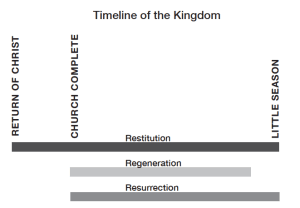
We can summarize the Three “R’s” of the kingdom by showing a general timeline of the kingdom.
First: the Return of Christ
Second: the completion of the Church
Third: the Little Season
- Restitution covers the entire period.
- Regeneration, begins with the completion of the Church and goes to at least 100 years before the little season. The reason for this ending point is that according to Isaiah 65:20 every individual must have at least 100 years of kingdom learning.
- Resurrection, while it begins with regeneration, will not be complete until the end of the Little Season, when mankind will be accounted worthy to obtain that world and the ressurection.
These then are the Three R’s of the Kingdom: Restitution, Regeneration, and Resurrection each describing a different aspect of the work and overlapping in their time frame.
We realize that there are different views among the brethren on these details. But, more importantly, we are in agreement that these concepts are integral parts of the Plan of God to bless all the families of the earth. Our understanding of how these things will come about should inspire us and motivate us to serve him without ceasing.
We will close with 1 Corinthians 15:24-26,28: “Then cometh the end, when he shall have delivered up the kingdom to God, even the Father; when he shall have put down all rule and all authority and power. For he must reign, till he hath put all enemies under his feet. The last enemy that shall be destroyed is death. And when all things shall be subdued unto him, then shall the Son also himself be subject unto him that put all things under him, that God may be all in all.”
–– Delivered by Br. Tom Ruggirello for Br. Carl Hagensick,
July, 2007 at the Bible Students General Convention