
Therefore when they were gathered together, Pilate said unto them, Whom will ye that I release unto you? Barabbas, or Jesus which is called Christ?–– Matthew 27:17
The contrast between the two men in Pilate’s court could not be more marked. The humble Galilean with no justifiable charge against him and the arrogant Barabbas found guilty of both sedition and murder. Jesus, a preacher whose radical message was growing in popularity, compared to a robber who had participated in rebellion against Rome.
Now at that feast, he released unto them one prisoner, whomsoever they desired. And there was one named Barabbas, who lay bound with them that had made insurrection with him, who had committed murder in the insurrection. And the multitude crying aloud began to desire him to do as he had ever done unto them. But Pilate answered them, saying, Will ye that I release unto you the King of the Jews? For he knew that the chief priests had delivered him for envy. But the chief priests moved the people, that he should rather release Barabbas unto them. And Pilate answered and said again unto them, What will ye then that I shall do unto him whom ye call the King of the Jews? And they cried out again, Crucify him (Mark 15:6-13).
The choice should have been clear, but the populace, stirred up by their jealous priests and rulers, were not disposed to reason. Crucify Him! Crucify Him! screamed the crowd, Release Barabbas unto us.
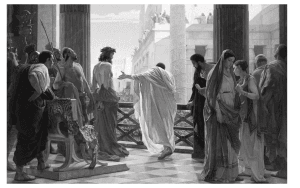 Antonio Ciseri’s depiction of Ecce Homo, 1871
Pilate’s hands were tied. His ploy to release the man he deemed innocent failed. Wearily, he gave up and released Barabbas to the crowd and sent Jesus to Calvary’s hill to be crucified.
There were four, that sad day in 33 AD who bore the title of thief. Each of their stories is different. Together they tell a story of deserved death and redemption from the power of the grave.
BARABBAS –– Set free, though guilty, while Jesus, guiltless, dies on the tree.
THE PENITENT –– Though guilty as charged, Jesus promises “thou shall be with me in paradise” (Luke 23:43).
THE IMPENITENT –– Remorseless to the end, he railed “if thou be Christ, save thyself and us” (Luke 23:39).
THE BELOVED –– Innocent and dying for our sins, Jesus vows to return as “a thief in the night.”
Jesus, in his parable of the sheepfold, described Israel of old, seeking to enter into his kingdom blessings by another way, as “thieves and robbers” (John10:1,8).
However, like the two crucified beside Jesus, they did all share the same attitude. Some, like the publicans and sinners, were penitent indeed, while others, like the scribes and Pharisees remained impenitent. The penitent were assured that day, by Jesus’ death, of a place with Jesus in paradise. Of the others Jesus said that, though they would see Abraham, Isaac, and Jacob in the kingdom, they themselves would be “cast out” of their positions of prominence and power (Mark 8:11,12).
Still a third class, the gentile world of mankind, like Barabbas, gains life in the place of the “beloved thief ” who died on Calvary’s tree.
Thus, it was that the Son of God gave his life so that the sons of men might live. In one simple act an exchange was made — the death of Jesus for the life of Barabbas. In that same act another exchange was made — the Son of God for the sons of Adam.
The Name Barabbas
In this simple incident, as so often is true in the Bible narratives, even the meaning of the names of the participants takes on special significance. The name Barabbas is of Hebrew origin. It is a compound of two words — Bar, meaning “son,” and abba, meaning “father.” Together they mean “the son of his father.” We have the word abba brought to our attention in several New Testament texts:
“And he said, Abba, Father, all things are possible unto thee; take away this cup from me: nevertheless not what I will, but what thou wilt” (Mark 14:36).
“For ye have not received the spirit of bondage again to fear; but ye have received the Spirit of adoption, whereby we cry, Abba, Father” (Romans 8:15).
“And because ye are sons, God hath sent forth the Spirit of his Son into your hearts, crying, Abba, Father” (Galatians 4:6).
The name Barabbas, then, carries the ultimate concept of heredity — the son of the father.
The economy of God’s plan that permitted sin to happen to the first pair, for then its consequences of pain, suffering, and death, could be passed on to the human race; and only one Redeemer — an equivalent for Adam — could remove the curse upon all as it is said in 1 Corinthians 15:21,22:
“For since by man came death, by man came also the resurrection of the dead. For as in Adam all die, even so in Christ shall all be made alive,” and in Psalm 51:5: “Behold, I was shapen in iniquity; and in sin did my mother conceive me.”
No name could better cover this concept than Barabbas, the son of his father. Through the death on the cross all the sons of their human fathers, all the way back to the original father, Adam, will be freed.
How appropriate then, and yet how little did the crowd realize, that when they clamored for the release of Barabbas and the crucifixion of Jesus, they would obtain the release of all earth’s Barabbases — the sons of their fathers — through the death of the guiltless man from Galilee.
–– The Herald of Christ’s Kingdom
1994/2
Is It I?
What deep emotions in their hearts did beat
As that small group who lay at Jesus’ feet
Did hear him say that one would go astray
And traitorously their loving Lord betray.
In unison their anguished cry arose
That none of them would sell him to their foes;
In heart-felt fear they asked, “Lord, is it I?”
For each one loved him dear; they’d ne’er deny.
Not loving John, who lay on Jesus’ breast,
Nor Peter bold, who towered o’er the rest,
Nor Mathew, Andrew, James—they all were sure
They’d stand the test with fervent love and pure.
But Jesus gave the fateful sop to one,
Who quickly did his wicked errand run,
Though he did join their ardent protest strong,
He set about to do his Master wrong.
And now we too, with deep concern, exclaim,
“Lord is it I? Will e’er I harm thy name?”
We each must search our inmost heart and thought,
”Will I betray or serve him as I ought.”
–– Carl A. Hagensick
The Herald of Christ’s Kingdom
2001/2