
Rome
I am not ashamed of the gospel of Christ: for it is the power of God unto salvation to every one that believeth; to the Jew first, and also to the Greek. –– Romans 1:16
First-century Rome had a motley population of some 800,000. The vast majority were plebeians, descendants of the slave class. These lived in crowded hovels with no plumbing facilities, indoor or outdoor. Garbage was
thrown untreated into the streets and the smell of stench hung heavily over their living quarters. Since Caesar Augustus had granted the right to members of this class to become members of the senate, many of them were ambitiously upwardly mobile.
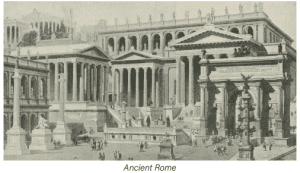 The upper middle class came from the equestrian, or soldier class. The males of this class were largely transient since the empire’s aggressive program of acquisition involved frequent military campaigns; soldiers’ wives formed an affluent but idle group, with military salaries augmented by the rich spoils of war.
The patricians, or descendants of Rome’s founding fathers, were the elite upper crust. It was from their midst that the majority of the senators were chosen and provided the succession of emperors. Octavian, or Caesar Augustus, did not descend from this Roman nobility but from a middle-class tradesman in one of the eastern provincial towns. He was, however, a distant relative of Julius Caesar, and his father had been one of the first members of the senate elected from that province.
As the capital of a thriving and growing empire, Rome was a magnet, attracting foreigners from its far-flung dominions. Not the least of this flood of immigrants, were Jews from throughout the empire. While largely despised by Pompey from the time of their mass immigration because of their religion, they were largely traders and among the financially upper middle class and had gained the favor of Caesar Augustus who established a daily offering of a lamb and two bulls to the temple in Jerusalem. They were exempt from military service and from appearing in court on the Sabbath.
Succeeding emperors were not so gracious. Tiberias repressed Jewish rites in Rome in 19 A.D. Claudius temporarily expelled the Jews from Rome in 49 A.D. Nevertheless, an active campaign of proselytism occurred and not all proselytes were required to carry out every feature of Jewish law. The “proselytes of the gate” were only required to renounce idolatry, serious moral abuses, and refrain from eating either the blood or meat of suffocated animals.
Despite their increasing numbers and relative affluence, the Jews were forced to live in isolation in the poorest parts of the city across the Tiber and near the Circus Maximus. Their seven neighborhoods each had its own synagogue and council of elders. Five Jewish cemeteries have been discovered with many Greek, and a few Latin, but no Hebrew inscriptions.
Nero
Nero was the Caesar of the Pauline captivity. He reigned for 15 years beginning in 54 A.D. His reign can be divided into three periods. It was in the first of these periods, 54-58 A.D. that Paul’s letter to Rome was penned. This period was called the “golden quinquennium” for it was marked by five years of good government and peace and popularity with the provinces. During the next five years, Nero fell under the influence of Poppaea Sabina, who ambitiously usurped the role of queen. This five-year period was marked by unrestrained debauchery. Poppaea feigned to be a Jewish proselyte and championed Jewish causes. Jewish hatred for Christianity found her a ready tool to persecute the growing Christian religion.
The final five years of Nero’s rule found 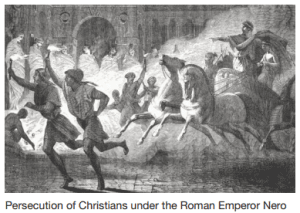 him facing the cost of his licentious living. To avoid bankruptcy Nero sought to replenish the treasuries by confiscating the estates of the wealthy, many of them senators, which turned the senate against him. This period began with the notorious fire of 64 A.D. which the emperor was falsely accused of setting as a means of clearing the poverty- ridden districts around the Circus Maximus for a glorious but affordable urban renewal program.
While Nero was favorable to Christianity in his first five years, he turned virulently against it in the last five. It was during these years that Paul was ordered killed. This change of mind was not just because Nero used Christians as scapegoats for the great fire, but because they were winning converts in ever-increasing numbers, and would not submit to Roman laws which they found to be against their conscience.
The Church in Rome
The church in Rome was probably founded in 33 A.D. when the “strangers [sojourners] of Rome” (Acts 2:10) returned from the Pentecost feast in Jerusalem where they heard the word of Christ from Peter or one of his fellow apostles miraculously speaking in their own tongue. Being Jews by nationality, they probably resided in the run-down areas of Rome where the Jewish community had been isolated.
Being the crossroads of the Roman Empire, many immigrants from the provinces heard the word and the church rapidly grew.
No letter of Paul carries personal greetings to as many brethren by name as the Epistle to the Romans. No less than 26 are mentioned in Romans 16:3-15. Only the name of Mary (Romans 16:6) is distinctly Jewish. She had evidently been with Paul before moving to Rome for he mentions that she had “bestowed much labor on us.”
Three others, Andronicus, Junia, and Herodion, are mentioned as “my kinsman.” That expression may mean they were relatives of Paul or, more likely, were fellow kinsmen, fellow Israelites. If the Rufus of verse 13 is the same as that of Mark 15:21, he was probably a Jew who was raised in Cyrenia in Africa and whose father helped Jesus carry his cross. Paul’s reference to Rufus’ mother as “his mother and mine” implies a close spiritual relationship that preceded the writing of the epistle. Paul’s close fellow laborers, Aquila and Priscilla, were a part of this church.
The other names in Romans 16 are either of Greek or Latin origin and indicate a large percentage of Gentiles in the church at Rome. Having such an admixture of nationalities, especially in a city with such rampant immorality and corruption, brought unique problems to the Roman ecclesia. It is to such an ecclesia that Paul addresses his weighty epistle.
Decadent Rome
The opening chapter deals with the decadence into which Rome had fallen and its causes. The infusion of Greek philosophies comes under attack in Romans 1:22, “Professing themselves to be wise, they became fools.” Their guilt for this came not from their ignorance of God for they should have “understood the things that are made” (Romans 1:20). Their problem was “when they knew God, they glorified him not as God” (Romans 1:21). In other words, acknowledging the existence of a higher intelligence, they were unwilling to accept his rules and laws for their lives — they failed to acknowledge the proper place of such a higher being in their lives.
This cause-and-effect relationship is shown further in Romans 1:28: “And even as they did not like to retain God in their knowledge, God gave them over to a reprobate mind, to do those things which are not convenient.” God’s rules, while known by their own conscience, were too restrictive for the licentious lives they wished to live. The phrase “reprobate mind” is translated as “degenerate minds” by Phillips and “depraved reason” in the New English Bible. Degenerate and depraved are the best fitting adjectives for the perverse sexual acts, including homosexuality, which are described in this chapter.
Jewish Guilt
The conduct of the Jews in Rome was as reprehensible as, or worse than, the conduct of the Gentiles. In Romans 2:17-25 Paul delivers this stunning denunciation of the hypocrisy of his fellow Jews: “Behold, thou art called a Jew, and … art confident that thou thyself art a guide of the blind, a light of them which are in darkness, an instructor of the foolish, a teacher of babes, which hast the form of knowledge and of the truth in the law. Thou therefore which teachest another, teachest thou not thyself? thou that preachest a man should not steal, dost thou steal? Thou that sayest a man should not commit adultery, dost thou commit adultery? thou that abhorrest idols, dost thou commit sacrilege? … For the name of God is blasphemed among the Gentiles through you, as it is written. For circumcision verily profiteth, if thou keep the law: but if thou be a breaker of the law, thy circumcision is made uncircumcision.”
If such were indeed the conduct of the Jews in Rome, it is no surprise that the Romans held them in contempt. Instead of being a light in the world, they had been overwhelmed by the darkness that surrounded them. Paul concludes by saying, “we have proved, both Jews and Gentiles, that they are all under sin; as it is written; There is none righteous, no, not one” (Romans 3:9,10).
However, Paul’s epistle does not lack hope; indeed, it contains great hope. Although the law could not bring about righteousness, justification (or righteousness) was available through the exercise of faith. “Therefore,” writes Paul, “we conclude that a man is justified by faith without the deeds of the law. Is he the God of the Jews only? is he not also of the Gentiles? Yes, of the Gentiles also” (Romans 3:28,29).
Justification — Obtaining the Righteousness of God
After illustrating the acquisition of righteousness through faith by the example of Abraham in Romans 4, the next chapter distinguishes between such justification and the further step of justification through the blood of Christ. Although justification by faith produces “peace with God (Romans 5:1), Paul writes, “Much more then, being now justified by his blood, we shall be saved from wrath through him” (Romans 5:9).
This justification is brought about by receiving “the atonement” (Romans 5:11), that efficacy which comes from the application of the blood of Christ. In Romans 5:16-20 Paul summarizes this phase of his argument: “And not as it was by one that sinned, so is the gift: for the judgment was by one to condemnation, but the free gift is of many offenses unto justification [dikaioma, Dikaioma is, so to speak, the material substratum, the foundation of dikaiosis, justification; obedience, righteousness fulfilled. It may be called justificament … the ground and material of justification.” — Gnomon of the Greek New Testament, J. A. Bengel, vol. 3, p. 74. a basis for justification, the blood of Christ made available at the first advent]. “For if by one man’s offence death reigned by one; much more they [the church during the Gospel age] which receive abundance of grace and of the gift of righteousness [dikaioma, the basis for righteousness] shall reign in life by one, Jesus Christ. Therefore, as by the offence of one judgment came upon all men to condemnation; even so by the righteousness [dikaioma] of one the free gift came upon all men unto justification [dikaiosis, the result of the application of dikaioma of life when mankind is raised from the dead]. For as by one man’s disobedience many were made sinners, so by the obedience of one shall many be made righteous [during Christ’s Mediatorial kingdom]. Moreover [in addition to the above — during the Jewish age] the law entered, that the offense might abound. But where sin abounded, grace did much more abound.”
Sanctification — Maintaining the Righteousness of God
A good practical and working definition of sanctification is furnished in Romans 6:16,22: “Know ye not, that to whom ye yield yourselves servants to obey, his servants ye are to whom ye obey; whether of sin unto death, or of obedience unto righteousness? But now being made free from sin, and become servants to God, ye have your fruit unto holiness, and the end everlasting life.”
Under the Mosaic Law, man had never been able to become free from sin and therefore could not bear such fruit unto holiness, resulting in everlasting life. Paul arrives at this conclusion in the following chapter where he writes: “The commandment, which was ordained to life, I found to be unto death” (Romans 7:10). It was this fact that led to the frustrated conclusion expressed in Romans 7:22-24, “For I delight in the law of God after the inward man: but I see another law in my members, warring against the law of my mind, and bringing me into captivity to the law of sin which is in my members. O wretched man that I am! who shall deliver me from the body of this death?”
This is in stark contrast to the sanctification Paul saw possible after the law of the spirit: “There is therefore now no condemnation to them which are in Christ Jesus, who walk not after the flesh, but after the Spirit” (Romans 8:1). This freedom from condemnation (justification) is not an end in itself, but only a Christian’s first step. It is only “as many as are led by the spirit of God” who “are the sons of God” (Romans 8:14). Only if we follow the spirit’s leadings will it be true of us that “the spirit beareth witness with our spirit, that we are the children of God” (Romans 8:16).
God’s Election
In the ninth chapter, Paul establishes the elective sovereignty of God. He uses the illustration of the potter: “Hath not the potter power over the clay, of the same lump to make one vessel unto honor, and another unto dishonor? What if God, willing to shew his wrath, and to make his power known, endured with much longsuffering the vessels of wrath fitted to destruction: and that he might make known the riches of his glory on the vessels of mercy, which he had afore prepared unto glory, even us, whom he hath called, not of the Jews only, but also of the Gentiles?” (Romans 9:21-24).
Thus, natural Israel, which sought righteousness through the works of the law, could not obtain it (Romans 9:31). Therefore, “they being ignorant of God’s righteousness, and going about to establish their own righteousness, have not submitted themselves unto the righteousness of God” (Romans 10:3). Though Christ was “the end of the law for righteousness to every one that believeth” (Romans 10:4), Israel could not call upon him because they believed not on him (Romans 10:14).
But the righteousness of God is shown in his long-range plans to rescue even the unbeliever: “Hath God cast away his people? God forbid!” (Romans 11:1). Though Israel was cast away to reconcile the Gentile world, eventually, she will be received back again, marking the onset of the resurrection — “life from the dead” (Romans 11:15). When “the fullness of the Gentiles be come in” and the Gentile election is complete, then “all Israel shall be saved” by the Deliverer who turns away ungodliness from Jacob through the new covenant which shall “take away their sins” (Romans 11:24-27). Thus, God’s righteousness is ultimately vindicated because “the gifts and calling of God are without repentance” (Romans 11:29).
Fruitage — The Results of Sanctification
“I beseech you, therefore, brethren, by the mercies of God [in the long patient exercise of his righteousness], that ye present your bodies a living sacrifice, holy, acceptable to God” (Romans 12:1). With this urgent opening, the apostle proceeds to admonish his readers in the copying of God’s righteousness by their upright and just dealings toward God, society, government, and neighbors. The admonitions of the twelfth and thirteenth chapters are most specific and not cloaked in polite generalities. A meditative reading of these chapters in a good paraphrased version, such as Phillips, makes them even more relevant to everyday living.
No admonitions come through more forcefully than those addressing interpersonal relationships. These require the recognition of differences of thought, expression, and action present in any social relationship, particularly in one with such diverse cultures as were present in the cosmopolitan church at Rome.
Chapters 14 and 15 are devoted to the subject of Christian liberty. Chapter 14 deals with “him that is weak in the flesh,” particularly in matters regarding the law — the observance of Sabbath days, the eating of meats considered unclean, etc. Romans 14:13 is an apt summation of this subject: “Let us not therefore judge one another any more: but judge this rather, that no man put a stumbling block or an occasion to fall in his brother’s way.”
It is the duty of the strong, Paul continues in chapter 15, “to bear the infirmities of the weak.” The responsibility of each member of the Church is to “please his neighbor for his good to edification” (Romans 15:1,2).
Paul’s Travel Plans
Evidently Paul, the great missionary apostle, held the hope for a long time that he would personally visit his brethren in Rome. He did so not as he anticipated on a trip that would continue to the westernmost limits of the Roman empire, to Spain (Romans 15:28), but in bonds to be tried and, after a few years of house arrest and then a temporary release, to be martyred. Several of the names to whom Paul sent greetings in the last chapter of his epistle have been uncovered in the catacombs of Rome.
It was just such ministries as those of all the apostles to the far-flung ecclesias of the rapidly growing Christian church, that strengthened the brethren for a life that frequently ended in martyrdom. Their ministry continues to strengthen us some two thousand years later.
–– The Herald of Christ’s Kingdom 2002/1