
Behold the Man. –– John 19:5
It is axiomatic in great literature to describe the characters in minute detail. Why? Because it is important. The author wants the reader to intimately know the people of whom he is writing. Knowing what they look like makes the character more believable. Yet the Bible, the greatest of all the great books, in describing its central character, Jesus Christ, omits all such descriptions. We do not know what Jesus looked like! How tall he was! What was the color of his hair? Or his eyes? Why are these details missing? Because they are not important.
“Wherefore henceforth know we no man after the flesh: yea, though we have known Christ after the flesh, yet now henceforth know we him no more” (2 Corinthians 5:16).
The Bible is not concerned with introducing us to what Jesus looked like, but to what he was — the inner man. His apostles, who knew him intimately, knew him not so much as the man, but as their Messiah, their Redeemer, their Savior.
John the Baptist on one occasion, while in prison, sent his followers to query Jesus as to whether he was indeed the one, the one promised, or whether they were to look for another. Jesus’ answer focused on the important things — not what his appearance was, but what his works were.
Jesus answered and said unto them, “Go and shew John again those things which ye do hear and see: The blind receive their sight, and the lame walk, the lepers are cleansed, and the deaf hear, the dead are raised up, and the poor have the gospel preached to them” (Matthew 11:4,5).
The focus was on his activities, what he was doing. These were the important things. When it comes to his work and his ministry the Bible is a veritable portrait gallery. Let’s walk through it together.
The Early Years
In a few short chapters both Matthew and Luke deal with his birth — lowly, to a poor couple from Nazareth, in a lowly manger bed. While all men were in expectation of him (Luke 3:15), only a handful noticed the event of his birth — a few shepherds (Luke 2), a few wise men from the East (Matthew 2), and, fearfully, King Herod.
During the next thirty years we see him but once, at the age of twelve, confounding the rabbis in the temple. One small clue of his real identity and mission comes from this small incident. His response to his parents’ anxieties, “Wist ye not that I must be about my Father’s business?” revealed a higher parentage than the human. It showed his early recognition of the true facts of his birth, that he was indeed the Son of God, born through a special act of the Holy Spirit upon his mother, Mary.
Sonship Verified
Next, we find him at the age of thirty, coming to his cousin John to be baptized. He answers the Baptist’s protestations with the simple statement, “Thus it becometh us to fulfill all righteousness” (Matthew 3:15). Upon rising from the water, we see the Spirit settling, like a dove, upon him, and hear a voice from heaven verifying his heavenly parentage, “This is my beloved son, in whom I am well pleased” (Luke 3:22).
From Jordan’s banks, we follow his lonely trek into the wilderness mountains where he meditates and fasts for forty days. Having committed himself to his mission on earth, he meditates on the works that lay in front of him and the law that lay behind him. He had come to fulfill every detail of that law (Matthew 5:17). 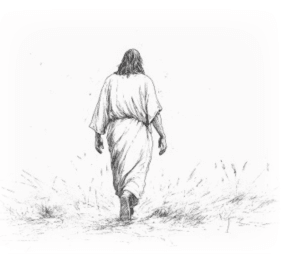
As to his work, it was to die for all mankind, to be a martyr in the fullest sense of that word (John 18:37). As he thought of that work the Adversary was by his side suggesting three simpler shortcuts to accomplish his ends without the necessity of dying. Having experienced hunger as a result of his forty-day fast, he could turn stones into bread and solve the hunger problems of the world (Matthew 3:3,4). Or he could win the support of the populace through some miraculous act (Matthew 3:5-7). Or he could cooperate with the powers that be and negotiate his kingdom with the god of this world (Matthew 3:8-10). He resists all three of these temptations with a quotation from his Father’s word, “It is written,” and the devil flees from him (Matthew 3:11).
The Master Teacher
His classroom was the open field, the seashore, the marketplace, the open road. His pupils were chiefly the poor of this world, rich in faith. While some, such as Nicodemus, were prominent, most, such as Mary Magdalene, were sinners. His methods were simple — short stories, parables he called them. Rich in simile and metaphor, these parables concealed the truth from many while revealing it plainly to others. His illustrations were simple, taken from everyday life — a shepherd losing one sheep, a wastrel son squandering his inheritance, a traveler beset by thieves and helped by a good Samaritan. Each parable had a very succinct point, a point that would illustrate his message to those who were listening and yet hiding the same message to the causal listener.
His subject matter was always the same — his kingdom. This was the one, all-absorbing theme of his ministry. He came to earth to give his life, and by giving his life, to redeem man and establish his kingdom.
The Great Physician
It was this same kingdom that he illustrated in countless miracles. These were the mark of his Messiahship. It was with these that he answered the queries of John’s troubled disciples — the blind receive their sight, the lame walk, the lepers are cleansed, the deaf hear, the dead are raised up and finally, as though it were the climactic miracle, the poor have the gospel preached unto them.
Of all his mighty miracles the most spectacular was the raising of the dead. Consider Lazarus. Dead for three days, his decaying body already stinking, raised back to life again. Yet Lazarus lived only for a few short years more and then he died again. This time there was no one to raise him to life again.
Great as all the works of the Great Physician were, he said that his disciples would do still greater works.
“Verily, verily, I say unto you, He that believeth on me, the works that I do shall he do also; and greater works than these shall he do; because I go unto my Father” (John 14:12).
These miracles are the miracles of God’s kingdom. Then his Church will be with him in glory. Then they will share in the work of that kingdom. Note the miracles of that time: “Then the eyes of the blind shall be opened, and the ears of the deaf shall be unstopped. Then shall the lame man leap as an hart, and the tongue of the dumb sing: for in the wilderness shall waters break out, and streams in the desert” (Isaiah 35:5,6).
These greater works are the same kind of works that Jesus performed but on a larger scale. He healed hundreds; these greater works will heal millions. His miracles extended life for a few years; these greater works will extend life forever.
Today some dabble in divine healing. But, at best, these healings are temporary. The healed soon die again. God’s kingdom will bring true divine healing, a healing that will be complete and last forever. But these healings are dependent on one thing, and that one thing we see in our next portrait of Jesus.
The Ransom
On a hill far away stood an old rugged cross,
The emblem of suffering and shame,
And on that old cross, the dearest and best
For a world of lost sinners was slain.
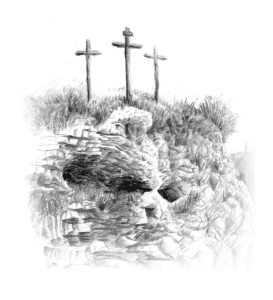
It is a tragic picture to contemplate.
A perfect man, so unjustly convicted, dying in the prime of life. But his greatest defeat was his greatest triumph. He left the heavenly courts to become a perfect man on earth to give his perfect life. The object for which he came, the purpose for which he came was to die as a martyr for men. His death was a glorious victory.
To fully appreciate the scope of that one redemptive act we need to take a closer look. His death was scripturally styled a ransom. Today we think of a ransom as a price for the release of a hostage which is paid to a kidnapper. The scriptural word ransom, however, has a deeper significance. Literally, it means “a price to correspond.”
Correspond to what? Notice the testimony of 1 Corinthians 15:20, 21,
“For since by man came death, by man came also the resurrection of the dead. For as in Adam all die, even so in Christ shall all be made alive.” Adam for Jesus, a perfect life for a perfect life, how beautifully they balance the scales of justice.
Now let us revisit a scene we saw earlier when Jesus was meditating in the wilderness. He was meditating, among other things, on the law of God, the law given to Israel through Moses at Sinai.
That law was perfect. Therefore, imperfect man could not keep it. As the Apostle Paul says in Romans 7:10: “The commandment, which was ordained to life, I found to be unto death.” No one could keep that law. But Jesus did. By keeping a perfect law perfectly, he demonstrated that he was a perfect man, therefore a corresponding price for the only other perfect man in history, Adam. Like an index finger, the law pointed out the one person who could pay the ransom price.
“Wherefore the law was our schoolmaster to bring us unto Christ, that we might be justified by faith” (Galatians 3:24).
Beyond this, we note that Adam and Eve had no children until they left the Garden of Eden. All their offspring inherited imperfect, not perfect life, from the first couple. Jesus also had the potential for a perfect human race in his loins (Isaiah 53:10). Thus, he corresponded not only to Adam but to the entire human race which came from Adam.
No wonder then we sing with rejoicing:
In the cross of Christ, I glory
Towering o’er the wrecks of time.
And again:
So, I’ll cherish the old rugged cross
Till my trophies at last I lay down;
I will cling to that old rugged cross
And exchange it someday for a crown.
The Risen Savior
Happily, the Bible does not end with a portrait of a crucified Savior. Now we see him as a risen Savior. We see him in different shapes and forms. To Mary, he appeared as a gardener. To a small group of followers, he materializes in a closed room, and again a few days later when Thomas is present he again appears, this time with wounds in his feet, hands, and side.
On the road to Emmaus, we see two disciples walking along, suddenly joined by a third person, discussing the events of the past three days. He answers their queries by quoting from the prophets as to the purpose of the suffering and death of the Messiah.
These appearances, some eleven of them, were for many reasons. They assured his followers that he was raised from the dead. They prepared his followers to deal with a spiritual Christ. His various bodies showed that he was no longer flesh and blood but could assume bodies appropriate to each occasion.
Forty days pass, and we see him one last time, with his disciples on the slopes of the Mount of Olives. Suddenly he ascends in their very midst, into the clouds of the sky, going out of sight for the last time. Yet the little group lingers waiting for one last glimpse. Two angels appear and give them a message of hope:
“Ye men of Galilee, why stand ye gazing up into heaven? this same Jesus, which is taken up from you into heaven, shall so come in like manner [not like form] as ye have seen him go into heaven” (Acts 1:11).
So they waited. Days passed by. Months, years, even whole lives went on in seemingly endless succession. The Bible itself was completed, with New Testament joining Old. It ended with that same expectation, “Even so, come, Lord Jesus” (Revelation 22:20).
Yet he did not come. Would he ever come? Yes! Now we see another portrait:
The Returned Lord
Do we indeed see him? Of course not! He is invisible. He himself said, “Yet a little while, and the world seeth me no more, but ye see me: because I live, ye shall live also” (John 14:19).
On the other hand, the same disciple says, “ … every eye shall see him … ” (Revelation 1:7). Can both be true? Only if we recognize two concepts to the word see. Even a blind man might use the expression after understanding something for the first time, “I see!” There is a mental vision just as surely as there is a physical vision. To the physical eye, Jesus’ return will be invisible, but to those watchful for signs of that event his presence will be obvious.
Jesus gave a number of signs to indicate his return, many of which are found in Matthew 24 and Daniel 12 — an unprecedented time of trouble, a rapid increase of knowledge, a transportation explosion, and the reawakening of Israel. These are signs we see all around us. Eventually, they will become so plain that every eye shall see him.
Why Does Jesus Return?
He returns to complete the work begun at his first advent. Then he taught of a kingdom; now he establishes it. Then he illustrated that kingdom with numerous healings; now he makes the healing of the entire race permanent. Soon all will know him for they will see the same signs he told those followers of John the Baptist in days of old: the blind see, the lame walk, lepers are cleansed, the deaf hear, the dead are raised, and the poor have the gospel preached unto them.
“They shall not hurt nor destroy in all my holy mountain for the earth shall be full of the knowledge of the LORD, as the waters cover the sea” (Isaiah 11:9).
“And they shall teach no more every man his neighbour, and every man his brother, saying, Know the LORD: for they shall all know me, from the least of them unto the greatest of them, saith the LORD: for I will forgive their iniquity, and I will remember their sin no more” (Jeremiah 31:34).
With such a portrait before us, let us join in singing the Hallelujah chorus as all men shall sing his praises — the praises of the King of Kings and the Lord of Lords. Hallelujah!
–– Notes from his Discourse,
“Portraits of Jesus, Parts 1 & 2”