
And delivered just Lot, vexed with the filthy conversation of the wicked. –– 2 Peter 2:7
Have you ever thought of Lot as a just or righteous man? Would you be more inclined to call him “bad Lot” or “weak Lot?” Why would the Apostle Peter use the word “just” to describe a character usually viewed as one who was far less than faithful?
Lot was the nephew of Abraham, being the son of his older brother, Haran. He was part of the entourage that Terah, Abraham’s father, led out of Ur of the Chaldees northwestward along the Euphrates River to a place they named Haran, in honor of Terah’s oldest son, now dead.
After the death of Terah, Abraham left Haran for “the promised land,” a land God had indicated he would inform him of when he was still residing in Ur. This act of Abraham is denoted as one of the great acts of faith in his life by the Apostle Paul in Hebrews 11:8, “By faith Abraham, when he was called to go out into a place which he should after receive for an inheritance, obeyed; and he went out, not knowing whither he went.”
If faith prompted Abraham to leave Haran, was it any less faith on the part of Lot? Some might say that he was younger and therefore had little choice. But his sister Milcah chose to be left behind. He did have a choice. Lot chose to go with Abraham. Assuredly, this was an act of faith on the part of Lot! Yet his act of faith was not singled out as was that of Abraham. Why? Because his faith did not continue to grow to maturity.
Arriving in the land of Canaan, both Abraham and Lot prospered so much that “the land was not able to bear them, that they might dwell together: for their substance was great” (Genesis 13:6). Strife developed between their herdsmen. In an amicable discussion, the two decided to part company. Lot chose the then-fertile area around the base of the Dead Sea. Although now a barren area, apparently it was agriculturally productive before the cataclysm that destroyed the twin cities of Sodom and Gomorrah.
The relocation to the area of Sodom was not in itself an act unpleasing to God. Given first choice, it was only logical to select the area with the best potential for prosperity. However, Lot’s selection put him in a position of temptation. Prosperity is always tempting, and one of the greatest antagonists of faith. Where prosperity exists, man feels less and less need for God.
Six Steps to Sin
Following the course of temptation, the move to Sodom traces his decline in six successive steps:
1) STRIFE (Genesis 13:7). Disagreements are natural. No two independent people can long live without differences of opinion, but these disputes need not degenerate into “For where envying and strife is, there is confusion and every evil work” (James 3:16). Strife breeds suspicion of another’s motives and destroys the incentive to work together. While Jude says that we are “to contend earnestly for the faith” (Jude 4), he does not say that we are to be contentious for it.
2) BEHOLDING (Genesis 13:10). Every materialistic act begins with a desire. “Then when lust hath conceived, it bringeth forth sin: and sin, when it is finished, bringeth forth death” (James 1:15). Modern commercial enterprises spend millions of dollars for the very purpose of creating such desire. Stores invest heavily in creating eye appeal. For Mother Eve, one of the appeals of the “tree of knowledge of good and evil” was that “it was pleasant to the eyes” (Genesis 3:6). Similarly, one of the strong temptations to the Christian is “the lust of the eyes” (1 John 2:16).
3) CHOOSING (Genesis 13:11). Desiring an object in a store window does not mean that we will choose to buy it. Noticing the fertility of the Jordan Valley, Lot could have considered other aspects of his choice: perhaps he should have deferred to his older uncle, Abraham; perhaps he should have taken into consideration the character of his new neighbors, which was already iniquitous. But Lot made his choice based solely on desires and materialistic considerations.
4) DWELLING TOWARD SODOM (Genesis 13:12). To Lot’s credit, he did not choose to live in Sodom, with all its iniquities. Nevertheless, by pitching his tent “toward Sodom” he was inviting the future temptations that put Lot in danger of losing his life on two In a similar vein, Solomon writes in his love song, “Take us the foxes, the little foxes that spoil the vines” (Song of Solomon 2:15). The little temptations, the small sins, sear the conscience, opening the door for greater sins to follow.
5) LIVING IN SODOM (Genesis 14:12). True to the pattern, a short while later Lot moved his residence to within the city. No doubt the conveniences of an urban environment over a desert tent and prosperity enabling him to purchase a home in the city were all factors in this decision. “Surely,” he may have thought, “there can be no greater danger in living in the city than in dwelling in its ” But there was greater danger, and a total of two cataclysms were required to extricate him from his difficulties.
6) SITTING IN THE GATE (Genesis 19:1). The position of “sitting in the gate” was a position of prominence and esteem reserved for the elders, or judges, of the city. After experiencing the wickedness of his Sodomite neighbors, Lot chose not to leave the city but to try to reform it. Numerous compromises would have been required to win such a high office, but a seared conscience often chooses to ignore the dangers of such a high office, but a seared conscience often chooses to ignore the dangers of such decisions.
Two Tragedies
Living in Sodom, his life came into danger twice. On one occasion he was taken captive, on the other he fled to avoid destruction. On the one, the whole city was saved for Lot’s sake. On the other, the whole city was destroyed for Lot’s sake.
The first of these incidents is recorded in Genesis, chapter 14. Chedarlaomer, King of Elam, had been holding the people around the Dead Sea as a tribute people. A rebellion finally occurred, and all the residents of Sodom, including Lot, were taken captive.
Upon hearing of this, Abraham garthered together 318 men, his entire household, and set out on a rescue mission. He restored all of Sodom’s possessions to the king and Lot to his home.
The second tragedy is recorded in the nineteenth chapter of Genesis. This time the attacker is God himself, because of the extreme wickedness of the residents of both Sodom and its sister city, Gomorrah. After negotiating for its being saved if just ten righteous people could be found there, Abraham left the matter in God’s hands (Genesis 18).
Ten righteous were not found. Only Lot, his wife, and their two daughters were sufficiently concerned to flee the city before an earthquake caused subterranean deposits of sulfur and salt to be forced up through the resultant fissures. The friction thus set the sulfur on fire and, with the accompanying salt, rained back on the earth. Lot’s wife, stopping to look longingly back, became encrusted in the salt and was turned into a salty pillar.
How well these two incidents demonstrate the workings of God in our lives. How often do our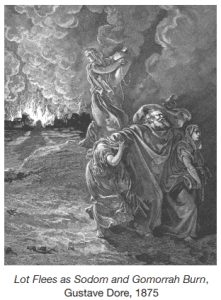 wrong decisions put us in harm’s way? How frequently does the Lord deliver us from these situations, even though they may be of our own making? Delivering us, he does not change our environment. We are returned to our individual Sodom. The choice is ours, whether to remain or flee. The time comes, however, when the choice is “flee or die.”
Worthy of consideration in this regard is the counsel of Revelation 18:4, “And I heard another voice from heaven, saying, Come out of her, my people, that ye be not partakers of her sins, and that ye receive not of her plagues.”
The Christian is required to accept the consequences of his actions, to ask the Lord for deliverance, and to accept salvation from him; but he must go further. He must repent of former wrong conduct and change his course of action lest, ultimately, he be destroyed with the wicked.
Vexation Of Soul
“And delivered just Lot, vexed with the filthy conversation of the wicked: (For that righteous man dwelling among them, in seeing and hearing, vexed his righteous soul from day to day with their unlawful deeds;)” (2 Peter 2: 7,8).
Despite Lot’s history, Peter says that he was “just” and had a “righteous soul.” Noting Lot’s involvement with the Sodomites, Peter assures us that this was vexing to Lot’s soul. The word translated “vexed” in verse 7 is very different from the one translated “vexed” in verse 8.
Both the New International Version and the Revised Version translate verse 7 with the word “distressed.” Lot was distressed by the unrighteous acts of his neighbors. Probably he sought his judgeship with the hope of reforming the city.
The word “vexed” in verse 8 comes from the Greek basanizo, a word often translated “torment,” but, according to Strong’s Concordance, it meant literally “a touchstone.” A touchstone was used in gold mining, to assay the gold content of ore. The ore was rubbed against the stone and, if containing gold, would leave streaks of gold on the touchstone. Idiomatically, it came to signify a “putting to the test, an investigation, to assay or assess.”
The thought, then, in our text is that being distressed by the unrighteousness surrounding him, Lot’s soul was put to the test. How would he react? Would he seek to reform, or would he flee? It was, indeed, a vexing question.
Entering the Defenced Cities
A parallel to this lesson is found in Jeremiah 8:9-22. Here he talks of “wise men” who had “rejected the word of the Lord.” In consequence, their wives and fields were given to others. Their response to the troubles around them was to say, “Peace, peace, when there is no peace.” Like Lot, they compromised with evil to maintain peaceful relationships — co-existence.
The further deterioration in conditions around them leads them to the decision of Jeremiah 8:14, “Why do we sit still? assemble yourselves, and let us enter into the defenced cities, and let us be silent there: for the LORD our God hath put us to silence, and given us water of gall to drink, because we have sinned against the LORD.”
This decision is just as wrong as Lot’s decision to remain in Sodom after being rescued by Abraham. Therefore these “wise men” lament in verse 20: “The harvest is past, the summer is ended, and we are not saved.”
Righteous Lot
Thus, despite the deterioration of Lot’s faith and his continuing association with the Sodomites, he earned Peter’s judgment as “just” and “righteous.” But, as the story shows, being righteous does not necessarily mean being right. His righteousness is related to his heart’s intentions. They were good. He was vexed, distressed, by the wickedness which surrounded him. Nevertheless, his decisions were not right. Thus, he failed of the high commendation of faith which Paul gave Abraham.
The judgment of Lot in the Lord’s eyes is not given in the Bible. We do well, though, to profit from his mistakes and not to repeat them. As for his judgment or ours, how comforting are the Apostle’s words in 2 Corinthians 8:12, “For if there be first a willing mind, it is accepted according to that a man hath, and not according to that he hath not.”
–– The Herald of Christ’s Kingdom Online Reading