
After God’s Own Heart
“He [God] gave testimony, and said, I have found David, the son of Jesse, a man after mine own heart.”–Acts 13:22
AT THE time of our lesson, the Philistines had invaded Israel. The army of Israel, commanded by Saul, their first king, stopped the advance of the Philistines in the land of Judah. A stalemate developed. The Philistines occupied the hill on one side of a valley and the Israelites occupied the hill on the opposite side. Constantly on the alert, and with only an occasional skirmish, each army waited for the other to make the first move. Then the Philistines attacked with what would today be called a “psychological secret weapon.” The alert sentinels of Israel were astonished to see a huge man emerge from the Philistine entrenchment on the opposite hill and descend to the valley below. This man was literally a giant. His height was “six cubits and a span,” which is about 11.1 feet. That’s about twice the height of an average man today.
“And he had an helmet of brass upon his head, and he was armed with a coat of mail; and the weight of the coat was five thousand shekels of brass [about 156 pounds]. And the staff of his spear was like a weaver’s beam, and his spear’s head weighed 600 shekels of iron [almost 20 pounds].”–1 Samuel 17:5,7
To make sure the Israelites fully realized his great size, from the distance they were watching, he had a normal-sized armor-bearer with him to provide contrast. It is possible his armor-bearer was shorter than normal to make the giant loom even taller in the eyes of the Israelites.
Goliath Defies Israel
The sentinels of Israel gave the alarm and called Saul to see this thing. Then, with a voice matching his bulk, the giant shouted out his challenge: “I defy the armies of Israel this day!” The record says: “When Saul and all Israel heard those words of the Philistine, they were dismayed and greatly afraid.” This overgrown monster growled out his defiance of the armies of Israel twice a day, morning and evening, for forty days. We read that each time, “All the men of Israel, when they saw the man, fled from him and were sore afraid.”
Let us consider this remarkable situation in its proper setting. For 450 years the children of Israel had acknowledged no ruler but Jehovah God himself. After the partition of Canaan among the 12 tribes, they had been under the administration of judges, but their supreme ruler was God alone.
Other nations might have misgivings about the justice of the laws decreed and enforced by their kings, but Israel had the absolute assurance that their laws, dictated by God himself, were just and perfect. Other nations led a precarious existence ever on guard to defend themselves lest they be swallowed up by another. But the integrity of Israel was protected by the Lord God Almighty. All the forces of the universe were at their disposal if they but remained in harmony with Him and obeyed Him.
All this was not hearsay. It was demonstrated to them over and over again in ways they could see, feel, and hear. Faith was not necessary. To bring about their release from bondage, ten horrible plagues were visited upon Egypt. The waters of the Red Sea were divided for their benefit, and brought together again to rid them of their pursuers. The pillars of cloud and light led them unerringly. In the wilderness, when they ran short of bread, manna was provided; when they wanted meat, quails were sent. When they thirsted in the desert, water poured out of a rock. Many such miracles were performed.
The inhabitants of Canaan were dispersed before them and the land “flowing with milk and honey” was given to them. Not one man, woman or child in Israel was ignorant of these things. These events were read, rehearsed and repeated to them continually by their priests.
Wouldn’t you think that with such a history of assurance and help from the Almighty, the Israelites would be the boldest and most courageous people on earth? Wouldn’t this be especially true of the army, the pick of the men, sometimes referred to as “mighty men of valor”? What do we find? One lone Philistine, a misshapen and bloated monstrosity, stands up and bellows defiance at the combined armies of Israel–and they flee from him, “dismayed and greatly afraid!”
The One Who Did Not Fear
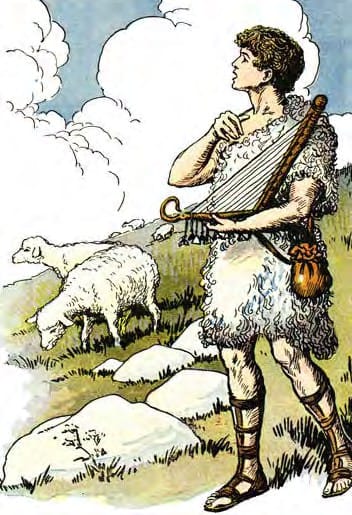
Ah, but there was one refreshing exception. There was one young man who did not fear the giant. Far from being a giant himself, he had seven brothers who were considered physically superior to him. He was just emerging from boyhood and still had the pink cheeks of youth. He is described as “ruddy, and withal of a beautiful countenance, and goodly to look to.” (1 Samuel 16:12) It was David, the shepherd boy, who had come to visit his three oldest brothers who were in the army of Saul. He had come to bring them some special food, a treat from home.
He had just found his brothers and was giving them the news from their home town, Bethlehem, when the Philistine –giant made one of his pompous appearances. Strutting about, and shaking his spear, he issued his challenge and cursed Israel. David looked and listened in astonishment! But he was not so much astonished by the size and antics of the –giant as he was by the reactions of the men of Israel. He felt something that had –escaped all the others. He saw and felt that by successfully defying the armies of Israel, this lone, ugly creature was defying Jehovah God himself. A wave of indignation and outrage swept over David as he looked about him at the cowering men of Israel. “Who is this uncircumcised Philistine,” he cried, “that he should defy the armies of the living God?” (1 Samuel 17:26) He tried to imbue them with his own spirit of indignation and outrage but they would not respond. Not one in the army would stand up to the giant, not even king Saul who was somewhat of a giant himself.
There is a lesson here for us. We are the Israel of God, spiritual Israel. Like Israel, we have tasted of God’s benefits. We have been delivered from bondage. We have been led through the wilderness of sin by the one whose footsteps we follow. We have been abundantly fed with manna from heaven, spiritual food, and have had our thirst quenched by the abundant water of truth from the rock.
But what happens? Sometimes one lone, Satan-inspired experience becomes swollen and inflated in our minds beyond all reality.
Momentarily forgetting all the Lord’s benefits and leadings, we revert to our old, craven, cowardly, earthly natures, and become “dismayed and greatly afraid.” Ah, but then David appears and, unlike the men of Israel, we respond. A “David experience” is sent by the Lord which restores our true perspective and we realize that “Hitherto hath the Lord helped us” (1 Samuel 7:12) and, “No weapon that is formed against us shall prosper.” (Isaiah 54:17) We lose our terror and are ashamed of our former reaction.
At this point David might have gone back to his sheep herding with a perfectly clear conscience. He was not in the army. He might have said, “This is Saul’s responsibility, not mine,” and walked away. But he didn’t; he lived too close to God for that. Any insult to God was a personal insult to himself. He couldn’t hold his peace. Like Jeremiah, the words were in his heart like a burning fire, shut up in his bones, and he could not keep them back. (Jeremiah 20:9) So he went about voicing his indignation against Israel’s inaction. We read that “he turned from one to another, and spake after the same manner [who is this uncircumcised Philistine, that he should defy the armies of the living God].” (1 Samuel 17:26)
As might be expected the matter was promptly reported to the commanding general, King Saul. They probably said to Saul, “There’s a young man here from Bethlehem who is stirring up the people.” That has a familiar ring, an advance echo of things to come. Years later the same would be said of Jesus.
So David was brought before King Saul. When Saul saw him, he was surprised. Judging from the bold words that had been reported to him, Saul had probably imagined David to be a large and powerful man. Now, a pink-cheeked boy stood before him. Ah but the mind, the intellect, the personality, was not that of a boy! David came right to the point. “Your men are frightened of Goliath,” he said to Saul, “but let no man’s heart fail because of him. I, thy servant will go and fight with this Philistine.” (1 Samuel 17:32)
“But you can’t,” Saul protested, “thou art but a youth, and he a man of war” (1 Samuel 17:33) Then David told Saul a story which gave the simple secret of his boldness and courage. He related an incident of his life as a shepherd boy. He said, in substance:
“One day, as I kept watch over my father’s sheep, a lion and a bear came out of the wilderness. Leaping into the flock, the lion seized a young lamb, and began to make off with it. I went after the lion, and smote him with my rod, and released the lamb from his mouth. Then when the enraged beast turned on me, I caught him by his beard, and smote him and slew him. The bear also took a lamb, but I rescued the lamb from his jaws, and I killed him too.”
Then he said to Saul: “Thy servant slew both the lion and the bear; and this uncircumcised Philistine shall be as one of them, seeing he hath defied the armies of the living God.” Now he gave Saul the secret of his courage: “The Lord, that delivered me out of the paw of the lion and out of the paw of the bear, he will deliver me out of the hand of this Philistine.”
David knew he hadn’t conquered the lion and the bear by his own strength. He didn’t take any credit for it. A lion can kill a horse or a full-grown steer with one blow of his powerful paw. A bear can do the same. These are not beasts that can ordinarily be killed by one’s bare hands. David knew that, but David loved his sheep and when one of the little lambs was threatened, he breathed a prayer for help and without the slightest hesitation, he was willing to lay down his life for the sheep. He attacked the great beasts with what happened to be in his hands at the time–a cudgel; and that was quite enough with God’s help.
There’s a lesson here that we should –remember: God does his work through the commonplace, the humble, and the meek. God has all the power that is needed. He doesn’t look for power in us. When he chooses a man, he looks only at the heart. David was such a man, a man after God’s own heart. So with a sincere and simple faith, David told King Saul:
“It was God that gave me the victory over the lion and the bear, when they threatened my flock. The same God will give me the victory over this other beast, who is threatening his flock, Israel.”
With this one simple statement, David robbed the giant of all the glamour he had built up–the glamour of being the great undefeated heavyweight champion of the Philistines–and showed him up for what he was, just another contemptible beast that the Lord would deliver into his hands to be slain.