
The Child Jesus
AFTER it was announced on that tragic day in Eden so long ago that the seed of the woman should bruise the serpent’s head, implying that a .Saviour would be born who would undo the works of Satan and restore Eden, from that time forward faithful and God- fearing women had a golden hope to be the mother of that child.
As history advanced and the vague hope given in Eden was augmented and amplified into clear and definite promises and covenants confined to the nation of Israel, every godly woman of Israel nurtured that hope, that she might perhaps be the mother of Messiah, the Anointed. That is one reason it was considered such a reproach in Israel to be barren; to be unable to have children. It was equivalent to being told, “You do not have a chance for the greatest honor possible for womankind, to be the mother of the Christ.”
So when the time finally came when, by virtue of the prophecies, men were in expectation of Christ, this wonderful age-long hope to be his mother must have flowed with special fervency in the hearts of the women of Israel of that time. It was the most blessed thing they could think of, an indication of the greatest possible favor of God With this background in mind we can better appreciate the events which transpired when, as written in the first chapter of Luke,
“The angel Gabriel was sent from God, unto a city of Galilee named Nazareth, to a virgin of the house of David, and the virgin’s name was Mary.”
Mary was a devout young girl, a linear descendant of David, and thoroughly familiar with the hopes and promises of Israel. We may be sure that she too had the hope of perhaps being selected to be the mother of the Holy One who was to sit on David’s throne. So we can well imagine her emotions when Gabriel, whose name means “the mighty one of God,” appeared to her and said:
“Hail! Thou art highly favored. The Lord is with thee. Blessed art thou among women. And when she saw him she was troubled at his saying, and cast in her mind what manner of salutation this should be. And the angel said unto her: Fear not, Mary; for thou hast found favor with God. And behold, thou shalt conceive in thy womb, and bring forth a son, and shalt call his name Jesus. He shall be great, and shall be called the Son of the Highest; and the Lord God shall give unto him the throne of his father David. And he shall reign over the house of Jacob for ever; and of his kingdom there shall be no end.”
To say that Mary was “thrilled” at the prospect of being the mother of Messiah is to use an entirely inadequate expression. She was overwhelmed by the great honor and yet she reacted with humility. The record says that she went in haste to the hill country of Judea to visit her cousin Elizabeth and to tell her the good news. But she didn’t have to tell her. As soon as she saw Mary, the holy spirit prompted Elizabeth with prophetic insight to proclaim:
“Blessed art thou among women; and blessed is the fruit of thy womb. And whence is this to me, that the mother of my Lord should come to me?”
As soon as she had heard this confirmation, Mary expressed her innermost feelings:
“And Mary said, My soul doth magnify the Lord; and my spirit hath rejoiced in God, my Saviour; for he hath regarded the low estate of his handmaiden. For, behold, all generations shall call me blessed.”
In due time Jesus was born in Bethlehem and the angelic announcement of his birth was made, not to the proud and haughty leaders of Israel, but to humble shepherds keeping watch over their flocks by night. The shepherds lost no time in visiting the babe Jesus lying in a manger. They told Mary what the angel of the Lord had told them. They related how the glory of the Lord shone round about them, that a multitude of the heavenly host had appeared to them praising God and saying: “Glory to God in the highest, and on earth peace, good will toward men.” Then we read that “Mary kept all these things, and pondered them in her heart.”
Praise Came From Many
In due time the babe Jesus was taken to Jerusalem and presented to the Lord as was the custom. In Jerusalem a man named Simeon, who is described as “just and devout, waiting for the consolation of Israel,” took Jesus in his arms and proclaimed that he was the Christ. In the temple the prophetess Anna also recognized the babe Jesus as the Redeemer. Then we read: “And Joseph and his mother marveled at those things which were spoken of him.” These were more things for Mary to ponder in her heart.
Let us not forget the visit of the wise men from the east. We are informed by the historians Tacitus and Suetonius, and by Josephus, that there prevailed throughout the entire east at that time an intense conviction that before long a powerful monarch would arise in Judea and gain dominion over the world. This conviction was said to derive from ancient prophecies. Virgil, who lived a little before this, says that a child from heaven was looked for who should restore the Golden Age and take away sin. Confucius also had prophesied the appearance of such a deliverer. But the clearest of all these prophecies was one by Zoroaster. It is claimed that this great Persian religious leader was at one time a disciple of the prophet Jeremiah.
It seems that Zoroaster taught the Persians concerning a coming Christ. He declared that in the latter days a pure virgin should conceive and as soon as the child was born a star would appear, visible even at noonday with undiminished luster. Zoroaster said to his disciples regarding that star:
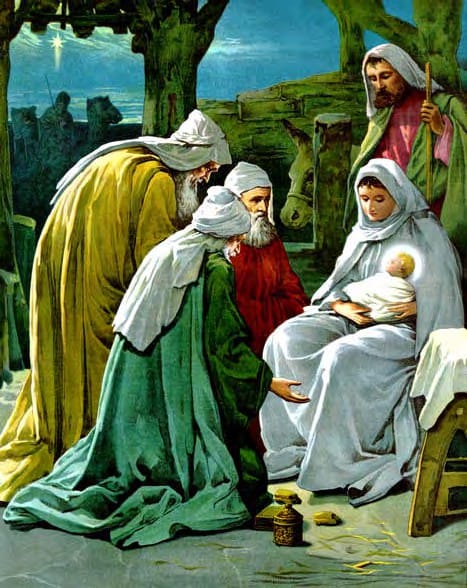
“You, my sons, will perceive its rising before any other nation. As soon as you see the star, follow it wherever it leads you, and adore the mysterious child; offering your gifts to him with the profoundest humility. He is the almighty WORD which created the heavens!”
We should also remember that Daniel and the three Hebrew children, Hananiah, Mishael and Azariah, were princes in Persia and intimates of the wise men of that country which was then the principal nation of the world. It is easy to see how prophecies concerning Jesus would be handed down as tradition through that channel also. So Daniel’s prophecies respecting the time of Messiah’s birth would also be well known to the disciples of Zoroaster, Persia’s wise men. Furthermore, there were Jews scattered abroad throughout that country who still, more or less, kept alive the thought of Israel’s hope for the great Messiah, the one so long promised of God, prophesied as the bringer of blessings not only to Israel but to all the families of the earth. See Reprints, pages 3703 and 4098.
After the wise men had followed the star, found and worshipped the babe Jesus, and left their rich gifts of gold, frankincense, and myrrh, Mary must have pondered this even in her heart too. Then came the frightful repercussions from the visit of the wise men the necessity to flee to Egypt to escape Herod’s pitiless slaughter of the babes of Bethlehem. Then, after the death of Herod, the return from Egypt, and the change of residence to Nazareth or Galilee.
At this point a curtain descends. From this time forward we find no scriptural record of Jesus until he is 12 years of age. There are traditions of course, telling of wonderful and sometimes mischievous miracles supposedly performed by the child Jesus. But we know that these traditions are false because when he changed water into wine at a wedding, after he had begun his ministry, we read:
“This beginning of miracles did Jesus in Cana of Galilee, and manifested forth his glory; and his disciples believed on him.” John 2:11
Mary’s Reaction to her Son
We have no record of what transpired during this period of Jesus’ childhood. We do not know. But isn’t it natural to want to know? It is to me, and I think we can make some reasonable assumptions. I think it is reasonable to assume Mary fully realized that her son was the long-promised Messiah. Why so? Because she had seen and talked with the angel Gabriel face-to-face and was told that her son Jesus would be called the son of God. She had heard a firsthand account of the angel’s announcement to the shepherds on the night of Jesus’ birth when he was called “a Saviour, which is Christ the Lord. She had heard the witness of Simeon and Anna, that Jesus was the Christ and Redeemer. She had seen the wise men of the east fall down and worship Jesus. Now don’t you think it is reasonable to assume that Mary, who had pondered and treasured these things in her heart regarding her precious baby, would want to find out all she could about him? Wouldn’t you, under the same circumstances? If men were in expectation of Messiah, as we are told they were, she would want to know why. Since they went up to Jerusalem to worship each year, Mary would probably ask the priests respecting the prophecies concerning Messiah. They would tell her because it was their duty to do so. So I think she accumulated a considerable fund of knowledge about Jesus and his place in prophecy–who he was and what he would do. She certainly knew better than anyone else that he was not begotten of man but was begotten of God, that he was the son of God.
I am sure that Mary felt the responsibilities of her position very keenly. She realized that she had the privilege of rearing a child who actually was the son of the Most High God, to care not only for his physical needs, but to nurture his growing and inquiring mind as well. She must have made it the subject of daily prayer, to be guided in the performance of this important task, to say the right thing, to give the right answer. Jesus was a perfect child with mental and physical endowments far beyond other children his age. All children ask questions. That is how they learn. –Jesus must have started to ask questions at a very early age. What sort of questions do you suppose they would be? One day, when very young, he may have innocently asked, “Mother, why do people stop and point to me, and say, `What a beautiful child’?” Mary perhaps replied, “It is inner beauty that is the most important, my darling–to be a good boy.” Perhaps another day, when older, Jesus may have said, “When I climb the hill with the other children, they quickly tire and want to sit down. Why is it that I do not?” What could Mary do but answer, “Thank God that you are a strong and sturdy child, my son.”
Of course Mary and Joseph took the child Jesus to worship regularly. At the synagogue the commandments were recited each sabbath and a portion of holy scriptures read to the congregation. This might have resulted in the child Jesus one day asking his mother, “Why is it that the other children do not remember the scriptures that are read at the synagogue, while I can remember every word I have heard?” It became increasingly hard for Mary to answer questions like these. “Thank God for a good memory, my dear,” she would reply. But it was not the whole truth. Jesus was beginning to realize he was, somehow, different.
Mary and Joseph must have been familiar with, and lived by the words of, Deuteronomy 6:4-7:
“Hear, O Israel, the Lord our God is one Lord. And thou shalt love the Lord thy God with all thy heart, and with all thy soul, and with all thy might. And these words, which I command thee this day, shall be in thine heart; and thou shalt teach them diligently unto thy children, and shalt talk of them when thou sittest in thine house, and when thou walkest by the way, and when thou liest down, and when thou risest up.”
Supplementing the teachings of the synagogue Mary and Joseph must have diligently taught Jesus the words of the Lord at home also, creating an atmosphere of love and reverence for God. Jesus, with perfect capacity, would heartily respond to this wholesome influence. When Jesus was older, perhaps about ten or eleven, he might say to his mother:
“My mind seems always to turn to thoughts of the great God of our fathers, the Creator of heaven and earth. I feel a strong tie to Him, a tenderness even greater than I have toward my father Joseph. When I speak of this to my companions, they think it strange. Mother, am I so different from others?”
When Mary heard this question, she knew the time had come to tell Jesus all the things she had pondered and treasured in her heart for so many years. “Yes, Jesus,” she said, “you are different from others. Very different indeed. It is time you knew why. Sit down my sweet son, and I’ll tell you all I know, from the beginning.”
Let us listen in on the conversation that might have taken place between Mary and Jesus. To assume the possibility of such a conversation occurring is not irreverent since every aspect of it is scriptural as you will see.
Mary Instructs Her Son
“Jesus,” Mary said, “Do you know that I have seen the mighty angel Gabriel? Many years ago, before you were born, just before I married your father Joseph, Gabriel appeared to me. He was as close to me as you are now. It was the same bright and shining Gabriel that appeared to the prophet Daniel hundreds of years ago.” Jesus’ eyes grew wide with wonder. “Did he speak to you, mother?” he asked. “Indeed he did,” Mary answered. “He greeted me very heartily, saying: `Hail; you are highly favored; the Lord is with thee.’ I was afraid at first, but he reassured me, saying, `Fear not, Mary, for thou hast found favor with God.’ Then Gabriel told me the most wonderful thing! He said that I would have a son by the power of God, and should call him Jesus. Then he said some things about you which I think you are old enough to hear. You asked me if you are different from others. What the angel Gabriel said will answer your question. He said of you: `He shall be great, and shall be called the Son of the Highest, the Son of God; and the Lord God shall give unto him the throne of his father David; and he shall reign over the house of David for ever; and of his kingdom there shall be no end.’ So is it any wonder, my dear son, that your heart and mind always turn to your heavenly Father? It is because you are His son, and not the son of Joseph. And there is much more to tell,” Mary continued. “I have pondered these things in my heart for so long, waiting to tell you. We have already told you that you were born in Bethlehem when we were there to register for the tax. But we did not tell you of the glorious things that happened the night you were born. Near Bethlehem there were some shepherds, keeping watch over their flock by night. Suddenly, the angel of the Lord shone round about them. They were afraid, of course, just as I was, when Gabriel appeared to me. Then the angel said to them: `Fear not, for behold I bring you good tidings of great joy, which shall be to all people; for unto you is born this day, in the city of David, a Saviour which is Christ the Lord.’ And suddenly there was with the angel a multitude of the heavenly host, praising God, and saying: `Glory to God in the highest, and on earth peace, good will toward men.’ And the angel told the shepherds exactly where to find you; so they left their flocks and came to see you; and they told me all about what they had seen and heard. That night the angel called you a Saviour, which is Christ the Lord.”
Jesus was overwhelmed by what his mother told him, but a great peace descended upon him. Now he knew the reason for many things. But he felt very humble, saying: “Mother, is it possible that I shall inherit the throne of David and reign for ever; that I shall be the King of Israel; that I shall be the Saviour, which is Christ the Lord?” “There is no doubt of it, my child,” Mary answered. “But let me tell you even more. When you were a little baby we brought you to Jerusalem to present you to the Lord. As far as others knew we were simply doing as the law prescribed for a firstborn son. But to me it was much more than that because, you see, I knew who you really were! When you were presented before the Lord, I said in my heart:
`Lord God, I present to you your own baby son!’ Then something else happened. In the temple at Jerusalem there was an old man named Simeon who had been told by the power of God that he would not die until he had seen the Lord’s Christ. When Simeon saw you he tenderly took you in his arms and, lifting up his eyes, he praised God, and said: `Lord, now lettest thou thy servant depart in peace, according to thy word; for mine eyes have seen the salvation which thou hast prepared before the face of all people, a light to lighten the Gentiles, and the glory of thy people Israel.’ After that the prophetess Anna came in. When she saw you, she thanked God and said to everyone there that you were the one who would bring redemption to Israel.”
“Oh, mother,” Jesus said, “These things you tell me are so wonderful, and so great. How can I ever measure up to them? I am but a little child!” “Never fear, my child,” Mary answered. Your Father is the Almighty himself and he will guide his son. You are always under his care. He has already saved you from great danger. Let me tell you about it. When you were a little baby and we were still living in Bethlehem, some prominent wise men came from a far country in the east. They went to Jerusalem and asked King Herod, `Where is he that is born king of the Jews?’ It seems that a mysterious star had appeared to them, low in the heavens, moving before them, to lead them to a new-born king, the Messiah who will eventually rule the world. The star led them to our nation. They said they had come to worship this new king. Herod and all his court were worried about this news of a new king of the Jews. So Herod called together all the chief priests and scribes, and asked them where, according to the prophet, Christ should be born. They told Herod of the prophecy of Micah: `But thou, Bethlehem Ephratah, though thou be little among thousands of Judah, yet out of thee shall he come forth unto me, that is to be ruler in Israel whose goings forth have been from old, from everlasting.’ Herod intended to kill you because he did not want any other king in Israel. So he sent the wise men to Bethlehem to find you and asked them to let him know when they had done so. Then the star went before them and led them to our very door! I’ll never forget that day! A wonderful brilliance permeated everything and this grand oriental caravan stopped right in front of our house.
The dignified wise men, in their colorful costumes, dismounted and came to the door. They seemed overjoyed. They pointed to the bright star hanging overhead and said that it meant that the new king was here and that they had come to worship him. We invited them in and when they saw you, those big men fell down before you and worshipped you. They cried in happiness and adoration. `This is the WORD who made heaven and earth,’ they said. `This is the Son of God!’ Then they brought in heavy treasure chests and opened them. One chest was full of gold coins, newly minted. Another was full of precious frankincense; another of costly, sweet-smelling myrrh. You laughed merrily as they presented these gifts to you, Tiny as you were, you seemed to thank them with your eyes and smile. They left us as suddenly as they had come and the wondrous light disappeared with them.”
“That night we were warned by an angel from God that Herod would try to kill you. We were told to take you and flee to Egypt. We obeyed at once. The gifts of the wise men gave us the means. When Herod’s soldiers came for you, they found the house empty. Then Herod was exceedingly angry and did a very wicked thing. He ordered all the children in Bethlehem and in all the coasts thereof, from two years old and under, killed by the sword. We stayed in Egypt until Herod died and we were told by an angel from God that it was safe to return to the land of Israel. Then we came here to Nazareth. So you see, my son, your heavenly Father is caring for you, and you may be sure he will help you fulfill everything that has been prophesied of you.”
Jesus was silent for a long time, his head bowed in thought. Then he raised his head. “Mother,” he said, “I have heard the book of the prophet Isaiah read at the synagogue and I know every word of it. Isaiah said in one place, `The Lord himself shall give you a sign. Behold a virgin shall conceive, and bear a son, and shall call his name Immanuel.’ (Isaiah 7:14) Was this spoken of you, mother, and of me?” Mary answered, “Yes, Jesus, I think it was.” “But you named me `Jesus’ and not `Immanuel.’“ “The name Jesus means Saviour,” Mary answered. “God, through Gabriel, said to name you so. The angels said to the shepherds on the night you were born that you would be `a Saviour, which is Christ the Lord.’“ “But why did Isaiah say I would be called Immanuel?” “I have wondered about that, too,” Mary answered. “Immanuel means `God with us.’ Perhaps the prophet means that God is with us since he has given us his son to be a saviour.”
Jesus nodded. “And I remember Isaiah also said, `For unto us a child is born; unto us a son is given; and the government shall be upon his shoulder; and his name shall be called Wonderful, Counsellor, The Mighty God, The Everlasting Father, the Prince of Peace. Of the increase of his government and peace there shall be no end, upon the throne of David, and upon his kingdom; to order it, and to establish it with judgment and with justice, from henceforth even for ever. The zeal of the Lord of hosts will perform this.’ Mother, is it possible this prophecy refers to me and all these titles shall be mine?” “Yes, Jesus,” Mary answered, “There is no doubt that you are the son of God. You are the promised Messiah and Saviour.” “If that is so,” Jesus said, getting up, “should I not be about my Father’s business?
There is so much to do!” “But you are so young! You are only a child!” “But mother, the prophet Samuel was only a child when he began the service of God in the temple. I feel that I should be about my Father’s business!”
Of course this conversation between Mary and Jesus is an assumption, pure and simple. Yet it is useful to bring out the incidents surrounding Jesus’ birth and the prophecies relating thereto. Considering the perfect and keenly active mind of the child Jesus, the mental powers far beyond his years when compared to other children, it is certainly not an unlikely assumption. We read in Luke 2:40, “And the child grew and waxed strong, filled with wisdom, and the grace of God was with him.” Note that he was “filled with wisdom.” Is it not likely that he obtained much of this wisdom from his mother? All the ingredients of such a conversation existed and it could have taken place. Assuming that it did take place makes subsequent events more meaningful.
The record says that Jesus’ parents went to Jerusalem every year at the feast of the Passover. The entire celebration took eight days of which the feast of Passover was one, followed by seven days of unleavened bread. At this particular Passover season, Jesus was twelve years old. A Jewish boy was considered “a son of the law” when he had attained his twelfth year. He was considered on the threshhold of manhood. It was the age of responsibility. He then became responsible under the law and from that age forward was required to keep its festivals and other ceremonials. This particular trip to Jerusalem had special significance for Jesus not only because he could now attend as a participant, but for a deeper reason. He reasoned that since at twelve years of age Jewish boys came under the requirements of the Law Covenant, this arrangement might have been made to indicate his proper course and duty. Perhaps this was the time he was expected to begin some phase of his ministry. He was so anxious to please his Heavenly Father. Even at that age it was his burning desire. He therefore resolved that he would settle this question when he got to Jerusalem. He decided that he would consult the very highest authorities respecting the teachings of the law in this matter. There is no doubt in my mind that he told his mother what he intended to do.
When they got to Jerusalem, he attended the necessary ceremonials with his parents. But as often as he could get away by himself, he sought out eminent teachers of the temple. I am sure that his parents had complete confidence in him and were not worried about him, giving him much freedom of movement. But we can imagine that during most of the Passover feast and the days of unleavened bread the great scholars of the temple were busy with important functions. Waiting to see them, perhaps Jesus had access to some sort of library of scrolls connected with the temple and engrossed himself in the study of these. At any rate, it appears that he did not have an opportunity for a conference with the teachers until the close of the feast.
The Teachers Are Amazed
At this time we can imagine the custodian of the temple entering the private chambers and saying to the teachers and doctors of the law, “There is a boy outside who has been here every day of the feast seeking a conference with you. He says he must have answers to some questions.” “But we can’t talk to every boy who has a question. Send him to one of the priests.” “But sirs, this is such an unusual boy. He reasons and talks like a mature man. I have never seen the like of him. And he has a fantastic knowledge of the scriptures.
Frankly, I was not able to answer him myself. I do wish you gentlemen would see him.” The teachers sighed and sat down. It was the custom for teachers to sit on benches in a half-circle with the pupils sitting on mats on the floor at their feet. “Send him in,” they said wearily. When the winsome and charming boy Jesus walked in and respectfully greeted them, they smiled and motioned for him to sit down.
The time came for those who had come to the feast from a distance to leave for home. Different families from the same locality usually traveled together as one caravan. Jesus’ parents, thinking he was in the company of some of their relatives, went a day’s journey toward home before they discovered he was not in the company. Then they returned to Jerusalem journeying another day. We can imagine Joseph saying to Mary, anxiously, “Jerusalem is such a big city.
Where do you suppose that boy can be?” We can imagine Mary replying, “I think I know just where he is, Joseph.” That is why, on the third day, they went straight to the temple. We read:
“And it happened, after three days, they found him in the temple, sitting in the midst of the teachers; both hearing them, and asking them questions. And all were astonished at his intelligence and replies. And seeing him they were amazed. And his mother said to him, `Child, why hast thou done thus to us? Behold, thy father and I seek thee sorrowing.’ And he said to them, `Why did you seek me? Did you not know that I must be in the house of my Father.’ Luke 2:46-49, Diaglott
Yes, he had told his mother where he would be in Jerusalem. But she did not expect that his intense interest in the scriptures would cause him to miss the caravan home and completely absorb him for three days.
Jesus apparently received the information he sought, that, although a boy at twelve became amenable to the law, none could enter upon a teaching or preaching service until thirty years of age, the age of a mature man. But I am sure he obtained much more information than that. I am sure Jesus was wise enough not to disclose his identity to the teachers, was respectful enough to his elders not to contradict them in any errors he may have detected, and tactful enough to ask for the information he most wanted without being too insistent. What was the information he most wanted and obtained? It was much of the same information he later gave to his disciples on the way to Emmaus:
“And beginning at Moses, and all the prophets, he expounded unto them, in all the scriptures, the things concerning himself.” Luke 24:27 Knowing he was the son of God, knowing he was the Messiah, what could be more natural, even at twelve, than that he should seek to know from the teachers of the temple what the scriptures said concerning himself. I am sure the teachers told him all they knew. This handsome boy, so earnest in his desire to know the scriptures, and asking such intelligent questions, must have thoroughly captivated them. He drew them out so that they vied with one another to tell him of the prophecies concerning Messiah. Jesus remembered every word. Jesus left with his parents, and we read:
“He went down with them, and came to Nazareth, and was subject to them. And his mother kept all these things in her heart. And Jesus advanced in wisdom, and in manliness, and in favor with God and men.” Luke 2:51,52, Diaglott
Now another curtain descends and there are eighteen years of silence insofar as any specific acts of Jesus are concerned. But that one sentence, “Jesus advanced in wisdom, and in manliness and in favor with God and men,” tells us all we need to know. He advanced in wisdom by contemplating the scriptures and observing his fellow-man. Many of his parables he would later tell were based upon what he observed during this period. Being a carpenter he could speak with authority about a house built upon a rock and a house built upon the sand, and the necessity for counting the cost before building a tower. Having contact with farmers he later told the parable of the sower, the wheat and tares, and the laborers in the vineyard. Knowing the ways of shepherds, he would use the illustrations of a shepherd and the sheep, the lost sheep, and the sheep and the goats. Talking with fishermen he would later speak of the net cast into the sea, and the pearl of great price. We know something else of those years. We know that it was his custom to stand up in the synagogue and read the scriptures aloud to the congregation. This is disclosed by Luke describing his visit to Nazareth after he had begun his ministry:
“And he came to Nazareth where he had been brought up, and as his custom was, he went into the synagogue on the Sabbath day, and stood up for to read.” Luke 4:16
He remembered every word. These were fruitful years, full of rich experiences he would later draw upon. He advanced in favor with God and men. The Lord loved him, and so did men. Being perfect he must have attracted people to him by wholesome goodness and sheer personal magnetism. But all the while he was counting the days because he knew that David had written of him:
“Lo, I come; in the volume of the book it is written of me; I delight to do thy will, O my God; yea, thy law is within my heart. Psalms 40:7,8
He was counting the days until his thirtieth birthday. I think it was on that very day that John the Baptist, waist-deep in the waters of Jordan, looked up and saw the perfect man Jesus coming toward him. He pointed to Jesus and said in a loud voice, for all to hear: “Behold the Lamb of God, which taketh away the sin of the world!” (John 1:29) Jesus eagerly entered the water. Now he could really be about his Father’s business!
When he arose out of the water and the holy spirit of God flooded his being, from that time forward he was in direct communication with his heavenly Father no more necessity to be taught of his mother, to be told who he was, that he was the son of God, or to seek counsel from teachers in the temple. Now he directly heard his heavenly Father’s audible voice:
“And, lo, a voice from heaven, saying, This is my beloved Son, in whom I am well pleased.” Matthew 3:17
The Counsel of God
“Thou shalt guide me with thy counsel, and afterward receive me to glory.” Psalms 73:24
A LITTLE child, mystified about something, says to himself: “I’m going to .ask my dad about that, when he comes home.” Later he asks his question .and listens, wide-eyed, to his father’s answer. This is one of the great rewards of parenthood the little child trusts his father fully and completely. He believes that his father’s words are always true and right. His father may actually be an ignorant and unlearned man; but the child values his counsel above that of the Chief Justice of the Supreme Court. He points his father out to his playmates and says proudly, “That’s my dad! He knows everything!”
On one occasion, the disciples came to Jesus and asked: “Who is greatest in the kingdom of heaven?” (Matthew 18:1) “And Jesus called a little child unto him.” It seems that the little children were never very far from Jesus. With natural curiosity, and attracted by his warm and loving personality, they got as close to him as they could, so close sometimes that the disciples felt that they had to shoo them away! So:
“Jesus called a little child unto him, and set him in the midst of them; and said: Verily I say unto you, except ye be converted and become as little children, ye shall not enter into the kingdom of heaven.” Matthew 18:2,3
“Except ye be converted!” That was a strange thing to say! These were his disciples he was talking to weren’t they converted already? In a very important sense they were not. Their very question disclosed their selfishly ambitious state of mind. They wanted to know which of them would be the greatest in heaven, which of them would be higher than the others in heaven! Doesn’t that sound familiar? There was a shocking similarity here between their spirit and that of Satan who had said, “I will ascend into heaven; I will exalt my throne above the stars of God.” (Isaiah 14:13) Jesus quickly detected this similarity of spirit and told them plainly that unless they became as little children, they would not even enter into the kingdom of heaven, much less be the greatest there. They must first be converted, that is, changed in disposition to that of a child.
A little child, before it is exposed to the world, is simple of heart: meek, humble, truthful, free from ambition and rivalry, faithful, trusting, loving. A little child is obedient, teachable, without guile, indifferent to social distinctions and popular notions. Black, white, yellow, rich or poor these mean nothing. Such are the attributes of character that Jesus must have had in mind when he said also, on another occasion:
“Suffer little children, and forbid them not, to come unto me; for of such is the kingdom of heaven.” Matthew 19:14
A natural child grows up and, in this evil world, often departs from the counsel of his parents. He seeks and finds other counsel, some good, some bad. But the child of God remains a little child in the sense that he does not depart from the counsel of his Heavenly Father but fully trusting, seeks more and more of that counsel. David wrote:
“When my father and my mother forsake me, then the Lord will take me up.” Psalms 27:10
Have you ever been lost? One of my most vivid memories is of such an incident, which occurred when I was about three. We lived in the country, and very seldom went to town. On this occasion my father brought me to the city. Holding me by the hand he took me into a large department store, the first one I had ever seen. I was dazzled and enchanted by all the bright and glittering things in the store. I let go of my father’s hand to get closer to what I wanted to see. For a few moments I was completely engrossed in some attractive display. When I eagerly turned to talk to my father about it, HE WAS NOT THERE! A moment before I was gay and carefree, full of delight; now I was terror-stricken. I looked wildly about for my father, running here and there, trying to raise myself up on my tiptoes to see farther. Tears filled my eyes and my throat tightened. The beauties of the store were just the same as they were before, but suddenly they were no longer of any interest to me. I wanted just one thing–MY FATHER. I wanted to hold his hand again; nothing else mattered.
Never before in my life had I felt so terribly alone, forsaken, and miserable. The whole thing lasted only a few minutes. My father quickly found me. Seeing my confusion and tears he took me in his arms and comforted me. Then we went on again hand in hand. My wondering delight in all the things around me quickly returned; everything was joyful, good, and right once more.
Have you ever felt forsaken? Human parents eventually die and otherwise forsake their children. They let go of their children’s hands–it is inevitable. But how fortunate the one whom the Lord takes up his hand never fails; it is always there to hold, to comfort, and to protect. That is what David meant when he said:
“When my father and my mother forsake me, then the Lord will take me up.” Psalms 27:10
The Lord will never forsake you. He will always guide you with his counsel. How very fortunate the one whom the Lord takes up and guides with his counsel!
Jesus called these child-like ones who seek and delight in the counsel of the Lord, his little ones. Of these it is written:
“Blessed is the man that walketh not in the counsel of the ungodly; nor standeth in the way of sinners; nor sitteth in the seat of the scornful; but his delight is in the law of the Lord; and in his law doth he meditate day and night. And he shall be like a tree, planted by the rivers of water, that bringeth forth his fruit in his season; his leaf also shall not wither; and whatsoever he doeth shall prosper. The ungodly are not so, but are like the chaff which the wind driveth away.
Therefore the ungodly shall not stand in judgment, nor sinners in the congregation of the righteous. For the Lord knoweth the way of the righteous; but the way of the ungodly shall perish.” Psalms 1:1-6
“And he shall be like a tree planted by the rivers of water.” How beautiful and refreshing that sounds: drawing abundantly from the water of truth, bearing much fruit, and prospering in the heavenly way.
“Counsel in the heart of man is like deep water; but a man of understanding will draw it out.” Proverbs 20:5
The water is there, but it is deep. It must be found and drawn out. The scriptures contain “the whole counsel of God.” But, to the uninitiated to those whose minds have not been illuminated by the holy spirit these things are too deep.
Finding the Counsel of God
How can a Christian find and avail himself of the counsel of God? He must first learn the basic principles of the truth, which Paul describes as “milk” in Hebrews 5:12. He later must be able to also assimilate the “meat” of the scriptures. Of course when a child is weaned and starts eating meat, he does not entirely stop drinking milk. The wise parent knows there should always be a glass of milk on the table. So to understand the deep things, we must often go back to first principles to the milk of the word.
How does a Christian find the counsel of God in the maze of scripture provided? We read:
“Whom shall he teach knowledge? And whom shall he make to understand doctrine? Them that are weaned from the milk, and drawn from the breasts. For precept must be upon precept, precept upon precept; line upon line, line upon line; here a little, and there a little.” Isaiah 28:9,10
God has been very gracious to us at this end of the age. Jesus was talking to his disciples about the end of the age and when he would come again. In Matthew chapter 24 he told them to “watch” for his coming (verse 44). It was at this point in his discourse that the relative time of the application of his words was fixed. He promised a faithful and wise servant who would give his household meat in due season. That servant was Pastor Russell. By use of his books, the “keys to the scriptures,” we have been enlightened, and bountifully fed “meat in due season” present truth.
“Remember the former things of old; for I am God, and there is none else; I am God, and there is none like me; declaring the end from the beginning; and from ancient times the things that are not yet done; saying, My counsel shall stand, and I will do all my pleasure.” Isaiah 46:9,10
God’s Purpose for the Church
What is God’s pleasure? Jesus himself answered this question:
“It is the Father’s good pleasure to give you the Kingdom.” Luke 12:32
Let us well remember this point the selection and development of a church class to rule with Christ in his kingdom was not an alternative plan should other plans fail. It was not an afterthought. It was the original purpose and counsel of God! It was his “good pleasure” from the beginning. Paul plainly states this:
“Blessed be the God and Father of our Lord Jesus Christ, who hath blessed us with all spiritual blessings in heavenly places in Christ; according as he hath chosen us in him BEFORE THE FOUNDATION OF THE WORLD, that we should be holy, and without blame before him in love; having predestinated us, unto the adoption of children, by Jesus Christ to himself, according to the good pleasure of his will.” Ephesians 1:3-5
To become a member of this predestinated group of 144,000 kings and priests is a GREAT prize an exceeding high calling. Paul calls it “the prize of the high calling of God in Christ Jesus.” (Philippians 3:14) It is also described as “glory and honor and immortality.” (Romans 2:7) In another place it is called “partaking of the divine nature.” (2 Peter 1:4) It is termed “the crown of life.” (James 1:12) The crown is the highest part of the person. The promised “crown of life” is the highest form of life.
Our poor human minds cannot really grasp the magnitude of this thing. How can we, by using imperfect, earthly language, describe so lofty and glorious a condition? How can we measure the difference between the human and divine? IT’S IMPOSSIBLE! But we do have a hint in Isaiah where Jehovah God says of himself:
“As the heavens are higher than the earth, so are my ways higher than your ways, and my thoughts than your thoughts.” Isaiah 55:9
This suggests a measure. But how high are the heavens above the earth? Let us see. Light travels at the speed of 186,000 miles a second. Now suppose that instead of traveling only one second it traveled a whole year at that same rate of speed. Just consider how many seconds there are in one year and allow 186,000 miles for each second. That would be the distance known as one light year. It is difficult for us to grasp the vastness of such a distance. Yet many of the stars of heaven are millions of light years distant from the earth! Now we begin to appreciate how much higher than ourselves God is as indicated by the expression, “As the heavens are higher than the earth.”
Bearing this in mind, let us now consider a scripture showing the similarity of our glorified Lord Jesus to the Heavenly Father.
“Who, being the brightness of his glory, and the express image of his person . . . sat down on the right hand of the Majesty on high.” Hebrews 1:3
This places the glorified Christ on that same lofty position described by the phrase, “As the heavens are higher than the earth.” This is further confirmed by the scripture that tells us that Jehovah God:
“Raised him from the dead, and set him at his own right hand in the heavenly places; far above all principality and power, and might, and dominion, and every name that is named.” Ephesians 1:20,21
Now we quote a scripture that is almost incredible in its implication. It is addressed to the “beloved” of God, the members of his church, to you and to me:
“Beloved; now are we the sons of God; and it doth not yet appear what we shall be; but we know that, when he shall appear, we shall be like him; for we shall see him as he is!” 1 John 3:2
There we have it! First Jehovah God, so very high above us “as the heavens are higher than the earth.” Then Jesus Christ, the express image of his person, on the same plane. Then WE SHALL BE LIKE HIM! It sounds impossible doesn’t it? It sounds so impossible that some of the Lord’s children have said:
“I don’t aspire to such glory. I could not. If I can just squeeze, unnoticed, through the side door into heaven, and take a humble place in the Kingdom, a back seat, so to speak; I shall be completely satisfied.”
That attitude does show commendable humility. Our Lord Jesus showed a similar humility. When the bitter cup of an agonizing death was imminent, he prayed to his Heavenly Father:
“I have finished the work which thou gavest me to do. And now, O Father, glorify thou me, with thine own self, with the glory which I had with thee before the world was.” John 17:5
God had promised him much greater glory than that, but Jesus would have been content with his previous condition. We read:
“He humbled himself . . . Wherefore God also hath highly exalted him, and given him a name which is above every name; that at the name of Jesus every knee should bow.” Philippians 2:8-10
We also read that he was “made so much better than the angels.” (Hebrews 1:4) Just as the Heavenly Father gave his son Jesus abundantly more than he asked, so he will do for each of his beloved and faithful children. It must be done; he has promised it. His word does not return unto him void. As the apostle says:
“We shall all be changed. For this corruptible must put on incorruption; and this mortal must put on immortality.” 1 Corinthians 15:51-53
Glory, honor and immortality! Let us accept the promise with joy and not be overwhelmed by it. As the apostle counsels us:
“Let us hold fast the profession of our faith, WITHOUT WAVERING for he is faithful that promised.” Hebrews 10:23
So we see that although the reward promised is very high and great, IT IS OBTAINABLE. Not only is it obtainable, God wants us to have it. It is his good pleasure to give it to us. Every necessary facility is furnished us so that we may qualify for the prize.