
Abraham Faces the Supreme Test
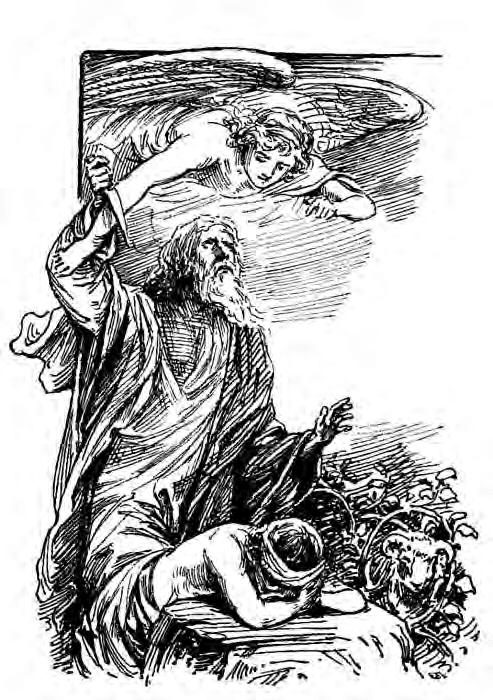
Now came the supreme test of Abraham’s obedience to God. With the altar made, the wood arranged in order upon it, with Isaac bound and laid upon the wood, the fateful moment could no longer be delayed. “And Abraham stretched forth his hand, and took the knife, to slay his son.” (Genesis 22:10) From the human standpoint, what tragic words these are! I remember my dear Armenian mother reading this account of Abraham’s ordeal to me from the Bible when I was a small child. In the beautiful and richly expressive Armenian language the story is even more moving than it is in English.
Imagining myself in the place of Isaac on the altar I would cry with the tragedy of it all. When this verse was read, “And Abraham stretched forth his hand and took the knife to slay his son,” my tears would flow most freely. Then mother would read the next three verses and almost instantly my weeping would turn to joy!
“And the angel of the Lord called unto him out of heaven, and said: Abraham, Abraham. And he said: Here am I. And he said, Lay not thine hand upon the lad, neither do thou anything unto him: for now I know that thou fearest God, seeing thou hast not withheld thy son, thine only son from me. And Abraham lifted up his eyes, and looked, and behold behind him a ram caught in a thicket by his horns: and Abraham went and took the ram, and offered him up for a burnt offering in the stead of his son.”
Can you imagine the relief that Abraham must have felt? Even with his amazing faith the sorrowful load on his mind had been continuous and heavy for three days! Now it slipped away and his heart was flooded with joy! Isaac had been as good as dead. Abraham, instead of getting Isaac back literally from the dead as he had confidently expected to do, got him back figuratively from the dead. As Paul sums it up,
“By faith Abraham, when he was tried, offered up Isaac: and he that had received the promises offered up his only begotten son, of whom it was said, That in Isaac shall thy seed be called: accounting that God was able to raise him up, even from the dead; from whence also he received him in a figure.” Hebrews 11:17-19
When the ordeal was over the Lord spoke to Abraham again. Even ordinary speech from God is an awesome thing. When after the Exodus God sounded his voice from the mountain, the Israelites were terrified. They begged Moses to talk to God privately, and then speak to them, saying: “But let not God speak to us, lest we die.” (Exodus 20:19) The plain, unadorned, word of God is firm and absolutely sure, and Abraham believed this above all men. It is written in Isaiah 55:11: “So shall my word be that goeth forth out of my mouth: it shall not return unto me void.”
But the way God spoke to Abraham now was not with ordinary speech, but was most extraordinary. Why? On this occasion God actually took an oath! How can this be? In our courts of law today, before testimony is taken, a witness is required to take an oath to swear to tell the truth. When he takes this oath, his hand rests upon the Bible, the word of God. Thus even the civil authorities tacitly admit to the absolute truth and trustworthiness of God’s word, that there is no higher standard upon which to base an oath. Testimony given after such an oath is considered to be the truth and is so recorded. It ends all argument. But if God’s plain word is already the perfect standard of truth, why did God on this occasion take an oath to support his word? No one asked him to do so. No one doubted his word. Abraham had amply demonstrated that he believed God. In fact, he believed God so thoroughly that it was “accounted to him for righteousness.” God was so pleased with Abraham, so delighted with his unquestioning obedience which even the perfect man Adam had lacked, so gratified by his unshakable faith maintained under the severest possible test, that he emphasized his word, his promises to Abraham, to the superlative degree by his oath:
“And the angel of the Lord called unto Abraham out of heaven the second time, and said, By myself have I sworn, saith the Lord, for because thou hast done this thing, and hast not withheld thy son, thine only son: That in blessing I will bless thee, and in multiplying I will multiply thy seed as the stars of heaven, and as the sand which is upon the sea shore; and thy seed shall possess the gate of his enemies. And in thy seed shall all the nations of the earth be blessed; because thou hast obeyed my voice.” Genesis 22:15-18
God’s Oath-bound Covenant
Thus we find the great God of Heaven making a covenant, an unconditional, oath-bound covenant, with a man.
There is a lesson here. It is written that without faith it is impossible to please God. (Hebrews 11:6) It follows then that with faith it is possible to please God. With the astounding faith that Abraham displayed, it is possible to please God very much indeed! Not that we can ever attain the degree of faith that Abraham had, but Paul says that we can follow him in this matter. He says:
“That ye be not slothful, but followers of them, who through faith and patience inherit the promises. For when God made promise to Abraham, because he could swear by no greater, he swear by himself, saying, Surely, blessing I will bless thee, and multiplying I will multiply thee. For men verily swear by the greater: and an oath for confirmation is to them an end of all strife. Wherein God, willing more abundantly to show unto the heirs of promise, the immutability of his counsel, confirmed it by an oath! That by two immutable things, in which it was impossible for God to lie, we might have a strong consolation, who have fled for refuge to lay hold upon the hope set before us: which hope we have as an anchor of the soul, both sure and stedfast, and which entereth into that within the veil.” Hebrews 6:12-14,16-19
What are the two immutable things here referred to? It is written, “In the mouth of two or three witnesses shall every word be established.” (2 Corinthians 13:1) Here, the first immutable or unchangeable witness is the sureness of God’s plain word because it is impossible for God to lie. The second immutable witness is the confirmation of his word by his oath. Here we have another of those sublime messages from the Lord which seem almost too good, and too great, for us to accept and appropriate to ourselves. What does Paul say was the real reason God swore by himself took an oath? Listen: “To more abundantly show unto the heirs of promise the immutability of his counsel.” Who are these heirs of promise? “If ye be Christ’s then are ye Abraham’s seed, and heirs according to the promise.” (Galatians 3:29)
We who are consecrated belong to the Lord. We have given ourselves to him alone. We have dispensed with all other allegiances. We have become the spiritual seed of Abraham, called in the promise, “The stars of heaven.” It is for us the oath was taken, Paul says, that “we might have a strong consolation … to lay hold upon the hope set before us.” What strong consolation do we have, what sure and steadfast anchor of the soul entering within the veil? As “heirs of promise” we have given unto us “exceeding great and precious promises that by these we might be partakers of the divine nature.” (2 Peter 1:4) Now we are assured that all of God’s exceeding great and precious promises to us have the same force and validity, are just as sure and steadfast, as his oath-bound promise to Abraham! They enter within and beyond the veil with the glorious promise that, if faithful, we shall be partakers of the divine nature.
So let us, as Paul advises, “lay hold” upon this hope set before us. Let us tightly grasp it, fully appropriate it to ourselves. Let it sink into our very souls, filling our conscious and subconscious minds until it anchors us beyond the veil, making our calling and election sure!
Isaac’s Question
Now let us go back for a moment to where Abraham and Isaac with their small caravan had reached Mount Moriah. Leaving the caravan, father and son were approaching the spot designated by the Lord for the sacrifice. Then Isaac asked a question: “Father, where is the lamb?” Abraham’s reply that “God would provide himself a lamb” did not really answer this question. Neither did the wild ram offered instead of Isaac constitute an answer to this question. For over two thousand weary years this question went unanswered.
During this long interval the descendants of Abraham suffered all manner of hardships because of their sins. Whenever conditions became intolerable, they cried to the Lord in their distress as the Lord said to Moses from the burning bush: “I have heard their cry.” (Exodus 3:7) “The cry of the children of Israel is come unto me.” (Exodus 3:9) They cried to him when they hungered and thirsted in the wilderness. When they gained the promised land and their enemies invaded and oppressed them, they cried to God for help.
When they were finally dispersed and banished to Babylon, they cried to God. Of that time it is written in Psalm 137:1: “By the rivers of Babylon there we sat down; Yea, we wept when we remembered Zion.” And then, the bitterest of all–the iron yoke of Rome. Again they cried to God. What was always the burden of their cry?
Deliverance! They wanted a deliverer! They wanted THE deliverer God had promised. Jacob had prophesied that Shiloh would come and gather the people for deliverance. (Genesis 49:10) Isaiah had prophesied that a child would be born who would become a wonderful counsellor and a prince of peace, and that the government would be upon his shoulder (Isaiah 9:6), a government not shouldered by Babylon, not by Medo-Persia, not by Rome. Ezekiel spoke of one who would come whose right it is to rule. (Ezekiel 21:27) Jeremiah had prophesied,
“Behold, the days come, saith the Lord, that I will raise unto David a righteous branch, and a king shall reign and prosper, and shall execute judgment and justice in the earth. In his days shall Judah be saved, and Israel shall dwell safely.” Jeremiah 23:5,6
These were promises of deliverance from bondage and oppression. But they were not saved, they did not dwell safely, nothing good seemed to happen to them. They were oppressed and humiliated, dispersed, banished, and trodden down! Every time they cried to God to send help they really echoed the question Isaac asked back there in the wilderness. They said in effect, “Where is the lamb?” Where is he that should redeem Israel? Where is he who shall take away our sins and restore us to God’s favor? “Where is the lamb?”
This question was originally asked in the wilderness of Moriah. About 2075 years later, in the wilderness of Betha-bara, beyond Jordan, the answer was given. It was answered by the voice of one crying in the wilderness. A man roughly clothed in camel’s hair with a girdle of skins (Mark 1:6) suddenly pointed to a handsome young man walking toward him and cried, “Behold the lamb! Behold the Lamb of God, which taketh away the sin of the world!” (John 1:29) The next day John the Baptist again saw Jesus of Nazareth and as though bearing a second witness, repeated for all to hear: “Behold the lamb of God!” (John 1:36) Isaac’s question had at last been answered!
This answer to Isaac’s question was a golden key. It turned in the lock and opened the door to vast prophetic treasures. Now the significance of Abraham’s experience can be appreciated by the Lord’s people. Let us use this key, and see what we find.
Jesus Is the Lamb
If Jesus was the lamb figuratively offered up back there by Abraham, Abraham must have represented Jehovah God. As Isaac was the only begotten son of Abraham, Jesus was the only begotten Son of God. The three days journey to the mountain of Moriah must have represented the three years of Jesus’ human life which ended on the hill of Golgotha. Abraham accompanied his son Isaac on the journey, being constantly at his side, just as Jesus during his ministry was in constant communion with his Heavenly Father and was always guided and sustained by Him. When the time and place of the sacrifice had been reached, Abraham, with heavy heart, placed upon the back of Isaac the wood of his son’s own burning. How do you suppose the Heavenly Father felt when his son Jesus was made to carry the heavy wood of his own cross, when drained of strength and vitality by his life of sacrifice, Jesus fell under the weight of the cross? If the very rock upon which Isaac was bound later became the exact location of the brazen altar of Solomon’s Temple, what significance does this have? Later when the fat and vital organs of the bullock, representing the man Jesus, were offered on the brazen altar, it became a parallel picture and comprised another of the necessary two or three witnesses by which every word shall be established. Did not the ram, caught by the horns in a thicket, and which was ultimately sacrificed “typify Isaac–in his stead, his representative, and in that sense, of course, it typified Christ. If Isaac typifies Christ, then the ram typifies Christ.” Question Book, page 557, paragraph 3.
And what was illustrated by the complete submission of Isaac to his father’s will, in obeying his request and permitting himself to be bound upon the altar which would mean his death? When Jesus hung, dying on the cross, some wagged their heads and said: “If thou be the son of God, come down from the cross!” (Matthew 27:40) Likewise, the chief priests, scribes and elders said: “He saved others, himself he cannot save. If he be the King of Israel, let him now come down from the cross.” (Matthew 27:42) Don’t you think he could have done so if he had wanted to? This was the one who had turned water into wine, healed the ick, raised the dead, cast out demons, walked on water, fed the multitudes, and read the hearts and minds of men. On one occasion there was a great storm at sea. They say that one severe storm can generate more power than a hundred atomic bombs. Yet this man Jesus, who now hung on the cross, had simply rebuked the storm, “and there was a great calm.” (Matthew 8:26,27) Men marveled saying, what manner of man is this that even the winds and the sea, obey him!? Of course he could have come down from the cross, in an instant, if he had wanted to! But he didn’t. Just as Isaac obeyed his father and voluntarily stayed on the altar of sacrifice, Jesus became “obedient unto death, even the death of the cross.” (Philippians 2:8) What a beautiful illustration this is!
We read in Genesis 22:1 “that God did tempt Abraham.” A better translation would be that God tried or tested Abraham in the matter of offering Isaac. It was an extremely severe test, but Abraham passed it successfully, demonstrating his great faith. But Abraham had already demonstrated his great faith before this incident. Paul says,
“By faith, Abraham, when he was called to go out into a place which he should after receive for an inheritance, obeyed; and he went out, not knowing whither he went. By faith, he sojourned in the land of promise, as in a strange country, dwelling in tabernacles [or tents].” Hebrews 11:8,9
This took faith and it was before he was told to offer up Isaac. Why was his faith further tested?
God Tests Our Strengths
It seems to me that God tries or tests not our weaknesses, but our strengths, not our weak points but our strong points. Isn’t this reasonable? A teacher does not test his pupils until they have been instructed and have learned their lessons. The higher the education the more difficult the examination. The greater our strengths, the greater our trials along those lines may be. Abraham was a man of unusual faith so his faith was tried with unusual severity. The trials we have are evidences that we are making progress, that we have advanced, that God sees in us something worthy of testing and proving. We read in Job 23:10, “But he knoweth the way that I take. When he hath tried me, I shall come forth as gold.” Fiery trials do not produce or create the “gold” in our characters. They simply remove the dross and purify and make manifest the golden traits that are already there, that have already been developed. As we read in 1 Peter 1:7, “That the trial of your faith, being much more precious than of gold that perisheth, though it be tried with fire, might be found unto praise, and honor and glory.” Our trials should encourage and not discourage us.
Yet how small our severest trials are in comparison with the trial of Abraham’s faith. How fortunate that the Lord does not ask such stupendous exhibitions of faith from us. How thankful we are that his testings are always just and reasonable, not beyond our ability. We read,
“There hath no temptation taken you but such as is common to man. But God is faithful, who will not suffer you to be tempted above that ye are able, but will, with the temptation also make a way to escape, that ye may be able to bear it.” 1 Corinthians 10:13
The Diaglott uses the word “trial” instead of “temptation.” Strange to say, this text has been a source of great discouragement to some in the narrow way because it appears to say that there is a way to escape every temptation. If the Lord has provided a way of escape, surely the child of God will take it. Thus it appears to teach that we should be able to escape every temptation. Naturally, the one who has been tempted and has fallen under the temptation becomes discouraged. Satan, who engineered the temptation in the first place, now subtly suggests to him: “Did not the Lord promise a `way of escape’? See, he failed you. You cannot rely on his promises.” Or Satan may suggest a variation of this: “The Lord has promised his children a way of escape. Since none was provided for you, you are obviously not a child of God.”
Let us, as Jesus did, dispose of Satan by citing scriptures. In this case the Diaglott reads:
“No trial has assailed you, except what belongs to man; and God is faithful, who will not permit you to be tried beyond your ability; but with the trial, will also direct the issue, that you may be able to bear it.”
There we have it! “He will direct the issue.” He will direct that the issue or result will be for our good. When we have failed under a temptation or trial–and which of us has not–and another set of similar circumstances occurs, we are instantly on our guard. This
time we do not fail. With each victory we gain strength and assurance and maturity.
The experience of Peter provides a classic example of this principle. Just before his crucifixion Jesus knew that Satan was going to make an attempt against Simon Peter. Jesus warned Peter, saying, “Simon, Simon; behold, Satan hath desired to have you, that he may sift you as wheat.” Then he reassured Peter, saying, “But I have prayed for thee, that thy faith fail not.”
Notice here that Jesus did not pray that Peter would successfully resist Satan’s temptation or escape it. He knew that Peter would not resist but would fall under that temptation. He told him so, saying, “I tell thee, Peter, the cock shall not crow this day, before that thou shalt thrice deny that thou knowest me.” (Luke 22:31,32,34) You would think that this forewarning would enable Peter to collect his thoughts, be on the alert, and steel himself with determination not to fail!
But even this forewarning did not provide a “way of escape” for Peter. No “way of escape” was provided. But the Lord did “direct the issue.” Jesus knew that Peter’s failure would be extremely discouraging toone so fiercely loyal as he was; that he might lose faith in himself and thenceforth consider himself unfit to be a follower of the Master; that Satan would suggest these things to Peter’s mind, and seek to sift him out. So Jesus prayed that his “faith fail not.” Jesus’ prayer was answered. Peter’s ignominious failure cut him to the heart. He wept bitterly. Then he felt very humble. He remembered his Master’s words: “I have prayed for thee, that thy faith fail not; and when thou art converted, strengthen thy brethren.” (Luke 22:32) The experience converted this impetuous, reckless and self-assured man into an apostle of meekness and quietness a tower of strength to the early Church. When the time of martyrdom came for this rugged saint, it is said that he ran to meet his executioner, as if, by this gesture, he might wipe out that act of cowardice so many years before when he ran away!
It was this same Peter who from his wealth of experience wrote to us, to you and to me:
“Beloved, think it not strange concerning the fiery trial which is to try you, as though some strange thing happened unto you; but rejoice, inasmuch as ye are partakers of Christ’s sufferings; that, when his glory shall be revealed, ye may be glad also with exceeding joy.” 1 Peter 4:12,13
Why Does God Permit Evil?
ONE has but to read the daily newspaper to be impressed with all the evil in the world today. We read of widespread crime, violence, corruption and open immorality. Pollution is becoming increasingly serious. There always seems to be a war or revolution going on somewhere. Of course there is also much beauty, goodness and happiness in the world, but evil seems to predominate.
Many thoughtful people are puzzled with this because the prevalence of evil in the world seems inconsistent with the character of God. We know that God is just and good, and hates evil of every kind:
“Thou art not a God that hath pleasure in wickedness; neither shall evil dwell with thee. … Thou hatest all workers of iniquity.” Psalms 5:4,5
God created the world and man upon it. He is all-powerful and supreme; nothing can successfully oppose his will. We know this because it is written of him:
“Thou art the God, even thou alone, of all the kingdoms of the earth. Thou hast made heaven and earth.” 2 Kings 19:15
In Isaiah God says:
“So shall my word be that goeth forth out of my mouth. It shall not return unto me void; but it shall accomplish that which I please, and it shall prosper in the thing whereto I sent it.” Isaiah 55:11
Now for the question that disturbs many people: “If God is all-powerful, if he is good and hates evil, why did he ever permit evil to occur on the earth; why does he not now eliminate it?” Not finding a satisfactory answer to this question, many good people reach the conclusion that there is no God, or that God is dead. “If there is a God,” they say, “he would certainly do something to alleviate present conditions. He would have mercy upon us in our suffering.” What, then, is the answer?
Let me assure you that there is indeed a living God, that he is both good and all-powerful. The evil we see on the earth today is by his permission and will be for the ultimate good of humankind. God has a definite plan and the permission of evil is a part of that plan. By providing mankind an experience with sin and its terrible consequences, the permission of evil will eventually have a good result. As is written: “This sore travail hath God given to the sons of man, to be exercised therewith.” (Ecclesiastes 1:13) When later contrasted with righteousness and its benefits, mankind will want no more of sin and evil.
But it may be argued, “A man does not live long enough to benefit from the lessons he has learned. His life is too short. How can experience with evil be for the good of mankind? How can they benefit by it when they are dead?” This brings us to the most beautiful part of the plan of God concerning mankind. Every descendant of Adam who has ever died is to be brought back to life again and be given an opportunity to live his life on earth under ideal circumstances, in a world filled with righteousness instead of evil.
This is guaranteed by the ransom sacrifice of Jesus Christ.
“Since by man came death, by man came also the resurrection of the dead. For as in Adam all die, even so in Christ shall all be made alive.” 1 Corinthians 15:21,22
Jesus gave his perfect human life in offset for Adam’s forfeited life. He thus ransomed Adam and all his descendants from death. The prophecy of Hosea must be completely fulfilled: “I will ransom them from the power of the grave.” (Hosea 13:14) The ransom price has already been provided. The redeemer, Christ Jesus, has already done his work. This means the time must come when mankind will be actually released from the grave. This should not be surprising. Jesus said:
“Marvel not at this; for the hour is coming in the which all that are in the graves shall hear his voice, and shall come forth.” John 5:28,29
How else can the permission of evil by a loving God be justified? If a man remains dead and never has the opportunity to profit by his experience, what good is that experience? But God’s kingdom on earth with Christ as king, will bring to mankind a time of restitution, of restoration, a time of beginning again. Every one will have a fresh start in life a new life.
A Second Chance
Just think of such a time! By living one’s life over again while retaining every memory of the previous life, every mistake of the past could be rectified. Every decision that proved to be wrong in the previous life could be reversed. Sins of omission and commission which, in the previous life, had resulted in injury and grief to one’s self and others, could be avoided. All the opportunities to bestow love, understanding and happiness that were missed before could be grasped; all the pain, heartache, and regret could be averted. In that time of beginning again, one would know how to live, love and serve God because of the rich experience of the past. In that wonderful kingdom of God on earth, life will be meaningful, full, and satisfying; it will be free of doubt and corroding worry. The way will be clear.
No matter what a miserable failure one made of his life, he will have another chance. All the troubles and tribulations of the past, instead of being worse than useless torments, will be valuable guides. Remembering the lessons of the past, one will know how to walk, serenely and confidently, in the right way.
Although such a thing seems almost too good to be true, reason tells us that it should be true. It is true because the Bible says so. All the experience of the present life, the lessons learned at the cost of so much pain and heartbreak, will not be wasted. These lessons will be invaluable in re-living and re-forming one’s life. Death is not the irrevocable end of human existence. There must and will be a time of beginning again.
This is a universal human longing. How many times has someone said, “If I only had my life to live over again!” Or, “If I only knew then what I know now!” Adam and Eve may have used that very expression after they sinned. They may have pleaded, “Oh to have another chance! Please, God, give me one more chance!” This is a universal desire. The Bible says: “The desire of all nations [or peoples] shall come.” (Haggai 2:7) The kingdom of God on earth will give Adam and his race another chance. The permission of evil which has been for man’s experience will have been a futile and useless torment unless he is given an opportunity to use his experience.
“If there be a messenger with him, an interpreter, one among a thousand, to show unto man his uprightness; then he is gracious unto him, and saith, Deliver him from going down to the pit [grave], I have found a ransom. His flesh shall be fresher than a child’s. He shall return to the days of his youth.” Job 33:23-25
To return to the days of one’s youth, is to begin again. For parents who are grieving over the death of a loved one, it is written:
“Refrain thy voice from weeping, and thine eyes from tears; for thy work shall be rewarded, saith the Lord. And they shall come again from the land of the enemy.” Jeremiah 31:16
The present evil world under Satan’s rule has been “the land of the enemy.” The grave, to which it has led, is also “the land of the enemy,” but they shall return to another land to God’s kingdom on earth under Christ to begin life over again in joy and happiness. Of that time it is written:
“The ransomed of the Lord shall return, and come to Zion with songs, and everlasting joy upon their heads. . . . And sorrow and sighing shall flee away.” Isaiah 35:10
Having learned their lesson with sin and then being obedient to the rule of righteousness in the earth, mankind will attain continue to live and not die any more.
“For the wages of sin is death; but the gift of God is eternal life, through Jesus Christ our Lord.” Romans 6:23
This is the loving Plan of God for mankind.
The Golden Gate
An angel stood at the Golden Gate, For the password there to the higher state. “I am a Presbyterian,” said one, “My church on earth has its work well done.”
The angel said, “I am sorry to say, That over your name there will be delay. The name you have named I cannot find, Please make room for the man behind.”
“And what is your password, friend,” he said. “I am a Methodist born and bred.” “The Methodist name is not in the book, Here it is for yourself, you can look.”
To the question asked by the angel there, Another said, “I have wrought with care, I am a Baptist through and through. To the testament church I have been true.”
The angel said, “I am sorry, friend, But the Baptist name has not been penned, Perhaps to you the name is clear, But the name you have named is not know here.”
“What is your name?” he said to another. “I am a faithful U.B. Brother.” “The U.B. name may be good on earth, But at this gate it has no worth.”
“I belong to the Lutheran crowd,” Said another man as he stooped and bowed. “Your name is one that I don’t recall, And it’s not the password after all.”
Another said at the Gate of Gold, “Episcopal is the name I hold.” And he started to pass through the open gate, But the angel said, “You will have to wait.”
“Your name like the others, I do not see, Such names as these mean nothing to me. There is a password for you all, And by that word you stand or fall.”
So one by one they came to the Gate, Seeking a home and a high estate. One by one were the sects arrayed, There at the Gate in a vain parade.
At last the angel spake to the throng, “These names on earth alone belong, But the password here if you enter in, Is the blood of Christ has cleansed from sin.”
“So here to these names you must bid adieu, And all of the company may pass through.” Then they said the blood it has cleansed from sin, And the saved and the ransomed entered in.
There is one church in Heaven above, Its password Christ and its service love. Names are the password of an hour, They are fruitless words if they have no power.
If they bind not men by the will above, In brotherhood of the Father’s love, If they not journey with another, Heart to heart, and the soul of a brother.
If they find no center that has sufficed In the family circle of Jesus Christ, For many creeds like weeds in the sod, And many temples, but only one true God.
—Kathryn Domingo