
Jesus took this occasion to give one of his most moving parables in answer to the lawyer’s question, “Who is my neighbor?” This parable was not particularly for the benefit of the lawyer who was a hardened Pharisee and a tool of the Pharisees. Jesus was not casting his pearls before swine. The parable was chiefly for his disciples, and also for the common people, who were listening with sincere interest.
“And Jesus answering said: A certain man went down from Jerusalem to Jericho, and fell among thieves, who stripped him of his raiment, and wounded him; and departed, leaving him half dead.
And, by chance, there came down a certain priest that way, and when he saw him, he passed by on the other side. And likewise a Levite, when he was at the place, came and looked on him, and passed by on the other side. But a certain Samaritan, as he journeyed, came where he was, and when he saw him, he had compassion on him, and went to him, and bound up his wounds, pouring in oil, and wine, and set him on his own beast and brought him to an inn, and took care of him. And on the morrow when he departed he took out two pence, and gave them to the host, and said unto him: Take care of him, and whatsoever thou spendest more, when I come again, I will repay thee. Which now of these three thinkest thou was neighbor unto him that fell among thieves? And he [the lawyer] said: He that showed mercy on him. Then said Jesus unto him, Go and do thou likewise!”
This parable touched the hearts of all who heard it. To the common people, it restored the “key of knowledge” that the Pharisees had taken away. They had been confused and bewildered at the conduct of these “holy” and “separate” Pharisees, the ones who “sat in Moses’ seat.” They could not understand the cruel and oppressive practices these practiced while professing to keep the perfect law of God. But by the spirit of the Samaritan in the parable, Jesus exhibited to the people the real spirit of God of whom it is written: “The Lord, the Lord God, merciful and gracious, longsuffering and abundant in goodness and truth, keeping mercy for thousands; forgiving iniquity and transgression and sin.” (Exodus 34:6,7) “The Lord is longsuffering and of great mercy; forgiving iniquity and transgression.” (Numbers 14:18) “O give thanks unto the Lord, for he is good; for his mercy endureth forever.” (1 Chronicles 16:34) By the characters in the parable, Jesus pointed out the unfaithfulness of their own religious leaders.
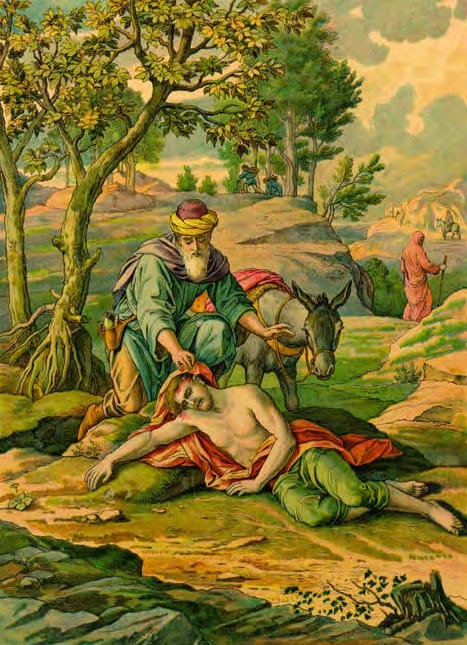
Let us consider some features of the parable. After the man had been robbed and beaten unconscious by bandits, and lay bleeding on the ground, who was the first to come by and see him? It was a “certain priest.” Why do you suppose Jesus selected a priest for this part of the story? I think it was because a priest was supposed to be particularly merciful. It was one of the qualifications of a Jewish priest. Paul mentions it:
“For every high priest, taken from among men, is ordained for men in things pertaining to God; that he may offer both gifts and sacrifices for sin; who can have compassion on the ignorant, and on them that are out of the way.” Hebrews 5:1,2
A priest was ordained “for men”; his life was consecrated for the benefit of men. He must be one “who can have compassion.” But what did this priest do? “And when he saw him, hepassed by on the other side.” “He saw him.” He saw that the man was wounded, and helpless and bleeding, and yet he passed by!
The next one to come along was a Levite. It was written of them:
“Then the priests the Levites arose and blessed the people; and their voice was heard, and their prayer came up to his holy dwelling place, even to heaven.” 2 Chronicles 30:27
That is descriptive of a true Levite, a servant of God, to whom the Lord had regard, whose prayers for pity and mercy God heard. But what did this Levite of the parable do? He “looked on him, and passed byon the other side!” “He looked on him.” He saw that if the man was not helped he would die. Yet he passed by!
There was no mistaking the lesson. This is what the religious leaders of that day were doing. They were “passing by on the other side.” They were ignoring the sufferings and burdens of the people. As Jesus said:
“They bind heavy burdens and grievous to be borne, and lay them on men’s shoulders; but they themselves will not move them with one of their fingers.” Matthew 23:4
By pointing out these things to the people, Jesus, by contrast, called attention to his message, to his invitation:
“Come unto me, all ye that labor and are heavy laden, and I will give you rest. Take my yoke upon you and learn of me; for I am meek and lowly in heart; and ye shall find rest unto your souls; for my yoke is easy and my burden is light.” Matt, 11:28-30
Then the parable says: “A certain Samaritan, as he journeyed, came where he was; and when he saw him, he had compassion on him.” Why do you suppose the Lord selected a Samaritan for the hero of the parable, for the one who showed compassion? The Samaritans were a mixed race, the offspring of Babylonians and apostate Jews, and were hated by the real Jews. The Samaritans were excluded from Jewish favor. They were classed with Gentiles or worse. When Jesus sent forth his twelve disciples to perform miracles and to preach “the kingdom of heaven is at hand,” he “commanded them saying, Go not into the way of the Gentiles, and into any city of the Samaritans enter ye not.” (Matthew 10:5) They were not considered the best of people. But I think one reason why the Lord used a Samaritan for the merciful one was to show that mercy and pity have nothing to do with race, color or creed; that there is a common human brotherhood among all the children of Adam; that all men are neighbors, one to another; that all are brothers; each is his brother’s keeper. Although the Christian is told to do good “especially unto them who are of the household of faith,” he must, nevertheless, “do good unto all men.” (Galatians 6:10)
There is still another, far more sublime meaning to this parable which the disciples of Jesus could not understand until after they had received the holy spirit at Pentecost. The man who fell among thieves represented Adam and his race. The great thief and robber is Satan, the devil. Is it not written that he sought “by robbery” to be equal with God? (Philippians 2:6) It is Satan that Jesus referred to when he said:
“The thief cometh … for to steal, and to kill and to destroy. I am come that they might have life, and that they might have it more abundantly.” John 10:10
The thief in the parable “stripped the man of his raiment, and wounded him … leaving him half dead.” Satan caused Adam to sin, robbing him of his raiment, his robe, the robe of righteousness, with which he was clothed as a perfect man. Hestruck him down, he caused him to fall, he wounded him to the point of death. In the parable, the man was left “half dead.” That’s a pretty good description of Adam’s race, the living dead: “Let the dead bury their dead,” Jesus said. “Born in sin, and shapen in iniquity.”
The good Samaritan in the parable represented our Lord Jesus Christ. As the Samaritans were a despised race, hated and looked down upon, it is written of Jesus:
“He is despised and rejected of men … he was despised, and we esteemed him not.” Isaiah 53:3
In the parable, the Samaritan saw the man lying there, on the road, robbed and struck down, wounded and bleeding, half dead, and unable to help himself. Jesus saw Adam and his race in a dead and dying condition stripped, robbed of righteousness, in a totally helpless condition, on that “broad road to destruction.” Jesus “had compassion on him.” As it is written of him, “But when he saw the multitude, he was moved with compassion on them, because they fainted and were scattered abroad.” (Matthew 9:36)
In the parable the Samaritan got down from his mount, went to the man, knelt beside him, bound up his wounds, pouring in oil and wine, and took care of him. Likewise Jesus, moved with pity and mercy, descended from heaven, humbled himself to the level of man, and by his ransom sacrifice he bound up the wounds of Adam and his race took care of him pouring on the oil of joy and the wine of his blood poured out.
In the parable the Samaritan paid a sum of money to the innkeeper on behalf of the wounded man. Jesus took in his hands to heaven itself, and paid to the Justice of God, the merit of his sacrifice for Adam, the corresponding price, which will insure man’s complete recovery and restoration from his terrifying experience with sin and death.
This is how the insistence of the Scribes, Pharisees and lawyers that Jesus keep the traditions and commandments of men resulted in the giving of a beautiful and moving parable, full of goodness and truth. It is another instance when God caused “the wrath of men to praise Him”!
The True and Living God
THERE are many sincere people in the world who do not think of God as a living, spirit being. They regard God as merely a good principle as opposed to an evil principle without intelligence and personality. Others regard him as a blind force, neither good nor evil, called “nature,” which has, without plan, purpose, or intelligence, produced everything that exists by a haphazard process of evolution. Many well-educated people hold such views.
Those who so believe may be sincere, but they are not truly wise. It is written in the Bible that reverence for the Lord, as an intelligent spirit being, is the beginning of wisdom. (Proverbs 9:10)
The fact that there really is an intelligent creator must be evident to all thinking people. Let me illustrate: When you see a beautiful painting of a flower, you know that there must have been a skilled painter with high artistic sense and an appreciation of beauty to produce such a lovely work of art. You would never for amoment conclude that the painting produced itself or just happened by chance. Is it reasonable to conclude that the original flower, the intricacy and beauty of which inspired the artist to paint it, came about by mere chance without a creator? Certainly not. On the contrary, it would mean that the original flower was designed and created by someone much more skillful and artistic than the person who merely copied it. This is the only wise conclusion to draw. It cannot be otherwise.
Every result must be produced by a competent cause. Everything that exists must have been made. If the thing made is more beautiful and intricate in design or greater in power and scope than man can produce, it is obvious that it was made by an intelligent being superior to man. Any other view would be foolish. As we read, “The fool hath said in his heart, there is no God.” (Psalms 14:1) David also said:
“When I consider thy heavens, the work of thy fingers; the moon and the stars which thou hast ordained; what is man that thou art mindful of him? And the son of man, that thou visitest him?” Psalms 8:3,4
David recognized the tremendous power represented in the universe. He was awed by it, and realized the insignificance of mere man in comparison to the great God, the creator and controller of heaven and earth. He reacted with true wisdom:
“The heavens declare the glory of God, and the firmament showeth his handiwork. Day unto day uttereth speech, and night unto night showeth knowledge.” Psalms 19:1,2
It’s true: every sunrise bringing a new day and every sunset bringing another night display God’s mighty hand, showing that the earth is revolving exactly on schedule, under the strict control of his immutable laws.
All the precise and invariable laws of nature testify to the wisdom and power ofGod who established them. It was by learning these laws, depending upon them, and harnessing them that man was able to set foot upon the moon and return to earth. This is true of all the other great accomplishments of man such as the harnessing of the power of the atom. Man really has nothing to boast about in himself.
“Thus saith the Lord, let not the wise man glory in his wisdom; neither let the mighty man glory in his might; let not the rich man glory in his riches. But let him that glorieth glory in this, that he understandeth and knoweth me; that I am the Lord which exercise lovingkindness, judgment, and righteousness in the earth. For in these things I delight, saith the Lord.” Jeremiah 9:23,24
That is the important thing: to understand and know God, the attributes of his glorious character, and his loving plan for mankind.
The most powerful evidence of the existence of a personal God with a superior intellect is man himself. Since the creator of something must be superior to the thing he has made, the fact that man, with all his intellectual and moral qualities, exists is proof that a creator exists who has vastly greater powers and attainments than man. This is the very thought expressed in the psalm, “He that planted the ear, shall he not hear? He that formed the eye, shall he not see?” (Psalms 94:9) Carrying the thought further, we can reason: He who gave to humans the sense of justice, shall we not consider him the very embodiment of justice? He who gave us the power of sympathy, compassion and love, shall we not consider that he, who is the author of all our powers, possesses these attributes himself and is infinitely superior to us in the exercise of them?
Mankind is endowed with a sense of veneration and worship. This is a God-given quality and is evident in all races of men no matter how primitive and uncivilized. Having created man with this desire to worship God, would it not be reasonable for God to satisfy that desire by revealing himself to man, to show man what he is like and what his plan for mankind is? We find just such a revelation in the Bible. The Bible was written by holy men of old who were moved to write by God’s spirit. (2 Peter 1:21) It is God’s word. From the Bible we learn what God is really like. It is here that his glorious character and plan are revealed to us. His plan for humankind is entirely in harmony with his character. Every feature of it is wise, just, and loving; and, of course, God has the power to carry it out.
In carrying out his plan, God created the earth for man’s eternal habitation. Thus we read: “The heaven, even the heavens, are the Lord’s; but the earth hath he given to the children of men.” (Psalms 115:16) God already had a heavenly family angelic children; but he also wanted a human family human children. So he created his earthly masterpiece, man, and gave him the earth as his dominion.
Adam, the first man, was created perfect, in the earthly image of God, and was designed to live forever upon the earth. He was God’s human son. He and his wife, Eve, were empowered to bring forth and fill the earth with a perfect human race, God’s human family. Thus we read:
“So God created man in his own image; in the image of God created he him; male and female created he them. And God blessed them; and God said unto them, Be fruitful, and multiply, and replenish [fill] the earth; and have dominion.” Genesis 1:27,28
“Thou has made him [man] a little lower than the angels, and hast crowned him with glory and honour. Thou madest him to have dominion over the works of thy hands.” Psalms 8:5,6
The image of God in which man was created was a character likeness, not a physical likeness. Similar to God, man could reason wisely, reach just and loving decisions, formulate plans based on his decisions, and then use his physical powers to carry them out. All this he could do within the limits of his dominion which was the earth. It is obvious mankind is nolonger in the image of God. His actions are not always wise, just and loving. There is much ignorance, injustice, and hate in the world today; but it will not always be so. Mankind is to be restored to the image of God. This is God’s plan and must be accomplished. It is here that we see God’s wisdom, justice, and love displayed.
First of all, God wisely and lovingly planned a human family, each member of which would love him and be eternally loyal to him. Then he justly put Adam to the test of obedience. When Adam failed the test, he justly condemned him to death. Then he wisely permitted his human family to have an experience with sin and death to teach them the evil consequences of disobedience. Then he lovingly provided a Saviour, which is Christ the Lord, to ransom Adam and his race.
The grand culmination of that plan, the Kingdom of God on earth, is now near when: “There shall be a resurrection of the dead, both of the just and unjust.” (Acts 24:15) In that kingdom all evil influences will be restrained. Then all the willing and obedient will be restored to human perfection to live everlastingly upon the earth as God’s human family.
The Two Salvations
SOME may be surprised that there are two salvations and may quote Acts 4:12, speaking of Jesus Christ: “Neither is there salvation in any other; for there is none other name under heaven given among men, whereby we must be saved.” But we are not suggesting that there is, or could be, any other basis for salvation but Jesus Christ.
Both salvations are through him. The Bible teaches that humankind is divided into two general categories of those who will be saved with each receiving a different reward: one will be earthly, the other heavenly.
The primary salvation is an earthly reward or destiny. Adam was never given heavenly prospects, he was never promised a future spirit nature in heaven. On the contrary he was created to live eternally upon the earth. Genesis 3:22 clearly states that he was given the power to “put forth his hand, and take also of the trees of life, and eat, and live forever.” Live forever where? Obviously upon the earth; he was told to multiply and fill the earth with a race of perfect human beings like himself. But this privilege required his obedience. The alternative was death, not a continuation of his life as a spirit being either in heaven or a place of torment. In Genesis 2:17 God told Adam plainly that if he disobeyed, he would “surely die.” Adam did disobey, and there is no mistaking the sentence God passed upon him, that he would “return unto the ground. For dust thou art, and unto dust shalt thou return.” (Genesis 3:19) Because of Adam’s sin, all mankind were born sinners, and inherited death:
“Wherefore, as by one man sin entered into the world, and death by sin; so death passed upon all men, for that all have sinned.” Romans 5:12
Although the sentence of death was entirely just, the great love of God provided a salvation from death permitting mankind to be restored to perfect life upon the earth such as Adam enjoyed before he sinned. This is what God originally designed should be the eternal destiny of all the obedient of mankind. Thus we read:
“For God so loved the world, that he gave his only begotten Son, that whosoever believeth in him should not perish, but have everlasting life.” John 3:16
So we see that what was lost was life on earth, and life on earth is what is to be regained. Thus we read: “For the Son of man is come to save that which was lost.” (Matthew 18:11) Jesus came to provide a ransom for Adam. He died without deserving to die, he laid down his perfect life sacrificially giving his unforfeited life in offset for Adam’s forfeited life; thus he redeemed or “saved” Adam and all his race. The result will be that an opportunity for salvation from death will be extended to all mankind.
“For since by man came death, by man came also the resurrection of the dead. For as in Adam all die, even so in Christ shall all be made alive.” 1 Corinthians 15:21,22
Every member of Adam’s race will be brought back to life from the dead. Paul says that God “will have all men to be saved [from death] and to come unto the knowledge of the truth.” (1 Timothy 2:4) All the willing and obedient will be restored to human perfection on earth. This will be during “the times of restitution of all things, which God hath spoken by the mouth of all his holy prophets since the world began.” (Acts 3:21) This is the general salvation. It does not change man’s earthly nature nor transport him to heaven. Those who attain to this salvation “shall build houses, and inhabit them; and they shall plant vineyards, and eat the fruit of them.” (Isaiah 65:21) That does not describe a spiritual, heavenly state.
Beside this salvation, there is another and greater salvation. It is offered now to a limited number of mankind. Those who partake of this greater salvation will experience a change of nature from human to spirit beings. They will die as humans and be resurrected to the glorious, immortal, divine nature. They will attain to the heavenly kingdom of God. Of such it is written:
“It is sown a natural [human] body, it is raised a spiritual body. There is a natural body, and there is a spiritual body. And as we have borne the image of the earthy, we shall also bear the image of the heavenly. . . . Flesh and blood cannot inherit the kingdom of God. … We shall all be changed. For this corruptible must put on incorruption, and this mortal must put on immortality.” 1 Corinthians 15:44,49-51,53
These are the ones to whom Jesus said:
“In my Father’s house are many mansions. I go to prepare a place for you. … that where I am, there ye may be also.” John 14:2,3
Both salvations provide a deliverance from sin and death based upon the ransom sacrifice of Jesus. Both lead to perfection and lasting life one to human life on earth, the other to spirit life in heaven.
Only this greatest salvation, termed in Philippians 3:14, “the prize of the high calling of God in Christ Jesus,” is offered now. Its beginning is referred to as “so great salvation, which at the first began to be spoken by the Lord, and was confirmed unto us by them that heard him.” (Hebrews 2:3) Our Lord Jesus opened the way which is called “a new and living way” (Hebrews 10:20) by his ransom sacrifice. He became our Saviour from death. It was he who issued the invitation to the great salvation. Paul refers to God who sent Jesus to be our Saviour:
“Who hath saved us, and called us with an holy calling, not according to our works, but according to his own purpose and grace, which was given us in Christ Jesus before the world began; but is now made manifest by the appearing of our Saviour Jesus Christ, who hath abolished death, and hath brought life and immortality to light through the gospel.” 2 Timothy 1:9,10
This “great salvation” costs a person everything he has. The living of a good and moral life, although very commendable, is not sufficient to gain this highest prize. There must be a full consecration or dedication of one’s self, and everything one has, to the cause of Christ. This is what Jesus meant when he said, “sell all that thou hast.” (Luke 18:22) But to one who does so, nothing is really lost. It is merely exchanged forsomething of immensely greater value, which Jesus called “treasure in heaven.” This is the “great” salvation, the heavenly inheritance, called “glory and honour and immortality, eternal life.” (Romans 2:7)
The “high calling of God in Christ Jesus” was very real to the apostle Paul. He saw its value. He did not consider the cost too high. He said:
“The sufferings of this present time are not worthy to be compared with the glory which shall be revealed in us.” Romans 8:18
He willingly exchanged all his earthly prospects for the much more excellent heavenly prospects:
“But what things were gain to me, those I counted loss for Christ. Yea, doubtless, and I count all things but loss, for the excellency of the knowledge of Christ Jesus my Lord; for whom I have suffered the loss of all things, and do count them as vile refuse, that I may win Christ.” Philippians 3:7,8
He recommended to other believers in Christ that they do the same thing, saying:
“Present your bodies a living sacrifice, holy, acceptable unto God, which is your reasonable service. Be not conformed to this world; but be ye transformed by the renewing of your mind.” Romans 12:1,2
Those aspiring to the “great salvation” must not submit themselves to the evil influences of this world, to be shaped by them, but must submit themselves entirely to the will of God. By doing so they will be transformed in mind and character by a heavenly influence, the Holy Spirit, which emanates from the word of God, the Bible.
Those of the “high calling” are under God’s special care. We read of such:
“We know that all things work together for good to them that love God; to them who are the called according to his purpose.” Romans 8:28
Earthly prosperity is not promised, but every good spiritual advantage is assured to these “sons of God.” Blessed are those who hear and obey the call to this special salvation!
Thou Art the Man
“And Nathan said to David: Thou art the man!” 2 Samuel 12:7
WHEN God rejected Saul from being king over Israel, Samuel the prophet mourned deeply for him. He had loved Saul so much. He remembered the day when he had first suggested to young Saul that the Lord had selected him to be king of Israel. Saul had answered with great humility and modesty:
“Am I not a Benjamite, of the smallest of the tribes of Israel? And my family the least of all the families of the tribe of Benjamin?
Wherefore, then, speakest thou so to me?” 1 Samuel 9:21
Saul had made himself mighty small that day: the least important family of the smallest tribe. That’s about as small as he could possibly make himself. He had done it with complete sincerity. We know this to be true because later when Samuel wanted to publicly proclaim Saul king, they could not find him! They searched and searched, but he could not be found. He was hiding. This was embarrassing. All the people of Israel had assembled before Samuel to see the one on whom the lot had fallen to be their first king, and they were waiting. Finally Samuel had to inquire of the Lord to find where Saul was hiding:
“And the Lord answered; Behold, he hath hid himself among the stuff. And they ran and fetched him thence; and when he stood among the people, he was higher than any of the people, from his shoulders and upward. And Samuel said to all the people: See ye him, whom the Lord hath chosen? That there is none like him among all the people? And all the people shouted, and said: God save the king!” 1 Samuel 10:22-24
Yes, Samuel remembered that day. But after that he had watched Saul’s disposition gradually change from a modest, unassuming spirit to one of pride, arrogance and disobedience. This contrary spirit finally culminated in Saul’s neglect of the Lord’s commandment with regard to the utter destruction of the Amalekites and their substance. He disobeyed the Lord by saving the Amalekite king and the best of the spoil together with the choicest sheep and oxen, presumably to sacrifice to the Lord. This isthe excuse he made when Samuel confronted him with his sin:
“And Samuel said, Hath the Lord as great delight in burnt offerings and sacrifice as in obeying the voice of the Lord? Behold, to obey is better than sacrifice, and to hearken than the fat of rams. For rebellion is as the sin of witchcraft, and stubbornness is as iniquity and idolatry. Because thou has rejected the word of the Lord, he hath also rejected thee from being king.” 1 Samuel 15:22,23
It hurt Samuel to have to say this to Saul but he did it nevertheless, in the performance of his duty as a prophet.
We can take a lesson from this incident of Saul’s disobedience. Some of the Lord’s people, anointed to be priests and kings, may indulge a selfish desire to keep the best of the things that the Lord has condemned, rationalizing and excusing themselves that they do it for the Lord’s cause. Let us not forget that this is the way Saullost his crown. As we read in verse 28:”And Samuel said unto him: The Lord hath rent the kingdom of Israel from thee this day, and hath given it to a neighbor of thine, that is better than thou.” This brings to mind the exhortation: “Hold that fast which thou hast, that no man take thy crown.” Revelation 3:11
Samuel continued to mourn for Saul this strong, tall, handsome man, head and shoulders above all others in Israel, who so much looked the part of a king.
“And the Lord said unto Samuel: How long wilt thou mourn for Saul, seeing I have rejected him from reigning over Israel? Fill thine horn with oil, and go. I will send thee to Jesse, the Bethlehemite; for I have provided me a king among his sons.” 1 Samuel 16:1
The Lord was about to reveal to Samuel the one he had caused Samuel to tell Saul about: the successor of Saul, the “neighbor of thine, that is better than thou.”
The Selection of David
The coming of Samuel to Bethlehem caused great excitement and trembling. Samuel was highly revered as God’s mouthpiece, and they wondered what his coming might signify. Was he a bearer of bad news? Did he have a message of condemnation, a dire warning of calamities to come?
“And the elders of the town trembled at his coming, and said: Comest thou peaceably? And he said: Peaceably. I am come to sacrifice unto the Lord.” 1 Samuel 16:4,5
He did not reveal his entire mission to the elders and the people lest word be carried back to Saul who might do something to impede his mission. He did invited Jesse and his sons to the sacrifice and afterward revealed his mission to them alone.
How proud Jesse must have felt! He had eight splendid sons and he thought they were pretty fine boys. Now he was told by the prophet of God that the Lord had actually selected one of them to be the king of Israel! It was arranged for the sons of Jesse to pass before Samuel, one at a time, from the oldest to the youngest, so that the Lord might indicate his choice.
“And it came to pass, when they were come, that he looked on Eliab, and said, Surely the Lord’s anointed is before him.” 1 Samuel 16:6
Eliab must have been a fine looking man with a serene, kingly bearing, tall and commanding, exactly the kind of man Samuel would have selected without divine direction.
“But the Lord said unto Samuel: Look not on his countenance, or on the height of his stature, because I have refused him. For the Lord seeth not as man seeth, for man looketh on the outward appearance, but the Lord looketh on the heart. Then Jesse called Abinadab, and made him pass before Samuel. And he said: Neither hath the Lord chosen this. Then Jesse made Shammah to pass by. And he said: Neither hath the Lord chosen this.” 1 Samuel 16:7-9
One after another seven splendid specimens of fine manhood passed before Sam uel; seven times the Lord indicated: “It is not he.”
“And Samuel said unto Jesse: `Are here all thy children?’ And he said: `There remaineth yet the youngest, and behold, he keepeth the sheep.’“ 1 Samuel 16:11
What a fine prophetic description of Jesus Jesse thus unwittingly gave: “Behold, he keepeth the sheep.” Isn’t that what Jesus does? Jesse said, “There’s only my youngest left, the little boy. He isn’t really grown up yet. I didn’t think you’d want him to be here so I sent him out with the sheep somebody has to look after the sheep.”
“And Samuel said unto Jesse: Send, and fetch him; for we will not sit down till he come hither. And he sent and brought him in. Now he was ruddy, and withal of a beautiful countenance, and goodly to look to.” 1 Samuel 16:11,12
David came in haste from the field; just as he was. He had no time to change from the rough leather garments of a shepherd. Deeply tanned by the wind and sun, he must have given a healthy, robust appearance.
“And the Lord said: Arise, anoint him, for this is he. Then Samuel took the horn of oil and anointed him in the midst of his brethren. And the spirit of the Lord came upon David from that day forward.” 1 Samuel 16:12,13
Once again the smallest, the least, the most insignificant from the human standpoint had been selected. First it had been Saul, of the least family of the smallest tribe. Now it was David, the youngest of eight sons, the smallest and least of the house of Jesse, only a lad charged with the care of humble and helpless sheep.
There is an interesting sidelight to this account. Each one of Jesse’s sons had his hopes raised to the heights as he passed before Samuel only to have them dashed to the ground. Yet I find no indication of jealousy or resentment on the part of David’s brothers because of the Lord’s preference for David over them. They seemed rather to have rejoiced with David as he was anointed in their midst. How different from the spirit of Cain who slew his brother because “The Lord had respect unto Abel, and to his offering” (Genesis 4:4) rather than Cain’s. How different from the hateful, murderous spirit of the sons of Jacob against their brother Joseph whom their father loved above them.
What can we conclude from this? I think we might conclude that the line of Jesse was a goodly heritage; and that David and his brothers shared naturally noble characteristics. David himself implied this in when he wrote: “Yea, I have a good heritage.” (Psalms 16:6) After all, this was the line through which Jesus Christ entered his earthly existence, one of his titles being: “The son of David.”
God’s Decisions Are Best
There is also an important lesson for us. The Lord has selected certain ones for his service. He has placed them in the body as it pleaseth Him. Some he has placed in more prominent positions than others, for the promulgation of the printed word and a public witness throughout the world by radio, television, films, etc. These brethren are the Lord’s selection. If some among us are inclined to feel that these choices are not good, that others could do better, let them remember the seven superior specimens of manhood whom the Lord passed over to select David. The Lord knew exactly what he was doing.
Jesse had eight sons, all fine men. Eliab, the oldest, was of such a gracious and kingly bearing that Samuel exclaimed when he saw him: “Surely, this is the Lord’s anointed!” Yet the Lord passed him by and selected David. Why? Was this choice capricious and without reason? Was it only because David was the youngest and least in the family of Jesse? Of course not! How, then, does God select those whom he will use? Here is the method God uses:
“For the eyes of the Lord run to and fro throughout the whole earth; to show himself strong in the behalf of them whose heart is perfect toward him.” 2 Chronicles 16:9
Consider the astounding implications of this scripture. Through his power and instrumentalities God always knows everything that’s going on. He knows the innermost thoughts of every living person every moment of every day. Impossible? It is not only possible but absolutely necessary. If there is to be a resurrection of the dead, if people are to return to this earth the same as they were when they died, the memory of God must hold what they were. What they were is the sum total of all their experiences, all their thoughts, all their lives.
“For the Lord searcheth all hearts and understandeth all the imaginations of the thoughts.” 1 Chronicles 28:9
There was nothing capricious or whimsical about the selection of David. The Lord wanted a man of a certain heart condition, a man whose heart was perfect toward him. Out of the hundreds of thousands of Israel he knew just where to find him. He knew just the one:
“He raised up unto them David to be their king; to whom he also gave testimony and said, I have found David, the son of Jesse, a man after mine own heart.” Acts 13:22
He found one whose heart was “perfect toward him.” David had a perfect love for God. His love was complete and entire; his reliance on the Lord absolute. The Lord was everything to him. He wrote:
“I will love thee, O Lord, my strength, in whom I will trust: my buckler, and the horn of my salvation, and my high tower. I will call upon the Lord, who is worthy to be praised!” Psalms 18:1,2
These are the sublime things, the outstanding things, expressing perfect love and devotion, that the Lord saw in David’s heart when his eyes ran to and fro throughout the hosts of Israel. That is why he told Samuel, “I will send thee to Jesse, the Bethlehemite; for I have provided me a king among his sons.”
Just as Samuel anointed David to be a king, passing over those of finer outward appearance, the Lord has drawn us to partake of an anointing to kingship. His eyes have “run to and fro” throughout the whole earth to find us, passing over many more wise, more mighty and more noble than we are. (1 Corinthians 1:26) He has chosen us because of what he has seen in our hearts –the incipient possibilities there. Just as he found in David’s heart, in addition to great love, the qualities of faith, meekness, courage, energy and obedience, he looks for the same characteristics in us.
When David was anointed, he was young, inexperienced, untrained and unskilled in the duties of the high office to which he was called. So are we when God first draws us to Jesus. This condition which, in the estimation of men, would be an insurmountable barrier to our high calling is no obstacle in God’s sight. God is able to inspire his called ones with his spirit and to arm them with his might. He did with David and he does with us. After his anointing, David’s kingdom was not established immediately; neither is ours. We are surrounded by enemies on every side as was David. The whole of our time in the flesh is a continual warfare. But we know that, if faithful, we will gain our crown.
David was a shepherd as a young man during his most formative years. He was a good shepherd. He loved his sheep and was willing to lay down his life for them. He demonstrated this on one occasion by killing a lion and a bear that threatened his flock. As he himself recounted it to Saul:
“And David said unto Saul: Thy servant kept his father’s sheep; and there came a lion and a bear and took a lamb out of the flock. And I went out after him and smote him and delivered it out of his mouth. And when he arose against me, I caught him by his beard and smote him and slew him. Thy servant slew both the lion and the bear.” 1 Samuel 17:34-36
It took tremendous courage and devotion to do that. He had no firearms, not even a sword. Only a club and a faith in God as wide as the great outdoors he loved so much, and an intense love for the flock entrusted to his care.
David used his long periods of isolation as a shepherd to think and meditate upon God and his great and loving ways. Some of his most sublime psalms were composed under the stars in the silent watches of the night. His fondness for his shepherd calling naturally made him relate much of his thinking to that vocation. As a result he used many expressions derived from his experiences as a shepherd.
His being entrusted with the kingship of Israel is described in shepherd terms:
“He chose David also his servant, and took him from the sheepfolds, from following the ewes great with young, he brought him to feed Jacob his people, and Israel his inheritance. So he fed them according to the integrity of his heart, and guided them by the skillfulness of his hands.” Psalms 78:70-72
A Good King Is a Good Shepherd
Here the office of king over Israel is likened to that of a shepherd who faithfully guides and feeds his flock. To be a good king he must lead Israel in the paths of righteousness, in the worship of the true God, and feed them with all his righteous precepts. The phrase, “He took him from the sheepfolds” gives us a sense of contrast, between the humble shepherd and the exalted monarch. It reminds us of the words of Jesus: “He that is faithful in that which is least, is faithful also in much.” (Luke 16:10) The eyes of the Lord ran to and fro throughout the whole earth and found David, the humble shepherd boy, devoted to his sheep, willing to lay down his life for them, daring to attack a lion and a bear in their defense. God knew that David would show the same love, zeal, integrity and self-sacrifice as a king over Israel as he did as a shepherd over sheep.
There is a lesson for us. We too are selected to be kings. The Lord’s eyes are upon us to mark the degree of our love for his sheep, our brethren, and our sympathy for the poor lost sheep of the world.
What will he see? What will he find in our hearts? Will he conclude that we, as David, will be “faithful also in much”?
In addition to being king of Israel, David was one of the foremost of the prophets. He was a talented musician, poet, and composer of psalms. His prophecies are in the form of songs. For example: “I will sing of mercy and judgment, unto thee, O Lord, will I sing.” (Psalms 101:1) This psalm contains a prophecy of the great mercy of the Lord in providing a ransom for the human race, that “he hath appointed a day, in the which he will judge the world in righteousness.” (Acts 17:31)
David’s heart was full of song; it overflowed with song. He could not refrain from singing God’s praises. As he said: “I will sing unto the Lord as long as I live; I will sing praises to my God while I have my being.” (Psalms 104:33) This carries a note of exultation, a heart so full of praise that ordinary speech is not sufficient to fully express to the Lord what is in the heart.
The apostle catches the same spirit in his exhortation:
“Be filled with the spirit, speaking to yourselves in psalms and hymns and spiritual songs, singing and making melody in your heart to the Lord. Ephesians 5:18,19
Another of David’s songs of exultation and praise is Psalm 105:
“Oh give thanks unto the Lord, call upon his name; make known his deeds among the people. Sing unto him; sing psalms unto him. Talk ye of all his wondrous works.” Psalms 105:1,2
The psalm prophecies of David, which are couched in shepherd terms, are beautifully impressive. The church, following sacrificially in the footsteps of Jesus, is described as a shepherd would see it: “Yea, for thy sake are we killed all the day long. We are counted as sheep for the slaughter.” Psalms 44:22
David loved his sheep and was intimately acquainted with each lamb. Sometimes in spite of all his efforts for the flock’s well-being, a lamb would die. This would fill David’s heart with grief. Other shepherds may simply leave the dead lamb for wild beasts to devour since it was no longer of value. But David had such a love for it individually, that he dug a grave and tenderly laid the lifeless body in it; he sorrowed over the poor creature thus cut down by death. Later when the holy Spirit impelled him to express a prophecy regarding the sorrowfulness of dying, the prison-house of death, and the joy of the resurrection in the morning of the Messianic age under the dominion of Christ and the church, he wrote from his experience as a shepherd:
“Like sheep they are laid in the grave. Death shall feed on them, and the upright shall have dominion over them in the morning!” Psalms 49:14
Could it be expressed in a more tender and loving way?
In several of the psalms, David refers to Israel as the sheep of God’s pasture. (Psalms 74:1; 79:13) He refers to the deliverance of the children of Israel from Egypt: “But made his own people to go forth like sheep, and guided them in the wilderness like a flock.” (Psalms 78:52) “Thou leddest thy people like a flock, by the hand of Moses and Aaron.” (Psalms 77:20)
When David had been overtaken by grievous sin and felt that the Lord had withdrawn his favor from him, that a cloud had come between him and his God, he thought of the pitiful condition of a sheep gone astray, utterly helpless in the wilderness, whose only hope is in being found again by the shepherd, who longs to hear the voice of the shepherd again. He wrote in agonizing repentance:
“I have gone astray like a lost sheep. Seek thy servant, for I do not forget thy commandments.” –Psalms 119:176
When Nathan had been sent and he had been found again by the Lord and restored to favor, he voiced his grateful adoration.
Shepherd words again came to his lips:
“Oh come, let us worship and bow down; let us kneel before the Lord our Maker; for he is our God, and we are the people of his pasture, and the sheep of his hand!” Psalms 95:6,7
King Ahab
By way of contrast let us consider the story of Ahab, king of Israel. The account is found in 1 Kings chapter 21. King Ahab had a large palace surrounded by beautiful grounds. One day he decided that he wanted a vegetable garden, but he didn’t want to dig up any of the palace lawns for this purpose. He looked over at a vineyard next to his grounds and thought that it would be just right for his vegetables. He went to the owner of the vineyard, a man named Naboth, and offered to buy or trade for the property. Much to his surprise and disappointment, Naboth refused to sell. This was a blow to Ahab’s vanity. Wasn’t he the king? He should be able to get what he wanted. So he went back to the palace and pouted just like a spoiled child.
The record says: “And he laid him down upon his bed and turned away his face and would eat nobread.” Isn’t that a perfect picture of a spoiled child?
When he wouldn’t eat, his wife Jezebel became worried and asked him what was bothering him and he told her. She said, in effect: “They can’t do this to you! You’re the king! I’ll see that you get the vineyard!” So she wrote letters in Ahab’s name arranging to have Naboth falsely accused and stoned to death, which was done.
Up to this point Ahab was technically innocent. Jezebel had used Ahab’s name without his knowledge. Jezebel was the murderer, not Ahab. Then what happened? The record says:
“And it came to pass, when Ahab heard that Naboth was dead, that Ahab rose up to go down to the vineyard of Naboth … to take possession of it.”
As soon as he did that he became a murderer, equally guilty with Jezebel. If he had refused to take the vineyard, he would have remained innocent. But his act of taking possession of receiving the fruits of the crime, made him a co-conspirator with Jezebel. “And the word of the Lord came to Elijah, the Tishbite.” The prophet Elijah was told to confront Ahab with his crime at the very moment when Ahab was taking Naboth’s vineyard. Elijah obeyed. Ahab was caught red-handed in the act of taking the vineyard. What was his reaction to Elijah’s accusation? “And Ahab said to Elijah: Hast thou found me, O mine enemy?” 1Kings 21:20
David’s Sin Contrasted with Ahab’s
Let us go back to the sin of David. He also was a king of Israel. His sin was almost identical to that of Ahab’s. By his orders it was arranged that Uriah, the Hittite, be killed, so that David might possess, not a vineyard, but Uriah’s wife, Bathsheba. Do you see the similarity? The record says: “And the Lord sent Nathan unto David.” Nathan was the prophet of God at that time. As Elijah had confronted Ahab, Nathan confronted David with his sin. What was David’s reaction to Nathan’s accusation? “And David said unto Nathan: I have sinned against the Lord!” (2 Samuel 12:13) Do you see the contrast between the two, the difference in reaction, the difference which reveals the heart condition upon which God looks?
Ahab, addressing the prophet of God, arrogantly said “Hast thou found me, O mine enemy?” But David humbly said: “I have sinned against the Lord!” What did the Lord’s prophet reply to each? Elijah said to Ahab the arrogant: “In the place where dogs licked the blood of Naboth, shall dogs lick thy blood, even thine!” But Nathan said to David, the humble and repentant one: “And the Lord also hath put away thy sin; thou shalt not die.” That is why David could sing out of the fullness of his heart:
“The Lord is merciful and gracious; slow to anger and plenteous in mercy. He hath not dealt with us after our sins, nor rewarded us according to our iniquities. For as the heaven is high above the earth, so great is his mercy toward them that fear him. As far as the east is from the west, so far hath he removed our transgressions from us.
Like as a father pitieth his children, so the Lord pitieth them that fear him; for he knoweth our frame; He remembereth that we are dust.” Psalms 103:8,10-14
These two incidents also point up the vast difference in God’s eyes between the sin of being momentarily overtaken in a fault because of fleshly weaknesses and that of sinning deliberately, willfully, with malice aforethought, and without repentance.
David the king, the strong and valiant man of war, showed a meek, lamb-like quality when confronted by Nathan. “I have sinned against the Lord,” he said. He could have retorted: “How dare you accuse the King? The King can do no wrong! I have absolute power over my subjects!” and sent Nathan away. But no. At heart he was still the same humble shepherd boy that he was the day he was anointed, the least of the house of Jesse. He freely acknowledged his wrong and the Lord was quick to forgive.
Because of his sin, David had been alienated from God. A cloud had come between the Lord and him, hiding the Lord’s face from him. His prayers did not seem toascend as they once did. His keen zest forlife was dulled. You may be sure he composed none of his beautiful and lilting psalms during this period. His guilt pressed heavily upon him day and night. He knew the Lord was displeased. He felt that displeasure as keenly and literally as though a millstone was tied around his neck. This separation from God was sheer torment for David, he who was so accustomed to such an intimate fellowship with his Creator.
He actually began to deteriorate physically. He felt the approach of death and the grave. He gave expression to some of his feelings of anguish in the sixth psalm:
“O Lord, rebuke me not in thine anger, neither chasten me in thy hot displeasure. Have mercy on me, O Lord, for I am weak. O Lord, heal, me, for my bones are vexed. My soul is also sore vexed; but thou O Lord, how long? Return, O Lord; deliver my soul; O save me for thy mercies sake. For in death there is no remembrance of thee. In the grave, who shall give thee thanks? I am weary with my groaning; all the night make I my bed to swim. I water my couch with tears.” Psalms 6:1-6
Here in four verses he uses the pleading expression “O Lord!” five times. This is the sad state that David was in when Nathan was sent to him. The important point is that the Lord sent Nathan to David. As grievously as David had sinned, the Lord did not abandon him; he did not easily let him go! No! He sought him out, he opened the way, he reached out for him to lift him up, to bring him back! How tenderly and tactfully the Lord dealt with his erring servant David!
Nathan was instructed to approach the king at a time when he sat at judgment hearing the grievances of the people. The account is found in 2 Samuel chapter 12. Nathan spoke as though he had a case for David to hear and render judgment upon. He told of two men in a city, one rich and the other poor. The rich man had great flocks and herds and an abundance of everything the heart could desire.
“But the poor man had nothing, save one little ewe lamb, which he had bought and nourished up; and it grew up together with him and with his children. It did eat of his own meat and drank of his own cup and lay in his bosom, and was unto him as a daughter.”
When David heard this, he immediately gave Nathan his full attention. He had been listening to the wearisome bickerings and disputations of the people all day. Here was something that touched his shepherd’s heart. He knew what it was to love a little lamb that had been forsaken by its mother, to wrap it in his own cloak, to feed it at his own table, to let the little creature share the warmth of his bed at night. This was something he could understand! He had done this very thing. It filled him with the nostalgia of his happy shepherd days.
Nathan continued the story. He told how one day a traveler came to the rich man’s house and had to be fed. But the rich man, instead of taking a lamb from his own great flock, one that would never be missed, took the poor man’s one ewe lamb and killed it to serve the meat to his guest. Don’t forget that David thought this was an actual account Nathan was relating so that royal judgment might be rendered.
At this point David must have leaped from his throne in his anger at the cruelty and the callous heartlessness of the rich man:
“And David’s anger was greatly kindled against the man. And he said to Nathan: as the Lord liveth, the man that hath done this thing shall surely die! And he shall restore the lamb fourfold, because he did this thing, and because he had no pity!” 2 Samuel 12:5,6
Thou Art the Man
Nathan lifted his hand and David stopped short. He suddenly realized that what Nathan had related was an allegorical account of his own sin. It dawned on him that by his rendering judgment in the case, he had actually passed sentence on himself: THE SENTENCE OF DEATH! He dropped his head in shame and remorse. Then Nathan said quietly: “Yes. Thou art the man!” Do you see how the Lord touched David’s heart so he might bring him back? In his condition a blunt and direct accusation by Nathan might have hardened David’s heart causing him to react improperly and drive him farther away from the Lord. So the Lord reached out and found his lost sheep in such a loving and gentle way that it brought out all the goodness of David’s heart, and it led to his forgiveness and recovery to favor. I think it must have been with tears streaming down his face that “David said unto Nathan, I have sinned against the Lord! And Nathan said unto David: The Lord also hath put away thy sin; Thou shalt not die.” Can you imagine the relief David felt to be at least forgiven, to feel the heavy load he had been carrying for so long, slip from his shoulders, to once more feel that his prayers reached the Lord, to realize that the Lord loved him, to know true happiness once again?
The Lord Does Not Abandon Us
I am sure we have all had the experience at one time or another of feeling estrangement from the Lord. When this has occurred, it has not been the Lord’s doing. He has said, “I will never leave thee nor forsake thee.” If we ever feel the loss of his favor, it is because of some unfaithfulness or laxity on our part. But the illustration of David shows that the Lord does not abandon us in such a condition. On the contrary, he takes the initiative. He seeks us out. If we respond as David did, he tenderly and lovingly restores us to his favor.
Jesus gave us a beautiful parable teaching this. He had just been telling his disciples how precious the Lord’s little ones are in his sight, saying that their guardian angels always behold the face of the Heavenly Father, and how the Father had sent the son, that is, himself, to save that which was lost. Then he said:
“How think ye? If a man have an hundred sheep, and one of them be gone astray, doth he not leave the ninety and nine and goeth and seeketh that which is gone astray? And if it be so, that he find it, verily I say unto you, he rejoiceth more of that sheep, than of the ninety and nine which went not astray. Even so, it is not the will of your Father which is in heaven, that one of these little ones should perish.” Matthew 18:12-14
Doesn’t that touch the heart? He “goeth and seeketh that which is gone astray!” When he has found the lost sheep, he rejoices! I tell you that when the Lord rejoices over us we can feel it. We have a sense of well-being. We know that everything is right again.
When one is temporarily alienated from God, exactly how does the Lord find him and call him back, by what means or instrumentality? To David he sent Nathan, and he will send “Nathan” to us too. Not literally, of course. The Lord does not communicate with us by an audible voice in our ears, or by visions in the night, or by reincarnating a prophet to visit us. He speaks to us through his word, through the scriptures. Nathan said to David: “Thou art the man!”
In times of distress when we seek to renew our close communion with the Lord, let us go to the scriptures, applying them to ourselves with these words in mind: “THOU ART THE MAN!” The scriptures are full of examples, pictures, parables and illustrations, bearing upon every human problem and situation. As we read these and find those that fit our particular case, let us say to ourselves, of ourselves: “Thou art the man!” These scriptures were written for you, for your admonition, they speak of you. If any scripture fits your case and fills your need, then “Thou art the man!” As these words brought to David a contrite and penitent spirit, they will have the same impact upon us. As they resulted in David’s complete restoration to God’s favor, they will do the same for us too.
Events in the world indicate that the time is very short. Let us not spend a minute away from God’s full favor. Let us not waste one moment. David said, under inspiration: “Delight thyself also in the Lord, and he shall give thee the desires of thine heart.” (Psalms 37:4) He voiced our sentiments exactly when he wrote:
“One thing have I desired of the Lord, that will I seek after, that I may dwell in the house of the Lord all the days of my life, to behold the beauty of the Lord, and to inquire in his temple.” Psalms 27:4
“Thus Saith the Lord”
“Then opened he their understanding, that they might understand the scriptures; and said unto them, Thus it is written.” Luke 24:45,46
THE expression, “Thus saith the Lord,” is used over 400 times in the Bible plus many similar expressions such as “It is written,” or “The word of the Lord came unto me,” or “I, the Lord, have spoken it.” They call attention to specific statements, messages and lessons from God. It is as though the prophet, or other spokesman, is telling us:
“Now hear this! What I am going to say now, is not merely my opinion, or of my own wisdom, but thus saith the Lord; it is God speaking; these are his words.”
This is a wonderful expression and full of meaning for Bible Students. We have a reverence for God’s word and a “Thus saith the Lord” is the end of all controversy with us.
It seems so very simple, doesn’t it? All we have to do is to prove everything by the word of God. All we have to do is to accept what is in harmony with that word and reject that which is not. But it is
not as simple as that. If it were, everyone would understand the truth and there would beno false doctrines. But there are false doctrines, hundreds of them. Each one is claimed to rest upon the word of God. For every false doctrine many of which are hideous in the extreme, there is a purported “Thus saith the Lord.”
Let us consider some of these and the scriptural passages which it is claimed support them. Afterward we will prove that these doctrines are indeed scripturally false.
False Doctrines in Christendom
First we have the incredibly cruel and God-dishonoring doctrine of eternal torment. Here are some of the scriptures upon which this repulsive doctrine is based:
“And he shall be tormented with fire, and brimstone in the presence of the holy angels, and in the presence of the Lamb; and the smoke of their torment ascendeth up for ever and ever; and they have no rest day nor night.”–Revelation 14:10,11
“Then shall he say also unto them on the left hand, depart from me, ye cursed, into everlasting fire, prepared for the devil and his angels.” Matthew 25:41
“And the devil that deceived them was cast into the lake of fire and brimstone … and shall be tormented day and night, for ever and ever.” Revelation 20:10
“Wherefore if thy hand or thy foot offend thee, cut them off, and cast them from thee; it is better for thee to enter into life halt or maimed, rather than, having two hands or two feet, to be cast into everlasting fire. And if thine eye offend thee, pluck it out, and cast it from thee; for it is better for thee to enter into life with one eye, rather than having two eyes, to be cast into hell fire.” Matthew 18:8,9
These are perfectly good scriptures “Thus saith the Lord!” and they seem to clearly teach eternal torment. But do they? Is that what the Lord is really saying?
Another prominent false doctrine of Christendom is that of the Trinity. God is claimed to be triune, the union of the Father, the Son, and the Holy Spirit as three persons in one God. One expression of the creed is this:
“That we worship one God as Trinity, and Trinity in Unity; neither confounding the persons nor dividing the substances; for there is one person of the Father, another of the Son, and another of the Holy Ghost. But the Godhead of the Father, and of the Son, and of the Holy Ghost is all one; the glory Equal; the majesty Co-eternal.”
All of this double-talk, or triple-talk in this case, is based upon this text:
“For there are three that bear record in heaven; the Father, the Word, and the Holy Ghost; and these three are one.” 1 John 5:7
“Thus saith the Lord!” say the Trinitarians. As a further proof that Jesus as a member of the Trinity is equal with God, they cite Paul’s words:
“Who, being in the form of God, thought it not robbery to be equal with God.” Philippians 2:6
“What more proof do you need?” they say. “Thus saith the Lord!”
It is also taught in the nominal churches, in all good conscience, that there is no future probation, that salvation is in this life only, that the world will have no future chance for life. This narrow conception of the plan of God, is based on 2 Corinthians 6:2: “Behold, now is the accepted time; behold, now is the day of salvation.” “Thus saith the Lord!” they say. “It is even repeated for emphasis: `NOW is the accepted time, NOW is the day of salvation.’ Can there be any doubt of what it says? Those who are not saved now are eternally lost.”
These are only three of the hundreds of false doctrines taught today. Each one is conscientiously claimed to be firmly based upon a “Thus saith the Lord!” To one unfamiliar with the divine plan, the claim appears true. But it is not as simple as that. To determine what the Lord is really saying we must often dig beneath the surface. We must analyze, divide, compare, and assemble: “Here a little, and there a little.” We must interpret and coordinate. We must apply certain inflexible rules and guides. When in doubt, we must consider the preponderance, or weight of evidence. We must also arrange scriptures chronologically and not confuse one age with another. Above all, we must remember that the scriptures declare God’s plan. We must learn to think from God’s standpoint according to his plan. His plan is not subject to change at our whim:
“The Lord of Hosts hath sworn, saying, surely as I have thought, so shall it come to pass; and as I have purposed, so shall it stand.” Isaiah 14:24
We must learn to think like he does. “Come now, and let us reason together,” he says. We must be filled with his spirit of truth and approach the scriptures in that spirit humbly, prayerfully, and reverentially, fearing greatly to misinterpret, and perhaps mislead and stumble others. The penalty for stumbling others is extremely severe. This is the great Creator’s word we are dealing with, his sacred word which is not to be handled carelessly and flippantly. This is not for fun; it is serious. As we read in Isaiah:
“Thus saith the Lord: the heaven is my throne, and the earth is my footstool … For all those things hath mine hand made, and all those things have been, saith the Lord. But to this man will I look, even to him that is poor and of a contrite spirit, and trembleth at my word.” Isaiah 66:1,2
In order to understand what God is saying, we must study God’s word topically, in orderly steps. As we read:
“Thy word is a lamp unto my feet, and a light unto my path. Order my steps in thy word.” Psalms 119:105,133
God has not given us an understanding of his word to satisfy idle curiosity. It is given to us for a purpose, for the development and completion of the church, the body of Christ. As Paul said to Timothy:
“All scripture given by inspiration of God is profitable … that the man of God may be perfect [or complete], thoroughly furnished unto all good works.” 2 Timothy 3:16,17
This being the case, we are expected to pursue our studies in a methodical and workmanlike manner to be approved by God as we are told:
“Study to show thyself approved unto God, a workman that needeth not to be ashamed, rightly dividing the word of truth.” 2 Timothy 2:15
The Diaglott says, “Rightly treating the word of truth.” The interlinear is, “Cutting straight the word of truth.” This is what we must do to ascertain what the Lord is really saying, what he is really telling us, that “Thus saith the Lord!”
A Checklist for Interpreting Scripture
I have formulated a list of tests that may be applied to interpretations of scripture to help determine its real meaning. You may think of other tests also. Does it square with the ransom? Is it in accordance with the divine plan? Is the scripture correctly translated? Is it spurious in whole or in part? Does the proposed interpretation comport with God’s character? To what age or time does the scripture apply? To what class of persons does it apply? Is it merely historical, having already had a total fulfillment? If already fulfilled, does it have a secondary application or fulfillment to come? Is it literal or symbolic? Does it have a typical significance? Does its context vary its apparent meaning? Is it intended to be ironic or sarcastic rather than literal? Does it employ an archaic idiom not in use today? Is its correct application suggested by partially fulfilled prophecies? Does it teach something by inference? Is the subject really what it appears to be? Are the events given in correct chronological order or has the order been purposely altered or reversed to prevent understanding before the due time? Does incorrect punctuation alter the true meaning? Does the scripture conflict with other scriptures on the same subject? Is there another scripture, or another witness, to confirm the proposed interpretation?
Let us go back and review the scriptures that were cited to support certain false doctrines. Let us apply some of these tests to determine what the Lord really says. Let us thus prove that these doctrines are not, in fact, supported by a “Thus saith the Lord!,” although they may appear to be.
Eternal Torment
Consider the scriptures that are used to teach eternal torment. Do not think that a study of such scriptures is too elementary. Although convinced the doctrine of eternal torment is false, many mature Bible Students cannot readily explain the scriptures used to support the doctrine. Consider the first:
“And he shall be tormented with fire and brimstone in the presence of the holy angels, and in the presence of the Lamb; and the smoke of their torment ascendeth up for ever, and ever; and they have no rest day nor night.” Revelation 14:10,11
First we ask, “Does the proposed interpretation comport with God’s character?” No it does not. There are numerous scriptures which teach that love is one of the principal characteristics of God. Here is just one:
“God is love. There is no fear in love; but perfect love casteth out fear, because fear hath torment.” 1 John 4:8,18
Because God is love, he is incapable of torment. To torment anyone is entirely foreign to God’s character. It is contrary to his thoughts. He simply wouldn’t think of it; itis an abomination to him. This is confirmed by Jeremiah where God denounces those who sacrificed their children by fire to pagan gods:
“They have built also the high places of Baal, to burn their sons with fire for burnt offerings unto Baal, which I commanded not, nor spake it, neither came it into my mind.” Jeremiah 19:5
“And they built the high places of Baal … to cause their sons, and their daughters to pass through the fire unto Molech, which I commanded them not, neither came it into my mind, that they should do this abomination.” Jeremiah 32:35
Eternal torment does not comport with God’s character of love.
Another characteristic of God is justice: “Justice and judgment are the habitation of thy throne” (Psalms 89:14), or as Moffatt renders it: “Thy throne rests upon equality and justice.” Does eternal torment comport with God’s character of justice? Is it just to impose an eternity of torment for the sins of only a few brief years of this present life? Is it equitable? Of course it is not! It is a grossly disproportionate punishment.
The penalty for sin was announced at the beginning in Genesis 2:17 as simply death: “Thou shalt surely die” is what God said. This is what Adam was to expect if he sinned: nothing more than death.
Would it be just for God to announce the penalty as death, then after the sin had been committed to rudely surprise the sinner by amplifying the penalty to an eternity of torment? Such a thing would be most unjust. Thus it does not comport with God’s character in this respect either.
Does the proposed interpretation square with the ransom? It does not. Jesus came as a man to assume the penalty for sin. If the sentence upon Adam was eternal torment and Jesus took Adam’s place, Jesus must be tormented forever which we know is false. The sentence for disobedience was simply death; Jesus died to pay the penalty as the ransom.
Is eternal torment in accordance with the divine plan? Emphatically no. The plan provides for the restoration of mankind to perfection and harmony with God. A restitution of all things was spoken by the mouth of all God’s holy prophets since the world began. (Acts 3:21) Eternally tormenting a large segment of humanity is incompatible with this. Since we are told that “all the wicked will he destroy” (Psalms 145:20), God will certainly not keep any of the wicked alive in torment. On the contrary 2 Thessalonians 1:9 says plainly that they “shall be punished with everlasting destruction.”
Now we apply another test which indicates that direction we must take to determine what the scriptures really do teach. “Is it literal or symbolic?” The scripture is obviously highly symbolic. Revelation is a book of symbols. As we read in the first verse of the first chapter, the “things which were shortly to come to pass” were signified, or SIGN-ified, unto John. They were given in signs and symbols. The entire 14th chapter is replete with symbols. There is a “lamb,” a symbol of Christ, standing on “mount Zion,” his heavenly kingdom. There is “thunder,” a symbol of controversy, and the “harps” of Bible testimonies sing a “new song,” harmoniously declaring the glad tidings of restitution. There is a “throne,” a symbol of authority and rulership. There are “beasts” and “elders” and “virgins” and “angels,” all having symbolic significance. Then in verse 8 we are told that “Babylon,” a great city, is fallen. This too is a symbol. “Babylon” means “confusion” and is a symbol of the nominal church as a whole. So the prophecy refers to the time of the Lord’s casting off of the nominal systems, removing His favor from them. Then in verse 9 a “beast” and his “image” are mentioned. Bible Students concur that this symbolizes the papal system and a so-called Protestant Federation, Protestants who no longer protest. In regard to this “beast” and its “image” we find a remarkable interpretation of the prophecy written in 1897 by Pastor Russell. It reads as though it were a comment on yesterday’s news reports concerning the ecumenical movement. We quote:
“We find in Revelation a prophecy of a special combination of influence by which Protestant denominations will be unified, and, though separate, yet be brought into cooperation with Papacy, in a manner that will give both of them increased powers, and deceive many into supposing that the new combination will be God’s instrumentality for doing the work predicted of Messiah; and that it is thus his representative.”$FStudies in the Scriptures, volume 4, page 581.
With this background we are able to deal with the true meaning of this scripture:
“If any man worship the beast, and his image, and receive his mark in his forehead, or in his hand, the same shall drink of the wine of the wrath of God, which is poured out without mixture into the cup of his indignation; and he shall be tormented with fire, and brimstone in the presence of the holy angels, and in the presence of the Lamb; and the smoke of their torment ascendeth up for ever, and ever; and they have no rest day nor night.” Revelation 14:9-11
Here more symbols are brought into the picture: the “mark” or identification of those in harmony or sympathy with the beast or his image which is applied on the “forehead” indicating a mere intellectual assent, or in the “hand” implying a more active cooperation. These shall drink the “wine of the wrath of God” out of the “cup of his indignation” which indicates that such feel the manifestation of God’s displeasure, being compelled to drink a bitter dose. Do you see how full of symbols the book of Revelation is? To take these symbols literally would be extremely foolish. Jesus is not aliteral lamb, a literal beast is not worshipped, it does not have a literal image. Literal marks are not made on literal foreheads and hands. These are all symbols which, when correctly interpreted, beautifully represent profound truths and tell of tremendous events to come.
Verses 10 and 11 say that those who worship the symbolic beast and his symbolic image shall drink of the symbolic wine of wrath from the symbolic cup. From this point forward the teachers of eternal torment insist that symbolisms cease and that the remainder of the text must be taken literally, that the words “he shall be tormented with fire and brimstone” and “the smoke of their torment ascendeth up for ever and ever” is exactly and literally what it says. But is this reasonable? No, it is entirely unreasonable. There is no justification for such a view. On the contrary, a fair and reasonable person must conclude that because of all the other symbols and the highly symbolic nature of the entire book, these expressions must be symbolic and not literal.
Those who insist on a literal interpretation of this portion of the text are in a further difficulty. The text says that the torments takes place “in the presence of the Lamb.” If the torment with fire and brimstone is literal, so must the lamb be also: an animal, the young offspring of a sheep. By what reasoning can you say that the one is literal and the other is not? Both occur in the same sentence. If one is literal, so is the other.
So we have established beyond the shadow of a doubt that the torment by fire and brimstone of the worshippers of the beast and his image is symbolic. What then does it really mean? We turn to Revelation 18:4 which also refers to the fall of Babylon, the nominal church systems of confusion: “Come out of her, my people, that ye be not partakers of her sins, and that ye receive not of her plagues.” So the scripture under consideration simply means that all who remain in Babylon, either in spirit or in name, are in opposition to the word of God. Those who do not “come out of her” will be subject to torment and vexation so long as they are worshipping creeds, doctrines, and organizations of men. The remembrance of this distress is shown in the smoke of torment and it will never be forgotten. Those who are finally brought out of these systems will forever remember how they were tormented. They will have learned an everlasting lesson.
The next text cited as a proof of eternal torment is Matthew 25:41: “Then shall he say also unto them on the left hand, depart from me, ye cursed, into everlasting fire, prepared for the devil and his angels.” This is from the parable of the Sheep and Goats and describes the fate of the disapproved ones at the end of the Millennial age. Is there anything in this scripture to indicate that those in the fire are preserved alive? Have you ever heard of a preserving fire? Of course you haven’t. Fire always destroys and consumes. Fire is a symbol of destruction; everlasting fire is a symbol of everlasting destruction, the second death, from which there is no resurrection. Notice that in this case it is fire that is prepared for the devil and his angels. We know exactly what is going to happen to the devil: “That through death, he [Jesus] might destroy him that had the power of death; that is, the devil.” (Hebrews 2:14) This confirms that fire means destruction.
This explanation also applies to Revelation 20:10: “And the devil that deceived them was cast into the lake of fire and brimstone … and shall be tormented day and night, for ever, and ever.” Brimstone, or sulfur is one of the most destructive elements known. When paired with fire it symbolizes utter destruction. The torment “for ever and ever” means this punishment is everlasting.
Now we consider the next text:
“Wherefore if thy hand or thy foot offend thee, cut them off, and cast them from thee. It is better for thee to enter into life halt or maimed, rather than, having two hands or two feet, to be cast into everlasting fire. And if thine eye offend thee, pluck it out, and cast it from thee. It is better for thee to enter into life with one eye, rather than, having two eyes, to be cast into hell fire.” Matthew 18:8,9
These are the words of Jesus. Did Jesus advocate self-mutilation? Obviously not. He healed men, he restored their hands and feet and eyes. We must conclude that symbolic terms are being used here. The scripture simply and powerfully teaches that itis better for a Christian to cut off and eliminate from his life things as dear to him as a hand, foot, or an eye if such things would prevent him from making his calling and election sure. Such eradication would be better than to fail of his calling and lose his eternal existence in the second death.
As we have previously seen, everlasting fire means everlasting destruction. “Thus saith the Lord!” Thus we have determined what the Lord really says. The correct interpretations fully satisfy us. They square with the ransom, they are in full accordance with the divine plan, and they comport with God’s character of justice, wisdom, love and power. They cause us to love and praise God.
The Trinity
Consider the scriptures cited to prove the false and confusing doctrine of the Trinity: that God is three persons yet one God.
“For there are three that bear record in heaven; the Father, the Word, and the Holy Ghost; . . . and these three are one. And there are three that bear witness on earth.” 1 John 5:7,8
This scripture certainly appears to be an unanswerable argument to support the doctrine of the Trinity, but since it is so contrary to reason and we know God to be eminently reasonable we suspect something is wrong with the translation. Let us examine the scripture in the original language. The Diaglott is an excellent authority for this purpose. There we find the text omitted and a footnote as follows:
“This text concerning the heavenly witness is not contained in any Greek manuscript which was written earlier than the fifth century. It is not cited by any of the Greek ecclesiastical writers; nor by any of the early Latin fathers, even when the subjects upon which they treated would naturally have led them to appeal to its authority. It is therefore evidently spurious; and was first cited … in the latter end of the fifth century; but by whom is of no great moment, as its design must be obvious to all.”
It seems that we must be on the alert for forgeries too! This is not a “Thus saith the Lord.”
Then we have Philippians 2:6 which says of Jesus, “Who being in the form of God, thought it not robbery to be equal with God.” This appears to say that Jesus was equal with God and did not consider it wrong to be so, that he did not consider such equality as robbing God of anything. Again we sense something is wrong and ask, “Is this scripture correctly translated?” Going back to the original Greek, we find that the King James Version has added one small word and omitted one small word, completely reversing the meaning of the text. Thus the expression “thought it not robbery to be equal with God,” should read, “thought not by robbery, to be equal with God.” Accordingly, the Diaglott correctly renders the text: “Who, though being in God’s form, yet did not meditate a usurpation to be like God.” Here Jesus, the humble and obedient son of God, is contrasted with the arrogant and disobedient Satan, who is quoted as saying:
“I will ascend into heaven, I will exalt my throne above the stars of God; I will sit also upon the mount of the congregation in the sides of the north; I will ascend above the heights of the clouds; I will be like the Most High.”–Isaiah 14:13,14
Thus instead of proving the Trinity, the correct translation of Philippians 2:6 disproves it.
Let us get the correct perspective on this subject. Although Jesus did say, “I, and my Father are one” (John 10:30), he prayed on behalf of his disciples, “That they may be one, even as we are one” (John 17:22). How was he one with the Father? He was one with the Father as he wants us to be one with him: one in mind, purpose, sympathy, love, and good works THE SAME CHARACTER. That’s why he could say, “He that hath seen me, hath seen the Father.” (John 14:9) In other words, “I am patterned after the Father; I am a model of Him. I have the same characteristics.”
Thus understanding the subject of the Trinity we are spared such absurdities as God himself being out of conscious existence at the conception of Jesus, that the child Jesus was God, that the man Jesus prayed to himself, that his agony of prayer in Gethsemane was farcical, that his desperate cry on the cross “My God, my God, why hast thou forsaken me,” was mere play-acting, that God died on the cross, and that he resurrected himself.
Finally the doctrine of the Trinity does not square with the ransom which requires the sacrifice of a perfect human life in the place of Adam. Nor is it in accordance with the divine plan which places Jesus in the future role of mediator between God and man, an impossibility if he is God.
“For there is one God, and one Mediator between God and men, the man Christ Jesus.” 1 Timothy 2:5
No Future Probation
Let us consider the scripture upon which is based the false doctrine that there is no future probation, that salvation is in this life only, that the world will have no future chance for life:
“Behold, now is the accepted time; behold, now is the day of salvation.” 2 Corinthians 6:2
Here again the interpretation does not square with the ransom. Since Christ died for all, all must have an opportunity for life, all must be saved from death. This is God’s provision:
“Who will have all men to be saved, and come unto the knowledge of the truth.” 1 Timothy 2:4
In this life only a few have had an opportunity for salvation. Countless millions have lived and died without even having heard the name of Christ. So they must first be saved from death in a resurrection on the earth, then be brought to a knowledge of the truth of God’s wonderful provision for them.
Is it in accordance with the divine plan? No, it is not. A future probation is plainly taught by Acts 3:21 which tells of the “times of restitution of all things, which God hath spoken by the mouth of all his holy prophets since the world began.” So the interpretation given this scripture is obviously incorrect since it denies the testimony of all God’s holy prophets since the world began.
What does it really mean? Again we look closely at the original language and find an error in translation which makes all the difference. Instead of “the” accepted time, and “the” day of salvation, it should read “an” accepted time, and “a” day of salvation. There is a day of salvation now, and a day of salvation to come. These two salvations are contrasted by two scriptures:
“Strait is the gate, and narrow is the way which leadeth unto life; and few there be that find it.” Matthew 7:14
This describes the present narrow way of sacrifice taken by the church of Christ. Only a few, a “little flock,” are separated from the world. This class, “by patient continuance in well doing, seek for glory, and honor, and immortality, eternal life.” (Romans 2:7) This is a difficult and restricted salvation with the correspondingly high reward of the divine nature. Isaiah tells of the other salvation to be offered to all the remainder of mankind during the Millennial kingdom:
“And a highway shall be there, and a way; and it shall be called, The way of holiness; the unclean shall not pass over it; but it shall be for those; the wayfaring men, though fools, shall not err therein.” Isaiah 35:8
This is the way to human perfection and eternal life on earth to all the willing and obedient. It is a different and easier way. What a wonderful plan! Not the gloomy prospect of the vast majority of mankind unsaved and eternally damned, but the delightful prospect of everyone saved from death and then given an opportunity, under ideal conditions to attain restitution, a glorious resurrection. This truly comports with God’s character and is in accordance with his plan.
How to Know What’s True
We find that it is not always easy to determine whether a certain interpretation of scripture is a “Thus saith the Lord” or not. While most scriptures are plain, many require careful analysis and the application of certain tests before the true word of the Lord on the subject may be ascertained.
There is one quick and easy test that includes and overrides all the others. This test is available only to the initiated, those to whom Jesus referred when he said:
“It is given unto you to know the mysteries of the kingdom of heaven, but to them it is not given.” Matthew 13:11
This comprehensive test is suggested by one of the last acts of Jesus just before his ascension:
“Then opened he their understanding, that they might understand the scriptures; and said unto them, Thus it is written.” Luke 24:45,46
How did he “open their understanding”? Did he perform a miracle whereby his disciples automatically understood without the exercise of their reasoning faculties? I don’t think so. I think he opened their understanding by opening the divine plan to them. He gave them an outline of God’s plan of salvation. He told them of the fall, his death as a ransom, his resurrection, the call of the church, their work of preaching the gospel of the kingdom to come among all nations. This is confirmed by the context. Then and only then could they understand “Thus it is written” or “Thus saith the Lord.” Once they knew the master plan, all the prophetic utterances of the past fell into place. They now fitted, dove-tailed, harmonized, and made sense to the disciples. As Jesus said in verse 44:
“These are the words which I spake unto you, while I was yet with you; that all things must be fulfilled, which were written in the law of Moses, and in the prophets, and in the Psalms, concerning me.”
What is the supreme and all-embracing test to be applied to scriptural interpretation? It is the question, “Is it in accordance with the divine plan?”
Someone may say, “We seem to be going around in circles. You imply that we must understand the divine plan before we can interpret the scriptures. But how can we understand the plan unless we first interpret the scriptures?” Good question. We answer by asking another question. How did the disciples of Jesus back there know of the divine plan? Jesus told them. “Then opened he their understanding,” the text says. We know of the plan because he has done the same for us. He has also given us, the harvest church at this end of the age, an understanding of the divine plan of the ages.
Through his wonderful providences and the rich endowment of the Holy Spirit, the Lord has enlightened and stimulated the minds of certain servants, particularly one special servant. He has caused books to be written which present the plan clearly and accurately. Today there is no excuse for the consecrated to be ignorant of the plan. We have the incomparable, topically arranged, six volumes of Studies in the Scriptures; we have the Reprints a veritable treasure trove of Bible truth, we have Tabernacle Shadows a dramatic pantomime of the plan, we have the Berean Manual containing Bible comments and teacher’s helps which are the very essence of spiritual wisdom. There are other instructive books as well. All these are the Lord’s provision. Let us avail ourselves of them fully. To do otherwise would be ungrateful and unthankful.
So let us thus keep the plan always fresh and vital in our minds. What will be the result? If we do this, we will know the divine plan of the ages so thoroughly that any wrong interpretation of scripture will instantly alert us. It will ring a bell. We will recognize it to be false because it is not in accordance with the divine plan of the ages which we have been taught and know so well.
“Thus Saith the Lord!”
Thy Kingdom Come
“After this manner therefore pray ye: Our Father which art in heaven, hallowed be thy name. Thy kingdom come. Thy will be done in earth, as it is in heaven.” Matthew 6:9,10
JESUS referred to a kingdom when he taught his disciples to pray. Some doubt whether it really is a literal kingdom of God on earth for which we are to pray. When they read, “the kingdom of God is within you” (Luke 17:21), some conclude that the kingdom spoken of is only a condition of heart within a Christian, not a literal kingdom. This is a mistake. A better translation of Luke 17:21 reads, “The kingdom of God is (to be) in your midst,” or “among you.” It is indeed to be a literal kingdom exercising supreme rule upon the earth, with Christ as king, causing God’s will to be done on earth.
The conditions we find on earth today are surely not God’s will. We know that God is good, but all about us there is every kind of evil. We see selfishness, dishonesty, immorality and hate. There are robberies, murders, and all sorts of violence. Accidents and calamities constantly occur. Many people of the earth face starvation; sickness, suffering and death are everywhere. Over all hangs the threat of atomic war, pollution, and anarchy, causing men’s hearts to fail for fear. This seems to be the normal course of events. It is hard to conceive of God’s will ever being done on earth.
But at one time there was a kingdom on earth in which God’s will was done as it is in heaven. It was many thousands of years ago. God had prepared the earth for man’s habitation. He had provided an infinite variety of vegetation, fruits and herbs. By his power, fish, fowl and beasts had been brought forth after their kind. Then God created his earthly masterpiece: MAN, a noble creature, only a little lower than the angels.
“So God created man in his own image. In the image of God created he him; male and female created he them. And God blessed them. … And the Lord God planted a garden eastward in Eden; and there he put the man whom he had formed. … And God saw everything that he had made, and behold, it was very good.” Genesis 1:27-31; 2:8
We also read that man was given dominion over the fish of the sea, the fowl of the air, and over every living thing upon the earth. Here in Eden was a little kingdom with Adam as king and Eve as queen. They were blessed of God and had a dominion over the earth. All of it was pronounced by God himself as being “very good.” God’s will was indeed done on earth in that kingdom. In reference to this first pair, we read:
“And God blessed them. And God said unto them, Be fruitful, and multiply, and replenish [fill] the earth, and subdue it.” Genesis 1:28
They had been entrusted with the marvelous power of procreation, of creating their own kind. As they would multiply, the garden of Eden would not have been large enough. They would need to push outward. To do this, they would “subdue” the earth and develop it, using the original Eden, that God-given model, as a sample and source of nursery stock for a continued perfect food supply. Thus the boundaries of Eden would be extended until it eventually covered the earth. What a wonderful prospect: a race of perfect human creatures, each one an earthly image of God himself, living forever
in happiness upon the earth under ideal conditions. But something happened to change things.
“And the Lord God commanded the man, saying, Of every tree of the garden thou mayest freely eat. But of the tree of the knowledge of good and evil, thou shalt not eat of it; for in the day that thou eatest thereof, thou shalt surely die.” Genesis 2:16,17
God said, in effect: You must render unto me your full and complete obedience. I could have created you so you had no other choice. I could have made you like the animals with their compelling instincts so that you would obey me by compulsion. But you are my son, made in my own image and likeness, with a free will, with freedom of choice. I want you to always choose the good and right way because you want to. Now I am going to put you to the test, to prove your obedience to me. I have planted in this garden every tree that is good for food. There are endless varieties. Now, “of every tree of the garden thou mayest freely eat; but of the tree of the knowledge of good and evil, thou shalt not eat of it; for in the day that thou eatest thereof, thou shalt surely die.” (Genesis 2:16,17)
This test of obedience was eminently fair. It placed no hardship upon Adam. It did not limit his food supply in the least. The supply remained more than ample and the variety was practically limitless. Of every tree in the world that was good for food, the fruit of only one tree was prohibited.
It may be argued that the penalty for disobedience in such a small matter–death for eating a forbidden fruit–was too severe. But it was not the degree of disobedience, but the simple act of disobedience that was to be punished. God purposely made the test easy so that there would be no excuse on Adam’s part. He could not say, “This thing is too hard for me. What you are asking is beyond my capabilities.” God had every right to demand complete obedience from the man he had created. This man was made with the ability to “put forth his hand, and take of the tree of life, and eat, and live forever.” (Genesis 3:22) God cannot tolerate sin forever. By definition, sin is disobedience to God’s law. For continued life, obedience was absolutely essential.
Then occurred the greatest tragedy the world has ever known, a tragedy resulting in the suffering and death of billions of people. In spite of what the Lord had said to Adam, Satan told Eve a great lie, saying: “Ye shall not surely die.” (Genesis 3:4) Eve was deceived but Adam was not deceived. He ate of the forbidden fruit deliberately and with full knowledge of the sentence he was incurring; he preferred to die with his wife. Thus Adam failed in the simple test of obedience that God had required, and the penalty must be imposed. God said to Adam:
“In the sweat of thy face shalt thou eat bread, till thou return unto the ground; for dust thou art, and unto dust shalt thou return.” Genesis 3:19
But if it was Adam who was sentenced to death, why do we die also? It is because we have an inheritance of sin and death. All of Adam’s children were born after he had sinned, after he was driven from the garden. Thus they were all born imperfect and prone to sin. As it is written, “Behold, I was shapen in iniquity, and in sin did my mother conceive me.” (Psalms 51:5) This includes your ancestors and mine. The death sentence of father Adam passed upon them and has come down to us.
“Wherefore by one man sin entered the world, and death by sin; so death passed upon all men, for that all have sinned.” Romans 5:12
Although God’s justice condemned man to death, God’s love provided a way for him to live again. God said, “I will ransom them from the power of the grave.” (Hosea 13:14) God sent his only begotten son to earth to lay down his unforfeited life in the place of Adam’s forfeited life, to thus redeem Adam and all his race from death. Jesus paid a corresponding price, or ransom, for Adam.
“For since by man came death, by man came also the resurrection of the dead. For as in Adam all die, even so in Christ shall all be made alive.” 1 Corinthians 15:21,22
There will indeed be a literal kingdom of God on earth with Christ as king to not only resurrect the dead, but also to restore all the willing and obedient from the condition of sin and death, bringing them up to human perfection which Adam had before he sinned. The whole earth will be made into a beautiful garden as Eden was for the eternal enjoyment of all mankind. Then the prayer “Thy kingdom come, thy will be done in earth, as it is in heaven,” will be answered.
“Unto Us a Child Is Born”
“For unto us a child is born; unto us a son is given; and the government shall be upon his shoulder.” Isaiah 9:6
“And there were in the same country shepherds, abiding in the field, keeping watch over their flock by night; and lo, the angel of the Lord came upon them, and the glory of the Lord shone round about them; and they were sore afraid. And the angel said unto them: Fear not; for behold, I bring you good tidings of great joy, which shall be to all people; for unto you is born, this day, in the city of David, a Saviour, which is Christ the Lord. And this shall be a sign unto you: Ye shall find the babe, wrapped in swaddling clothes, lying in a manger. And suddenly there was, with the angel, a multitude of the heavenly host, praising God, and saying: Glory to God in the highest, and on earth peace, good will toward men.” Luke 2:6-14
WHEN God began his earthly creation, there was great joy in heaven. Many people think heavenly beings are grim, ghostly creatures, without natural emotion always serious and somewhat terrifying. They sometimes picture them as avenging angels with fiery swords. If a heavenly being suddenly appeared, it would scare them half to death. The early disciples of Jesus felt the same way because when Jesus appeared to them after his resurrection, “they were terrified, and affrighted, and supposed that they had seen a spirit.” (Luke 24:37)
Some nominal Christians, expecting to become angels when they die, try to conform themselves to what they think angels are by becoming dull, emotionless and grim, mistaking this for Godly piety. But when God laid the foundations of the earth, there were great and spontaneous demonstrations of pure joy by all his spirit creation: “When the morning stars sang together, and all the sons of God shouted for joy.” (Job 38:7) Do you want to be like an angel? How long has it been since you shouted for joy? We know the angels of God are happy and joyful creatures. How could it be otherwise?
They always behold the face of our great, loving heavenly Father, the one of whom David said: “In thy presence is fulness of joy, and at thy right hand there are pleasures for evermore.” (Psalms 16:11) When God said, “Let us make man in our image, and after our likeness” (Genesis 1:26), he was describing happy, joyful creatures. He made them thus and placed them in a beautiful garden a joy to live in and a joy to behold.
How quickly can joy turn to sorrow! The greater the capacity one has for happiness, the deeper the sorrow one can experience. Eve was broken-hearted over what she had done. She had eaten of the fruit of the tree which God had forbidden and she had induced her husband to eat of it. She had not really meant to do this. She had been outsmarted. It had all happened so quickly.
When God asked her, “What is this that thou has done?” she answered pitifully: “The serpent beguiled me, and I did eat.” (Genesis 3:13) In other words: “The serpent fooled me, deceived me, took advantage of my trustfulness and inexperience, posing as a friend, a wise counselor; he promised the reward of a special knowledge of good and evil. He beguiled me!”
Poor woman! She had indeed gained a knowledge of differentiating good from evil. Now she knew that everyone did not tell the truth, that the serpent Satan was a liar. But at what tremendous cost was this knowledge attained! It was indeed merciful that Adam and Eve did not at once realize the full enormity of their loss the loss of life for themselves and for billions of their descendants the turning of the world into one vast graveyard. Had they realized it, they would have been overwhelmed.
But the immediate loss of Eden was bad enough, and it hurt. To be driven from an environment of love, beauty and tranquility into a world of hostility, ugliness and turmoil was painful. No one likes to be beguiled or deceived. So Eve quite naturally resented it. She must have been greatly incensed at the serpent, Satan, who had maneuvered her into this situation. It was exactly at this point that God, in his great mercy and wisdom, gave her a ray of hope. It was a faint light, only a glimmer, but at least it was something, something she could lay hold upon and treasure in her heart in the dark days to come. The Lord gave her this ray of hope only indirectly. He was not speaking to her. He was speaking to the serpent, but she overheard it. God said, “I will put enmity between thee and the woman.” Oh yes! Eve already felt that enmity. She was already wondering how she might avenge herself upon the one who had beguiled her.
“I will put enmity between thee and the woman; and between thy seed and her seed. It shall bruise thy head, and thou shalt bruise his heel.” Genesis 3:15
Yes it was indeed a faint hope, but it was something. Eve hungrily grasped at the promise. Thinking about it later and talking it over with Adam, she understood it to mean that one of her children would, somehow, bruise the head of the serpent, Satan deal him a mortal wound and perhaps in some way bring about a restoration of that which was lost.
Eve’s Children Fuel Her Hopes
One can imagine how eagerly she waited for her first child. When her firstborn son came, Eve thought, “Perhaps this is the one!
Perhaps this is the promised seed. Oh, I hope so!” She happily exclaimed, “I have gotten a man from the Lord!” (Genesis 4:1) In other words: “This is the man the Lord promised, this is the man who shall bruise the serpent’s head. Unto us a child is born; unto us a son is given!”
But their firstborn son, Cain, was a cruel disappointment to his parents. Instead of bruising the serpent’s head, he “rose up against Abel, his brother, and slew him.” (Genesis 4:8) Instead of bringing life, he brought death. They never fully recovered from that disappointment. When during the centuries of their long lives thehead of Satan remained unbruised and Eden unredeemed, hope must have dimmed and almost died in their hearts.
They just didn’t understand. It was not the due time to understand. They didn’t understand that although the promised seed would be the “seed of the woman,” it would not be the seed of the man. They didn’t understand that the slaying of animals to provide skins for their covering prefigured the death of someone as a corresponding price to cover their sins. They didn’t understand that thousands of years would be required to develop and mature the various features of God’s plan of redemption before Eve would be avenged and Eden would be reclaimed.
Let us draw the curtain on 4000 years of human experience of human misery, pain, sickness, despair and death with Eve’s old enemy, the serpent Satan, reigning as god of this world. Adam and Eve have finally died in disappointment, seeing numerous generations of descendants without having seen the promised seed. Inevery generation thereafter, for 4000 years men had vainly looked and longed for that seed of promise.
Then one day in the tiny village of Bethlehem, not far from the site of old Eden, a descendant of Mother Eve, a young woman named Mary, delivered her firstborn son. Whereas Eve hoped that her son Cain was the “man from the Lord” sent to save them, Mary knew her son Jesus was “that man.” Had not the angel Gabriel told her? Had not the child been supernaturally conceived? Had not the angelic choir joyfully announced him as the “Saviour, which is Christ the Lord”? Had not the shepherds told her all about it? Yes, Eve only hoped but Mary knew!
The Birth of Jesus
The announcement of the birth of Jesus to the shepherds is one of the most hauntingly beautiful accounts ever written. The shepherds near Bethlehem were keeping watch over their flock by night. The night was dark and peaceful. Sheep herding is a lonely occupation and a strenuous one. Grazing sheep range far and wide and need constant watching lest they stray. Being defenseless creatures, they must be watched over by shepherds, especially at night, lest lions, bears or wolves attack them while they sleep. These shepherds, although humble men, were necessarily rough and tough. They were almost constantly isolated, not used to the stir and excitement of city life. The account says they were “abiding in the field.” This was their home. Their roof was the vault of heaven. They lived under the stars. There was a sameness and monotony in their lives. Every day was the same. They grazed, watered, rested and guarded the sheep. Day in and day out, in silence broken only by the plaintive cries of the sheep, the rustle of the wind in the grass, and the occasional distant howl of the wolf. Nothing exciting ever happened until that night!
Then, suddenly, they saw the most glorious sight that human eyes have ever beheld! “The glory of the Lord shone round about them.” This was no ordinary glory. This was the glory of Jehovah God himself! There is no greater glory.
We do not know the exact form or dimension this glory took, but it was a most magnificent sight! Is it any wonder that “they were sore afraid”? Then came the reassuring voice of the angel of the Lord:
“Fear not, for behold, I bring you good tidings of great joy which shall be to all people; for unto you is born, this day, in the city of David, a Saviour, which is Christ the Lord. Luke 2:10,11
We may think we have witnessed something wonderful when we have attended a great symphony concert or a grand opera performance, but these pale into miserable insignificance when compared with what followed the angel’s announcement that night: “A multitude of the heavenly host praising God!” We sometimes refer to the best music we know as “heavenly music,” but this was really heavenly music with real angelic voices, exquisitely delightful to the human ear. That is what the entranced shepherds heard, men to whom “nothing exciting ever happened!”
One might ask, “Why was all this wasted on simple shepherds? Why was not so glorious an announcement made to the great religious leaders of the day–to the Chief Priests, Pharisees, and Scribes?” It was afine demonstration of God’s established principle: “God resisteth the proud, but giveth grace unto the humble.” (James 4:6) These humble shepherds were willing and enthusiastic couriers of the Good News. They didn’t waste a moment to visit the child. They said:
“Let us now go, even unto Bethlehem, and see this thing which is come to pass; which the Lord hath made known unto us. And they came with haste, and found Mary and Joseph, and the babe lying in a manger.” Luke 2:15,16
The sight of the holy Child had a peculiar effect on these normally silent and taciturn shepherds. Their tongues were loosed. They talked! How they talked! They went about, telling everyone they met the glorious things they had seen and heard, and about the wonderful child to whom they had been led:
“And when they had seen it, they made known abroad the saying which was told them concerning this child.” Luke 2:17
What was the saying here referred to? What had the angel said? They would never forget that angelic voice and those wonderful words he spoke for as long as they lived: “Fear not; for behold, I bring you good tidings of great joy, which shall be to all people. For unto you is born, this day, in the city of David, a Saviour, which is Christ the Lord.” In their enthusiasm, the shepherds told many people. The record says that “all they that heard it, wondered at those things which were told them by the shepherds.” (Luke 2:18) Then it adds, “But Mary kept all these things, and pondered them in her heart.” (Luke 2:19) She treasured everything said about Jesus and she would remember them in the days to come.
A Perfect Baby
Every young mother thinks her baby is the most perfect, the most unusual baby in the world. Mary must have thought so too, but unlike all the other mothers in the world, she was right! Her baby was the only perfect baby ever born, and the most unusual baby the only begotten son of the most high God! Mary had “pondered in her heart” the words of the angel Gabriel to her when he had announced the forthcoming birth of Jesus, saying that her child would “be called the son of the highest, the son of God.” Now she had heard the testimony of the shepherds, that the angel had called her child “a saviour which is Christ, the Lord.” How beautiful, and how natural, that she should ponder in her heart these things about her precious baby.
The account of the events surrounding Jesus’ birth are beautifully but cryptically written. All the needful facts are given but the non-essentials are not. This brevity is necessary, of course, otherwise the Bible would be too voluminous and unwieldy. But sometimes I’m a little curious about the details that have been omitted and speculate about how it might have been.
For example, we read that Joseph, accompanied by Mary, journeyed to Bethlehem to be taxed. The Roman decree was that each person must go to his native city, and register for the tax rolls. Though Joseph was a carpenter in Nazareth of Galilee, his native city was Bethlehem. So he went there to be taxed. But that’s the last we hear about taxation. Surely sometime soon after Jesus’ birth Joseph must have gone to the government offices in Bethlehem to register and pay his tax. If Mary pondered in her heart the things concerning her child, Joseph must have done so as well. The record says he was “a just man.” He must also have been loving and kind for the Lord to have selected him as Mary’s husband and Jesus’ foster-father and earthly protector.
With these things in mind, let us see what might have happened. All new fathers are insufferably proud. As Joseph made his way to register for taxation, his mind was full of the wonderful events surrounding the child’s birth. He could not keep the thing to himself. He probably told the man ahead of him in line, as well as the man behind him: “My wife Mary had a baby! A fine boy! A most beautiful child! Absolutely perfect! I’ve seen many babies, but never one like this. And they predict great things for him too.” The men would laugh, and congratulate him, winking at one another. “That’s the way they all feel about the first,” they would say. “But come on, let’s keep this line moving.”
Getting to the Roman registrar, Joseph would say: “I’m Joseph, the carpenter of Nazareth, in Galilee. My wife Mary is with me. And there is now another member of the family to register. My wife has just given birth to a boy! A most beautiful and unusual child.” “The child’s name, please?” impatiently asked the registrar. “We’re going to name him Jesus,” Joseph replied. “But let me tell you some wonderful things about him. Some shepherds in the field …” “My dear man,” snapped the registrar waving him off, “don’t you realize you’re delaying Caesar’s business?”
How astounded that Roman agent would have been had he realized that this baby he had no time for was the only begotten son of God, God’s agent for the whole of creation. “Without him was not anything made that was made.” He was the Saviour of the world and Christ the Lord; Lord of lords, and King of kings; much greater than Caesar. His life, death and influence would shake the mighty Roman Empire to it’s foundations and eventually cause its disappearance. He would be the ransom for all mankind. He would be raised from the dead, and be highly exalted to the right hand of God. His teachings would be written down in all the languages of the world and would spread from nation to nation, continent to continent, until it covered the earth. Eventually, together with 144,000 kings and priests, each far greater than the mighty Caesar Augustus, he would establish a kingdom on earth, raise the dead, and bring mankind to perfection and harmony with God!