
The Viewpoint of the Authorities
Let us consider these same events as seen by the Jewish religionists and by the civil authorities. When Judas came to the Chief Priests, they were delighted. They had tried so long to take and kill Jesus, but he had always slipped from their grasp. He seemed to lead a charmed life. His healings and other miracles drew an enormous following among the people. This reduced their influence and they were consumed with jealousy. The fact that these miracles proved Jesus to be the promised Messiah did not concern them in the least. The chief priests and Pharisees had been particularly worried when they heard that Jesus had raised Lazarus from the dead. This was a spectacular miracle. They held a special meeting, a sort of counsel of war.
“Then gathered the chief priests and the Pharisees a counsel; and said, What do we? For this man doeth many miracles. If we let him thus alone, all men will believe on him; and the Romans shall come and take away both our place and nation. Then, from that day forth, they took counsel together, for to put him to death.” John 11:47,48,53
When one of Jesus’ own disciples offered to betray him, they were delighted. They quickly agreed on 30 pieces of silver, the current price of a slave. They discussed with Judas the sign by which he would indicate to their officers which one Jesus was. Even they must have been disgusted when Judas said: “Whomsoever I shall kiss, that same is he; hold him fast.” (Matthew 26:48) It is hard to imagine how a man who had intimately associated with the loving and gentle Jesus for so long could do such a thing. Judas earned his 30 pieces of silver right after the passover supper of which he had partaken with Jesus. He gave the “Judas Kiss,” an expression used to this day to denote a foul betrayal of trust.
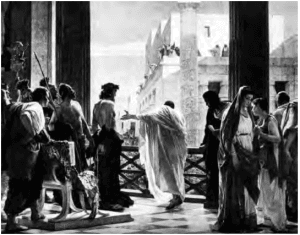
In the hands of the Jews Jesus was accused by false witnesses, condemned to death, spit upon, buffeted, slapped and mocked. The next morning he was bound and delivered over to Pontius Pilate, the Roman governor. The reason for this was that under Roman rule, the Jews were not permitted to carry out an execution. This must be done by the Roman authorities. The Jews now told Pilate that they had tried Jesus and found him guilty of blasphemy; they requested that he carry out the sentence of death. Pilate tried to question Jesus about it but Jesus would not defend himself. This pleased the Jews.
He seemed to be playing right into their hands. Pilate was not much impressed by religious disputes and found no fault in Jesus. The record says: “For he knew that for envy they had delivered him.” (Matthew 27:18) He wanted to release Jesus. The Jews had foreseen such a possibility and had organized a mob of loud and violent men who now made a great noise shouting: “Crucify him; let him be crucified.” The Jewish mob prevailed and Jesus was led away by Roman soldiers to be crucified.
Even when Jesus hung on the cross, they would not let him alone! The record says:
“Likewise also the chief priests, mocking him, with the scribes and elders said: He saved others, himself he cannot save. If he be King of Israel, let him now come down from the cross, and we will believe him. He trusted in God; let Him deliver him now, if he will have him; for he said, I am the Son of God.” Matthew 27:41-43
“If he will have him,” they said! This was open defiance and an insult to God because they well knew Jesus was from God. God showed his displeasure. We read: “And, behold, the vail of the temple was rent in twain, from the top to the bottom.” This vail of the temple was 60 feet long, 30 feet wide and six inches thick. God showed his contempt by ripping it from top to bottom. These wicked men observed the death of Jesus with pleasure. “Now we are rid of him for ever,” they probably said among themselves. Jesus truly “came unto his own, and his own received him not.” Then the chief priests and Pharisees went even further in their defiance. They requested of Pilate that Jesus’ tomb be sealed, and Roman guards be assigned to watch it. If they thus hoped to prevent Jesus’ resurrection, how puny and ineffective their efforts were!
The guards were probably napping that Sunday morning and the sharp earthquake awoke them with a start. They saw the mighty angel descend, whose face was like lightning, coming straight at them! Have you ever been near when lightning has struck? I have. The light is so bright that it blinds you temporarily. The brilliant flash of light and the sight of the angel descending was too much for even those tough Roman guards. The record says, “For fear of him the keepers did shake and became as dead men.” They fainted away. Too bad! Had they retained consciousness, they might have witnessed a most stupendous event. They may have seen the resurrection of Jesus Christ!
The Viewpoint of the Disciples
Let us look at these events from the viewpoint of the apostles and disciples of Jesus at that time. When Jesus began his ministry, he was in direct communication with his Heavenly Father. One of the first things the Heavenly Father did was to –indicate to Jesus just who were to be his apostles and disciples, the ones he had personally selected to be the companions of Jesus. This fact is clearly shown in Jesus’ prayer just before his betrayal. He said:
“I have manifested thy name unto the men which thou gavest me out of the world; thine they were, and thou gavest them me.” John 17:6 When we read that Jesus saw certain men and said “Follow me,” this does not imply a haphazard, spur-of-the-moment selection. No! the Heavenly Father had indicated to Jesus the exact individuals. God had previously prepared their minds because when they were invited by Jesus to follow him, they promptly dropped everything and followed him. They were very special people, although in the eyes of the world they were ignorant, rough and uncultured, what we would today call “of the lower strata of society.” But in the eyes of Jesus, these men were true nobility! They were potential kings! This is proved by what he said in Matthew:
“Then answered Peter and said unto him: Behold we have forsaken all and followed thee. What shall we have therefore? And Jesus said unto them, Verily I say unto you that ye which have followed me, in the regeneration, when the Son of man shall sit in the throne of his glory, ye also shall sit upon 12 thrones, judging the 12 tribes of Israel. And every one that hath forsaken houses, or brethren, or sisters, or father, or mother, or wife, or children, or lands, for my name’s sake, shall receive an hundredfold, and shall inherit everlasting life.” Matthew 19:27-29
The Apostles Loved Their Master
These whom the Father had drawn loved Jesus and were his constant companions. They ministered to his material needs. They were at his side when he healed the multitudes, preached the gospel of the kingdom to them, and spoke to them in parables. They loved it most of all when later he withdrew to the mountain or wilderness where they could be alone with him, sit at his feet, commune with him on a more personal basis, hear the interpretations of the parables he had given to the multitudes, and absorb the unfailing strength, assurance, and love which flowed from him.
Of course they made many blunders. Jesus had to rebuke them on several occasions. For example, they tried to forbid the little children to come to Jesus. On another occasion they wanted the right to sit one on his right hand and another on his left in his kingdom. Once they wanted to call fire from heaven and destroy an inhospitable village. Whenever Jesus rebuked them, he did it patiently and gently, using each occasion to teach them valuable lessons.
Jesus was particularly pleased when, in answer to his question “Whom say ye that I am?” Peter answered, “Thou art the Christ, the Son of the living God.” (Matthew 16:16) Then we read:
“From that time forth began Jesus to show unto his disciples how he must go unto Jerusalem, and suffer many things of the elders, and chief priests, and scribes, and be killed, and be raised again the third day.” Matthew 16:21
I don’t think we can blame the warm and impulsive Peter too much for saying to Jesus, “Be it far from thee, Lord; this shall not be unto thee.” They had learned to depend upon him so much. They were like sheep and Jesus was their shepherd. They could not think of carrying on without him. What can sheep do without a shepherd? They would be lost without him. But Jesus was preparing their minds for future events. He kept telling them that he was going to leave them but they did not understand; they did not understand because they did not want to understand. It was something they did not want to happen so they pushed the thought from their minds. But Jesus kept on telling them; he did not want them to be taken entirely by surprise. When Mary of Bethany poured the very precious ointment upon him, Jesus said, “In that she hath poured this ointment on my body, she did it for my burial.”
After the passover supper we read:
“And when they had sung an hymn they went out into the mount of olives. Then saith Jesus unto them: All ye shall be offended [or stumble] because of me this night; for it is written, I will smite the shepherd, and the sheep of the flock will be scattered abroad. But after I am risen again, I will go before you into Galilee.” Matthew 26:30-32
In a few hours it happened. As his disciples slept Jesus endured the anguish of Gethsemane alone. Then came Judas leading the armed multitude of officers from the chief priests and elders. Although Jesus was betrayed and arrested, they did not really take him. That armed multitude was not big enough to take him by force. No! He gave himself into their hands, saying:
“Dost thou think that I cannot entreat my Father, and he will send to my relief more than twelve legions of angels?” Matthew 26:53, Diaglott
Smitten Shepherd–Scattered Sheep
Then we read one of the most tragic sentences in the Bible: “Then all the disciples forsook him and fled.” (Matthew 26:56) They did not really want to. This was their beloved Master whom they loved with all their hearts. They really meant to be loyal. Peter had said to Jesus just a few hours before, “Though all men shall be offended [or stumble] because of thee, yet will I never be offended.” Peter really meant it with all his heart but the poor, weak, flesh prevailed. They fled! Jesus understood completely. The prophecy: “I will smite the shepherd, and the sheep of the flock shall be scattered abroad,” was fulfilled. Jesus endured the ordeal that followed ALONE. I have often thought, “What a pity it was two thieves who were crucified with Jesus; it might have been two disciples faithful to the last!
The bravest of the disciples were the women. They watched from a distance as their Lord was crucified. They watched him die. They saw his side pierced. They waited and watched as his body was taken down from the cross. They followed at a distance to see where it would be laid. Then they went home and prepared spices and ointments for the body of Jesus. Now we read from Luke:
“Now upon the first day of the week, very early in the morning, they came unto the sepulchre, bringing the spices which they had prepared, and certain others with them. And they found the stone rolled away from the sepulchre. And they entered in, and found not the body of the Lord Jesus. And it came to pass, as they were much perplexed thereabout, behold, two men stood by them in shining garments. And as they were afraid, and bowed down their faces to the earth, they said unto them, Why seek ye the living amongst the dead? He is not here, but is risen. Remember how he spake unto you when he was yet in Galilee, saying, The Son of man must be delivered into the hands of sinful men, and be crucified, and the third day rise again? And they remembered his words, and returned from the sepulchre, and told all these things unto the eleven, and to all the rest. It was Mary Magdalene, and Joanna, and Mary the mother of James, and other women that were with them, which told these things unto the apostles; and their words seemed to them as idle tales, and they believed them not. Then arose Peter, and ran unto the sepulchre; and, stooping down, he beheld the linen clothes laid by themselves, and departed, wondering in himself at that which was come to pass.” Luke 24:1-12
Yes, they “wondered in themselves.” Their hopes had been built up for 3 1/2 years, high hopes of a restored kingdom of Israel with Jesus as king and they themselves reigning with him. Now these hopes had been dashed to the ground.
They were in this frame of mind when two of the disciples decided to walk from Jerusalem to a village called Emmaus. Emmaus means “hot springs” and is about eight miles from Jerusalem. One of these disciples was Cleopas, the other is thought to have been Peter. They probably wanted to get away from the hustle and bustle of the city to a quiet place where they could talk, think, and perhaps understand. Their hearts were heavy and as they walked the record says: “They talked together of all these things which had happened,” and “they communed together and reasoned.” (Luke 24:15) In other words, they tried to make sense out of the situation, but had difficulty doing so.
Jesus joined them on the road in a form they did not recognize. “And he said unto them, what manner of communications are these that ye have one to another, as ye walk and are sad?” They must have sensed a sympathetic understanding in this stranger because they poured out what was in their hearts. They told him how their beloved Master whom they described as “a prophet, mighty in deed and word before God, and all the people,” had been delivered up by the chief priests, condemned to death and crucified; how all their high hopes had been shattered. Then they added wistfully, “But we trusted that it had been he which should have redeemed Israel!” Then we read that Jesus said unto them:
“O foolish and slow of heart to believe all that the prophets have spoken. Ought not Christ to have suffered these things and to enter into his glory? And, beginning at Moses, and all the prophets, he expounded unto them in all the scriptures the things concerning himself.” Luke 24:25-27
What a feast it was for their souls, what a balm for their hearts, torn by grief and confusion! What a thrill, what an exaltation of spirit to see everything fall perfectly into place as he talked, to see the reason for it all and to know it was the truth! Confusion and doubt dissolved and the mystery of recent events became an open book. As they said later after Jesus had manifested himself to them and departed:
“Did not our hearts burn within us while he talked with us by the way, and while he opened to us the scriptures?”
These were the things Jesus had not told them before because as Jesus said, “Ye can not bear them now.” When Jesus was with them, his disciples looked for him to set up an immediate earthly government to supplant Roman rule. They stubbornly held to this idea and closed their minds to any other. When Jesus told them of his im pending suffering and death they said, “Be it far from thee Lord; this shall not be unto thee.” They simply refused to believe it. Things were going too well for them then. Now it was different. Jesus had indeed suffered, he had indeed died. They had to face this grim reality. As a plow rips deep into the hard subsoil to soften it and prepare it to receive and nurture the seed, so their hearts had been bruised, torn, humbled, and made ready for what was now “meat in due season” for them.
What did he tell them as he walked with them to Emmaus?
“Beginning at Moses, and all the prophets, he expounded unto them in all the scriptures the things concerning himself.”
These were the “many things” he had to say to them which they could not “bear” before. But they could bear them now! Now it really made an impression, now it was “meat in due season.” It gave them a KEY to the scriptures.
They learned their lesson well. They remembered . After the holy Spirit was given at Pentecost Peter preached to the multitude. We read in Acts the third chapter that he said: “Those things which God –before had showed by the mouth of all his prophets, that Christ should suffer.” Then he pointed to the future, saying:
“When the times of refreshing shall come from the presence of the Lord; and he shall send Jesus Christ, which before was preached unto you, whom the heavens must retain until the times of restitution of all things, which God hath spoken by the mouth of all his holy prophets since the world began.” Acts 3:18-21
We are now in those “times.” This was what Jesus had revealed to them on the way to Emmaus!
The Viewpoint of Today’s Disciples
Let us consider the significance of these events to us the harvest Church at this end of the age. We are in the most favored position in the history of God’s people because we have the truth at this end of the age. We have a more clear and brilliant view of the Divine Plan of the Ages than all the men of God in the past. They saw dimly and prophetically; we see clearly and unmistakably. We see it actually unfold. We have more light than Moses and all the prophets. We know more about the significance of Daniel’s prophecy than Daniel did himself. He earnestly desired to see then, but was told to “Shut up the words, and seal the book, even to the time of the end.” (Daniel 12:4) We are in this “time of the end.” Speaking of this glorious plan of redemption which is now so clear to us, Peter confirms that the prophets wrote for our benefit and did not fully comprehend their own words. Not even the angels then understood as clearly as we do now! He says:
“Of which salvation the prophets have inquired, and searched diligently; who prophesied of the grace that should come unto you; searching what or what manner of time the Spirit of Christ which was in them did signify; when it testified beforehand the sufferings of Christ, and the glory that should follow; unto whom it was revealed that not unto themselves, but unto us they did minister the things which are now reported unto you by them that have preached the gospel unto you with the Holy Spirit sent down from heaven;
WHICH THINGS THE ANGELS DESIRE TO LOOK INTO.” 1 Peter 1:10-12
The Diaglott makes it even stronger: “Into which things angels earnestly desire to look.” I wonder, sometimes, if we fully appreciate this grand privilege, which is ours.
Our Grand Privilege
Let us not forget how this enlightenment came about. It came about quite suddenly, relatively speaking. After the apostles fell asleep in death, the truth gradually became obscured until “darkness covered the earth, and gross darkness the people” in the Dark Ages. Faithful Christians, seeking to walk in the way of the Lord, were confused and distraught, just like those disciples on the way to Emmaus. Then at the end of the age the Lord returned as he had promised, and a great enlightenment occurred. Through the instrumentality of a Faithful and Wise Servant, Bro. Russell, the Lord joined those in the way and spoke to them. Once again beginning at Moses and all the prophets he expounded unto them all the scriptures. Once again the hearts of these modern disciples burned and glowed as the treasures of the scriptures were opened to them. EVERYTHING FELL PERFECTLY INTO PLACE! As Jesus’ words were “meat in due season” for those who walked with him to Emmaus so long ago, those who now sought to walk in his footsteps were supplied the same abundant and soul-satisfying “meat in due season” by our returned Lord.
To us the Gospel Church, the death and resurrection of Jesus are of vital importance. They are the foundation of our most holy faith. Without the death of Jesus there would be no ransom; the fate of mankind would be hopeless. Without the resurrection of Jesus, the ransom could not be implemented. There could have been no gospel message of hope of divine favor through a dead Savior. If Christ had not risen from the dead, who could have established the Millennial Kingdom? Who could have given the church a share in the first resurrection and heavenly glory? Who could call forth from the tomb the sleeping thousands of millions of Adam’s race, awakening them to the opportunities of life everlasting?
This is what the apostle calls forcibly and beautifully to our minds when he says:
“And if Christ be not risen, then is our preaching vain, and your faith is also vain. Yea, and we are found false witnesses of God; because we have testified of God that he raised up Christ; whom he raised not up, if so be that the dead rise not. For if the dead rise not, then is not Christ raised; and if Christ be not raised, your faith is vain; ye are yet in your sins. Then they also which are fallen asleep in Christ are perished. If in this life only we have hope in Christ we are of all men most miserable. But now is Christ risen from the dead, and become the first-fruits of them that slept. For since by man came death, by man came also the resurrection of the dead. For as in Adam all die, even so in Christ shall all be made alive. But every man in his own order. Christ the first-fruits; afterward they that are Christ’s at his coming. Then cometh the end, when he shall have delivered up the kingdom to God, even the Father; when he shall have put down all rule and all authority and power. For he must reign till he hath put all enemies under his feet. The last enemy that shall be destroyed is death.” 1 Corinthians 15:14-26
Yes, we of the Gospel Church have a deep and personal interest in the resurrection of Jesus Christ from the dead. Our eternal destiny rests upon it. Our every hope of a future life is based upon it. As Peter expresses it:
“Blessed be the God and Father of our Lord Jesus Christ, who, according to his abundant mercy, hath begotten us again unto a living hope, by the resurrection of Jesus Christ from the dead; to an inheritance incorruptible, and undefiled, and that fadeth not away, reserved in heaven for you.” 1 Peter 1:3,4
The Viewpoint of God
How can we possibly know something of God’s viewpoint of these events? How can we know the mind of God? Perhaps through reasoning we can have some insight. We humans are created in the image and likeness of God. This means that we have the same basic sensibilities that He has, that we are capable of being moved by the same emotions, except that God’s sensibilities are on a vastly higher scale and more refined than ours. This includes his compassion and mercy. He feels things more keenly than we do. He says:
“As the heavens are higher than the earth, so are my ways higher than your ways, and my thoughts than your thoughts.” Isaiah 55:9
Considering these facts, we begin to appreciate how God viewed these events.
If any of you had a beloved son who was treated as Jesus was treated by his enemies, could you be complacent about it? Could you remain unmoved? So how do you suppose God felt when His beloved and only begotten Son was spit upon, beaten with fists, slapped, cursed, bound, stripped, scourged, crowned with thorns, mocked, hit on the head with a stick, and then nailed through his hands and feet, alive, to a cross? Then, after all this, the necessity of turning his face from his son, for a moment seeming to forsake him, and hearing his tragic cry: “My God, my God, why has thou forsaken me?” Do you think God was unmoved by these things? I don’t think so! I think God was deeply moved. I think it HURT God! Perhaps for the three days that Jesus was dead God even felt a certain loneliness. Wouldn’t you?
On that Sunday morning when his son rose triumphantly from the grave, I am sure God felt the same joy as the angels felt, as we feel, only more intensely.
Let us not forget that God created angels and men for his own pleasure. He did not need them. He is all-sufficient and selfsufficient. He created them because of the JOY he had in them; in seeing them happy! We know this because it is written of the Logos that he was God’s delight.
Through the death and resurrection of Jesus Christ, it is God’s joy and delight to have 144,000 joint-heirs with Christ and a race of perfect human creatures to love Him throughout eternity.
The Deliverance of Peter
“The angel of the LORD encampeth round about them that fear [reverence] him, and delivereth them.” Psalm 34:7
WE HAVE taken our lesson today from an event in the experience of the early church, about twelve years after our Lord’s crucifixion. The story is related in the 12th chapter of Acts, where we read in verses 1 to 3: “Now about that time, Herod the King stretched forth his hands to vex certain of the church. And he killed James, the brother of John, with the sword. And, because he saw it pleased the Jews, he proceeded further to take Peter also.”
In order to fully understand what is happening here, let us consider some background. Who was this Herod the king? Herod was a family name. There were several kings by this name that Rome had set over Israel. First, there was Herod the Great, who ruled about the time of our Lord’s birth, and who murdered the babes in Bethlehem. Next there was his son, Herod Archelaus, who ruled briefly. He was succeeded by another son of Herod the Great, the infamous Herod Antipas, who murdered John the Baptist and whose soldiers mocked Jesus just before his crucifixion. Then came the Herod of our lesson, Herod Agrippa the First, grandson of Herod the Great. It was he who beheaded the apostle James.
This Herod was not a Jew, but an Edo–mite, a descendant of Esau. He pandered to Claudius Caesar, the –Emperor of Rome, who gave him the rulership of Judea. Although he had no real interest in Israel, he professed an intense devotion to their religion, as a matter of policy. History says of him:
“He curried favor with the Jews in every way. He hung in the Temple, as a votive offering, the gold chain which the Emperor had given him. He lived in Jerusalem, and punctiliously observed the tradition of the fathers. He thus secured the fervent loyalty of the Pharisees.”
Instead of merely tolerating this Herod because he had been imposed upon them by Rome, the Jews, led by the Pharisees, heartily approved of him as their king, and fully accepted him as such. This was contrary to their law, which stipulated that none but an Israelite should be recognized as a king over Israel. Thus we read, in Deuteronomy 17:14,15 (Leeser):
“When thou sayest, I wish to set a king over me, like all the nations that are round about me; then thou mayest indeed set a king over thee, [but] the one whom the LORD thy God will choose. From the midst of thy brethren shalt thou set a king over thee. Thou mayest not set over thee a stranger, who is not thy brother.”
The Jews had been guilty of violating this law not long before the time of our lesson, as recorded in John 19:14, 15. On that occasion Pilate brought Jesus before them, and said:
“Behold your King! But they cried out, Away with him, away with him! Crucify him! Pilate saith unto them, Shall I crucify your king?
The chief priests answered, We have no king but Caesar.” Thus they acknowledged Caesar, a Gentile stranger, their king, contrary to their law.
Herod Agrippa knew about this provision of the Jewish law and it made him uneasy because he was a stranger an Edomite; so he did some clever stage-acting. History reports:
“At the Feast of Tabernacles, in AD 41, he took the reader’s stand, and read the whole book of Deuteronomy aloud, bursting into theatrical tears, as if quite overcome, when he reached the words: thou mayest not set over thee a stranger, who is not thy brother; whereupon the Jews cried out, Do not weep, Agrippa, thou art our brother.”
Do you see what a crafty and unprincipled hypocrite Herod Agrippa was? Now we can better understand his attacks on the early church. The Jews were in violent opposition to the Christians, and he was determined to please the Jews at all cost. So “he killed James . . . and because he saw it pleased the Jews, he proceeded to take Peter also.”
The murder of James was a great shock to the Church. He was one of the three who usually accompanied our Lord in the most confidential capacity. With his brother John and Peter, he was with the Lord in the Mount of Transfiguration. Also, together with John and Peter, he was present at the awakening of Jairus’ daughter. In the same company, he was one of the inner circle of the Lord’s friends during the agony of Gethsemane. It was he and his brother whom our Lord surnamed Boanerges, “Sons of Thunder,” because of their eloquence and forcefulness of speech. It was he and his brother, whose mother entreated the Lord that they might sit, “The one on his right hand, and the other on his left, in the kingdom.” On that occasion Jesus asked them, “Are ye able to drink of the cup that I shall drink of?” They answered, “We are able.” Jesus replied, “Ye shall indeed drink of my cup.” He must have said this with a certain sorrow because he undoubtedly foresaw what would shortly happen to James. Yes, it was not long after this that James did indeed drink of the cup of death at Herod’s hands