
The Gospel Age Harvest Under Brother Russell’s Ministry
THERE are many references to the Gospel Age Harvest in the Bible, but the most concise and connected one is the parable of the wheat and the tares, given by Jesus:
“Another parable put he forth unto them, saying, The kingdom of heaven is likened unto a man which sowed good seed in his field. But while men slept, his enemy came and sowed tares among the wheat, and went his way. But when the blade was sprung up, and brought forth fruit, then appeared the tares also. So the servants of the householder came and said unto him, Sir, didst not thou sow good seed in thy field? From whence then hath it tares? He said unto them, An enemy hath done this. The servants said unto him, Wilt thou then that we go and gather them up? But he said, Nay; lest while ye gather up the tares, ye root up also the wheat with them. Let both grow together until the harvest and in the time of the harvest I will say to the reapers, Gather ye together first the tares, and bind them in bundles to burn them; but gather the wheat into my barn.
Then Jesus sent the multitude away, and went into the house; and his disciples came unto him, saying, Declare unto us the parable of the tares of the field. He answered and said unto them, He that soweth the good seed is the Son of man. The field is the world. The good seed are the children of the kingdom; but the tares are the children of the wicked one. The enemy that sowed them is the devil. The harvest is the end of the age; and the reapers are the angels [or messengers].”–Matthew 13:24-30,36-39
Let us briefly consider the parable in the light of transpired events which we know to be facts. The good seed was sown by the son of man, Jesus, at his first advent. It was the gospel of the kingdom which he preached. It was the Divine Plan of the Ages, the faith once delivered to the saints, the opening of the scriptures on the way to Emmaus, the enlightenment at Pentecost. It was what we would today call The Truth. This is the seed that produced the true church, the children of the kingdom, the body of Christ, the wheat class of the parable.
This truth of the high calling, the great salvation, was first spoken by the son of man, our Lord:
“How shall we escape, if we neglect so great salvation; which at the first began to be spoken by the Lord and was confirmed unto us by them that heard him.” Hebrews 2:3
Thus was the good seed sown, and the early Church established.
Then we read that “while men slept,” an enemy, which Jesus identified as the devil, sowed tares in the field. Within a few generations after the apostles fell asleep in death, Satan began the sowing of the tare seeds. He gradually and subtly introduced new and strange ideas into the church. One by one all the beautiful and harmonious doctrines of the Divine Plan so familiar to the early church were subverted, transposed, twisted and corrupted. With each substitution of error for truth, the light became dimmer and dimmer until darkness covered the earth and gross darkness the people. (Isaiah 60:2)
The tare seeds sprouted, flourished, and produced a wonderful crop of imitation wheat; a counterfeit kingdom of God was established that was great and powerful. As always happens when Satan has his way, terror and frightfulness held sway. The Bible was suppressed, the name of God was dishonored and degraded by the doctrines of demons ascribed to him and by the horrors committed in his name.
This was the period we call “the dark ages.”
It would seem that Satan had completely triumphed. There was still wheat in the field there always has been; but the true wheat were so completely surrounded and obscured by the lush crop of tares as to be scarcely noticeable. This condition lasted for many centuries.
We will not go into detail regarding the great reformation, the timely invention of the art of printing, the gradual emerging of the Bible from the obscurity of dead languages, and the ever increasing understanding of it.
In due course in 1799 “the time of the end” arrived, in fulfillment of Daniel’s prophecy (Daniel 11), and “the end of the age” approached, when Christ should return. These were times of great expectations among students of the Bible.
Just as some had been in expectation of Jesus before his first advent, it came to pass that in 1844 some students of Bible chronology, called Second Adventists, had expectations of his second advent. But they had a wrong conception of it. They expected that, in 1873 or 1874, Christ would return, visibly and in the flesh, whereupon the world, and all but Second Adventists would be burned up Editor’s Note: The expectation regarding 1874 was held by a small group within the Adventist movements. In the 1860s the Advent Christian segment was more numerous than the Seventh Day Adventists who stopped setting dates in 1844. Some Advent Christians did continue setting dates during the 1850s and 1860s. According to one Seventh Day Adventist source there was a group identified as the 1873 time movement who were expecting the visible return of Christ about 1873. N. H. Barbour may have had some part in that. His book titled “The Lord’s Coming in 1873” was published in 1871.
Now let us see what events the Lord was shaping behind the scenes. On February 16, 1852, there was born of consecrated parents a boy named Charles Taze Russell. He was destined for great things. He was without a doubt, as is said of the apostle Paul in Galatians 1:15, set apart from his very birth, by the Lord’s grace. He was destined to become the honored servant of the Lord through whom would be restored to the church “the faith once delivered to the saints” (Jude 3), the truth in its purity, and upon whose shoulders would be placed the responsibility to initiate the harvest of the Gospel Age and direct its work for 42 years.
Like the boy Jesus, who sought to be about his Father’s business at 12 years of age, young Charles T. Russell consecrated very early in life. We learn from his autobiography in Reprints page 3820 that in the year 1868, when he was only 16 years of age, he had already been a consecrated child of God for some years! This would place the time of his consecration at about 12 years of age.
He early recognized the falsity of the creeds of Christendom as being contrary to reason and to the loving character of God; for awhile his faith wavered. He then re-examined the Bible and realized that the creeds were not a true representation of its teachings. Under the Lord’s guidance, he was placed in contact with Adventists and, for awhile, studied with them. Of this period he writes, in his autobiography:
“I soon began to see that we were living somewhere near the close of the Gospel Age, and near the time when the Lord had declared that the wise, watching ones of his children should come to a clear knowledge of his plan. At this time, myself and a few other truth seekers in Pittsburgh and Allegheny, formed a class for Bible study; and from 1870 to 1875 was a time of constant growth in grace, and knowledge, and love of God and his Word.”
He was only 18 years old when he formed and led this class of Bible Students! While studying with this class in 1872, exactly 6,000 years from the creation of Adam, the philosophy of the ransom for all and the resulting restitution of all things was revealed to him in all its clarity.
Then young Russell realized that the chronology of the Adventists, showing that the Lord would return in 1874, might be correct. But he also saw that Christ’s revealment in the flesh, and the anticipated burning up of the world, was incorrect. Accordingly, in 1872, he wrote a pamphlet entitled “The Object and Manner of the Lord’s Return,” and circulated 50,000 copies of it. This was certainly “meat in due season.”
Now I will read a scripture and let you judge whether or not it fits the case exactly:
“Who then is the faithful and wise servant, whom his Lord hath made ruler over his household, to give them meat in due season? Blessed is that servant, whom his Lord when he cometh, shall find so doing. Verily I say unto you, that he shall make him ruler over all his goods.” Matthew 24:45-47
Could it possibly have been anyone else that was here referred to?
After making a thorough review of the time prophecies and minutely examining all the evidence, by 1876 Brother Russell was fully convinced of the Lord’s invisible presence since 1874, and that it was then that the harvest of the Gospel Age had begun.
This gave him the greatest thrill of his life. He writes of this time:
“The evidence satisfied me. Being a person of positive convictions, and fully consecrated to the Lord, I at once saw that the special times in which we live have an important bearing upon our duty and work as Christ’s disciples; that, being in the time of harvest, the harvest work should be done; and that present truth was the sickle by which the Lord would have us do a gathering and reaping work everywhere among his children. … The knowledge of the fact that we were already in the harvest period gave me an impetus to spread the truth such as I never had before. I therefore at once resolved upon a vigorous campaign for the truth. I determined to curtail my business cares, and give my time, as well as means, to the great harvest work.”
The returned Lord had found a devoted and enthusiastic servant ready, able and willing to do what was required, at the time it must be done. Thus began the Gospel Age harvest under Brother Russell’s ministry. He was 24 years old!
Brother Russell knew that it had been written that at the time of the harvest, “Judgment must begin at the house of God.” (1 Peter 4:17) Being a person of prompt and direct action, he called a meeting of all the ministers of Allegheny and Pittsburgh among whom were some very prominent clergymen. Astonishingly they all came to the meeting! Do you know of any young man of 25 today who could successfully call a meeting of all the ministers of this city?
This gives us an insight into the force of his personality. The holy spirit gave him an earnestness and fervency that was difficult to resist. He was like another young man named Stephen of whom it is written that “they were not able to resist the wisdom and the spirit by which he spake.” (Acts 6:10)
Brother Russell showed the assembled ministers the scriptures that indicated our Lord’s presence, and urged them to investigate and proclaim the message. But every one of them refused to believe it. This did not discourage Bro. Russell. On the contrary, he realized that since it was his mind that the Lord had enlightened with this great dispensational truth, it was his responsibility to pursue the work of the harvest.
Realizing that he had been called to a special service, he recognized and applied to himself and his co-workers these words of the Lord:
“Gather the wheat into my barn.” Matthew 13:30
“Gather my saints together unto me; those that have made a covenant with me by sacrifice.” Psalms 50:5
“And he shall send his angels [messengers] with a great trumpet [the Jubilee trumpet]; and they shall gather together his elect from the four winds, from one end of heaven [the ecclesiastical heaven] to the other.” Matthew 24:31
He resolved to vigorously proclaim to those captive in Babylon the command to.. .
“Come out of her, my people, that ye be not partakers of her sins, and that ye receive not of her plagues.” Revelation 18:4
He realized that Christ had returned as a crowned reaper:
“And I looked, and behold a white cloud, and upon the cloud one sat like unto the Son of man, having on his head a golden crown, and in his hand a sharp sickle. And another angel came out of the temple crying with a loud voice to him that sat on the cloud, thrust in thy sickle, and reap; for the time is come for thee to reap.” Revelation 14:14,15
He recognized that since 1874 Christ was present as King. He knew from Acts 3:21 and other scriptures that because Christ had returned, the “times of restitution” had commenced, that he was then living in the seventh thousand year period of man’s history, that the Grand Jubilee, the great millennium of God’s kingdom on earth had actually started. In this same year, 1877, Brother Rus sell gave up all his secular work to devote his entire time and fortune to the harvest work. His fortune was considerable, amounting to about $350,000 which he had accumulated as a successful merchant. In those days this was an enormous sum. Over the years, he devoted every penny of it to the work.
In July, 1879, Brother Russell at the age of 27 began to publish a journal called “Zion’s Watch Tower and Herald of Christ’s Presence.” He thus placed on record his realization that the Lord’s second presence was the very foundation of the truth movement. In his opening remarks of that first issue, he gave the first object of its publication as follows:
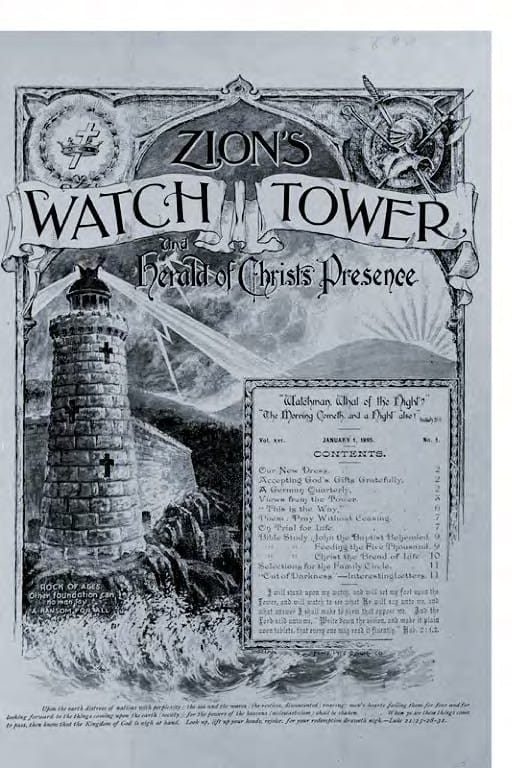
“That we are living `in the last days’ `the day of the Lord’ `the end’ of the Gospel Age, and consequently, in the dawn of the `new’ age are facts not only discernable by the close student of the Word, led by the Spirit, but the outward sins recognizable by the world bear the same testimony; and we are desirous that the `household of faith’ be fully awake to the fact that . . `We are living, we are dwelling In a grand and awful time;
In an age on ages telling; To be living is sublime.’
It is also significant that the first article of that first issue was on the subject of our Lord’s second advent.
Brother Russell pursued the harvest work with great energy and enthusiasm. In 1881 he wrote a pamphlet entitled “Food for Thinking Christians,” and determined to circulate it on three consecutive Sundays to the congregations of all the protestant churches in the United States, Canada, and Great Britain. Do you realize the magnitude of this venture? There was only a small handful of brethren cooperating with him in the harvest work at that time, but the job was done on schedule. He printed 1,400,000 copies and hired telegraph messengers to hand them out, on the appointed Sundays, at church doors. This one grand witness cost him $40,000, but it was only money.
From a small beginning, the harvest work grew rapidly and was abundantly blessed by the Lord. During his ministry Brother Russell traveled over a million miles all over the world, and this was before the advent of air travel. He delivered 30,000 sermons many of them three hours long. He wrote over 50,000 pages of Bible teachings including six volumes of “Studies in the Scriptures,” “Tabernacle Shadows,” Tower articles, booklets, and newspaper columns. These writings constituted the harvest message. These were circulated by the millions of copies in many languages throughout the entire world. He produced over 200 tracts, some of which attained a circulation of over 50 million copies. He wrote about a thousand letters a month. Is it any wonder he is referred to as “the man which had the ink-horn by his side”? (Ezekiel 9:2,11) One of my favorite pictures of Pastor Russell shows him at his writing desk with a fountain pen in his hand.
He knew he was that “man.” An incident during the early days at Allegheny demonstrated this. An open Bible was to be painted on one of the large front windows of the office. A sign painter not in the truth was hired to do the job. Without instruction from anyone and entirely on his own volition, he painted the Bible open to Ezekiel chapter 9, telling of the man clothed with linen with the writer’s ink-horn. When Bro. Russell looked at the finished painting, he turned pale. He recognized it for what it was: a sign from the Lord.
As the work progressed under Brother Russell’s direction, there were usually about seventy well-qualified pilgrims on the road, each giving two or more talks a day. In addition there were about 700 part-time pilgrims devoting their weekends to the service. But the branch of the harvest work nearest Brother Russell’s heart was the colporteur service participated in by an army of 800 devoted, self-sacrificing workers. Much of the success of the harvest work in those days was due to the colporteurs.
In those days, before the advent of radio and television broadcasting, the most effective medium of publicity was through newspapers, and magazines. Brother Rus sell felt it was a duty to take advantage of this, and he wrote “sermons” which were syndicated and appeared in about 4,000 newspapers and magazines, as many as 2,000 at one time. It is estimated that he thus preached to about 15 to 20 million people weekly. That was quite an audience. An editor of that day wrote: “Pastor Russell’s writings are said to have a greater newspaper circulation every week than those of any other living man.”
There is an interesting anecdote in this connection. We know Brother Russell never took collections nor solicited funds. It had always been a mystery to outsiders where he got the money to carry on a religious campaign of such colossal proportions. So when a young brother called upon a newspaper editor regarding the syndicated sermons, the editor leaned over and asked the question that perplexed everybody: “Tell me, where does the money come from?” The young brother, innocently and quite truthfully, replied: “Oh, his Father is very rich.” The secret was out! The editor felt he had the scoop of the season. The paper carried it the next day: His Father Is Rich! How true.
Toward the end of his ministry, in the year 1914 which was the 40th year of the harvest, the “Photo Drama of Creation” was presented to the public. Many felt that this was the most wonderful feature of the harvest work. A brother who was active in the work at that time writes:
“The moving pictures alone were the grandest, most beautiful, as well as the most instructive, of anything ever seen, before or since on the cinema screen. People looked upon these in wonderment. The colorings, to say nothing of the marvels in production, were superb; and all of it was done by consecrated talent. While the pictures [moving and slides] were the acme of beauty and charm, and correspondingly entertaining and instructive, I believe the most marvelous part of the whole drama was the lectures on the phonograph. Herein the supreme achievement of the whole endeavor stands out. Brother Russell was recognized as a master of simple, pure, expressive, constructive English, always; but taking these lectures as a whole, they are marvels of conciseness and comprehensiveness. Only a great master could ever have produced such results.”
This was done in the era of silent pictures, long before color movies were introduced. At the height of this activity, “The Drama” was shown in 80 cities a day. In a short time, eight million people in the United States and Canada had heard and seen a glorious message from the word of God and in such an impressive way that they would never forget it for the rest of their lives. It was also shown in Great Britain and many European countries.