
The Lord Is My Shepherd
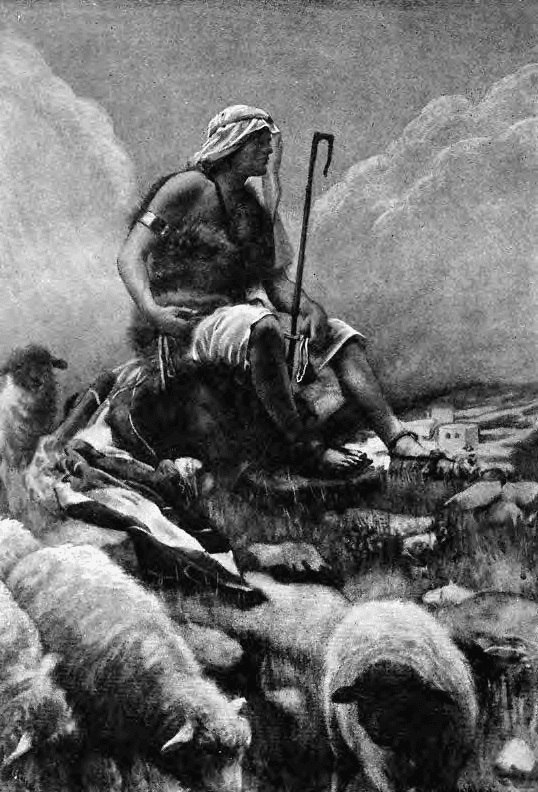
David’s original reference was, of course, to Jehovah God, the Father. Isaiah similarly refers to Jehovah God:
“He shall feed his flock like a shepherd; he shall gather the lambs with his arm, and carry them in his bosom, and shall gently lead those that are with young.” Isaiah 40:11
Ezekiel reveals that God would appoint another shepherd, an under-shepherd, over his flock:
“Therefore will I save my flock, and they shall no more be a prey … and I will set up one shepherd over them, and he shall feed them; even my servant David. And he shall feed them, and he shall be their shepherd.” Ezekiel 34:22-25
David is frequently used in the scriptures as a type of Christ, and he is so used here. This is confirmed by the words of Jesus, “I am the Good Shepherd. The Good Shepherd giveth his life for the sheep.” (John 10:11) By virtue of his ransom sacrifice, the Great Shepherd’s son, Jesus, has been given full charge of the sheep. Jesus continues:
“I am the Good Shepherd, and know my sheep, and am known of mine. As the Father knoweth me, even so know I the Father; and I lay down my life for the sheep.” John 10:14,15
When the psalm says, “The Lord is my shepherd,” we are entirely justified in understanding it to also mean our Lord Jesus Christ.
The night was a dangerous time for the sheep. It was then that predatory animals were about. Wolves and lions prowled in the darkness, waiting for an opportunity to snatch a lamb. So the shepherd kept vigilant watch at night. Consider the account of Jesus’ birth:
“And there were, in the same country, shepherds abiding in the fields, keeping watch over their flock by night.” Luke 2:8
The sheep could not always see the shepherd in the darkness, but they knew he was there watching; they felt completely secure. So with us. Just knowing that the Lord is our shepherd, that he is there watching over us in this dark night of sin and death, is such a comfort to us! This is what David described:
“He that keepeth thee, will not slumber. Behold, he that keepeth Israel shall neither slumber nor sleep. The Lord is thy keeper. The Lord shall preserve thee from all evil; he shall preserve thy soul.” Psalms 121:3-7
Sometimes a wind arose in the night and the sheep became restless from the strange sound. Then the shepherd spoke to them with his reassuring voice. When we hear the winds of strange doctrines arise, let us too hear the voice of our shepherd let us consider his word.
Instead of being frightened and “tossed to and fro, carried about with every wind of doctrine” (Ephesians 4:14), let us rest securely in the truth that we have.
“The sheep hear his voice; and he calleth his own sheep by name, and leadeth them out. And when he putteth forth his own sheep, he goeth before them, and the sheep follow him; for they know his voice. And a stranger will they not follow, but will flee from him; for they know not the voice of strangers.” John 10:3-5
I Shall Not Want
The thought is, “I shall have no lack.” This is literally true. The child of God shall not want for the temporal necessities of the present life, for light along his pathway, for instruction in the narrow way. He shall not want for care and discipline, for consolation and grace, nor for fellowship and sympathy. He shall not want for the holy spirit as he makes room in his heart to receive more and more of it. As David expressed it:
“No good thing will he withhold from them that walk uprightly.” Psalms 84:11
“No good thing!” What a stupendously bountiful promise! Paul echoed the same thought:
“But my God shall supply all your need, according to his riches in glory, by Christ Jesus.” Philippians 4:19
David had cared well for his flock. He had seen that while his sheep lacked nothing, the wild beasts of the field, who had no shepherd, often went hungry. He related this thought to the Lord’s provision for his people:
“O taste, and see that the Lord is good. Blessed is the man that trusteth in him. Oh fear the Lord, ye his saints; for there is no want to them that fear him. The young lions do lack, and suffer hunger; but they that seek the Lord shall not want any good thing!” Psalms 34:8-10
As David sometimes stumbled and yet clung to the Lord and his overruling providences, he was able to write out of the richness of his experience:
“The steps of a good man are ordered of the Lord; and he delighteth in his way. Though he fall, he shall not be utterly cast down; for the Lord up holdeth him with his hand. I have been young and now am old; Yet have I not seen the righteous forsaken, nor his seed begging bread.” Psalms 37:23-25
He Maketh Me to Lie Down in Green Pastures
The sheep is a ruminating animal. After grazing in the rich green pastures it must lie down and chew its cud. The shepherd encourages it to do so since it cannot properly digest its food unless it ruminates. The word “ruminate” also means to meditate. This emphasizes the importance of meditation in our lives. It is only in this way that spiritual food can be properly appropriated by us and become a part of our spiritual make-up, our characters, what we really are. There must be periods of pause, and quietness when we may turn our thoughts to our great heavenly Father, and his holy word, his great plan, and recount to ourselves all his leadings and providences in our lives. Thus we ascertain what his will is for us individually.
It has been said: “When we pray, we talk to God; when we meditate, God talks to us.” David said:
“O, how I love thy law! It is my meditation all the day.” Psalms 119:97
“My soul shall be satisfied as with marrow and fatness; and my mouth shall praise thee with joyful lips; when I remember thee upon my bed, and meditate on thee in the night watches.” Psalms 63:5,6
David meditated upon the Lord and his goodness at every opportunity: “all the day” and “in the night watches.” In other words, day and night. His meditations were acceptable to the Lord; God loved him for it. His prayer was answered:
“Let the words of my mouth, and the meditations of my heart, be acceptable in thy sight, O Lord, my rock and my redeemer.” Psalms 19:14
Let us consider some ways we can have our meditations acceptable in God’s sight and worthy of his love for us. When our eyes open in the morning, after a night’s sleep, we can think of the promise, “Weeping may endure for a night, but joy cometh in the morning.” (Psalms 30:5) We can be glad that we are alive and thankful for the measure of health we enjoy. These are gifts of God.
Perhaps we will think, “This is the day which the Lord hath made; we will rejoice, and be glad in it.” (Psalms 118:24) Should the sun stream through the window or the rain beat against it, we will meditate on the unfathomable mercies of God who: “Maketh his sun to rise on the evil, and on the good; and sendeth rain on the just and on the unjust.” (Matthew 5:45) Throughout the day we will meditate particularly on the day’s Manna text and its comments. The Lord has mightily used these for the benefit of his people. So many have testified that he has spoken to them, directed them, and touched their hearts, in this way.
The newspaper headlines of wars, will remind us of, “He maketh wars to cease unto the end of the earth; he breaketh the bow, and cutteth the spear in sunder; he burneth the chariot in the fire. Be still and know that I am God.” (Psalms 46:9,10) We will be still for a few moments and meditate on this sure promise of peace in the world.
When we read the reports of all the violence, cruelty, destruction and ignorance, we will long for the time prophesied: “Violence shall no more be heard in thy land.” (Isaiah 60:18) We will meditate on the wonderful Millennial promise: “They shall not hurt, nor destroy, in all my holy mountain; for the earth shall be full of the knowledge of the Lord, as the waters cover the sea.” (Isaiah 11:9)
If things seem to go wrong in our affairs and we experience disappointments in our earthly pursuits during the day, we will think of the words of Jesus: “In the world ye shall have tribulation; but be of good cheer; I have overcome the world.” (John 16:33) We will meditate upon the overruling providences of the Lord and recall the many times he has led us in the past, the many times when seeming calamities have turned out to be blessings for us. We will be reminded that this thing also will be for our good. So whether things go well for us or seem to go wrong, we will always, “Know that all things work together for good to them that love God; to them who are the called according to his purpose.” (Romans 8:28)
Every day of our lives, we will encounter or hear grief and pain. Loved ones snatched away by the great enemy death: babies from their mothers’ arms; husbands and wives, fathers and mothers; aged ones, leaning on one another, depending on one another suddenly parted by death; bringing sorrow and crying to the lonely survivor. How appropriate for us, who know the plan of God, who know the reason for it all, to close our eyes and meditate for a moment on that glorious day now near at hand, when, “God shall wipe away all tears from their eyes; and there shall be no more death, neither sorrow nor crying; neither shall there be any more pain; for the former things are passed away.” (Revelation 21:4)
Whenever we see the lame, the halt, and the blind; those with physical deformities and diseases which Jesus described as those “whom Satan hath bound” (Luke 13:16), we can fervently breathe the prayer, “Thy kingdom come!” knowing that this is the answer to all earth’s problems. Perhaps this will lead us to meditate upon the glorious prospect before us, that if we are faithful, we will have a part in the healing of the nations! Think of it! How often, when you have seen sickness, suffering, and deformity, have you longed to have the power to relieve it, to be able to say, “Take up thy bed and walk!”? You will have that power, if faithful, and much more than that: to grant not only physical healing and perfection, but life everlasting to the obedient. That is something to mediate over!
Of course we will not during every minute of every day think only of these things. Attention must be given to our earthly occupations in fulfilling our obligations to our employers or to the care of our families. But the mind of the new creature will so love the things of the Lord that, when it is not otherwise occupied, it will naturally and automatically, as the compass needle turns to the north, swing to godly meditations. This is what Paul meant when he wrote, “Bringing into captivity every thought to the obedience of Christ.” (2 Corinthians 10:5) “Every thought!” This is the antidote for the poisons of the world, the deadly, venomous concepts and ideas abroad in the earth. It’s a simple matter of displacement, really. If our minds are full of good things, there will be no room for unprofitable or evil things. Persistence in good meditations will bring about a change in us, a real change that will be noticed by people, that will show. As Paul said, “Meditate upon these things, give yourself wholly to them, that thy profiting may appear to all.” (1 Timothy 4:15)
When the day is over and it is time to rest, we are told:
“When thou liest down, thou shalt not be afraid. Yea, thou shalt lie down, and thy sleep shall be sweet.” Proverbs 3:24
“My meditation of him shall be sweet. I will be glad in the Lord.” Psalms 104:34
He Leadeth Me Beside the Still Waters Sheep will not drink from rapidly flowing or turbulent waters. Gurgling, noisy waterfalls and streams, with rushing cross-currents, frighten them. So the shepherd leads them to a place where a deep pool has formed, where the water is quiet, softly-flowing, pure and clean. Only then will the sheep satisfy their thirst.
All this is full of meaning for us. Our shepherd has led us to waters or the understanding of doctrines, which satisfies our longings as nothing else can do. It has imbued us with a deep calm, a peace that passeth all understanding. We know we have the truth! Our shepherd has led us away from the troubled and muddy streams which Isaiah says, “Cannot rest; whose waters cast up mire and dirt” (Isaiah 57:20) the vileness of doctrines of devils such as eternal torment.
There are some in a Society who once enjoyed the still waters as we do the calm, clean, clear doctrines of the Divine Plan of the Ages as expounded by a faithful and wise servant of the Lord. But they decided the waters were too still, that the light was not advancing fast enough, that the kingdom was not progressing quickly enough. “The waters are getting stagnant,” they said. “They are too quiet, too still. We must continually, with each issue of our magazine, have something new, to tickle our ears.” So they began to agitate and trouble the waters, to push things along more rapidly, to create cross- currents, waves and much gurgling noise, first pushing the water one way, then the other, always changing motion, changing direction, changing doctrine, churning about.
The water began to get muddy. It soon became unfit for the Lord’s true sheep to drink. So the sheep, thirsting for the clean, clear, “still waters,” turned away from it. Thank God our great Good Shepherd still leads his sheep “beside the still waters” or, as the margin says, “Waters of quietness.” We have the strength of confidence in our shepherd.
“In quietness and confidence shall be your strength.” Isaiah 30:15
He Restoreth My Soul
The primary meaning is our justification to life. By faith a complete restitution or restoration of soul is granted to each member of the “little flock,” that he might have something to offer in sacrifice to the Lord, a “living sacrifice,” something “Holy, acceptable unto God.” (Romans 12:1)
But there is another meaning as well. The souls of men have shrunk and shriveled under the reign of sin and death. Generous and unselfish impulses have been ruthlessly exploited so that they are suppressed. Those having such impulses hold them back. Those of gentle nature have been rudely pushed aside. The peaceful soul has been beaten down. Men dare not show friendliness to their neighbors for fear of being misunderstood and rebuffed. Men fear to express the truth because of the vicious opposition of entrenched error. Every good and loving tendency is curbed until it withers and dies. This is how it is under Satan’s reign. Thus the “living soul” with which man was created with all its beauty of thought and tenderness of emotion and heart of love, has under Satan’s rule been degraded, debased and brutalized. But what happens when one comes into the truth, when one is drawn to Jesus, when one becomes enlightened by the word of God, consecrated, justified, becomes filled with the holy spirit?
What does the Good Shepherd do for such an one who thus becomes one of his sheep? “He restoreth my soul!” The shrunken, shriveled, withered, brutalized and fear-filled soul is transformed! It returns to God’s original design. It blooms like a flower. It enlarges, expands and grows in love and becomes, once again, the image of God. It is restored.
But there is still more meaning to this phrase. It is a continuous process, an ever-repeating experience. Every time we lie down in the “green pastures” and meditate on the precepts of God, every time we are led “beside the still waters” of truth, we experience a wonderful restoration of soul! We gain strength in the Lord. We become “strong in the Lord, and in the power of his might.” (Ephesians 6:10) As we read:
“They that wait upon the Lord shall renew their strength; they shall mount up with wings as eagles; they shall run and not be weary; and they shall walk and not faint.” Isaiah 40:31
“Wait on the Lord; be of good courage, and he shall strengthen thine heart; wait, I say, on the Lord.” Psalms 27:14
What is this “waiting on the Lord” from which such restoration can be gained? The psalmist tells us:
“Yea, let none that wait on thee be ashamed. Show me thy ways, O Lord; teach me thy paths. Lead me in thy truth, and teach me; for thou art the God of my salvation; on Thee do I wait all the day.” Psalms 25:3-5
When we “wait upon the Lord,” he shows us his ways, teaches us his paths, and leads us in his truth.
He Leadeth Me in the Paths of Righteousness for His Name’s Sake
The shepherd does not simply strike out across country with his flock, not knowing what the terrain is like before him, what pitfalls there may be, or what dens of wild animals he may encounter on the way. No, he does not risk his sheep. He follows carefully laid-out paths, tested, tried and true paths, paths that take the sheep to the green pastures, and the still waters. These are the right paths, the “paths of righteousness.”
But sometimes the sheep tend to wander off the path. They turn a little to the right or to the left. As soon as the shepherd sees this tendency, he calls to them. He calls them back to the right path because he knows that if the sheep continue to stray, even a little, they will eventually be separated from the flock. They will be lost in unfamiliar terrain and be at the mercy of wolves and the lion that “walketh about, seeking whom he may devour.” When the sheep hear the voice of their beloved shepherd whose voice they know, they instantly obey and return to walk in the right path.
That is the way it is with the sheep of the Lord’s flock:
“And thine ears shall hear a word behind thee, saying: This is the way, walk ye in it; when ye turn to the right hand, and when ye turn to the left.” Isaiah 30:21
“Thine ears shall hear a voice behind thee.” Note carefully that it is not a voice before thee, a modern voice of so-called new light or human philosophies. It is a voice behind thee the old theology with all its old and blessed doctrines of hope through Christ our redeemer, our ransom, our teacher, our example, our leader. It is the voice of the Lord uttered through his inspired apostles and prophets from two to four thousand years ago. It is a voice behind us, revived and re-echoed by “that servant” who brought it to our attention and renewed the old faith, the faith of the early church, “The faith once delivered unto the saints!” Today the voices of false shepherds may be heard from all sorts of directions, but the Lord’s true sheep will hear and obey only the voice behind them, the voice that directs and holds them in the right way the narrow way, the way of sacrifice, of suffering with Christ that we also may be glorified together.
David said, “He leadeth me in the paths of righteousness for his name’s sake.” It is not because of our own sakes or our own worthiness, nor because we amount to anything, but through the Lord’s grace because we are his, because we trust in his name, in his merit, the merit of his sacrifice.
The Valley of the Shadow of Death
The whole world is walking in “the valley of the shadow of death.” The world fears death, fears what may be in store for thembeyond the grave. We were all born in thisvalley and we shall all die in it. Adam entered this valley 6,000 years ago when he disobeyed God. All his children have beenbrought forth there in sorrow, in the shadow of death. As soon as he is born, a child begins to die. He is under condemnation; death overshadows him. This is the valley of Satan the Devil who has the power of death. But Jesus became a ransom for Adam and his race, and he will lift the shadow death in due time. As we read:
“Forasmuch, then, as the children are partakers of flesh and blood, he also himself likewise took part of the same, that through death, he might destroy him that had the power of death, that is the devil.” Hebrews 2:14
This merit of Jesus’ sacrifice is applied to the little flock now. As Paul expresses it:
“We walk in newness of life.” Romans 6:4
“There is therefore, now no condemnation to them which are in Christ Jesus, who walk not after the flesh, but after the spirit.” Romans 8:1
In this sense, in the sense of being free from Adamic condemnation, we can say, “Though I walk through the valley of the shadow of death, I will fear no evil; for thou art with me.” We fear no evil because we know: we know our future and we knowthe future of the world; we know that redemption has been provided; we know about the first resurrection, and the general resurrection, “When all that are in their graves shall come forth.”
But there is still another meaning to this phrase. There is another “shadow of death” peculiar to the Lord’s sheep, the justified ones, those dead with Christ. It is the shadow of second death. This is what Paul had in mind when he said that we stand in jeopardy every hour. (1 Corinthians 15:30) The Diaglott says, “In danger every hour.” Jesus passed through the valley of this shadow of death before us and it was an agonizing experience:
“Who, in the days of his flesh, when he had offered up prayers and supplications, with strong crying and tears, unto him that was able to save him from death, and was heard in that he feared.” Hebrews 5:7
This was in Gethsemane just before his crucifixion. Jesus knew if he had failed at any point in his sacrificial work, it would have meant his own destruction. But he had not failed, and the heavenly Father reassured him. While it is not necessary for us to pass through such an agonizing experience, we are nevertheless also under the shadow of the second death.
But “I will fear no evil!” Why is it we do not fear this shadow of death? What comforts us? How are we assured? How do we know the Lord is dealing with us, that we will be of those over which “the second death hath no power”? (Revelation 20:6) It is because “thy rod and thy staff, they comfort me.” The rod is for the defense of the sheep. When a lion and a bear sought to take a lamb from David’s flock, he slew them with his rod. The sheep saw this happen! They witnessed it. One of the lambs was actually in the mouth of the lion when David’s rod descended. One moment he felt the great teeth closing with crushing force. The next moment the blow was struck, and he was released unharmed! So the sheep had complete confidence in the shepherd, that he would defend them.
We, too, have this confidence. We know that all the power of God is exercised in our behalf. “No weapon that is formed against thee, shall prosper.” (Isaiah 54:17) This is a comfort to the Lord’s sheep. It is to me because this has been a part of my personal experience. I want to testify that I have been in the mouth of the lion and I have seen the rod of the Lord descend with incredible swiftness in my behalf, and seemingly impossible things happened. I tell you that I shall never doubt again!
The shepherd’s staff was also for the comfort and safety of his sheep. It had a large hook at the end. If a lamb stumbled and fell, the shepherd used his staff to lift him up and help him to his feet. Have we not all stumbled at some time; have we not lost our footing, and fallen into the ditch; have we not cried to the Lord and presently felt his staff encircle us, lift us up andrestore us to a standing before him? Thinking back on such experiences is a source of great comfort to the Lord’s people. These are evidences of the strongest kind that the Lord is dealing with us, that he is with us. We can exclaim with David, “Yea, though I walk through the valley of the shadow of death, I will fear no evil; for thou art with me; thy rod and thy staff, they comfort me.”
Thou Preparest a Table Before Me
When the Lord prepares a table, we may be sure it will be clean, that it will be good, that it will be orderly, bountiful and beautiful. Our table of spiritual food has been spread by careful hands, hands fully submissive and obedient to the great Head of the house, by the hands of a “faithful and wise servant, whom his Lord hath made ruler over his household, to give them meat in due season.” (Matthew 24:45) The “goods” are the glorious and harmonious fundamental doctrines of the Divine Plan of the Ages.
To this faithful steward the Lord said, “Write the vision, and make it plain upon tables that he may run that readeth it.” (Habakkuk 2:2) He obeyed setting it out in an orderly, systematic manner, as Berean Studies and a Chart of the Ages: “that he may run that readeth it,” that he that read eth it may run for the prize of the high calling.
There are many surface truths in the scriptures which all may see and appreciate. But the systematic ordering of the divine plan, much of which was purposely hidden and obscurely expressed, and the bringing out of its wonderful details was left to an appointed time at the end of the age. When the appointed time came, that faithful and wise servant was led to see the systematic harmony of divine truth, not to guess or surmise as some do today. He saw it so plainly he could deftly, logically, and scripturally demonstrate it to others. He made plain to others what the Lord made plain to him. The commission was to “make it plain,” not make it obscure. It is this plain and clear truth that today satisfies our longings as nothing else can do.
When the Lord returned and prepared a table for his people at the hand of his servant, the food was clean. It is still clean. The food was good. It is still good. The table set with a divine plan was orderly, bountiful and beautiful. It is still so. The menu has not changed.
Those craving a constant change of menu, or new and fancy dishes, must leave the Lord’s table and go elsewhere. Many have done so. Those desiring a sensational and highly-spiced spiritual diet will look for it somewhere else. But they will eventually get indigestion because they are unable to assimilate such food.
As we partake of this beautiful and bountiful table the Lord has prepared, let us determine to keep the table clean! Let none of the consecrated promulgate strange, unproven ideas, becoming stumbling-blocks in the way of others. Be content to spread only the truth you have received and proved true to your thorough satisfaction: good, wholesome food for hungry hearts! Idle speculations are unprofitable and unpalatable. Keep the table clean!
Don’t forget that the table is prepared for us in the presence of our enemies. Satan and those under his control are our enemies. They would like to see us leave the Lord’s table, to deprive ourselves of the nourishing spiritual food there, to starve us as new creatures. So they offer us tables full of deception, of which James says, “This wisdom descendeth not from above, but is earthly, sensual, devilish.” (James 3:15) The Lord’s true people are so completely satisfied with the table the Lord has prepared before them, that they do not have the slightest interest in any other.
Thou Anointest My Head with Oil
In ancient times when kings and priests were invested with their office, they were anointed with a sweet and fragrant oil. Aaron was so anointed. As the oil ran down to the hem of his garments it typified the liberal anointing of The Christ, head and body, with the holy spirit to office. An anointing to office was a joyful and exhilarating experience. It was a joyful experience for those at Pentecost and it is for us as well as we come under that same anointing. Paul quotes Psalm 45:7, “Thou hast loved righteousness and hated iniquity; therefore God, even thy God, hath anointed thee with the oil of gladness above thy fellows.” Hebrews 1:9
Let us happily and gladly abide under that anointing until we are actually inducted into office as kings and priests.
My Cup Runneth Over
How eloquently these four words demonstrate a full heart, a heart overflowing with gratitude, love and adoration, a fullness of joy for all the Lord’s benefits toward him, an abundance of thankfulness that the Lord is his shepherd, providing green pastures and still waters, restoring his soul, leading him in the paths of righteousness, protecting him from evil in the valley of the shadow of death, comforting him with rod and staff, setting a table before him, anointing his head with oil. The Lord’s lavish abundance is described by Jesus as not just full but: “Pressed down, and shaken together and running over!” (Luke 6:38)
These were blessings that even the golden-tongued David could find no words to describe. So he described the effect of the Lord’s bounty upon his heart: “My cup runneth over!” This is exactly our reaction. Can we, with sinful lips and imperfect language, thank God adequately for all he has given us, for all that he has done for us? No, we cannot. But we can echo the words of David and God will understand. We can simply say, “My cup runneth over!”
Surely Goodness and Mercy Shall Follow Me All the Days of My Life “Surely,” David says. There is not a shadow of a doubt. God’s goodness and mercy shall follow us, or pursue us, as another translation has it. “Always with us, all the days of our life; both this present life and also of that which is to come eternal life!”
If as obedient sheep we continue to follow our shepherd, we shall eventually dwell in the house of the Lord forever as members of the royal family. Jesus, our great shepherd, said, “In my Father’s house are many mansions … I go to prepare a place for you … That where I am, there ye may be also.” John 14:2,3
What a glorious prospect!
The Story of Esther
THE events of our lesson, found in the book of Esther, took place about 500 years before Christ. The second universal empire, that of the Medes and Persians, ruled the world under king Ahasuerus. This king was the great Xerxes of secular history. The Bible account says that he reigned over 127 provinces, from India to Ethiopia. This comprised the entire civilized world of that time. As was usually the case with ancient heathen kings, Ahasuerus was an absolute monarch, a severe autocrat. His word was law. He had the power of life or death in his hands. He sat upon a magnificent throne in a large and beautiful palace called Shushan.
The king had accumulated great treasures, the best of everything, gathered from all parts of his worldwide kingdom. He was very proud of these possessions. One day he decided to make an exhibition of histreasures. He proclaimed a feast to last 180 days to which he invited all his governors and other public servants from all over the world. Today we would call it a World’s Fair or Exposition. Of course, they didn’t eat all the time during the 180 days, which is six months. Between feastings we read that “he showed the riches of his glorious kingdom, and the honour of his excellent majesty.” (Esther 1:4)
You can imagine the quantity and variety of the treasures the king had if it took six months to exhibit all of it! It was the cream of the wealth of 127 nations. There must have been innumerable objects of gold and silver, jewelry made from precious stones, carvings of ivory and jade, intricate tapestries and oriental rugs, the royal wardrobe of many gorgeous costumes, pictures and statues by the finest artists and sculptors, the best of the kingdom’s crops and produce, exotic flowers, prize animals, both wild and domestic, huge elephants, colorful birds, chariots, catapults, battering rams, and other military equipment, etc. There must have been programs of entertainment, contests of strength and skill, of horsemanship, swordsmanship, archery and military drills, circuses, with all manner of acrobatics, and display of magical tricks, concerts by great orchestras, elaborate pageants and dramas with beautiful costumes, acting singing and dancing.
When this great “World’s Fair” was over, the king gave a special banquet for his princes, governors, and palace staff in the garden of the palace. It was a sort of farewell party, lasting seven days, for those who would be leaving to return to the distant provinces. Here we get another glimpse of the king’s great wealth. We read of the furnishings of that banquet, that the colorful draperies were fastened with cords of fine linen and purple, to silver rings and pillars of marble. The couches upon which the feasters sat, were of gold and silver, placed upon a mosaic floor of red, blue, white and black marble. The cups they used during the banquet were of solid gold, each one a work of art, no two alike. There was an abundance of wine of the most excellent quality for anyone who wanted it, but no one was compelled to drink.
The queen, the king’s wife, was named Vashti, and she was beautiful. Vashti means beautiful. While the king was having a banquet in the garden for the men, she was having one in her apartment for the women of the royal household.
On the last day of the farewell banquet, the king was in a good mood. Everything had gone well. He had made a fine impression by the display of all his treasures of which he was so proud. Probably because of drinking many farewell toasts to those who would be departing, he had partaken rather freely of wine. The account says that “the heart of the king was merry with wine.” In his expansive mood, a thought came to his mind what better way to end the celebration, than by showing the assembly the greatest treasure of all his beautiful queen!
This was his most precious possession. So he commanded the seven chamberlains who waited on him to bring Vashti to them, making sure that she was dressed in her finest gown and had the royal crown upon her head so that all might admire her beauty. Then they eagerly waited for her to appear. In a few minutes the chamberlains returned alone. Vashti had refused to come!
The feasters were stunned! This was unbelievable! To defy the king who ruled the world was a very serious thing. Bad as it was, to do it before the princes and governors of all the provinces and thus put the king to open shame, was unforgivable. The king was angry. He consulted his wise men, the seven top-ranking princes of the realm, about what should be done to the queen for refusing to obey his command. The decision was that because of the bad example Vashti had set in that she had defied her husband’s rightful authority before all the people, she should no longer be queen. They recommended that, “Her royal estate let the king give unto her neighbor, who is better than she.” (Esther 1:19, Rotherham) The king agreed; Vashti was deposed and divorced.
It now became necessary for the king to select another queen. Of course she must be the most beautiful girl in all his worldwide kingdom. So they held a beauty contest. Since the kingdom of the Medes and Persians which Ahasuerus ruled was a universal empire, I think we can correctly say it was the very first Miss Universe beauty contest. Hundreds of pretty girls from every nation of the world were brought to Shushan the palace so that theking might pick out a new queen from among them. Each was assigned a maid. During a twelve month period, each was trained in local customs and language, and furnished all the perfumes and beauty aids she required to prepare herself for the judging.
There was in the palace an Israelite named Mordecai, who was a trusted officer of the king. Years before he had adopted a little orphan girl named Esther, and brought her up as his own daughter. She was now fifteen years old and was exquisitely lovely. So Mordecai entered her in the contest without telling anyone that she was his daughter. Esther was so charming that everyone who saw her, loved her. The Chief Eunuch in charge of the contest arrangements was so captivated by her that instead of only one, he assigned Esther seven maids, especially selected from the palace staff. He provided her every luxury, and arranged for her and her maids to occupy the best apartment in a wing of the palace.
Mordecai knew that Esther, as a devoted daughter, would miss him so every day he would walk in front of the building where Esther lived so that she might see him from her window. Perhaps they had even prearranged a system of signals whereby she could indicate how things were going with her. This is suggested by these words,
“And throughout every day, Mordecai used to walk to and fro before the court of the house of the women, to get to know the welfare of Esther. Esther 2:11, Rotherham
Esther Is Presented to the King
After their long preparation and training, the girls were ready to be shown to the king. What a colorful pageant that must have been!
Dressed in their daintiest native costumes, adorned with cosmetics, anointed with perfume, and acting their best, they were taken in, one by one, into the king’s presence. Each one went in with high hopes of perhaps becoming the queen of the whole world; they came out disappointed and were assigned a secondary place in the household of the king. He gave no special recognition to any of them. Then it was Esther’s turn to go in. Verse 15 seems to indicate that she did not depend upon artificial beauty aids as the others had done, but was her natural, lovely self. This time the king was utterly captivated. “And the king loved Esther above all the women, and she obtained grace and favour in his sight more than all the virgins, so that he set the royal crown upon her head, and made her queen instead of Vashti.” Esther 2:17
The king did not know that Esther was an Israelite, and he did not care. He loved her for herself alone. The glad news was proclaimed throughout the kingdom and there was great rejoicing. We can just imagine how very proud and happy Mordecai was, that his beloved Esther had been chosen queen. We read in the verse 18: “Then the king made a great feast unto all his princes and his servants, even Esther’s feast.” He wanted to proudly show them all the beauty of his new queen. We may be sure that on this occasion Esther did not refuse to come as Vashti had done.
We read of Mordecai that he “sat in the king’s gate.” This means that he was responsible for the safety of the king, that no one should enter the palace who might do him harm. He was something like the Secret Service that guards our president’s life. One day Mordecai heard of a plot against the king’s life. He told Queen Esther about it, who told the king in Mordecai’s name. The plotters were arrested and hanged. It was the custom in those days to keep a record of any favor done to the king, so it was written in the royal record book how Mordecai had saved the king’s life.