
God Reveals the Dream to Daniel
After this they went to bed and calmly went to sleep. Now we read from the account:
“Then was the secret revealed unto Daniel in a night vision. Then Daniel blessed the God of heaven. Daniel answered and said: Blessed be the name of God for ever and ever; for wisdom and might are his. And he changeth the times and the seasons; he removeth kings, and setteth up kings; he giveth wisdom unto the wise, and knowledge to them that know understanding. He revealeth the deep and secret things; he knoweth what is in the darkness, and the light dwelleth with him. I thank thee and praise thee, O thou God of my fathers, who hast given me wisdom and might; and hast made known unto me now what we desired of thee; for thou hast made known unto us the king’s matter!”
Isn’t that a wonderful song of praise? Daniel’s heart was overflowing with thankfulness and love. No wonder the angel of the Lord, on a later occasion, three times referred to Daniel as “A man greatly beloved!” (Daniel 9:23; 10:11,19) It is a wonderful thing to be greatly beloved of the Lord!
Daniel hurried to Arioch, captain of the king’s guard, and said:
“Destroy not the wise men of Babylon. Bring me in before the king, and I will show unto the king the interpretation. Then Arioch brought in Daniel before the king in haste, and said thus unto him: I have found a man of the captives of Judah, who will make known unto the king the interpretation. The king answered and said to Daniel … Art thou able to make known unto me the dream which I have seen, and the interpretation thereof? Daniel answered in the presence of the king and said, the wise men, the astrologers, the magicians, the soothsayers, cannot show unto the king; but there is a God in heaven that revealeth secrets, and maketh known to the king Nebuchadnezzar what shall be in the latter days.”
Thus Daniel gave the full credit to God and modestly disclaimed any special wisdom of his own, saying:
“But as for me, this secret is not revealed to me for any wisdom that I have more than any living.”
Then Daniel related the dream to Nebuchadnezzar. As he talked the king’s memory returned with stunning force, vividly corroborating every fascinating detail of the dream he saw that night. He trembled as the description poured from Daniel’s lips:
“Thou, O king, sawest, and, behold a great image! This great image, whose brightness was excellent, stood before thee, and the form thereof was terrible. This image’s head was of fine gold, his breast and his arms of silver, his belly and his thighs of brass, his legs of iron, his feet part of iron, and part of clay. Thou sawest till that stone was cut out without hands, which smote the image upon his feet, that were of iron and clay, and brake them to pieces. Then was the iron, the clay, the brass, the silver, and the gold, broken to pieces together, and became like the chaff of the summer threshing floors; and the wind carried them away, that no place was found for them; and the stone that smote the image became a great mountain, and filled the whole earth.”
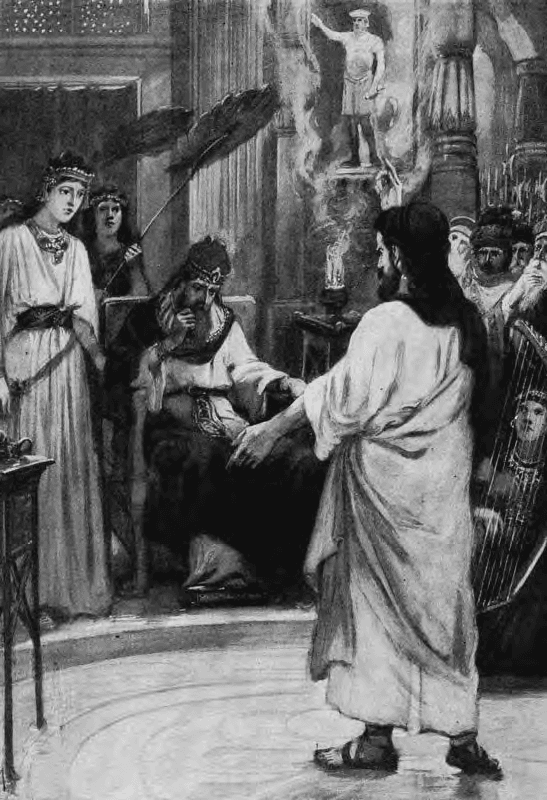
The king was too overcome to say anything, but it was evident from his face that his dream had been accurately described. Daniel continued:
“This is the dream; and we will tell the interpretation thereof before the king. Thou, O king, art a king of kings; for the God of Heaven hath given thee a kingdom, power and strength and glory. And wheresoever the children of men dwell, the beasts of the field, and the fowls of the heaven, hath he given into thine hand, and hath made thee ruler over them all. Thou art this head of gold.”
Then Daniel went on to say that the image’s breast and arms of silver represented another and inferior kingdom which would in time succeed Babylon. Bible Students know it was the universal empire of Medo-Persia. He said there would arise a third kingdom represented by the brass of the image, which we know was Greece, the successor of Medo-Persia. Daniel described a fourth very strong kingdom, represented by the iron legs and feet part of iron and part of clay, which we know as the Roman empire and its remnant kingdoms now upon the earth.
Then Daniel gave the grand climax of the prophecy, the complete fulfillment of which is still future but which is now in progress:
“And in the days of these kings shall the God of heaven set up a kingdom which shall never be destroyed. [The kingdom has been established.] And the kingdom shall not be left to other people, but it shall break in pieces and consume all these kingdoms, and it shall stand forever. Forasmuch as thou sawest, that the stone was cut out of the mountain without hands, and that it brake in pieces the iron, the brass, the clay, the silver and the gold; the great God hath made known to the king what shall come to pass hereafter. And the dream is certain, and the interpretation thereof sure.”
The record continues: “Then the king, Nebuchadnezzar, fell upon his face, and worshipped Daniel.” How quickly the situation had changed! A few minutes before this king sat upon his throne in regal splendor, a powerful monarch, with the world in his hands, angry and vengeful, ordering the deaths of the wisest men of the realm.
Now a few minutes later that same king lay prone, fallen upon his face! Do you see how easily the Lord maneuvers and manipulates even the mightiest king in the world? Do you see how easy it is for him to intervene to accomplish his will on behalf of his people? We read:
“The king answered unto Daniel, and said, Of a truth it is, that your God is a God of gods, and a Lord of kings and a revealer of secrets; seeing thou couldest reveal this secret. Then the king made Daniel a great man, and gave him many great gifts, and made him ruler over the whole province of Babylon, and chief of the governors over all the wise men of Babylon”
At Daniel’s request his three companions, Hananiah, Mishael and Azariah, were raised to positions of great power being set over the affairs of the province of Babylon.
Additional Lessons for Us
Let us go back and consider more of the lessons taught by this incident in Daniel’s life that raised him so suddenly from obscurity to greatness. When the Lord first put into motion a series of events leading to the promotion of Daniel and his companions, there was a time when things looked extremely black. They had been condemned to death without fault and without recourse. The Lord’s hand seemed to be against them, but they did not yield to discouragement and despair. They took it to the lord in prayer. Having done so they left the matter in the Lord’s hands.
Sometimes we may have discouraging and despairing experiences, times when our very existence as new creatures seems to be threatened, when our service to the Lord appears to be at an end. At such a time let us remember that as in the case of Daniel and his companions, the Lord may permit us to be brought low just before he exalts us, that the humbling experiences are necessary for our advancement. Let us react as Daniel and his companions did, as expressed by Peter:
“Humble yourselves therefore under the mighty hand of God, that he may exalt you in due time; casting all your care upon him, for he careth for you.” 1 Peter 5:6,7
When the crisis is over, when the Lord has seen us through our trying experience, let us like Daniel be quick to thank and praise the Lord for his goodness to us. The Lord, seeing a heart condition similar to Dan iel’s, will also call us “greatly beloved.” He does so through Paul who said:
“My brethren, dearly beloved, and longed for; my joy and crown, so stand fast in the Lord, dearly beloved.” Philippians 4:1
There is another lesson we can learn. When the Lord made known to Daniel the king’s secret, Daniel’s first thought was for others besides himself. He hurried to Arioch and said: “Destroy not the wise men of Babylon.” This showed a largeness of heart that the Lord loved. Let us follow this example too. When we have been favored and prospered of the Lord, let us think of others besides ourselves.
Let God Be Praised
As Daniel gave the full credit to God for the interpretation of the king’s dream, let us if we are permitted to know and understand some of the deep and secret things of God’s plan, give God all the credit, not thinking we are wise to know these things. Let us apply to ourselves the words of Daniel: “But as for me, this secret is not revealed to me for any wisdom that I have more than any living.” Let us realize that it is only by the grace of God that our minds are illuminated and our hearts filled with this wonderful truth!
As Daniel and his companions were saved from death and exalted to the rulership of Babylon, we if faithful, will live and reign with Christ a thousand years! (Revelation 20:4)
The Mysterious Teachings of Jesus
“It is given unto you to know the mysteries of the kingdom of heaven, but to them it is not given. Therefore speak I to them in parables; because they seeing, see not; and hearing, they hear not; neither do they understand.” Matthew 13:11,13
THE disciples of Jesus asked why he spoke to the multitude in parables, which were often difficult to understand, and he replied: “Unto you it is given to know the mysteries of the kingdom of God; but to others in parables; that seeing they might not see, and hearing they might not understand.” (Luke 8:10) Thus there are certain teachings of Jesus that can be understood and appreciated only by his true disciples and which make no sense to others. We will now consider some of these mysterious teachings of Jesus.
In Matthew Jesus withdrew from the multitude and sat down with his disciples to teach them certain moral and ethical precepts which were for them alone:
“And he opened his mouth and taught them, saying: Blessed [or Divinely approved] are the poor in spirit [humble-minded], for theirs is the kingdom of heaven. Blessed are the meek, for they shall inherit the earth.” Matthew 5:2,5
Thus Jesus said that a man can gain possession of heaven and earth if he is humble-minded and meek. This is certainly not the way of the world. To be successful in business or politics, a person has to be tough-minded and aggressive, not humble-minded and meek. This illustrates the inability of most people of the world to understand the principles that Jesus taught the traits of character that will prepare a person for the “great salvation” to gain a heavenly reward and inherit rulership of the earth. Jesus stated this principle directly:
“Whosoever exalteth himself shall be abased, and he that humbleth himself shall be exalted.” Luke 14:11
We read, “God resisteth the proud, but giveth grace unto the humble.” (James 4:6) God does not favor and cannot use an arrogant, self-assertive or vindictive person. He favors and will exalt the gentle, loving, and considerate person, one who is humble enough to be teachable, submitting himself to the rule of God.
“Blessed are they that mourn, for they shall be comforted.” Matthew 5:4
This too seems strange. Is it not more blessed to be happy and rejoice? But there is a deeper, spiritual meaning here. When Jesus said, “Blessed are they that mourn,” he described some who have deep feelings for their fellow man, who have loving and sympathetic hearts touched with pity for the suffering world of mankind for all the sickness, sorrow, pain and disappointment in the present evil world. Those who are of the “great salvation” or “high calling” feel this way and “they shall be comforted” when they see mankind restored to perfection and happiness on earth in “the times of restitution” and when they themselves have a part in bringing it about.
“Blessed are they which do hunger and thirst after righteousness, for they shall be filled.” Matthew 5:6
How can it be called blessed to hunger and thirst? Jesus here referred to a hunger and thirst not for food and drink but for ”righteousness.” Today the world is full of unrighteousness and injustice. Although there is much good in the world, evil greatly predominates. As David said, “I have seen the wicked in great power, and spreading himself like a green bay tree.” (Psalms 37:35) The wicked seem to prosper without hindrance. They hide behind lies and misrepresentations.
This condition is permitted by the Lord to provide mankind an experience with sin, but those who are aspiring to the heavenly “high calling” are out of harmony with this present situation and long for the coming time when all this evil will be done away with and righteousness and justice will prevail. They “hunger” for the promised time to come, described by Isaiah:
“Judgment also will I lay to the line, and righteousness to the plummet; and the hail shall sweep away the refuge of lies, and the waters shall overflow the hiding place.” Isaiah 28:17
When this happens and the world is at last set free from the unrighteousness that has so long prevailed, their “hunger” shall be filled or satisfied.
“Blessed are the merciful, for they shall obtain mercy.” Matthew 5:7
There is not much mercy shown today by anyone, especially in business or war. If a business competitor makes a mistake, he must expect to pay the consequences. In war full advantage is taken of an enemy’s weaknesses without mercy. It is considered only natural for men to do so. It may be natural for fallen humanity, but it is not God’s way. He is a merciful God. Micah says “he delighteth in mercy.” (Micah 7:18) James tells us, “The Lord is very compassionate and of tender mercy.” (James 5:11) Jesus said to his disciples, “Be ye therefore merciful, as your Father also is merciful.” (Luke 6:36) So in this way, too by being merciful to all those of the “great salvation” are different from the world.
There are many other such teachings of Jesus that are contrary to the spirit of the world and which only those of the “high calling of God” can understand and accept. For example, he said:
“Love your enemies, and pray for them which despitefully use you and persecute you; that ye may be the children of your Father which is in heaven. For he maketh his sun to rise on the evil and on the good, and sendeth rain on the just and on the unjust.” Matthew 5:44,45
To love one’s enemies is not natural or logical to the world, but let us remember that if Jesus had not loved his enemies, we would not be saved at all because it is written that “while we were yet sinners, Christ died for us.” (Romans 5:8) We read, “Greater love hath no man than this, that a man lay down his life for his friends.” (John 15:13) But all these things are foolishness to the worldly-minded; they cannot accept them.
“The natural man receiveth not the things of the Spirit of God, for they are foolishness unto him. Neither can he know them, because they are spiritually discerned.” 1 Corinthians 2:14
The way to the heavenly kingdom of God is a blessed way, but it is not easy. It is not for everyone. Jesus described it:
“Strait [difficult] is the gate, and narrow is the way, which leadeth unto life; and few there be that find it.” Matthew 7:14
How does one enter upon this “narrow way”? First there must be a powerful attraction to the precepts of God taught by Jesus some of which we have discussed. As Jesus said, “No man can come unto me except the Father which hath sent me draw him.” (John 6:44) One so drawn accepts Jesus as his personal Saviour. He consecrates his life to the service of God. From then on he is led by the holy spirit of God and becomes a spiritual son of God. As it is written, “For as many as are led by the Spirit of God, they are the sons of God.” (Romans 8:14) He develops a new, Christ-like mind, and becomes a new person.
“If any man be in Christ, he is a new creature. Old things are passed away; behold, all things are become new.” 2 Corinthians 5:17
Those called to this “high calling” follow the example of Jesus by laying down their lives as he did and living in accordance with his teachings.
“For even hereunto were ye called; because Christ also suffered for us, leaving us an example, that ye should follow his steps.” 1 Peter 2:21
When the “great salvation” of the heavenly calling is complete, which will be soon, the merit of Christ’s ransom sacrifice will be available for all the rest of humankind. Then there will be a resurrection of the dead and a world-wide salvation of all the willing and obedient leading to eternal perfect human life on earth. Those of the heavenly salvation, together with their Lord Jesus Christ, will then rule and bless the world.
The Parable of the Rich Man and Lazarus
THE parable of the rich man and Lazarus has been seriously misunderstood by many, causing much unhappiness and fear. Its correct interpretation is a wonderful prophecy. Let us first read the parable:
“There was a certain rich man, which was clothed in purple and fine linen, and fared sumptuously every day. And there was a certain beggar named Lazarus, which was laid at his gate, full of sores, and desiring to be fed with the crumbs which fell from the rich man’s table. Moreover, the dogs came and licked his sores. And it came to pass that the beggar died, and was carried by the angels into Abraham’s bosom. The rich man also died, and was buried. And in hell he lift up his eyes, being in torments, and seeth Abraham afar off, and Lazarus in his bosom. And he cried and said, Father Abraham, have mercy on me, and send Lazarus, that he may dip the tip of his finger in water, and cool my tongue; for I am tormented in this flame. But Abraham said, Son, remember that thou in thy lifetime receivedst thy good things, and likewise Lazarus evil things; but now he is comforted, and thou art tormented. And beside all this, between us and you there is a great gulf fixed; so that they which would pass from hence to you cannot, neither can they pass to us that would come from thence.” Luke 16:19-26
A common mistake is to accept this account as a literal statement of fact instead of the parable which it is. To take it literally involves several absurdities. Did our Lord mean to imply that all rich people are to spend eternity in misery because they ate regularly and wore purple and fine linen? Surely not. To get into heaven must we be poor beggars with sores licked by dogs, and must we eat crumbs?
Nothing is said in this parable about the rich man being wicked or Lazarus being righteous. Isn’t character a consideration? Will the rich, tormented in fire, actually see the poor in bliss; and will the honored poor see the rich in eternal misery? Can this really be the arrangement of an all-wise, all-loving creator, one who knew the end from the beginning? Of course not!
It is obvious that the account cannot be literal. It is a parable. In a parable the thing said is not the thing meant. A parable is defined as “a short narrative in which some important truth is veiled,” or hidden. Let us consider the important truth hidden in this parable.
The Two Men Represent Two Classes
The rich man represents one class of people and the poor man Lazarus another class. The rich man was the nation of Israel which, at the time the parable was given, had been rich in God’s special favor. God said of them, “You only have I known of all the families of the earth.” (Amos 3:2) In this sense they “fared sumptuously every day.” It is written of them: “What advantage then hath the Jew? … Much every way. Chiefly because unto them were committed the oracles of God.” (Romans 3:1,2) They had the promises, the prophets, the blessings and privileges of the law covenant. The organization of their nation as atypical kingdom of God invested them with royalty as shown in the rich man’s “purple.” Their typical sacrifices constituted them a holy [righteous] nation, represented by the rich man’s “fine linen” symbolic of righteousness.
Lazarus, the poor beggar of the parable who was laid at the rich man’s gate, represents an outcast class, those outside divine favor. It included the “publicans and sinners” of Israel, alienated from God, sin-sick, and hungering and thirsting after righteousness. It also included truth-hungry Gentiles, described as “aliens from the commonwealth of Israel, and strangers from the covenants of promise, having no hope.” (Ephesians 2:12) Those of this class had no fine linen of typical justification but, in moral sickness and sin, were the companions of “dogs,” a term the Jews applied to the heathen. They had no “purple” representing a share in God’s favor as part of his kingdom. None of the promises belonged to those outside of Israel. All they could have would be merely such crumbs as might fall from the rich man’s [Israel’s] table. Such a crumb of favor was the healing of the daughter of the Gentile woman of Canaan. On that occasion Jesus said, “It is not meet to take the children’s bread and cast it to dogs. And she said, Truth, Lord; yet the dogs eat of the crumbs which fall from their master’s table.” (Matthew 15:22, 26,27)
Now that we know the two classes illustrated by the rich man and Lazarus, we can easily trace the fulfillment of this prophetic parable in history. “The rich man died, and was buried; and in hell [hades, oblivion] he lift up his eyes, being in torments.” After rejecting Jesus as their Messiah and crucifying him, Israel lost thefavor of God.
Jesus had said of that nation, “Behold, your house is left unto you desolate.” (Matthew 23:38) In AD 70 the sentence was carried out. Israel was destroyed as a nation at the hands of Titus and the Roman army. Thus the rich man died and was buried. Nationally, Israel went into oblivion.
Although nationally dead and buried, the Jews as a people were very much alive, although scattered among the nations of the world, during the next nineteen centuries. They have had much anguish of soul as they have received severe persecutions as, for example, from Hitler during World War II. For the past nineteen centuries Jews have cried out to God, who in the parable is represented as Abraham. In the language of the parable, they have “lifted up their eyes, being in torments.”
What happened to the beggar? As the Jews died to their favor, so the outcast publicans, sinners and Gentiles died to their disfavor. Such of them as desired the favors of God, who were hungering and thirsting for his word of promise, were received by him. The early Christian church was made up of this “Lazarus” class. Instead of being alienated from God, these became the children of God and heirs of his promises. In the parable they are represented as children of Abraham in his arms. Jesus and his disciples are the spiritual seed of Abraham, received to God’s bosom of favor. Thus we read, “If ye be Christ’s, then are ye Abraham’s seed, and heirs according to the promise.” (Galatians 3:29) “There is a great gulf fixed” between Judaism and Christianity the Gospel Church enjoys free grace, joy, comfort and peace, while the Jew holds to the law covenant which condemns and torments.
This parable does not tell the whole story. It ends with Israel still nationally dead, their national hopes like dried bones in a grave. The happy ending to the prophetic story shows that there is to be a grand awakening, a national resurrection of the nation of Israel:
“Then he said unto me, Son of man, these bones are the whole house of Israel. Behold they say, Our bones are dried, and our hope is lost. We are cut off for our parts. Therefore prophesy and say unto them, Thus saith the Lord God: Behold, O my people, I will open your graves, and cause you to come up out of your graves, and bring you into the land of Israel. And ye shall know that I am the Lord, when I have opened your graves, O my people, and brought you up out of your graves; and shall put my spirit in you, and ye shall live. And I shall place you in your own land. Then shall ye know that I the Lord have spoken it, and performed it, saith the Lord.” Ezekiel 37:11-14
Do we not now see the beginning of this before our very eyes in the re-establishment of the nation of Israel? The events of the near future are described by the apostle Paul:
“And so all Israel shall be saved. As it is written, There shall come out of Sion the Deliverer [Christ], and shall turn away ungodliness from Jacob. For this is my covenant unto them, when I shall take away their sins.”–Romans 11:26,27
The Parable of the Two Sons
“But the father said to his servants: Bring forth the best robe, and put it on him; and put a ring on his hand, and shoes on his feet; and bring hither the fatted calf, and kill it; and let us eat, and be merry; for this my son was dead, and is alive again; he was lost, and is found.” Luke 15:22-24
TODAY we are going to consider another instance where David’s prophecy in Psalm 76 was fulfilled by Jesus: “Surely the wrath of men shall praise thee.” (Psalms 76:10) The account is found in Luke chapter 15. By way of introduction, verse one of the previous chapter reads: “And it came to pass, as he went into the house of one of the chief Pharisees, to eat bread on the sabbath day, that they watched him.”
Besides the chief Pharisee, there were other Pharisees, lawyers and scribes present. As the scripture indicates, they had invited Jesus so they could watch him, to find occasion against him, to condemn him according to their narrow and heartless interpretation of the law.
They had set traps like this for him before. Instead of glorifying God for Jesus’ marvelous healing ministry which was bringing hope to the hopeless and joy to the joyless, giving the people a foretaste of God’s kingdom on earth, they with bitter jealousy resented the powers and popularity of Jesus and sought to condemn and kill him. According to them, healing was work, hence healing on the Sabbath was a violation of the law. So they laid a trap for Jesus. They invited him to dinner on the Sabbath day and arranged for a poor man, swollen with dropsy, to be there in front of the door. Then they watched Jesus.
Jesus saw the trap instantly and was angered at the hardness of their hearts. He healed the man without the slightest hesitation. Then he boldly entered the house of the chief Pharisee and took his place as invited guest. As a result of the incident at the door he gave them a number of parables, one after another, comprising the entire 14th chapter of Luke.
The parables of Jesus were in themselves intensely interesting stories. Even though his hearers could not appreciate their rich hidden significance, nevertheless they loved to hear the stories because of their sheer human-interest value. The characters in these parables were fascinating. They were drawn from every-day life, familiar to everyone. They lived and breathed! Being a perfect man you may be sure Jesus could relate the stories superbly, with perfect expression and voice, thrilling his hearers.
On this particular occasion, Jesus’ parables were aimed primarily at the scribes, Pharisees and lawyers present. But his resonant voice carried through the open windows and doors. When the publicans and sinners learned that he was there in that house telling parables, they wanted to hear him too, like children wanting to hear stories. So large numbers of them came from far and wide. We can imagine that they stood at the doors and windows, crowding and pushing for a better view to hear every word. They just couldn’t keep away from Jesus.
This is what we read:
“Then drew near unto him all the publicans and sinners, for to hear him. And the Pharisees and scribes murmured, saying: This man receiveth sinners, and [even] eateth with them.” Luke 15:1,2
It was in answer to this criticism from the Pharisees and scribes that Jesus gave three of his most beautiful and touching parables: the parable of the Hundred Sheep, one of which was lost and then found; the parable of the Ten Silver Coins, one of which was lost and then found; and the parable of the Two Sons, one of which was a prodigal who strayed from his father’s house was lost and was then found.
These parables were given by Jesus not only for the edification of the scribes and Pharisees at the table that day, but also for the comfort and encouragement of the eavesdropping publicans and sinners whom the scribes and Pharisees despised. The parable of the Two Sons is a particularly moving study.
“A certain man had two sons; and the younger of them said to his father: Father, give me the portion of goods that falleth to me. And he divided unto them his living. And not many days after, the younger son gathered all together, and took his journey into a far country; and there wasted his substance with riotous living. And when he had spent all, there arose a mighty famine in that land; and he began to be in want. And he went and joined himself to a citizen of that country; and he sent him into his fields to feed swine. And he would fain have filled his belly with the husks that the swine did eat; and no man gave unto him. And when he came to himself, he said: How many hired servants of my father’s have bread enough, and to spare; and I perish with hunger! I will arise and go to my father; and I will say unto him: Father, I have sinned against heaven, and before thee; and am no more worthy to be called thy son. Make me as one of thy hired servants. And he arose, and came to his father. But when he was yet a great way off, his father saw him, and had compassion, and ran. And the son said unto him: Father, I have sinned against heaven, and in thy sight, and am no more worthy to be called thy son. But the father said to his servants: Bring forth the best robe, and put it on him and put a ring on his hand, and shoes on his feet. And bring hither the fattened calf, and kill it; and let us eat, and be merry; for this, my son, was dead, and is alive again; he was lost, and is found. And they began to be merry. Now his elder son was in the field; and, as he came and drew nigh to the house, he heard music and dancing.
And he called one of the servants, and asked what these things meant. And he said unto him: thy brother is come; and thy father hath killed the fatted calf, because he hath received him safe and sound! And he was angry, and would not go in; therefore came his father out, and entreated him. And he answering, said to his father; Lo, These many years do I serve thee; neither transgressed I at any time thy commandment; and yet thou never gavest me a kid, that I might make merry with my friends. But as soon as this, thy son, was come, which hath devoured thy living with harlots, thou hast killed
for him the fatted calf. And he said unto Him: Son, thou art ever with me, and all that I have is thine. It was meet that we should make merry, and be glad; for this, thy brother, was dead and is alive again; and was lost, and is found.” Luke 15:11-32
Powerful Emotions Are on Display
Here is a story that is simple yet tugs at the heartstrings. The strongest of human emotions are skillfully played upon: the love of a parent for his children, a boy’s wanderlust with its desire to break parental ties and be on one’s own, a parent’s worry for the safety of his wandering boy, the boy’s disillusionment and homesickness for his father’s house, the joyful reunion of father and son, and the older brother’s jealousy. These are powerful emotions and you may be sure that every one of those priests, scribes, Pharisees, lawyers, publicans, and sinners who heard Jesus were moved by the story. It was something they could all understand and appreciate. The characters were realistic and convincing.
Let us consider this story. It was the custom of that time and country that the elder son inherit his father’s estate if he chose to remain at home with his father. The younger sons, if they wanted it, were usually given some portion and allowed to enter other businesses or professions. This is what the younger son of the parable elected to do. So the father gave him a portion of his means in cash. So that the elder son might not be jealous, he gave him an equal portion at the same time. This does not mean that the father gave his sons everything he had retaining nothing for himself. He merely gave a reasonable individual portion to each son keeping the remainder. Of course if the elder son served his father faithfully until his father’s death, he would inherit everything that was left.
As soon as the younger son had received his share, he announced that he was leaving home to go to some far-away place. How typical this is of young people! How anxious and eager they are to break away from parental ties and go their own way! How unmindful of the love, longing and heartbreak they often leave behind! But there is no record that the father made any objection. He must have given his son the best possible advice: to be always upright and honest and
God-fearing; to shun evil companions and not waste his resources; above all, to keep in touch–all of which advice the son proceeded to ignore. Again, how typical! Young people of the world tend to have a contempt for the advice of their parents. With all the profound wisdom of their teen-age years, they know better! Their parents are “square” and they use the word contemptuously. But, do you know? I like being a “square.” I’m proud of it! The word “square” is one of the finest words in our language. You give a man a square deal if you are honest. You give him a square meal when he is hungry. You stand four-square for the right as you see it. When you are out of debt, you are square with the world and you can look your fellow- man square in the eyes.
The young son of the parable was a fool. As the saying goes, “A fool and his money are soon parted.” In the process of parting with his money, he learned a humiliating lesson. When he had money, he was popular and had numerous friends who flattered him and told him how wonderful he was. As soon as his money ran out, his friends ran out.
For the first time in his life, he knew the pangs of real hunger. When he tried to get a job, he found there was a bad depression. The language of the parable calls it “a mighty famine” which is the same thing. In his desperation, he became a swineherd. For a Jew, this was an especially demeaning occupation the ultimate degradation.
Swine were considered unclean animals not even to be touched. He even got to the same level as the swine. He was so hungry he tried to feed himself with what the swine were eating: slop is what we would call it today. But his boss wouldn’t even let him do that: “no man gave unto him” the parable says. How skillfully Jesus wove his story! What a description he gave of total debasement! A starving man is denied even the food of the pigs under his care!