
Jonah’s Experience
We find a similar storm at sea related in the Book of Jonah. The Lord told Jonah to go to Nineveh, but Jonah took a ship going in the opposite direction in an effort to flee from the presence of the Lord. We read:
“But the Lord sent out a great wind into the sea, and there was a mighty tempest in the sea, so that the ship was like to be broken. Then the mariners were afraid, and cried every man unto his god. But Jonah was gone down into the sides of the ship; and he lay, and was fast asleep. So the shipmaster came to him, and said unto him, What meanest thou, O sleeper? Arise, call upon thy God, if so be that God will think upon us, that we perish not.” Jonah 1:4-6
The mariners finally concluded that the storm had resulted because God was displeased with someone on board. They cast lots to determine who it was and the lot fell on Jonah. Then Jonah admitted that he was the one at fault:
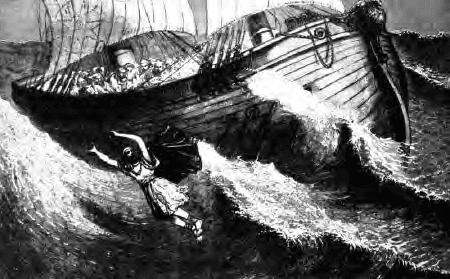
“He said unto them, Take me up, and cast me forth into the sea; so shall the sea be calm unto you; for I know that for my sake this great tempest is upon you. Nevertheless, the men rowed hard to bring it to the land; but they could not; for the sea wrought, and was tempestuous against them. Wherefore they cried unto the Lord, and said, We beseech thee, O Lord, we beseech thee, let us not perish for this man’s life; and lay not upon us innocent blood; for thou, O Lord, hast done as it pleased thee. So they took up Jonah, and cast him forth into the sea. And the sea ceased from her raging.” Jonah 1:12- 15
Jonah did not drown in the sea. God had prepared a great fish to swallow Jonah and transport him to Nineveh where he should have gone in the first place. What a way to go! I think that must have been the very first submarine voyage on record. It is indeed true, as the Wise Man has said:
“There is no new thing under the sun. Is there anything whereof it may be said, See this is new? it hath been already of old time, which was before us.” Ecclesiastes 1:9,10
Lessons for Us
Returning to the incident at the Sea of Galilee, let us consider some lessons. The waters of Galilee are beautiful, sparkling, clean and sweet. It receives its waters from the River Jordan and gives them forth again. Thus it remains sweet, fresh, and lifegiving.
Further along the Dead Sea receives the same waters from the Jordan but it does not give them forth. That is why it is dead.
Pure water is a symbol of truth. We must not only receive the truth into good and honest hearts but we must give it forth to others in all its beauty and purity. We must ever give out the truth to keep it fresh and sweet in our own hearts and minds. Jesus said:
“Ye are the light of the world. A city that is set on an hill cannot be hid. Neither do men light a candle, and put it under a bushel, but on a candlestick; that it giveth light unto all that are in the house. Let your light so shine before men , that they may see your good works, and glorify your Father which is in heaven.” Matthew 5:14-16
The Sea of Galilee is only a small sample. We look forward to the time when “the earth shall be filled with the knowledge of the glory of the Lord, as the waters cover the sea.” (Isaiah 11:9)
Satan is a very sneaky and cowardly person. He is malicious, ferocious, and heartless. He has no honor or sense of fair play. He takes advantage of every circumstance suitable to his evil purpose without pity or remorse. We remember that it was after Jesus had fasted for forty days that Satan tempted him with food. Now when he saw Jesus exhausted and fast asleep in a fragile boat in the middle of the Sea of Galilee, he took advantage of it and made a vicious attack just like the bully that he is.
There are important lessons here for the Lord’s people. As Satan attacked Jesus when he was physically exhausted and asleep, he attacks us at a time when we are the most vulnerable, when our spirituality is at a low ebb. As he brought the storm upon Galilee, he comes upon us like a flood. Such an attack and the remedy is described in Isaiah:
“When the enemy shall come in like a flood, the Spirit of the Lord shall lift up a standard against him.” Isaiah 59:19
What is this “standard” that is lifted up against Satan? It is the Standard of Truth; it is a faith and strength in the Lord. We read: “Finally, my brethren, be strong in the Lord, and in the power of his might.” How? “Put on the whole armor of God, that ye may be able to stand against the wiles of the devil.” (Ephesians 6:10,11) We must ever be on guard and keep up our spiritual vigor . . . “Lest Satan should get an advantage of us; for we are not ignorant of his devices.” 2 Corinthians 2:11
How do we maintain our spiritual health and vigor, and put on the whole armor of God? We do it by studying and maintaining the Standard of Truth, the pure truth which our returned Lord has provided us through a wise and faithful servant, and by daily conforming our lives thereto. There is no other standard of truth. It was to spiritual prosperity and health that John referred:
“Beloved, I wish above all things that thou mayest prosper and be in health, even as thy soul prospereth. For I rejoiced greatly when the brethren came and testified of the truth that is in thee, even as thou walkest in the truth.” 3 John 2,3
As the normally tranquil Sea of Galilee suddenly became stormy, our circumstances can change suddenly and drastically for the worse. When this happens, let us realize that we are sharing the experience of Jesus on Galilee, and rejoice. Thus we read:
“Beloved, think it not strange concerning the fiery trial which is to try you, as though some strange thing happened unto you; but rejoice, inasmuch as ye are partakers of Christ’s sufferings; that, when his glory shall be revealed, ye may be glad also with exceeding joy.” 1 Peter 4:12,13
The storm on Galilee did not last long. It passed as suddenly as it had come because Jesus took charge. He will do the same in your storm.
“And It Came To Pass”
Once at a testimony meeting the leader asked each one to quote a favorite Bible verse. One brother simply quoted the words, “And it came to pass.” This surprised everybody because it is not even a verse. Yet he insisted that the phrase “and it came to pass” was the one most meaningful to him. “Why?” asked the leader. The brother explained that in every trouble the problem or the difficulty did not come to stay; it came to pass. It came to teach its particular lesson; to leave its imprint upon his character; but it was not, of itself, a finality. It did not come to stay “It came to pass.”
Our trials will never be more severe or last longer than we can bear. That’s a promise:
“No trial has assailed you, except what belongs to man. And God is faithful, who will not permit you to be tried beyond your ability; but with the trial, will also direct the issue, that you may be able to bear it.”–1 Corinthians 10:13, Diaglott
It is commendable that the disciples did their best to reach shore and to keep their ship afloat before they asked for help. We learn from this that we should always do our best to resolve our own difficulties before expecting the Lord to perform miracles on our behalf.
According to the three gospels that describe this incident the disciples expressed themselves differently when they ran to Jesus for help in their extremity. This may show how individuals with different personalities and various stages of Christian development react to an overwhelming crisis. According to Matthew’s account, some cried, “Lord, save us!” This is the cry of faith. It says, “You are the Lord, we know you have the power to save us!” Then, according to various translations of Matthew 8:25 and Luke 8:24, some said, “We are perishing! We are lost! We are drowning! We are going down!” This is the cry of despair, of little faith, of fearing the worst, that it is too late for anything to be done. According to various translations of Mark 4:38, some plaintively called in question the mercy and compassion of Jesus, saying, “Master, carest thou not that we perish? Does it not concern thee that we perish? Master, we are sinking! Do you not care? Don’t you care that we’re drowning?” These disciples not only exhibited little or no faith, they actually showed an active distrust. They reproached Jesus, accusing him of insensitivity to their problem. In effect, they said: “Here we are, in terrible trouble, and YOU DON’T CARE!”
How do we compare with those disciples? When some serious storm of life overtakes us and the relief we seek does not quickly come, does our faith fail? Do we tend to despair and accuse the Lord of not caring? The Lord may permit some such experience to see how we react to test our faith. Let us determine that after doing our very best we will go to the Lord and simply say: “Lord, help me!” Let us never doubt that he does care, that he is there with us in the boat. Thus we will obey the admonition, “Casting all your care upon him, for he careth for you.” (1 Peter 5:7) We also have the assurance that no storm will ever overwhelm us:
“Cast thy burden upon the Lord, and he shall sustain thee. He shall never suffer the righteous to be moved.”–Psalms 55:22
“He hath said, I will never leave thee, nor forsake thee.” Hebrews 13:5
Let our reliance on the Lord be such that he need not sorrowfully say to us, as he did to his disciples that day: “Why are ye fearful, O ye of little faith? How is it that ye have no faith? Where is your faith?”
“Peace Be Still”
This experience of the storm on Galilee not only tried the faith of the disciples, but it crystallized and established their faith. “What manner of man is this?” they said, “that even the wind and the sea obey him!” How could they ever again doubt Jesus’ power to save? So with us, when we have had a severe crisis and have been carried through it, and have heard the Lord’s “Peace be still,” how can we ever again doubt the Lord’s power on our behalf?
And this experience also made a strong impression on Jesus. We know this because later, when he gave a prophecy regarding the end of the age, he remembered that roaring storm on Galilee, and the perplexity and heart-failing fear it had caused the men in the boat.
He used that very incident to describe the great Time of Trouble. Note his words:
“And upon the earth distress of nations, with perplexity; the sea and the waves roaring; men’s hearts failing them for fear, and for looking after those things which are coming on the earth.” Luke 21:25,26
Doesn’t that describe the storm on Galilee?
As the winds suddenly came upon Galilee from every direction, causing a cyclone, the four winds of earth, spoken of in Revelation 7:1, are loosed by the four angels and great calamities come upon the world. We read:
“Thus saith the Lord of hosts, Behold, evil shall go forth from nation to nation; and a great whirlwind shall be raised up from the coasts of the earth.” Jeremiah 25:32
“For they have sown the wind, and they shall reap the whirlwind.” Hosea 8:7
Proverbs says that Israel and the world of mankind, like the men on Galilee, will, in the final stages of the Time of Trouble, call upon the Lord in their extremity:
“When your fear cometh as desolation, and your destruction cometh as a whirlwind, when distress and anguish cometh upon you; then shall they call upon me.” Proverbs 1:27,28
“Woe to the multitudes of many people, which make a noise like the voice of the seas; and to the rushing of nations, that make a rushing like the rushing of mighty waters! The nations shall rush like the rushing of many waters; but God shall rebuke them.” Isaiah 17:12,13
This great Time of Trouble and its termination is graphically described in Psalm 107:
“They that go down to the sea in ships; that do business in great waters; these see the works of the Lord, and his wonders in the deep. For he commandeth, and raiseth the stormy wind, which lifteth up the waves thereof. They mount up to the heaven; they go down again to the depths. Their soul is melted because of trouble. They reel to and fro, and stagger like a drunken man, and are at their wit’s end.
Then they cry unto the Lord in their trouble; and he bringeth them out of their distresses. He maketh the storm a calm, so that the waves thereof are still. Then are they glad because they be quiet; so he bringeth them unto their desired haven. O that men would praise the Lord for his goodness, and for his wonderful works to the children of men!” Psalms 107:23-31
“Be Still”
We read in the psalms of the tremendous power of God to still the Time of Trouble, the very same power that Jesus used to quickly quiet the raging waters of Galilee:
“O Lord God of hosts; who is a strong Lord like unto thee? . . . Thou rulest the raging of the sea. When the waves thereof arise, thou stillest them.” Psalms 89:8,9
“O God of our salvation Who stilleth the noise of the seas, the noise of their waves, and the tumult of the people.” Psalms 65:5,7
As Jesus said to the troubled sea, “Peace be still!” God will proclaim to a troubled world, in the words of Psalm 46:10, “Be still, and know that I am God.”
The psalmist said, “Then are they glad because they be quiet. So he bringeth them unto their desired haven.” What is the world’s desired haven? We read:
“For thus saith the Lord of hosts, Yet once, it is a little while, and I will shake the heavens, and the earth, and the sea, and the dry land. And I will shake all nations, and the desire of all nations shall come.” Haggai 2:6,7
The “desired haven” is “the desire of all nations.” It is the Kingdom of God that is desired. The world earnestly desires it without knowing exactly what it is and how it will come. All they know is that they are suffering and want relief from their troubles from sickness, sorrow, sighing, pain and death; from poverty, hunger, tyranny and anarchy. Paul describes this time:
“For we know that the whole creation is groaning together, and suffering the pangs of labor, which have not yet brought forth the birth. For the longing of the creation looks eagerly for the time when the glory of the sons of God shall be revealed.” Romans 8:22,19, Conybeare
Yes, they will finally come to their desired haven of rest when the sons of God, Christ and the church, are revealed in kingdom power and glory. Then will be fulfilled the prophecy of Revelation 21:1, “And I saw a new heaven and a new earth; for the first heaven and the first earth were passed away; and there was no more sea” no more restless and discontented masses of humanity.
After the psalmist says, “Then are they glad because they be quiet; so he bringeth them unto their desired haven,” he exclaims:
“Oh that men would praise the Lord for his goodness, and for his wonderful works to the children of men!”–Psalms 107:31
The last verse of the last psalm voices this fervent hope: “Let everything that hath breath praise the Lord.” (Psalms 150:6) This hope will be realized.
When the kingdom has done its work, every intelligent creature in the universe will praise the Lord for his goodness. John saw this time in prophetic vision:
“And every creature which is in heaven and on earth, and such as are in the sea; and all that are in them, heard I saying, Blessing and honor, and glory, and power, be unto him that sitteth upon the throne, and unto the Lamb for ever and ever!” Revelation 5:13
The terror of the men on the boat that day on Galilee aptly pictured the world at their wits’ end during the Time of Trouble. But it did not picture any fear on the part of the Lord’s true people. We who know the plan of God, who know the blessed outcome, will not fear. Psalm 46 describes our position:
“God is our refuge and strength, a very present help in trouble. Therefore will not we fear, though the earth be removed, and though the mountains be carried into the midst of the sea. Though the waters thereof roar and be troubled. Though the mountains shake with the swelling thereof.” Psalms 46:1-3
This brings to mind what happened to Jonah. He also was in a ship and as was the case on Galilee, a terrible storm arose and the ship was about to be capsized. The men on board were frantic, reeling to and fro, their hearts failing them for fear. But where was Jonah? He was fast asleep in the hold. He was completely relaxed. He knew the hand of God was upon him, that nothing could happen to him without God’s permission. Even when they threw him into the sea, he was not worried. In fact, he told them to do it. He was always safe. He was safe on board ship. He was safe when he dropped over the side. He was safe as he sank deeper and deeper into the water. He was worried for a moment when a huge fish with wide-open mouth rushed toward him. Then he was safe in the fish’s belly. It didn’t hurt a bit. Did you know that prayers can go through water, too? We read that “Jonah prayed unto the Lord his God out of the fish’s belly.” (Jonah 2:1) Notice this: It was not a prayer of fear but one of thanksgiving and praise. Jonah actually thanked God for casting him into the sea not the men on the boat, but God. He said: “For thou hadst cast me into the deep, in the midst of the seas; and the floods compassed me about.” (Jonah 2:3) He thanked God for the storm too! “All thy billows, and thy waves passed over me,” he said.
This beautifully illustrates what should be the attitude of the Lord’s people during not only the great Time of Trouble, but any trouble in their lives. If we are the Lord’s, we are always safe, always in his hands. As Jonah was cast into the sea but was safe in the belly of the fish, we can be in the midst of the raging sea of trouble, and yet safe from it. Any storm that may come is His storm. Regardless of where we are and what he may permit to come upon us, we are safely and securely under his hand. Realizing this we can repeat and apply to ourselves the beautiful sentiments of Psalm 139:
“Thou hast hedged me in, behind and before, and laid thine hand upon me. Such knowledge is too wonderful for me. It is high. I cannot attain unto it. Whither shall I go from thy Spirit? or whither shall I flee from thy presence? If I ascend up into heaven, thou art there. If I make my bed in hell, behold, thou art there. If I take the wings of the morning, and dwell in the uttermost parts of the sea; even there shall thy hand lead me, and thy right hand shall hold me.” Psalms 139:5-10
Winds of Doctrine
Now we come to a lesson which is not so pleasant but which must be learned. There is another kind of wind blowing today and it is blowing upon the church of God. It is causing waves of dissention and division. Some are being carried away by this wind and are in danger of shipwreck. It is the “wind of doctrine.” Paul describes this wind and those who bring it upon the church:
“That we be no more children, tossed to and fro, and carried about with every wind of doctrine, by the sleight of men, and cunning craftiness, whereby they lie in wait to deceive; but speaking the truth in love, may grow up into him in all things, which is the head, even Christ.” Ephesians 4:14,15
Here is the same text from the Weymouth translation which brings the thought out very clearly:
“So we shall no longer be babes, nor shall we resemble mariners, tossed on the waves and carried about with every changing wind of doctrine, according to men’s cleverness, and unscrupulous cunning, making use of every shifting device to mislead. But we shall lovingly hold to the truth, and shall, in all respects grow up into union with him who is our head, even Christ.”
In these stormy days when changing winds of doctrine are blowing, let us “lovingly hold to the truth.” Let it not be necessary for Jesus to sorrowfully say to us, “Where is your faith? Where is the Most Holy Faith which I revealed to you through my faithful and wise servant upon my return? the Divine Plan in all its beauty and purity which I have caused to be written upon tables, and a chart for you to read. How is it that you have let it slip? Where is your FAITH?”
If we waver in our understanding of the truth and are tossed about with winds of doctrine, we will not receive the promised reward.
“He that wavereth is like a wave of the sea, driven with wind and tossed. For let not that man think that he shall receive anything of the Lord.” James 1:6,7
“Be not carried about with diverse and strange doctrines; for it is a good thing that the heart be established with grace.” Hebrews 13:9
“Retaining faith and a good conscience, which some, having thrust away concerning THE FAITH, suffered shipwreck.” 1 Timothy 1:19, Diaglott
Let us take Paul’s advice to Timothy:
“Take heed unto thyself and unto the doctrine; for in doing this, thou shalt both save thyself and them that hear thee.” 1 Timothy 4:16
Let us not forget the qualification for eldership given in Titus:
“Holding fast the faithful word as he hath been taught; that he may be able by sound doctrine, both to exhort and to convince the gainsayers.” Titus 1:9
We read, “When he giveth quietness, who then can make trouble?” (Job 34:29) Satan whipped up that mighty storm on Galilee. But when Jesus raised his hand and quietly said, “Peace, be still,” Satan’s power utterly failed “and there was a great calm.” If we constantly bear in mind that this tremendous power of God is always available on our behalf in our storms of life, what quietness of mind and heart it will give us!
“And the peace of God, which passeth all understanding, shall keep your hearts and minds, through Christ Jesus.” Philippians 4:7
Let us trust in this promise. As we read:
“Thou wilt keep him in perfect peace, whose mind is stayed on thee; because he trusteth in thee.” Isaiah 26:3
Jesus spoke to you too when he said, “Peace be still!” He said:
“Peace I leave with you; my peace I give unto you. Not as the world giveth, give I unto you. Let not your heart be troubled, neither let it be afraid.” John 14:27
We thank our Heavenly Father for the lessons taught us by his son, our Lord Jesus Christ. May we learn them well and achieve that peace of God which passeth all understanding.
Peace on Earth
MOST people consider the hope of peace on earth as wishful thinking; something quite impossible to attain. “Man is a warlike animal,” they say “He has been fighting from earliest antiquity. The histories of every nation, from the most ancient times to the present, are filled with accounts of wars and bloodshed. This is the very nature of man,” they say. But the Bible clearly teaches that war and violence are not the true nature of man.
Man was not originally created a warlike animal. The first man, Adam, was created in the image of God:
“And God said, Let us make man in our image, after our likeness. . . . So God created man in his own image; in the image of God created he him.” Genesis 1:26,27
We also read, “God is love.” (1 John 4:8) This is his image. Jesus confirmed this when he said:
“Love your enemies . . . and pray for them which despitefully use you and persecute you; that ye may be the children of your Father which is in heaven.” Matthew 5:44,45
“Love your enemies . . . and ye shall be the children of the Highest; for he is kind unto the unthankful and to the evil. Be ye therefore merciful, as your Father also is merciful.” Luke 6:35,36
We read a description of the character of God in Psalm 145:
“The Lord is gracious and full of compassion; slow to anger, and of great mercy. The Lord is good to all; and his tender mercies are over all his works.” Psalms 145:8,9
God-like conduct is described in the words, “If thine enemy hunger, feed him. If he thirst, give him drink.” (Romans 12:20) This is the character image in which man was originally created, but it is certainly not man’s character now. Mankind has, to a large degree, fallen from the image of God in which Adam was created; he has been transformed into another image.
In Genesis chapter 3 we are told how this transformation started. The perfect Adam and his wife Eve, created in the image of God, were given a beautiful garden home where all their needs were abundantly supplied, and where they might live for ever in happiness. Then God put Adam to a test of obedience. This was entirely proper. Is it not right for a parent to require obedience of his children? Adam fully intended to obey God. But Satan, the devil, a powerful spirit being who had rebelled against God, induced Adam’s wife to disobey and to influence Adam to also disobey. God had previously told Adam that if he disobeyed, he would surely die. (Genesis 2:17) When he pronounced sentence upon him, he told him that he would “return unto the ground; for out of it wast thou taken. For dust thou art, and unto dust shalt thou return.” (Genesis 3:19)
Sin is defined as disobedience to God’s law. Thus it was that sin entered into the world.
“Wherefore, as by one man sin entered into the world, and death by sin; and so death passed upon all men, for that all have sinned.” Romans 5:12
It was after Adam sinned that he had his children. Thus all of Adam’s children were born imperfect. They were all “born in sin and shapen in iniquity.” (Psalms 51:5) Sinful Adam could not bring forth a perfect race. Job says, “Who can bring a clean thing out of an unclean? Not one.” (Job 14:4) Not one of Adam’s descendants was without sin and each succeeding generation fell still further from the image of God.
War has been called an evil disease which afflicts mankind, but war is not the disease. It is merely the symptom of the real disease which is sin. This is the underlying cause of all unhappiness in the world. Sin not only accounts for wars between nations, but also antagonisms within nations, disharmony between parties and organizations, strife between and within families, and the lack of tranquility in a person’s mind.
This steady degeneration of mankind from the image of God, going deeper and deeper into sin and death, would present a hopeless prospect were it not for the sure word of God. The Bible gives us the only hope of the world. It foretells a wonderful future for mankind when all wars and violence will cease, when sin and death will be completely eliminated, when even those who have already died will be restored to life, and when all the willing and obedient will live for ever in perfect health and happiness upon the earth, having been restored to the image of God. Then there will be true peace on earth.
Let us cite some of these prophecies, starting with one which has already been partially fulfilled. The prophet Isaiah described a most joyful occasion, the birth of a mighty Ruler who would eventually bring peace on earth:
“Unto us a child is born; unto us a son is given; and the government shall be upon his shoulder. And his name shall be called Wonderful, Counsellor, The mighty God, The everlasting Father, The prince of Peace. Of the increase of his government and peace there shall be no end.” Isaiah 9:6,7
This foretold the birth of Jesus, the Prince of Peace, who is to rule the world. To bring peace on earth, it was necessary for Jesus to first eliminate the underlying cause of all the trouble, which was sin and the sentence of death. It was sin that alienated man from God and resulted in the present deplorable condition of the world. Jesus had first to provide a basis for the removal of sin and for the reconciliation of mankind to harmony with God. This he accomplished by his sacrificial death nearly two thousand years ago, giving his life for the life of Adam and his race. When Adam disobeyed God, he forfeited his life and brought forth an imperfect and dying race. Jesus, whose father was God, was born on earth and grew to perfect and sinless manhood the exact equivalent of Adam before Adam sinned. Unlike Adam, Jesus was obedient to God. He died without deserving to die, giving up his unforfeited life in exchange for Adam’s forfeited life thus redeeming Adam and all his descendants. He thus became a ransom for Adam, releasing him and all his children from the sentence of death.
“For since by man came death, by man came also the resurrection of the dead. For as in Adam all die, even so in Christ shall all be made alive.” 1 Corinthians 15:21,22
“Therefore, as by the offence of one, judgment came upon all men to condemnation; even so by the righteousness of one the free gift came upon all men unto justification of life. For as by one man’s disobedience many were made sinners, so by the obedience of one shall many be made righteous.” Romans 5:18,19
Peace Via the Ransom
Paul refers to Jesus, “Who gave himself a ransom for all, to be testified in due time.” (1 Timothy 2:6) This means that in due time, as a result of the ransom that Jesus provided, all mankind will be released from sin and death. When this has been accomplished, there will be peace on earth. Then will be fulfilled the words of Isaiah:
“They shall beat their swords into plowshares, and their spears into pruninghooks. Nation shall not lift up sword against nation, neither shall they learn war any more.” Isaiah 2:4
“The wolf also shall dwell with the lamb, and the leopard shall lie down with the kid; and the calf and the young lion, and the fatling together; and a little child shall lead them. And the cow and the bear shall feed; their young ones shall lie down together; and the lion shall eat straw like the ox. And the suckling child shall play on the hole of the asp, and the weaned child shall put his hand on the cockatrice’ den. They shall not hurt nor destroy in all my holy mountain [kingdom]; for the earth shall be full of the knowledge of the Lord, as the waters cover the sea.” Isaiah 11:6-9
That Faithful and Wise Servant
“Who then is the faithful and wise servant, whom his Lord hath made ruler over his household, to give them meat in due season? Blessed is that servant, whom his Lord, when he cometh, shall find so doing. Verily I say unto you, that he shall make him ruler over all his goods.” Matthew 24:45-47
WHEN Jesus was on earth, he was the head or ruler of his own spiritual household, the household of faith, the house of God. Just as the head of a literal household provides food for his family, Jesus, when present in the flesh, fed his disciples as much spiritual food as they could absorb. But they could not absorb everything he wanted to tell them because the holy Spirit had not yet been sent. Their natural minds had not been stimulated and sensitized to spiritual things. As it is written:
“The natural man receiveth not the things of the spirit of God . . . because they are spiritually discerned.” 1 Corinthians 2:14
On one of the last talks he had with his disciples before his crucifixion, Jesus said to them:
“I have yet many things to say unto you, but ye cannot bear them now. Howbeit, when the spirit of truth is come, it will guide you into all truth.” John 16:12,13
Notice that he said ALL truth. Of course this does not mean all scientific truth, or all the facts pertaining to the universe, or all the unsearchable wisdom of God. But it does mean every spiritual truth, every basic doctrine, every concept essential to our making our calling and election sure “that the man of God may be perfect [or complete], thoroughly furnished unto all good works.” (2 Timothy 3:17)
They remembered this promise in the dark days that followed when they saw their beloved master betrayed, unjustly accused, scourged, tormented, and put to an agonizing death upon the cross. Even his body was missing from the tomb! We read:
“Then arose Peter, and ran unto the sepulchre; and stooping down, he beheld the linen clothes laid by themselves; and departed, wondering in himself at that which was come to pass.” Luke 24:12
Yes, they wondered. It was all very confusing to them. But Jesus had promised that they would understand, and they waited for that promised spirit of understanding to come.
They were in this frame of mind when, after the crucifixion, two of the disciples decided to walk from Jerusalem to a village called Emmaus. Emmaus means “hot springs” and was about eight miles from Jerusalem. One of the disciples was Cleopas and the other is thought to have been Peter. They probably wanted to get away from the hustle and bustle of the city to a quiet place where they could talk and think, and perhaps understand. Their hearts were heavy and as they walked the record says: “They talked together of all these things which had happened,” and “they communed together, and reasoned.” (Luke 24) In other words, they tried to make sense out of the situation but had difficulty doing so. Jesus joined them on the road in a form they did not recognize. “And he said unto them, What manner of communications are these ye have one to another as ye walk, and are sad?” They must have sensed a sympathetic understanding in this stranger because they poured out what was in their hearts. They told him how their beloved master whom they described as “a prophet, mighty in deed and word before God and all the people,” had been delivered up by the chief priests, condemned to death, and crucified; how all their high hopes had been shattered; and they added wistfully: “But we trusted that it had been he which should have redeemed Israel.” Then we read:
“[Jesus] said unto them, O foolish and slow of heart to believe all that the prophets have spoken! Ought not Christ to have suffered these things, and to enter into his glory? And beginning at Moses and all the prophets, he expounded unto them, in all the scriptures, the things concerning himself.” Luke 24:25-27
What a feast it was for their souls! What a balm for their hearts torn by grief and confusion! What a thrill! What an exaltation of spirit!
To see everything fall perfectly into place as he talked, to see the reason for it all, to know that it was the truth! Confusion and doubt dissolved and the mystery of recent events became an open book. As they said later after Jesus had revealed himself to them and departed:
“Did not our hearts burn within us while he talked with us by the way, and while he opened to us the scriptures?”
Here is a prime example of “meat in due season.” These were things Jesus had not told them before. Why not? Because as Jesus had said, “Ye can not bear them now.” When Jesus was on earth as a man, his disciples looked for him to set up an immediate earthly government, to supplant Roman rule, to wrest the sovereignty of Israel away from Rome. As they said: “We trusted that it had been he which should have redeemed Israel.” They had stubbornly held to this idea and closed their minds to any other. When Jesus told them of his impending suffering and death, they said: “Be it far from thee, Lord; this shall not be unto thee.” (Matthew 16:22) They simply refused to believe it. Things were going too well for them. Now it was different. Jesus had indeed suffered and died. They had to face this grim reality. As a plow rips deep into the hard subsoil to soften and prepare it to receive and nurture the seed, so their hearts had been bruised, torn, humbled, and made ready for what was NOW meat in due season for them. What did Jesus tell them, as he walked with them to Emmaus? “Beginning at Moses, and all the prophets, he expounded unto them in all the scriptures, the things concerning himself.” These were the “many things” he had to say to them which they could not “bear” before. But they could bear them now! Now it was meat in due season. It gave them a key to the scriptures.
They learned their lesson well. They remembered. After the holy spirit was given at Pentecost, Peter spoke these words: “Those things which God before had showed by the mouth of all his prophets, that Christ should suffer.” (Acts 3:18) Then he pointed to the future saying:
“When the times of refreshing shall come from the presence of the Lord; and he shall send Jesus Christ which was before preached unto you; whom the heaven must retain until the TIMES OF RESTITUTION OF ALL THINGS, which God hath spoken by the mouth of all his holy prophets since the world began.” Acts 3:19- 21
This is what Jesus had revealed to them on the way to Emmaus. Now the seed had borne fruit.
If there is one central, predominating theme, common to the preaching of all God’s holy prophets since the world began, it must be of vital importance in the plan of God, it must be an essential, basic doctrine. Let us consider the messages of these prophets and see the thread that runs through them all the common denominator. Let us take each prophet in turn, selecting and paraphrasing for the sake of brevity, a few prophecies from each.
A Look at the Prophecies
Jude quotes ENOCH, the seventh from Adam, as prophesying: “Behold, the Lord cometh with ten thousand of his saints; to execute judgment upon all.” (Jude 14,15) Here we have a prophet living way back there, the seventh from Adam, telling of the second coming of Christ, the exaltation of the church with him, and the judging of all men in righteousness. This implies ransom and restitution.
Next JACOB prophesied (Genesis 49:10): “The sceptre shall not depart from Judah, nor a lawgiver from between his feet, until Shiloh come; and to Him shall the gathering of the people be.” Here we have the coming of Christ, with the sceptre or right of rulership, to gather and bless the people. This also implies ransom and restitution.
MOSES, as a historian, recorded the circumstances of man’s creation and God’s original purpose to give him dominion over the earth. (Genesis 1:28) He recorded God’s declaration to the serpent that the seed of the woman would bruise its head. (Genesis 3:15) He wrote of the promise to Abraham that in him all the families of the earth shall be blessed (Genesis 12:3), that Abraham’s inheritance should be an earthly one (Genesis 13:15), an everlasting one (Genesis 17:8), that all the nations of the earth shall be blessed in him (Genesis 18:18), and that in his seed shall all the nations of the earth be blessed. (Genesis 22:18) This promise was renewed to Isaac and Jacob.
From the statutes recorded by Moses we see that the sacrifices on and after the day of atonement and the blessing of the people typically showed the ransoming and perfection of mankind in the Millennium. (Leviticus 1:5) The glory appearing unto all the people foretold their future release from sin and death. (Leviticus 9:23) In the sounding of the Jubilee trumpet and the return of every man to his possessions, we see the world’s restoration to the image and likeness of God. (Leviticus 25:10) Could ransom and restitution be more clearly taught?
As a prophet , Moses declared that God would raise up a great prophet and deliverer like unto himself to whom all the people shall give heed in the Millennial age (Deuteronomy 18:15,19); that this great deliverer would set before the people life if obedient and death if disobedient. (Deuteronomy 30:15) In the 90th Psalm, called “a prayer of Moses,” we read: “Thou turnest men to destruction, and sayest, Return, ye children of men.”
This is what Moses taught. So when Jesus began with Moses and expounded to them the scriptures on the way to Emmaus, these are the things he must have talked about. What is the central, predominating theme? Ransom and restitution!
The prophet SAMUEL recorded Hannah’s prophecy: “The Lord killeth, and maketh alive. He bringeth down to hell, and bringeth up.” (1 Samuel 2:6) Again, ransom and restitution.
The prophet JOB in his suffering prayed that he might be hidden in the grave and stay there until God’s wrath should be passed that God would then remember him in resurrection. Job also records ELIHU’s prophecy reiterating ransom and restitution:
“If there be a messenger with him, an interpreter, one among a thousand, to show unto man his uprightness; then he is gracious unto him, and saith, Deliver him from going down to the pit; I HAVE FOUND A RANSOM. His flesh shall be fresher than a child’s. He shall return to the days of his youth.” Job 33:23-25
The prophet and sweet psalmist DAVID foresaw and wrote that after this dark night of weeping will come a morning of joy (Psalms 30:5); that the meek shall inherit the earth (Psalms 37:11); that whereas now men are like sheep laid in the grave, they shall come forth, and the upright shall have dominion over them in the morning (Psalms 49:14); that mercy and truth will meet, righteousness and peace kiss each other, and truth spring out of the earth when righteousness looks down from heaven (Psalms 85:10,11); that the heavens, earth, seas, fields, and trees of the wood, shall rejoice because the Lord is coming to judge the earth with righteousness and the people with his truth (Psalms 96:11-13); that all the earth shall join in a joyful noise to the Lord with songs of praise, harps, psalms, trumpets and cornets, while the seas, floods, and hills clap their hands because he comes to judge the earth (Psalms 98:4-9); and that the foundations of the earth have been laid so that it shall not be removed but be forever the home of man. (Psalms 104:5) What is the theme of all this? The common thread is ransom and restitution.
SOLOMON declared in his Proverbs that the upright shall dwell in the land, and the perfect shall remain in it (Proverbs 2:21) and that the righteous shall be recompensed in the earth. (Proverbs 11:31) He says that the earth abideth forever. (Ecclesiastes 1:4)
There are over forty references to ransom and restitution in ISAIAH. Time permits the mention of only a few. He prophesied that in the last days the Lord’s Kingdom will be established on the ruins of all earthly kingdoms, all nations will flow into it to learn of his ways, at which time they will beat their swords into plowshares, their spears into pruning-hooks, and learn war no more (Isaiah 2:2- 4); that the poor and the meek will be lifted up and the earth filled as full with the knowledge of the Lord as the waters cover the sea (Isaiah 11:4-9); that at the time the pillar of the Lord is recognized in the world, the world will return to the Lord and he will be entreated of them and heal them (Isaiah 19:22); that the Lord will make to all people a feast of fat things doctrines of joy well refined, will swallow up death in victory, and wipe away tears from off all faces; all the people will say, Lo, this is our God; we have waited for him, and he will save us (Isaiah 25:6-12); that when the Lord’s judgments are in the earth, the inhabitants of the world will learn righteousness and the dead will live again (Isaiah 26:9,13,19); that the inhabitant shall not say I am sick because the people shall be forgiven their iniquity. (Isaiah 33:24)
Isaiah also declared that the wilderness and solitary places shall blossom as the rose, the weak hands and feeble knees be strengthened, the fearful be encouraged, the blind have their eyes opened, the deaf have their ears unstopped, the lame made to leap as an hart, the tongue of the dumb made to sing (Isaiah 35); that all the prisoners in the great prison-house of death shall be brought forth (Isaiah 42:7); that the Lord will establish the earth and cause the people to inherit the once desolate heritages (Isaiah 49:8-13); that the
redeemed of the Lord which is all mankind shall return from the tomb and gain salvation with songs and everlasting joy upon their heads; sorrow and mourning shall flee away (Isaiah 51:11); that the Lord will make this earth, his footstool, glorious. (Isaiah 60:13) How unmistakable the common, predominating theme of all these prophecies: ransom and restitution!
The prophet JEREMIAH foretold that the Lord will give the people a heart to know him and they shall return to Him with their whole heart (Jeremiah 24:7); that the children shall come again from the land of the enemy and shall no longer suffer for the sins of the parents; that they shall teach no more every man his neighbor, and every man his brother, saying, “Know the Lord,” for they shall all know Him, from the least even unto the greatest (Jeremiah 31:16, 29,34); that the Lord will give the people one heart and one way and make an everlasting covenant with Israel and the world of mankind, and not turn away from them to do them good; that they shall not depart from Him. (Jeremiah 46:27)
EZEKIEL foretold a coming time when the Lord will take away the stony hearts out of the people and give them hearts that are warm and tender (Ezekiel 11:19); that the Sodomites, Samaritans, and the Jews shall return to their former estate; that the Lord will establish his covenant with them (Ezekiel 16:55); that it will no more be true that the children suffer for the sins of their parents (Ezekiel 18:2,3); that it will no longer be necessary for anybody to die (Ezekiel 18:31,32); that the Lord will put his spirit into the people and cause them to walk in his ways, and the land that was desolate shall become like the garden of Eden. (Ezekiel 37:24; 36:35) What is all this but ransom and restitution?
DANIEL foretold that the God of Heaven shall set up a kingdom which shall never be destroyed but shall break in pieces and consume all other kingdoms and shall stand forever (Daniel 2:44); that the dominion and greatness of the kingdom under the whole heaven shall be given to the saints of the Most High as an everlasting dominion. (Daniel 7:27)
HOSEA prophesied that the Lord will break the bow and sword, stop battles, make all to lie down safely, and hear the cries of men (Hosea 2:18,21); that the people will be raised up and live in the Lord’s sight (Hosea 6:2); that he will ransom them from hell and redeem them from death, and destroy hell altogether. (Hosea 13:14)
The prophet JOEL prophesied that the Lord will cause the pastures to spring, the trees to bear fruit abundantly, and that whosoever shall call upon the name of the Lord shall be delivered. (Joel 2:22-32)
AMOS was the next holy prophet. He said that the Lord would return and build again the tabernacle of David and set it up which means to re-establish the Kingdom of God on earth that the residue of men, all the rest of mankind, might seek after the Lord. (Amos 9:11,12) Again, the common theme is ransom and restitution.
In the last verse of OBADIAH’s short prophecy he says: “And saviours shall come up on mount Zion, to judge the mount of Esau.” In other words, Jesus Christ and his body members, the church, shall constitute the heavenly phase of the kingdom and shall judge the world in righteousness.
The prophet JONAH, by his experiences with the great fish, prophesied of Jesus who was sacrificed and was three days in the grave. The sparing of Nineveh pictures God’s mercy upon the poor world in the times of restitution.
The prophet MICAH wrote of the coming of the kingdom of God on earth accompanied by the rebuking of strong nations afar off; that then they shall beat their swords into plowshares and their spears into prun–ing-hooks; that nation shall not lift up sword against nation neither shall they learn war any more; that they shall sit every man under his vine and under his fig tree, and none shall make them afraid; that all people will walk in the name of our God; that the first dominion lost by Adam in Eden will be restored to Christ the Tower of the flock. (Micah 4:1-5,8) Could restitution be more clearly taught than this?
NAHUM prophesied that the Lord will revenge himself upon Satan, undoing his work; that the Lord will rebuke and quiet the sea, the restless masses of humanity (Nahum 1:2,4); that upon the mountains will be seen the feet of him that bringeth good tidings and publisheth peace. (Nahum 1:15)
HABAKKUK was the prophet who foresaw that at the time of the end a faithful and wise servant would attune his ear to the word of God, especially the dispensational truths, saying according to Moffatt: “On my watch-tower I will stand, at my post upon the turret, watching to see what he will say to me, what answer he will offer to my plea”; that the Lord would bless that servant’s efforts and lead him to make a chart of the Divine Plan of the Ages, saying: “Write the vision, and make it plain upon tables, that he may run that readeth it.” (Habakkuk 2:1,2) Habakkuk also wrote of the time when “the earth shall be filled with the knowledge of the Lord as the waters cover the sea.” (Habakkuk 2:14)
ZEPHANIAH foresaw the time when the entire social order of the earth would be devoured by the fire of God’s jealousy; that then he would turn to the people a pure language or doctrine with the result that they would call upon the name of the Lord to serve Him with one consent. (Zephaniah 3:8,9)
HAGGAI said that, “The desire of all nations shall come.” (Haggai 2:7)
ZECHARIAH prophesied that many nations shall be joined to the Lord in that Day and be his people, and he will dwell in the midst of them (Zechariah 2:11); that the ground shall give its increase and that the Lord will remove the fears of the people (Zechariah 8:3,8,12); that the battle bow shall be cut off and the Lord shall speak peace to the people (Zechariah 9:10); that the Lord shall be king over all the earth and men shall dwell in it; that there shall be no more utter destruction but all shall be holiness unto the Lord. (Zechariah 14:9, 11,20)
MALACHI foretold that from the rising of the sun even unto the going down thereof the Lord’s name shall be great among all the people, and in every place heart adoration shall be offered to His name (Malachi 1:11); that a Sun of Righteousness shall arise with healing in its beams. (Malachi 4:2)
JOHN THE BAPTIST was the last of the holy prophets because Jesus said: “The law and the prophets were until John.” John turned and looked at Jesus and said:
“Behold, the Lamb of God, that taketh away the sin of the world.” John 1:29
Thus, we can scripturally confirm Peter’s words that the time of restitution of all things was spoken by the mouths of ALL God’s recorded holy prophets since the world began. What an abundance of testimony! We are indeed “compassed about with so great a cloud of witnesses”! (Hebrews 12:1) While these prophets spoke of many other things, there is one central, predominating theme common to them all: RANSOM and RESTITUTION.
The Loss of Ransom and Restitution
Where is this doctrine today? With a doctrine as prominent as this found on almost every page of the Bible you would think it would be clearly taught and understood by all who name the name of Christ in every corner of the world as the waters cover the sea. But search as we might among the hundreds of nominal Christian denominations throughout the world, we find not one that teaches the pure doctrine of ransom and restitution! This seems incredible. How did such a state of affairs ever come about? Let us see.
In the early church through the preaching of Peter and other apostles the significance of Jesus’ ransom sacrifice and the coming restitution of all things “spoken by the mouth of all the holy prophets since the world began,” was clearly seen. They clearly saw and fully appreciated their part in the high calling, to be the joint-administrators of that restitution. As Paul said, “Ye see your calling, brethren.” But Paul also warned them of things to come. He told the church:
“For I KNOW this [he was positive about this] that after my departing shall grievous wolves enter in among you, not sparing the flock. Also of your own selves shall men arise, speaking perverse things, to draw disciples after them. Therefore, watch and remember [Note: he said REMEMBER] that I ceased not to warn every one, night and day, with tears.” Acts 20:29-31
Paul had been given a revelation about this. “For I KNOW this,” he says. If the revelation was important enough for him continually to warn every one night and day with pleading and tears, it must be of utmost importance to the church THEN and NOW.
Let us see what happened and whether Paul’s warning was justified. After the apostles fell asleep in death the lights began going out. Paul had “departed” and the “grievous wolves” he had foreseen so vividly had entered in among the Lord’s people. “Perverse things” began to be spoken. For a while they did heed Paul’s warning and “watched” and “remembered,” and held to the pure and precious truths. It did not last; the pressure became too great. It was easier to submit to powerful leaders than to continually challenge and resist. It is always easier to drift with the current. Darkness gradually settled upon the earth. When new thoughts were introduced “new light” the apostles were no longer there to consult about their validity. It was all very subtle and gradual which is the way Satan works. The time finally came when the obliteration of the pure doctrine of ransom and restitution was virtually complete. Instead of the ransom paid by Jesus once for all, there was a constantly repeated, ceremonious celebration of the Mass. Instead of a future kingdom of Christ on earth to bring about a restitution of all things, there was a counterfeit kingdom, reigning now with popes as Kings. Instead of the restoration of man to human perfection to live forever upon the earth, there was the repulsive doctrine of eternal torment. Instead of a merciful and compassionate God to be loved with all one’s soul because he is good, there was a demoniac God to be feared with terror! Instead of one God and Jesus Christ whom he has sent, there was a three-headed, six-eyed Trinitarian monster!
One by one, all the beautiful and harmonious doctrines of the Divine Plan so familiar to the early church were subverted, transposed, twisted, and corrupted. With each substitution of error for truth the light became dimmer and dimmer. The rivers and torrents of truth that the original Christians had enjoyed slowed down to a trickle, then finally sank and disappeared into the quicksand of error and confusion. A counterfeit kingdom of God was established which was great and powerful. “Darkness covered the earth, and gross darkness the people.” Even the reading of the Bible was forbidden and the translation of it from dead languages was prohibited.
Satan’s Apparent Triumph
It would seem that Satan had completely triumphed. As always happens when Satan has his way, terror and frightfulness held sway. The name of God was dishonored and degraded by the horrors committed in his name. Inquisitions were instituted against so-called heretics and every conceivable instrument of torture was used to obtain conversions. Tens of thousands died after long agony, their consciousness deliberately prolonged to the utmost so that the greatest possible suffering might be experienced. All happened in the name of God and Christ!
“After all [they reasoned] what are the tortures we inflict compared with the eternity of torment ordained by God for sinners? And it has been estimated by those who seemingly have given the subject thorough investigation, that this great counterfeit kingdom of God has, directly or indirectly, during the past 1300 years, caused the death of fifty millions of people!” Volume 2, p. 346.
It has been said that the darkness is greatest just before the dawn. We find that the same scripture that foretold the darkness also foretold the lifting of it and the restoration of the old truths:
“For behold, the darkness shall cover the earth, and gross darkness the people. [That’s the DARKNESS] But the Lord shall arise upon thee, and his glory shall be seen upon thee. Arise, shine; for thy light is come; and the glory of the Lord is risen upon thee!” Isaiah 60:2,1
How was the restoration of the light of truth to be accomplished in the face of such utter darkness and savage opposition? It was accomplished in a simple but effective way which God has often used. God stirred up the hearts of honest and consecrated men. He inspired them with the courage to proclaim what light they had and to suffer martyrdom if necessary. This spirit is exemplified by Martin Luther’s declaration at the Congress of Worms. When he stood alone before the princes of Germany and the stern Emperor Charles V and was commanded to recant his teachings, he boldly said:
“Unless I shall be convinced by scriptures for I can put no faith in popes and councils, as is evident that they have frequently erred, and even contradicted each other UNLESS MY CONSCIENCE SHALL BE CONVINCED BY THE WORD OF GOD, I neither will nor can recant, since it is unworthy of an honest man to act contrary to his own conviction. Here I stand! It is impossible for me to act otherwise; so help me God!” Reprints page 504.
God did help Martin Luther and all the other great reformers.
The Lord never lacked a man to represent him in the earth. There were Zwingli and Carlstadt under whose preaching the images of the church were being dashed to pieces and the ceremony of the Mass abolished. There were Calvin, Knox, Wesley, Wycliffe, Huss, and others. The old truths, long forgotten, slowly began to emerge. Satan fought it, every inch of the way!
The span of human life is short. When each great reformer died, Satan saw to it that his work died with him. He saw to it that organized religious systems were built around the reformer’s teachings and further progress hedged and hampered with creedal and dogmatic fences. But this did not mean a reversion to the former darkness. The reforms were cumulative thanks to the art of printing. As one lost momentum and stopped, another picked up where it left off and the restoration of truth steadily advanced. It could not be stopped in spite of persecutions and book-burnings. When God’s time comes for his word to go forth, it MUST be accomplished. The words of Isaiah now had direct application:
“So shall my word be, that goeth forth out of my mouth; it shall not return unto me void, but it shall accomplish that which I please, and it shall prosper in the thing whereunto I sent it.” Isaiah 55:11
Now let us reason together. If something has been possessed, then is lost, then is steadily restored, the time must eventually come when restoration is complete. This is only logical. For example, if you had a thousand dollars and lost it, then began a program to make regular deposits to regain that amount, the day would come when you once again had one thousand dollars. By the same token the time must come when the basic truths of the Divine Plan enjoyed by the early church but lost in the dark ages, are fully restored to the watching ones. The time must come when there is a LAST reformer because the reformation work is complete. It follows that any reformer arising beyond this point is spurious. It is possible for the basic truths to be restored 100% but they cannot be restored 150%.