
Greater Works Than These?
Yes, it is true, absolutely true! Greater works than these have been performed and will be performed by the followers of the Master! I am not referring to the tent meetings of so-called healing evangelists where, from among the thousands that come, only a pitiful handful claim to have been helped. I am not referring to the shrines and grottos where purported healings are even less frequent. These are not greater works.
Have you ever seen someone rise from the dead? I have, and it is a most awe-inspiring sight. I have seen men, dead in trespasses and sins become quickened, rise up, and walk joyfully in newness of life. (Ephesians 2:1-5) You have too! Is not this a greater work? Those whom Jesus raised up died again in due course, but these have life eternal destined for glory, honor and immortality! In the language of Paul, the two are “not worthy to be compared!” Jesus did not do this greater work at his first advent because it was not yet the due time to do it. He had first to die and ascend to the Father before “the new and living way” could be opened and the greater works be performed.
Have you ever seen the healing of the blind? Of course you have. There is no greater blindness than that of the mind blinded by Satan, blind to God’s mercy and loving-kindness, blind to God’s plan of the ages. Spiritual blindness is gross darkness! We have all been blind but now we can see really see! The blind ones healed by Jesus were able to see the things of earth for a few years and it was a wonderful thing. But how much greater the opening of the eyes of the understanding–to have the glorious gospel of Christ shine into the mind, to see the heavenly light, to appreciate the beauties and colorations and marvels of all the facets of the divine plan, and finally to “see Him as He is!” This is indeed a greater work!
The healing of those being tormented by the fevers of worldly ambition, pride or discontent, through the truth, releasing them from the burdensome anxieties and care of this life, just as Peter’s wife’s mother healed of her fever by Jesus, arose and ministered unto the Master and those with him (Matthew 8:15), so these healed from their feverish lust for riches, and consuming ambition and pride of life, joyfully minister serving the Lord and his brethren. This is a much greater work! Then there is the healing of the loathsome leprosy of sin, bringing about the blessed state of justification, transforming the unclean outcast into a child of God. How much greater this is than the extending of human life for a few brief years!
Changing water into wine? Yes, greater works than this. Taking the clear water of truth and using it to produce the most excellent wine the wine of participation and communion in the shed blood of Jesus Christ, and the wine of joy which at his invitation we drink with him in his kingdom, at a wedding feast far grander than that at Cana.
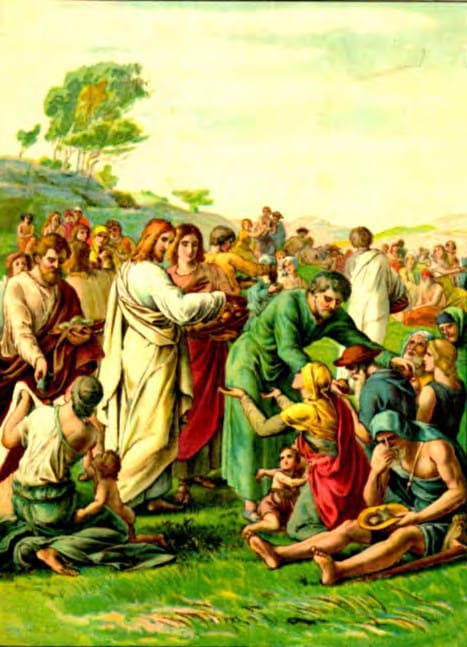
Have you seen a multitude of five thousand fed and filled with only five barley loaves and two small fishes that had been blessed by the Lord? You’ve seen a far greater work than that with very modest resources, aptly comparable to only five loaves and two fishes, but richly blessed by the Lord. A worldwide promulgation of spiritual food has been made to millions of people during this harvest time by the use of tracts, books, newspapers, public meetings, radio, television and personal witness work. Now the brethren in the United States and Canada are taking steps to make the delicious food of the gospel available to the multitudes in Japan. Who knows but that there may be twelve basketsful left over for use in China and elsewhere? Is not this a much greater work?
Have you seen anyone rebuke a mighty storm and create a great calm? Is it possible to perform a greater work than that? Yes it is. Remember there were only a few disciples on the ship that day who were saved from the storm that Satan had brewed. On the other hand, how many thousands of the Lord’s people have been caught in Satan’s storms of circumstances and have cried, “Master, Master, we perish!” They have heard the Master’s “Peace, be still,” and have experienced that blessed calmness of mind which comes from a renewed faith that “all things work together for good.” As Jesus walked upon the stormy sea, the Christian serenely walks the way he has chosen in a world gone mad, rising above the restless and turbulent conditions of this present evil world. The faith of Jesus’ followers today is stronger than was Peter’s who, in attempting to follow Jesus upon the water, sank in panic and cried, “Lord save me!” This too, is a greater work.
Personal Participation in These Works
But in what way do we personally have part in these “greater works”? This is important because Jesus said that those who “believe in him” would do the greater works. First and most important, we individually participate in these “greater works” in the sense that they are done in us, with our cooperation and invitation. We have, as Paul expressed it in Romans 6:19, yielded ourselves as servants to righteousness and holiness. Each consecrated and accepted follower of the Master has been raised from dead works to newness of life.
What an exhilarating experience it has been! Just as Lazarus, hearing the voice of Jesus say, “Come forth!” rose up and left the tomb, we too have responded and “passed from death unto life.”
The eyes of each one of us have been opened to see the deep things of God, but first it was necessary for us to realize our blindness and earnestly desire to see. There was once a poor blind beggar on the Jericho road who persistently cried out, “Jesus, thou son of David, have mercy on me!” (Mark 10:47) When Jesus stopped and asked him, “What wilt thou that I should do unto thee?” he eagerly responded: “Lord, that I might receive my sight!” He knew what he wanted! So we too must cooperate and yield ourselves.
Consider the incident when Jesus saw a man who had been born blind. He made clay with his saliva, “and anointed the eyes of the blind man with the clay.” (John 9:1-25) Then Jesus told him to go to a certain pool of water and wash off the clay. When the man did so, he received his sight. Jesus could have easily healed him without this procedure, but he gave the man an opportunity to cooperate, to yield himself. Blind as he was, he had to travel a certain distance to the pool. It tested his sincerity and his faith. A skeptical man might have said, “What nonsense is this? Will mud cure the blindness I have had from birth?” But this man went and did as he was told. When the splendor of light and sight burst upon his new eyes, he was able to say the words from which a grand old hymn has been composed: “One thing I know, that, whereas I was blind now I see!”
There was an even deeper significance to this peculiar method our Lord used to heal the blind man and it illustrates our part in the “greater works.” The secretions of his mouth, representing the spirit of the Lord’s lips his grace and truth and the soil with which he mixed it, represented the poor, earthly talents of the Lord’s people engaged in telling forth the truth as they have opportunity. This combination has been most effective in opening the eyes of understanding of those whom the Lord has called.
By earnestly desiring these “greater works” to be done in us, by yielding ourselves to their accomplishment in ourselves, and by cooperating with the Lord and our brethren in Christ to apply these works to other called-out ones, we fulfill the prophecy of our text: “And greater works than these shall ye do.” By our efforts and cooperation, feeble but blessed by the Lord, other ears too are unstopped to the truth. The lameness of character in others, as well as ourselves, is overcome, the spiritual palsy, fever and leprosy healed, and the minds, obsessed and sick with doctrines of devils, are made clean and lucid!
The Body of Christ Does These Works
Of course, no one individual does all of these “greater works.” But as members of the Body of Christ, we all share in whatever is accomplished by the whole body. Paul wrote:
“And the eye cannot say unto the hand, I have no need of thee, nor again the head to the feet, I have no need of you.” 1 Corinthians 12:21,22
Here is the next verse from the Diaglott: “But much more necessary are those members of the Body which are thought to be more feeble.” Isn’t that encouraging? We can all take heart from that verse. This means that our humble and feeble efforts, which we think are so futile and so ineffective, are noted by the Lord, and we are reckoned and counted as having a real part in the complete works of the entire body, including the head, Christ Jesus! I continue with the 29th and 30th verses:
“Are all apostles? Are all prophets? Are all teachers? Are all workers of miracles? Have all the gifts of healing? Do all speak with tongues? Do all interpret?”
The obvious answer is “No.” But each one of us, regardless of our positions in the body, are considered by God as participating in the works of the whole body.
There is an important application of our text which is yet to be fulfilled more “greater works” to be done and it is a wonderful and delightful prospect. We are assured that if we are faithful unto death, we shall “live and reign with Christ a thousand years.” The work of that Millennial Kingdom is a work of restitution. We will be the administrative agents of Christ in the performance of that work. At his first advent, by his wonderful works Jesus gave the people a foretaste or sample of that work, and it will be our grand privilege to bring about its complete fulfillment. Instead of a few persons, temporarily raised, all the dead will be awakened, and, if obedient, will live forever.
Under our administration all the sick will be healed, every physical disability will be eliminated, and the people will stay well. Satan and his angels, with their evil influences, will be removed from the scene to obsess human minds no more. Instead of five thousand, the entire world of mankind all who have ever lived will be supplied abundantly with the bread of life. As Jesus gave the bread into the hands of his disciples to distribute to the hungry multitude, it will then be through us that the merit of Jesus’ ransom sacrifice will be applied, and “the earth shall be full of the knowledge of the Lord as the waters cover the sea.” (Isaiah 11:9) Then will be completely fulfilled the prophecy of our text: “Verily, verily, I say unto you, he that believeth on me, the works that I do shall he do also, and greater works than these shall he do.”
We thank the Heavenly Father for the great privilege accorded us, to participate in the “greater works” now. May we be prepared for the still greater works of the future!
The Lilies of the Field
ON ONE occasion a very large number of people gathered to hear Jesus preach the gospel of the kingdom and to be healed by him. The account is in the twelfth chapter of Luke. We read in the first verse that “there were gathered together an innumerable multitude of people, insomuch that they trod one upon another.” The Diaglott says that “the crowd … assembled by tens of thousands so that they trampled on each other.”
But Jesus wanted to especially teach his disciples that day and warn them about something. So after ministering to the crowd, he drew his disciples aside to have an intimate talk with them. The Scribes and Pharisees had been getting particularly vicious of late. Jesus had exposed their evil deeds and they reacted with murderous intent. So he warned his disciples, saying, “Beware ye of the leaven of the Pharisees, which is hypocrisy.” Then he told his disciples not to be afraid of them and assured them of God’s particular care saying, in the sixth verse, “Are not five sparrows sold for two farthings, and not one of them is forgotten before God?” Matthew 10:29 makes these words of Jesus even more meaningful: “And not one of them shall fall on the ground without your Father.” He went on to say, “But even the very hairs of your head are all numbered. Fear not, therefore, ye are of more value than many sparrows.”
It was hard for his disciples, and it is hard for us, to conceive of the Almighty God who is so very great taking notice of things as small and insignificant as sparrows, caring whether one of them falls to the ground or not. But it must be so. Didn’t he create the sparrow? Didn’t he design its organism? Didn’t he make its bones hollow and light and at the same time shaped and braced for maximum strength?
Didn’t he design its wings, and arrange its colorful feathers to permit graceful flight? Didn’t he give it a coat of down and higher temperature than other animals to keep it warm? Didn’t he put a song in its heart and implant in its little head unerring instincts which rival the highest navigational skills of civilized man? Of course he marks the sparrows fall! He has regard for every living thing that he has made. He loves them all. He himself called them “very good.” (Genesis 1:31) We read of him in Psalm 145:16, “Thou openest thine hand, and satisfiest the desire of every living thing.”
Nothing is too small for God to notice. But it is so different in the world. Big important men of the world “can’t be bothered” with little things and little people. But the Almighty God, the Creator of heaven and earth, notices and cares. Jesus told us about the sparrows on this occasion to teach us that we, the Lord’s people, are his special and particular care, “Of more value than many sparrows.”
Do you realize that to a child of God, nothing happens by accident? This is so, because “all things work together for their good.” As in the case of the sparrow, “Not one of them shall fall … without your Father!” Every incident in life has meaning for us and is for our good, for our highest spiritual welfare. It is so different with the world in general. With them God permits the wrath of men and of Satan to have free sway, to bring misfortune and calamities without rhyme or reason except as it provides an experience with sin. But the wrath of men and of Satan has no indiscriminate power over us. This is shown by John 19:10,11. Pilate said to Jesus, “Know est thou not, that I have power to crucify thee?” Jesus replied, “Thou couldest have no power at all against me, except it were given thee from above.” Remember that Jesus was not speaking to an insignificant person when he said this. He was speaking to the king, one representing the universal empire of Rome, the highest power in the world at the time. He said that even Pilate had “no power at all” against him unless permitted by God. This was true of Christ and it is true of every member of the body of Christ. We are on an entirely different basis than the world. Every experience we have is permitted and designed by God, to work something good to us. As Paul said,
“For our light affliction, which is but for a moment, worketh for us a far more exceeding, and eternal weight of glory.” 2 Corinthians 4:17
Then Jesus said to his disciples, “But the very hairs of your head are all numbered.” This is a beautiful figure of speech showing how intimately God knows us and understands us. He knows all about us. He knows us better than we know ourselves. We do not know the number of hairs upon our heads. David expressed the same thought:
“O Lord, thou hast searched me, and known me. Thou knowest my down sitting and mine uprising. Thou understandest my thoughts afar off. Thou compassest my path, and my lying down, and art acquainted with all my ways. For there is not a word in my tongue, but lo, O Lord, thou knowest it altogether.” Psalm 139:1-5
Yes, he knows us “altogether” even to the number of hairs upon our heads! I’m going to read the fifth verse from Leeser: “Behind and before, hast thou hedged me in, and thou placest upon me, thy hand.” The Lord has hedged us in completely surrounded us by his loving providences, and his hand is in all our affairs, small and great.
At this point in Jesus’ teaching of his disciples there was an interruption. Apparently, some of the large crowd had followed Jesus and were “listening in” to his instruction. Although Jesus’ words to his disciples were sublime words, they did not appeal particularly to others. What did they care about the sparrows and hairs of the head? So one of the crowd interrupted Jesus to present a personal financial problem which he thought more important. After all Jesus was considered a learned and influential rabbi. So we read, starting with Luke 12:13:
“And one of the company said unto him, Master speak to my brother, that he divide the inheritance with me.”
This man’s father had apparently left everything to his brother, perhaps for good reason, but he wanted to get his hands on some of the money.
“And he [Jesus] said unto him, Man, who made me a judge, or a divider over you?”
Then, although he refused to comply with the man’s request, he took this opportunity to teach them all, his disciples and the others alike, a valuable lesson of general application.
“And he said unto them, Take heed, and beware of covetousness; for a man’s life consisteth not in the abundance of the things which he possesseth. And he spake a parable unto them, saying, The ground of a certain rich man brought forth plentifully; and he thought within himself, saying, What shall I do, because I have no room where to bestow my fruits? And he said, This will I do; I will pull down my barns, and I will build greater; and there will I bestow all my fruits and my goods. And I will say to my soul, drink and be merry. But God said unto him, Thou fool! This night thy soul shall be required of thee. Then whose shall these things be, which thou hast provided? So is he that layeth up treasure for himself, and is not rich toward God.”
Here Jesus reiterated a common fact of life, summed up by the modern expression, “You can’t take it with you.” Solomon said the same thing in Ecclesiastes 6:1,2:
“There is an evil which I have seen under the sun, and it is common among men. A man to whom God hath given riches, wealth, and honor, so that he wanteth nothing for his soul of all that he desireth; yet God giveth him not power to eat thereof, but a stranger eateth it. This is vanity, and it is an evil disease.”
By this parable Jesus told the man who coveted his brother’s inheritance, and all others who desire wealth,
“It really isn’t worth it. It isn’t worth all the conniving, all the scheming. It isn’t worth the sweat, and toil, and tears. Even if you do amass great wealth, you will never live long enough to enjoy it.
After all your labor, you will have to leave it behind. There is much more to life than the feverish ambition for riches.”
As Jesus expressed it: “A man’s life consisteth not in the abundance of the things which he possesses.”
Did you know that at the end of the parable he told of a way that you can take it with you? He gave an alternative; he spoke of being “rich toward God.” He thus contrasted the “laying up of treasures on earth,” as the man in the parable had done, with the more excellent way of “laying up of treasure in heaven” and thus being really “rich toward God.” As he had previously told them, in his sermon on the mount, Matthew 6:19-21:
“Lay not up for yourselves treasures upon earth, where moth and rust doth corrupt, and where thieves break through and steal; but lay up for yourselves treasures in heaven, where neither moth nor rust doth corrupt, and where thieves do not break through and steal. For where your treasure is, there will your heart be also.”
Where are our hearts? Our hearts are beyond the veil. We have set our hearts on heavenly things, on the heavenly kingdom, to live and reign with Christ. By our preparation for that kingdom, by the development of the mind of the New Creature, we are laying up in heaven the great treasure of glory, honor and immortality, and the privilege of participating in the kingdom work of blessing the world. Thus we are “rich toward God.”
This teaching of Jesus emphasizing heavenly things and the relative unimportance of earthly things led up to the beautiful lesson of Matthew 6:25-34 which has comforted the hearts and soothed the minds of Christians throughout the centuries:
“Therefore I say unto you, Take no thought for your life, what ye shall eat; nor yet for your body, what ye shall put on. Is not the life more than meat, and the body more than raiment? Behold the fowls of the air; for they sow not, neither do they reap, nor gather into barns; yet your Heavenly Father feedeth them. Are ye not much better than they? Which of you, by taking thought, can add one cubit unto his stature? And why take ye thought for raiment? Consider the lilies of the field, how they grow. They toil not, neither do they spin; and yet I say unto you, that even Solomon in all his glory was not arrayed like one of these. Wherefore, if God so clothe the grass of the field, which today is, and tomorrow is cast into the oven, shall he not much more clothe you, O ye of little faith? Therefore, take no thought, saying, What shall we eat? or, What shall we drink? or, Wherewithal shall we be clothed? (For after all these things do the Gentiles seek); for your Heavenly Father knoweth that ye have need of all these things. But seek ye first the kingdom of God, and his righteousness, and all these things shall be added unto you. Take therefore no thought for the morrow; for the morrow shall take thought for the things of itself. Sufficient unto the day is the evil thereof.”
These verses written 2000 years ago have astonished modern psychiatrists because they embody principles completely in harmony with the latest scientific findings regarding mental health. Some doctors actually prescribe the reading and memorizing of these verses in the treatment of psychosomatic illnesses. Well they might because the wisdom given here is that of the one who designed and created the human mind. This is the very wisdom of God. All of Jesus’ teachings were of God. Jesus told us so: “The words that I speak unto you, I speak not of myself, but the Father that dwelleth in me.” John 14:10
Anxiety kills and incapacitates more people than any other single factor. A large number of diseases are induced by uncontrolled anxiety. But Jesus did not give these teachings to his disciples to cure their illnesses or keep them physically well. They are for our spiritual health. If we appropriate them to ourselves, we will obtain the blessing promised in Philippians 4:7: “And the peace of God, which passeth all understanding, shall keep your hearts and minds through Christ Jesus.” We need this “peace of God” so much these days. The present evil world is disintegrating all about us with horrible grinding noise. Masses of humanity are in turmoil and rebellion. Law and order are breaking down. We are living in the days of the fulfillment of Luke 21:25, 26:
“Upon the earth distress of nations, with perplexity; the sea and the waves roaring; men’s hearts failing them for fear, and for looking after those things which are coming on the earth.”
But amid all this the Lord’s people are able to enjoy the “peace of God which passeth all understanding.” The disciples of old could not understand the peacefulness of Jesus during a storm at sea, related in Mark 4:37-39:
“And there arose a great storm of wind, and the waves beat into the ship. And he was in the hinder part of the ship, asleep on a pillow. And they awake him, and say unto him, Master, carest thou not that we perish? And he arose, and rebuked the wind, and said unto the sea, Peace, be still. And the wind ceased, and there was a great calm.”
If we can learn and take to heart the lesson Jesus gave us in Matthew 6:25-34, we too will experience a great calm. The restlessness and storms of the world will no longer affect us.
What Did Jesus Really Mean?
Before we consider what these sayings of Jesus mean, let us first consider what they do not mean. When Jesus said “Take no thought for your life, what ye shall eat; nor yet for your body, what ye shall put on,” hedid not encourage us to carelessness or sloth. He did not mean that we should go to bed without having, to the best of our ability taken thought and made preparation for the morning meal. He did not mean that we should expect clothes to grow upon our backs as feathers do upon sparrows or adornment upon lilies.
How do we know he did not mean this? Because there are many plain scriptures to the contrary. For example, Romans 12:11 admonishes us to be “not slothful in business.” Romans 12:17 says to “provide things honest in the sight of all men.” Ephesians 4:28 advises the man of God to “labour, working with his hands the thing which is good that he may have, to give to him that needeth.” 1 Timothy 5:8 positively states that “if any provide not for his own, and especially for those of his own house, he hath denied the faith, and is worse than an infidel.”
There is much other scriptural evidence as well. Did not our Lord reprove the idlers in the parable of the vineyard? (Matthew 20:6) Did he not call the slothful servant wicked, in the parable of the talents? (Matthew 25:26) Did he not hold up to scorn the thoughtless builder who began constructing a tower without taking thought whether he could finish it? (Luke 14:28-30) It is written in Proverbs 6:6, “Go to the ant, thou sluggard; consider her ways and be wise.” Is it not the ant’s custom to lay up provision in advance of necessity? Besides the Creator’s method of having a plan and working all things towards its accomplishment certainly does not indicate that he would approve of carelessness, thoughtlessness, improvidence or any such thing.
Let us not suppose that these words of the Master teach that people should not make reasonable provision for their own needs and comfort, and to arrange matters that they might not be dependent upon charity in their old age. Let us not suppose that he meant that parents should be neglectful of their duties toward dependent members of their own families. On the contrary, the entire tenor of the scriptures indicate that God’s people are to be frugal, to avoid debts, to be “forehanded,” and to be with some reserve of capital. Economy is a part of the divine arrangement. This was clearly illustrated by our Lord Jesus. Although he had the power to create food fora great multitude, he nevertheless instructed his disciples to gather up the fragments that remained so that they might be utilized for another meal. He thus taught conservation of resources and condemned wastefulness.
Having determined what our Lord did not mean by his reference to the fowls of the air and the lilies of the field, let us now consider what he did mean and avail ourselves of the peace of mind and heart he desired to convey to us by this lesson.
“Therefore I say unto you, Take no thought for your life, what ye shall eat; nor yet for your body, what ye shall put on. Is not the life more than meat, and the body more than raiment?”
The Diaglott interlinear says more correctly, “Be not over-anxious about your life, what you shall eat … nor about your body, what you shall wear.”
Jesus knew of the corrosive effect of fear and anxiety upon the mind. He knew that to be overly anxious about earthly things would be a special hindrance to those walking the narrow way. So he told them not to worry unduly about such things. The apostle expresses the same thought in Philippians 4:6 [Diaglott interlinear]: “Be not over- anxious about anything.” As we have seen, this does not refer to a proper care and sense of responsibility regarding our affairs but refers to extreme worry, an anxiety that would rob the soul of rest and peace, indicating a lack of faith in the Lord and in his care for his people. We should always realize that the Lord’s care over us is thorough and complete. Psalm 37:23 says that all our steps are ordered of the Lord. Psalm 84:11 tells us that no good thing is withheld from us. This is confirmed by Romans 8:28, that all things are made to work together for our good. We are constantly under the Lord’s particular care because 1 Peter 3:12 assures us that the eyes of the Lord are ever upon the righteous and his ears are open to their prayers.
Then Jesus said, “Behold the fowls of the air; for they sow not, neither do they reap, nor gather into barns; yet your heavenly Father feedeth them. Are ye not much better than they?” Luke renders this text (12:24), “Consider the ravens; for they neither sow nor reap; which neither have storehouse nor barn; and God feedeth them. How much more are ye better than the fowls?”
Considering the ravens brings to mind the experiences of Elijah, related in 1 Kings chapter 17. Ahab was an exceedingly wicked king of Israel the worst one they had ever had. 1 Kings 16:33 tells us that “Ahab did more to provoke the Lord God of Israel to anger than all the kings of Israel that were before him.” He consorted with Jezebel. He was morally corrupt and led Israel into the most detestable idolatry. As a punishment, God decreed that there should be no dew nor rain upon the land. This was serious because they had no means of irrigation except drawing water by hand from wells. So it would mean a complete crop failure and resulting famine. Elijah delivered the Lord’s decree to Ahab and was then directed to flee from the king’s vengeance and hide by a certain brook. We read the account from 1 Kings 17:4-6:
“And it shall be that thou shalt drink of the brook; and I have commanded the ravens to feed thee there. So he went, and did according unto the word of the Lord; for he went and dwelt by the brook Cherith that is before Jordan. And the ravens brought him bread and flesh in the morning, and bread and flesh in the evening; and he drank of the brook.”
Various efforts have been made to discount the miracle implied here but there is no reason to believe that the account is not literally true. To this day the open-air bazaars of the east must always guard against ravens plundering their stalls, and it is very likely that Elijah was thus fed from the bazaars of nearby Jerusalem or Jericho by ravens nesting at the brook by which he hid. In any case the lesson to us is one of divine care and providence over those who are devoted to God’s service. We may be sure that he who sustained Elijah can equally sustain us and, if necessary, by means just as unusual and unconventional.
Then Jesus said, “Which of you, by taking thought, can add one cubit unto his stature?” The Diaglott renders it more accurately: “Which of you, by being over-anxious, can prolong his life one moment?” This emphasizes the utter futility and foolishness of worrying about things beyond our control. It is foolish for the world to do so and leads them to nervous breakdowns. It is particularly absurd for the Lord’s people to do so, because the things beyond our control are under the complete control and under the firm guiding hand of our loving Heavenly Father. Did not Jesus say in Luke 18:27, “The things which are impossible with men, are possible with God”?
In order to attain the rest of soul promised we must learn to develop a complete reliance upon God. If we are faced with a seemingly impossible situation, we should first do all we can and then say to the Lord: “This thing is beyond me. I can do nothing more. Please take over for me, and do what is best.” In this we will comply with Psalm 55:22: “Cast thy burden upon the Lord, and he shall sustain thee. He shall never suffer the righteous to be moved.” Having done this, we should dismiss all anxiety from our minds and completely relax. David did this, as he said in Psalm 3:4,5: “I cried unto the Lord with my voice, and he heard me … I laid me down and slept.”
The Lord is entirely capable of handling every situation. He is a merciful God and his powers are limitless. Bro. Russell beautifully expresses this thought on page 1560 of the Reprints.
“The Psalmist says, `The Lord is good to all, and his tender mercies are over all his works.’ (Psalms 145:9,16) This sweeping statement takes in the utmost bounds of the material universe, and also the humblest, as well as the most exalted, sentient being. The whole creation is his care. Jehovah, our God, is the great Emperor of the whole universe and his wisdom, power, goodness, and benevolence are abundantly equal to all the responsibilities of so exalted an office. The human mind staggers in its efforts to comprehend the mental resources of a being who is able to assume and to bear such responsibility. Think for a moment of the memory that never fails; of the judgment that never errs; of the wisdom that plans for eternity without the possibility of failure, and that times that plan with unerring precision for the ages to come; of the power and skill which can harness even every opposing element, animate or inanimate, and make them all work together for the accomplishment of his grand designs; of the tireless vigilance that never ceases, nor seeks relief from the pressing cares of universal dominion; whose eye never sleeps, whose ear is ever open, and who is ever cognizant of all the necessities, and active in all the interests of his broad domains. Well has the Psalmist said, in consideration of the immensity and the minutiae of God’s providences over all his works: `Such knowledge is too wonderful for me. It is high; I cannot attain unto it!’ Psalms 139:6”
Now we come to that part of the lesson which is the most beautiful of all. Jesus said, “And why take ye thought [or, are over-anxious] for raiment? Consider the lilies of the field, how they grow. They toil not, neither do they spin, and yet I say unto you, That even Solomon, in all his glory, was not arrayed like one of these. Wherefore, if God so clothe the grass of the field, which today is, and tomorrow is cast into the oven, shall he not much more clothe you, O ye of little faith?”
Continuing from the Diaglott:
“Therefore, be not over-anxious, saying What shall we eat? or, What shall we drink? or, With what shall we be clothed? [Luke’s account adds in 12:29: “And be not in restless suspense.”] For all the nations require these things; and your Heavenly Father knows that you have need of these things. But seek you first his righteousness and kingdom; and all these things shall be super-added to you.”
It is interesting to note that our Lord did not choose a hot-house plant but chose a flower of the field for his illustration. The lily of the field grows under exposed conditions. It thrives under such conditions because the great Creator has arranged for its best interests. This does not mean that the plant is idle. If it were idle, it would die. It is not idle by any means. It continually sends forth roots and absorbs and avails itself of the nourishment provided. But does the lily grow by worrying? No. It merely uses the opportunities that come to it. It reaches out for them. By so doing it develops and matures and blossoms and has an exquisite organism which, even under the microscope, displays a breath-taking beauty. The lesson is obvious. The field is the world. The Lord has placed us in an exposed and seemingly unfavorable environment. Nevertheless his providences are so arranged that his people grow, thrive, and become very beautiful in the character-likeness of the Lord; in his eyes more beautiful than Solomon in all his glory.
Other Spiritual Lessons
Now let us go back in review and see what further spiritual lessons may be derived from these sayings of Jesus. When Jesus told his disciples, “Therefore, I say unto you, Take no thought for your life,” he referred to life laid down. As he said in John 15:13, “Greater love hath no man than this, that a man lay down his life for his friends.” Jesus did so, as he said in John 10:15: “I lay down my life for the sheep.” We also lay down our lives, with his, as expressed in Colossians 3:3: “For ye are dead, and your life is hid with Christ in God.” In this sense we should take no over-anxious thought for our human lives which are on the altar of sacrifice. We should say, as Paul did, “Neither count I my life dear unto myself.” (Acts 20:24) Our primary interest should be our spiritual lives, to live and reign with Christ.
Jesus referred to food: “Take no thought … what ye shall eat.” He spoke of how the Heavenly Father feeds the fowls of the air. For us there is food much more important than bread and meat. Satan tried to over-emphasize the importance of material food, but Jesus replied, “Man shall not live by bread alone, but by every word that proceedeth out of the mouth of God.” (Matthew 4:4) As food is scattered for birds to feed upon and satisfy their hunger, ample and rich spiritual food is provided for those who “hunger and thirst after righteousness.” Matthew 5:6
The food upon which we feed should not be a fluid, changeable thing this way today, that way tomorrow. This is not conducive to peace of mind. It produces agitation, uncertainty. The real truth is something in which we can become established. The apostle says, “Wherefore I will not be negligent to put you always in remembrance of these things though ye know them, and be established in the present truth.“ (2 Peter 1:12) “Remembrance” does not mean something new. We cannot remember what we have never known before. So the apostle does not here speak of new and strange things but old established truths, the same old truths that the Lord completely restored to his Church at this end of the age by the hand of a faithful and wise servant whom he made ruler over all his goods. (Matthew 24:45-47) It is only by holding on to the old truths the Lord has thus given us that peace of mind and heart can be maintained.
Jesus said, “Besides, which of you, by being over-anxious, can prolong his life one moment?” Some today are over-anxious as to when the Messianic phase of the Kingdom will be openly manifested in power and glory upon the earth. “We have waited 2000 years for the Kingdom to come,” they say. “We couldn’t bear to have to wait another hundred years!” This is not a valid statement. Nobody has waited 2000 years and no one will have to wait another hundred years. None of us has waited any longer than the few years of his consecrated life and no one will wait a moment longer than the end of his human existence. Let us not be over-anxious about this. The Messianic Kingdom will be openly manifest to the world exactly on time regardless of any anxiety on our part.
Jesus spoke of raiment and how God so splendidly clothed the lilies of the field that they rivaled even Solomon’s glory. Then he asked, “Shall he not much more clothe you?” He was referring to more than earthly clothing. He was referring to that glorious robe of Christ’s righteousness with which we are arrayed, a robe which covers our imperfections and makes us beautiful indeed, which makes us acceptable to God and enables us to “seek the kingdom of God.” Compared to this glorious robe, our human wants are insignificant. God knows all the things we need as natural men. As it is written, “Your Father knoweth what things ye have need of before ye ask him.” (Matthew 6:8) Jesus added, “But seek ye first the kingdom of God, and his righteousness, and all these things shall be added to you.” The Diaglott says “super-added to you,” signifying abundance. God is very generous.
Now we come to the final admonition of Jesus on this occasion: “Take therefore no thought for the morrow; for the morrow shall take thought for the things of itself. Sufficient unto the day is the evil thereof.” The Diaglott reads: “Be not over-anxious, then, about the morrow; for the morrow will claim anxiety for itself. Sufficient for each day is its own trouble.”
It is so foolish and inconsistent for the Lord’s people to worry about the morrow. It indicates a lack of faith. Worrying about the future is simply a refusal to take God at his word. Has he not said, “I will surely do thee good?” (Genesis 32:12) Are we not told, “The angel of the Lord encampeth round about them that fear Him, and delivereth them?” (Psalms 34:7) It is written, “No weapon that is formed against thee shall prosper.” (Isaiah 54:17) Also, “I will never leave thee nor forsake thee.” (Hebrews 13:5) These are definite and positive promises of God. It is written in 1 Kings 8:56, “There hath not failed one word of all his good promise.” We should remind ourselves of how the Lord has dealt with us in the past, thinking often of his providential leadings of the past, and remember that he has not changed!
By worrying about the future we bring ourselves down to the level of those described in Luke 21:26: “Men’s hearts failing them for fear; and for looking after those things which are coming.” We should not be on this level. On the contrary, our hearts should be full of happy anticipation of good things from our Heavenly Father. We read, “Prove me now herewith, saith the Lord of Hosts, if I will not open you the windows of heaven, and pour you out a blessing, that there shall not be room enough to receive it.” (Malachi 3:10) We should expect a plentitude of blessing from the Lord, and nothing but good because we are promised that everything is working for our good. Our only concern should be whether we have room enough to receive the abundance of spiritual blessings promised. Make room and they will come.
After all why should we, his children, anticipate evil from God? Has he given us reason to do so? How would you like it if your children always anticipated evil from you? As Jesus put it in Luke 11:11-13:
“If a son shall ask bread of any of you that is a father, will he give him a stone? Or if he ask a fish, will he for a fish, give him a serpent? Or, if he shall ask an egg, will ye offer him a scorpion? If ye, then, being evil, know how to give good gifts unto your children; how much more shall your Heavenly Father.”
Do you remember the happy and carefree days of your childhood? Rich or poor, your loving parents supplied everything you needed. Did you have to worry about what you would eat or wear, or whether you would have shelter the next day? No. Such a thought never entered your mind. You would have been surprised if anyone suggested such a thing. You had parents, didn’t you? That was enough. Why can’t we have the same reliance upon our Heavenly Father, as we did upon our earthly father? He is much more loving and powerful and reliable.
So instead of taking anxious thought, let us joyfully anticipate tomorrow. It is tomorrow when we will gain an abundant entrance into the everlasting kingdom of our Lord and Saviour Jesus Christ. (2 Peter 1:11) All the good things promised to the poor groaning creation are coming tomorrow. In the world of tomorrow, now so close, physical restitution blessings will flow to the people of the world. Tomorrow death will be abolished. It is tomorrow that Revelation 21:4,5 will be accomplished:
“And God shall wipe away all tears from their eyes; and there shall be no more death, neither sorrow, nor crying, neither shall there by any more pain; for the former things are passed away. And he that sat upon the throne said, Behold, I make all things new!”
Now the world is filled with fear and fear is contagious; it is catching. We must guard our hearts and minds against the fear that is saturating the world. To do this we must constantly refresh ourselves with God’s Word and revealed truth, and keep close to God in prayer. As the apostle sums it up:
“Be not over-anxious about anything; but in everything let your petitions be made known to God, by prayer and supplication, with thanksgiving. And that peace of God which surpasses all conception, shall guard your hearts, and your minds by Christ Jesus.” Philippians 4:6, 7, Diaglott
Let us avail ourselves of this wonderful peace!
The Love and Mercy of God
THE God revealed to us in the Bible is a kind, loving and merciful God. He is the highest embodiment of every virtue. Having created man, he is infinitely nobler than the noblest man. Although he disciplines his human children temporarily for their own good, he is as a loving Father to them. We read of him:
“The Lord is merciful and gracious; slow to anger, and plenteous in mercy. He will not always chide; neither will he keep his anger for ever. He hath not dealt with us after our sins, nor rewarded us according to our iniquities. For as the heaven is high above the earth, so great is his mercy toward them that fear him. As far as the east is from the west, so far hath he removed our transgressions from us.
Like as a father pitieth his children, so the Lord pitieth them that fear him. For he knoweth our frame; he remembereth that we are dust.” Psalms 103:8-14
We are told that “God is love.” (1 John 4:16) Love is a controlling attribute of God’s character. Everything he does is influenced by love. He is loving and merciful to all whether they deserve it or not. He is loving even to his enemies. We read the words of Jesus:
“But I say unto you, Love your enemies, and pray for them which despitefully use you and persecute you; that ye may be the children of your Father which is in heaven; for he maketh his sun to rise on the evil and on the good, and sendeth rain on the just and on the unjust.” Matthew 5:44,45
“Love your enemies … and ye shall be the children of the Highest; for he is kind unto the unthankful and to the evil. Be ye therefore merciful, as your Father also is merciful.” Luke 6:35,36
Thus we see that God is kind and merciful even to those who are evil, unjust and unthankful.
No other religion than that of the Bible reveals such a God of love and compassion. This is a God we can love, reverence and worship with all our hearts. No other religion than that of the Bible suggests so high a standard of dealing with our fellow men. As we read in Luke:
“Thou shalt love the Lord thy God with all thy heart, and with all thy soul, and with all thy strength, and with all thy mind; and thy neighbor as thyself.” Luke 10:27
This rule of love, which has been called “The Golden Rule,” is positively stated as “All things whatsoever ye would that men should do to you, do ye even so to them.” (Matthew 7:12) Probably the closest approach to this sentiment is found in the writings of Confucius: “Do not do to others what you would not wish them to do to you.” Although this is an admirable rule, there is a vast difference between it and the Bible’s Golden Rule. The rule of Confucius is negative, saying, Do not do evil to others. This rule can be obeyed by doing nothing. It is passive. But the Golden Rule of Christ is positive. It says, Do good to others. This calls for love in action; it is what God does. He has planned good things for his human family and he will positively bring them to pass.
There are some who claim the Bible teaches the eternal torment of the wicked in a hell of literal fire. This puzzles many who ask: “If God is loving and merciful, how can he torment anyone?” The doctrine of eternal torment is not taught in the Bible. It is based upon mistranslations and misinterpretations of certain symbolic passages of scripture. It is obviously false since it is entirely contrary to the loving character of God. Since he made us, we know that he is better than we are. Would you torture your child? No matter what he had done, would you, even for a moment, hold his hand over a flame?
Would you torture even an animal? Of course not. No sane person would. So eternal torment is a terrible thing with which to charge God and is totally untrue. God is infinitely superior to us. His thoughts and ways are so much higher than ours. If you are kind, loving, merciful and forgiving to your children, he is much more so to his human family. We read in Isaiah:
“Let the wicked forsake his way, and let the unrighteous man his thoughts; and let him return unto the Lord, and he will have mercy upon him; and to our God, for he will abundantly pardon. For my thoughts are not your thoughts, neither are your ways my ways, saith the Lord. For as the heavens are higher than the earth, so are my ways higher than your ways, and my thoughts than your thoughts.” Isaiah 55:7-9
There are several scriptures that tell us plainly that God would not even think of tormenting anyone, that to do such a terrible thing never came into his mind. In ancient times the false gods Baal and Molech were worshipped by the offering of human sacrifices. Little children were burned alive upon the high altars of these gods. The loving God of the Bible considered this an abomination and a sin, totally contrary to his will. Thus we read:
“They have built also the high places of Baal, to burn their sons with fire for burnt offerings unto Baal, which I commanded not, nor spake it, neither came it into my mind.” Jeremiah 19:5
“And they built the high places of Baal … to cause their sons and their daughters to pass through the fire to Molech; which I commanded them not, neither came it into my mind, that they should do this abomination.” Jeremiah 32:35
The penalty for sin is not eternal torment. It is very plainly stated to be death in Genesis 2:17. God said to Adam before he sinned, “Thou shalt surely die.” After Adam had sinned, God told him: “Thou [shalt] return unto the ground; for out of it wast thou taken. For dust thou art, and unto dust shalt thou return.” (Genesis 3:19) If torment was to be the penalty for sin instead of death, God would certainly have told Adam so before he sinned so he might be forewarned of what to expect. For God to have thus clearly stated the penalty to be death and then, after the sin had been committed, to have changed the penalty to an eternal life of torment, would have been most unjust. It would be deceptive. God is neither unjust nor deceptive.
This is especially important because the penalty did not involve Adam alone but included all his race.
“Wherefore, as by one man sin entered into the world, and death by sin; and so death passed upon all men, for that all have sinned.” Romans 5:12
Since God is so loving, merciful and forgiving, will the penalty of death ever be removed? Will it ever come to pass that mankind will continue to live, and not to die any more? The Bible most emphatically teaches that the death penalty will be removed. In fact, the first step has already been taken. We read:
“For God so loved the world, that he gave his only begotten Son, that whosoever believeth in him should not perish, but have everlasting life.” John 3:16
Jesus came to earth as a perfect man and died on the cross as a ransom sacrifice for Adam, giving up his un forfeited life in the place and stead of Adam’s forfeited life, paying the penalty of death for Adam and all his race. Thus he became the Saviour of all mankind. This provided the basis for God’s forgiveness and the removal of the death penalty. God says, “I will forgive their iniquity, and I will remember their sin no more.” (Jeremiah 31:34) Paul writes of “Our Saviour Jesus Christ, who hath abolished death.” (2 Timothy 1:10) The kingdom of God on earth, for which we have so long prayed with the words “Thy kingdom come, thy will be done in earth as it is in heaven,” will soon be manifested. Even those who have already died are not forgotten. God lovingly holds them in his memory and will bring them back to life again. Families, parted by death, will be reunited. You will see your loved ones again. Jesus himself told us:
“Marvel not at this; for the hour is coming in the which all that are in the graves shall hear his voice, and shall come forth.” John 5:28,29
The Multi-Metallic Image
ONE of the most fascinating and inspirational books of the Bible is that of Daniel. No modern literature provides such interesting narrative nor portrays a nobler hero. In addition to the sheer excitement of its adventure the book contains lessons of the highest precepts. It is full of lessons and examples of sublime faith, loyalty, courage, integrity, and complete and absolute devotion to God. It also contains prophecies of tremendous and worldwide importance, presented in the most dramatic manner. Those prophecies which have been fulfilled are seen by Bible Students to have been precisely accurate; those in the process of fulfillment or unfulfilled are the subject of intense interest and anticipation by those acquainted with God’s plan.
The book of Daniel was given for us, the last members of the body
of Christ, right now. How do we know? Because we are now living in that period of history known as “the time of the end.” We are living in “the end of the age,” the Gospel age, and the beginning of the Millennial age. We read the words of the Lord:
“And he said, Go thy way, Daniel; for the words are closed up, and sealed, till the time of the end. Many shall be purified, and made white, and tried; but the wicked shall do wickedly and none of the wicked shall understand; but the wise shall understand.” Daniel 12:9,10
So today we are going to consider a small portion of the book of Daniel and see what lessons it has for us. We read from the first chapter:
“In the third year of the reign of Jehoiakim, king of Judah, came Nebuchadnezzar, king of Babylon, unto Jerusalem, and besieged it. And the Lord gave Jehoiakim, king of Judah, into his hand.”
This was some 20 years before the final destruction of Jerusalem. Nebuchadnezzar took many captives to Babylon at this time. This was the first captivity and included the very cream of the Jewish nation. We read:
“And the king [Nebuchadnezzar] spake unto Ashpenaz, the master of his eunuchs, that he should bring certain of the children of Israel, and of the king’s seed, and of the princes; children in whom was no blemish, but well-favored, and skillful in all wisdom, and cunning in knowledge, and understanding science; and such as had ability in them to stand in the king’s palace; and whom they might teach the learning and the tongue of the Chaldeans.”
These are very high and exacting qualifications which king Nebuchadnezzar set. Ashpenaz obeyed him selecting a considerable number of the very elite of the nation: “Now among these were of the children of Judah: Daniel, Hananiah, Mishael, and Azariah.”
At this time Daniel was 14 years old; the others were probably about the same age. We immediately begin to wonder how a 14-year-old boy could possibly meet the specifications which had been set: “Skillful in all wisdom, and cunning in knowledge, and understanding science.” I think it is obvious that this refers to some sort of qualifying test which was applied similar to our modern IQ test to make the selections. It was a kind of aptitude test that would indicate a person’s capacity or potential, whether a person would be skillful in learning wisdom, or cunning in absorbing knowledge, or logical enough to understand science, if these things were taught to him. These boys were also tested for what we would today call the quality of poise. This is indicated by the requirement: “And such as had ability in them to stand in the king’s palace.” After all Nebuchadnezzar ruled the world with force and was greatly feared. Incurring his slightest displeasure meant death:
“All people, nations, and languages, trembled and feared before him. Whom he would, he slew, and whom he would, he kept alive, and whom he would, he set up, and whom he would, he put down.” Daniel 5:19
For one to stand calmly before such a fearsome monarch and his court required a high degree of self-assurance which, in the case of Daniel and his companions, was based upon faith in God.
We know that they were the children of godly, reverential, parents because of their names. The name Daniel means “God is my judge.” Hananiah means “Jehovah is gracious” or “Jehovah has favored.” Mishael means “God-like.” Azariah means “Jehovah has helped” or “The help of Jehovah.” This clearly denotes a God-fearing parentage and upbringing. Today we would say that they were “born and raised in the truth.”
There is no doubt that Godly traits can be inherited from Godly parents as well as be inculcated by early training. One such trait is faith. Paul mentions this in his letter to Timothy:
“When I call to remembrance the unfeigned faith that is in thee, which dwelt first in thy grandmother Lois, and thy mother Eunice, and I am persuaded that it is in thee also.” 2 Timothy 1:5
Early Child Training Is Important
We read in Proverbs, “Train up a child in the way he should go; and when he is old, he will not depart from it.” (Proverbs 22:6) The training of our children in the precepts of the truth is not only an obligation but a great joy. Our joy in them is supreme should it ever transpire that the Lord calls them and they consecrate to him. But many of us are disappointed in this regard.
It will help us to remember that there are only a limited number of crowns available. The Lord knows how many there are and who should have them, and HE does the calling. But there are some who say, tearfully:
“Something went wrong. I did train up my child in the way he should go, and he did depart from it! In his adolescence and young manhood, he rebelled, and went his own way. What happened? What did I do wrong?”
Let’s read the scripture again. It says: “When he is OLD, he will not depart from it.” When he is young, he might. In his adolescence, in the sometimes confused transition from childhood to manhood, he might depart from it. For a while, in his efforts to free himself from parental control, he might seem to depart. But he can’t entirely forget his early training, or ignore his inheritance. When he is older, when he has matured, then “he will not depart from it!” I have met a number of second generation, and even third generation, consecrated individuals who have had this very experience. Not that all the children of the consecrated will eventually consecrate but in every case their early training, their Christian upbringing, will make an indelible impression upon their characters leaving a definite mark which will tend to evoke the Lord’s blessing in the future.
By common consent Daniel seems to have been the leader and spokesman of the Hebrew boys who had thus been selected for special training in the court of the king of Babylon. It was a sort of’ royal university with the faculty composed of the wisest men of the realm. It was a three-year course at the completion of which the king himself would give them an examination and from this graduating class the king would draw his assistants and councilors of state for the rulership of the universal empire of Babylon.
What a wonderful opportunity! While studying they would be treated as members of the royal household. So we read:
“And the king appointed them a daily provision of the king’s meat, and of the wine which he drank; so nourishing them three years that at the end thereof they might stand before the king.” Daniel 1:5
Daniel must have been a handsome and personable lad. Even the master of the king’s servants, called “the prince of the eunuchs,” whom we might assume from his position of command to be a severe man, was strongly attracted to Daniel. The account is: “Now God had brought Daniel into favor and tender love with the prince of the eunuchs.” Surely God did not coerce the prince of the eunuchs to love Daniel. He did cause him to observe Daniel’s fine qualities and be won over by these. The superior qualities of the boy Jesus at about the same age were similarly noticed because we read:
“And Jesus increased in wisdom and stature, and in favor with God and man.” Luke 2:52
This favor with God and man was not something outside of Daniel himself. I think we can infer that by heredity and by natural training of Godly parents Daniel had a noble, amiable, winsome character, a character that not only prepared him to be the Lord’s mouthpiece but that also made him attractive to all with whom he had to do.
There is a lesson here not only for young people but also for the parents who shape them. We should seek to attain characteristics pleasing to God and inoffensive to those about us. We should not be hated except for our loyalty to God and the truth, directly or indirectly. It is only then that we may take satisfaction in it, or think we are suffering for righteousness’ sake, or expect to be rewarded for it. The apostle points out some suffer as evildoers and as busybodies in other men’s matters. (1 Peter 4:15) Others suffer because of ungentleness, uncouthness or lack of the wisdom of moderation which the Lord counsels. (Philippians 4:5; James 1:5)
Let us contrast, for a moment, the condition of Daniel and his companions before their captivity and after their captivity.
In Jerusalem, reared by Godly Hebrew parents, strictly trained in the law and the statutes, they led a sheltered and blameless existence.
Suddenly they found themselves among the worst of the heathen where the Hebrew law was totally ignored, where might made right, where moral standards did not exist, where strange and cruel gods were worshiped instead of Jehovah. They were in the household of the king, favored by him and obligated to him for their well-being and future prospects. They were young, and away from parental and religious control. It would have been perfectly natural under these circumstances for them to adopt the ways and customs of their heathen hosts, to lower their standards, to become careless in their conduct, and to say to themselves:
“What’s the difference? Who will know? Surely, we must not offend our benefactors by being too different from them? When in Rome, do as the Romans do, or, more correctly, when in Babylon, do as the Babylonians do.”
The Young Hebrews Remain Faithful Although it would have been quite natural, these young Hebrews were unusual persons. They did not take the lax and easy way, the natural way. In the very beginning a crisis arose because of their determination to remain faithful to the law of their God. We read:
“But Daniel purposed in his heart that he would not defile himself with the portion of the king’s meat, nor with the wine which he drank. Therefore he requested of the prince of the eunuchs that he might not defile himself.”
The food provided for these college students was good, probably far better and more varied than they had been used to previously. But Israelites, under their law covenant were forbidden to eat certain foods which were in common use among the other nations, food such as pork, rabbit flesh, eels, oysters, etc. Other meats had to be slaughtered in a certain manner to eliminate the blood. There were other regulations regarding the manner of food preparation and combination. If these statutes of the law were violated, the person was considered defiled. Even at his youthful age and in spite of the temptation to eat exotic foods, which probably were most delicious, Daniel was determined to adhere to the law of his God. Instead of the king’s food he requested that they be supplied pulse to eat and with water instead of wine to drink. “Pulse” is a term applied to legumes, such as peas, beans, lentils, and perhaps certain grains. The prince of the eunuchs objected fearing the Hebrew boys would appear undernourished and that he would be held responsible. But after a ten-day trial, the young Hebrews were found to be in better condition than those who ate the king’s food, so they were allowed to continue on their plain but wholesome diet.
Daniel’s determination not to be defiled with certain food reminds us of the words of the apostle: “If any man defile the temple of God, him shall God destroy.” (1 Corinthians 3:17) In one sense of the word, the temple of God is his church. This is borne out by Peter: “Ye, also, as living stones, are built up a spiritual house.” (1 Peter 2:5) There is a powerful lesson here. It is brought out by Pastor Russell’s comments on Daniel’s attitude regarding defiling food:
“Whoever introduces into the church that which is defiling; whoever does injury to any of its living stones; is an evildoer in the highest sense of that term, in that he is defiling and injuring the body of Christ, which is the church. If all could realize this, how careful all would be in respect to the bringing in of different errors, and false doctrines, misinterpretations of scripture, etc. How careful each then would be, to see that he speaks the things which he does know; that he would confine himself to the things written in the word of the Lord. In proportion as those who are right at heart see this, they will be careful that they do nothing to defile or stumble or injure any of the Lord’s little ones.” Reprints, page 3621.
How accurately Bro. Russell described what would happen! He was a very wise man. After his departure evildoers did indeed arise using Bro. Russell’s own publishing facilities to introduce false doctrines that stumbled thousands. Many precious truths revealed by our returned Lord were repudiated and replaced by erroneous doctrines that upset and did violence to the plan. Old, well-proven, and precious truths were rudely pushed aside and replaced by so-called “new light.” By contrived translations and cunning misinterpretations of scriptures, the faith of many of the Lord’s little ones was overthrown. Those responsible were indeed, in the language of Bro. Russell, “evildoers in the highest sense of that term” because Jesus himself said:
“But whoso shall offend one of these little ones, which believe in me, it were better for him that a millstone were hanged about his neck and that he were drowned in the depth of the sea.” Matthew 18:6
May God grant that it never happens again!
Simple Food Represents Truth
Daniel and his companions ate plain and simple food. I think the lesson of simplicity is taught here. Our meetings and worship should be marked by simplicity. All needless ceremony such as practiced by the nominal churches should be shunned. There is a danger that we will lose our simplicity. Most of us came out of the nominal systems or were members of fraternal organizations, and a tendency for ceremony has stuck to us. It has a certain fascination and we are liable to revert to it. That is why Paul said:
“But I fear, lest by any means, as the serpent beguiled Eve through his subtility, so your minds should be corrupted from the simplicity that is in Christ.” 2 Corinthians 11:3
There is another and more important lesson regarding the food of Daniel and his companions. It was plain but nourishing food. The truth is like that. It is not complicated. In its purity it is plain, simple and satisfying. Some needlessly complicate the truth. This causes confusion and sometimes division. “Babylon” means confusion. As Daniel and his companions shunned the exotic and enticing foods of Babylon, the Lord’s people will shun confusing doctrines, old and new. The structure of truth is a finely balanced building, one structural member depending upon another forsupport. Take out one piece or alter its shape and the structure no longer balances; the other pieces no longer fit. If we deny even one essential and well- established doctrine or alter its meaning, even a seemingly unimportant one, we destroy the symmetry and harmony of the truth.
We read of Daniel and his companions after they had eaten simple and wholesome food for ten days:
“And at the end of ten, days their countenances appeared fairer and fatter in flesh than all the children which did eat the portion of the king’s meat.” Daniel 1:15
The plain, clean, unadulterated truth agrees with us. It makes us serene and confident no matter what transpires on the earth. There can be no surprises for us because we know the plan and our place and part in it. This knowledge should show, as with Daniel and his companions it should show in our countenances. The difference should be noticed. The world is in a state of wild-eyed fear:
“Upon the earth distress of nations, with perplexity; the sea and the waves roaring; men’s hearts failing them for fear, and for looking after those things which are coming on the earth; for the powers of heaven shall be shaken.”–Luke 21:25,26
But our condition is described in Psalm 46:
“God is our refuge and strength; a very present help in trouble. Therefore will not we fear, though the earth be removed, and though the mountains be carried into the midst of the sea. Though the waters thereof roar, and be troubled; though the mountains shake with the swelling thereof.” Psalms 46:1-3
The knowledge of the pure, plain, wholesome truth should show in our faces and be reflected in our spirits and attitudes. It should daily influence the way we conduct ourselves.
Daniel and his companions were conscientious in their studies. We read of them in verse 17:
“As for these four children, God gave them knowledge and skill in all learning and wisdom; and Daniel had understanding in all visions and dreams.”
We are not to understand that this skill and learning were wholly miraculous. The gift of understanding visions and dreams was of course miraculous. Only Daniel had this gift. The general knowledge and skill they achieved was a natural result of aptitude combined with conscientious effort. These were boys who had the strength of character to impose self-denial for righteousness’ sake. This showed the stuff they were made of. We would expect them to have courage and strength of character in all other matters including their studies. Their determination in the matter of their food, showing that they would rather deny themselves than violate God’s law, is very revealing. It indicated a mental and moral discipline, an attribute that would be helpful in all the affairs of life.
Little Things Do Matter
There is a lesson in this for every Christian. Many are inclined to think of the little things of life as unimportant. But it is a fact that proficiency cannot be attained in any department of life without determined will-power. It is equally true that we cannot show strength of will-power in important things if we are lax and pliable in the small things of life. A Christian who wants to be an overcomer at all must make the effort all along the line, on every point great or small, where conscience and principle are involved. This is a teaching of our Lord:
“He that is faithful in that which is least, is faithful also in much. Luke 16:10
The three-year course of study was finally finished. We read:
“Now at the end of the days that the king had said he should bring them in, then the prince of the eunuchs brought them in before Nebuchadnezzar. And the king communed with them; and among them all was found none like Daniel, Hananiah, Mishael and Azariah. Therefore stood they before the king. And all matters of wisdom and understanding that the king inquired of them he found them ten times better than all the magicians and astrologers that were in all his realm.”
This is somewhat astonishing when we remember the ages of Daniel and his companions. They were now only about 17, yet in wisdom and understanding were ten times better than all the magicians and astrologers in Babylon! This reminds us of Paul’s admonition to young Timothy:
“Let no one despise thy youth, but become a pattern of the believers; in word, in conduct, in love, in purity.”–1 Timothy 4:12, Diaglott
We are in a condition similar to that of Daniel and his companions, and our prospects are similar. As they found themselves captives in a strange land, we are strangers and pilgrims in the earth. (1 Peter 2:11) We are in the world but not of the world. As they were enrolled in the royal college, we are in the school of Christ. They were selected for their special schooling because certain potentialities were seen in them. Before the Father draws us to Christ he sees potentialities in us. Rough and poor though our exteriors may be, God looketh on the heart. He never calls one for enrollment in the school of Christ in preparation for the high calling unless he sees in that person the ability to make his calling and election sure, with God’s help. This should be very encouraging to us. As Daniel and his companions were being fitted for positions of rulership in the kingdom, we are being prepared to reign with Christ. As they learned all the wisdom of the Chaldeans, we are made “wise unto salvation.”
(2 Timothy 3:15) When their course of study had ended, Daniel and his companions were brought before the king, the king communed with them, and was satisfied with their attainments. As for us when our course is ended, we will appear before the King of kings, and Lord of lords. Our head, Jesus Christ, will present us to God the Father. As Jude expresses it:
“Now unto him that is able to keep you from falling, and to present you faultless before the presence of his glory with exceeding joy; to the only wise God our Saviour, be glory and majesty, dominion and power, both now and forever.” Jude 24,25
Our great King will commune with us too. We shall see him face to face and hear his “Well done, thou good and faithful servant.” What a thrilling and joyful experience that will be! It is not too distant for some of us. In the words of Psalm 17:
“As for me, I will behold thy face in righteousness. I shall be satisfied when I awake with thy likeness.” Psalms 17:15
Daniel, Hananiah, Mishael, and Azariah, the children of Judah, were now members of a very elite group. Not only were they considered on a par with the group described as “the magicians, and astrologers, and the sorcerers, and the Chaldeans,” but they with other graduates of the royal college formed a sort of executive pool–a pool of talent from which came the magistrates, administrators, and rulers over the provinces of the expanding Babylonian empire. Even though the king had declared them to be “ten times better than all the magicians and astrologers … in all matters of wisdom and understanding,” it would only be natural that those of more mature age would be first selected. So it might take years for their turns to come. But the Lord had plans for them in Babylon; he had work for them to do, especially Daniel. He did not wait for the normal course of promotion to leisurely operate. He intervened; he speeded things up. It is always true that where the Lord’s people and his service are concerned, the principle of Psalm 75 applies:
“For promotion cometh neither from the east nor from the west, nor from the south; but God is the judge; he putteth down one, and setteth up another.” Psalms 75:6,7