
The Land Promised to Abraham
Instead of the one pair of eyes of Abraham, three million pairs of eyes of the children of Abraham were looking at that same land. This was the land of which Joseph spoke when he was upon his death-bed in Egypt, saying:
“I die. And God will surely visit you, and bring you out of this land, unto the land which he sware to Abraham, to Isaac and to Jacob.” Genesis 50:24
This was the very land of which God spoke to Moses when he commissioned him to lead the children of Israel out of Egypt, calling it “a good land, and a large; unto a land flowing with milk and honey.”
They were here at last! All they had to do now was to walk in and take possession. Although the land was already inhabited by other peoples, this should present no problem to them. Had not the Almighty God given it to Israel assuring them over and over again that it was theirs? Could not the God who had so easily and so recently destroyed the armies of Egypt on their behalf also disperse these enemies before them? It would be logical to think so. But it did not seem logical to these who had so recently been slaves. They needed further assurance. So it was proposed to spy out the land before venturing into it, first to see whether it was a good and productive land and second to determine whether the inhabitants were such as they would be able to defeat and drive out. This seemed a very strange thing to do. Were they not assured of both of these points already? Had not the Lord repeatedly told them that it was a good land, that it was theirs for the taking? You would think they would take the Lord at his word. Nevertheless they sent out twelve spies, one from each tribe, among whom were Caleb and Joshua.
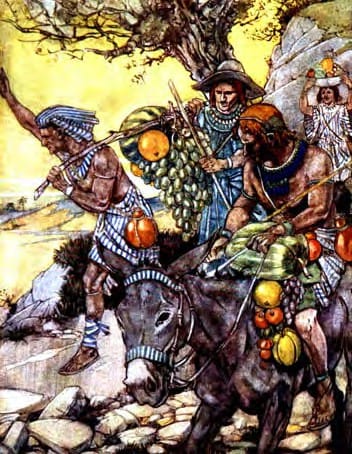
After forty days of searching out the country, the spies returned and made their report. They were unanimous as to the facts. It was indeed an exceedingly good land. As proof of this they brought back some of the fruit of it grapes, pomegranates and figs, which were large and of excellent quality. For example, a single bunch of grapes was of such size and weight that it had to be suspended from a pole and carried between two men. The spies also agreed that the inhabitants of the country were strong and warlike, living in high- walled cities, and that some of the people were of great stature. In all of these things they were in agreement. But it was astonishing to see how different persons can take the very same set of facts and reach opposite conclusions.
Ten of the spies said, “We be not able to go up against the people for they are stronger than we.” (Numbers 13:31) But two of them reached a different conclusion. Caleb said enthusiastically: “Let us go up at once and possess it; for we are well able to overcome it!” (Numbers 13:30) Then Caleb and Joshua both stood before the people:
“And they spake unto all the company of the children of Israel, saying, The land which we passed through to search it, is an exceeding good land. If the Lord delight in us, then he will bring us into this land, and give it to us; a land which floweth with milk and honey. Only rebel not ye against the Lord, neither fear ye the people of the land; for they are bread for us [Moffatt: “we shall eat them up”]. Their defence is departed from them, and the Lord is with us. Fear them not.” Numbers 14:7-9
But the people rejected the optimism of Caleb and Joshua and even wanted to stone them for expressing it. They accepted instead the evil and pessimistic report of the ten spies, and became utterly discouraged. They wept, saying, “Would God that we had died in the land of Egypt! Or would God we had died in this wilderness!” (Numbers 14:2) They rebelled against God who had only a few months before demonstrated his mighty power on their behalf in delivering them from Egypt, saying:
“Wherefore hath the Lord brought us unto this land, to fall by the sword; that our wives and our children should be a prey? Were it not better for us to return into Egypt?” Numbers 14:3
They rebelled against Moses, saying: “Let us make a captain and let us return into Egypt.” (Numbers 14:4) Rather incredible, isn’t it.
Here they were, on the very border of the Promised Land, an occasion which should have been the happiest moment of their lives, and instead they considered their situation a hopeless calamity! The Lord was very displeased with them. We read:
“And the Lord said unto Moses, How long will this people provoke me? And how long will it be ere they believe me, for all the signs which I have showed among them?” Numbers 14:11
The Lord took them at their word. They had said, “Would God we had died in the wilderness!” This was their sentence and they had pronounced it upon themselves. The Lord told Moses:
“Say unto them, As truly as I live, saith the Lord, as ye have spoken in mine ears, so will I do to you. Your carcases shall fall in this wilderness; and all that were numbered of you, according to your whole number, from twenty years old and upward, which have murmured against me . . . Ye shall not come into the land concerning which I sware to make you dwell therein, save Caleb . . . and Joshua . . . But your little ones, which ye said should be a prey, them will I bring in, and they shall know the land, which ye have despised.” Numbers 14:28-31
Because of their cowardice and lack of faith they were found unworthy. They must now leave that beautiful Promised Land behind and return into the howling wilderness. They must wander about in it for forty years until all the adults then living except Caleb and Joshua had died. Then their children were to return and enter the Promised Land.
At Canaan’s Borders Again
Now we pass over forty heart-breaking years of the wilderness experiences of Israel. They have now returned. We find them once again on the borders of Canaan, but now there is a great difference! All that rebellious generation had died as the Lord had said. Their great leader Moses also had died and was buried by the hand of God in the land of Moab. Israel now consisted of those who were under age when they were here forty years before, and their children who were born in the wilderness. The cringing slavishness which characterized the adults who came out of Egypt had been eliminated. There were only two men left who remembered the rigors of Egypt as adults and they were the faithful Joshua and Caleb. Joshua had replaced Moses as their divinely appointed leader. We read:
“Now after the death of Moses, the servant of the Lord, it came to pass that the Lord spake unto Joshua, the son of Nun, Moses’ minister, saying: Moses my servant is dead. Now, therefore, arise, go over this Jordan, thou, and all this people, unto the land which I do give to them, even to the children of Israel. There shall not any man be able to stand before thee all the days of thy life. As I was with Moses, so I will be with thee. I will not fail thee, nor forsake thee. Be strong and of a good courage; for unto this people shalt thou divide for an inheritance the land, which I sware unto their fathers to give them. Only be thou strong and very courageous.” Joshua 1:1,2,5-7
Once again they were poised to enter the Land of Promise, but what a difference! Now there was strength, assurance, and confidence!
No cringing fearfulness, no hesitation, no murmuring, no complaining. Their bright new spirit is manifested in Joshua 1:16,18:
“And they answered Joshua, saying, All that thou commandest us we will do; and withersoever thou sendest us, we will go. Whosoever he be that doth rebel against thy commandment and will not hearken unto thy words in all that thou commandest him, he shall be put to death. Only be strong and of a good courage.”
What a difference! Instead of the necessity of Joshua encouraging them, they told him to be strong and courageous!
Their first objective upon crossing the river must be the conquest of Jericho, a city located about five miles from the Jordan. It was a high-walled city with strong defenses, capable of withstanding siege. They must first destroy Jericho because if they did not, but marched past it, their enemies would undoubtedly use the city as a sanctuary from which to attack them from the rear. So Joshua sent two spies to Jericho to observe and report on the strength of the city and the spirit of its defenders. The spies returned:
“And they said unto Joshua, Truly the Lord hath delivered into our hands all the land; for even all the inhabitants of the country do faint because of us.” Joshua 2:24
The next day the hosts of Israel approached the Jordan and camped at the edge of it. It was the worst possible time of the year in which to attempt a crossing. The river was in full flood stage and overflowing its banks. Normally a hundred feet wide, and shallow and fordable at this point, it was now perhaps 500 feet wide with the main channel running deep and swift. They had no boats nor pontoons with which to construct a bridge. Even if there had been a bridge and they marched across it ten abreast for twelve hours a day, it would take more than seven days for the three million or more Israelites to make the crossing.
But the Jordan being at flood stage was really a blessing in disguise. The Canaanites, who were aware of the approaching Israelites, considered the river to be an impassable barrier and felt secure.
Had it been shallow and fordable, as it usually was at this point, you may be sure they would have been there in force to repel an invasion. Israel would have had a severe battle with poor weapons against a well-equipped enemy. But all this was prevented by the swollen river which the Canaanites did not believe Israel could cross.
That raging, roaring river must have been a fearful sight to desert dwellers, but there is no record that the children of –Israel were afraid and complained at this prospect of crossing it as their fathers had done forty years before. They rested in the Lord and depended upon him to show how it was to be done.
Joshua sent his officers among the people to instruct them as to the plan of procedure to be followed, which he had received of the Lord. So great was the host of Israel that this took three days. Today with modern radio and voice amplifying equipment it could be done almost instantly. The instructions were simple. The priests were to take up the Ark of the Covenant and march into the river which would dry up at their approach. Then the children of Israel were to cross over on dry land. The order was given and the priests, bearing the sacred Ark, slowly approached the river. Every eye was upon them as they came closer and closer to the water. Would it dry up before them as the Lord had said? Excitement ran high. The priests got to the very edge of the water and nothing happened. The water did not draw back.
A hush fell upon the watching host of Israel, but the priests did not hesitate; they did not break their stride. Their orders were to march into the river and that is what they did. As soon as they actually stepped into the water, the miracle happened. The water drew away from their feet. Each step they took the water receded further. As they advanced and the level of the water fell, the roaring of the river diminished and the current slowed. As they approached the main channel the raging torrent had shrunk into a limpid-flowing brook.
When they finally stepped down into the lowest part of the river bed, the water disappeared entirely. Reaching the center of the river the priests with the ark stopped and were standing on dry ground. The children of Israel had been watching with fascination. Now the signal was given and the millions of Israel who lined the bank in each direction as far as eye could see quickly passed over without even getting their feet wet. When all were across safely, the priests, bearing the ark, completed the crossing. Now before the astonished eyes of the Israelites the process was reversed. With each step the priests took up from the bed of the river, the water began to flow again and increase in volume, licking at their heels as they walked. As soon as they had gained the opposite shore, the Jordan was once again a raging torrent.
What a grand feeling it must have been to at last enter the Promised Land! For many weary years they had anticipated it, dreamed about it, yearned for it. Whenever things went wrong during their wanderings, when they hungered and thirsted and were weary, how often they must have said: “Some day we will reach that land flowing with milk and honey which the Lord has promised us!” Every time they broke camp to roam some more in the scorching desert they must have said: “Some day we will not need these tents. When we get to that wonderful Promised Land we will wander no more. We will build houses and live under our own vines and fig trees, in a cool land of rivers and lakes!” Now the time had come at long last: they were actually walking on that Promised Land! Then came the conquest of Jeri–cho by another stupendous miracle which may well be the subject of another talk.