
God Prepares a Great Leader (Moses)
THE setting of our lesson is Egypt, where the children of Israel resided, in the land of Goshen. Joseph had ruled Egypt for 80 years, dying at the age of 110. Many years had passed since then, as we read in Exodus 1:6-8.
“And Joseph died, and all his brethren, and all of that generation. And the children of Israel were fruitful, and waxed exceeding mighty; and the land was filled with them. Now there arose up a new king over Egypt, which knew not Joseph.”
Since Joseph ruled Egypt for 80 years, there was undoubtedly more than one Pharaoh on the throne during the period. But they were benevolent Pharaohs who recognized and appreciated Joseph’s administrative ability and remembered the great debt they owed him for saving their nation from famine. But, now, many years after Joseph’s death a new Pharaoh had risen, who did not respect Joseph, and who was antagonistic toward the Israelites and did not recognize any debt to them, nor to Joseph whose people they were.
It is generally agreed that this Pharaoh was Rameses the second, a hard hearted, selfish, and wicked despot. It is this Pharaoh who “knew not Joseph.” Using the Revised Version, we read in Exodus 1:9,10:
“And he said to his people, Behold, the people of Israel are too many and too mighty for us. Come, let us deal shrewdly with them, lest they multiply, and, if war befall us, they join our enemies and fight against us, and escape from the land.”
This Pharaoh saw that the Israelites were more rugged stock, and were multiplying much more rapidly than the Egyptians. Therefore, he considered them a menace to the country.
Up to this time the presence of Israel had been considered a protection to Egypt; a sort of buffer zone. The land of Goshen lay to the eastward and it was from this direction that an attack from Assyria might be expected. Thus, Israel would take the brunt of the attack. But now, with the Israelites becoming more numerous than the Egyptians, a new danger threatened. It occurred to this suspicious and cynical Pharaoh that an invading army might bribe Israel with the promise of independence, thus enlisting their support to overthrow his rule in Egypt. So he decided to do something about it.
In order to stop their population growth, Pharaoh gave orders to have the Israelites subjected to extremely hard labor with the idea that this would debilitate them. Not many realize the tremendous scope of his program of oppression. He completely and drastically reorganized the lives of the children of Israel. He converted the entire land of Goshen, with its over two millions of population, into a vast prison state with every able-bodied man sentenced to hard labor under the cruel administration of armed slave-masters.
What a contrast this was to their previous condition. When they first came to Egypt they were shepherds and herdsmen . That is why they were given the land of Goshen which was a grassy plain suitable for grazing. Pharaoh said to Joseph these words, as found in Genesis 47:6,
“The land of Egypt is before thee. In the best of the land make thy father and thy brethren to dwell. In the land of Goshen let them dwell.”
Herding cattle and sheep is not easy, but it is a clean invigorating life, spent in large and peaceful open spaces without confining restrictions and the pressure of continual urgency. But now all this was rudely changed. Suddenly, these peaceful shepherd people were rounded up and put in chain gangs for the making of brick and to do heavy construction work. A labor for which they were totally unsuited. They were driven to the limit of human endurance by the whips of strong taskmasters. Thus we read the account in Exodus 1:11-14, “Therefore, they did set over them task-masters, to afflict them with their burdens. The Moffatt translation reads:
“They put them under captains of the labor gangs, to crush them with heavy loads, and they built for Pharaoh treasure cities, Pithom and Raamses. But the more they afflicted them, the more they multiplied and grew. And they were grieved because of the children of Israel. And the Egyptians made the children of Israel to serve with hard bondage, in mortar and in brick, and in all manner of service in the field. All their service wherein they made them serve with rigour.”
The making and handling of sun-dried brick is hard work, even when one is not driven in his labors as were the Israelites. First, the clay must be dug from the alluvial deposits of the Nile delta, and wet and heavy, it must be back-packed to the factory site. And all the while a lively pace must be maintained. Then the clay must be further wetted and mixed with chopped straw as a binder, and rammed tightly in molds. Then, after the setting of the mixture, the molds must be inverted and the wet bricks carried on heavily-loaded stretchers to the drying floors. High daily quotas were established for brick production, calculated to tax human endurance to the utmost, and severe beatings administered for failure to meet the quotas. Then the bricks after being turned over several times in the drying process must be –gathered and back-packed to the building site, often miles away. In all this, speed was constantly urged by whip-wielding guards. Many of the workers dropped under their loads in sheer exhaustion. When this happened they were mercilessly beaten with sticks upon the soles of their feet until they got up and staggered on.
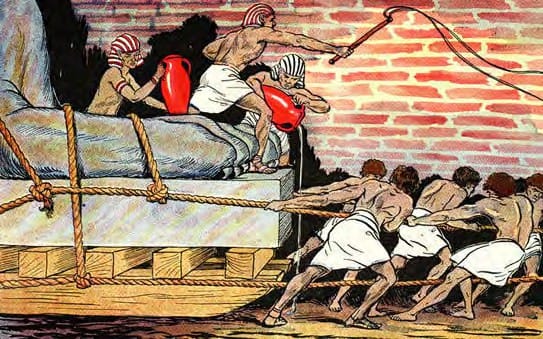
The record is, that with these bricks the children of Israel built whole cities of warehouses for Pharaoh, in which to store the treasures of Egypt. This construction work, too, was very laborious. Mortar must be produced. They did not have Portland cement in those days, but used a mixture of clay and bitumen, substances very difficult to combine. As the erection of a building progressed, scaffolding had to be built, and the bricks and mortar carried up ladders to the bricklayers. The Egyptian brick of that time was much larger than ours, weighing perhaps ten pounds each. Here, again, high quotas were enforced. So many bricks a day must be laid, under penalty of severe punishment.
And the women carried their share of the burden. Many gave up their homes, took their young children with them, and set up camp near their men-folk, to cook for them and provide a place of rest and comfort at the end of the long day’s toil. Many others undoubtedly replaced the men in the work of tending flocks and herds. The statement of Exodus 1:14, states, “that the children of Israel were pressed into all manner of service in the field.” This implies that, in addition to brick-making, they were compelled to learn all the trades and occupations of their master. Thus, from being herdsmen, they were forced into an industrial school, learning the various skills of the most advanced civilization of that time. Such training, although severe, proved to be very useful later on when they were delivered from Egypt and were on their own. Thus it was overruled for their good.
But this elaborate plan of Pharaoh did not work as intended to prevent the increase of the children of Israel. In verse 12 we read, “But the more they afflicted them, the more they multiplied and grew.” But it did provide the Egyptians an enormous supply of very profitable slave labor. So it was continued as a national policy.