
The Healings Attracted an Audience
There was no telegraph or telephone in those days, no daily newspapers, not even a regular mail service since not many knew how to read or write. But word began getting around, as though by electricity, and rumors started to fly–A NEW PROPHET HAD ARISEN IN ISRAEL! “This man can heal all manner of diseases, even leprosy,” the reports said. “He can cast out demons! He just tells them to leave and they do!”
At first there was disbelief–there had been false prophets before. “Let’s not get too excited about this,” someone would say, “probably nothing to it.” Then the next caravan would bring more news “He is a young man, named Jesus from Nazareth. He has cast out a legion of demons; they entered a herd of swine, and went over a cliff! A touch of his hand, and the blind receive their sight! Even one born blind, without eyeballs, can now see!”
There was still some disbelief this was just too good to be true. Then came the news that the dead son of a widow at Nain had been actually restored to life by this wonderful young man, and that he had miraculously fed not a hundred as Elisha had done in days of old, but five thousand persons! That was all they needed to know! How could they miss? Here was a man of God who would not only heal their diseases, but if they ran out of money he would feed them as well. So we read, “And there went out a fame of him throughout all the regions round about.” (Luke 4:14) Thousands upon thousands of people left their homes and businesses and converged upon the place where Jesus was: the sick, the lame, the blind, the deaf and dumb, and those with mental afflictions. The able-bodied ones carried the disabled ones; those with sight led the blind. All had one purpose to find this man Jesus and be healed of their diseases.
It was the most natural thing in the world that they should do this. This is what Jesus wanted them to do. He wanted them to come to him. It was ordained that he should be identified in just this manner by his miracles of healing and thus to draw men to him. As we read:
“Now when John had heard in the prison the works of Christ, he sent two of his disciples, and said unto him: Art thou he that should come, or do we look for another? Jesus answered and said unto them, Go and show John again those things which ye do hear and see the blind receive their sight, and the lame walk, the lepers are cleansed, and the deaf hear, the dead are raised up and the poor have the gospel preached unto them. Matthew 11:2-5
Jesus knew that John the baptist was familiar with the old prophecies he would recognize their fulfillment, he would know from the works of Jesus that Jesus was indeed the Messiah. John did know.
Picture the situation. Suppose it was announced today by reputable eye-witnesses that there was a man lecturing publicly in your city who could heal every disease, regardless how advanced, including cancer and insanity, who could cure every degree of blindness, instantly repair the damage to any organ or limb, and even bring back to life any who had died up to four days before. What would happen? Why there would be the greatest traffic jam in history! Just about everyone would want to see him and hear him. Although many would come out of curiosity, most would come in desperate earnestness to be healed of their afflictions. Human nature was the same in Jesus’ day; the proportion of afflicted ones was much greater.
They came by thousands and thousands, most of them on foot–poor, ill-clothed, dusty, hungry, sick or caring for the sick, weary from their journey, homesick in strange surroundings, scattered from their homes. Jesus’ heart went out to them when he saw them.
“When he saw the multitude he was moved with compassion on them, because they fainted and were scattered abroad.” Matthew 9:36
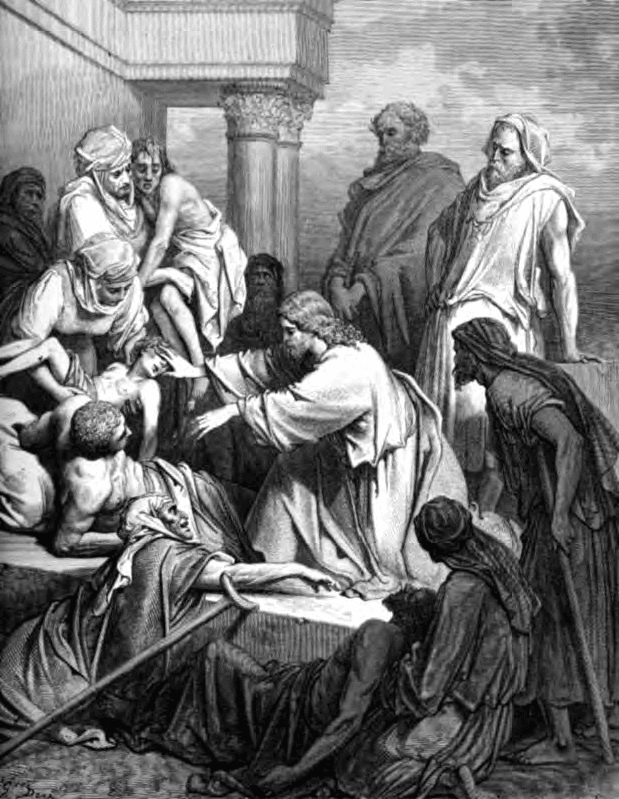
Many of us do not realize the really magnificent scope of Jesus’ healing activities. Some have the impression that he healed only a few people, as a sort of small sample of what would eventually be done in his millennial kingdom. But in fact he gave a most generous sample. He translated his great compassion into great action. As we read:
“And from Jerusalem, and from Idumea and from beyond Jordan; and they about Tyre and Sidon; a great multitude, when they had heard what great things he did, came unto him.” Mark 3:8
“A great multitude of people, out of all Judea and Jerusalem, and from the sea-coast of Tyre and Sidon, which came to hear him, and be healed of their diseases. And the whole multitude sought to touch him, for there went virtue [power] out of him and healed them all.” Luke 6:17,19
A great multitude is a lot of people, and he healed them all not just one or two, here and there, but all.
“And Jesus went about all the cities and villages, teaching in their synagogues and preaching the gospel of the kingdom and healing every sickness and every disease, among the people.” Matthew 9:35,36
Visiting “all the cities and villages and healing every sickness and every disease” covers a lot of territory and a lot of people.
“Now, when the sun was setting, all they that had any sick with diverse diseases, brought them unto him; and he laid his hands on every one of them, and healed them. And when it was day, he departed.” Luke 4:40,42
Note that he seems to have started his healing when the sun was setting, and did not finish until daylight. It took him all night, but he healed “every one of them.”
How else could it possibly be? Could Jesus, with his loving and compassionate heart, turn to his disciples and say, “That is enough, I will heal no more today maybe some other time?” Ah no! In that great multitude would be those who had traveled long distances to find him and had already waited for days for their turn to see him.
Some had reached the limit of their endurance and were faint. The most serious cases of illness would find it the most difficult to approach him. The crowd is described in one place as “An innumerable multitude of people, insomuch that they trod one upon another.” (Luke 12:1) In their desperation to be healed, the somewhat stronger would push aside the weak, literally treading upon them, so that those who needed healing the most, would be left to the last. So Jesus stayed to the last and healed “every one of them,” even though it took all night! Thus we read:
“He healed all that were sick; that it might be fulfilled which was spoken by Isaiah the prophet saying: Himself took our infirmities and bare our sicknesses.” Matthew 8:16,17
Jesus’ Ministry Cost Him Something
He was “touched with the feeling of our infirmities.” (Hebrews 4:15) “Himself took our infirmities”: what does this mean? It means that Jesus’ healing ministry cost him something!
“Surely he hath borne our griefs and carried our sorrows … he was wounded [tormented] for our transgressions; he was bruised for our iniquities … with his stripes we are healed.” Isaiah 53:4,5
The reference here is not only to his painful death on the cross as a ransom–it included far more than that. His heart ached for every unfortunate person he saw. He was moved with compassion. When he saw someone in pain, he sympathetically felt that pain. When he saw heart-breaking sorrow over the death of a loved one, he wept! He daily bore their griefs, and carried their sorrows. His heart was wounded and bruised by the things he saw–the hopelessness and degradation and despair of the people under their bondage to Satan. He was tormented by the sight of all the suffering he saw.
All this was a drain on his nervous energy. When he healed them, he suffered a further loss–“For there went virtue out of him” vitality went out of him and he felt the loss of it.
This is revealed by an incident recorded in Mark chapter five. A certain woman had been afflicted by a wasting disease for twelve long years. During this time she had sought help from the physicians and had suffered many things at their hands, but had received absolutely no relief. Going from one doctor to another she had spent everything she had, but instead of getting better she had grown worse. Then she had heard of this wonderful young man named Jesus who was able to heal every disease. Weak as she was, she sought him out. But when she found the crowd around him was so great, she couldn’t get the Master’s attention. Important things were going on just then one of the rulers of the synagogue had asked Jesus to heal his dying daughter. Jesus had consented. A great crowd was accompanying him to the ruler’s house to see a miracle, so the poor woman knew it would be impossible for her to push her way through that crowd to see Jesus and present her petition. After all, who was she to claim his attention above that of a ruler of the synagogue?
Then, in her humility, she reasoned, “Why should I even take the time to speak to him? He has such a super-abundance of power that if I may only reach out and touch his clothes I shall be whole. He won’t miss it, he won’t even have to know about it.” So she joined
the multitude. As the crowd pressed to the front and sides of Jesus to catch his every word, she slipped up behind him and reaching out, she managed to touch his garment. It was as though she had touched a live wire–she felt a tremendous surge of energy permeate her
entire body, and with great exhilaration she knew she had been healed.
“And Jesus, immediately knowing in himself that virtue had gone out of him, turned about in the press and said, Who touched my clothes? And his disciples said unto him, Thou seest the multitude
thronging thee; and sayest thou Who touched me? And he looked round about to see her that had done this thing. But the woman fearing and trembling, knowing what was done in her, came and fell down before him and told him all the truth. And he said unto her, Daughter, thy faith hath made thee whole; go in peace, and be whole of thy plague.” Mark 5:30-34
Yes, Jesus had instantly felt virtue or power go out of him; we can presume that this occurred every time he healed anyone.
Let us try to get the full implication of this. Thousands upon thousands a very great multitude, from all parts of the country gathered to see and hear him, bringing all their sick with them. We read:
“And the whole multitude sought to touch him, for there went virtue out of him and healed them all.” Luke 6:19
If one woman touching the hem of his garment caused a loss of vitality that he could feel, what would the touch of’ a great multitude do to him? Of course he was a perfect man with an extra-ordinary store of natural vitality and unusual recuperative powers, but we can reasonably conclude that each incident of healing and teaching the multitude left him tired and exhausted physically. He was human after all. As themultitude sought him, he was literally touched with the feeling of human infirmities, he literally bore human griefs and carried human sorrows. He was wounded and bruised and tormented by human sins, yet without sin. When we consider the vast multitudes he contacted during his ministry, we realize that his 3 1/2 years of experience along this line far exceeded a lifetime of ordinary human experience.
Now let us recapitulate for a moment. Jesus had come to offer himself as a ransom for all, but he also came to preach the truth of God’s kingdom to Israel to give natural Israel an opportunity to become spiritual Israel. This is one of his last statements on earth:
“To this end was I born, and for this cause came I into the world that I should bear witness unto the truth. Everyone that is of the truth heareth my voice.” John 18:37
“Every one that is of the truth.” This means that he had to give the opportunity to all Israel to hear his voice or message, and he was only one man with a few ignorant and unlearned disciples. He had no radio, no television, no microphones, no power amplifiers, no tape recorders, no printing presses, no tracts, no magazines–and his time was very short too just 3 1/2 years in which to perform a great task.
“Fishing” for Men
What did he do? When he told his disciples that he would make them “fishers of men” (Matthew 4:19), he revealed to them his method. As a fisherman offers the fish a bait, he would offer the people something they wanted very much and they would come to him.
Then he would preach to them the gospel of the kingdom the good news that they could become the spiritual seed of Abraham, a nation of kings and priests, that they could be used to bless all the families of the earth.
What was the bait? A rich foretaste of the blessings which would, eventually, be to all the families of the earth by his millennial kingdom on earth, when life would be given more abundantly, when there would be no more sickness and pain, when all tears would be wiped away, when there would be no more death, neither sorrow nor crying. (Revelation 21:4) Yes, it was a foretaste of God’s kingdom, when the desire of all nations shall come. (Haggai 2:7) This is confirmed by Luke:
“And heal the sick that are therein, and say unto them, The kingdom of God is come nigh unto you.” Luke 10:9
Near the close of his ministry, Jesus commissioned seventy disciples to perform a harvest or gleaning work after him–to go to every city and place and preach the gospel so that no one might be overlooked. He gave these seventy disciples miraculous powers to attract people. He told them that when they entered a city, they should “heal the sick that are therein and say unto them, The Kingdom of God is come nigh unto you.” In other words, “You have tasted in advance the blessings of God’s kingdom to come this is but a sample of what the kingdom of God will eventually do on a vast and worldwide scale.” Jesus’ miracles, especially his healings, identified him as the Messiah (Mark 12:37), “and the common people heard him gladly.”
For a while Jesus was the most popular person in the land. On one occasion five thousand banded together and “when they had seen the miracle that Jesus did, said, This is of a truth that prophet (John 6:14) that should come into the world.” They planned to take him and make him a king.
Soon the time came when Jesus had taught his disciples everything their fleshly minds could absorb. They must now wait for the coming of the holy spirit to further enlighten them, to lift them to a higher plane of understanding. On one of his last days on earth Jesus gathered his disciples about him and said, “I have yet many things to say unto you but ye cannot bear them now. Howbeit, when the spirit of truth is come it will guide you into all truth.” (John 16:12,13) For 3 1/2 years they had witnessed his mighty works of healing and his other breath-taking miracles. They themselves had been empowered to perform some miracles in the name of Jesus. So they were thoroughly persuaded that Jesus was indeed the Messiah sent from God. It was on the occasion of this same gathering that Jesus said the words of our text: “Believe me that I am in the Father, and the Father in me; or else believe me for the very works sake.” Then he made a surprising statement which has mystified and frustrated Christians for centuries:
“Verily, verily, I say unto you, he that believeth on me, the works that I do shall he do also, and greater works than these shall he do.” John 14:11,12
Greater works than these? What an astounding thought! What could be greater than raising the dead, to defy the cruel finality of death as Jesus did, to tell the mourners to stop their lamentations, to tell a heartbroken mother to refrain her voice from weeping, and her eyes from tears (Jeremiah 31:16), to take the cold hand of a little dead child and say “arise,” to feel the pulse leap beneath your fingers and see the warm flush of life flood the white cheeks, to see the eyes open and look about with wonder at the strange gathering, to see the mother’s tears of hopeless sorrow turn to tears of joy as she clasps her darling in her arms? Greater works than these?
Greater works than these? To have all the sick of the entire countryside assemble before you sick of every conceivable disease and infirmity and to take them one after another and to heal every one of them?
Greater works than these? To cause the blind to see, the deaf to hear, the dumb to speak, the lame to leap and run?
Greater works than these? To change water into wine, to feed five thousand persons with five loaves and two fishes, to walk on water, to still a mighty storm?