
Pharaoh Tries Genocide
Now Pharaoh tried another method of reducing the Hebrew population. He commanded Hebrew midwives to strangle every male child at birth. But this command was disregarded, the God-fearing midwives claiming that they arrived too late. So this plan also failed. Thus we read in Exodus 1:20,
“Therefore God dealt well with the midwives. And the people multiplied and waxed very mighty.”
Furious at being thus frustrated, Pharaoh now made a decree displaying far more cruelty than even the notorious Herod who slaughtered the babes of Bethlehem. He commanded every Hebrew parent to slaughter his own male children and decreed that those failing to do so should themselves be executed. He went further than that in his Satanic cruelty. He commanded the Egyptians that if they saw any Hebrew boy they must seize him and throw him into the river and drown him. In Acts 7, verses 18 and 19 we read where Stephen refers to this Pharaoh and his evil decree:
“Another king arose, who knew not Joseph. The same dealt subtilly with our kindred, and evil entreated our fathers, so that they cast out their young children, to the end that they might not live.”
In Exodus 1:22 we read, “And Pharaoh charged all his people, saying, every son that is born, ye shall cast into the river.” These are the distressing conditions which prevailed when Moses was born.
Now we can better understand what happened next. We read in Exodus 2, verses 1 and 2:
“And there went a man of the house of Levi and took to wife a daughter of Levi, and the woman conceived, and bare a son. And when she saw him, that he was a goodly child, she hid him three months.”
This description of the babe Moses as a “goodly child” is not really adequate. In Acts 7, verse 20, Stephen describes him as being “exceeding fair,” which the Diaglott and Moffatt translations render “divinely beautiful.” Phillips calls him “a child of remarkable beauty.” Recounting this event, Paul wrote concerning Moses, in Hebrews 11, verse 23, using the Diaglott, “In Faith Moses, being born, was hidden three months by his parents, because they saw the child was beautiful: and they did not fear the edict of the king:”
Weymouth renders the text, “Through faith, the child Moses was hid for three months by his parents, because they saw his rare beauty: and the king’s edict had no terror for them.” An interesting sidelight is provided by the Jewish historian, Josephus. He records that, later on, “those who saw the infant Moses as he was carried along the streets, forgot their business, and stood still to gaze at him.”
At first it was easy enough to hide a tiny new-born baby of sweet disposition, who slept most of the time, and seldom cried; and even then, not loudly. But as the child grew, concealment became more and more difficult. The law respecting male infants was well known; and probably a reward offered for information regarding those evading it. So the time came when an agonizing decision had to be made. Considering that the child Moses was bound to be discovered sooner or later, his parents decided upon a unique plan of action.
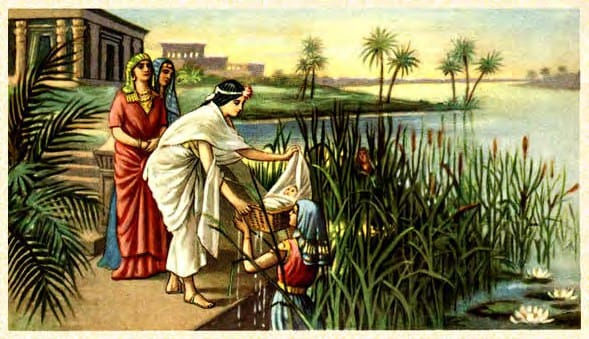
Moses and Pharaoh’s Daughter
They lived near the Nile river and their whole strategy was based upon the fact that Pharaoh’s daughter came down to the river to bathe, at a certain spot, at a certain time, every day. Although called “Pharaoh’s daughter,” we are told by historians that she was, in reality, the wife of the reigning Pharaoh, being the daughter of a preceding Pharaoh. She was barren, and greatly yearned to have a son who would be heir to the throne. The Nile river was held sacred by the Egyptians as being the source of life and fertility. So her daily immersion in the Nile was a ceremonial religious rite, performed with the object of curing her barrenness. Moses’ parents knew all this, and planned accordingly. Now let us read the scriptural account from Exodus 2:2-9, using the Revised Version, which rivals any fiction story in pathetic tenderness and emotional suspense. We will paraphrase as we go along:
“And when she could hide him no longer, she took for him a basket made of bulrushes, and daubed it with bitumen and pitch. And she put the child in it, and placed it among the reeds at the river’s brink.”
How carefully Moses’ mother wove that little basket which was to contain the most precious thing in the world to her. It was a tiny little ark, to preserve a tiny life in the water. As she made it, she probably thought of the great ark of Noah’s day which the Lord had instructed should be covered with pitch to make it water-tight. So she did likewise, testing it in a tub of water to make sure it would stay dry.
Then she lined it with the softest wool for warmth and comfort. She made a cover for it, also of bulrushes, but loosely woven to permit ventilation. Early the next morning, before it was fully light, she dressed the child in his daintiest clothes, fed him, and placed him in the ark, where he promptly went to sleep. Then, as the sun was rising, she and her husband, together with Miriam, the nine-year-old sister of Moses, carried the ark with its precious cargo down to the river. They took a last tearful look at their beautiful baby, then they covered the ark and placed it in the water at just the right spot, tying it to a clump of reeds to prevent it being carried away by the current. Before leaving they bowed their heads, committing their helpless child to God’s care. Then little Miriam, who loved her baby brother so very much, stayed behind and watched from a distance to see what would happen to him. But someone else was watching too. The angel of the Lord was there.
Do you realize that, technically, Moses’ parents had obeyed the law of Pharaoh? The edict, given in Exodus 1:22, was that every Hebrew boy must be cast into the river, even though he was in a little water-proof cradle! Now we read:
“And his sister stood at a distance, to know what would be done to him. Now the daughter of Pharaoh came down to bathe at the river, and her maidens walked beside the river. She saw the basket among the reeds, and sent her maid to fetch it. When she opened it, she saw the child: and lo, the babe was crying. She took pity on him and said, This is one of the Hebrews’ children.”
Can you imagine the impact this had on Pharaoh’s daughter? She had come to the river, yearning for a baby son, and, suddenly, she had in her arms a baby boy of surpassing beauty! How her womanly heart must have responded to the situation. The gods had heard her petition, she concluded. She had asked the sacred river to give her a son, and here it was! She immediately determined to adopt him, even though she knew he was of Hebrew parentage.
There is something about a crying baby that touches the heart. They are so entirely helpless. Crying is the only way they have to announce their needs. Pharaoh’s daughter surmised correctly that it was from hunger that the baby cried. After all, it had been several hours since he had been fed. So it was at exactly the right moment that little Miriam ran up to her, and she knew just what to say, too. As we read in the account:
“Then his sister said to Pharaoh’s daughter, shall I go and call you a nurse from the Hebrew women, to nurse the child for you? And Pharaoh’s daughter said to her, go. So the girl went and called the child’s mother. And Pharaoh’s daughter said to her, take this child away, and nurse him for me, and I will give you your wages. So the woman took the child and nursed him.”
I am sure that Pharaoh’s daughter was not deceived a bit. When she handed the baby over to the Hebrew woman, and saw how he immediately stopped his crying, and gurgled with happiness. She saw through Miriam’s little scheme. She knew that this woman was the baby’s real mother. But she didn’t care. The baby now belonged to her. He was no longer a Hebrew boy. He was now an Egyptian prince.
What a transformation there now was in the household of Moses’ parents. On one day the child Moses was a danger and a menace in their home. There was an atmosphere of fear and tension. A dread of every footstep, as perhaps that of an Egyptian officer, coming to kill their baby, and to also take their own lives for daring to disobey the royal edict. The next day, through Divine providence, the child is back in the same home, which now had become a safe and secure sanctuary, under the protection of Pharaoh himself. The child’s own mother is now paid wages by the Egyptian princess for caring for him.
Moses’ Early Years
It took a lot of faith for Moses’ parents to do what they did. Because of their faith, they qualified to be of the ancient worthy class. Paul includes them with those he lists in the 11th chapter of Hebrews. We read in the 23rd verse, Revised Version:
“By faith Moses, when he was born, was hid for three months by his parents, because they saw that the child was beautiful: and they were not afraid of the king’s edict.”
They now had a powerful incentive to instruct the child Moses in the knowledge of the Lord, and particularly of his promise to Abraham, Isaac and Jacob; that in their seed “all the families of the earth be blessed.” They realized that by his adoption into the royal family of Egypt, Moses might eventually be in a position to alleviate the sufferings of the children of Israel and, perhaps, in some way even deliver them from Egypt. They knew that Jacob had prophesied to Joseph: “I die, but God shall be with you, and bring you again unto the land of your fathers.” They knew Joseph had said, Genesis 50:24, “I die, and God will surely visit you, and bring you out of this land unto the land which he sware to Abraham, to Isaac, and to Jacob.” Under these circumstances it is only natural that they would continually impress upon young Moses, while he was in their care, the importance of his Hebrew heritage, and his responsibility to maintain his devotion to Jehovah, the great God of his fathers.
They would often remind him of God’s promises, that the children of Israel must eventually dwell in the land of Canaan. That their sojourn in Egypt was only temporary. So this is the atmosphere in which Moses was reared. He learned the Hebrew language, and traditions, and customs. He was thoroughly imbued in the faith of his fathers. He saw the sufferings of his people under their taskmasters, and sympathized with them. It all made a deep and lasting impression upon his young mind. We now read the account, “And the child grew, and she brought him unto Pharaoh’s daughter, and he became her son. And she called his name Moses, and said, because I drew him out of the water.”
It has been suggested that Moses was probably between seven and twelve years of age when he left his parental home, and was taken to the royal palace to live. This does not mean that Pharaoh’s daughter never saw him from boyhood until that time. She must have visited him frequently in the home of his parents, perhaps personally delivering his mother’s wages to her. She probably brought Moses presents, and colorful Egyptian clothing, befitting a young prince.
She had named him Moses, which means, “Born from the water,” thus indicating that she had indeed borne a son, out of the water of the sacred river Nile. I am sure that the beauty, and charming disposition and mannerisms of the little boy must have thoroughly captivated her, and caused her to love him very much. But the time finally came when all natural home ties must be broken. Young Moses must take up his life with the royal family, as the son of Pharaoh’s daughter. His father and mother had prepared Moses for this eventuality; and he had become well acquainted with his adoptive mother. So the transition was not a distressing experience.
Moses at the Palace
Now we find a gap in the scriptural account. The next verse of Exodus 2:11 refers to Moses as a full grown man. But we can pretty well piece together what happened in the interim. Stephen tells us, in Acts 7:22, Diaglott, that, “Moses was educated in all the wisdom of the Egyptians, and was powerful in his words and works.”
Now his formal education began. You may be sure that, as a royal prince, it was the very best education that Egypt could provide.
Egypt was the world center of learning at that time. History tells us that the reigning Pharaoh, Rameses the 2nd, had established a library at Thebes, containing 20,000 books, and that two great universities had access to this library. Jewish historians say that Moses attended one of these universities. They tell us that he learned mathematics, geometry, astronomy, celestial navigation, medicine and music. He mastered the art of surveying and the division of lands. Astonishing his instructors with his genius, he designed boats, and invented hydraulic and other machinery, for the use in war and other purposes. We are told that he gained a thorough knowledge of the languages and hieroglyphics of all nations. Beside all this, he is said to have been an outstanding musician in harp and flute. All the while I am sure that he was permitted to frequently visit his parents, whom he loved and respected.
His parents would continue to instruct him regarding the God of Israel, the only true God, and faith in his oath-bound Covenant. This would counteract any Egyptian religious instruction and philosophy to which he was exposed at school. Also, his parents would continually remind him of his relationship to the oppressed Israelites, and imbue him with a patriotic feeling of devotion to his own people. We know this to be true because these qualities stand out prominently throughout his entire life as they could not do unless they had been thoroughly implanted and cherished in his youth.
As he had been a very beautiful child, Moses became a very handsome man. We again quote Jewish tradition which says, “As a man, he was so handsome that passers-by would turn to gaze after him. Even laborers forget their tasks in the spell of his rare beauty.” Stephen tells us in Acts 7:22 that Moses “Was mighty in words and deeds.” The Weymouth translation says that he “possessed great influence through his eloquence and his achievements.” The scriptures are silent as to what his “mighty deeds” and “achievements” were. Again we turn to the writings of Josephus to fill the gap. We are told that when Moses was grown to manhood the Ethiopians invaded Egypt. Pharaoh’s army was utterly defeated and the enemy began pouring into Egypt. Panic spread over the country and Pharaoh trembled at the approach of the savage barbarians. As was the custom in times of crisis, the Oracles were consulted as to what should be done. They advised that the command of the Egyptian army should be entrusted to Moses. Pharaoh then so ordered. General Moses quickly reorganized the army, and, by a clever strategy, surprised the enemy and drove them out of Egypt with heavy losses. He then pursued the defeated Ethiopians into their own country, capturing one city after another, destroying all resistance. He is said to have returned from this campaign the most popular man in Egypt. F See Reprints, page 3988. This must have been one of the “mighty deeds” and “achievements” to which Stephen refers.
Why do you suppose Moses, a man of God, so willingly took the lead in such a military action? I am sure that the thought uppermost in his mind was not so much the defense of Pharaoh’s government but the defense of his own people, the children of Israel, who were domiciled in Egypt, and whose lives were endangered by the invasion.
The Rejection of Royalty
Now we come to the time described by Paul in Hebrews 11:24-26, “By faith Moses, when he was come to years, refused to be called the son of Pharaoh’s daughter; choosing rather to suffer affliction with the people of God, than to enjoy the pleasures of sin for a season; Esteeming the reproach of Christ greater riches than the treasures of Egypt; for he had respect unto the recompence of the reward.”
One wonders what powerful force caused Moses to take this stand: to make such a drastic decision. He was handsome and talented Crown Prince of Egypt, and admired by all. Because of the success of his Ethiopian campaign he had become the most popular man in Egypt. He would probably succeed to the throne, in due course.
What induced him to forsake all this and identify himself with the despised and enslaved children of Israel? What incentive did he have to do this?
First of all, a strong sense of justice is indicated. He had come to the realization that the luxury and wealth he had been enjoying were the “pleasures of sin.” Wealth unjustly resulting from the sinful enslavement and oppression of his own people. His sense of justice could no longer accept this. Another powerful force was the faith of his fathers; a belief in God and an absolute conviction that God would keep the oath-bound Covenant made with the children of Israel, that through them all the families of the earth would be blessed. This is what is meant by his “esteeming the reproach of Christ (Messiah), (or the Anointed), greater riches than the treasures of Egypt.”
How were the reproaches of Messiah heaped against the Israelites? No doubt the Egyptians had learned that the Israelites believed themselves to be the heirs of the great promises from the Almighty to their fathers, Abraham, Isaac and Jacob, and that through their nation should come the great Messiah, the great Deliverer, who should bless and rule the world. No doubt the children of Israel were frequently taunted by their oppressors because of their extravagant hopes. Perhaps a taskmaster, beating an Israelite, would sneeringly say, “Where is your great Messiah now? Why doesn’t he come to deliver you from me?” This would be the “reproach of Messiah.” Moses chose to place himself under that reproach, rather than remain in the palace. Believing God’s promises, he preferred to associate himself with his despised people, and left the courts of Egypt. As the apostle explains, this was because “he had respect unto the recompense of the reward.” He hoped, by identifying himself with his own people, to preserve his share in the Abrahamic promises, and to obtain the reward of a “better resurrection.” Moses learned and maintained this magnificent faith through the influence of his parents who taught him these things at every opportunity. So it is no wonder that they, too, are listed as ancient worthies in Hebrews 11:23.
Paul’s statement in Hebrews 11:24 that “by faith Moses, when he was come to years, refused to be called the son of Pharaoh’s daughter,” indicates that he went to his adoptive mother and told her of his decision to renounce his position as Crown Prince, and to resign from the royal court. How she must have pleaded with him to change his mind, but to no avail. Pharaoh himself was very displeased and angry. But Moses didn’t care. We know this from Hebrews 11:27, “By faith he forsook Egypt (that is, he renounced his position in Egypt), not fearing the wrath of the king.” Then Moses must have returned to again live in the home of his parents. This is suggested by Exodus 2:11, saying that “he went out unto his brethren.” And by Paul’s statement in Hebrews 11:25, that he chose “to suffer affliction with the people of God.” And also Stephen’s statement in Acts 7:23, that “it came into his heart to visit his brethren, the children of Israel.”
Moses had a plan. He now expected the children of Israel to accept him as their leader, to deliver them from their bondage in Egypt. He felt that God had prepared him from infancy for this very task. And had he not proven his leadership ability in the Ethiopian campaign? He was eager to assume this leadership, feeling confident that he could do it. Thus we read, from Stephen’s account in Acts 7:23-25, “And when he was full forty years old, it came into his heart to visit his brethren, the children of Israel. And seeing one of them suffer wrong, he defended him, and avenged him that was oppressed, and smote the Egyptian. For he supposed his brethren would have understood how God, by his hand, would deliver them; but they understood not.”
Moses was right, of course. God had indeed selected him to lead the children of Israel out of Egypt. But his timing was off. He anticipated the Lord by forty years. He thought he was ready but really was not. He was too self-assured. He was ready to go ahead in his own might, instead of the Lord’s.
The Flight to Midian
We now continue with the narrative by reading Exodus 2:13-15. “And when he went out the second day, behold, two men of the Hebrews strove together. And he said to him that did wrong, wherefore smitest thou thy fellow? And he said, who made thee a prince and a judge over us? Intendest thou to kill me as thou killest the Egyptian? And Moses feared, and said, Surely this thing is known. Now when Pharaoh heard this thing, he sought to slay Moses. But Moses fled from the face of Pharaoh, and dwelt in the land of Midian.”
In Midian, Moses became a simple shepherd. What a humbling experience this was for him. The handsome, talented, highly-educated Crown Prince and military commander of Egypt, plodding after a flock of sheep, and not for only a few days, but for forty years. But during that time he lost none of his faith and devotion to God. Nor his strength of character, nor all the wisdom of the Egyptians he had learned. But he did lose something. He lost his pride and self assurance.
We read in Numbers 12:3, “Now the man Moses was very meek, above all the men which were upon the face of the earth.” He wasn’t that way before. Now he was doubly educated. Now he could be used by the Lord. Now he was fit to lead the children of Israel out of their bondage in Egypt, and he did. God’s preparation of Moses to be a great leader, holds lessons for the New Creation. Those who will live and reign with Christ will also be leaders. As Moses led the children of Israel out from the bondage of Egypt, into the promised land, we will have part in leading the world of mankind out from Satan’s bondage of sin and death, into the promised kingdom of God and its restitution to life.
With Moses the preparation began very early. When he was born, his parents saw that he was a “beautiful child.” But the Lord saw that he was a beautiful child even before he was born. He saw that Moses was beautifully endowed by inheritance, that his disposition and natural talents would be such as could be molded to make him just right for the Master’s use. Others of the prophets were similarly selected by God from birth, for example, Samuel and John the Baptist. And of the New Creation, Paul is an example of this. He said in Galatians 1:15 that, “It pleased God, who separated me from my mother’s womb, and called me by his grace.”
I think others, also, have been so noted and especially led by the Lord from the time of their birth. I believe Brother Russell was one of those. Born of Godly parents, superbly gifted by inheritance, and endowed with a high degree of veneration, he was, from his earliest youth, led by God, surrounded by his providences, and given just the right experiences to fit him to be “that Faithful and Wise Servant” of prophecy, the one through whom we all have received the truth at this end of the age.
But with most of us the preparation starts much later in life and without any outstanding talents and natural endowments to begin with. How true it is that “Not many wise, mighty or noble are called.” (1 Corinthians 1:26) But no matter what our station in life when we are called, if our consecration is sincere and entire , and, if we yield ourselves into the hands of the Lord as clay in the hands of the potter, the Lord will see to it that our preparation for the kingdom is thorough and complete. He will see to it that we are surrounded by his providences, and receive every necessary experience to shape us and to mold us, thus to make us fit for the Master’s use. Therefore, we read in Jeremiah 18:6, “O house of Israel, cannot I do with you as the potter? saith the Lord. Behold, as the clay is in the potter’s hand, so are ye in mine hand.”
As spiritual Israel, we are the heirs of this promise. And how wonderful it is to be in the hands of our loving Heavenly Father!
Satan Controlled Pharaoh
In the oppression of the children of Israel by Rameses the second, the hand of Satan is clearly seen. Satan was in Eden and heard the pronouncement of God, that the Seed of the woman should bruise the serpent’s head. (Genesis 3:15) He had carefully traced that “seed” through the centuries. He had seen it develop in God’s gracious promises to Abraham, Isaac and Jacob. As time went on, he identified the children of Israel as the source of that “seed” which was to bruise his head. So we can see that it was none other than Satan who put the evil thought of genocide into Pharaoh’s mind, to destroy Israel and thus kill the “seed” of promise. But Satan’s scheme was not successful. It was overruled for Israel’s ultimate good. Their troubles drew them closer together, in ties of mutual misery. Their segregation kept them separated from the idolatrous Egyptians. Their oppression led them to cry to the Lord in their distress, and resulted in a great deliverance from Egypt, and an entrance into the promised land.
Satan was not discouraged. He continued to trace the “seed” down through the ages. In time, he identified it as Jesus, and tried repeatedly to destroy him. Failing in this, he has traced the “seed” of promise in the Church, the Body of Christ, and has continued his efforts to destroy it. He is trying to destroy the remnant of it right now.
Let us learn from Israel’s experience. When we see Satan’s efforts to disrupt the Church, let it draw us closer together in mutual sympathy, and in separateness from the world, the flesh, and the devil; and in holding fast to our heritage of harvest truth. If faithful, our fleshly bondage in Egypt will soon be over, and as Spiritual Israel, we, too, will have a great deliverance, into the glorious promised Heavenly inheritance.
Stephen says, in Acts 7:20, that Moses, as a baby, was “exceeding fair.” The marginal notation is “Fair to God.” The Moffatt translation describes him as “divinely beautiful.” This brings to mind the child Jesus. If the imperfect child Moses was so beautiful, how much lovelier must the perfect child Jesus have been. We are told, in Song of Solomon 5:16, that he was “altogether lovely.” Luke 2:52 records for us that everybody loved him, both God and men, with these words, “Jesus increased in wisdom and stature, and in favour with God and man.”
What a handsome boy he must have been at 12 years of age, when he visited the Temple at Jerusalem, seeking information from the Doctors of the law. We read in Luke 2:46 that after three days his parents “found him in the temple, sitting in the midst of the doctors, both hearing them, and asking questions.” To hold the interest of those dignified and learned men for three days, suggests not only an unusual mental capacity for one so young, but also a high degree of personal charm.
God’s Children Are Beautiful
Do you realize that God sees his spiritual children as very beautiful? Not beautiful in outward physical appearance, because it is written in 1 Samuel 16:7, “The Lord seeth not as man seeth; for man looketh on the outward appearance, but the Lord looketh on the heart.” What is this rare and Divine beauty which the Lord sees in his children? It is an inner beauty, it is their total heart-devotion to him. A complete consecration, and an earnest heart-desire to conform to God’s glorious character, as exemplified in Christ Jesus. It is because their imperfections and shortcomings are covered by the beautiful robe of Christ’s righteousness. With all their hearts, they seek to serve the Lord now. They are preparing themselves for the greater service of the future, when they shall live and reign with Christ. They are beautiful because they are begotten by the Holy Spirit to the glorious, golden Divine Nature, and are holy in God’s sight. This is what is meant by 1 Chronicles 16:29:
“Give unto the Lord the glory due unto his name. Bring an offering, and come before him. Worship the Lord in the beauty of holiness.”
We also read, in Psalms 90:17, “Let the beauty of the Lord our God be upon us, and establish thou the work of our hands.” In Psalm 45, verses 10,11,13-15, we may note how graphically is the expression as the Lord looks upon us. He sees us as his own lovely daughter, a royal princess, the beautiful Bride of Christ. We read, “Hearken, O daughter, and consider, and incline thine ear. Forget also thine own people, and thy father’s (Adam’s) house. So shall the King greatly desire thy beauty; for he is thy Lord; and worship thou him. The King’s daughter is all glorious within; her clothing is of wrought gold. She shall be brought unto the King in raiment of needlework. The virgins her companions that follow her shall be brought unto thee. With gladness and rejoicing shall they be brought. They shall enter into the king’s palace.”
Besides the beauty of character, illustrated by the “raiment of needlework,” the work of the Lord we are engaged in, also makes us beautiful in God’s sight. Therefore, we read in Isaiah 52:7,
“How beautiful upon the mountains are the feet of him that bringeth good tidings; that publisheth peace; that bringeth good tidings of good; that publisheth salvation; that saith unto Zion, Thy God reigneth!”
God esteems very highly, and considers beautiful, the “feet” members of the Body of Christ; those who now proclaim that Christ’s reign has begun.
So we, as the child Moses was, and as Jesus was, are “fair to God.” What a precious thought this is! How careful this should make us in our Christian walk, to maintain this marvelous standing before the Lord.
Parallels Between Moses and Us
As Moses, of the Children of Israel, was born under condemnation to death by the edict of Pharaoh, so we, the children of Adam, are born under the condemnation to death. But by the providences of the Lord, Moses was drawn out of the water, saved from death, and adopted into a royal family. Similarly, as is written of each of us, in Psalm 18:16, “He sent from above, he took me, he drew me out of the many waters.” We were taken out of the world; we were redeemed from sin and death, and have been adopted into the family of God. But although Moses now belonged to the king, he remained for a while in his parental home. So with us. Although spirit-begotten New Creatures, children of the Heavenly King, we are not immediately glorified, but must remain in the flesh for a while. As the child Moses was there instructed in the faith of his fathers and given a religious training he would never forget, so our characters as New Creatures are developed while still in the tabernacle of our flesh.
The parents of Moses demonstrated an outstanding faith by concealing the babe Moses, and then placing him in the river. Thousands of Hebrew boys must have died because of Pharaoh’s cruel edict. But we read of Moses’ parents that by faith they hid Moses and “were not afraid of the king’s commandment.” As far as we know, they had no revelation in this matter. No angel instructed them to do what they did. They had no assurance whatever of success. They acted in pure faith, and laid their lives on the line.
How richly the Lord blessed their action. As a reward, they will be of the Ancient Worthy class. They are examples to us. If we remain in the faith and emulate their faith, we also will be richly blessed, and will even gain a higher reward the reward of the Divine Nature.
Now we come to the beautiful picture of consecration as found in Hebrews 11:24-26. We read, “By faith Moses, when he was come to years, refused to be called the son of Pharaoh’s daughter; choosing rather to suffer affliction with the people of God, than to enjoy the pleasures of sin for a season. Esteeming the reproach of Christ greater riches than the treasures in Egypt; for he had respect unto the recompence of the reward.”
This is an illustration of the Christian course. In consecration, we renounce the world and its pleasures and interests, choosing rather the afflictions of Christ. As in 2 Timothy 2:12, Paul writes, “If we suffer [with him], we shall also reign with him.” Thus we renounce the miserable rewards and treasures the world had to offer for the much greater treasures of heaven. As our Lord commanded in Matthew 6:19-21,
“Lay not up for yourselves treasures upon earth, where moth and rust doth corrupt, and where thieves break through nor steal. For where your treasure is, there will your heart be also.”
We also have respect unto the “recompence of the reward.” We know our reward, if we are faithful, is the highest reward God will ever grant to any creature.
Now we come to the most important lesson of all. Stephen says of Moses in Egypt, in Acts 7:22 that he “was learned in all the wisdom of the Egyptians, and was mighty in words and in deeds.” Phillips translation: “He became not only an excellent speaker, but a man of action as well.” He was anxious and eager to deliver the children of Israel out of their bondage in Egypt, and felt quite equal to the task. However, forty years later, in Midian, we read of the same man, Moses:
“And Moses said unto God, who am I, that I should go unto Pharaoh, and that I should bring forth the children of Israel out of Egypt?”–Exodus 3:11
“And Moses said unto the Lord, O my Lord, I am not eloquent, neither heretofore, nor since thou hast spoken unto thy servant; but I am slow of speech, and of a slow tongue.” Exodus 4:10
Is this the same person, we might ask? What had happened to Moses to so completely transform him from an eloquent, self-assured, eager-for-action man, into the very meekest of men; claiming slowness of speech and saying, “Who am I?” esteeming himself incompetent for the job?
This brings out the most important lesson of all. The necessity for humility. It took 40 years as a lowly shepherd in Midian to teach Moses this lesson. Not a minute of that time was wasted. It was worth it. Now, at last, he was fit to be used of the Lord. He would now go in the Lord’s strength, and not in his own.
What do we learn from this? No matter how noble, talented, and wise in the truth you are, God cannot use you if you lack humility. You cannot be of the Little Flock without it. In 1 Peter 5:5,6 we read,
“Be clothed with humility; for God resisteth the proud, and giveth grace to the humble. Humble yourselves, therefore, under the mighty hand of God, that he may exalt you in due time.”
Let it not take us forty years to learn this lesson. See Reprints, pages 1651, 2900, 2903, 2904, 2909, 3982, 3988, 5250, 5251, 5261, and 5264.>
God’s Plan of the Ages
SOME do not believe that God exists and hence are unable to accept the idea that there is an orderly and coordinated divine Plan of the Ages concerning mankind. But many who doubt the very existence of God have not given the matter sufficient intelligent thought. When the facts are seriously considered, it is almost impossible not to believe in a Supreme Creator.
Effects must be produced by competent causes. Everything that exists must have been made by someone. If a thing has beauty, symmetry and intricacy of design, it must have been produced by a superior intelligence. We reach this conclusion by pure reasoning. It is not necessary to see the Supreme Creator to believe he exists.
The evidence that God exists is overwhelming. Everything around us proves it. Every tree, plant and flower amazes us. Intricate in design, exquisitely beautiful in form and texture, each speaks of a wisdom and skill above the human. It is absurd to boast of human skill and ingenuity yet attribute to mere chance the regularity, uniformity and harmony of nature. The very fact that there are dependable and unvarying laws of nature presupposes an intelligent lawgiver.
There are some truly amazing attributes possessed by the animal creation that are beyond human wisdom. The snake has an infrared sensor so responsive it can detect temperature changes of one thousandth of a degree. The hornet navigates accurately even on cloudy days by sensing the polarization of light. A bird flies thousands of miles from a tree branch in your back yard, and returns to the same branch through stellar navigation. Such powers have been exercised by the lower animals for untold ages. Men have only recently understood these amazing characteristics and are seeking, sometimes vainly, to duplicate them scientifically. This is certainly proof of an intelligent creator far superior to the human.
The greatest masterpiece of all earthly creation is the human being itself. It is extremely complicated and exhibits God’s handiwork in every respect. Man has mental attributes far above the animal creation. He has moral and ethical qualities totally lacking in the lower animals.
By using deductive reasoning we can prove that God exists and we can also determine what he is like. It is self-evident that the highest and grandest thing created cannot be superior to its maker but must of necessity be inferior to it. Since the grandest earthly creation of God is man, since man is endowed with the characteristics of justice, love and wisdom, it follows that God, the creator of man, must possess these attributes to a far wider and grander degree. We know what God is like because of the things he has created. We know he is just, benevolent, wise and powerful much more than we are. It must be so. Without seeing God with our eyes, we see him with our minds. We instinctively love and seek to worship such a great and wonderful God.
How can we know God’s plan for humankind? Again we use deductive reasoning. It is logical to suppose that such an infinitely wise and good being as God, who made man mentally capable of realizing that he exists, would then be moved by his love and justice to supply the wants of man’s nature by giving him some revelation concerning himself and his plan for mankind. Where do we find such a revelation? We find it only in the Bible. This book was written over a period of many centuries by men inspired by God’s spirit.
They faithfully recorded what God wanted to reveal to mankind. We can identify the Bible as God’s word because it is the only ancient record that explains to the satisfaction of every reasonable mind such important subjects as:
How the earth was prepared for man’s habitation, describing the various geological events preceding the appearance of life.
The exact order in which the various forms of vegetation and animal life appeared upon the earth, facts confirmed by the latest scientific findings.
How man was created perfect and designed to live forever, and how he fell from perfection into sin and death.
Why evil is now permitted.
How man was redeemed from death, as a result of which the dead will be raised, and all the willing and obedient of mankind be restored to perfection, to live everlastingly in health and happiness upon the earth.
The Bible also contains prophecies of future events and tells when they will take place. Written thousands of years ago, it foretells and accurately describes present conditions, and locates where we now are in relation to God’s plan, and reveals what we can expect in the immediate future.
But if man was created perfect and designed to live forever, why is he in such an imperfect condition today? He suffers diseases, pain, calamities, sorrows, and all manner of evils, and dies an early death. Why? The Bible tells us how God required the first man, Adam, to be obedient to him to continue to live. This was an entirely just requirement. Do we not expect obedience from our children? God purposely made the test of obedience very easy. He simply designated a certain fruit tree and asked Adam not to eat of it. Adam failed the test. God thereupon withdrew his favor from him and Adam began to die. It was after Adam had sinned against God that he brought forth his children. Thus they were all born imperfect, “born in sin and shapen in inquity.” (Psalms 51:5) The human race began to degenerate and has fallen steadily ever since. This accounts for present day conditions. It was Adam’s sin of disobedience that is the cause of all human miseries.
But God did not leave mankind in such a hopeless condition. Being loving as well as just, he provided a way to redeem man from death. He provided a ransom:
“For God so loved the world, that he gave his only begotten Son.” John 3:16
“Christ Jesus, who gave himself a ransom for all, to be testified in due time.” 1 Timothy 2:5,6
Ransom means “corresponding price” or “equivalent price.” Suppose a man is captured and held by an enemy who demands the payment of a certain sum for his release. That sum represents the value of the man his price or ransom. When Adam disobeyed God and was condemned to death, a perfect man’s life was forfeited. To redeem Adam’s life and thus release him from death, another perfect man’s unforfeited life must be yielded up in offset, in the place and stead of the forfeited life. This is the ransom price for Adam.
God arranged for this price to be provided. Jesus was born a man, but unlike other men, he was perfect because God was his father. He was the equivalent of Adam before Adam sinned. He sacrificed his perfect human life; he died without deserving to die in the place of Adam who deserved to die. God accepted his sacrifice as the ransom price for Adam. Thus Adam and all his race who inherited death through him, were redeemed and will live again. Then will be fulfilled the prophecy: “I will ransom them from the power of the grave. I will redeem them from death.” (Hosea 13:14) We read, “there shall be a resurrection of the dead, both of the just and unjust.” (Acts 24:15) Every man who has ever lived, the good and the bad, will b e raised from death during God’s kingdom under Christ, soon to be fully established on earth. It will be a benevolent but firm kingdom, ruling in absolute justice and equity. Then will be fulfilled the prophecy,
“And they shall teach no more every man his neighbor, and every man his brother, saying, Know the Lord; for they shall all know me, from the least of them unto the greatest of them, saith the Lord; for I will forgive their iniquity, and I will remember their sin no more.” Jeremiah 31:34
Many prophecies of the Bible indicate that this kingdom is near. The signs are numerous and unmistakable.
God’s Will on Earth
WE LEARN from the Bible that the first man, Adam, was created perfect, designed to live forever. Because of his disobedience, he was sentenced to death. As a result, all of his descendents were born sinners under the sentence of death. That is why all men die. Then Jesus came to earth as a perfect man and died on the cross as a ransom sacrifice for Adam, thus redeeming him and his race from death. This is made plain by Paul in Romans:
“Wherefore, as by one man sin entered into the world, and death by sin; and so death passed upon all men, for that all have sinned.
Therefore, as by the offence of one judgment came upon all men to condemnation; even so by the righteousness of one, the free gift came upon all men unto justification of life. For as by one man’s disobedience many were made sinners, so by the obedience of one shall many be made righteous.” Romans 5:12,18,19
In many places the Bible tells us that there will be a kingdom of God on earth during which the dead are to be raised and all the willing and obedient of mankind restored to human perfection and eternal life. This is the kingdom for which Jesus taught us to pray: “Thy kingdom come; thy will be done in earth, as it is in heaven.” (Matthew 6:10) Meantime our good and all-powerful God has permitted evil to hold sway in the earth for the purpose of giving mankind an experience with sin and death so that they will learn to abhor sin, and will turn to righteousness with all their hearts when given an opportunity to do so during that coming kingdom.
Adam sinned over six thousand years ago; Jesus provided the ransom price nearly two thousand years ago. Why has evil been permitted to go on for so long? One reason is that it is necessary for the entire human race to have experience with evil. Adam and Eve were told: “Be fruitful, and multiply, and replenish [fill] the earth.” (Genesis 1:28) It has taken over six thousand years for a sufficient number of Adam’s descendents to be born so as to fully populate the earth.
During that time each generation has had its experience with evil, then fallen asleep in death. Since those in death are not conscious of the passing of time, no one person has had contact with it any longer than for his own lifetime. When all are raised from the dead, the whole human race will have had its experience with evil and together will learn the blessed results of righteousness.
There is another important reason for the delay of the kingdom. For the past two thousand years since the time of Christ, a special group of persons is being selected by God. They are called out from among mankind to be associates of Christ in the heavenly kingdom which is to rule the world. They are termed “holy brethren, partakers of the heavenly calling.” (Hebrews 3:1) These individuals are “saved” in advance of the rest of mankind for a special purpose: to be prepared to attain the divine nature, to reign with Christ. Paul refers to him “who hath saved us, and called us with an holy calling.” (2 Timothy 1:9) These lay down their human lives sacrificially as Jesus did to gain immortal spirit life as he did. This is what Paul describes:
“It is a faithful saying; for if we be dead with him, we shall also live with him. If we suffer, we shall also reign with him.” 2 Timothy 2:11,12
These individuals must first have their resurrection change from the human nature to the divine before the rest of mankind are raised up in the kingdom.
“Blessed and holy is he that hath part in the first resurrection . . . they shall be priests of God and of Christ, and shall reign with him a thousand years.” Revelation 20:6
This is the thousand-year kingdom during which the restitution of mankind takes place; these called-out ones reign with Christ for this purpose. The selection of this special class of called-out persons is now almost complete; the time when God’s kingdom on earth will be fully inaugurated is now very near.
In the kingdom there will be an entire change of environment, from evil to good. Satan is the ruler of the present evil world. He is called “the prince of this world.” (John 12:31; 14:30; 16:11) Under his usurped rulership it has become easy to maintain a sinful course and difficult to maintain a righteous one. Because of Satan’s influence, the air is saturated with the spirit of evil. That is why Satan is called “the prince of the power of the air; the spirit that now worketh in the children of disobedience.” (Ephesians 2:2) This is Malachi’s description of this evil world:
“Now we call the proud happy; yea, they that work wickedness are set up; yea, they that tempt God are even delivered.” Malachi 3:15
Because those who take an evil course prosper in this world, most people have no incentive to follow righteousness, but rather the reverse. Today the current of evil is swift and carries them along in the wrong direction.
When God’s kingdom is in power in the earth, it will be different. Satan will then be totally restrained.
“And he laid hold on the dragon, that old serpent which is the Devil and Satan, and bound him a thousand years.” Revelation 20:2
Christ will take full control of earth and change the atmosphere from evil to righteousness. The flow of the current will be reversed; it will be easier to do right than wrong. As much as evil saturates the earth now, righteousness will fill the earth then. This fact, coupled with the experience each one has had with the dreadful consequences of evil, will break sinful habits and will tend to prevent a relapse into sinful ways. It will be as prophesied in Jeremiah:
“And they shall teach no more every man his neighbor, and every man his brother, saying, Know the Lord; for they shall all know me, from the least of them unto the greatest of them, saith the Lord. For I will forgive their iniquity, and I will remember their sin no more.” Jeremiah 31:34
Habakkuk tells us that “the earth shall be filled with the knowledge of the glory of the Lord, as the waters cover the sea.” (Habakkuk 2:14)
In the kingdom there will be rewards for following righteousness which will be powerful incentives to do what is right. For example, eternal youth is promised to the one who is obedient to the kingdom laws and turns from evil. “His flesh shall be fresher than a child’s. He shall return to the days of his youth.” (Job 33:25) This would be quite an incentive for one who is old and wrinkled.
Here are some scriptures describing that wonderful time when death will cease and human perfection be restored:
“The inhabitant shall not say, I am sick.” Isaiah 33:24
“Then shall thy light break forth as the morning, and thine health shall spring forth speedily.” Isaiah 58:8
“Behold, I will bring it health and cure, and I will cure them, and will reveal unto them the abundance of peace and truth.” Jeremiah 33:6
“He will swallow up death in victory; and the Lord God will wipe away tears from off all faces. . . . And it shall be said in that day: Lo, this is our God, we have waited for him, and he will save us. We will be glad and rejoice in his salvation.” Isaiah 25:8,9
“Then the eyes of the blind shall be opened, and the ears of the deaf shall be unstopped. Then shall the lame man leap as an hart, and the tongue of the dumb sing. . . . And the ransomed of the Lord shall return, and come to Zion with songs, and everlasting joy upon their heads. They shall obtain joy and gladness, and sorrow and sighing shall flee away.” Isaiah 35:5,6,10
Finally here is the scripture that guarantees the end of all calamities, regardless of their origin or nature:
“And God shall wipe away all tears from their eyes. And there shall be no more death, neither sorrow nor crying; neither shall there be any more pain; for the former things are passed away.” Revelation 21:4
Heirs of God
“Now I say, that the heir, as long as he is a child, differeth nothing from a servant, though he be lord of all; but is under tutors and governors until the time appointed of the father.” Galatians 4:1,2
THE members of the body of Christ are called “heirs of God” in Romans 8:17. This Galatians text suggests that the manner in which an heir to an earthly throne is reared and prepared for his calling may contain valuable illustrations of the manner in which an “heir of God” is developed. To facilitate such a consideration we first present an allegory.
A royal prince is born in a kingdom of this world and the entire nation rejoices. There is an heir at last, a prince of the blood! There are days of celebration. The babe is cherished and most carefully reared. Particular care is taken of his diet so that he may grow up strong and sound. Even before he can walk or talk the task of molding what is called the Royal Character has begun. He is firmly, though kindly, disciplined from the very beginning so that he may learn obedience. He is set apart; his training in every respect is minutely planned and supervised.
As a young boy he is surrounded by just the right people including some children his own age. Great pains are taken to see that he is not “spoiled.” Even though he is a prince of the blood, he cannot have everything he wants. Although constantly watched over he is often treated in a way which might be called “wholesome neglect” so that he might develop self-reliance. Every decision is not made for him; basic principles are laid down and he is often placed in a position where he must consider the circumstances and decide for himself what he will do. If his decision is wrong, he is allowed to suffer the consequences of his own unwise acts to a degree. In this way he learns and matures. But he always has access to his father, the king. If he has a problem which seems important to him though it may be a childish problem and he seeks his father’s guidance, the king will interrupt even a cabinet meeting of the realm in order to counsel his son.
A normal family life is maintained as much as possible. He eats at his father’s table and woe to him if he complains about the food served to him there. He freely associates with his brothers and sisters without affecting superiority. Just as in any family friction sometimes develops. His reaction to this is considered an important part of his training for rulership. His quickness to forgive and make peace is especially prized by the king because these are royal virtues. As he grows older he is particularly taught courtesy and consideration for others because these qualities will endear him to the people he will one day be called upon to rule. Because his high calling in life naturally tends to pride, the importance of humility is constantly impressed upon him to counteract this influence. Although the vast resources of the kingdom will some day be at his disposal, he is taught simplicity and self-denial by being given only a limited allowance of money. At the same time he is taught generosity to others and is encouraged to give gifts to his companions and to those less fortunate than himself.
For his education tutors and counselors are appointed by the king to instruct him. Experts in every line are ready to answer his every question and show him the right way. He eagerly avails himself of these helps and grows in knowledge and wisdom accepting any necessary reproof and correction. He is always obedient and loyal to his father never speaking against him or disputing his authority. Very young in life he is assigned an “equerry,” a companion not necessarily of royal blood, but someone older and more experienced than himself, to intimately serve him, watch over him, and preserve him. This “equerry” is directly responsible to the king himself for the safety of the royal child.
As his instruction progresses the heir learns to think like his father along the lines of the policies of the kingdom in which he will some day rule. He develops a sound mind which pleases the king very much. He is taught the art of war and the use of armaments of defense and offense. He is taught who the enemies of the king are, the nature of the enemy, his wiles and stratagems, and the best ways of resisting and combating him. He is instructed in the objectives of the kingdom and how to attain them. At every opportunity he acts as an ambassador for his king, telling all the world about the wonders of the kingdom, and promoting good will for it wherever he may be sent. He is much in the public eye. The time comes when he is mature and wise and fully indoctrinated in the policies of the kingdom, and ready to ascend to the throne. When his call to the higher service is delayed, he waits without impatience, being entirely willing with all his might to serve his father in any capacity for as long as is necessary. Finally his call comes when he least expects it. Perhaps he is quietly summoned in the night to quickly rise up and go to the palace to assume his office of power and glory. But he is not surprised when his change comes because this is what he was born for and what he has lived for all his royal life. This is his calling and it is natural for him to assume it at last. His reign is long, peaceful, and prosperous.