
David Confronts Goliath
Later, as David with staff and sling calmly approached the giant, he must have shown his contempt in his face. Goliath sensed that David looked upon him as only an animal. He gave himself away when he angrily asked, “Am I a dog that thou cometh to me with staves?”
Just picture the scene! It was like a –gigantic amphitheater with the arena in the valley below and the audience on the hillsides–the Philistines on the one side, and the Israelites on the other. For 40 days the Philistine champion had shouted his defiance to the armies of Israel. Now David lifted his voice so that all who had heard the giant might now hear his reply. David’s reply voiced the sublime quality of his faith and the depth of his humility. It must have delighted God to hear it. He said:
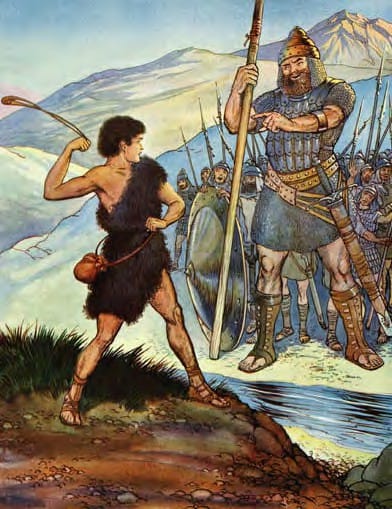
“Thou comest to me with a sword, and with a spear, and with a shield; but I come to thee in the name of the Lord of Hosts, the God of the armies of Israel, whom thou hast defied. And all this assembly shall know that the Lord saveth, not with sword, and spear; for the battle is the Lord’s and He will give you into our hands.”–1 Samuel 17:45,47
As a final gesture of contempt and to show his utter fearlessness, David ran to meet the Philistine giant. It was over quickly. The giant, so fully armed, did not even have time to draw his sword before the stone from David’s sling sank into his forehead. He fell on his face. David drew the giant’s great sword from its sheath–and used it.
David beautifully typifies Christ. His loving care for his father’s sheep prefigured Jesus’ love and care for the sheep his Father gave him. We are that sheepfold! Jesus saves his lambs from the wiles of the Adversary, from the mouth of the roaring lion, seeking whom he may devour. –Jesus lays down his life for his sheep. As Goliath defied and blasphemed the armies of God, morning and evening, Satan has continually defied God by his rebellion against the rule of heaven. He has through the ages blasphemed God by the “doctrines of devils” he has promulgated. He continually assails and brings railing accusations against the Israel of God, spiritual Israel, of which we are members. Christ, the great antitypical David, will in due time be Satan’s executioner as David was of Goliath.
The Psalms of David
The psalms of David have been termed the most beautiful poetry ever written. Even worldly scholars with no reverence for the Bible or appreciation of spiritual things have pronounced the psalms to be of the highest order of classic literature. But the psalms mean much more than that to us. The voice of God is there. He speaks to us through the psalms. He instructs us, he encourages us, he inspires us, he comforts us, he strengthens us.
Much of the psalms is sheer praise. As we read the exquisite words of praise to God that filled David’s heart, our own hearts also fill and overflow with praise. We feel the same love and closeness to God that David felt when he wrote the words. What a man writes, he must first think. Anyone who could write with such depth of feeling and eloquence must think sublime thoughts indeed!
Although the psalms were written under the inspiration of God, that does not mean that God dictated the exact words. David wrote as he was moved by the holy spirit, but not automatically. He used his own native talent, his own words and expressions, many of them based upon his personal experiences as a shepherd. But the holy spirit of God, acting upon his mind caused him to incorporate in his psalms those elements of prophecy and spiritual sustenance needed by the Lord’s people now. As we read in 1 Corinthians 10:11 –[Diaglott] they, “Were written for our –admonition, on whom the ends of the ages have come.” David wrote his innermost thoughts, his meditations on the wonders of God, his longings and yearnings, his joys and his lamentations, his angers and sorrows, his love and praises to his God. In the most eloquent language, he poured out his very soul. Through it all ran the thread of prophetic illumination provided by the overruling influence of the holy spirit upon his mind.
David was an outdoors man. He lived in the open. He had seen the glories of–nature in their every mood including the great sea, with its tides, storms and calms, the multitude and variety of its creatures; the seasons of the earth, seedtime and harvest, sunshine and rain; man and his dominion.
“All sheep and oxen; yea, and the beasts of the field; the fowl of the air and the fish of the sea; and whatsoever passeth through the paths of the seas.”–Psalms 8:7,8
The leadings of the Lord he had personally experienced. Watching the sheep, he meditated on these things in the quietness of his isolation. When he thought of some men even in his day who ascribed these things to mere chance and not a –personal Creator, he exclaimed: “The fool hath said in his heart, there is no God.” (Psalms 14:1)
At night he lay down wrapped in his cloak to sleep; the ground was his bed and the vast canopy of heaven his tent. He studied the stars of heaven before he went to sleep:
“When I consider thy heavens, the work of thy fingers; the moon and the stars which thou has ordained; what is man that thou art mindful of him?”–Psalms 8:3,4
What a magnificent conception of the power of God this is! The universe with its millions of stars and their planets–much greater than our sun and earth–are all highly organized and moving at fantastic speeds in orderly orbits. They are tremendous weights, suspended on nothing yet David says they are the work of his fingers! He does not say they are the work of his mighty arms or the force of his whole being, but his fingers! The universe was but a light task for him, by no means approaching the full potential of his powers!
David wrote this prayer of praise:
“I will love thee, O Lord, my strength. The Lord is my rock, and my fortress, and my deliverer; my God, my strength, in whom I will trust; my buckler, and the horn of my salvation, and my high tower. I will call upon the Lord, who is worthy to be praised; so shall I be saved from mine enemies.”–Psalms 18:1-3
Consider this prayer. If one has to go into battle, it is natural to pray before going. One knows that many will be killed and it is understandable that one pray to be spared. It is natural for a general of an army to pray for victory before committing his troops. But after one’s life has been spared and the battle won, the matter is often forgotten. But this inspiring prayer of praise, was made by David after the battle–it says so in the heading. He had just won a decisive victory over all his enemies. So these words do not contain possible motive for self-preservation, no motive of desired victory. The words show a heart full of thanks and love and praise to God. He did not forget! No wonder David was a man after God’s own heart!
There is a lesson here for us. We are told in Philippians 4:6 to make our requests known unto God, and we are quick to do this. But when a request is heard and in due course an answer given and the blessing granted, are we just as quick to thank and praise him for it? We often give a general expression of thanks, such as “We thank thee for all thy blessings,” which is good. But when a specific request has been made and has been graciously granted, how much better to give specific thanks for that particular blessing. An earthly parent loves an appreciative and thankful child; how much more, our heavenly Father!
“I will love thee, O Lord,” David said. Then he pours out his love by ascribing to the Lord certain endearing and meaningful titles: My Rock, My Fortress, My Deliverer, My God, My Strength in whom I will trust, My Buckler, The Horn of My –Salvation, My High Tower, Worthy to be praised.
Our “Castle”
There is a maxim of English law to the effect that “A man’s home is his castle.” In medieval times the law was comparatively ineffective and each man had to take measures for his own personal safety and defense. The feudal lords and barons built themselves castles, usually upon a rock, with thick walls and strong defenses to withstand siege, surrounded by moats so no one might approach without permission. Here they were safe from molestation. Outside they always had to wear armor and carry a sword, but in the castle they could relax and be at peace. The castle became the symbol of the integrity of a person in English law. David had a similar thought when he wrote:
“Be thou my strong habitation, whereunto I may continually resort. Thou hast given commandment to save me; for thou art my rock and my fortress.”–Psalms 71:3
We can identify with this. We too have a castle, a “strong habitation,” to which we may “continually resort.” Anywhere, anytime, and under any circumstances we can call upon the Lord. One moment we are worried, distressed, and faced with a seemingly hopeless situation. The next moment we feel a “strong habitation” enclosing us, a safe and secure castle around us. Then with David we can sing: “The Lord is my light and my salvation; whom shall I fear? The Lord is the strength of my life; of whom shall I be afraid?”– Psalms 27:1
David said, “Thou hast given commandment to save me.” Commandment to whom? Let me illustrate. It is the duty of the Secret Service to guard the life of the President of the United States. From the moment he is elected, he is no longer a private citizen. His life is not his own; he is under what is known as “maximum security.” He is guarded day and night lest an enemy seek to destroy him. Even before election day, units of the Secret Service are assigned to each likely candidate so that whichever one is successful may have this special protection from the moment of his election.
We consider the presidency of the United States to be an enormously–important office, and it is–probably the most important in the world. But there are 144,000 higher positions out of this world, those who shall live and reign with Christ. Of these Jesus said:
“No man can come unto me, except the Father . . . draw him.”–John 6:44
God selects and elects those who shall be the heirs of salvation. As soon as they are so selected, they are in mortal danger from the great enemy Satan. So God assigns a heavenly “Secret Service” to protect his elect. He calls mighty angels into his presence and commands them, charges them, and sends them forth to watch over us. So it is written: “Thou hast given commandment to save me.” Also: “He shall give his angels charge over thee, to keep thee in all thy ways.” (Psalms 91:11) And: “Are they not all ministering spirits, sent forth to minister for them who shall be heirs of salvation?” (Hebrews 1:14)
Do you fully realize and appreciate the care and attention the Lord is giving you? Earthly secret service men, highly trained and dedicated as they are, sometimes fail in their assignment; presidents have been assassinated. But the angels assigned to our protection never fail.
When God has given a commandment to save, it cannot fail. Not one of his purposes ever do. An angel who has been given the commandment to protect a child of God, one of his little ones, is backed up by all the power of God himself.
Jesus said, “Take heed that ye despise not one of these little ones; for I say unto you, that in heaven their angels do always behold the face of my Father which is in heaven.” (Matthew 18:10) This is a most extraordinary arrangement. By contrast, in a military organization there is what is called “the chain of command.” A private has no direct access to the Commanding General. He makes his request to his sergeant, the sergeant passes it up through the various ranking officers, and only if it is of extreme importance in the opinion of those officers does it ever finally reach the general. A decision must follow the same course downward and be endorsed by all those through whose hands it passed before, until it finally reaches the sergeant, who then tells the soldier. This process may take weeks or even months.
But an angel assigned to one of the Lord’s little ones does not have to follow a “chain of command.” No! God considers us too precious for that. He says, “Behold, I have graven thee upon the palms of my hands.” (Isaiah 49:16) We are always before Him! He takes a constant personal interest in our welfare. The angels assigned to us always have a direct and instant access to their Supreme Commander; they always behold the face of the Heavenly Father. It is a direct, face-to-face communication on our behalf.
All Things Are for Our Good
Paul said, “We know that all things work together for good to them that love God; to them who are the called according to his purpose.” (Romans 8:28) Only God could make such a promise because only God with his almighty power has all things under his control; his almighty power is instantly available in our behalf. Does this mean that those who love God and are called according to his purpose do not have a care in the world? Does this mean that we are miraculously supplied with food, clothing, and all the necessities of life? Are we never tired, never worried, never hurt, never discouraged, never sick? Do we never experience trials and difficulties? Is everything in our lives perfect, peaceful, and serene? Is that what is meant by “all things working together for our good”? God could grant all this, but it wouldn’t be for our good, for our eternal welfare. Instead he uses his almighty power to manipulate “all things” to give us just the right experiences in life, to develop, shape, chasten, fit, and finally change and exalt us to the glorious divine nature.
Sometimes we don’t understand the necessity of the experiences to which we are subjected. There is a tendency to cry to the Lord with tears and ask, “Why? Oh why?” Later, sometimes much later, it becomes beautifully apparent why the experience was necessary, and we thank God for it. Here’s a story that illustrates this:
Once, the only survivor of a shipwreck was thrown upon a desert island. He built a hut of driftwood and put in it everything he had. He prayed to God for rescue and scanned the horizon daily for ships. A long time passed, while he lived precariously on what he could get from the sea. One evening, upon returning from a hunt for food, he was horrified to find his hut in flames–struck by lightning! All he had was gone. To his limited vision, this was the worst thing that could possibly happen, and he complained bitterly to God. “Why, oh why? Was not my situation bad enough before? At least I had shelter and a few comforts. Now I have nothing!” Utterly discouraged and giving up all hope he flung himself upon the ground and wept all night, cursing the fire that had destroyed his hut. The very next morning, a ship arrived. As he was brought aboard, the captain said: “We saw your signal fire last night!”
Joseph’s Example
There is another and better example right from the scriptures. It is the story of Joseph. Here was a boy who was rejected by his brothers. They hated him so much that they considered killing him. He was deprived of his most precious possession, a coat of many colors. He was thrown into a deep pit without water and left to die. He was sold for twenty pieces of silver to slave traders. They took him into Egypt and sold him as a slave. His Egyptian master’s wife bore false witness against him and he was unjustly imprisoned. In prison he did a favor for a fellow-prisoner who promised to help him when he got out, but did not do so. He stayed in that prison for two whole years. The Egyptians were not noted for coddling their prisoners; the record says that he was “bound.” Here is one misfortune after another; here was a seemingly hopeless and impossible situation. But that is the kind of a situation that God handles to demonstrate his power. Jesus said, “The things which are impossible with men, are possible with God.” (Luke 18:27) God intervened for Joseph. The record says: “And it came to pass at the end of two full years, that Pharaoh dreamed.” (Genesis 41:1) From then on things happened rapidly. Joseph rose to be the ruler of Egypt which at that time was the most powerful nation in the world.
His many painful experiences must have caused Joseph to wonder, “Why are these things happening to me?” But afterward, when it was all over, he saw and freely acknowledged that all things had worked together for good. He said to his brethren:
“Now therefore be not grieved nor angry with yourselves, that ye sold me hither; for God did send me before you to preserve life. And God sent me before you to preserve you a posterity in the earth, and to save your lives by a great deliverance. So now, it was not you that sent me hither, but God; and he hath made me a father to Pharaoh, and lord of all his house, and a ruler throughout all the land of Egypt.”–Genesis 45:5,7,8
The same principle is expressed in Hebrews:
“Now no chastening for the present seemeth to be joyous, but grievous; nevertheless, afterward, it yieldeth the peaceable fruit of righteousness, unto them which are exercised thereby.”–Hebrews 12:11
So with experience and Christian maturity we learn to “trust him, come what may,” knowing it is for our good. It is in this way that we attain the “peace of God, which passeth all understanding” (Philippians 4:7). Jesus said:
“Peace I leave with you; my peace I give unto you. Not as the world giveth give I unto you.”–John 14:27
The world cannot assure us of peace based upon “all things working together for good.” Satan is the god of this world. He seeks to devour and destroy the Lord’s people. But God manipulates even the overt acts of Satan so that they also work together for our good. This is included in the “all things.”
Guardian Angels
David wrote, “The angel of the Lord encampeth around about them that fear him, and delivereth them.” (Psalms 34:7) These angels are alert, ready for action like troops encamped on the field of battle.
They are “round about” us. We are ringed about and completely surrounded by this protection.
The scriptures provide an encouraging illustration of this in 2 Kings chapter 6. At one time the king of Syria warred against Israel. He met in secret counsel with his military commanders to map out his campaign. But every time he planned an attack, the Lord revealed his plans to Elisha the prophet who told the king of Israel. The Israelites anticipated every move of the Syrians and checkmated them at every turn. The king of Syria was greatly disturbed over his defeats and said, “Surely we have a spy among us!” Then one of his own spies told the king that it was Elisha the prophet who revealed his secrets. The king of Syria decided that Elisha must be captured at whatever the cost.
Elisha was then staying at Dothan. The king of Syria sent a large part of his army, described as “horses and chariots, and a great host,” to take him. Why such a large force to capture one man? The record says that they “compassed the city about.” The idea was to approach at night and form a tight ring around the city to prevent Elisha’s escape. Then, in the morning, they would close in until they had him. It seemed an absolutely foolproof plan. As the Syrian host moved upon the city that night, and silently formed their noose, Although Elisha knew it, he was not troubled. He slept soundly.
Elisha’s young servant did not have his master’s calm assurance. When he got up early in the morning and saw the terrifying ring of military might, he ran to Elisha and cried: “Alas, my master, What shall we do? What shall we do?” Elisha answered, “Fear not; for they that be with us, are more than they that be with them.” But the servant did not have the insight and the faith of his master. He was filled with terror. The enemy he could see with his physical eyes, the defense he could not see with the eye of faith.
“And Elisha prayed and said, Lord, I pray thee, open his eyes that he may see. And the Lord opened the eyes of the young man, and he saw; and behold the mountain was full of horses and chariots of fire, round about Elisha.”–2 Kings 6:17
The defensive forces of God took the visible form of horses and chariots because these were symbols the young man could understand. They were “round about” Elisha which means they formed an inner ring between him and the enemy.
All of us who are running for the prize of the high calling are encompassed about and threatened by Satan’s forces: “Principalities, powers, rulers of the darkness of this world, wicked spirits in high places.” (Ephesians 6:12) They seek to destroy and devour the new creature. They form a ring around us. This would be a terrifying thing if we did not, by the eye of faith, see the inner ring of vastly superior power: the “horses and chariots of fire” which Elisha described as “they that be with us.”
Since we know this, how can we be afraid of anything? As David put it so beautifully in poetic meter: “The Lord is my light and my salvation; whom shall I fear? The Lord is the strength of my life; of whom shall I be afraid?” (Psalms 27:1) Doesn’t that give you a warm feeling of security and peace?
Jesus said, “The very hairs of your head are numbered.” (Matthew 10:30) You who are mothers think you know your children pretty well. But do you know how many hairs there are on your child’s head? Here is a beautiful figure of speech showing how thoroughly God knows and understands you. He knows everything about you. He knows what you should have and what you should not have. He knows what you should experience and what you should not experience. But does this mean that he knows just how much trouble, aggravation and sickness you can stand, and then proceeds to see that you get every bit you can stand? Oh no! You wouldn’t do that to your children. We try to be kind, loving and patient with our children. When our children are in difficulty, we feel pity and compassion; love wells up in our hearts. We spare our children all we can, giving them only the needed discipline. So it is with our heavenly Father, only he is ever so much more kind, loving and patient than we are. Of us he has caused to be written:
“And they shall be mine, saith the Lord of Hosts, in that day when I make up my jewels; and I will spare then, as a man spareth his own son that serveth him.”–Malachi 3:17
God Loves Us
Someone once said to me many years ago:
“I’m afraid of God’s love. I’m afraid to consecrate. I’ve had trouble all my life. I’ve been bludgeoned and beaten down by adverse circumstances, for as long as I can remember. I love God and I want him to love me; but I read in Hebrews 12:6, `Whom the Lord loveth, he chasteneth; and scourgeth every son whom he receiveth.’ Now that’s very discouraging. I just couldn’t take any more chastening and scourging than I’ve had. I want peace and rest!”
Perhaps others have felt the same way as this person. We have a very wily adversary and we should not be “ignorant of his devices.” (2 Corinthians 2:11) He twists and turns and misrepresents God’s character. He misquotes and misapplies scripture in the most plausible manner, shifting his tactics to correspond to the weakness of his intended victim. He has convinced millions who take the name of Christ that God is a fiend who inflicts eternal torment and misery upon the vast majority of mankind. Defaming God is Satan’s specialty. This is his device for blinding men’s minds. Even to one who has come to a knowledge of the truth and has been drawn to the verge of consecration, he subtly suggests: “Don’t do it. You have enough trouble already. Why expose yourself to the chastenings and scourgings of the Lord? He is a God of punishment and pain.” This is just a variation of the old torment doctrine.
When Satan tempted Jesus and misapplied scriptures, Jesus answered him with scripture correctly applied. Let us now do the same. In his last talk with his disciples before his betrayal, Jesus said, “Peace I leave with you; my peace I give unto you . . . Let not your heart be troubled, neither let it be afraid.” (John 14:27) On another occasion he said:
“Come unto me all ye that labor and are heavy laden, and I will give you rest. Take my yoke upon you and learn of me; for I am meek and lowly in heart, and ye shall find rest unto your souls; for my yoke is easy, and my burden is light.”– Matthew 11:28-30
Does this sound like something to be afraid of? A yoke has two sides to permit two to pull side by side. Jesus invites us to share his yoke with him, to walk with him. Think of having the Lord walk with us throughout life, constantly at our side, sharing every burden. When our steps falter, his are strong and carry us along. When our stresses and strains become too great, he invites us to cast our cares upon him. He wants to carry our burdens. It is written, “Cast thy burden upon the Lord, and he shall sustain thee. He shall never suffer the righteous to be moved.” (Psalms 55:22) Also, “Casting all your care upon him; for he careth for you.” (1 Peter 5:7) This is a wonderful arrangement, certainly nothing to be afraid of.
Ah, but what about the chastenings and scourgings? The key to the correct understanding of this scripture is in the two words loveth and son. “Whom he loveth, he chasteneth; and scourgeth every son.“ God is love and there is no fear in love. So this scripture simply means that he lovingly applies corrective discipline to us as his children. He applies only enough to teach us the right way. He spares us all he can. He does not, as some suppose, keep books on our conduct, exacting the last full measure of punishment indicated. On the contrary he does not give us all the punishment we deserve.
David knew this from personal experience. On one occasion he had sinned grievously and was guilty of death, but God did not exact the full penalty. David, overwhelmed with God’s mercy and love, sang with exultation:
“The Lord is merciful and gracious; slow to anger, and plenteous in mercy. He hath not dealt with us after our sins, nor rewarded us according to our iniquities; for as the heaven is high above the earth, so great is his mercy toward them that fear him. As far as the east is from the west, so far hath he removed our transgressions from us.
Like as a father pitieth his children, so the Lord pitieth them that fear him. For he knoweth our frame, he remembereth that we are dust.”– Psalms 103:8,10-14
David knew what he was talking about. He knew God’s loving and merciful ways. His thoughts were as close to God’s thoughts as is humanly possible. How God loved him for it! He delighted in David. Years and generations after David had passed from the earthly scene, God favored his descendants even though they were sometimes not entirely worthy. Why did he do that? “For my servant David’s sake!” Just because they belong to David, that’s all! When Jesus came, one of his titles was, “The Son of David.” His kingdom authority by which he will bless the world is called, “The throne of David.”
Here is a most precious thought: We are the heirs of this intimate relationship between God and David. We are of the spiritual “David” class. All the richness of God’s love is ours if we will, by faith, receive it.
Belshazzar’s Feast
BEFORE going into our lesson of Belshazzar’s feast, let us first consider the setting. Babylon, the capital city of the Babylonian universal empire, was the greatest city in the world. In many respects it has not been excelled to this day. It measured 14 miles from north to south, and 14 miles from east to west. It was surrounded by walls up to 350 feet high, the height of a modern 35-story building. The walls were 80 feet thick. Just imagine walls of those dimensions, extending for 56 miles, to enclose the city! There were 100 colossal gates, about one every half mile, which gave access to the city.
These gates were of solid brass, swung on massive iron hinges, and secured by huge iron bars, manipulated by an ingenious system of levers. The great river Euphrates looped and flowed diagonally through the city. The walls were arched over the river at the points of entry and exit, and there were water-gates of bronze within the arches, extending down to the water and which opened to permit navigation. In daylight, a constant watch was kept from the top of the walls. From that height the watchers could detect an approaching enemy while still a great distance away. At night, all gates were securely closed and barred. The city was considered absolutely impregnable. An ancient historian has written: “Babylon was the strongest fortress in the world. Even a small force of brave men could have held it for years.” It was considered siege-proof.
Within the city were other wonders of construction. There were temples of great size and unsurpassed grandeur, decorated with gold, silver, and, precious stones. In and about the temples there were hundreds of gold and silver images of gods. A solid gold image of Bel stood 50 feet high, and weighed 43,000 pounds. In addition to the royal palace of Nebuchadnezzar, the king, there were a number of other splendid palaces for the nobility of the realm.
There were many magnificent gardens and, in addition to these, the city contained one of the seven wonders of the world known as The Hanging Gardens of Babylon. This was built by Nebuchadnezzar to please his favorite wife, a princess of the Medes. It seems that she was unhappy on the level plains of Babylon and pined for the more rugged scenery of her native country with its terraced hills. To make her happy, a garden consisting of several levels, or tiers, was constructed with a base said to be over a hundred acres. Each succeeding tier, somewhat smaller than the one below it, was supported by enormous stone arches, thirty feet high, arch upon arch, forming a tapering pyramidal structure 300 feet in height. Each level was overlaid with soil, and planted with exotic flowers gathered from all over the world. Their colorful blossoms hung down and cascaded from one level to another with spectacular effect. Visitors from the world over came to see this magnificent garden and also to admire all the other wonders of Babylon, the greatest and most prosperous city in the world.
Now with this background we can better understand why King Nebuchadnezzar was so greatly lifted up in pride, as recorded in the 4th chapter of Daniel. The king was walking on the flat roof of his palace. All the beautiful architecture of the city lay before him.
There were glittering temples and towering castles. The hanging gardens were not only resplendent in color but the delightful aroma of the blossoms hung in the air. The mighty Euphrates flowed nearby, bringing to Babylon the commerce and wealth of the world. Around all were the secure, impregnable walls. The king’s heart swelled with pride as he contemplated that all these things were made solely for his own personal enjoyment and pleasure. It made him feel big and important. So he exclaimed aloud, as recorded in Daniel 4:30,31 (Moffatt):
“There lies Babylon the great, which I have built for a royal residence, by my vast power and to my noble majesty!”
His arrogance displeased God. We read further:
“The words had not left his lips, when a voice fell from heaven: `O king Nebuchadnezzar, here is your sentence: Your kingdom is taken from you! You shall be driven away from human beings, to dwell with the wild animals. You shall be forced to eat grass like cattle, and seven years shall pass over you, till you learn that the Most High reigns over the realm of men, and gives it to anyone whom he chooses.’“
The sentence was immediately carried out. When, after seven years, his insanity was at last over and his reason returned, the great Nebuchadnezzar realized that he really was not as important as he thought he was.
Overconfident Belshazzar
Now let us consider our lesson which is found in the fifth chapter of Daniel. Nebuchadnezzar was dead. Nabonidus, his son, was probably also dead. Belshazzar, the grandson of Nebuchadnezzar had but recently come to the throne of Babylonia. Coveting the immense riches of Babylon, the Medes and Persians had consolidated their forces under Cyrus, the Persian, and for several months they had been besieging the city. This was the Cyrus whom the Lord, through his prophet Isaiah, declared should free his people, many of whom were captive in Babylon. See Isaiah 44:28 and 45:1.> But the inhabitants of Babylon felt quite secure behind their immense walls. They were amply provisioned for a much longer siege than it was supposed any army could enforce. They felt they could survive indefinitely. In addition to stored commodities, there were large farms and pastures within the city walls which supplied abundant food. All the water needed was drawn from the great river which flowed through the city. So the defenders of Babylon had a contempt for the besieging army of Cyrus and were amused at his tactics. Watching from the walls, they could see the enemy troops a considerable distance away. They seemed to be digging and throwing up some sort of earth-works, near the river bend. They did not even approach close to the city to permit bombardment by the catapults on the walls. Cowards! Nothing to fear from them!
Belshazzar himself probably climbed the wall to take a look. The tiny figures in the distance, grubbing in the dirt, resembled the futile workings of an anthill. He laughed, and returned to his palace, considering the siege a complete failure. He decided to celebrate the occasion by giving a great feast.
Usually when a siege is in progress, food is strictly rationed. But so confident was king Belshazzar in the strength of his capital and so contemptuous was he of Cyrus, that he ordered a sumptuous feast prepared. He, together with his princes, wives and concubines, would be host to a thousand of the nobility of Babylon. There would be food and wine in abundance, limited only by the capacity of the revelers.
No need to skimp. Babylon would never be taken! Was not the city under the patronage and protection of the powerful gods whose temples were there? These were the gods who had enabled his grandfather, Nebuchadnezzar, to conquer the whole world.
The feast was prepared and served in the great ballroom of the royal palace. At an elevated table, at the end of the room, sat king Belshazzar together with his many sons, his wives, and his concubines. The room was illuminated by a huge lampstand, or chandelier, near the king’s table. Below were rows and rows of tables, seating a thousand of the nobility of Babylonia with their ladies. At the king’s signal, course after course of exotic foods were successively served, on enormous platters, carried from the palace kitchens by hundreds of slaves. Wine flowed freely. As each cup was emptied it was immediately refilled. Toasts were proposed and drunk to the praise of the gods of Babylon. Since there were many gods, there were many toasts. The wine began to take effect, and the toasts became more reckless. We can imagine, at this point, that a prominent noble arose, with brimming cup, and loudly said: “I drink confusion to the God of the Hebrews! Any of the gods of Babylon is greater than He!” A sudden hush fell on the assembly. Many there had a fearful respect for the God of the Hebrews. They had heard something of his wonderful works. So they felt uneasy at this gesture of defiance. The king was displeased at this dampening of the spirit of revelry. Stimulated by the wine, he arose and shouted:
“I will drink that toast! And I’ll show you what I think of the God of the Hebrews! Bring here the sacred golden and silver vessels which my grandfather, Nebuchadnezzar, took from the Hebrew temple in Jerusalem, that we may drink our wine from them, to the praise of our own gods! I’ll show you which gods are stronger!”
We read now from the record in Daniel 5:2-4:
“Belshazzar, whiles he tasted the wine, commanded to bring the golden and silver vessels which his father [margin: grandfather] had taken out of the temple which was in Jerusalem; that the king, and his princes, his wives, and his concubines, might drink therein. Then they brought the golden vessels that were taken out of the temple of the house of God, which was at Jerusalem; and the king and his princes, his wives, and his concubines, drank in them. They drank wine, and praised the gods of gold and of silver, of brass, of iron, of wood, and of stone.”
Belshazzar Profanes the Temple Vessels This act of publicly profaning the sacred vessels of Jehovah’s temple, in praise of idols, was an act of grossest blasphemy.
Belshazzar’s grandfather, Nebuchadnezzar, would never have done so; he knew better. He knew from experience that the God of the Hebrews was above any other god or any earthly king. We read in Daniel 2:47 that he had said to Daniel: “Of a truth it is, that your God is a God of gods, and a Lord of kings.” He had also said, in Daniel 3:29, “I make a decree, that every people, nation, and language, which speak any thing amiss against the God of Shadrach, Meshach and Abednego, shall be cut in pieces.” Belshazzar should have listened to his grandfather and not spoken amiss of the God of the Hebrews. He had access to the records of the national decrees. In the archives was a record in Nebuchadnezzar’s own hand, made after his recovery from insanity a most powerful witness, by a most powerful king. We read in Daniel 4:34-37,
“And at the end of the days, I, Nebuchadnezzar, lifted up mine eyes unto heaven, and mine understanding returned unto me; and I blessed the Most High, and I praised and honoured him that liveth forever; whose dominion, and his kingdom is from generation to generation. And all the inhabitants of the earth are reputed as nothing; and he doeth according to his will in the army of heaven, and among the inhabitants of the earth. And none can stay his hand, or say unto him, What doest thou? Now I, Nebuchadnezzar, praise and extol and honour the King of heaven, all whose works are truth and his ways judgment. And those that walk in pride, he is able to abase.”
Belshazzar should have known all these things. He should have profited by his grandfather’s experience. He should have taken it to heart; especially that last phrase: “Those that walk in pride, he is able to abase,” which was the great lesson Nebuchadnezzar had learned. In fact, Belshazzar did know all these things. As a prince of the blood, successor to the throne, he would be carefully instructed in the history of the empire and the acts of his forefathers. When he defied and blasphemed God, he did it willfully and deliberately.
Suddenly the light in the room dimmed as a dark shadow passed over the great chandelier. Every eye turned toward it in time to see a huge hand beginning to write something upon the wall. We now read from the Moffatt translation, starting with Daniel 5:5,
“That very hour, the fingers of a man’s hand appeared, writing on the plaster of the royal palace, opposite the lampstand. The king saw the palm of the hand as it wrote. And the king’s fresh color paled; his thoughts alarmed him. The muscles of his thighs relaxed, and his knees struck one against another.”
Belshazzar was terrified, and his ruddy color, induced by the wine, paled. His self-assurance left him, and he was instantly sobered. He trembled violently from head to foot. The hand disappeared, but the writing remained; four words, in large characters, mysterious, and undecipherable, high upon the wall where all could see. Reflected by the light, the writing seemed to flow, as though of fire. The whole assembly was dumbfounded. There was absolute silence, until the king cried out. We continue from the record:
“The king cried aloud, for the enchanters, the diviners, and the astrologers to be brought in.”
They came in haste, looked at the writing, and each in turn shook his head. The characters were strange, and not of any known language. The king was desperate. He now offered rich inducements. We read:
“The king declared to the sages of Babylon, Whoever reads this writing, and tells me the meaning of it, shall be robed in purple, and wear a golden chain round his neck, and rank as third within the realm.”
But even this great incentive, of being the third in rank in the rulership of the world, was to no avail. The record says:
“But not one of all the king’s sages could read the writing, or explain the meaning to the king.”
Now there was pandemonium. Stark terror gripped the whole company. The ladies fled. Some of them sought out the queen- mother and told her what was going on. She had not attended the feast, but even from her apartment she could hear the frightened cries of the feasters. She quickly went to the banquet-hall. As she entered the noise subsided and they made way for her to approach the king. By this time the king was a pitiful object. Pale as death, and trembling violently, he could scarcely stand upon his feet. His nobles were not much better. We now continue from the record:
“Then, at the cries of the king, and his lords, the queen-mother came into the banqueting-hall. The queen-mother said: O king, live forever! Let not your thoughts alarm you; let not your colour go.
Within your realm there is a man in whom is the spirit of the gods divine. In the days of your grandfather, light and learning and wisdom, like the wisdom of the gods themselves, were found in him, so that King Nebuchadnezzar, your [grand]father, himself made him master of the magicians, enchanters, diviners, and astrologers; since rare ability, knowledge, learning, the power of interpreting dreams, and solving riddles, and reversing spells, were found in this very Daniel, whom the king named Belteshazzar. Let Daniel be called, and he will explain the meaning of this.”
Daniel Interprets the Writing
The prophet Daniel was at this time about 90 years of age. He was probably still in the government service, although not in the exalted capacity of rulership he occupied under Nebuchadnezzar. He doubtless resided in one of the palace buildings nearby. A messenger of the king was hastily dispatched to fetch Daniel. But I think an angel of the Lord got there first and Daniel knew every aspect of the situation. He knew of the profaning of the temple vessels, the insult to God, the appearance of the hand, the mysterious writing, and the meaning of the words. So he was not surprised when the messenger of the king knocked at his door. Continuing the narrative, we read:
“Then Daniel was brought into the king’s presence. The king said to Daniel, so you are the Daniel belonging to the exiles of Judah, whom the king, my [grand]father, brought from Judah? I hear that the spirit of the gods themselves is in you, and that light and learning and rare wisdom are to be found in you. Well now, the sages, the enchanters, have been brought into my presence to read this writing, and to let me hear the meaning of it, but they could not explain its meaning.
However, I hear that you can explain things and reverse spells. Now, if you can read this writing, and let me hear the meaning of it, you shall wear a purple robe, and a golden chain around your neck, and you shall rank third within the realm.”
This offer did not impress Daniel very much. He had been a ruler before ever this king was born. He had once been set over the whole province of Babylon. He knew how to abound, and how to be abased. He knew the futility of earthly glory. At his age, the prospect of another exaltation in the kingdom of Babylon held no special appeal. He had no fear of this king who was so inferior in every way to his grandfather, the great Nebuchadnezzar. What he was about to do he would do as the prophet of the Most High God and not for earthly favors. So he said to the king, somewhat disdainfully:
“Keep your gifts for yourself, and give your rewards to someone else! However, I will read the writing to the king, and let him hear the meaning of it. O king, the Most High God gave Nebuchadnezzar, your [grand]father, the realm, with its greatness and glory and majesty. And, owing to the greatness he bestowed upon him, all races, nations, and folk of every tongue, trembled in fear of him; for he killed whom he pleased, and spared whom he pleased; he raised whom he pleased, and put down whom he pleased. But when his mind became proud; when his spirit became defiant; so that he bore himself haughtily; he was deposed from his royal throne, and deprived of his glory. He was driven away from human beings, his mind was made like the mind of an animal, and his dwelling was with the beasts. He ate grass like cattle, and his body was drenched with the dews of heaven, till he learned that the Most High God rules over the realms of men, and that he sets over it anyone whom he chooses. Yet you, his son, O Belshazzar, have not humbled yourself, though you knew all this. You uplifted yourself against the Lord of heaven, by having the vessels of his house brought in before you, and from them you, and your lords, your consorts, and your concubines, have drunk wine, praising the gods of silver and gold, bronze, iron, wood and stone, which can neither see nor hear nor understand. You have not glorified the God who holds in his power your breath of life, and all your destiny. Hence the palm of the hand was sent from his presence, and this writing was inscribed.”
The king slumped in his chair, and all the nobles stood, fascinated, as Daniel faced the wall and pointed to the strange writing:
“This is the inscription: MENE, MENE, TEKEL, PERES. The meaning of it is: MENE (numbered); God has numbered the days of your kingdom, and ended it. TEKEL (weighed); you are weighed in the scales, and found wanting. PERES (divided); your kingdom is divided up and assigned to the Medes and the Persians.”
Great Babylon Under Siege
In the meantime, when the feast was in progress, tremendous events were taking place outside the city. It was dark and the watch on the wall had been withdrawn. The city being under siege, all gates were closed and barred, including the river gates. But now the army of Cyrus had finished its task. What was thought to be the digging of futile earthworks a distance from the city was, in reality, the excavation of a great trench connecting the two lateral sides of the loop in the river Euphrates which flowed through Babylon. About the time the handwriting appeared on the wall of the banquet-room, the river was diverted and began flowing through its new channel.
The loop passing through Babylon dried up. The great bronze water gates, so tightly closed, now hung forty feet in the air above a broad highway which was the river bed. Over the dry river bed the armies of Cyrus now marched into the supposedly impregnable Babylon.
Rank upon rank, thousands upon thousands of men. The token guard of the city, taken completely by surprise, was quickly overpowered, and Cyrus himself, accompanied by Darius, entered the royal palace with drawn sword. Just as Daniel had finished his speech to the king, and had been given the purple robe and the golden chain, and Belshazzar had –proclaimed him third in rank within the realm, Cyrus strode up the aisle of the great banquet-hall, up to the king’s table, and thrust Belshazzar through with his sword. He then proclaimed Darius, king of Babylonia.
I think that promotion of Daniel was the shortest promotion on record. He was third in rank in the kingdom of Babylonia for about five minutes. The account ends with the words:
“That very night Belshazzar, the Chaldean king, was killed, and Darius the Mede received the kingdom, he being about sixty-two years of age.”
The second universal empire of Nebuchadnezzar’s vision had been inaugurated. The breast and arms of silver had succeeded the head of gold. The Medes and Persians now ruled the world.
The Plague of Pride
There are numerous lessons for us in this account of Belshazzar’s feast, and the fall of Babylon, but the principal lesson is regarding pride. As Daniel told Belshazzar: You “have not humbled yourself. .
. . You uplifted yourself against the Lord of heaven. You have not glorified God who holds in his power your breath of life, and all your destiny.” We read in Proverbs 16:18, “Pride goeth before destruction, and a haughty spirit before a fall.” This is what happened to Belshazzar. Again we read in Proverbs 16:5, “Every one that is proud in heart, is an abomination to the Lord.” Pride in any form and in anybody is abominable. So let us consider the nature of pride and its consequences.
First, there are the various forms of pride found in the world and which constitute the spirit of the world. The Lord’s people should be far removed from such forms of pride. For example, some in the world consider themselves superior to others in every way, as though they were especially created out of some preferable “dust of the earth.” They boast of their noble ancestry and inherited qualities. But they had better not look too far back. Mark Twain tells how he began tracing his ancestry. When he got back to a horse-thief, he quit.
Some in the world glory in inherited wealth. But many have found that it is not wise to boast of such riches since an investigation might reveal that many fortunes were founded on piracy, oppression, slavery and other forms of exploitation.
Pride of education is not appropriate either. What is there to be proud of? It only means that you have absorbed what others have found out or written about. Besides, the “wisdom of the world” is wholly unreliable. History has been tampered with, war and violence are glorified, ethics are distorted, philosophy is tainted, and even scientific books of only a few years ago, are obsolete in the face of rapidly increasing knowledge.
Pride in one’s beauty or physical superiority is certainly not justified. Such qualities are inherited. The parent, rather than the child, might have some reason for pride.
Pride as respects clothing or adornments is also foolish. The maker of the fabrics, or the ornaments, might have some reason for pride in his handiwork, but surely nor the wearer. He is merely appropriating to himself the skill and labor of others.
Lessons for the Lord’s People
But our lesson here is not for the world, but for the Lord’s people. The scriptures are given for our admonition. The pride here warned against is spiritual pride. Whereas in the world pride is merely foolish, to the New Creature it is extremely dangerous. It can result in the loss of our calling and election because if we exalt ourselves with pride, as Nebuchadnezzar did, and as Belshazzar did, we place ourselves under the condemnation of Luke 18:14: “Every one that exalteth himself shall be abased.” This eliminates our exaltation to glory, honor and immortality. So we are exhorted in 1 Peter 5:6, “Humble yourselves therefore under the mighty hand of God, that he may exalt you in due time.” Thus pride is a spiritual sickness which, unless curbed, can lead to the loss of everything. Because James 4:6 says, “God resisteth the proud, but giveth grace unto the humble.” What chance do you have if God himself resists you? So let us now consider some of the many forms that spiritual pride can assume, in order that we may shun it like the plague it is.
First there is a general feeling of pride which is most likely to overtake those who are longest in the narrow way and most prominent in the Lord’s service. It is insidious because it develops very gradually and imperceptibly. It finally manifests itself in a feeling of superiority, of being better than others. When attending Berean studies, one afflicted with such pride hears no proper answer to any of the questions except his own. In testimony meetings he hears no really helpful testimony except his own. How halting and ineffective the others are to him. He never sees an elder in the chair who knows how to lead a meeting. He considers his discourses much deeper and more profound than those of other speakers, whose best efforts he despises.
If at election time he receives less votes than others, his feelings are hurt. He fancies himself a martyr and blames certain “enemies” in the class. This is an almost hopeless condition. It is difficult to reverse when so firmly established. Only a severe chastening of the Lord can correct it. The only safe way is to prevent it. How can this be done? The slightest tendency toward superiority should be noted and curbed. If you begin to think you are somebody great and have a special standing before the Lord, above your brethren, earnestly consider 1 Corinthians 10:12, “Let him that thinketh he standeth, take heed lest he fall.” If you feel smug and conceited, thinking your abilities, which are really so imperfect in the Lord’s sight, are better than those of your brethren, take heed to Philippians 2:3, “Let nothing be done through strife or vainglory; but in lowliness of mind, let each esteem others better than themselves.” Or, as the Revised Version renders it: “Do nothing from selfishness or conceit, but in humility count others better than yourselves.”
Some exhibit pride by being envious of those who are in more prominent positions in the public promulgation of the truth, thinking that they could do better, and therefore they should occupy those positions. Such should consider 1 Corinthians 12:18, “But now hath God set the members, every one of them, in the body, as it hath pleased him.” Also Romans 12:10, “Be kindly affectioned one to another, with brotherly love; in honour preferring one another.”
Then there is a form of spiritual pride which is particularly insidious because it stems from the beauty of the truth itself. God’s divine plan of the ages is magnificent beyond compare. When one first gets a glimpse of it he is dazzled by its sheer grandeur. He cannot get too much of it. He delights and revels in its radiance this marvelous revelation of an Almighty God of love, this great salvation, this life from the dead, this perfect solution to every problem of humankind! To know and accept the truth is the supreme experience of a lifetime. The more one delves into it, the more of its luster appears. It is simple, yet glorious. It is absolutely flawless, and there are so few in the world who appreciate it.
Some at this point are susceptible to the virus of pride. He begins to think that he must be a cut above his fellowman to be granted this insight into the Lord’s plan, that he must have some natural superiority of mind, or nobility of character, which makes him worthy of it. He begins to feel important, that he is somebody great, God’s special favorite. This condition is bad enough but the next step such a one may take is particularly deplorable. Although he knows that God revealed the beauties of the divine plan to him through the agency of a faithful and wise servant, he comes to believe that he has a clearer grasp of the truth than “that servant” did; that he can use better words to more aptly express the correct thought. Thus he elevates himself and equates his own mind with that of the greatest Bible Student of modern times God’s special instrument for the restoration of “that faith once delivered to the saints.” He fancies that he can improve the truth. He begins to see “new light.” He finally becomes so swollen with spiritual pride that he believes he has special revelations from the Lord, that he has been appointed God’s special instrument to promulgate some great doctrine, to discover some new interpretation of scripture, or some new type. He gets revelations all right, but they are not from the Lord. If he cannot avoid it, he may mention or quote Bro. Russell’s writings, but when he does so, it is usually with some disparaging remark that “he disagrees with Bro. Russell in a good many things,” or that “he follows no man, but goes to the Word of God directly.”
Do you see how terribly destructive spiritual pride can be, how it can destroy the New Creature? Let us be on the alert to quench the slightest beginning of pride. Let us continually keep in mind that it was not because of any value or worth on our part that we were called and given a knowledge of the truth. It was a wholly unmerited favor, a gift of God, entirely undeserved. 1 Corinthians 1:26-29 describes the Lord’s people as “Not many wise . . . not many mighty, nor many noble. But the foolish . . . the weak . . . the base . . . the despised . . . things that are not; that no flesh should glory in his presence.” We can take credit for absolutely nothing. Everything we have or are is a gift. We read in 1 Corinthians 4:7, “What hast thou that thou didst not receive? Now, if thou didst receive it, why dost thou glory?” Also James 1:17, “Every good gift, and every perfect gift is from above, and cometh down from the Father of lights.” And we cannot even be proud of any service of the Lord we are privileged to perform. It is the Lord who uses us, and not we ourselves. We are tools in his hand. So what do we have to boast of? As Isaiah 10:15 expresses it,
“Shall the axe boast itself against him that heweth therewith? Or shall the saw magnify itself against him that shaketh it? As if the rod should shake itself against them that lift it up; or as if the staff should lift up itself, as if it were not wood.”
As Luke 17:10 points out, “We are unprofitable servants.” So let us remember the lesson Nebuchadnezzar and Belshazzar so painfully learned, that “those who walk in pride, he is able to abase.” Daniel 4:37
Other Lessons from This Experience
As the Hebrews were taken captive to literal Babylon and were imprisoned there, the Lord’s true people have been captive in mystic Babylon. At the end of the Gospel age, the fall or rejection of Babylon is announced and the Lord calls his people out from that system saying in Revelation 18:4, “Come out of her, my people.” As literal Babylon was immensely wealthy, and dominated the world, Christendom, until recently, has done so: subjugating and exploiting heathen nations. But now the controlling role of Christendom is — being effectively challenged by powerful Communist governments.
As literal Babylon was considered impregnable, the Papacy, an important segment of mystic Babylon, falsely appropriates to itself the promise of Matthew 16:18 that, “The gates of hell shall not prevail against it.”
Literal Babylon’s feeling of safety followed by its quick fall reminds us of 1 Thessalonians 5:3, “For when they shall say, peace and safety, then sudden destruction cometh upon them, as travail upon a woman with child; and they shall not escape.” This describes the present time when the kingdoms of this world are giving way to the rule of Christ.
As the power and prosperity of literal Babylon depended upon the commerce brought to it by the river Euphrates, and the city fell by the diverting of its waters, so mystic Babylon will collapse because the people of the earth will withdraw their support. Thus the prophecy of Revelation 16:12 will be fulfilled: “And the . . . angel poured out his vial upon the great river Euphrates; and the water thereof dried up, that the way of the kings of the east might be prepared.” Since the east is the place of sun rising, the “kings of the east” are those who accompany the “Sun of Righteousness,” Christ Jesus, the new king of earth.
The lesson Nebuchadnezzar learned was “that the Most High reigns over the realm of men, and gives it to anyone whom he chooses.” Daniel 4:17 shows that God has always been in supreme control of the earth. He has not abdicated his rulership; not for a moment. Satan is a usurper with no real right to rule. His rule has been merely permissive. In due time the dominion of earth is completely wrested from him and given to Christ, God’s choice. In Ezekiel 21:27 Christ is called the one “whose right it is; and I will give it him.”
Nebuchadnezzar’s statement in Daniel 4:37–“Now I, Nebuchadnezzar, praise and exalt and honour the king of Heaven; for all he does is right, his dealings are all just, and haughty men he is able to abase” –will be the heart sentiments of restored humankind at the end of the Millennial Age.
Belshazzar’s contempt for the besieging Cyrus, who was appointed by God to conquer Babylon and who typified the Christ, the anointed King, reminds us of Psalms 2:1-6, prophetic of the change of earth’s rule:
“Why do the heathen rage, and the people imagine a vain thing? The kings of the earth set themselves, and the rulers take counsel together, against the Lord, and against his anointed, . . . let us break their bands asunder, and cast away their cords from us. He that sitteth in the heavens shall laugh; the Lord shall have them in derision. Then shall he speak unto them in his wrath, and vex them in his sore displeasure. Yet have I set my king upon my holy hill of Zion.”
The eating and drinking of Belshazzar’s feast at the time of the impending fall of literal Babylon, brings to mind the prophecy of Luke 17:26,27,
“As it was in the days of Noah, so shall it be also in the days of the Son of man. They did eat, they drank, they married wives, they were given in marriage, until the day that Noah entered into the ark, and the flood came and destroyed them all.”
At the feast their praising of the gods of gold and of silver reminds us of the false standards of this present evil world–the praise of success, the feverish pursuit of prosperity, the worship of mammon. With the Lord’s people it is different. We heed Jesus’ words, given in Luke 12:33,34 (Diaglott),
“Make for yourselves purses which grow not old; an unfailing treasure in the heavens; where no thief approaches, nor moth destroys. For where your treasure is, there your heart will also be.”
The rulers of literal Babylon drank wine from the sacred vessels of the Lord. The leaders of mystic Babylon have misused the Holy Bible. They have derived false, God-dishonoring doctrines from it and have been drunken by them, and made others drunk. As Revelation 17:2 expresses it: “The inhabitants of the earth have been made drunk with the wine of her fornication.”
At the feast a hand appeared and wrote upon the wall, against the lampstand, and the rulers of literal Babylon were frightened, so much that their knees knocked together. We read in Luke 21:25,26,
“And there shall be signs in the sun, and in the moon, and in the stars; and upon the earth distress of nations, with perplexity, the sea and the waves roaring; men’s hearts failing them for fear, and for looking after those things which are coming on the earth; for the powers of heaven shall be shaken.”
As the handwriting on the wall immediately preceded the taking of the city, this might indicate that just before the final calamity, earth’s rulers will have a definite and frightening indication of it.
The message from God was: “Thou art weighed in the balances, and art found wanting.” God weighs and judges nations, and their leaders. He has found that none measure up to the standard of the kingdom and that all must be removed.
We are impressed by the fearlessness of Daniel in interpreting the writing on the wall. This clearly indicates that we should faithfully witness to the kingdom without any fear of the consequences.
As Cyrus slew Belshazzar and took over the government of the world, Christ, the antitypical Cyrus, removes Satan and his government from the scene and inaugurates the Messianic phase of the Kingdom in power and glory.
Daniel was robed in purple, a golden chain was hung around his neck, and he ranked third in the Kingdom. The Church, pictured by Daniel, will be clothed with the royal robe of rulership, given the golden chain of the divine nature, and rank third, after the Heavenly Father and Christ Jesus. Let us strive to be of that faithful Daniel class!