
Elijah’s Courage
It took a great deal of courage for the prophet Elijah to boldly walk into the palace, enter the throne-room, face king Ahab, and say: “As Jehovah God of Israel liveth, before whom I stand, there shall not be dew nor rain these years, but according to my word.” (1 Kings 17:1)
Withholding rain was in strict accordance with the word of the Lord given to Israel. They were promised abundant rain and rich crops as long as they maintained their worship of the true God. But if they turned to idolatry, the blessing of rain was to cease and their crops would fail. Thus the Lord said:
“It shall come to pass, if ye shall hearken diligently unto my commandments which I command you this day; to love the Lord your God, and to serve him with all your heart, and with all your soul; that I will give you the rain of your land in his due season; the first rain and the latter rain, that thou mayest gather in thy corn, and thy wine, and thine oil. And I will send grass in thy fields for thy cattle, that thou mayest eat and be full. [Now the warning!] Take heed to yourselves, that your heart be not deceived, and ye turn aside and serve other gods, and worship them. And then the Lord’s wrath be kindled against you, and he shut up the heaven, that there be no rain, and that the land yield not her fruits.” Deuteronomy 11:13-17
Ahab knew exactly what Elijah was talking about. He was familiar with the law and he had now been reminded of the penalty for idolatry. It was up to him, as king, to remedy the situation or else have Israel suffer the consequences.
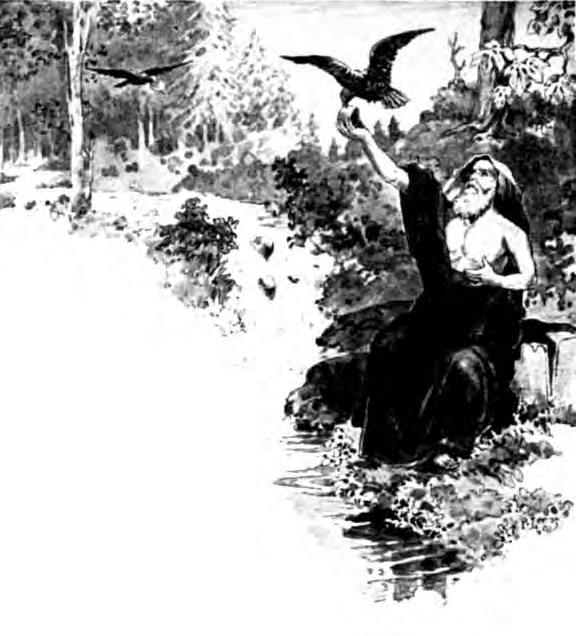
Having delivered his message, Elijah turned around and walked out of the palace. We can imagine that Elijah’s encounter with Ahab would be promptly communicated to Queen Jezebel and that she would immediately take steps to have Elijah arrested and killed. As he was leaving the palace, the word of the Lord came to Elijah instructing him to escape and hide in a certain wilderness area. Here he had water to drink from a spring-fed brook and, by a wonderful provision of the Lord, he was miraculously fed in a most delightful way. We read: “And the ravens brought him bread and flesh in the morning, and bread and flesh in the evening; and he drank of the brook.” (1 Kings 17:6)
How would you like to have that kind of service? In fact we do! We are in the wilderness in the sense of being separated from the spirit of the world. We are in the world but not of the world. Not only is our literal bread and water sure (Isaiah 33:16), but more importantly we are amply supplied with the pure water of truth. We also partake of bread. We read: “And Jesus said unto them, I am the bread of life. He that cometh to me shall never hunger; and he that believeth on me shall never thirst.” (John 6:35) We have meat as well:
“Who then is the faithful and wise servant, whom his Lord hath made ruler over his household, to give them meat in due season.” Matthew 24:45
Did Elijah complain of the quality of the meat provided? Did he despise the instrumentality of the Lord and drive the ravens away saying, “I want to be served in some other manner?” Of course not. Nor should we. The truth is found in the six volumes of Studies in the Scriptures and other writings of Bro. Russell. We should not scorn them nor lay them aside. As Elijah was well fed, we have all we can eat, “morning” and “evening,” in the morning of the Millennial Age and the evening of the Gospel Age.
Making the rains to stop was a terrible calamity. Crops failed and there was a severe famine in the land. Flocks and herds could find no pasturage and died of thirst. At first the people irrigated small garden plots by laboriously drawing water from deep wells, but as the drought progressed, even the wells began drying up and the people faced starvation. Instead of blaming herself for the troubles of Israel, Jezebel blamed Elijah. Through King Ahab, she made every effort to find and kill him, but the Lord kept Elijah concealed from her.
According to Luke 4:25 and James 5:17, the rains were withheld for 3 1/2 years. –Israel reached their extremity and cried to the Lord for relief, and the Lord heard their cry.
“And it came to pass, after many days, that the word of the Lord came to Elijah in the third year, saying, Go, show thyself unto Ahab; and I will send rain upon the earth. And Elijah went to show himself unto Ahab. . . . And there was a sore famine in Samaria.”–1 Kings 18:1,2
Once again Elijah stood before Ahab. Now what sort of greeting would you expect Ahab to give Elijah under the circumstances, seeing his nation ruined by drought and the people starving?
Wouldn’t you think he would humbly say to God’s prophet:
“I know this trouble upon Israel is my fault, because I permitted idolatry to be established, and I’m sorry. Please ask the Lord to forgive me, and restore rain to our poor suffering land.”
He did not say anything like that. These are his words:
“And it came to pass, when Ahab saw Elijah, that Ahab said unto him, Art thou he that troubleth Israel?”–1 Kings 18:17
Isn’t that incredible? He missed the point entirely! He blamed Elijah for everything!
Since he did not admit his guilt and promise reformation, it became necessary for Elijah to demonstrate to him and all the people the real cause of their trouble and give them an opportunity to reform. Before rain could be restored, Israel must abandon idolatry and return to the worship of Jehovah. Elijah replied to Ahab:
“And [Elijah] answered, I have not troubled Israel; but thou and thy father’s house, in that ye have forsaken the commandments of the Lord, and thou has followed Baalim. Now therefore send, and gather to me all Israel unto mount Carmel; and the prophets of Baal four hundred and fifty, and the prophets of the groves, four hundred, which eat at Jezebel’s able.”1 Kings 18:18,19