
As is customary, sentries were posted around the camp. Under cover of darkness Gideon and his servant crept close to one of the sentry posts where two soldiers on guard duty were talking together.
“And when Gideon was come, behold, there was a man that told a dream unto his fellow, and said, Behold, I dreamed a dream; and, lo, a cake of barley bread tumbled into, the host of Midian, and came unto a tent, and smote it, that it fell, and overturned it, that the tent lay along. And his fellow answered and said, this is nothing else save the sword of Gideon, the son of Joash, a man of Israel. For unto his hand hath God delivered Midian, and all his host. And it was so, when Gideon heard the telling of the dream, and the interpretation thereof, that he worshipped, and returned into the hosts of Israel and said, Arise; for the Lord hath delivered into your hand the host of Midian.” Judges 7:13-15
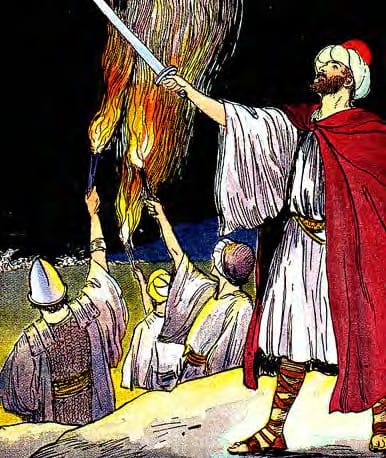
He woke them all up even though it was still night and not just the chosen 300, but all the men of Israel who were still in the camp.
They were to be in readiness to pursue the defeated enemy. So convinced was Gideon of victory that he sent swift messengers to all the tribes to quickly come down against Midian and take a spoil to thus regain some of their losses from the seven years of oppression.
The Lord had instructed Gideon of the plan of attack. It was a simple yet extremely effective plan. Each of the 300 men was given a trumpet, an empty pitcher, and a lighted lamp. Concealing their lamps in their pitchers they silently approached the camp of Midian and spaced themselves so as to completely surround it. Then at the darkest part of the night, the middle watch, at a given signal by Gideon, they blew their trumpets, broke their pitchers, waved their lamps, and shouted: “THE SWORD OF THE LORD AND OF GIDEON!” We read:
“And they stood every man in his place round about the camp. And all the host ran and cried, and fled. And the three hundred blew the trumpets, and the Lord set every man’s sword against his fellow, even throughout all the host. And the host fled.” Judges 7:21,22
In the dark they mistook each other as the enemy and slaughtered each other as they fled.
Some may wonder why this strategy was so effective. The reason is simple. A perfect illusion had been created. In those days when an army moved at night, it was customary for only the regimental trumpeter or bugler to signal attack or retreat, as the case might be. So when the Midianites were suddenly awakened by the noise of the breaking of pitchers and saw 300 widely spaced lamps completely surrounding them and heard 300 buglers sounding attack, the instant and natural conclusion of these trained men of war was that 300 regiments of fully armored men were –attacking them, that they were hopelessly outnumbered. The breaking pitchers did sound very much like the rattling of armor and the clashing of swords upon iron shields in battle.
Then the great number of camels in the camp panicked and created pandemonium. A camel is a large, ungainly beast, very unruly when stampeded, running in an erratic, zigzag course, trampling down anything in its path with its enormous splayed feet. We are told in the account that “their camels were without number, as the sand of the sea side for multitude.”
It was a complete rout. Now all the rest of the men in Gideon’s encampment joined the 300 in pursuit. As dawn broke men from other parts of Israel arrived on the scene and attacked the fleeing host of Midian from every side completely defeating them. We read that “there fell an hundred and twenty thousand men that drew sword.” (Judges 8:10)
Although Gideon did not realize it at the time, a great promise and prophecy had been fulfilled. It is found in Leviticus 26 and is addressed to faithful Israelites:
“And ye shall chase your enemies, and they shall fall before you by the sword. And five of you shall chase an hundred, and an hundred of you shall put ten thousand to flight. And your enemies shall fall before you by the sword.” Leviticus 26:7,8
This is what happened when Israel had repented of their idolatry and returned to their God. This was “the sword of the Lord, and of Gideon.”
“Thus was Midian subdued before the children of Israel, so that they lifted up their heads no more. And the country was in quietness forty years in the days of Gideon.” Judges 8:28
Lessons for Us
There are many valuable lessons to be learned from this account. When the children of Israel realized that their departure from the true worship of God was responsible for their being oppressed by Midian, they cried to God in sincere repentance. God heard them and delivered them. I think we can learn a timely lesson from this. At this end of the age the Lord has made the truth very plain to his people through the ministry of a special servant. If any of the Lord’s people have strayed from the truth, perhaps the Lord will permit chastisement to come upon them as he did upon Israel. He may permit some crushing experiences in order to indicate his disapproval. We know that God does sometimes rebuke his children for their own good because we read, “My son, despise not thou the chastening of the Lord, nor faint when thou art rebuked of him.” (Hebrews 12:5) Those who are alert to recognize the discipline of the Lord and search their hearts and identify the reason for it, should with broken heart cry to the Lord in humble repentance and return to the true precepts of God. If they do, God will hear their cry and give them relief just as he did to the children of Israel when they abandoned their waywardness and returned to him. God never ignores or despises a humble and heartfelt repentance. On the contrary, he delights in it and considers it an acceptable sacrifice to him. This is beautifully stated in Psalm 51:
“The sacrifices of God are a broken spirit. A broken and a contrite heart, O God, thou wilt not despise.”–Psalms 51:17
Rotherham’s translation is even more meaningful: “The sacrifices of God are a spirit that is broken. A heart, broken and crushed, O God thou wilt not despise.”
Gideon’s sounding of the trumpet throughout all the land, signaling the impending defeat of Midian and the deliverance of Israel from their yoke, has a wonderful significance. It is a portrayal of the Jubilee Trumpet, signaling the Grand Jubilee of a thousand years during which all the enemies of humanity will be destroyed, “the last enemy that shall be destroyed is death.” (1 Corinthians 15:26) In the second volume of Studies in the Scriptures the time features of the Jubilee system are so beautifully and convincingly brought out that there can be no doubt in a reasonable mind that the Grand Jubilee began in 1874, that “the times of restitution” there commenced, that the King, Christ Jesus, began his reign, that the proclamation of liberty began, that the call to battle against Satan’s “Midian” of oppression was then heard, that since then there has been a great awakening of men to a realization of their rights, the rise of Communism, of strong labor unions, of a myriad of protest movements, of powerful and violent demands for a redistribution of properties and privileges, the desire of every man to return to his rightful possessions. Can there really be any doubt about it?
This trumpet is the same as “the trump of God”:
“For this we say unto you by the word of the Lord, that we which are alive and remain unto the coming [Rotherham: presence] of the Lord, shall not precede them which are asleep. For the Lord himself shall descend from heaven with a shout, with the voice of the archangel, and with the trump of God; and the dead in Christ shall rise first. Then we which are alive and remain, shall be caught up together with them in the clouds, to meet the Lord in the air, and so shall we ever be with the Lord.” 1 Thessalonians 4:15-17
Do you believe that the sleeping saints were raised in 1878 and that since then those of us who remain are instantly changed at death? If so, you must believe that the trumpet has been sounding since then and that the Grand Jubilee of a thousand years is under way. This is further confirmed by Paul:
“Behold, I show you a mystery: We shall not all sleep, but we shall all be changed; in a moment, in the twinkling of an eye, at the last trump [Rotherham: “during the last trumpet”]; for the trumpet shall sound and the dead shall be raised incorruptible, and we shall be changed.” 1 Corinthians 15:51,52
It is this same trumpet mentioned in Revelation:
“And the seventh angel sounded his trumpet; and there were loud voices in heaven, saying, The kingdom of the world has become our Lord’s and his Christ’s, and he shall reign for the ages of the ages.
And those twenty-four elders who sit in the presence of God on their thrones, fell on their faces, and worshipped God, saying, We give thanks to thee, O Lord God, the omnipotent; thou who art and thou who wast, because thou hast taken thy great power and reigned. And the nations were enraged, and thy wrath came, and the appointed time of the dead to be judged [Rotherham: “vindicated”; this is the raising of the sleeping saints ] and to give the reward to thy servants the prophets, and to the saints, and to those who fear thy name, the little and the great and to destroy those who destroy [corrupt, pollute] the earth.”–Revelation 11:15-18, Diaglott
There is nothing wrong with the sequence of these verses. They are in the correct order of time. They clearly show that the reign of Christ begins before the time of trouble. This fact is also indicated in Psalm 2:
“Why do the heathen rage, and the people imagine a vain thing? Then shall he speak unto them in his wrath, and vex them in his sore displeasure. Yet have I set my King upon my Holy Hill of Zion.” Psalms 2:1,5,6
This sequence of events is still further confirmed in Daniel: “And at that time shall Michael stand up; the great Prince [Rotherham: ruler] which standeth for the children of thy people; and there shall be a time of trouble such as never was since there was a nation.” Daniel 12:1
Yes, the Grand Jubilee trumpet is now sounding and will continue to sound until the end of the Millennial age at which time every man shall have returned to his rightful possession human perfection in a happy, worldwide Eden.
In response to Gideon’s trumpet the men of Israel began to assemble under his command. They came by the thousands. Then a very strange thing happened. Gideon, who had received so many positive assurances from the Lord, began to doubt that the Lord would indeed save Israel by his hand. He put out the fleece asking God for a sign. Gideon did not act wisely when he did this and he knew it. He felt guilty about not taking God at his word. He knew that he was provoking God by requiring him to confirm his plainly spoken word by a sign. He admitted it when he said to God: “Let not thine anger be hot against me.” (Judges 6:39)
Full Assurance of Faith
There is a lesson here. I think it is wrong for any of us to ask the Lord for a special sign; it indicates a lack of faith. Although the Lord may graciously comply with our request, as he did with Gideon, nevertheless I am sure he is much more pleased with those who are guided in all their affairs and decisions by the principles expressed in his word. If we had the privilege of always asking
God for a sign a direct “Yes” or “No” regarding every affair of life it would result in a weakening of character. We would not have to use our brains. On the contrary the Lord wants us to study his word, the precepts contained in the Bible, to develop the “mind of Christ,” the spirit of a sound mind, to think like God does, to make sound decisions because we are familiar with the ways of reasonings of God. He indicates this very thing when he says, “Come now, and let us reason together.” (Isaiah 1:18) Also: “My son, give me thine heart, and let thine eyes observe my ways.” (Proverbs 23:26) Along this line, Bro. Russell wrote:
“We are not to think that because the Lord thus granted proofs to Gideon, it would be proper for us today to make similar tests. We have much advantage every way. Behind us are the experiences of Gideon and others for now thousands of years; added to which we have the New Testament records of God’s favor toward mankind and the Lord Jesus. We have the `wonderful words of life,’ and an introduction to the Heavenly Father through the begetting of the Holy Spirit as a result of faith in the precious blood. Ours is a different case. The Lord would have us walk by faith in the lessons already taught us, and not by sights and signs of our own time.” Reprints, page 5606.>
We find that the Lord graciously reassured Gideon over and over again, repeatedly bolstering up his faltering faith. He has great patience with us too. He helps us overcome our unbelief. I am reminded of an incident related in Mark 9:17 to 29, about a man whose son was obsessed by a particularly vicious evil spirit. The disciples could not cast out the demon so the man finally brought his little boy to Jesus, begging him for help. Then we read: “Jesus said unto him, If thou canst believe, all things are possible to him that believeth.” The poor man was desperate. He had tried everything to heal his son. Even the disciples of Jesus had failed him. How could he have faith in anything any more? But he wanted so much to have the necessary faith, so he cried out in anguish: “Lord, I believe!
Help thou mine unbelief!” And Jesus had mercy on him, and healed the boy. We can learn an encouraging lesson from this. If our faith ever falters, preventing us from attaining some blessing we seek, let us too cry to God: “Lord, I believe! Help thou mine unbelief!” And he will.
A Test for God’s People
The account says that at first 32,000 men enthusiastically responded to Gideon’s call to battle. But after they had observed the powerful enemy arrayed against them, 22,000 were afraid and accepted the opportunity to return home. They had been entirely sincere when they had gathered to Gideon, but now they had counted the cost, they had seen the possibility of death, and they backed away from the conflict. This illustrates a test that comes upon all those invited to the high calling. Many enthusiastically respond, thinking of the glory, honor and immortality, and the joy of being associated with Christ in the kingdom to bless the world. Then they pause and think soberly about what sacrifice is involved just as those soldiers of Gideon. In the language of Luke 14:28, they “sit down and count the cost.” They find that it will cost them everything they have, that it means a full consecration and a faithfulness in sacrifice even unto death.
They see that the way will be rough and narrow, a constant battle against the forces of evil in themselves and the world. It is at this point the original enthusiasm of many fades and they react like the rich young man of Matthew 19:22 who declined the invitation of Jesus, the Greater Gideon, and “went away sorrowful.”
There is nothing wrong with counting the cost. Jesus himself recommended it in Luke 14:28,31. What is wrong is the reaching of an illogical conclusion and thus passing up the grandest opportunity that will ever be offered to anyone. These do not realize what a tremendous bargain the high calling really is. It is like getting a million dollars by paying just one cent. Paul had the right conception of the matter when he wrote:
“For I reckon that the sufferings of this present time are not worthy to be compared with the glory which shall be revealed in us. For our light affliction, which is but for a moment, worketh for us a far more exceeding and eternal weight of glory.”–Romans 8:18; 2 Corinthians 4:17
After the fearful 22,000 went home, there were 10,000 brave men left who under Gideon’s leadership were willing to do battle against the overwhelmingly superior enemy. These represent those who, after counting the cost, do not draw back but go forward and make a full consecration under the headship of Christ.
Now came the second test by the Lord’s direction which reduced Gideon’s army from 10,000 to a mere 300. It was a test by water. They were led to the brook to drink. Here, as in many other places in the scriptures, water represents the truth. As all the men were thirsty and eagerly drank of the water, so all the consecrated love and appreciate the truth. But the test of Gideon showed a difference in the manner of partaking which divided the soldiers into two classes. Most of the soldiers forgetting all else but their thirst for water loosened their armor, removed their helmet, unbuckled their swords, threw themselves flat on the ground, soiling their uniforms in the process, and buried their faces in the water. This seems to picture a somewhat careless group of the Lord’s consecrated people. They love the truth but only think of their own satisfaction in it. They do not maintain an alertness to their opportunities. They lay aside the “helmet of salvation and the sword of the Spirit.” (Ephesians 6:17) They lack zeal, both in their own development and in the service of the truth to others. They do not keep “the whole armor of God” (Ephesians 6:11) including “the breastplate of righteousness” securely fastened. They allow their robes to become spotted (James 1:27). You will recognize this group as the Great Company.
A small minority of the soldiers, only 300, a “little flock” so to speak, drank in an entirely different manner. Squatting at the water’s edge with bodies erect and eyes alert, and with their armor and swords intact, they cupped their hands, brought the water up to their lips, and lapped it with their tongues. It was these who were chosen from the others. These represent the ones who never for a moment forget their high calling as “good soldiers of Jesus Christ.” (2 Timothy 2:3) These are they who while partaking of the water of truth remain upright and alert to every opportunity of service, who obey the injunction of Ephesians 6:13 to keep on “the whole armor of God, that ye may be able to withstand in the evil day; and having done all, to stand”; who never for a moment relax their hold on “the sword of the Spirit, which is the word of God.” (Ephesians 6:17) They hold to the truth with which the Lord has armed them and never let it go. As the selected soldiers cupped their hand for the water, it is written of these: “[their] hands have handled of the Word of life.” (1 John 1:1) They use their tongues; they are zealous in proclaiming the truth to others. These are the “called, chosen, and faithful” of Revelation 17:14.
Thus we read, “Many are called, but few are chosen.” (Matthew 22:14) Only 300 out of 10,000! This proportion should have a sobering effect upon us. Let us determine to be of this small, select group.
Each of the chosen ones was given a trumpet, a pitcher and a lamp. The battle order that Gideon gave them was very simple. “Do as I do.” That’s all:
“And he said unto them, Look on me, and do likewise. And, behold, when I come to the outside of the camp, it shall be, that as I do, so shall ye do.” Judges 7:17
The instruction to us by the Greater Gideon, Jesus Christ, is likewise simple. It is just two words: “Follow me!” As the apostle puts it, “Leaving us an example, that ye should follow his steps.”1 Peter 2:21
They took their places around the camp. When Gideon blew his trumpet, his soldiers blew their trumpets. Similarly we follow the leading of the Captain of our salvation (Hebrews 2:10) in the proclamation of the Harvest Message at this time of the Jubilee Trumpet.
The instruction of Gideon to simply blow trumpets at such a time may have seemed foolish to some of his men. “What can a blast of sound accomplish against a host of armed men?” they may have asked. But foolish as it seemed, it was extremely effective. Similarly some of God’s best methods seem strange and foolish to men. In Isaiah 28:21, God’s method of defeating his enemies is described as “his work, his strange work, and the bringing to pass of his act, his strange act.” And it is written: “It pleased God by the foolishness of preaching, to save them that believe.” (1 Corinthians 1:21) If we follow the Lord’s instructions, our apparently foolish, feeble efforts will accomplish that which the Lord pleases.
Doing exactly what Gideon did the soldiers broke their pitchers and held their lamps high in the air, meanwhile alternately blowing upon their trumpets and shouting: “The sword of the Lord and of Gideon!” The pitchers represent our earthen vessels; the breaking of them to let the light shine out is the faithful carrying out of our consecration. Thus we read:
“But we have this treasure in earthen vessels.” 2 Corinthians 4:7
“I beseech you therefore, brethren, by the mercies of God, that ye present your bodies a living sacrifice, holy, acceptable unto God, which is your reasonable service.” Romans 12:1
It is written of a faithful child of God:
“He shall be a vessel unto honour, sanctified, and meet for the Master’s use, and prepared unto every good work.” 2 Timothy 2:21
As a beautiful hymn expresses it: “A broken and emptied vessel, for the Master’s use made meet.” We read in Psalm 31:12, “I am like a broken vessel.” In this we follow the example of the greater Gideon, Jesus Christ, who broke his earthen vessel. Paul says this about our Lord:
“[He] took bread, and when he had given thanks, he brake it, and said, Take eat, this is my body which is broken for you. This do in remembrance of me.” 1 Corinthians 11:23,24
In other words, “Do the same thing. Sacrifice your human bodies, as I have done mine.” When our Lord broke his earthen vessel and raised his lamp on high during his earthly ministry, the prophecy of Isaiah was fulfilled:
“The people that walked in darkness have seen a Great light. They that dwell in the land of the shadow of death, upon them hath the light shined.” Isaiah 9:2
Jesus confirmed this: “Then spake Jesus unto them, saying, I am the light of the world. He that followeth me shall not walk in darkness, but shall have the light of life.” John 8:12
Speaking of our broken vessels and the reflected light we display, Jesus said:
“Ye are the light of the world. A city that is set on an hill cannot be hid. . . . Let your light so shine before men, and glorify your Father which is in heaven.” Matthew 5:14,16
Our lights are not as great as his. They are feeble and flickering. But by the Lord’s grace and blessing, they are made effective in accomplishing his will.
“THE SWORD OF THE LORD AND OF GIDEON!” they shouted,
and the enemy fled, slaughtering one another as they went. Thus by obedience to God’s command and without using their weapons, Gideon and his small band exerted a mighty force against the stronghold of Midian. Regarding the antitypical Gideon band of which we are members, we read:
“The weapons of our warfare are not carnal, but mighty through God to the pulling down of strong holds.” 2 Corinthians 10:4
“Not by might, nor by power, but by my Spirit, saith the Lord of hosts.” Zechariah 4:6
The defeat of the Midianites released the people of Israel from their long and hard bondage to Midian. After all they had suffered it was a glorious liberty indeed. Thus Christ and the church are to release mankind from their 6000-year bondage to Satan, the devil, and to sin and death. Then this prophecy will be fulfilled:
“The creature [human creation] itself also shall be delivered from the bondage of corruption into the glorious liberty of the children of God.” Romans 8:21
When the enemy was in headlong flight, the 9,700 men of Gideon’s army who had failed to show the required zeal in the test at the brook now joined in the chase with great enthusiasm, assisting in the destruction of the enemy. This pictures the hearty and willing cooperation of the Great Company in the great work of the Millennial age, assisting Christ and the church in the elimination of every vestige of sin.
We find in the record that all the men of Israel joined in pursuing the enemy. This represents all the other forces cooperating in the work of the Kingdom. The captains of the various tribes would picture the “Princes in all the earth.” Next in order would be the converted Nation of Israel, the Blesser Nation, followed by every person of good will, all the willing and obedient of mankind, “whosoever will.” Thus the victory over sin and death will be complete.
Paul names Gideon as one of the Ancient Worthies in Hebrews 11:32. His record of faithfulness in leading Israel to victory over Midian is given in verse 34: “Out of weakness was made strong, waxed valiant in fight, turned to flight the armies of the aliens.” How delighted Gideon will be when he returns and finds that he was used as a type of Christ and that his little band of 300 pictured the victorious church!
“Then Gideon built an altar there unto the Lord, and called it Jehovah-shalom: unto this day it is yet in Ophrah of the Abiezrites.” Judges 6:24
We thank the Lord for the lessons of Gideon’s victory. We look forward to the victory of the Greater Gideon, our Lord Jesus Christ, over sin and death, and our part in it!