
Naaman Does NOT Meet Elisha
Naaman naturally expected that Elisha would immediately appear and greet him. He waited and waited. Verse 9 intimates this when it says that “he stood at the door of the house of Elisha.” Finally the door opened, but it was not Elisha. It was his servant with a short message from Elisha saying: “Go, and wash in Jordan seven times, and thy flesh shall come again to thee, and thou shalt be clean.” THAT’S ALL!
We read in verse 11 that “Naaman was wroth.” He had expected great consideration for his rank and as a representative of the king of Syria. He had come many days’ journey bearing costly presents. This man would not even come out of his house to see him. Should not a healer be expected to see his patient, to make gestures over him, and pray? Should not a prophet of God be expected to conduct some sort of ceremony, offering sacrifice and incense, make a great ado to bring about a cure from such a serious disease?
“This man turns me away like a dog with a bone. As to his direction to wash seven times, this is nothing but an insult, Does he intimate that I need a bath? Besides, if washing were necessary, we have rivers in Syria with much cleaner water than this muddy river Jordan of theirs!”
So Naaman was very angry and gave the order to start back to Syria immediately.
“But Naaman was wroth, and went away and said, Behold, I thought, He will surely come out to me, and stand and call on the name of Jehovah his God, and strike his hand over the place, and
recover the leper. Are not Abana and Pharpar, rivers of Damascus better than all the waters of Israel? May I not wash in them, and be clean? so he turned and went away in a rage.” 2 Kings 5:11,12
As to the superior quality of the waters of Syria, Naaman was quite correct. For example, an ancient writer says of the Abana river which is fed by the snows of Hebron:
“It has the clearest waters possible, and singularly bright in color; in the morning a full, deep, emerald green; in the evening, a sapphire blue; like a gem.”
But to return to Syria, Naaman and his company had to cross the Jordan. They probably stopped at the river to rest and water their horses. In the meantime, Naaman’s anger had cooled somewhat, as anger will. He began to think more rationally. He reminded himself that the prophet’s reputation for miracles was far too widespread to be groundless. His humble abode might indicate nobility of character rather than meanness. It might mean that he was not accustomed to taking bribes or payment for his services and this might account for the fact that he did not come out. Perhaps he simply did not want to claim a reward for his prescription to heal Naaman. Besides, Naaman may have reasoned that Elisha was a representative of Jehovah God, the Lord of Hosts, the greatest king of all. Therefore, it was not entirely unreasonable that Elisha’s dignity of office would prevent him from coming out to a mere general of the king of Syria. So might it not only be his pride that made him angry with Elisha?
As he was resting on the bank of Jordan, Naaman was musing over these things. At this point, a delegation of his soldiers approached, asking to speak with him. It was a tribute to Naaman’s character that he was beloved of those under his command. He was a father to them. They sincerely wanted him to be healed. They said to Naaman:
“If the prophet had asked you to perform some great exploit, such as leading an army against Israel’s enemies, as a condition for your healing, would you not do it? But he has not asked any hard thing of you. He has asked something very simple and easy. Why not do it? Here we are at the river. It would be easy to do as the prophet says.”
Thus we read in the account:
“And his servants came near and spake unto him, and said: My father, if the prophet had bid thee do some great thing, wouldest thou not have done it? How much rather, then, when he saith to thee, Wash and be clean?” 2 Kings 5:13
This was all the encouragement Naaman needed. He arose and walked down the bank into the water. We read in verse 14:
“Then went he down, and dipped himself seven times in Jordan, according to the saying of the man of God. And his flesh came again like unto the flesh of a little child, and he was clean.”
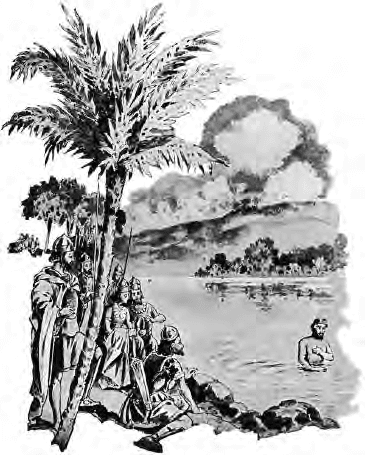
We can imagine his solders watching Naaman from the bank as he went down to the water. He immersed himself once and then looked at his horribly leprous skin. No sign of improvement. He dipped himself again; still no improvement. Three, four, five, six times; still no sign. A lesser man would have been discouraged. But Naaman was a man of discipline. He knew how to give orders and how to carry them out. The prophet had said seven times. He dipped himself once more. The last dip only took one second, but this time, when he came up, his leprosy was clean gone, and his flesh was like that of a baby: soft, smooth, pink and healthy. Naaman was the happiest man in the world.
We know from what happened later that Naaman must have knelt down, then and there, on the bank of the Jordan, together with his soldiers, and raised his voice in thanks to the God of Israel, and swore that thenceforth he would worship no other God but Jehovah.
So Naaman was healed, not only of his leprosy, but also of his idolatry.
He immediately started back to Samaria to see Elisha. We read from the account:
“And he returned to the man of God, he and all his company, and came and stood before him.”
Naaman DOES Meet Elisha This time Elisha came out to see Naaman. Naaman said:
“Behold, now I know that there is no God in all the earth but in Israel. Now, therefore I pray thee, take a blessing [or present] of thy servant. But he said, As the Lord liveth, before whom I stand, I will receive none. And he urged him to take it, but he refused.”
Thus Elisha, who lived frugally in a small house, turned down a gift of ten talents of silver, six thousand pieces of gold, and ten changes of raiment! Elisha could certainly have made good use of the money as well as the clothes in the Lord’s service. He had, under his care and instruction, a group of young men known as “the sons of the prophets.” There were fifty of these (2 Kings 2:7). Sometimes they did not have enough to eat. (2 Kings 4:38) Why, then, did Elisha not take the gift? Because accepting it would have meant the selling, and making merchandise of, the divine power operating through him.
Elisha well knew that God’s gifts are not for sale.
Then Naaman made a request which showed his conversion to the worship of Jehovah God. We read:
“And Naaman said, Shall there not then, I pray thee, be given to thy servant, two mules’ burden of earth? For thy servant will henceforth offer neither burnt offering nor sacrifice unto other gods, but unto Jehovah.” 2 Kings 5:17
This demonstrated a most unusual degree of dedication. Because they were the chosen people of God, Naaman considered the very soil of Israel to be sacred, the only earth upon which an altar to Jehovah might properly be erected. Then, as further proof of his sincerity, he asked forgiveness in advance for the times when, in the discharge of his duties, he would have to accompany the king of Syria into the temple of the idol Rimmon; saying in verse 18: “In this thing may Jehovah pardon thy servant.” Elisha replied, “Go in peace,” and Naaman returned to Syria.
What do you suppose was the first thing Naaman did when he got home? The scriptures do not say, but I think that the first thing he did was to release from servitude that “little maid” of Israel. Perhaps he bestowed upon her much of the treasure that Elisha would not accept, then escorted her happily back to her family. I like to think he did that.
A Picture of the Divine Plan
There are many lessons we can derive from the story of Naaman, the Syrian. First there is a general, broad outline of the Divine Plan of the Ages for the salvation of mankind.
Leprosy is a symbol of sin, and a very fitting one it is. Note the similarities: As, in the time of Naaman, leprosy was incurable, sin is incurable without divine intervention. It is loathsome. It is contagious. It has a small beginning and becomes progressively worse. It is terribly destructive. It deforms, distorts, and makes ugly. Once the nerves of conscience are dulled, it is, like leprosy, deceptively painless as it progresses. It ends in death. As James puts it: “And sin, when it is finished, bringeth forth death.” (James 1:15)
As Naaman became a leper, Adam contracted the leprosy of sin and passed it to all his posterity. Every member of Adam’s race can say, as David did:
“Behold, I was shapen in iniquity, and in sin did my mother conceive me.” Psalms 51:5
As centuries rolled by, the situation appeared hopeless, just as Naaman lost all hope. Then, as in the case of Naaman, a ray of hope was given to mankind through Israel. Moses said:
“The Lord thy God will raise up unto thee a prophet from the midst of thee, of thy brethren, like unto me. Unto him ye shall hearken.” Deuteronomy 18:15
In due time, the prophet foretold by Moses came to earth. As Naaman had heard from the little Israelitish maid that there was a prophet in Israel capable of healing his leprosy, the people of Jesus’ day realized that there was, among them, a great prophet who was endowed with power over sin and death. When Jesus at Nain raised up the widow’s son from the dead, we read that, “They glorified God, saying, that a great prophet is risen up among us.” (Luke 7:16) We read that on the way to Emmaus, the disciples spoke, “Concerning Jesus of Nazareth, who was a prophet, mighty in deed and word before God and all the people.” (Luke 24:19) The “little maid” of our story may have used similar words to describe Elisha to Naaman. Then the apostle conclusively links “that prophet” with the “times of restitution” during which the whole world will be healed of the leprosy of sin:
“Repent ye therefore, and be converted, that your sins may be blotted out, when the times of refreshing shall come from the presence of the Lord. And he shall send Jesus Christ, who before was preached unto you; whom the heaven must retain, until the times of restitution of all things, which God hath spoken by the mouth of all his holy prophets since the world began. For Moses truly said unto the fathers, A prophet shall the Lord your God raise up unto you of your brethren, like unto me. Him shall ye hear in all things, whatsoever he shall say unto you.” Acts 3:19-22
When Naaman told the king of Syria that he had heard there was a healing prophet of God in Israel, the king said: “Go to; go!” This reminds us of Isaiah’s words:
“And many people shall go and say, Come ye, and let us go up to the mountain of the Lord, to the house of the God of Jacob; and he will teach us of his ways, and we will walk in his paths. For out of Zion shall go forth the law, and the word of the Lord from Jerusalem.” Isaiah 2:3
As Naaman hastened to go to the land of the Jews, to the capital of Israel, to seek healing from Jehovah God at the hand of his prophet, others in the future will do the same:
“And the inhabitants of one city shall go to another, saying, Let us go speedily to pray before the Lord, and to seek the Lord of Hosts. I will go also. Yea, many people and strong nations shall come to seek the Lord of hosts in Jerusalem, and to pray before the Lord. Thus saith the Lord of hosts, In those days it shall come to pass, that ten men shall take hold out of all languages of the nations, even shall take hold of the skirt of him that is a Jew, saying, We will go with you; for we have heard that God is with you.” Zechariah 8:21-23
Does this not also remind us of the woman who came to Jesus and touched the hem, or skirt of his garment and was instantly healed?
Perfect Health Is a Great Incentive
This brings to mind one of the great incentives that will be offered to man to fall in line with the kingdom of God under the administration of the Ancient Worthies. Physical healing will be a positive in centive. As people hear that those in Israel who are obedient to the Lord are attaining perfect health and are getting younger instead of older, there will be a veritable stampede to find out how they also can attain such benefits. Thus they will learn of the Lord’s ways and walk in his paths. The coming of leprous Naaman from Syria to Elisha the prophet in Israel for healing may well picture the world of mankind, aliens from God and leprous with sin, submitting themselves to the “princes in all the earth” for deliverance from sin and death.
Elisha’s directing of Naaman to the river to be healed of the curse of leprosy reminds us of the beautiful promise in Revelation when the curse of sin and death will be washed away:
“And he showed me a pure river of water of life, clear as crystal, proceeding out of the throne of God, and of the Lamb. In the midst of the street of it, and on either side of the river, was there the tree of life, which bare twelve manner of fruits, and yielded her fruit every month. And the leaves of the tree were for the healing of the nations. And there shall be no more curse.” Revelation 22:1-3
We also think of that wonderful time foretold in verse 17:
“And the Spirit and the bride say, Come. And let him that heareth say, Come. And let him that is athirst come. And whosoever will, let him take the water of life freely.” Revelation 22:17
Naaman found that the river was indeed the “water of life.” A few moments before, sitting on the bank of Jordan, he was despondent, discouraged, afflicted, and facing death. After the seventh dip he was delivered from his affliction and his flesh became “like the flesh of a little child” soft, smooth, pink and healthy. We are immediately reminded of that grand restitution promise in Job to all mankind afflicted by the leprosy of sin:
“Then he is gracious unto him, and saith, Deliver him from going down to the pit; I have found a ransom. His flesh shall be fresher than a child’s. He shall return to the days of his youth.” Job 33:24,25
Just as Naaman acknowledged Jehovah as the only true God, and said that he would thenceforth serve no other, we read:
“For then will I turn to the people a pure language, that they may all call upon the name of the Lord [Jehovah], to serve him with one consent.” Zephaniah 3:9
“For the earth shall be filled with the knowledge of the glory of the Lord, as the waters cover the sea.” Habakkuk 2:14
The dipping of Naaman seven times is also significant. A similar picture is given in Daniel chapter 4. We remember that Nebuchadnezzar was deprived of his sanity until “seven times” had passed over him. Then his reason returned to him and he “praised and extolled and honored the King of Heaven.” Six thousand years of sin and death have already passed over mankind. When seven thousand years have passed, at the end of the Millennial Age, man’s reason will have fully returned. As also pictured by the “seven times” of Naaman, the leprosy of sin and death will be cured. Then all mankind will “praise, and extol, and honor” Jehovah God, the great King of Heaven.
Spiritual Lessons
In addition to this general outline of the Divine Plan, the account of Naaman the Syrian contains valuable spiritual lessons for the “household of faith.” Let us consider some of them.
First of all, we see the progression of a Christian life. Naaman was a man of Syria, of an alien nation, having neither part nor lot with Israel, having no covenant relationship with God; he was a hopeless leper. It is written of us, while we were yet sinners:
“At that time ye were without Christ, being aliens from the commonwealth of Israel, and strangers from the covenants of promise, having no hope, and without God in the world.” Ephesians 2:12
Consciousness of Sin Is Necessary
Then the Lord draws us. But before he does so, there must be a consciousness of sin, a realization that of our own selves we can do nothing, just as Naaman was aware of his hopeless, leprous condition. Just as Naaman heard that there was a prophet who was able to save him from his leprosy, we are given “ears to hear.” Our attention is drawn to our Saviour, Jesus Christ, of whom we read, “The blood of Jesus Christ . . . cleanseth us from all sin.” (1 John 1:7) The Lord draws us to his truth. We discern the ransom by which sin may be remitted.
In Naaman’s case, a “little maid” was the agency used. One wonders at this. In view of the fact that Elisha had done so many wonderful things in Israel, should not the people of Syria, a nation immediately adjacent, know something about them? Granted, there were no newspapers in those days, but caravans performed the same function, carrying news as well as trade goods from country to country.
Miracles of the magnitude Elisha performed would be exciting news indeed. In those days, as now, nations who were potential enemies had spies in each other’s territories. Should not Syrian spies have reported to General Naaman the miracles of Elisha? It would be reasonable to think so. Yet Naaman heard of the prophet-healer of Israel only from the mouth of a little slave girl. Similarly would it not be logical today to expect to hear the message of truth from the churches of the world? But that is not where we get it. Instead we are put in contact with the truth in all sorts of strange ways, often by unusual agencies. This should not surprise us.
The Lord sometimes uses methods to accomplish his purpose which appear illogical to our minds. For example, the tremendously important event of Jesus’ birth was not announced through the Scribes, Pharisees and religious leaders of Israel, as would appear to be logical, but by a few humble and unlearned shepherds to whom people paid almost no heed. So with us. We may come to a knowledge of the tremendously important message of truth, a force that will transform us from sinful humans to the divine nature to glory, honor and immortality, the highest prize in the universe perhaps by means of a simple tract which just happened to be put under our particular door by some poor sister who could scarcely walk.
I have heard of one who was brought into the truth by a robin. The bird took a sheet of paper from a trash pile and made it the foundation for her nest. She wove her nest upon it and raised a family. The next winter a windstorm dislodged the nest and deposited it with a thump upon a front porch. When the lady of the house came out to pick it up, the big black word HELL caught her eye. She smoothed out the paper, and saw the title to be WHAT SAY THE SCRIPTURES ABOUT HELL? She had been worrying sick about hell-fire, and had been earnestly praying about it.
There is another instance where a tract was put under the door of a small Jewish store. But apparently that wasn’t where it belonged.
Later in the day, a man living several blocks away came into the store to make a small purchase, which the thrifty storekeeper wrapped in the tract. You know in the old days, tracts were quite large, about magazine size when folded. So that is how the tract came to be delivered to the right place. The brother read it and accepted the truth.
Many other such instances can be given. Let us not despise the small opportunities of service: mailing a comforting tract to the bereaved, distributing invitations to hear a local public lecture, or a radio or television program, a word to a fellow-worker, neighbor or relative. This is what the “little maid” did. The Lord uses various means to draw his people. Although they are sometimes unusual, they are rarely spectacular. It may be a chance turning of the radio dial, a sudden impulse to change channels for no logical reason at all, a rambling walk on Sunday that brings one to a meeting hall where a Bible study is in progress.
There must also be some cooperative efforts by the Lord’s people to do things that an individual or small ecclesia cannot do alone. Tracts and other literature must be printed. Radio programs must be prepared and broadcast. Television films must be produced. Tools must be provided for willing workers to use. Everyone can have a part in this also, even if it is only by offering a sincere and earnest prayer for the harvest work.
As Naaman came to the capital of Israel to find the prophet, we read of the household of faith:
“But ye are come unto Mount Zion, and unto the city of the living God, the heavenly Jerusalem . . . to the general assembly, and church of the firstborn, which are written in heaven.” Hebrews 12:22,23
As Naaman was drawn to the prophet, we are drawn to Christ:
“No man can come to me, except the Father . . . draw him.” John 6:44
Elisha told Naaman that if he immersed himself in water seven times, his leprosy would be healed. We know that water immersion is a symbol of consecration and that the number seven means completeness. So combining the two symbols would indicate that a full and complete consecration, a perfect submission to the will of God, is required to bring about the cancellation of Adamic condemnation.
But at first Naaman was not willing to do what the prophet said. He “went away” grieved. This reminds us of the rich young ruler who came to Jesus, also seeking life:
“Jesus said unto him, If thou wilt be perfect, go and sell that thou hast, and give to the poor, and thou shalt have treasure in heaven; and come and follow me. But when the young man heard that saying, he went away sorrowful, for he had great possessions.” Matthew 19:21,22
Naaman sat on the river bank thinking over Elisha’s instructions and was undecided what to do. We “sit down and count the cost,” as instructed in Luke 14:28. The apostle Paul did some reckoning too, and he reached the right conclusion:
“For I reckon that the sufferings of this present time are not worthy to be compared with the glory which shall be revealed in us.” Romans 8:18 Paul referred to a spiritual glory, but what an earthly glory was revealed in Naaman! As in the case of some us, Naaman required a little persuasion. But once having made up his mind, he promptly and completely carried out the prophet’s instructions. Upon rising up from the water, his leprosy was completely gone, his flesh was new as a little child’s, his life saved. It might be said that he had an earthly “newness of life.” It was like a resurrection from the dead. One might say he was “born again.” For years he had been haunted by death and despair; now, in an instant, it all slipped away. All his worries were gone, and his mind was at peace. Similarly, of us it is written:
“Therefore we are buried with him by baptism into death; that like as Christ was raised up from the dead by the glory of the Father, even so we also should walk in newness of life. For if we have been planted together in the likeness of his death, we shall be also in the likeness of his resurrection.” Romans 6:4,5
“Therefore, being justified by faith, we have peace with God through our Lord Jesus Christ.” Romans 5:1
Cured “Leprosy” Brings Joy
What a joy to know our leprosy is cured, that we are justified in the sight of God, that our sins are forgiven, that the robe of Christ’s righteousness covers us, that we are released from the power of sin, and death! As David expressed it:
“Blessed is he whose transgression is forgiven, whose sin is covered. Blessed is the man unto whom the Lord imputeth not iniquity.” Psalms 32:1,2
In due course we too shall be “born again.”
Upon being cleansed, Naaman offered Elisha all his wealth. The refusal of Elisha to accept it, and his permitting Naaman to retain control of it, may well illustrate the fact that when we consecrate our all to the Lord our means, our time, our strength, our talents, our influence, our opportunities, our lips he hands it all back to us to administer for him as his stewards. He notes our faithfulness in our stewardship, and rewards it. As we read, “It is required in stewards, that a man be found faithful.” (1 Corinthians 4:2)
Personal Lessons
There are some lessons of personal application as well. There is a lesson about pride. Naaman was offended when no deference was paid him and his high position. The prophet did not even come out to see him. Was he not a great general, the commander-in-chief of the armies of Syria? Should there not be some special recognition, some pomp and ceremony? Those of the Lord’s people who happen to be better endowed than others, whether in means, or talent, or opportunities of service, should not expect to be treated preferentially or different from others, as though they were heaven’s favorites. None have anything in which to glory. All come short of the perfect standard. We read:
“For who maketh thee to differ from another? And what hast thou that thou didst not receive? Now, if thou didst receive it, why dost thou glory, as if thou hadst not received it?” 1 Corinthians 4:7
“For there is no difference. For all have sinned and come short of the glory of God.” Romans 3:22,23
Let us remember that all are “unprofitable servants” (Luke 17:10) and that it is only by the Lord’s grace and provision that our poor offerings are acceptable.
As Elisha lived in a small and humble house, Bible students often meet in dismal and unpretentious halls because they can afford no better. Yet in spite of outward appearances, these humble meeting places are the embassies of a great king because, “We are ambassadors for Christ” (2 Corinthians 5:20). If God had any regard for external appearances, he would not have permitted his son to be born in a stable.
Then of course, there is the lesson of faith. Naaman had great faith. He believed that there was a great prophet in Israel. It took faith to take his entire wealth with him and journey to Israel to find the prophet. It took faith to follow directions which seemed foolish and dip himself in the Jordan seven times as the prophet said. There must have been thousands of lepers in Israel at that time, many of them in the very city of Samaria. Some could probably have gone around the block to Elisha’s house, but none did. They didn’t have faith. Almost a thousand years later Jesus paid a great compliment to Naaman’s outstanding faith which was greater than any in Israel. He said:
“And many lepers were in Israel, in the time of Elisha the prophet. And none of them was cleansed, saving Naaman, the Syrian.” Luke 4:27
Let us emulate Naaman’s faith.
One wonders what the status of Naaman will be in the kingdom. Of course, he was not of the High Calling for that was not then open.
Nor would he be one of the Ancient Worthies, although he did have their kind of faith. But he was not of the commonwealth of Israel, he was not in covenant relationship with God. What then, was his standing? Since Jesus found him worth mentioning as a high example of faith, and since he dedicated himself to the worship of Jehovah, the true God, I have no doubt he will be accorded some special place in the government of the world, and be a ready, able and willing instrument of the “Princes in all the earth.”
Nehemiah
THE name Nehemiah signifies “Consolation from God,” and this is what we will receive by a consideration of some of his experiences recorded in the book that bears his name.
Nehemiah was the son of Hachaliah, of the tribe of Judah, of one of the prominent Hebrew families of the Babylonian captivity. The Medes and Persians had conquered Babylon. The second universal empire, represented by the breast and arms of silver of Nebuchadnezzar’s vision, now ruled the world. Our story starts at about 445 BC, at Shushan, the palace of Arta-xerxes, king of Persia. Josephus tells us that Nehemiah was a very young man at this time, probably in his twenties. In spite of his youth, he held a high rank in the royal court, that of cupbearer to the king. This title, sometimes translated “butler” is somewhat deceptive to modern ears and does not give the proper conception of the dignity of his position. His duties did not consist solely of tasting the king’s food and drink to prevent poisoning. He was, in fact, one of the most trusted officers of the realm, a confidant of the king, always at his right hand. He was one whose advice the king valued and sought, what today we would call a Minister of State. Daniel held a similar position in his time in the universal empire of Babylon.
We are not told how it came about that young Nehemiah was appointed to such an exalted station. We can only surmise that as in the case of Daniel, it resulted from some sort of competitive examination in which Nehemiah excelled. We may be absolutely sure by his conduct that he was reared by Godly parents who from earliest infancy inculcated in him a reverence and love for the God of Israel; who taught him the history, language, and law of Israel; who imbued him with his ancient and rightful heritage, so that, although he was in Persia, he was not a Persian.
As confidential officer and counselor to the king, it was Nehemiah’s duty to be acquainted with the mood and temper of the people so as to be able to advise the king of any potential threat to the empire. To this end, it appears to have been his custom to mingle, unrecognized, with the people in the marketplaces and especially among those of arriving caravans who could tell of conditions in other parts of the realm. Josephus tells us that he was doing this one day when he heard some new arrivals speaking the Hebrew language. He engaged them in conversation and was delighted to find that one of them was a close relative returning from an extended visit to Jerusalem. It was a tribute to Nehemiah’s upbringing in the faith of his fathers that he eagerly inquired respecting the holy land, the holy city, God’s holy temple, and the conditions of the Jews who had, years before, returned from captivity in Babylon under the proclamation of Cyrus. He was deeply interested in the welfare of Israel. Now let us read the record in Nehemiah’s own words:
“Hanani, one of my brethren, came, he and certain men of Judah; and I asked them concerning the Jews that had escaped, which were left of the captivity, and concerning Jerusalem. And they said unto me, The remnant that are left of the captivity there in the province are in great affliction, and reproach. The wall of Jerusalem also is broken down, and the gates thereof are burned with fire. And it came to pass, when I heard these words, that I sat down and wept, and mourned certain days, and fasted and prayed before the God of heaven.” Nehemiah 1:2-4
Do you see how keenly young Nehemiah felt about his people? How closely he identified himself with them and the holy city? He had never seen Jerusalem. He had never been there. All he knew about its former glory was from nostalgic accounts by his parents and others of the captivity. Yet he was deeply moved and distressed to hear of the devastation and degradation of Jerusalem, so much so that he wept. It is an evidence of his great faith in the God of his fathers that he immediately and naturally turned to prayer.