
Herod Seizes Peter
With James gone, the Church at Jerusalem depended more than ever upon the leadership of Peter. Then suddenly Herod arrested Peter also, intending to execute him publicly for the pleasure of the Jews. But the execution had to be postponed because it was the beginning of Passover week. According to Jewish custom, no one could be put to death during those holy days. So Peter was held in prison for the time being. Thus we read in Acts 12:4,
“And when he had apprehended him, he put him in prison, and delivered him to four quaternions of soldiers, to keep him; intending, after Passover, to bring him forth to the people.”
Herod was taking no chances. Sixteen soldiers were assigned to guard Peter day and night. The Knox translation says there was “a guard of four soldiers, relieved four times a day.” The arrest and imprisonment of Peter greatly distressed the church especially because the loss of James was fresh in their minds. It was a severe trial of their faith. They reacted in the only proper way by resorting to prayer on Peter’s behalf. We read, in Acts 12:5, “But prayer was made without ceasing, of the church unto God for him.” The Knox translation says, “There was a continual stream of prayer going up to God from the church on his behalf.”
By this time the numbers of Christians in Jerusalem had increased considerably. They had no church buildings in those days , but gathered in various convenient places, mostly in private homes much as we do today. So in this crisis we can imagine that there were several separate prayer meetings going on simultaneously in different parts of the city. We know of the earnestness of those prayers by the fact that these meetings were kept up all night and evidently throughout the entire week of Peter’s imprisonment. What was the burden of their prayers? Well instructed by the apostles, we may be sure they did not ask amiss. They did pray for Peter’s deliverance,
of course; that he be spared in order to –continue to serve them. But without doubt they added, as their Master had done in the garden, “Nevertheless, not my will, but thine be done.” Luke 22:42
Now let us see what was happening to Peter. Tradition tells us that he was taken to the famous Castle of Antonia, a stone fortress adjoining the Temple area in Jerusalem. It was a Roman military garrison. It is possible that Peter was imprisoned in the very same room in which Jesus was arraigned before Pilate, where he was scourged and mocked by Roman soldiers just before his crucifixion. It was from the stairs of this same castle that Paul, at a later date, addressed the mob that had assaulted him. That account is in Acts 21:31-40.
Since Peter was arrested at the order of Herod himself, he was considered a very important prisoner. His sixteen guards would be selected with great care. They were undoubtedly powerful men; highly disciplined, callous and ruthless. As an incentive to their utmost watchfulness, they were bluntly told that if Peter escaped, they would be killed in his place. But no one could imagine how it would be possible for Peter to escape. The castle had walls of stone ten feet thick. Every room was secured by massive iron gates with heavy locks and bolts. A large garrison of Roman soldiers lived in the castle itself. As is customary in a military establishment, armed sentries were posted outside and regularly made their rounds. It would be absolutely impossible for any unauthorized person to get out or get in. In the actual guarding of Peter within the prison, unusual precautions were taken. The sixteen soldiers took turns watching Peter: four of them being on duty at all times, in six-hour shifts, day and night, 24-hours a day. Chains were fastened to Peter’s wrists and attached to two of the soldiers, one on each side, in such a way that the slightest movement on Peter’s part would instantly alert them. Another soldier was posted inside the room, at the iron gateway, and a fourth in the corridor just outside the gate to the room. The chains attached to Peter were long enough for him to sit or stand during the day. At night he lay on the floor to sleep, the soldiers sitting one on each side of him. Could a prisoner ever be made more secure than that?
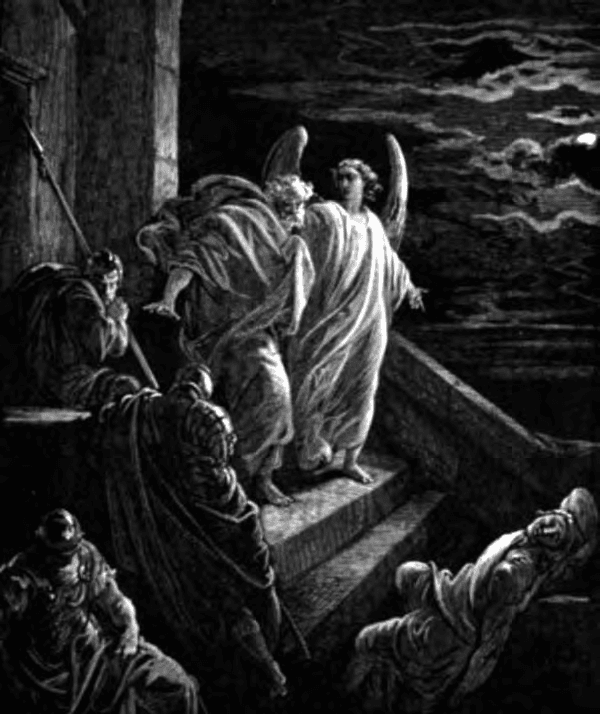
This is the situation in which Peter was for about a week. How did he occupy himself? I am sure a man of Peter’s hearty and impulsive nature, full of the Lord’s spirit, did not pass his time in moody silence and, feeling sorry for himself, sink into depression. On the contrary, the very fact that he was found worthy to be imprisoned in the very room in which his beloved Master had suffered must have been a great joy to him. Thinking back, he would be elated by the Lord’s words, quoted in John 15:20,21,
“Remember the word that I said unto you. The servant is not greater than his Lord. If they have persecuted me, they will also persecute you. . . . But all these things will they do unto you for my name’s sake.”
Also, Luke 21:12,13, which fitted his case so well,
“They shall lay hands on you, and persecute you; delivering you up to the synagogues, and into prisons; being brought before kings and rulers for my name’s sake. And it shall be to you for a testimony.”
Then he probably remembered the Lord’s words given in Matthew 10:17,18, which would strike him with special force:
“They will deliver you up to the councils . . . and ye shall be brought before governors and kings for my sake, for a testimony against them and the Gentiles.”