
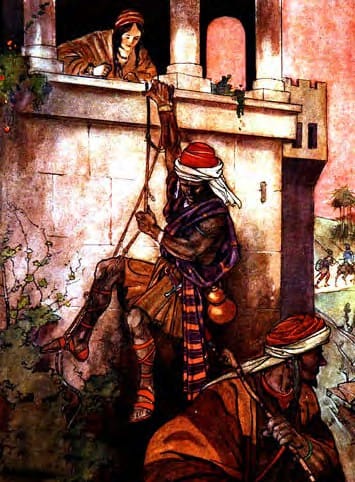
Jehovah to be the only true God. She then threw herself upon the mercy of the spies, asking that she and her family might be spared when Jericho would be destroyed as she confidently expected it would be. The spies made a bargain with her. We read in the 14th verse, “And the men answered her, our life for yours.” “You save our lives, and we will save yours.” Rahab quickly showed her sincerity by proposing a sound plan of escape. She would let them down with a rope through a window which would place them outside of the city wall. Then they must hide in a nearby mountain for three days until their pursuers ended their search and returned to the city. After that they could return safely to the camp of Israel. The plan pleased the spies. For their part, they proposed that when Jericho was attacked, if she and her whole family would gather in her house and stay there, they would all be saved alive.
But how was her house to be identified so that the attacking Israelites would spare it? There were probably many houses built upon the wall and, in the heat of battle, a mistake could easily be made. We can imagine that at this point one of the spies pointed to a red ribbon which adorned Rahab’s hair and said, “When the attack begins, tie that red ribbon in the window through which you let us down. That shall be the sign.” Our translation of the account calls it a “scarlet thread.” But a thread tied in a window perhaps fifty feet above the ground could not be seen from very far away, so it was probably a ribbon. Rahab agreed. She brought a stout rope of flax and fastened it to the window sill. It reached down to the ground outside. The spies slid down the rope and disappeared in the darkness.
It is interesting to note from verse 21 that although Rahab knew that the spies would not return to their encampment for three days and that the attack upon Jericho would probably not be made for some time after that, nevertheless she did not wait; she immediately bound the scarlet ribbon in the window. It was a comfort to her to see it there. It gave her a sense of security and peace, of being under the protection of the great God of Israel.
After hiding three days in the mountains, the spies returned safely and made their report, telling Joshua all that had happened to them.
“And they said unto Joshua, Truly the Lord hath delivered into our hands all the land; for even all the inhabitants of the country do faint because of us.” Joshua 2:24
The People Cross the Jordan
Then followed the stupendous miracle of the drying up of the Jordan river, which was in flood stage at the time, enabling the great host of Israel, led by the ark of the covenant, to pass over without getting their feet wet. As they went over, a selected representative of each tribe picked up a large stone from the bed of the river and carried it upon his shoulder to the opposite shore: twelve stones, one for each tribe. Leading the host across were 40,000 armed men just in case there should be an enemy attack, which, however, did not occur.
The miracle of the drying up of the Jordan before Israel was observed by enemy spies. One thing must have especially impressed the spies. They saw that ahead of the host of Israel went four men in priestly garments, bearing between them a glistening golden object. As the priests approached the river, the raging waters literally fled before them. It was apparent to the enemy spies that a tremendous power was being exerted by that golden object. The enemy spies quickly conveyed the information to their kings:
“And it came to pass, when all the kings of the Amorites which were on the side of Jordan westward, and all the kings of the Canaanites which were by the sea, heard that the Lord had dried up the waters of Jordan from before the children of Israel, until we passed over, that their heart melted; neither was there spirit in them any more, because of the children of Israel.” Joshua 5:1
This great demonstration of power brought forcibly to their memories the miracle of the passage of the Red Sea forty years before, when the power of Egypt was broken. Here was the very same Almighty God still strong on behalf of his people. If they were fearful before, as Rahab had told the spies, they were doubly fearful now.
Immediately after crossing the Jordan, the children of Israel went inland toward Jericho. They camped midway between the river and the city, about 2.5 miles from Jericho, in a place called Gilgal. Here they made a monument of the twelve stones taken from Jordan as a memorial of the great miracle that the Lord had performed there.
In the crystal-clear air of that region the watchmen on the high walls of Jericho could clearly see the great host of Israel arrive and set up camp nearby. From her house upon the wall Rahab could see them too. A camp of three million persons would cover an enormous area. The inhabitants of Jericho were terrified and they quickly closed and barred the great bronze gates of the city.
“Now Jericho was straitly shut up, because of the children of Israel. None went out, and none came in.”
Here at Gilgal at the command of the Lord, all the males of Israel were circumcised.
“And the Lord said unto Joshua, See, I have given into thine hand Jericho, and the king thereof, and the mighty men of valour.” Joshua 6:1,2
But how was it to be accomplished? The city was shut up tight. The Israelites were not equipped to besiege a walled city in the conventional way. They had no battering rams to force the gates. They had no catapults to fling huge stones over the walls. They had no great bows with which to shoot flaming arrows to set fire to the city. Wondering how he should proceed against Jericho, Joshua went alone early in the morning to scout the city. As he approached the massive walls a man in shining garments with a glittering sword in his hand stood before him, barring his way. Joshua instantly remembered the Lord’s promise, “There shall not any man be able to stand before thee all the days of thy life.” He boldly drew his own sword and went up to the man.
“And Joshua went unto him, and said unto him, Art thou for us, or for our adversaries? And he said, nay; but as captain of the host of the Lord am I now come.” Joshua 5:13,14
The margin says he was “prince” of the host of the Lord. Perhaps he was the same individual referred to in Daniel 12:1 as “Michael … the great prince which standeth for the children of thy people,” materialized as a man.
“And Joshua fell on his face to the earth, and did worship, and said unto him, What saith my lord unto his servant?”
The angel of the Lord told Joshua just what to do to conquer Jericho. The instructions are given in Joshua 6:3-5, which I will read from the Moffatt translation:
“For six days you, and all your men at arms, shall march round the town once a day, with seven priests carrying seven rams’ horns as trumpets in front of the ark. On the seventh day, you shall march round the town seven times, and the priests shall blow a trumpet blast. As soon as they blow a long trumpet blast on the horns, whenever you hear the sound, then all the people must raise a mighty shout; and the wall of the town will fall down flat, till every man of you can march in, straight in front of him.”
The Seige Begins
Joshua obeyed promptly. The next morning the watchmen on the walls of Jericho saw an approaching host and gave the alarm. Led by Joshua, the army of Israel marched in front. Next came seven priests in their distinctive garments blowing on rams’ horns, then four priests carrying between them with great care a glistening, golden object. As soon as they saw this stark terror filled the hearts of the men of Jericho. This was the same object before the power of which the waters of Jordan had fled! After the ark followed a large representative group of the men of Israel. The defenders of Jericho braced themselves, expecting some kind of action; but nothing happened. They saw no battering rams or other military machinery. The Israelites marched once around the city and then went straight back to their encampment. This was repeated for six days. Still nothing happened and the inhabitants of Jericho began to relax behind their strong walls. Then on the seventh day the usual procession appeared very early in the morning. As they began their march around the walls, the entire host of Israel silently approached the city and formed a huge ring around it, leaving only enough room for the marchers between them and the wall. The men of Jericho watched with fascination from the top of the high walls. This time the marching Israelites did not stop after one circuit but went around seven times. As they marched they scanned the walls particularly the houses built upon the walls. All windows were heavily shuttered; but in one of the windows of one of the houses, they saw a scarlet ribbon! This was the house of Rahab. The word was passed to the men of war to carefully note that house each time they made a circuit of the city. The order was that all those found in that house were to be spared. Then suddenly at a signal from Joshua, they stopped and the priests blew a long blast upon their horns. Then a deafening
shout went up such as was never heard up to that time nor since: three million voices, shouting in unison, with all their might! What an impact of sound that would be!
“And when the people heard the sound of the trumpet blast, and raised a mighty shout, down the wall fell flat, till every man could march in, straight in front of him.” Joshua 6:20 [Moffatt]
They marched in and took the town. But one section of the wall did not fall. It was that part upon which the house of Rahab stood and in the window of which a scarlet ribbon was tied. We know this because Joshua sent men to her house to bring her safely out, together with all her relatives and property. This was the same Rahab who afterward married into the tribe of Judah and became an Israelite, and who has the honor of being an ancestor of our Lord Jesus. She is listed in Hebrews chapter 11 as one of the faithful ancient worthies.
By the Lord’s commandment Jericho was utterly destroyed. Only the metals of the city were saved for the Lord’s use.
“And they burnt the city with fire, and all that was therein. Only the silver and the gold, and the vessels of brass and iron, they put into the treasury of the house of the Lord.” Joshua 6:24
This account of the conquest of Jericho is recorded in the Bible not only as an interesting narrative, which it is, but for a far more important reason. As we are told in 1 Corinthians 10:11, it has a typical significance. It is, “Written for our admonition, upon whom the ends of the ages are come.” Let us now consider and take to heart some of these admonitions.
Lessons for Us
The name “Joshua” is another form of the name “Jesus” and means “Savior.” It is interesting to note that the career of Joshua is one of the few recorded in some detail without any blemish being imputed. The shortcomings of other patriarchs are frankly stated in the Bible. Noah was drunken. Abraham so conducted himself as to merit the rebuke of Pharaoh in Egypt. (Genesis 12:18,19) Moses struck the rock and was debarred from the land of promise. Samson consorted with sinners. David was guilty of murder. But as far as the record shows, the career of Joshua was blameless. Of course this does not mean he was a perfect man, but it does aptly indicate that he was a type of Christ who was “holy, harmless, undefiled, separate from sinners.” Hebrews 7:26
Now let us consider that wonderful assurance God gave to Joshua:
“There shall not any man be able to stand before thee all the days of thy life. As I was with Moses, so I will be with thee. I will not fail thee nor forsake thee. Have I not commanded thee? Be strong, and of good courage. Be not afraid, neither be thou dismayed; for the Lord thy God is with thee, withersoever thou goest.” Joshua 1:5,9
Just imagine God saying that to you, personally! Impossible? Not at all! He is saying it to you. This glorious promise is applicable with equal and greater force to each member of spiritual Israel, to each consecrated child of God. You do not have to be given an important and exalted assignment such as Joshua was given. If you are faithful to the truth and are doing God’s will, even in a small way as your hands find to do, you are an heir of this promise! “There shall not any man be able to stand before THEE.” “God will not fail THEE, nor forsake THEE.” The Lord thy God is with THEE, withersoever THOU goest.” God will not permit any interference by anyone, man or devil, with your development as a new creature, humble as it may be. Opposition against you will not prosper. This grand promise is an heritage of each one of the Lord’s faithful people. This is powerfully confirmed by Isaiah:
“No weapon that is formed against thee shall prosper; and every tongue that shall rise against thee in judgment thou shalt condemn. This is the heritage of the servants of the Lord; and their righteousness is of me, saith the Lord.” Isaiah 54:17
Let us, as Joshua did, rely on this exceeding great and precious promise and go courageously forward in the strength of it.
The conquest of the sinful city of Jericho provides a general picture of the Divine Plan. In this picture the king of Jericho is Satan, the devil, and the city his worldwide dominion. As Jericho blocked the way to Canaan, the land of milk and honey, Satan’s rulership stands in the way of the world’s attaining Messianic blessings. As the king of Jericho shut the city up tight so that none came out, we read of Satan that he “opened not the house of his prisoners.” (Isaiah 14:17) Joshua represents Jesus Christ and Israel represents his kingdom.
After six days [or six thousand years] of seeming inaction against Satan’s stronghold, finally comes the seventh day [seventh thousand year]. Then, with a great shout such as never heard before, Satan’s dominion collapses and Christ’s kingdom takes control following which every vestige of sin is destroyed.
We are now living in the dawn of that seventh day. As the priests blew on their horns, the Jubilee trumpet is now sounding and the final shout signaling the utter collapse of Satan’s rulership is very near at hand. Isaiah describes this situation:
“The Lord shall go forth as a mighty man. He shall stir up jealousy like a man of war. He shall cry, yea roar. He shall prevail against his enemies. I have long time holden my peace. I have been still, and refrained myself. Now will I cry like a travailing woman. I will destroy and devour at once.” Isaiah 42:13,14
Also Jeremiah:
“The Lord shall roar from on high, and utter his voice from his holy habitation. He shall mightily roar upon his habitation. He shall give a shout, as they that tread the grapes, against all the inhabitants of the earth. A noise shall come even to the ends of the earth; for the Lord hath a controversy with the nations. He will plead with all flesh. He will give them that are wicked to the sword, saith the Lord.” Jeremiah 25:30,31
But aside from this general application, there is a deeper and more personal lesson for us in the conquest of Jericho which is for our admonition. In this picture Jericho represents our fallen human dispositions, traits of character which are contrary to the spirit of God and which, as 1 Peter 2:11 expresses it, “war against the soul.” Jericho represents the selfish and depraved appetites of the flesh. As we read in Galatians,
“For the flesh lusteth against the spirit, and the spirit against the flesh. And these are contrary the one to the other; so that ye cannot do the things that ye would.” Galatians 5:17
Jericho was a rich city with an abundance of expensive fabrics, fine clothing, and other luxuries, and was enclosed by strong walls. The natural man has an abundance of strongly entrenched fallen human traits and appetites. The natural man esteems the good things of the world to be of paramount importance. But just as the Lord decreed the utter destruction of Jericho, these fallen human propensities must be systematically and thoroughly eliminated by the Christian. We must not allow Jericho to block our way to our promised inheritance. With its thick double walls Jericho looked impregnable. How could it possibly be conquered? The conquering of our fallen human disposition with its established and ingrained habits seems similarly impossible. A wise man has said, “Habit is like a cable of many strands. We weave a thread of it every day; and at last we cannot break it.”
How about reversing the process? Instead of weaving a thread of it every day, let us break a thread of it every day. Thus a mighty work will be accomplished gradually and we will gain the rule over ourselves. As we read in Proverbs,
“He that is slow to anger is better than the mighty; and he that ruleth his spirit than he that taketh a city.” Proverbs 16:32
This suggests the conquering of Jericho. We must make every effort to conquer and destroy our personal Jerichos if we are to gain the prize.
“For if ye live after the flesh, ye shall die. But if ye, through the spirit, do mortify (put to death) the deeds of the body, ye shall live.” Romans 8:13
But just as the victory of the Israelites was gained by the power of God, we do not conquer in our own strengths. It would be impossible to do so. As Joshua did not hesitate to obey the command of the Lord to proceed against Jericho, we also should promptly and decisively obey in this regard. As the hearts of the kings of the Amorites melted when the Israelites began the invasion of the land, the promise to the spiritual Israelites is, “Resist the devil, and he will flee from you.” James 4:7
The ark of the covenant accompanied the Israelites and from it the mighty power of God emanated. We too enjoy the presence of God and his great power is exercised on our behalf. “All things work together for good.” Romans 8:28
Before entering the promised land, spies were sent out to determine the cost of conquering it. Similarly in contemplating consecration and attaining the heavenly kingdom, the child of God counts the cost. Blessed is the one who, after counting the cost, lays hold on the Lord’s promised “grace to help in time of need” (Hebrews 4:16) and says, as Caleb did, “Let us go up at once and possess it, for we are well able to overcome it!”
In crossing over through the bed of the Jordan river, the Israelites were figuratively immersed in its waters. This symbolized consecration which is also pictured by the ceremony of circumcision which immediately followed. It was after this that the children of Israel marched against Jericho. Similarly, it is after consecration that the child of God begins the destruction of the flesh and the development of an acceptable Christlike character.
Rahab’s tying of the scarlet ribbon in the window as a token by which she and her house escaped destruction reminds us of the first Passover when each household took of the scarlet blood of the lamb and applied it to the two exterior side posts and on the upper door posts of the house. As a result, they were assured:
“And the blood shall be to you for a token upon the houses where ye are; and when I see the blood, I will pass over you, and the plagues shall not be upon you, to destroy you, when I smite the land of Egypt.” Exodus 12:13
The faith that Rahab had that the scarlet ribbon would protect her pictures our faith in the precious blood of Christ. As it was a comfort to her, it is a sustaining comfort to us. The Israelites were required to stay in their houses which were marked with blood on Passover night so that the firstborn would escape destruction. Rahab and her family were required to remain in their house which was marked with scarlet. The family of God, the Church of the firstborns, must also remain under the blood by which they are sanctified. As at the first Passover, the alternative is death. We read in Hebrews:
“He that despised Moses’ law died without mercy under two or three witnesses. Of how much sorer punishment, suppose ye, shall he be thought worthy, who hath trodden under foot the Son of God, and hath counted the blood of the covenant, wherewith he was sanctified, an unholy thing, and hath done despite unto the spirit of grace?” Hebrews 10:28,29
Rahab was a Gentile but was because of her faith accepted into the commonwealth of Israel, so we are acceptable as spiritual Israelites by faith in Christ’s blood. This is called to our minds in Ephesians:
“Wherefore remember, that ye being in time past Gentiles in the flesh, who are called Uncircumcision, by that which is called the Circumcision in the flesh made by hands; that at that time ye were without Christ, and strangers from the covenants of promise; having no hope, and without God in the world. But now, in Christ Jesus, ye who sometimes were far off, are made nigh by the blood of Christ.” Ephesians 2:11-13
The marching of the children of Israel around Jericho for six days, blowing trumpets and not attempting any kind of attack, seemed foolish and pointless to those watching. Similarly nominal Christians do not understand our methods. They say, “Instead of just walking in the Christian way, you people should make a frontal attack upon the citadel of sin. You should join with us, in our efforts for social uplift, and to convert the world!”
But we are content to be obedient to the Lord’s command to simply walk the narrow way. As we go, we blow our trumpets of witness to the truth, giving forth the gospel message knowing full well that it is not now the due time for the blessing of the world. That will come on the seventh day in the Messianic Kingdom when Satan’s stronghold will be demolished. It will happen by the Lord’s power, not ours.
When the walls of Jericho collapsed, we read that “The people went up into the city, every man straight before him, and they took the city.” (Joshua 6:20) I think there is a lesson here. Let each one attack that part of Jericho which is in front of him. Let each one concern himself with overcoming his own shortcomings and not his neighbor’s. Jesus put it so well:
“Why beholdest thou the mote that is in thy brother’s eye? … First cast out the beam of thine own eye.” Matthew 7:3,5
We will have quite enough to do to conquer our own portion of Jericho. Jericho was destroyed with fire, and we read:
“Only the silver and the gold, and the vessels of brass and of iron, they put into the treasury of the house of the Lord.” Joshua 6:24
No one is totally depraved. There are some human traits that are good and praiseworthy in every person, especially those who are called of God. Each one has some possessions, talents, abilities and opportunities, that can be turned from sinful and unprofitable uses to the service of God. They can be “put into the treasury of the house of the Lord.” Upon consecration we are appointed the stewards of every good thing we have and are. We are told that, “it is required in stewards, that a man be found faithful.” (1 Corinthians 4:2) Some are more highly endowed with possessions and abilities comparable to gold and silver. Some of us can offer only brass and iron. But all are acceptable if placed and kept in full consecration, “in the treasure of the house of the Lord.”
Jesus contrasted the things of Jericho in us which are to be destroyed with those things in us which are consecrated and endure in God’s treasury:
“Lay not up for yourselves treasures upon the earth, where moth and rust doth corrupt, and where thieves break through and steal. But lay up for yourselves treasures in heaven, where neither moth nor rust doth corrupt, and where thieves do not break through nor steal. For where your treasure is, there will your heart be also.” Matthew 6:19-21
This is a picture of our supreme joy when we have finally broken the fetters of flesh and have entered the kingdom of heaven. Jude caught a glimpse of this blessed condition, when he said:
“Now unto him that is able to keep you from falling, and to present you faultless before the presence of his glory, with exceeding joy; to the only wise God our Saviour, be glory and majesty, dominion and power both now and ever. Amen.” Jude 24,25
The Footsteps of Jesus
THERE are some familiar expressions, descriptive of our Christian course, that we in present truth commonly use. They are beautiful and scriptural expressions but we use them so freely and so often that, I’m afraid, they have largely lost their meaning. They roll off our tongues so easily they have become commonplace and without force. Their lessons, which we need so much, have thus been largely lost.
We say, for example, that we are “following in the footsteps of Jesus.” This is suggested by Peter and by John:
“For even hereunto were ye called; because Christ also suffered for us, leaving us an example, that ye should follow his steps.” 1 Peter 2:21
“These are they who follow the Lamb withersoever he goeth.” Revelation 14:4
Every one of us has used the expression “following in the footsteps of Jesus” hundreds of times. But what does it really mean? To a worldly person it might mean that we journey to the holy land and carefully retrace, on foot, the steps Jesus took when on earth, from Bethlehem to Calvary. Some religious fanatics actually do this. Maps are available showing the route to be taken. Is this what the scripture means? Someone might say, “No, it means doing exactly what Jesus did.” Does it? Are we expected to literally turn water into wine, heal the sick, raise the dead, feed the multitude, be betrayed, and finally be nailed alive to a cross? I don’t think so. “Walking in the footsteps of Jesus” must have some other, more profound meaning.
Another expression we frequently use is that we are trying to be “overcomers.”
“To him that overcometh will I grant to sit with me in my throne, even as I also overcame, and am set down with my Father in his throne.” Revelation 3:21
This says that we must overcome, as Jesus overcame. What did Jesus overcome? Did he, as we do, have to overcome the weaknesses of a fallen nature and the sinful propensities of the flesh? No, he had none. He was holy, harmless, undefiled, separate from sinners. We are not that way.
We say “we must suffer with him.”
“And if children, then heirs; heirs of God, and joint-heirs with Christ; if so be that we suffer with him, that we may be also glorified together.” Romans 8:17
Are you suffering, are you in pain? Perhaps some are, but is this what the scripture means? “No,” some might say. “We must suffer what Christ suffered.” Yes, but what does that mean? Does it mean that we must be literally crucified in order to be glorified?
We have the expression, “bear your cross.”
“Then said Jesus unto his disciples, If any man will come after me, let him deny himself, and take up his cross, and follow me.” Matthew 16:24
“Whosoever doth not bear his cross, and come after me, cannot be my disciple.” Luke 14:27
Does this mean that every Christian is compelled to carry a literal wooden cross like Jesus? If not, what does it mean?
We say “we are not of the world.”
“If ye were of the world, the world would love his own; but because ye are not of the world, but I have chosen you out of the world, therefore the world hateth you.” John 15:19
This expression really mystifies those who are not in the truth.
“If you are not of this world, then where are you from? Mars? A space ship, perhaps? Aren’t you human? Don’t you eat food, and drink water, and need warmth, and shelter, like the rest of us? Aren’t you subject to the laws of the land? Aren’t you a citizen? What do you mean, you are not of the world? And who hates you, anyhow?”
Another expression often used without full understanding is “dead with Christ.”
“It is a faithful saying; for if we be dead with him, we shall also live with him.” 2 Timothy 2:11
What does it mean to be “dead with Christ”? A similar scripture is found in Revelation:
“Be thou faithful unto death, and I will give thee a crown of life.” Revelation 2:10
To what must we continue to be faithful until we die?
It is important for us to understand the import of these expressions that we so freely and readily use because the lessons they teach are vital for us to make our calling and election sure. We must know what it means to follow Jesus’ steps because we must do so to be of the 144,000. (see Revelation 14:3,4) We must know what “overcoming” involves because Revelation 3:21 says only overcomers will reign with Christ. We must know what “suffering with Christ” implies because Romans 8:17 says that without such suffering we cannot be glorified with him. We must know what it means to “take up our cross” because both Matthew 16:24 and Luke 14:27 state that we cannot be Christ’s disciples without so doing. We must know what it means to be “not of this world” because according to John 15:19 only such are chosen members of Christ.
Let us consider the meanings of some of these beautiful and descriptive scriptural expressions.
Walking in Christ’s Footsteps
Christ has left “us an example, that ye should follow his steps.” (1 Peter 2:21) Mof fatt renders it: “He left you an example, and you must be following his footsteps.”
We read, “He maketh my feet like hind’s feet, and setteth me upon my high places.” (2 Samuel 22:34; Psalms 18:33) The hind is a variety of deer whose hind feet step exactly into the tracks of its front feet when it walks without the slightest deviation. One would think from its footprints that a two-legged creature had walked by, so precisely does one footprint fit into the other. Perhaps when the prophets wrote, “he maketh my feet like hind’s feet,” they spoke prophetically of the footstep followers of Jesus who by so walking, would attain “high places,” the divine nature.
If we follow in the exact footsteps of another we always arrive at the same destination. If we closely follow Christ’s footsteps, we cannot go astray. We will never be lost, we will always be with our Lord, here now, and hereafter in the heavenly kingdom. Jesus said:
“If any man serve me, let him follow me; and where I am, there shall also my servant be. If any man serve me, him will my Father honor.” John 12:26
The “honor” spoken of is the divine nature: “glory, honor and immortality.”
When Jesus called his disciples, he said, “Follow me.” He didn’t mean merely following or walking behind him. He meant much more than that. He meant that they should follow his precepts, his commandments, his example. These are his steps. Let us now look for his footprints to see how closely we are following them.
The first step of the man Christ Jesus was consecration. Paul says:
“Wherefore, when he cometh into the world, he saith, Sacrifice and offering thou wouldest not, but a body hast thou prepared for me … Then said I, Lo, I come (in the volume of the book it is written of me), to do thy will, O God.”–Hebrews 10:5,7
Have you taken the step of consecration? Have you given up your own will, as Jesus did, substituting for it the will of the heavenly Father? Have you given up all earthly treasures, hopes and ambition, presenting your body “a living sacrifice, holy, acceptable unto God, which is your reasonable service”? (Romans 12:1) If you have, you have followed the most important footstep of Jesus.
When Jesus had taken this first step, he received the holy spirit. Do you have this evidence? Don’t be too quick to say No. Consider this: Do you understand the deep things of the plan of God? Do you understand this significance of the fall, the ransom, the coming restitution of all things? Do you appreciate the high calling, your participation in the sin-offering, and in the blessing of all the families of the earth? If you do, you have the strongest possible evidence of the holy spirit:
“God hath revealed them unto us by his spirit; for the spirit searcheth all things, yea, the deep things of God.” 1 Corinthians 2:10
There are other evidences of the holy spirit. They are the “fruits” of the spirit:
“But the fruit of the Spirit is love, joy, peace, longsuffering [or forbearance], gentleness [or kindness], goodness, faith [or fidelity], meekness, temperance [or self-control].” Galatians 5:22,23
The possession and development of these qualities are evidences of the holy spirit.
Into the Wilderness
Jesus’ next step was his wilderness experience where he meditated upon God’s word and was tempted of the devil. Have you been in the wilderness? Following consecration, have you often felt impelled to remove yourself from the distractions of the world to study God’s word revealing his plan and your place in it? This was a step of Jesus. Have you taken it? I’m sure you have.
Jesus hungered. Have you ever hungered for righteousness and truth, wishing to be filled with them, longing for the time the whole world will be filled with them?
Jesus was tempted of the devil. The first temptation was that he misuse his spiritual powers to serve his fleshly needs by turning stones into bread. He overcame this temptation, by saying: “Man shall not live by bread alone, but by every word that proceedeth out of the mouth of God.” Are you walking in his footsteps by sowing to the spirit instead of to the flesh? Is the truth the most important thing in the world to you, more important than the interests of the flesh?
The next temptation that Satan presented was for Jesus to spectacularly cast himself down from the pinnacle of the temple. Jesus rejected this proposal, saying, “Thou shalt not tempt the Lord thy God.” Walking in the footsteps of Jesus, we do not seek outward show nor to enhance our earthly reputations. Using the spirit of a sound mind we walk circumspectly and do not take unwise risks expecting God will miraculously preserve us from the consequences of our reckless acts.
“The devil taketh him up into an exceeding high mountain, and showeth him all the kingdoms of this world, and the glory of them; And saith unto him, All these things will I give thee, if thou wilt fall down and worship me.”
This was a proposal to change God’s plan, and Jesus refused to do it. He knew that what Satan proposed was unscriptural. He knew he had come to die as a ransom, not to reign his reign would come later.
Most importantly, he knew that only God is to be worshipped. To follow this footstep of Jesus we must never compromise the truth nor seek to change God’s plan. Jesus said, “Get thee hence, Satan.” He wasn’t very polite. He didn’t say, “Would you mind very much leaving me now? I wish to be alone, please.” No! He said, in effect, “Get out! Get away from me!” He was firm and positive. He chased Satan out, and Satan went. This was an important step in Jesus’ life, a step we must follow. We must resist Satan with all our might. He understands blunt language and a firm stand. “Resist the devil, and he will flee from you.” (James 4:7)
There is an interesting sequel to the event of Jesus’ temptation in the wilderness:
“Then the devil leaveth him, and behold angels came and ministered unto him.” Matthew 4:11
What delicious and nourishing food they must have served the hungry but triumphant Jesus; far better than the “stones made into bread” that Satan proposed. They gave him food for the soul, as well news from the heavenly courts and assurances of the love and approval of his heavenly Father.
A most important and comprehensive step is given in Jesus’ own words:
“To this end was I born, and for this cause came I into the world, that I should bear witness unto the truth.” John 18:37
All Bible students follow in this footstep. Upon hearing and comprehending the wonderful divine Plan of the Ages, we cannot help but talk of it to others. Jesus preached the gospel of the kingdom and we do the same. We cannot all do it from the public platform, or by radio or television, but we can all speak as we have opportunity, to neighbors and those we meet. Many have come into the truth and have attained the divine nature because a tract had been placed under their door. These footsteps of Jesus we can follow.
What of the many and mighty miracles of Jesus? He raised the dead, healed the sick, cast out devils, fed the multitudes, changed water into wine, and walked upon the stormy sea. Can we follow these steps? We can and we do. But how, for example, do we raise the dead? By our personal promulgation of the truth and by our support of the harvest work. Men dead in trespasses and sins become quickened and rise up and walk joyfully in newness of life. As we read, “Awake thou that sleepest and arise from the dead, and Christ will give thee light.” (Ephesians 5:14) This is indeed a raising of the dead. We heal blind eyes when through the telling of the message of truth, we cause the eyes of understanding to be opened, and let the glorious gospel of Christ to shine into the mind. These are footsteps of Jesus we can and do follow. We heal deaf ears when our message finds a “hearing ear,” leading someone to appreciate God’s wonderful plan of salvation. Wecast out devils when we relieve people’s minds of the frightful devils of false doctrines, superstitions and fears. The doctrine of eternal torture is one of the tormenting demons we eliminate. We also take this step Jesus took.
We feed multitudes when we support any public witness work that reaches millions of poor, hungry souls, satisfying them with hearty, substantial, nourishing, spiritual food. We also follow Jesus’ step in the miracle of changing water into wine. We take the pure water of truth and use it to produce a most excellent wine, the wine of participation and communion in the shed blood of Jesus Christ. Jesus walked upon the stormy sea,and we follow his steps. By the Lord s grace, we walk serenely in a world gone mad, rising above the restless and turbulent conditions of this present evil world because we know the meaning of it all. Considering what these steps are and how we follow them day by day should be reassuring and encouraging to us. Let us never again let the familiar and beautiful phrase “following in the footsteps of Jesus” become trite and meaningless.
There is one footstep of Jesus that no one else has trod. It is the step to Calvary. This step, too, we must take. Thanks to our merciful heavenly Father, we will not suffer a literal “death of the cross,” but we must, nevertheless be “obedient unto death” as our Master.
There is a sense in which we have been and are being crucified with Christ now:
“Knowing this, that our old man is crucified with him, that the body of sin might be destroyed; that henceforth we should not serve sin.” Romans 6:6
“I have been crucified together with Christ; still I live. Yet no longer I, but Christ lives in me; for that life which I now live in the flesh, I am living by that faith of the Son of God, who loved me, even to delivering himself up on my behalf.” Galatians 2:20, Diaglott “They that are Christ’s have crucified the flesh, with the affections and lusts. If we live in the spirit, let us also walk in the spirit.” Galatians 5:24,25
As we “walk in the Spirit,” we walk in the footsteps of Jesus. Don’t forget that if we walk in the exact footsteps of another, we arrive at the same destination. As Jesus himself said:
“In my Father’s house are many mansions … I go to prepare a place for you … that where I am, there ye may be also … I am the way.” John 14:2-4
Overcomers
Another expression we frequently use is that we are “overcomers.” It is important that we fully understand what this means because the promises of Christ to those who overcome are extremely lavish.
These promises are in Revelation, the last recorded message of Jesus Christ to the church; they are given for our encouragement. “To him that overcometh, will I give to eat of the tree of life.” (Revelation 2:7) This is clearly a promise of immortality. “He that overcometh shall not be hurt of the second death.” (Revelation 2:11) This ties in with, “Blessed and holy is he that hath part in the first resurrection; on such the second death hath no power; but they shall be priests of God, and of Christ, and shall reign with him a thousand years.” (Revelation 20:6) “To him that overcometh, will I give to eat of the hidden manna, and will give him a white stone, and in the stone a new name written, which no man knoweth saving he that receiveth it.” (Revelation 2:17) Manna was the bread that came down from heaven as a life-sustainer for Israel. It represented the living bread, Christ himself. Overcomers are promised the hidden manna. One characteristic of the golden pot of manna “hidden” in the tabernacle was that it was incorruptible. It well illustrates the immortal, incorruptible, condition promised to the church.
What does the promised white stone signify? In ancient times there was a custom of pledging close and enduring friendship by means of a small white stone. The stone was divided into halves, each person inscribed his name on the flat surface, and the parts were exchanged. In time of need or danger, producing either half brought instant aid from the holder of the other half. The white stone is a symbol of the close individual and personal relationship with the Lord that we enjoy through the sealing of the holy spirit. The “new name” is that of the bridegroom “which no man knoweth saving he that receiveth it.” In other words, it is an intimate spiritual relationship that the world cannot know nor appreciate. It is a “white stone” arrangement strictly between the Lord and ourselves, certifying that we belong to God and to Christ. As Paul describes it:
“The spirit itself beareth witness with our spirit, that we are the children of God, and if children, then heirs; heirs of God, and joint- heirs with Christ; if so be that we suffer with him, that we may be also glorified together.” Romans 8:16,17
Here is another precious promise to “overcomers”:
“He that overcometh the same shall be clothed in white raiment; and I will not blot out his name out of the book of life, but I will confess his name before my Father, and before his angels.” Revelation 3:5
The glorified church will not take off the robe of righteousness but will continue to walk in white raiment. In glory it will not be a robe of reckoned righteousness, but a robe of actual righteousness. This ties in with this description of the Lamb’s wife: “And it was granted that she should be arrayed in fine linen, clean and white; for the fine linen is the righteousness of saints.” (Revelation 19:8)
The promise is that the name of the overcomer will not be blotted out of the Book of Life. There is a definite heavenly record made of each of the Lord’s people. If your name is there, you have reason to rejoice greatly. Jesus said, “Rejoice, because your names are written in heaven.” (Luke 10:20) Isn’t that a thrilling thought? Your name may not be written on any earthly church membership list, but it is in God’s heavenly directory. That is what really counts. If you are an overcomer, the time is not too distant when you will answer the heavenly role call. The signs are now before our eyes:
“And at that time shall Michael stand up, the great prince which standeth for the children of thy people; and there shall be a time of trouble, such as never was since there was a nation, even to that same time. And at that time thy people shall be delivered; every one that shall be found written in the book.” Daniel 12:1
God grant that your name and mine may be written there!
Meeting God Face to Face
Jesus said, “I will confess his name before my Father and before his angels.” Can you picture that assembly? All the faithful overcomers are together, clothed with their glorious bodies. Old friends, once parted by death, have been reunited. Many with earthly family ties are together again. It is hard to imagine a more joyful occasion. Jesus is there whom, without actually seeing, we have known so long and loved so well. He embraces each of us. Then Jesus says, “Come, let me introduce you to the Father!” As we come into the presence of the heavenly Father, we behold his glorious majesty which human words are entirely inadequate to describe. He is surrounded by a multitude of angels. Jesus leads us, one at a time, before the heavenly Father and his angels and introduces us by name. The Father speaks graciously to each of us and we feel his infinite love enveloping us. Our joy is beyond measure. This is the event described in Jude:
“To present you faultless before the presence of his glory, with exceeding joy.” Jude 24
I think it is this very scene that the prophet David glimpsed when he wrote:
“In thy presence is fullness of joy; and at thy right hand there are pleasures for evermore!” Psalms 16:11
We read in Revelation:
“Him that overcometh will I make a pillar in the temple of my God; and he shall go no more out; and I will write upon him the name of my God, and the name of the city of my God, which is New Jerusalem, which cometh down out of heaven from my God; and I will write upon him my new name.” Revelation 3:12
This is a description of the consummation of our hopes. The temple, of which we are living stones, is shown as complete; we are a part of the New Jerusalem that will rule and bless the world in the name of Christ.
“To him that overcometh will I grant to sit with me in my throne, even as I also overcame and am set down with my Father in His throne.” Rec. 3:21
If Christ sits on the throne of God and we are granted to sit on Christ’s throne, we will surely have the rulership of all things.
“He that overcometh shall inherit all things; and I will be his God, and he shall be my son.” Revelation 21:7
The rewards of “overcoming” are truly stupendous. But that is not the only reason we want to be “overcomers.” We want to become “overcomers” because we know it pleases God and because Christ, our example, has overcome; we want to follow in his steps, we want to be with him, we want to be where he is.
But what, exactly, does it mean to “overcome”? How does one go about it? What does it involve? The word “overcome” is strongly suggestive of a great conflict of war, of powerful opposition, of struggle to gain the victory. It calls to mind the apostle Paul’s expressions: “Fight the good fight of faith.” (1 Timothy 6:12) “Endure hardness, as a good soldier of Jesus Christ.” (2 Timothy 2:3) “Watch ye; stand fast in the faith; quit you like men; be strong.” (1 Corinthians 16:13) To overcome requires energy and force of character. It requires perseverance and steadfastness, patient endurance to the very end of the present life.
What is it that we are to overcome? We are to overcome many things; they are all summed up by the general term WORLD.
“For whosoever is begotten of God overcometh the world. And this is the victory that overcometh the world, even our faith.” 1 John 5:4
“Know ye not that the friendship of the world, is emnity with God.”- James 4:4
“Love not the world, neither the things that are in the world. If any man love the world, the love of the Father is not in him.” 1 John 2:15
From these scriptures we should not get the thought that we are to have no worldly people as friends nor to have them consider us as friends. This would imply we were their enemies but we are not to be their enemies. We are to love them. We must if we are to be like our heavenly Father of whom it is written, “For God so loved the world, that he gave his only begotten son, that whosoever believeth in him should not perish, but have everlasting life.” (John 3:16) This seems contradictory to “love not the world” (1 John 2:15) but it really is not when rightly understood. While we must, like our heavenly Father and our Lord Jesus, love the individuals of the world and some day to raise them up and bless them, we are not to love the rulership of the Satanic world, nor the selfish spirit of the world, nor the God-dishonoring religions of the world, nor the corrupt politics of the world, nor the depraved sins of the world.
These are the elements of the world we are to hate; these are the elements of the world that hate us.
God loves each individual of the world and will bless each one. It is written that God “will have all men to be saved, and come unto the knowledge of the truth.” (1Timothy 2:4) Jesus “was the true Light which lighteth every man that cometh into the world.” (John 1:9) In harmony with this, Jesus instructed us:
“I say unto you, love your enemies, and pray for them which despitefully use you and persecute you; that ye may be the children of your Father which is in heaven; for he maketh his sun to rise on the evil, and on the good, and sendeth rain on the just, and on the unjust.” Matthew 5:44,45
The apostle confirmed that this is the proper attitude by saying:
“As we have therefore opportunity, let us do good unto all men.” Galatians 6:10
To love the world as God loves it is not the sentiment against which the apostles warn the church when they say “Love not the world” and “friendship of the world is enmity with God.” A love like God’s is a grand and ennobling love which, without having fellowship with the depraved, pities the fallen and longs for the time when they may be rescued from their degradation. Such love benevolently ignores personal antagonisms and animosities. It overlooks selfish considerations and ignores vengeful feelings. It considers only the possibilities, the ways and means, for peace, reformation and salvation. The love of the world, the friendship of the world, which the apostle condemns is the love of fellowship, implying the partaking of its spirit, its aims, ambitions and hopes, and its methods of pursuing them. If any man love the world in this sense, surely the love of the Father is not in him.
We Are Not of the World
An expression truth people frequently use is that “we are not of the world.”
“If ye were of the world, the world would love its own; but because ye are not of the world, but I have chosen you out of the world, therefore the world hateth you.” John 15:19
Jesus said, “I am not of this world.” (John 8:23) He said of his disciples, “They are not of the world, even as I am not of the world.” (John 17:14) He said to Pilate, just before his crucifixion: “My Kingdom is not of this world.” (John 18:36)
In one sense we are indeed identified with outer space. Jesus told the Jews, “Ye are from beneath; I am from above.” (John 8:23) He said in several places, “I came down from heaven.” (John 6:38) So we who are in Christ are of a different world. We are a separate nation, living in the midst of the people of this world. We are a peaceful nation. We keep our laws and their laws. The only exception might be where a violation of conscience is involved. We are told to be subject to “the powers that be.” (Romans 13:1) Paul said, “Remind them to be submissive to governments and authorities; to obey rulers.” (Titus 3:1, Diaglott) We realize the Lord has permitted these governments to keep a measure of order inthe world. We are protected by the police powers of this world’s governmental bodies. This makes possible the peaceful carrying on of the harvest work.
We can preach the gospel without hindrance. That is why Paul said:
“I exhort, therefore, that, first of all, supplications, prayers, intercessions, and giving of thanks be made for all men; for kings and for all that are in authority; that we may lead a quiet and peaceable life, in all godliness and honesty.” 1 Timothy 2:1,2
We are not of this world because we are really ambassadors from another government or “world.” The world does not understand us. They do not know that we belong to a different kingdom. But we understand them. They cannot understand because no man can understand beyond his mental status, so to speak. We, who have been begotten of the holy spirit, still understand natural things, but the natural man does not understand spiritual things.
“The natural man receiveth not the things of the spirit of God, for they are foolishness unto him; neither can he know them, because they are spiritually discerned. But he that is spiritual [or spirit- begotten] judgeth all things.” 1 Corinthians 2:14,15
So we, as sons of God, citizens of the heavenly kingdom, dwell in the midst of a perverse race or generation, steeped in sin for 6000 years. That is why our Lord declared, “Ye are not of the world, even as I am not of the world.”
How can we overcome the world so we may inherit all the wonderful promises made to overcomers? By what power do we overcome the world? How do we gain the victory? It must be a tremendous power to overcome the whole world. Here is the answer:
“This is the victory that overcometh the world, even our faith.” 1 John 5:4
The Meaning of Faith
Faith? Faith in what? The word “faith” has two meanings. The primary meaning, according to Webster, is: “Firm and earnest belief, on probable evidence of any kind, especially as a moral truth.” This well describes our firm and earnest belief in God, and his son Jesus Christ, although we have not seen them, our belief that the Bible is the inspired word of God, and true in every respect, and that the Lord is good and will perform all he has promised.
But there is another meaning of the word “faith,” which Webster defines as: “That which is believed; a system of religious belief.” Strong’s defines it as “a system of religious truth.” The word is frequently so used in the scriptures:
“Be sober, be vigilant; because your adversary the devil as a roaring lion, walketh about, seeking whom he may devour; whom resist steadfast in the faith.” 1 Peter 5:8,9
I think it is so used in the text, “This is the victory that overcometh the world, even our faith.” It refers to “our most holy faith.” The word was used by Paul when he had overcome the world:
“I have fought a good fight, I have finished my course, I have kept the faith.” 2 Timothy 4:7
What must we do to overcome the world? WE MUST STAY IN THE TRUTH. We must retain our faith in the divine Plan of the Ages as the Lord has revealed it to us at this end of the age. We must remain truth people. This is one of the final tests. Paul had a special revelation about this by inspiration of the holy spirit:
“Now the Spirit speaketh expressly, that in the latter times some shall depart from the faith.” 1 Timothy 4:1
Many have already departed since Brother Russell passed beyond the veil, and there will probably be many more. These will not be overcomers!
It takes strength of purpose, watchfulness and tenacity to be an overcomer. Paul admonishes us:
“Watch ye; stand fast in the faith; quit you like men; be strong.” 1 Corinthians 16:13
Those who do not hold to the truth but cast away their faith will lose the great rewards promised to overcomers:
“Cast not away therefore your confidence, which hath great recompense of reward; for ye have need of patience, that, after ye have done the will of God, ye might receive the promise.” Hebrews 10:35,36
Let us keep our confidence in the truth, our faith, our religion, our system of belief, which God restored to us at this end of the age by a special and honored instrument. This is the same faith the early church enjoyed but which was lost.
“I exhort you that ye should earnestly contend for the faith which was once delivered unto the saints.” Jude 3
By holding on to our faith in the truth and living according to it we develop as new creatures, we overcome all the evil influences of the world. “This is the victory that overcometh the world, EVEN OUR FAITH.”
The word of God has a wonderful transforming influence. It makes the followers of Christ different from others radically different. It would almost seem they were no longer human and, in a sense, they are not because they are new creatures. In what way are they different? It is said that “self-preservation is the first law of nature.” This is another way of saying that selfishness is the first law of the world. Men will preserve their own lives first. When in danger, they will flee and leave others to fend for themselves. They will even climb over the bodies of their dying companions to escape a calamity.
If there is a scarcity of food or water, the stronger will take from the weaker and let them die. There are some notable exceptions, of course, particularly of parents sacrificing themselves for their children. But the general rule is self-preservation. Evolutionists dignify the term by calling it “the survival of the fittest.” The stronger animal feeds on the weaker and survives. This supposedly improves the race. This is the law of the world but it is not the law of Christ.
“For scarcely for a righteous man will one die, yet peradventure for a good man some would even dare to die; but God commendeth his love toward us, in that, while we were yet sinners, Christ died for us.” Romans 5:7,8
What a contrast this is with the law of the world! This is the spirit we are to emulate. We are to be transformed from the law and spirit of the world. As Christ died for us, we are to be dead with him. There is no self-preservation, no “survival of the fittest” here. It is death, but death for a purpose! It is dying with Christ that we might live with him, that we may have a joyful part in the blessing of the world.
Rejecting the Law of Self-preservation
The Lord’s people deny and defy the first law of this world: self-preservation. We follow in the footsteps of Jesus, as Paul exhorts:
“I beseech you therefore, brethren, by the mercies of God, that ye present your bodies a living sacrifice; holy, acceptable unto God, which is your reasonable service. And be not conformed to this world, but be ye transformed by the renewing of your mind; that ye may prove what is that good, and acceptable, and perfect will of God.” Romans 12:1,2
Instead of conforming to the pattern of this world, we are remodeled or changed to another pattern (Christ). This is accomplished by the transforming influences of the word of God. As we study that word, weabsorb God’s ways and his wisdom, his spirit. We endeavor to think as Christ thought and do as he did. To the extent wedo this, the wisdom of this world is crowded out of our minds and our minds are renewed. This pleases the Lord for we read: “The wisdom of this world is foolishness with God.” (1 Corinthians 3:19) Paul describes this important change in us:
“But we all, with open face, beholding as in a glass the glory of the Lord, are changed into the same image, from glory to glory, even as by the spirit of the Lord.” 2 Corinthians 3:18
The glory or image of the Lord is reflected by his word. As we study his word we see the grandeur of his character. We see it reflected and exemplified by Christ. In proportion as we appreciate and copy it, we are changed from glory to glory, from one level of character- likeness to a higher one, growing more and more like Christ. Thus we will be overcomers.
“The overcomers must all be proven to be such as would sacrifice every other thing for the Lord; such as would sacrifice the love, and fellowship and approval, if necessary, of every other being, in order to retain the love and favor of the Lord. We believe that this test is coming daily closer and closer to the Lord’s consecrated people, and it behooves every one of us to remember that this is one of the elements of our trial, and to set our affections on the heavenly things accordingly, and to mortify or deaden all such affections toward earthly beings and things as would bring these into competition with our Lord in our affections, service, etc.” Manna, July 26
We must persevere to the end of our lives. If we do, we will not only overcome the world, we will gain the world. Jesus said:
“He that overcometh, and keepeth my works unto the end, to him will I give power over the nations; and he shall rule them with a rod of iron; as the vessels of a potter shall they be broken to pieces: even as I received of my Father.” Revelation 2:26,28
Yes, the evil dominion of Satan will be shattered and the faithful overcomers, reigning with Christ, will rule the nations firmly and justly.
Let us not fail in our determination to overcome the world. Let us go about it enthusiastically and cheerfully in spite of obstacles and opposition. IT CAN BE DONE. Jesus said:
“In the world ye shall have tribulation; but be of good cheer, I have overcome the world.” John 16:33
He has gone before us. Let us follow in his footsteps!
The Fruit of the Spirit
“But the fruit of the Spirit is love.” Galatians 5:22
AT ONE time “the earth was without form, and void, and darkness was upon the face of the deep.” There was nothing in this great wide world .but a dismal emptiness, a vacuum. The Hebrew dictionary defines this word “void” as bleak, lifeless, dead.
Then we read in Genesis 1:2 that “the Spirit of God moved upon the face of the waters.” As soon as the Spirit of God began to operate, things began to happen tremendous things; literally world-shaking events. The darkness fled and there was light. There was a separation of night and day. There was a firmament an atmosphere where none existed before. Seas and dry land appeared. Vegetation of all kinds and sizes sprang up and flourished. The seas teemed with living creatures, including great whales and monsters. Then other living creatures, in infinite variety, appeared on the land also. All these marvelous things happened, because the Holy Spirit of God moved; and this power of the Spirit is what David described in Psalm 104:30, “Thou sendest forth thy Spirit, they are created; and thou renewest the face of the earth.”
God’s Holy Spirit is His power, His influence, His force, His might, the implementing of His will. It cannot be successfully opposed. It makes itself felt. It does exactly what God wills. It gets results. It brings forth fruit.
Now let us cite some instances in the past, of the wonderful power of the Spirit of God.
The Spirit of the Lord came upon Joseph in Egypt and he interpreted Pharaoh’s dream regarding the seven years of plenty, and the seven years of famine. “And Pharaoh said unto his servants: Can we find such a one as this; a man in whom the Spirit of God is?” (Genesis 41:38) Then things began to happen in rapid succession, Joseph, the slave of the dungeon, rose up to be the ruler in Egypt.
The Spirit of God came upon Moses, the lowly shepherd of Midian. That meekest of all men who had fled in terror from Egypt went boldly back to Egypt; withstood the mighty Pharaoh to his face; was the Lord’s instrument in bringing ten horrible plagues upon Egypt; became the general of the millions of Israel; led them triumphantly out of Egypt; brought them the law from God, out of the mount; established the tabernacle sacrifices; and, finally, shepherded the hosts of Israel to the borders of Canaan. All because the Spirit of God came upon him.
When the time came to build the Tabernacle, and all its furnishings and appurtenances to the exact and exquisite specifications furnished by God there was none in Israel capable of it. They didn’t have the skill; they were largely brickmakers and stonemasons, and in their bondage, worked in the fields, with rough and callused hands. They were not artists. The scripture says:
“And the Egyptians made the Children of Israel to serve with rigor; and made their lives bitter with hard bondage; in mortar, and in brick, and in all manner of service in the field. All their service, wherein they made them serve, was with rigor.” Exodus 1:13,14
But whether they naturally had the necessary skill or not, the Tabernacle, with all its symbolic features, must be built, and built exactly right. So what happened? The Lord simply selected a man and said:
“I have filled him with the Spirit of God; in wisdom, and in understanding, and in knowledge, and in all manner of workmanship; to devise cunning works; to work in gold, and in silver, and in copper; and in cutting of stones, to set them; and in carving of timber; to work in all manner of workmanship.” Exodus 31:2-5
That man became superbly capable of doing the job. This is another demonstration of the power of the Spirit of God.
The Power of God’s Spirit
We read in Judges 6:34 that “The Spirit of the Lord came upon Gideon.” Gideon was only a farmer; a thresher of wheat. But with the Spirit of the Lord moving in him, he took 300 men like himself, and put to complete rout the tremendous military hosts of Midian, and Amalek.
Then let us consider the case of Samson. We read that “the Spirit of the Lord began to move Samson.” This was at a time when the Philistines were oppressing Israel and the wickedness of the Philistines had come to the full. What happened when the Spirit of the Lord moved Samson? “And he smote them hip and thigh, with a great slaughter,” we read in Judges 15:8. On another occasion we read that “the Spirit of the Lord came mightily upon him,” whereupon “he found a new jawbone of an ass, and put forth his hand and took it, and slew a thousand men therewith.” (Judges 15:14, 15) Then, for a while, he was deprived of the Spirit of God and his great strength failed. But when the Spirit came upon him again, he had the power to push apart the pillars of the great Temple of Dagon, and bring it down to ruin, together with all its occupants. Paul names Samson in Hebrews chapter 11 as one of the Ancient Worthies. He did what he did, by the Spirit of God.
David also is a case in point. Upon his being anointed by Samuel it is written that “the Spirit of the Lord came upon David, from that day forward.” (1 Samuel 16:13) Whereupon the shepherd boy slew the mighty Philistine giant Goliath; became a great and good king of Israel; a prophet, and sweet singer, and psalmist; the progenitor of Jesus in his human existence, who was called the “Son of David” and the originator of the “throne of David” which will rule the world in the Millennium.
The example of Jesus is the greatest example of all. It was prophesied of Jesus in Isaiah 11:1,2,
“And there shall come forth a rod out of the stem of Jesse; and a Branch shall grow out of his roots; and the Spirit of the Lord shall rest upon him; the Spirit of wisdom, and understanding; the Spirit of counsel, and might; the Spirit of knowledge, and of the fear of the Lord.”
The Spirit of the Lord did indeed rest upon him, as it is written in Matthew 3:16,
“And Jesus, when he was baptized, went up straightway out of the water; and, lo, the heavens were opened unto him, and he saw the Spirit of God descending like a dove, and lighting upon him.”
Later Jesus himself said in Luke 4:18, “The Spirit of the Lord is upon me.” Jesus was completely filled with the Spirit. His every thought and act was in accordance with the Spirit of God. It permeated every fiber of his being. John 3:34 tells us that he had the Spirit without measure. How did it manifest itself in Jesus? What fruit did it bear?
Peter sums it up very nicely in his preaching to Cornelius, as recorded in Acts 10:38,39,
“How God anointed Jesus of Nazareth, with the Holy Spirit and with power; who went about doing good, and healing all that were oppressed of the devil; for God was with him. And we are witnesses of all things which he did, both in the land of the Jews, and in Jerusalem; whom they slew and hanged on a tree.”
Imbued with God’s Spirit, and the power of it, Jesus went about doing good. He preached the Gospel of the Kingdom in spite of the savage opposition of the religionists of his day; and the common people heard him gladly. He performed many miracles of love and compassion, healing all manner of diseases, and even awakening the dead to life. He opened blind eyes; unstopped deaf ears; and made the dumb to speak. He cast out demons. He freely expended his own vitality and energy. He walked on the sea; he stilled a great storm; he fed 5,000 people with five loaves and two fishes; he changed water into wine. He preached a Sermon on the Mount, containing the essence of the true wisdom of God and putting to shame all the miserable ethics and practices of the world. He gave many masterful parables, 49 of which are recorded, by which he taught enduring lessons to his disciples. He vigorously and publicly reproved the Scribes and Pharisees, and others who were deceiving the people. He was holy, harmless, undefiled, separate from sinners. Then, although fully capable of delivering himself, he voluntarily submitted to betrayal; to a mock trial; to scourgings, and other indignities; and, finally, the agonizing death on the cross.
By his life, during which he kept the law of God perfectly in every detail, and by his death, which he did not deserve to die, he became the ransom or corresponding price for Adam, and his race, redeeming you and me. By his death and resurrection he opened up a new and living way whereby those partaking of his Spirit, and walking in his footsteps of sacrifice and death, may seek for, and attain, glory, honor, and immortality. Here is an example where the Holy Spirit of God had full and complete sway and brought forth fruit supremely.
Power on Pentecost
Then we come to the Day of Pentecost. In obedience to Jesus’ commandment in Acts 1:4,5, the disciples were waiting in Jerusalem for the fulfillment of Jesus’ promise: “For John truly baptized with water; but ye shall be baptized with the Holy Spirit.” We read in Acts 2:1-4 that,
“They were all with one accord, in one place. And suddenly, there came a sound from heaven, as of a rushing mighty wind, and it filled all the house where they were sitting. And there appeared unto them cloven tongues, like as of fire, and it sat upon each of them. And they were all filled with the Holy Spirit, and began to speak with other tongues, as the Spirit gave them utterance.”
One moment they were timid, frightened, afraid; hidden in an upper room; the door closed and locked; keeping as quiet as possible; apprehensive of any footstep on the stairs, lest it be that of a spy, or a Roman officer. Then, suddenly, a sound not of footsteps, but “as of a rushing mighty wind.” Have you ever heard the roar of a hurricane or typhoon? a mighty wind? It’s pretty loud; it pervades everything. “And it filled all the house.” The next moment “they were all filled with the Holy Spirit.” Then what happened? They began to speak!
They began to preach, and in languages other than their own. They must have unlocked the doors, and flung open the windows. They made themselves heard, far and wide; because we read that “this was noised abroad, and the multitude came together, and were confounded [or perplexed] because that every man heard them speak in his own language. And they were all amazed, and marveled.”
From then on, the gospel was preached boldly and vigorously. Do you see the transforming and energizing power of the Spirit?
Another good illustration is that of Stephen. We read of him in Acts 6:5 that he was “a man full of faith, and of the Holy Spirit.” We also read in verses 8 and 10:
“And Stephen, full of grace and power, did great wonders, and miracles among the people. And they were not able to resist the wisdom and the spirit by which he spake.”
The faithfulness of Stephen made him the first Christian martyr. In a very short time, the infusion of the Holy Spirit had caused him to be full of faith, grace and power. As the stones of the mob rained upon him, he was able, with his final breath to say: “Lord, lay not this sin to their charge!”
Then we have Saul of Tarsus. He had been blinded by a light from heaven on the Damascus Road. He had heard the voice ofJesus, he had caught a glimpse of the glorified Jesus. Then a disciple named Ananias was sent to him. The account is in Acts 9:17. Ananias laid his hands on Saul, whereupon he received his sight and was filled with the Holy Spirit.
Then things began to happen! He was transformed from Saul, the scourge of the Christians, to become PAUL, the foremost of the apostles. As the Lord said to Ananias, in Acts 9:15,16,
“He is a chosen vessel unto me; to bear my name before the Gentiles, and kings, and the children of Israel. For I will show him how great things he must suffer for my sake.”
Later, writing to the Corinthians, Paul told of these sufferings and cares:
“In labors more abundant; in stripes above measure; in prisons more frequent; in deaths oft. Of the Jews five times received I forty stripes save one. Thrice was I beaten with rods; once was I stoned; thrice I suffered shipwreck; a night and a day I have been in the deep. In journeyings often; in perils of waters; in perils of robbers; in perils by mine own countrymen; in perils by the heathen; in perils in the city; in perils in the wilderness; in perils in the sea; in perils among false brethren. In weariness, and painfulness; in watchings often; in hunger and thirst; in fastings often; in cold and nakedness. Besides those things that are without, that which cometh upon me daily: the care of all the churches.” 2 Corinthians 11:23-28
Filled and impelled by the Holy Spirit, Paul suffered all of these things and he gloried in them:
“But none of these things move me; neither count I my life dear unto myself; so that I might finish my course with joy; and the ministry, which I have received of the Lord Jesus, to testify the gospel of the grace of God.”–Acts 20:24
These are some examples of the operation and effect of the Holy Spirit of God. What is common to all of these examples? In each case, as soon as the Holy Spirit began to operate, things began to happen! Its action was fruitful. Results were achieved.
In the beginning, when the Spirit of Godmoved upon the face of the waters, the earth brought forth. When the Spirit of the Lord came upon Joseph, he was transformed from a slave to the ruler of Egypt. When the Spirit of God came upon Moses, the meekest of men, he became a mighty leader and law-giver. When a slavish, and clumsy brickmaker was filled with the Spirit of God, he became a superb artist and craftsman, in the gold, silver, copper, precious stones, curtains and wood-carving of the tabernacle in the wilderness. When “the Spirit of the Lord began to move Samson,” he performed the will of God with stupendous strength and zeal. When the Spirit of the Lord came upon David, he became a man after God’s own heart. When the Spirit of God came upon Jesus at Jordan, the heavens were opened unto him; he discerned the perfect will of God, and performed it, even to the death of the cross. When those at Pentecost were filled with the Holy Spirit, they were immediately transformed, from fearful, hiding Christians, into preaching and crusading Christians–who spread the Gospel farand wide in every language. When Stephen was filled with the Holy Spirit, he had such eloquence that the people “were not able to resist the wisdom and the spirit by which he spoke” and he attained such a degree of love that he was able to ask God to forgive those who killed him, while they were killing him! When Saul of Tarsus was filled with the Holy Spirit he was completely changed–from a vicious and sadistic persecutor of the Church, into its foremost apostle and minister, writing most ofthe New Testament, and literally laying down his life for the Gospel. There is one common result in all these instances– the Holy Spirit always brought forth fruit. It always prospered in the things whereunto it was sent. It always got results. It never failed.
The Holy Spirit and Us
Let us consider an astonishing and sobering thought. This same Holy Spirit, this mighty, irresistible power of God, is used on our behalf also! It operates in us. It dwells in us; it FILLS us (Ephesians 5:18). Galatians 5:25 says “we live in the Spirit” and we “walk in the Spirit.” Romans 8:9 says we are “in the Spirit,” and the “Spirit of God dwells in us.” Romans 8:11 says that “the Spirit of Him that raised up Jesus from the dead dwells” in us. Raising Jesus from the dead was a magnificent display of power–and this is the Spirit that dwells in us that is our Comforter and Helper. Romans 8:14 says “we are led by the Spirit of God,” and therefore “are the sons of God.” Hebrews 6:4 says we are made “partakers of the Holy Spirit.” Ephesians 1:13 says we are “sealed with the Holy Spirit.” 1 John 5:18 ways we are “begotten of God” by the Spirit. Ephesians 3:16 says we are “strengthened with might by his Spirit in the inner man.” Doesn’t that suggest POWER? Philippians 2:13 says, “For it is God who worketh in you, both to will and to do of his good pleasure.”
So this is not a trifling thing, with which we are dealing. We are dealing with the power of God himself. Based on all the testimony we have cited, wouldn’t you say that results should be expected? that there should be fruit? There should and there is. Paul confirms this in Romans 8:23 when he says that we “have the firstfruits of the Spirit.”
Now let us see what these fruits are, and let us, for our own encouragement, confirm that we have them or are developing them, and that, therefore, we are indeed “the sons of God.”
“[For] the Spirit itself beareth witness with our spirit, that we are the children of God. And if children, then heirs; heirs of God, and joint-heirs with Christ; if so be that we suffer with him, that we may be also glorified together.” Romans 8:16,17
Galatians 5:22,23 names the fruits of the Spirit:
“But the fruit of the Spirit is love, joy, peace, longsuffering [or forbearance], gentleness [or kindness], goodness, faith [or fidelity], meekness, and temperance [or self-control].”
It will be seen that love leads the list. This is the greatest and foremost. This is the fruit we are going to concentrate on today because all the others derive from it.
The Importance of Love
Someone asked Jesus, “Master, which is the great commandment in the law?” There were 3,600 commandments at that time in the Jewish law and the question they put to Jesus was: “which one is the greatest?” Jesus said unto them: “thou shalt love …” Doesn’t this show that love is the greatest thing in the world? “Thou shalt love the Lord thy God with all thy heart, and with all thy soul, and with all thy mind. This is the first, and greatest commandment!” Then he quoted the one second in importance which was love again: “And the second is like unto it: Thou shalt love thy neighbor as thyself.” Matthew 22:36-39
To the Jews, it was the law, a commandment which meant life to them, if kept perfectly, which it was impossible for them to do. But to us, love is the fruit of the Spirit of God, an evidence that we are his children and heirs, members of his household; as it is written in 1 John 4:16: “God is love; and he that dwelleth in love, dwelleth in God, and God in him.” Do you get the full implication of this scripture? If our consecrated lives are motivated and dominated by love, and God is love we are said to dwell in God! This is confirmed by Paul in Acts 17:28, “In Him we live, and move, and have our being.”
But the scripture goes further than that. It says that if we dwell in love, God dwells in us! How can such a thing be? Can the Almighty God dwell in our poor human bodies? Of course not. How then does God dwell in us? The answer is in 1Corinthians 3:16, “Know ye not, that ye are the temple of God, and that the Spirit of God dwelleth in you?” It is by his Spirit that God dwells in us, by his holy influence. But we must make room for Him to come in by dwelling in love, by loving Him supremely our neighbors as ourselves, and our brethren better than ourselves by enlarging our hearts to fully receive his Spirit of love. Then he will indeed dwell in us.
Love is the principal attribute of God, and it has tremendous power. Paul said, in 2 Timothy 1:7, “For God hath not given us the Spirit of fear, but of power and of love, and of a sound mind.” Notice that power and love are associated. Love has power. It has the power of life and death! Let me illustrate.
Many years ago, in New York’s Bellevue Hospital, the staff of the children’s ward were faced with a tragic fact. They were losing 32% of the children under a year old. That’s almost one third. The children were dying mostly through minor ailments. The doctors were dumbfounded. There was no apparent reason for it. The infants were receiving the finest medical care known to science. They had clean, germ-free surroundings. Their diets were carefully formulated, of the best ingredients. Temperatures were properly maintained. Beds were comfortable, everything seemed ideal. Yet the babies were dying.
Finally, one of the doctors suggested that the only thing the hospital was not supplying was love. It was a revolutionary idea, but they were desperate. So they sent out a call for love-volunteers women to come and love babies, so many hours a day. Hundreds of women responded, because they had a need, too a need for someone to love. They held the babies in their arms; fed them; talked to them; sang them little lullabies; showed them affection gave them love.
The death rate began to plunge immediately. In four months, it was down to almost zero!
This incident demonstrates the power of even the natural love with which God endowed his human creatures a tremendous power the power of life and death! How much more power is exerted by the higher form of love, with which God’s Spirit has endowed his New Creatures in Christ! The peculiar thing about love is that it is developed by giving. A wise man has said, “You are born of the qualities you habitually give out. If you give out hate, you become hateful. If you give out criticism, you become critical. If you give out love, you become lovely.”
So just as those women of Bellevue who gave love to the babies, were themselves filled and rewarded by love, we will develop love in ourselves by giving it. We need the spiritual love that each member of the household of God can supply. We must have it lest we die as New Creatures just as those Bellevue babies died. So let us more and more make room in our hearts, to be filled with the Spirit of love, which is the essence of God’s character. It has immense power. It will transform us; and it is for us to claim! As we are admonished in 1 Peter 1:22,
“Seeing ye have purified your souls in obeying the truth through the Spirit, unto unfeigned love of the brethren; see that ye love one another, with a pure heart, fervently.”
The love mentioned by the apostle is not maudlin sentimentality or romantic attachment; these are things of the natural man. I am not saying these are wrong or sinful, only that they are not what the apostle refers to. The love referred to is immeasurably deeper, and wider and grander. This higher form of love is the most important ingredient of Christian character the most important fruit of the Spirit.
Jesus made it a condition and proof of discipleship, when he said in John 13:34, 35, “A new commandment I give unto you, that ye love one another; as I have loved you, that ye also love one another. By this shall all men know that ye are my disciples, if ye have love one to another.” The apostle John emphasizes how essential love for the brethren is when he says: “We know that we have passed from death unto life, because we love the brethren. He that loveth not his brother, abideth in death.” (1 John 3:14) Have we “passed from death unto life”? Are we alive as new creatures? Or are we still dead with the world? Have we passed over the line from death to life?
THIS is the rule! This is the test love for the brethren!
How to Show Love for the Brethren
In order to test ourselves and “know that we have passed from death unto life” that there may be no doubt in our minds, that we may be reassured and encouraged let us now consider some ways in which we can show our love for the brethren.
We can show our love for our brethren by never withholding words of comfort in the midst of trials and trouble. By giving such words of comfort we demonstrate that we are not deficient in the Holy Spirit for the Holy Spirit was given as a Comforter not only of our own hearts, but of others through us. As it is written in 2 Corinthians 1:3,4,
“Blessed be God, even the Father of our Lord Jesus Christ, the Father of mercies, and the God of all comfort; who comforts us in all our tribulation, that we may be able to comfort them which are in any trouble, by the comfort wherewith we ourselves are comforted of God.”
I’m afraid the attempts of some of the dear friends to comfort others have the opposite effect. For example, if I am suffering, it is not much comfort to be bluntly told: “What did you expect? You knew you were going to have trials, didn’t you?” Of course it’s true, but not very comforting. How much better to say: “I am sure the Lord loves you, and has something good in mind for you when this is over.” Or perhaps: “Don’t forget that He will never permit more trials than you can bear.” Or perhaps, simply, “I’m so sorry. How can I help?” Such statements are both true and comforting.
Sometimes we can show our love for our brethren in a material way. If we have a plenitude of this world’s goods and one ofthe Lord’s people is suffering want, it isour privilege to help him. This demonstrates love in a very tangible and practical way. 1 John 3:17 (Diaglott) says:
“But whoever has the goods of the world, and may see his brother have need, and may shut up his compassions from him, how abides the love of God in him?”
Helping Ourselves Helps Our Brethren
But there’s another side to this coin. We can also show our love for our brethren by helping ourselves as much as possible, not being burdensome to our brethren. Love isan unselfish desire to do good to others, therefore, we should prefer to assist our brethren, rather than have them bear our burden. Acts 20:35 says: “It is more blessed to give, than to receive.” Paul said in Galatians 6:2, “Bear ye one another’s burdens, and so fulfil the law of Christ.” But he added in verse 5: “Every man shall bear his own burden.”
We can show our love for our brethren by realizing that they are imperfect, just as we are, by exercising the grace of Christian forbearance toward one another. As Paul admonishes in Ephesians 4:1,2,
“I, therefore, the prisoner of the Lord, beseech you, that ye walk worthy of the vocation wherewith ye are called; with all lowliness, and meekness, with long-suffering; forbearing one another in love.”
If all were perfect in the flesh, there would be no opportunity for the exercise of this grace.
But there may be times when it may benecessary to state some plain truths to those overtaken in a fault; who for a time permit the weaknesses of their fallen flesh to interfere with their welfare as New Creatures or with the welfare of others. At such times we can show our love by speaking kindly, and with a realization of our own weaknesses, so that we, as Paul said in Ephesians 4:15, “Speaking the truth in love, may grow up into him in all things, which is the Head, even Christ.”
There are many times when we can best show our love for an erring brother by quietly overlooking his unintentional faults. Such patient waiting on the Lord for Him to make the correction in His own time and way rather than for us to disturb the peace of the Church–the Lord will count as endured for His body’s sake. No matter how hard we try, it will always be true, as long as we are in the flesh, that we will sometimes give offense. James 3:2 says: “In many ways we all offend.” We can show our love for our brethren by overlooking and forgiving.
Honest differences of opinion will arise between ourselves and other brethren. If permitted full sway, this can be a root of contention. But we can show our love for our brethren, and for the Church, by making every reasonable effort to avoid expressing differences of opinion on non-essentials on points which our experience has shown us will engender strife. We should, rather, humbly seek to follow Paul’s admonition in 2 Corinthians 13:11 to “Be of one mind; live in peace.”
Whatsoever service we render to the brethren, whether spiritual or temporal, we should do with our whole heart as unto the Lord, because it is written in Colossians 3:23,24, “And whatsoever ye do, do it heartily, as to the Lord, and not unto men; knowing that of the Lord ye shall receive the reward of the inheritance; for ye serve the Lord Christ.”
We can show our love for the brethren by considering it our greatest honor here below to serve those who are the Lord’s. We should not be too choosy about the nature of the service. We should be as ready to serve in a lowly capacity, as in a more conspicuous position. Jesus said in Matthew 20:27,28,
“Whosoever will be chief among you, let him be your servant; even as the Son of Man came not to be ministered unto, but to minister; and to give his life a ransom for many.”
We can show our love for our brethren by doing what we can to build one another up in our most holy faith (Jude 20); and to “edify one another” (1 Thessalonians 5:11); “inciting one another to love and good works.” Our love toward the Lord’s brethren should be dignified, simple, pure, and expressed with only such manifestations as would be proper between brethren. This love, when fully developed, will rejoice more in honors coming to another than in honors coming to one’s self. As the apostle expresses it in Romans 12:10, “Be kindly affectioned one to another, with brotherly love; in honor preferring one another.”
We can show our love for our brethren by making due allowances for individual peculiarities of temperament. We should not force honors upon those who would be injured by them. But on the other hand, we should see that the self-effacing and lowly-minded ones are given the opportunities and recognition that is their due. Loving the brethren in this way, we shall, as stated in 1 John 3:18, “not love in word, neither in tongue, but in deed and in truth.” The desire to bless the Lord’s brethren in every way in our power should become the all- absorbing purpose of life. In this way we will be like Jesus, as it is written in 1 John 3:16, “He laid down his life for us; and we ought to lay down our lives for the brethren.”
We can show our love for our brethren by aiding by precept and example, the faint-hearted, the backward, the timid those lacking in combativeness and self-esteem. We can help the spiritually weak to gain strength, encouraging them to lay hold upon the Lord’s promises; and to trust in His providences in their behalf. Thus, as it is written in 1 Thessalonians 5:14, we will “Comfort the feeble-minded [or timid], support the weak.”
With hearts filled with love for the brethren, we will spend so much time attending to our own business we will have no time for busy-bodying. Those who interest themselves in matters which do not particularly concern them soon neglect their own affairs. They become, as Paul describes them in 1 Timothy 5:13, “not only idlers, but tattlers also and busy-bodies, speaking things which they ought not.” People who do this not only injure themselves but also bring reproach upon the cause of Christ. As it is written in 1 Peter 4:15, the Lord would not that any of us should suffer “as a busy-body in other men’s matters.” If we are tempted to tell abrother how he should handle matters which are only his own private concern, we should remember the apostle’s advice: “Study to be quiet, and to do your own business.” (1 Thessalonians 4:11)
Controlling Our Tongue
If we love our brethren as we ought, we shall make great efforts to control our tongue. Of course we shall not be able to do so perfectly for James says, in James 3:8, “The tongue can no man tame.” He also said, in James 3:2, “If a man offend not in word, the same is a perfect man, and able also to bridle the whole body.” But we must make every effort, nevertheless.
We can show our love for our brethren by being slow to believe evil of one another. In fact, we should be most reluctant to do so, making excuses in our minds as to why a brother might have said or done something which we think was contrary to the Lord’s will, always giving him the benefit of the doubt, ascribing good motives, because Paul said that love “thinketh no evil.” (1 Corinthians 13:5)
Knowing the weakness of our fallen flesh, the Lord provided a rule by which slander in the Church may be avoided. It is found in Matthew 18:15,16,
“If thy brother shall trespass against thee, go and tell him his fault, between thee and him alone. If he shall hear thee, thou hast gained thy brother. But if he will not hear thee, then take with thee one or two more; that in the mouth of two or three witnesses every word may be established.”
It is hard to conceive of one brother in Christ rendering evil to another, and it is still harder to believe that the injured one would render evil in return. But such things have happened. 1 Thessalonians 5:15 says: “See that none render evil for evil unto any man; but ever follow that which is good.”
If a brother should make a slip, and work injury to himself and others in the Church, our spirit toward him should always be one of brotherly love to help him regain his balance and his standing with the Lord, having due regard for the fact that we, ourselves, may similarly fall. Galatians 6:1 says,
“Brethren, if a man be overtaken in a fault, ye which are spiritual, restore such an one in the spirit of meekness; considering thyself, lest thou also be tempted.”
If we do have occasion to reprove or rebuke a brother, we should make sure that it isdone only after we have exercised all reasonable patience. Even then, we must besure that it is done in love. When the brother repents and makes some acknowledgment of his fault, we should be like the father of the prodigal: when we see the repentant one come, in an attitude of humility, we should go part way to meet him.
Forgiving Multiple Times
We can show our love for our brethren by never ceasing to forgive each other. Let us remember what Jesus said to Peter, as recorded in Matthew 18:21,22, when he inquired if he should forgive his brother seven times. “Jesus saith unto him, I say not unto thee, until seven times; but until seventy times seven.” Jesus knew that by the time Peter had reached the point where he was willing to forgive his brother 490 times, it would have become a settled habit; then he would forget to count. Let us, too, forget to count. Surely the Heavenly Father has forgiven us many more than 490 times, and it will certainly be necessary for us to ask his forgiveness many more times, before our change.
We read in 1 Peter 3:8, “Finally, be ye all of one mind, having compassion one of another; love as brethren.” We can show our love for our brethren by our efforts to maintain this unity of the Spirit.
But in spite of our best efforts, it is inevitable that some will fall away, under tests which the Lord permits. Divisions will take place. This is in accordance with 1 Corinthians 11:19 (Diaglott): “For it is necessary that there should be factions among you, so that the approved may be apparent among you.” But let us not be the cause of these divisions. If they come, let them come from another source.
We can show our love for our brethren by praying for them. When we know they have a special need, we can remember them at the throne of grace, specifically, by name and circumstance. We are assured in James 5:16 that such a prayer, if fervently made, “availeth much.”
We can show our love for our brethren by giving financial assistance to the work in the Lord’s vineyard, if we are able. This is another practical and tangible way to show our love; and it permits us to have a real and personal share in the work of the Lord.
The Heavenly Father has a way of revealing those who love him most. He places those who have been begotten of the Spirit where they may have opportunities to meet with one another, or otherwise have contact; and by the interest which they show in each other, and by the efforts which they make to have fellowship with each other, he judges how much of the Spirit of Love for himself they possess. 1John 4:20 expresses it:
“If a man say, I love God, and hateth his brother [in other words, does not love him enough to seek personal fellowship with him], he is a liar. For if he loveth not his brother whom he hath seen, how can he love God, whom he hath not seen?”
We can show our love for our brethren by not being too harsh with them; by not expecting more of them than they can render; by respecting their limitations.
We can show our love for our brethren who occupy positions as elders by avoiding the doing of anything which would injure them as New Creatures. We should especially hesitate to do anything which would curtail or destroy their ministry. The elders are the shepherds of the flock, and the Lord has set them so. They are special targets of
the adversary. The devil would like to see them accused and discredited, and removed from office. With the shepherds out of the way, he can enter in and devour the flock at his leisure. 1 Timothy 5:19 says: “Against an elder receive not an accusation, but before two or three witnesses.” This should be carefully adhered to.
We can show our love for our brethren by providing for those who properly have a demand upon us. The new creature must learn that it cannot, in all matters, do as it would prefer. We must, in certain matters, be governed by the obligations of the flesh. One of those obligations is the care of those whom the Lord has placed in our charge. We must do this “as unto the Lord” as performed for Him. It is a requirement of our faith. 1 Timothy 5:8 reads,
“But if any provide not for his own, and especially for those of his own house, he hath denied the faith, and is worse than an infidel.”
We can show our love for our brethren by our zeal to meet with those of like precious faith. We are like coals of fire which, if separated, will tend to cool; but which, if brought together, will tend to increase the fervency of the whole mass. We are encouraged to assemble with those who are, like ourselves, justified, consecrated, who love the Lord, and who believe in Christ’s ransom sacrifice.
Such meetings greatly assist to the overcoming of the world, and the making of our calling and election sure. When we are in such meetings, we are in good company because Jesus said “There am I in the midst.” (Matthew 18:20) There Jacob’s ladder touches the earth and the place becomes, as Jacob said in Genesis 28:17, “the gate of Heaven!” So we can show our love for the brethren, by “not forsaking the assembling of ourselves together, as the manner of some is; but exhorting one another. And so much the more, as ye see the day approaching.”
We can show our love for our brethren by living within our means. The Lord’s people should not be paupers. Rather, as is written in Romans 13:8, they should “Owe no man anything, but to love one another; for he that loveth another, hath fulfilled the law.”
We can show our love for our brethren, and our Lord Jesus, by feeding the Lord’s sheep. This is what Jesus told Peter to do to prove his love. Feeding the Lord’s sheep is not only the prerogative of elders in the Church; it can be done by anybody by the use of spiritual and profitable conversation at every opportunity, showing that we are thinking of the Lord. Do you realize that God hears and keeps a book of remembrance, of such conversations, that it identifies us as being His? Malachi 3:16,17 says:
“And they that feared the Lord spake often one to another; and the Lord hearkened and heard it; and a book of remembrance was written before him, for them that feared the Lord, and that thought upon his name. And they shall be mine, saith the Lord of hosts, in that day when I make up my jewels.”
Love Brings Peace
When love operates in these ways, it has real power. It provides peace in the Church and peace in our minds. It erects a barrier against the attacks of Satan. It promotes and maintains sound doctrine. It sanctifies us; it makes us Christlike and Godlike. By this power, God takes 144,000 of the foolish of the world, the weak of the world, the base of the world, the despised of the world, those who are nothing, and from being nothing he develops them and elevates them to the very pinnacle of life to the glorious divine nature. So this is a very real power we have operating within us, a power that is described in Colossians 1:11,12 as a “glorious power … which hath made us meet to be partakers of the inheritance of the saints in light.”
But in whatever way we may wish to show our love for our brethren, whatever we may wish to do for the members of the Lord’s body, this side of the veil, it should be done soon; for they will not be here long. If Mary had waited a week longer before she broke the precious alabaster box upon the Lord’s head, she would never have had the opportunity to use it on him. He had then been crucified. It has been said:
“Do not keep the alabaster box of your love and tenderness sealed up until your friends are dead. Flowers on the coffin cast no fragrance backward on the weary road.”
So do not delay. It may be your privilege to do today the last kind act, or to say today the last helpful word, to some member of Christ’s body.
Let us more fully yield ourselves to this magnificent power of God working in us and bear much fruit of the Holy Spirit: love.
The Future of the Nation of Israel
TO THE natural man, the situation in which the nation of Israel finds itself today is absolutely hopeless. It may be said that they have the bleakest prospects of any nation in the world, the least chance of survival. Ringed about and outnumbered a hundred to one by ferociously hostile nations nations who have sworn not merely to defeat them militarily but to exterminate them from the face of the earth, nations who are backed and encouraged by a great power with enormous atomic capability it seems only a matter of a short time when Israel will be no more.
This is the way it seems to the natural man. But to the un-natural man, the spiritual man, the man whom God has enlightened with his truth, the prospects for Israel are the brightest and most glorious of any nation in the world. They are the heirs of earthly promises of such grandeur and scope as to almost stagger the imagination.
Of heavenly Zion it is said, “Glorious things are spoken of thee, O city of God!” (Psalms 87:3) These things spoken of Christ and the Church, the heavenly Israel, are surpassingly glorious. The things spoken of natural Israel, the prophecies yet to be fulfilled on behalf of that people, are also very glorious indeed.
First let us assure ourselves that when Jesus sorrowed over Jerusalem saying: “Behold, your house is left unto you desolate” (Matthew 23:38; Luke 13:35), he did not mean that all their earthly promises had failed. How do we know? In the very next verse of both scriptures he said that the time would come when they would “see” or recognize him and would say of him, “Blessed is he that cometh in the name of the Lord.” Before declaring their house desolate Jesus said:
“How often would I have gathered thy children together, even as a hen gathereth her chickens under her wings, but ye would not.”
He was here speaking of the special gathering of the high calling, the wonderful opportunity of becoming spiritual Israel, and their national rejection of it. We read:
“He came unto his own [his own nation], and his own received him not. But as many as received him [individually], to them gave he power [or privilege] to become the sons of God [the Church].” John 1:11,12
This special privilege is what Israel had missed. Jesus was not speaking of their earthly promises which are still theirs. He did not cast off natural Israel forever.
As proof let us consider the words of theapostle Paul in Romans chapter 11. Someof the Gentiles in the church at Rome thought that God had indeed permanently cast off his people Israel, that the promises were only spiritual and only theirs. Paul uses this entire chapter to disabuse their minds of such a foolish notion. We read:
“I say then, Hath God cast away his people? God forbid. For I also am an Israelite, of the seed of Abraham, of the tribe of Benjamin. God hath not cast away his people which he fore-knew.” Romans 11:1,2
“What then? Israel hath not obtained that which he seeketh for [that is, the chief blessing, the high calling]; but the election hath obtained it, and the rest were blinded.” verse 7
“I say, then, Have they stumbled that they should fall? God forbid. But rather through their fall, salvation is come unto the Gentiles [that is, the high calling was opened to the Gentiles].” verse 11
“But if their fall is the wealth of the world, and their failure the wealth of the Gentiles, how much more will their full acceptance be?” verse 12, Diaglott
Note that there is to be a full acceptance, a full receiving back to favor, a full realization and obtaining of all the prophetic promises made to them. Verse 15 is really startling in its implications:
“For if the casting away of them be the reconciling of the world [that is, to permit the development of the Church for the Messianic rule of the world], what shall the receiving of them be, but life from the dead?” verse 15
Does this not teach that the resurrection of the dead and restitution will start with the nation of Israel when they have been received back into favor? I think it does.
The apostle then likens the temporary rejection of Israel to the breaking off of the natural branches of an olive tree and the acceptance of the Gentiles to the high calling as the grafting in of wild olive branches. In verses 18 to 21 he admonishes the Gentiles not to boast, not be too proud of this fact, not to say to themselves that the nation of Israel was permanently rejected for their sakes and that all of Israel’s earthly promises are forever lost. DO WE NEED THIS ADMONITION TODAY? In verses 23 and 24 the apostle positively says that the natural olive branches shall be grafted in again when their unbelief is taken away, that they will return once again to full favor with God.
The apostle persists in his argument. He evidently considered the subject very important and that the church at Rome was making a serious mistake regarding the prospects and future role of the nation of Israel. He must have considered it a vital subject because he spent so much time on it. He no doubt foresaw that the time would come at the end of the age when other Gentiles even some running for the prize of the high calling would become similarly conceited with themselves, developing a contempt for Israel and God’s promises to that nation. We continue the reading from the Diaglott:
“Brethren, that you may not be conceited with yourselves, I wish you not to be ignorant of this secret; that hardness in some measure has happened to Israel, until the fulness of the Gentiles may come in [that is to say, until the full number selected from the Gentiles for the high calling has been completed]. And then all Israel will be saved; as it has been written, The Deliverer [that is, Christ, head and body] shall come out of Zion, and shall turn away ungodliness from Jacob. And this is the covenant with them from me [the New Covenant], when I shall take away their sins. In relation to the glad tidings [the high calling] indeed, they are enemies on your account; but in regard to the election, they are [still] beloved on account of the fathers, because the gracious gifts and calling of God are things not to be repented of [yes, they still have a calling; a role to play in the blessing of the world. God has not repented and changed his plan in this regard]. Besides, as you [Gentiles] were once disobedient to God, but have now obtained mercy by their disobedience; so also, now, these have disobeyed so that they may obtain mercy through your mercy [that is, at the hands of the glorified Church].” Romans 11:25-31, Diaglott
Starting with verse 33 to the end of the chapter, the apostle seems to go into ecstasy:
“O the depth of the riches, both of the wisdom and knowledge of God! How unsearchable are his judgments, and his ways past finding out! For who hath known the mind of the Lord? Or who hath been his counsellor? Or who hath first given to him, and it shall be recompensed unto him again? For of him, and through him, and to him, are all things; to whom be glory for ever. Amen!”
Let us be similarly overwhelmed. Let us not be inclined to begrudge the Jews their precious promises because of their past imperfect performances. Let us remember that we too were totally unworthy of the high calling, that it is only by the grace of God his unmerited favor that we have this glorious hope set before us.
As Yet Unfulfilled Promises to Israel
Let us consider some of the unfulfilled promises to the nation of Israel that must shortly come to pass. These prophecies are very numerous and we cannot cover them all. In preparing this lesson I collected over 200 scriptures on the subject and there are many more.
First we should realize that the nation of Israel as presently constituted is not the nation of Israel that God will favor and use in his Messianic Kingdom. The present government of Israel is an interim government organized by men according to the best wisdom of this world. It was necessitated by the regathering of Israel to maintain order and discipline, to exercise police power, to permit an orderly and systematic repossession of the land in fulfillment of prophecy, and to plant and build up the country. It is not in its present form the promised throne of David. No! There is to be a glorious re-birth of the nation of Israel based upon a great conversion. The new government of Israel will not be parliamentary but benevolently autocratic under the rule of The Christ and administered by the Ancient Worthies:
“Instead of thy fathers shall be thy children, whom thou mayest make princes in all the earth.” Psalms 45:16
Before this happens there must first be a great day, a time of special and intense trouble for Israel. We read:
“Alas! for that day is great, so that none is like it. It is even the time of Jacob’s trouble; but he shall be saved out of it.” Jeremiah 30:7
The Attack of Gog
The prophet Ezekiel gives us more detail. In chapter 38 the chief of the forces that will attack Israel is identified as Gog. We read:
“In the latter years thou shalt come into the land that is brought back from the sword, and is gathered out of many people; against the mountains of Israel, which have been always waste; but it is brought forth out of the nations, and they shall dwell safely all of them [this has not yet been completely fulfilled]. Thou shalt ascend and come like a storm. Thou shalt be like a cloud to cover the land, thou and all thy bands, and many people with thee. Thus saith the Lord God, It shall also come to pass, that at the same time shall things come into thy mind, and thou shalt think an evil thought. And thou shalt say, I will go up to the land of unwalled villages. I will go to them that are at rest; that dwell safely; all of them dwelling without walls, and having neither bars nor gates; to take a spoil, and to take a prey. To turn thine hand upon the desolate places that are now inhabited, and upon the people that are gathered out of the nations, which have gotten cattle and goods, that dwell in the midst of the land. Therefore, son of man, prophesy and say unto Gog, Thus saith the Lord God, In that day when my people of Israel dwelleth safely, shalt thou not know it? And thou shalt come from thy place out of the north parts, thou and many people with thee, all of them riding upon horses [the modern version of the horse in warfare is the tank], a great company and a mighty army. And thou shalt come up against my people of Israel as a cloud to cover the land [this suggests a cloud of war planes in the sky]. It shall be in the latter days, and I will bring thee against my land, that the heathen [or nations] may know me, when I shall be sanctified in thee, O Gog, before their eyes.” Ezekiel 38:8-12,14-16.
I think we can reasonably identify Gog of the land of the north as Russia together with her allied nations. When they attack Israel, the eyes of the world will be upon them. Every nation will be watching. With modern satellite communication which makes worldwide television possible, this can be literally true. This great attack will happen before the very eyes of the world. Israel will be militarily outmatched and will suffer a great defeat. As we read in Zechariah:
“I will gather all nations against Jerusalem to battle. And the city shall be taken, and the houses rifled, and the women ravished. And half of the city shall go forth into captivity, and the residue of the people shall not be cut off from the city.” Zechariah 14:2
Just when Israel’s fate appears hopeless and with all the world watching, a most spectacular event will take place, such as the world has never before seen. The next verse says:
“Then shall the Lord go forth, and fight against those nations, as when he fought in the day of battle.”–verse 3.
Ezekiel expresses it more eloquently:
“And it shall come to pass at the same time, when God shall come against the land of Israel, saith the Lord God, that my fury shall come up in my face. For in my jealousy, and in the fire of my wrath, have I spoken. Surely, in that day there shall be a great shaking in the land of Israel. And I will plead against him [Gog] with pestilence and with blood; and I will rain upon him, and upon his bands, and upon the many people, that are with him, an overflowing rain, and great hailstones, fire and brimstone.” Ezekiel 38:18,19,22
This is symbolic language. The prophet uses the words fury, jealousy, wrath, a great shaking, pestilence, blood, an overflowing rain, great hailstone, fire, and brimstone. These were the most destructive things men knew at that time. Today men consider atomic bombs and the rockets that propel them to be the ultimate in destructive force. Although Gog and his allies will be liberally equipped with these, they are puny things indeed compared with the power of God. So we do not know and cannot comprehend the exact form in which this tremendous power of God will be expressed against the enemies of Israel. But we do know that it will be demonstrated in a most spectacular manner and that the whole world will witness it, will know that a most unusual thing has taken place– something that can be attributed only to God. What they see will convince them that it is indeed the Almighty God who is fighting for his people Israel.
Millions of atheists, agnostics and heathen the world over will be instantly converted to God.
“Thus will I magnify myself, and sanctify myself. And I will be known in the eyes of many nations; and they shall know that I am the LORD.” Ezekiel 38:23
This is confirmed two chapters earlier:
“And I will sanctify my great name, which was profaned among the heathen [or nations]. And the heathen shall know that I am the Lord, when I shall be sanctified in you before their eyes.“ Ezekiel 36:23
Most important of all this great act in their defense will instantly convert the nation of Israel. Yes, they do need conversion. There are few really believing Israelites among them; they still rely upon their own strength. When it is suggested that the Russians might attack them, they say, “Let them come. We can handle them!” But when they have reached their extremity in Jacob’s trouble, been humbled in defeat, and then see the great act by which God delivers them, they will be truly converted.
“I will restore thy judges as at the first, and thy counsellors as at the beginning. Afterward thou shalt be called, The city of righteousness, the faithful city.” Isaiah 1:26
It is at this time that the Ancient Worthies will come forth and take control of earth’s affairs. We are assured that Israel will recognize them and accept them. How will this be brought about? It seems reasonable to me that the stupendous event of the resurrection of the Ancient Worthies will somehow be tied in with God’s great act in the final defense of Israel.
Suppose at the critical moment when Israel is going down in defeat, the Ancient Worthies including King David suddenly appear and assume command. Then with the whole world watching they call down the miraculous destructive forces of God upon the attackers. This would serve two purposes: it would positively identify the Ancient Worthies to the Israelites because of their command of the forces of God, and at the same time it would serve notice upon the world that God, through Christ, had set his “princes in all the earth” backed by all the power of God to rule and to bless.
Instructed by the Ancient Worthies, Israel will realize that Jesus, whom they rejected and crucified, was indeed the Messiah. It is then that Zechariah 12 will be fulfilled:
“The Lord also shall save the tents of Judah first. In that day shall
the Lord defend the inhabitants of Jerusalem; and he that is feeble among them at that day shall be as David; and the house of David shall be as God; as the angel of the Lord before them. And it shall come to pass in that day, that I will seek to destroy all the nations that come against Jerusalem. And I will pour upon the house of David, and upon the inhabitants of Jerusalem, the spirit of grace and of supplications. And they shall look upon me whom they have pierced, and they shall mourn for him, as one mourneth for his only son; and shall be in bitterness for him, as one that is in bitterness for his firstborn.” Zechariah 12:7-10
That will be a sincere and complete conversion. It is then that they will say, “Blessed is he that cometh in the name of the Lord.” At long last the prayers of Israel will be answered. For centuries they have prayed so fervently without response. Don’t you think they prayed with all their hearts in Hitler’s concentration camps? Don’t you think they prayed desperately when led to the ovens? Six million Jews went to their deaths praying. But God did not seem to hear them. Then it will be different! We read:
“Then shall ye call upon me; and ye shall go and pray unto me, and I will hearken unto you. And ye shall seek me, and find me, when ye shall search for me with all your heart.” Jeremiah 29:12,13
Of that time we read further, in Jeremiah 30:9, 21,22: “They shall serve the Lord their God, and David their king whom I will raise up unto them.” Verse 21 refers to their supreme prince and ruler, the glorified Jesus Christ, who was born a Jew and who is now exalted to the presence of God. The Moffatt translation beautifully brings out this thought:
“Their prince shall be one of themselves. Their ruler shall be native- born. I will grant him access to myself, and he shall enter my presence. For how else could one dare to enter my presence? says the Eternal.”
As Ezekiel says:
“So will I make my holy name known in the midst of my people Israel … And the heathen [or nations] shall know that I am the LORD, the Holy One, in Israel So the house of Israel shall know that I am the LORD their God, from that day forward.” Ezekiel 39:7,22
The scriptures clearly teach that the New Covenant will be made with the chastened and converted nation of Israel. This is what Paul says:
“Behold, the days come, saith the Lord, when I will make a new covenant with the house of Israel and with the house of Judah. Not according to the covenant that I made with their fathers in the day when I took them by the hand to lead them out of the land of Egypt; because they continued not in my covenant [that is, the Law Covenant], and I regarded them not, saith the Lord.” Hebrews 8:8-12 [quoting from Jeremiah 31:31-34]
It was the rank and file of Israel who were led out of Egypt and who broke the Law Covenant. The Law Covenant was made with them. The covenant instituted at Mount Sinai was not made with Moses but with the people of Israel. This is clearly shown in the account:
“And Moses called all Israel, and said unto them, Hear, O Israel, the statutes and judgments which I speak in your ears this day, that ye may learn them, and keep them, and do them. The Lord our God made a covenant with us in Horeb. The Lord made not this covenant with our fathers, but with us; even us who are all of us alive here this day.” Deuteronomy 5:1-3
Notice how positively he emphasizes this fact, stating it in five different ways. We continue the reading in Hebrews:
“For this is the covenant that I will make with the house of Israel after those days, saith the Lord; I will put my laws into their mind, and write them in their hearts; and I will be to them a God, and they shall be to me a people. And they shall not teach every man his neighbor, and every man his brother, saying, Know the Lord, for all shall know me, from the least to the greatest. For I will be merciful to their unrighteousness, and their sins and their iniquities will I remember no more.” Hebrews 8:10-12
In Jeremiah regathered Israel is described as the ones with whom the New Covenant is to be made:
“Behold, I will gather them out of all the countries whither I have driven them in mine anger, and in my fury, and in great wrath. And I will bring them again unto this place, and I will cause them to dwell safely.” Jeremiah 32:37
Then the prophet says:
“And I will make an everlasting covenant with them, that I will not turn away from them to do them good. But I will put my fear in their hearts, that they shall not depart from me.” verse 40.
As further proof we cite the words of Ezekiel:
“For thus saith the Lord God; I will even deal with thee as thou hast done, which hast despised the oath, in breaking the covenant.” Ezekiel 16:59
This clearly describes unfaithful natural Israel. Then he goes on:
“Nevertheless, I will remember my covenant with thee in the days of thy youth [that is, the Law Covenant], and I will establish unto thee an everlasting covenant. And I will establish my covenant with thee; and thou shalt know that I am the Lord.” verses 60,62.
Thus the scriptures clearly indicate that under the New Covenant the benefits of the Messianic Kingdom will start with Israel and spread from them to the rest of the world. Israel will be the door to the highway of holiness. This is brought out by Jeremiah speaking definitely of Israel:
“Behold, I will bring them from the north country, and gather them from the coast of the earth; and with them the blind and the lame. . .
. They shall come with weeping, and with supplications will I lead them. I will cause them to walk by the rivers of waters [the same river of the water of life mentioned in Revelation 22:1] in a straight way [the highway of holiness mentioned in Isaiah 35:8] wherein they shall not stumble.” Jeremiah 31:8,9
This harmonizes with Isaiah’s words which indicate that Israel will be the gate to the highway of holiness. It was of Israel that he prophesied:
“Go through, go through the gates, prepare ye the way of the people. Cast up, cast up the highway, gather out the stones; lift up a standard for the people.” Isaiah 62:10
Two chapters earlier he said:
“Therefore thy gates shall be open continually; they shall not be shut day nor night, that men may bring unto thee the forces of the Gentiles [or nations].” Isaiah 60:11
The Resurrection Starts with Israel
The resurrection of the dead will start with Israel, not just the resurrection of the Ancient Worthies but also the general resurrection. Paul says, “What shall the receiving of them be, but life from the dead?” (Romans 11:15) Also the words of Ezekiel:
“Ye shall know that I am the Lord, when I have opened your graves, O my people, and brought you up out of your graves.” Ezekiel 37:13
Physical healing will start with Israel. It was of them that it was said, “Behold, I will bring it health and cure, and I will cure them.” (Jeremiah 33:6) Moral reform and restitution will start with Israel:
“A new heart also will I give you. And I will take away the stony heart out of your flesh, and I will give you an heart of flesh. And I will put my spirit within you and cause you to walk in my statutes, and ye shall keep my judgments and do them.” Ezekiel 36:26,27
“I will give them one heart, and I will put a new spirit within you. And I will take the stony heart out of their flesh, and will give them an heart of flesh; that they may walk in my statutes, and keep mine ordinances, and do them. And they shall be my people, and I will be their God.” Ezekiel 11:19.20
The earth will begin to return to Edenic conditions first in Israel. Referring to the land of Israel Ezekiel says: “They shall say, This land that was desolate is become like the Garden of Eden.” (Ezekiel 36:35) In the psalms: “Then shall the earth yield her increase; and God, even our own God, shall bless us.” Psalms 67:6
All these wonderful things the rest of the world will see and observe. As we read in Jeremiah:
“It shall be to me a name of joy; a praise and an honour before all the nations of the earth, which shall hear all the good that I do unto them.” Jeremiah 33:9
It is of such things that the world will hear. They will hear that in Israel the lame man leaps as an hart and the tongue of the dumb sings! They will hear that in Israel men are actually returning to the days of their youth, that their families separated by death, are being reunited, that the land of Israel is full of joy and praise to God.
Thus Israel under the Ancient Worthies will be a showcase nation. It will be a most natural thing that the world will ask: “How can we share in these good things? How can we obtain the same benefits?” They will be in a hurry to act to obtain the same blessings. The scriptures tell us what the other peoples of the world will do. There is no mistaking the clear import of these scriptures:
“Thus saith the LORD of hosts, It shall yet come to pass, that there shall come people, and the inhabitants of many cities. And the inhabitants of one city shall go to another, saying, Let us go speedily to pray before the LORD, and to seek the LORD of hosts. I will go also! Yea, many people, and strong nations, shall come to seek the LORD of hosts in Jerusalem, and to pray before the LORD. Thus saith the LORD of hosts, In those days it shall come to pass, that ten men shall take hold, out of all languages of the nations; even shall take hold of the skirt of him that is a Jew, saying, We will go with you; for we have heard that God is with you.” Zechariah 8:20-23
“And it shall come to pass in the last days, that the mountain of the LORD’s house shall be established in the top of the mountains, and shall be exalted above the hills; and all nations shall flow into it. And many people shall go and say, Come ye, and let us go up to the mountain of the LORD, to the house of the God of Jacob. And he will teach us of his ways, and we will walk in his paths. For out of Zion [the heavenly phase of the Kingdom] shall go forth the law, and the word of the LORD from Jerusalem [the earthly phase of the Kingdom].” Isaiah 2:2,3
“In the last days it shall come to pass, that the mountain of the house of the LORD shall be established in the top of the mountains and people shall flow unto it. And many nations shall come, and say, Come, and let us go up to the mountain of the LORD, and to the house of the God of Jacob; and he will teach us of his ways, and we will walk in his paths.” Micah 4:1,2
“At that time they shall call Jerusalem the throne of the LORD, and all nations shall be gathered unto it, to the name of the LORD, to Jerusalem.” Jeremiah 3:17
Thus will be fulfilled the prophecy found in Acts:
“Simeon hath declared how God at the first did visit the Gentiles, to take out of them a people for his name. And to this agree the words of the prophets, as it is written: After this I will return, and will build again the tabernacle of David, which is fallen down; and I will build again the ruins thereof, and I will set it up; that the residue of men [all the rest of mankind] might seek after the Lord, and all the Gentiles, upon whom my name is called, saith the Lord, who doeth all these things. Known unto God are all his works, from the beginning of the world.” Acts 15:14-18
We now quote from Reprints page 4575:
“Under the new regime of the New Covenant and its Millennial kingdom (in the hands of the antitypical Moses, the Mediator of the New Covenant), the law will go forth from Mt. Zion (spiritual Israel) and the Word of the Lord from Jerusalem (natural Israel). The result will be wonderful blessings mental, moral, and physical uplift, freedom from pests, the elimination of disease, etc. The start on the highway of holiness will there be made and the blessings of the Lord will fill the whole earth. Many nations will perceive and take note and desire to share those earthly good things with Israel. But the New Covenant will be made only with Israel. And the only way in which the other nations can receive a share of those restitution favors will be by becoming Israelites coming under the laws, regulations, and disciplines of the New Covenant. … Thus the highway of holiness will be opened up through Israel through the ancient worthies, through the New Covenant made with them. That highway of holiness will lead from imperfection to perfection, justification, restitution of all that was lost in Adam and redeemed at Calvary.”
This is what Pastor Russell taught and proved true by the scriptures. This is what I learned when I came into the truth 56 years ago. I have not found the slightest reason to change it. As we see these promises to Israel nearing fulfillment, we are elated. But it also has a sobering effect. We realize how very short the time in which to make our calling and election sure. Jesus said:
“When ye shall see Jerusalem compassed with armies, then know that the desolation thereof is nigh. [Yes, Jacob’s trouble is near.] And when these things begin to come to pass, then look up, and lift up your heads, for your redemption draweth night. And he spake to them a parable: Behold the fig tree, and all the trees. When they now shoot forth, ye see and know of your own selves that summer is now nigh at hand. So likewise ye, when ye see these things come to pass, know ye that the Kingdom of God is nigh at hand.” Luke 21:20,28-31