
The Loaves and Fishes
If our estimate of 15,000 persons is correct, this would mean that they were seated in a hundred groups of 150 each.
If the disciples served the food, each one would have to serve only ten groups, turning the food over to the leader of each group for further individual distribution. Thus the work involved would be divided among many hands, and quickly accomplished. We continue the account:
“And they did all eat, and were filled. And they took up of the fragments that remained, twelve baskets full. And they that had eaten were about five thousand, beside women and children.”
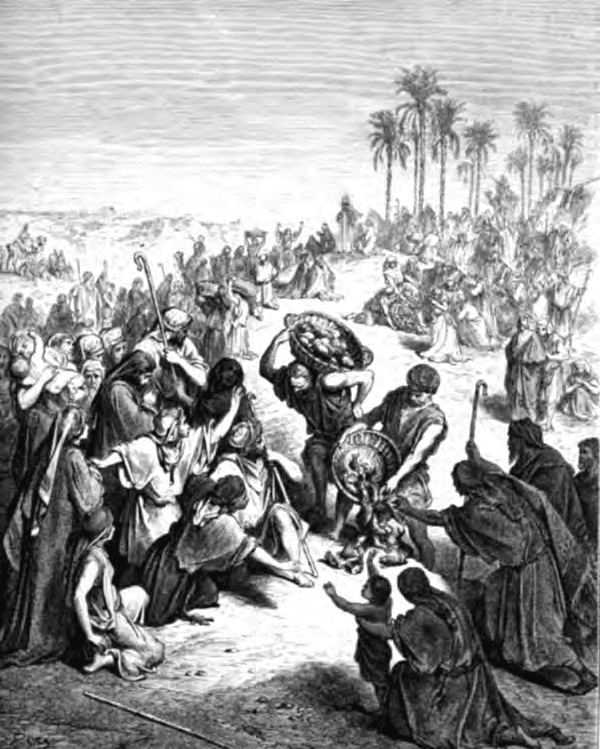
We should remember that in those days, loaves of bread were flat and circular, about an inch thick, and ten inches in diameter, and pliable in texture. Bread is still baked in this form in Near Eastern countries. My mother used to bake this kind of bread. The loaf was broken by tearing it apart into two pancake-like layers. Then the rest of the meal, whether cheese, meat, or whatever, would be rolled up in the bread and eaten like a sandwich. Thus it was possible to do very nicely without individual dishes or other utensils.
I don’t think many of us realize what a really stupendous miracle this feeding of the multitude was. Consider the facts. The five barley loaves and two small fishes could not have weighed more than a total of five pounds. But the food distributed to that multitude, allowing only about half a pound per person, weighed almost four tons! We see that whatever the Lord did he did generously and lavishly. He told his disciples to give, “Good measure, pressed down, and shaken together, and running over.” (Luke 6:38) But he himself far exceeded this standard, setting a glorious example of bountiful dealing.
After they had eaten, and the fragments had been gathered up, Jesus told his disciples to board their boat, and return across the Sea of Capernaum while he dismissed the people. The disciples left, but the people were reluctant to go. They were greatly excited over the miracle they had seen. That was the best bread and fish they had ever tasted. They were thrilled at the gracious words of God that had proceeded out of Jesus’ mouth. They had literally tasted of the Lord’s goodness. We read:
“Thereupon the people, having seen the miracle he had performed, said, this is indeed the Prophet who was to come into the world.” John 6:14,15 (Weymouth]
They remembered God’s promise to Moses:
“I will raise them up a Prophet from among their brethren, like unto thee, and will put my words in his mouth; and he shall speak unto them all that I shall command him.” Deuteronomy 18:18
We continue from John’s account:
“Perceiving, however, that they were about to come and carry him off by force to make him a king, Jesus withdrew again up the hill, alone by himself.”
Matthew’s account says that, “He made the disciples go on board the boat, and cross to the opposite shore, leaving him to dismiss the people. When he had done this, he climbed the hill to pray in solitude. Night came on, and he was there alone.” [Weymouth]
Meanwhile things were not going well for the disciples in the boat. The wind was against them so they could not use their sails. They began to row as hard as they could but even then could make no headway. “But the ship was now in the midst of the sea, tossed with waves, for the wind was contrary.” (Matthew 14:24) John says, “And the sea arose by reason of a great wind that blew.” (John 6:18) They had embarked at dusk and now it was the “fourth watch,” which a footnote of the Diaglott says was between three and six in the morning. In all this time according to John’s account they had gone 25 to 30 furlongs, only 2.5 to 3 miles. Reprints, page 2649. How tired they must have been! They had come on this outing to “rest a while,” but what had happened? They had rested only a couple of hours.
Then the multitude had arrived and they had served food to thousands of people. Now they had been rowing against the wind for over eight hours! As their efforts grew weaker, the wind seemed to get stronger and the waves higher. They were nearing the end of their endurance and thought they must surely perish in the sea.
Although it was dark and they were many miles away, Jesus saw them; another miracle. We read, “And he saw them, toiling in rowing, for the wind was contrary unto them.” (Mark 6:48) The disciples were rowing desperately, their muscles aching, their heads bowed with weariness. The waves of the angry sea crashed against the boat causing it to pitch wildly. They were being driven backward. It was only a matter of time when their strength would fail and they would no longer be able to keep the boat headed into the wind. Then they would surely capsize.