
The Great Hidden Treasure
“Again, the kingdom of heaven is like unto treasure, hid in a field; the which, when a man hath found, he hideth, and for joy thereof goeth and selleth all that he hath, and buyeth that field. Again the kingdom of heaven is like unto a merchantman, seeking goodly pearls; who, when he had found one pearl of great price, went and sold all that he had, and bought it.” Matthew 13:44-46 WHEN Jesus spoke of a “treasure hid in a field,” he used an illustration of great power and appeal to men. Paul used the same illustration when he spoke of Moses, who esteemed “the reproach of Christ greater riches than the treasures in Egypt.” (Hebrews 11:26)
Egypt was one of the oldest ruling nations and for thousands of years had been accumulating treasures. As a mighty military power, Egypt conquered and took spoil of hundreds of other nations for centuries. Located at the crossroads of trade between Europe, Asia, and the vast raw resources of Africa, she took tribute of every caravan, and amassed enormous wealth. The pharaohs of Egypt were so rich and had so much treasure that when the Israelites were slaves in Egypt, we read:
“Therefore they did set over them taskmasters, to afflict them with their burdens. And they built for Pharaoh, treasure-cities, Pithom and Raamses.” Exodus 1:11
Whole cities had to be built with rows and rows of huge brick buildings to contain the “treasures of Egypt.” When Paul said Moses esteemed “the reproaches of Christ greater riches than the treasures in Egypt,” it was no trifling matter.
There have been other vast accumulations of treasure. In the twelfth and thirteenth centuries Genghis Kahn and his Mongolian hordes swept over most of the then known world. He was one of the greatest conquerors the world has ever seen. His armies were victorious from Asia’s China Sea to the Dnieper River in Europe. He sacked and looted, and took spoil and tribute. He spared nothing. His armies were likened to locusts, denuding the land. He was called “the scourge of God.” Before he died, he had accumulated treasure beyond calculation.
In the sixteenth century, Pizarro, the Spanish conqueror, marched into Peru. At that time it was the empire of the Incas. (I have taken this from the Encyclopedia Brittanica.) Pizzaro forced an audience with Atahuallpa, the Inca emperor. The interview was conducted by Pizarro’s priest, Father Galverde, through an interpreter. The priest related briefly and dogmatically the history and teachings of the Roman Catholic faith. He stated categorically that the Pope had given Peru to the king of Spain. Just imagine! He called upon the Inca to forthwith become Christian and to acknowledge Charles the fifth as his master. The encyclopedia says that to this extraordinary harangue, the Inca emperor vehemently pointed out to the priest certain difficulties in the Catholic religion.
Now, I wonder what these difficulties were. I suspect the doctrine of eternal torment may have been one of them. Nevertheless, the Inca emperor declined to accept either Catholicism or Spanish sovereignty. He then took the Bible from the priest’s hands, looked at it, and flung it resentfully to the ground. The priest withdrew and Pizarro immediately gave the signal for attack. The crude weapons of the Inca soldiers were no match for Spanish muskets. There was a great slaughter. The captured emperor offered Pizarro a ransom for his release. He offered to fill the large room in which he was imprisoned with gold. The Spaniard agreed. The Inca fulfilled his promise and the room was filled to the ceiling with ingots of pure gold. Can you imagine the value of such a treasure especially at today’s prices?
There is a sidelight to this story. Pizarro took the gold but he did not release the Inca. Instead, he ordered him brought to trial on the charges of murder, sedition and idolatry. It was really a mock trial. The Inca was condemned to death and because he was an idolater, he was condemned to death by fire: to be burned alive! All of Pizarro’s officers, hard and cruel men though they were, objected to such a sentence as inhuman. But one man did not object, one man who thought the sentence was just and should be carried out. It was the priest! The Inca emperor was finally executed by strangulation, but by so doing, Pizarro killed the goose that laid golden eggs. That roomful of gold was but a small sample of the total Inca treasure which was then hidden away because of the treachery of the Spaniards.
Here are three examples of enormous treasure in the world. Where are they now? Where are the “treasures in Egypt”? Tombs of the Pharaohs have yielded golden coffins, masks, jewels and other such artifacts, but these amount to very little compared to the total treasures still buried in Egypt, treasures that are hidden. “Hid in a field,” as Jesus said.
Where is the treasure of Genghis Kahn the ransom of Asia and Europe? They say, “you can’t take it with you.” But in a way, Genghis Kahn did take it with him. He was buried and so was his treasure. “Hid in a field.”
Every year expeditions are sent into the jungles of Peru in search of the Inca gold hidden from Pizarro. Many abandoned villages of the Incas have been found, many noble monuments, many evidences of high civilization, and great intelligence but no treasure. To this day, it is still hidden. “Hid in a field.”
These treasures could be accidentally discovered at any time. A poor Arab farmer, scraping the ground with a wooden plow pulled by a donkey, could stumble upon the “treasures of Egypt.” A Russian peasant, deprived of all capitalistic property and working on a collective farm, perhaps digging a well, could unearth the hoarded treasure of Genghis Khan. A highway worker, bulldozing a road through the jungles of Peru could suddenly open the door of a cave filled with hundreds of tons of Inca gold.
Imagine the feelings of those people to be one moment, poor and discouraged and without prospects, then to suddenly find set before you, within your grasp, a great treasure riches beyond calculation! Can you imagine the joy?
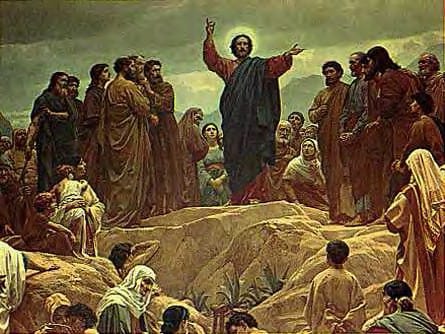
This is the picture Jesus was creating in the minds of his listeners when he said:
“The kingdom of heaven is like unto treasure hid in a field; the which, when a man hath found, he hideth; and for joy thereof, goeth and selleth all that he hath and buyeth that field.”
This brings to mind the statement about Jesus himself:
“Looking unto Jesus, the author and finisher of our faith; who, for the joy that was set before him, endured the cross, despising the shame, and is set down at the right hand of the throne of God.” Hebrews 12:2
The Treasure of the Parable
This suggests the primary meaning of the parable of the “Treasure hid in a field.” Just before Jesus gave this parable to his disciples, they asked him to interpret the parable of the “Wheat and Tares.” He told them, “The field is the world.” (Matthew 13:38) This gives us the clue.
Jesus, in his prehuman existence, saw a great treasure in the world. He saw the potentialities of a Millennial kingdom that would restore the fallen race of mankind to life and harmony with God. He greatly and joyfully desired to possess that treasure. But he had to first buy the “field.” He must pay the ransom price to buy the world of mankind. It cost him everything. He sold all that he had. “Though he was rich, yet … he became poor.” (2 Corinthians 8:9)
“[He] made himself of no reputation and took upon him the form of a servant, and was made in the likeness of men. And being found in fashion as a man, he humbled himself, and became obedient unto death, even the death of the cross; wherefore, God also hath highly exalted him, and given him a name which is above every name, that at the name of Jesus every knee should bow; of things in heaven, and things in earth, and things under the earth.”–Philippians 2:7-10
Yes, things BC1under the earth; a “treasure hid in a field.”
The heavenly Father accepted the price that Jesus offered for the “field” which is the world. Jesus now had the right, through the agency of the kingdom of heaven, the Millennial kingdom, to raise the treasure out of the pit, to bring about the resurrection and restitution of mankind.
When a man begins to remove treasure from a field he has purchase to keep it safe, it would be natural for him to remove the most precious things first. The Lord said to Israel:
“Ye shall be a peculiar treasure unto me, above all people; for all the earth is mine. And ye shall be unto me a kingdom of priests and an holy nation.” Exodus 19:5,6
“The Lord hath chosen Jacob for himself, and Israel for his peculiar treasure.” Psalms 135:4
As spiritual Israel, we are the heirs of these promises. We are the “peculiar treasure” of our Lord Jesus Christ who, by virtue of his ransom sacrifice, bought the world. We are the first to be removed from the evil world:
“Who gave himself for us, that he might redeem us from all iniquity, and purify unto himself a peculiar people, zealous of good works.” Titus 2:14
The Lord considers his people to be precious gems, a highly valued part of his treasure:
“And they shall be mine, saith the Lord of hosts, in that day when I make up my jewels; and I will spare them.” Malachi 3:17
“Thou shalt also be a crown of glory in the hand of the Lord; and a royal diadem, in the hand of thy God.” Isaiah 62:3
After the Church class, or royal priesthood, have been first taken from among men, then the Millennial blessings will flow to natural Israel and all other nations.