
The Villain
Every story has its villain. In the story of Esther it was a wicked man named Haman. We read that he was an Agagite, which means he was a descendant of Agag, king of Amalek. The Amalekites were a depraved race, and were the historic enemies of Israel. Not realizing his wickedness, the king had promoted Haman to be his right-hand man, and set him over all the others in the palace. Whenever Haman came along, the people bowed and even knelt down to him. How he loved it! But there was one man who did not bow or kneel to him, and that man was Mordecai. He knew of Haman’s wickedness and refused to show any respect for him. Haman already hated Mordecai because he was a Jew; now he hated him even more because he would not bow down to him. Haman’s first impulse was to kill Mordecai, which he had the power to do, but his hatred was so intense that he wanted to kill every Jew in the whole world much like Hitler wanted to do. Haman devised a plan to do this by using the autocratic power of King Ahasuerus, who ruled the whole world. It was a simple and brutal plan. The king trusted him. If, without mentioning Mordecai’s name, he could convince the king that all the Jews scattered throughout the world were a dangerous people, a menace to his kingdom, and ought to be exterminated, he would thus with one stroke not only kill Mordecai, but his entire race as well. However, when Haman made this plan, he was not aware that Queen Esther, whom the king loved so much, was also an Israelite. We now read from the record:
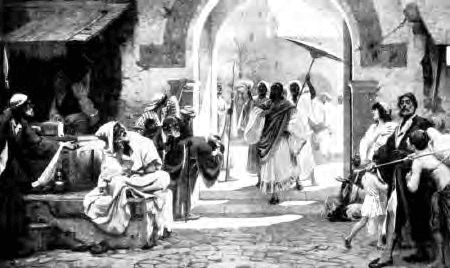
“Then Haman said to king Xerxes, There is one race scattered and separated among the races in all provinces of your kingdom. Their laws are different from those of every other race. They do not obey the king’s laws. Therefore it is not proper for the king to tolerate them. If it please the king, let an edict be written for their destruction.” Esther 3:8-11, Moffatt To impress the king with his sincerity he offered to pay out of his own pocket an enormous sum to defray the cost of the massacre. We read:
“And I will pay over, four million silver pounds to the royal treasurers for the royal treasury. So the king drew off his signet ring, and gave it to Haman … the enemy of the Jews. Keep your money, said the king to Haman, and do what you like with the race. They are in your hand.”
The signet ring which the king gave Ha man was a signing ring upon which was carved the king’s own seal. Haman could now write any law he wished and sign it with the ring in the king’s name. Of course the king did not know that he had thus consented to the death not only of his trusted servant Mordecai, but also of his own lovely queen.
Everything was working out as Haman had planned. The law he now wrote and sealed was an extremely wicked one. On a certain specified day, every man, woman and child of the Israelites all over the world should be killed. Then he added a Satanic touch: in order to provide an incentive for the carrying out of the massacre, anyone who killed a Jew, would be entitled to take over his property as a prize. The law was translated into every language of the world, and sent by swift messengers to the governors of every nation with orders to proclaim it to all their people. We can imagine the vicious result of this proclamation.
The Jews with their talent for accumulating wealth wherever they went had always aroused the envy and covetousness of their Gentile neighbors. Now here was an opportunity for the Gentiles to legally murder the Jews and seize their belongings. Impelled by greed, plans would be made as to which Jewish family would be the most profitable to kill on the appointed day. We may be sure that Haman had earmarked Mordecai as his own personal victim!
The decree of Haman was also published in Shushan, the palace. When Mordecai read it, he was deeply distressed and went into mourning. In this he was joined by all the Jews in the world. We read:
“And in every province withersoever the king’s commandment and his decree came, there was great mourning among the Jews; and fasting, and weeping, and wailing, and many lay in sackcloth and ashes.” Esther 4:3
Through a servant, Mordecai told Esther what Haman had done. He furnished her a copy of the decree and told her she must go in to the king and appeal to him for mercy on behalf of her people. She sent a messenger back to Mordecai telling him she could not go in to the king because itwas the law that anyone entering the king’s presence without being called would be instantly put to death, unless the king held out his golden scepter to such. It had been a month since the king had asked to see her.
“Then Mordecai told them to return answer to Esther: Think not that in the king’s palace you will escape any more than all the other Jews; for if you keep silence at such a time as this, relief and deliverance will rise for the Jews from another quarter, but you and your Father’s house will perish. And who knows whether you have not come to the kingdom for such a time as this? Then Esther told them to reply to Mordecai: Go, gather all the Jews to be found in Shushan, and hold a fast on my behalf, and neither eat nor drink for three days, night or day. I and my maids will also fast as you do. Then I will go to the king, though it is against the law, and if I perish, I perish.” Esther 4:13-16, Revised Version