
Esther Approaches the King
On the third day Esther put on her finest royal gown and went, unbidden, to the king’s throne room. She stood at the open door. The king glanced up and seeing his lovely queen he was charmed. He smiled and extended his golden scepter. With great relief Esther approached the king and touched the top of his scepter. Noting Esther’s look of anxiety and realizing she must have something very important in mind to thus risk her life, the king asked, “What is your wish, queen Esther? What is your request? You shall have it, were it half my kingdom.” (Moffatt) What a change of atmosphere can take place in just a few seconds! One moment Esther was fearing for her life, the next moment she was offered half of the whole world! But wise Esther did not immediately make her petition to the king. She invited him and Haman to have dinner with her that day. After dinner the king again asked Esther what her request was, and again told her she could have half of his kingdom. Haman heard this and realized the king’s great love for his queen. Again Esther did not make her request, but invited the king and Haman to dinner again the following day, promising to tell him at that time.
Haman was very proud of being the only guest invited to have dinner with the king and queen. This high honor went to his head and he felt that he was really somebody. On his way home he passed by Mordecai, sitting at the king’s gate. As usual Mordecai refused to bow to him. We now read from the account:
“That day Haman went away, glad and gratified. When he noticed that Mordecai neither rose up nor trembled before him in the king’s gate, he was indeed furious with Mordecai. But he restrained himself, and went home. Then he sent for his friends and his wife Zeresh. And Haman recounted to them the vastness of his wealth, the number of his children, all the promotion he had received from the king, and how the king had exalted him over the royal officials and courtiers. Yes, Haman added, And Queen Esther invited no man, except myself along with the king to the banquet she had prepared. And she has invited me again tomorrow along with the king. But all this is no good to me so long as I see Mordecai, the Jew, sitting at the king’s gate! Then his wife, Zeresh, and all his friends said to him, Have a gallows made, eighty feet high. Speak to the king tomorrow morning, and let Mordecai be hung on it. Then go into the banquet merrily along with the king. This pleased Haman and he had the gallows erected.” Esther 5:9-14, Moffatt He just couldn’t wait! Although he had arranged for a future date when all the Jews would be exterminated, he just couldn’t wait to kill Mordecai!
That night the king couldn’t sleep so he had someone read to him from the royal record book including the part where Mordecai had given information which had saved the king’s life. When he heard that, the king asked: “What honor and dignity has been conferred on Mordecai for this service?” “Nothing has been done for him,” they said. The king immediately decided that some honor must be given to Mordecai, so he asked: “Who is now in attendance at court?” Not even waiting until morning, Haman had just then come into the outer room to ask the king’s permission to hang Mordecai. They told the king that Haman was outside. “Let him come in,” the king said.
Haman was feeling very pleased with himself. Because Esther had invited him to her banquets, he felt that he was, next to the king, the most honorable man in the world. When he entered the throne room, the king asked him, “What should be doneto the man whom the king delights to honor?” He was sure the king was referring to him, certainly not Mordecai. All he could think of was what he would like done to himself.
“Haman said to himself, Whom would the king delight to honor more than myself? Then said Haman to the king, As for the man whom the king delights to honor, let them bring a royal robe which the king has worn, and a horse on which the king has ridden, with a royal crown upon his head. Let robe and horse be entrusted to one of the king’s highest officials, to see that the man whom the king delights to honor is arrayed, and led on horseback through the city square, with the proclamation, This is what is done for the man whom the king delights to honor. And the king said to Haman, Quick, get the robe and horse, as you have said, and do all this to Mordecai, the Jew, who sits at the king’s gate. Leave out nothing of what you have proposed.” Esther 6:6-10, Moffatt
This was a terrible shock to Haman. Here he was about to ask the king to have Mordecai hanged and now he was appointed to dress Mordecai in the king’s own robe, put the royal crown on his head, mount him upon the king’s own horse, and then, the most humiliating thing of all to lead the horse through the city square and, with a loud voice, praise Mordecai as “The man whom the king delights to honor!” This placed the hated Mordecai above him. This made him, the great Haman, a mere servant to Mordecai before all the people. It was a crushing blow to his vanity but he had to carry out the king’s order. As soon as he had done so, he hurried home. He wanted to hide. He was so ashamed he covered his face as he went. He put a bag over his head so that no one would recognize him. Only one thought consoled him: by a law which could not be changed, all the Jews, including Mordecai, would soon be killed. When he got home, he told his wife and friends what had happened, seeking consolation, but they had none to give him. His wife said, prophetically, “If Mordecai, before whom you have begun to fall, belongs to the Jewish race, you will never succeed against him. You will fail, and fall before him.” (Esther 6:13)
Haman hadn’t been home long when he was called to the second dinner of Queen Esther. As they ate, everything seemed to be right between the king and him, and he began to feel better. After dinner the king again asked, “What is your petition, Queen Esther? You shall have it. What is your request? Were it half my kingdom, it shall be done for you.” (Esther 7:2) This time Esther told the king what was on her mind. “I’m asking for my life.” she said, “and for the lives of all my people!” The king was astonished. “What do you mean?” he demanded. “How is your life threatened?” “I and all my race have been sold, to be massacred,” Esther answered. The king arose in anger. “Who is it?” he asked. “Where is the man who has dared to do this?” Esther pointed to Haman. “There is the man!” she said, “this wicked Haman!” Seeing the king’s anger, Haman fell before the queen to plead for his life. This angered the king still more and he said, “Will the man actually violate the queen in my very presence?” He called his servants who immediately covered Haman’s face, the signal of condemnation to death. Then a royal chamberlain spoke up and said, “In Haman’s house, gallows are standing, eighty feet high, which he erected for Mordecai, who did good service to the king. Hang him on that! said the king. So they hanged Haman on the gallows which he had erected for Mordecai.” Esther 7:9,10, Moffatt
Then Esther told the king that Mordecai was her father and the Israelites were her people. She begged the king to somehow reverse the law Haman had made to destroy the Jews. The king called in Mordecai and gave him the signet ring which he had taken from Haman. “Write any law you wish, in my name,” he told Mordecai, “and sign it with this ring.”
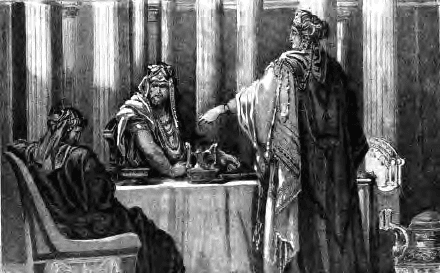
Mordecai was a wise man. He knew that no law of the Medes and Persians could be changed and that the wicked law which Haman had made could not be set aside. Because he knew that on the day set by Haman the Jews would be attacked by their enemies, he wrote a law that all Jews everywhere should arm and barricade themselves and defend themselves on the appointed day. This new law, sealed by the king’s ring, was translated into every language and sent to every part of the kingdom. Now the sadness of the Jews turned to joy and celebration. Mordecai was promoted and made a great man, second only to the king. We read that he was “clad in royal robes of violet and white, with a large golden crown, and with a mantle of fine linen and purple.” (Esther 8:15)
The day set for the massacre of the Jews came, but they were so well armed and prepared that they won out against their enemies. The fact that the king had promoted Mordecai, the Jew, to great authority in the kingdom, and that the beloved Queen Esther was also a Jew, had a powerfully deterring effect upon many who might have been contemplating harm to the Jews. Thus the wicked plot of Haman to destroy the Jews failed entirely. Haman’s vast fortune was turned over to Esther, and she entrusted it to Mordecai. The ten sons of Haman were also executed, and Mordecai greatly prospered in the kingdom.
Lessons for Us
The fact that the story of Esther was recorded in the Bible indicates that there are lessons to be learned from it. That is the purpose of all scripture. Let us consider some of the many lessons in this beautiful story of God’s providential care for his people.
The name Ahasuerus means Lion-King. Jesus Christ is designated, “The lion of the tribe of Judah.” (Revelation 5:5) Ahasuerus ruled all nations to the uttermost parts of the earth with autocratic power, subduing all opposition. The world was at his feet. Of Jesus it is written:
“Ask of me, and I shall give thee the nations for thine inheritance, and the uttermost parts of the earth for thy possession.” Psalms 2:8,9
“He shall rule them with a rod of iron. As the vessels of a potter shall they be broken to shivers.” Revelation 2:27
“He must reign till he hath put all enemies under his feet.” 1 Corinthians 15:25
The name Vashti means Beautiful. The king called for her to appear before him in her royal robe and golden crown. She lost a great opportunity when she refused to obey the king. From this we learn that if the Lord invites anyone to put on the royal robe of Christ’s righteousness, wear the golden crown of the divine nature, and appear before the great king in beauty of character as his bride, such an invitation should not be refused. It should be considered a great honor and be obeyed eagerly and promptly. Those contemplating consecration should think about this.
The decision regarding Vashti was, “Let the king give her royal estate unto her neighbor who is better than she.” This reminds us of the case of King Saul who also was disobedient. The decision regarding him was strikingly similar in its words:
“And Samuel said unto him, The Lord hath rent the kingdom of Israel from thee this day, and hath given it to a neighbor of thine, who is better than thou.” 1 Samuel 15:28
Vashti and Saul both lost their crowns. If not obedient, any one of us can be replaced and our crown assigned to a better person. Jesus said, “Hold that fast which thou hast, that no man take thy crown.” (Revelation 3:11) There is a very sobering thought here. We can lose our crowns by not holding fast to that which we have, by being disobedient to the truth. This test is even now upon the church.
We read, “The king’s daughter is all glorious within.” (Psalms 45:13) Vashti was very beautiful, but only on the outside. She did not exhibit the inner beauty that is pleasing to the Lord:
“Your beauty should not be dependent on an elaborate arrangement of the hair, or in the wearing of jewelry or fine clothes; but on the inner personality, the unfading loveliness of a meek and gentle spirit, a thing very precious in the eyes of God.” 1 Peter 3:3,4, Weymouth
We want to be beautiful and precious in God’s sight who looks not on the outward appearance, but on the heart.
The rejection of Vashti from the chief place in the kingdom of Ahasuerus suggests the rejection of natural Israel from the chief place of favor by our Lord. Although making a beautiful outward profession, their hearts were evil. Jesus told their leaders:
“Ye are like unto whited sepulchres, which indeed appear beautiful outward, but are within, full of dead men’s bones and of all uncleanness. Even so ye also, outwardly appear righteous unto men, but within ye are full of hypocrisy and iniquity.” Matthew 23:27,28
As a nation they were disobedient to the heavenly vision. They missed the opportunity to become Spiritual Israel the Bride of Christ. They rejected Christ and he rejected them. Now we begin to appreciate the significance of the divorce of Vashti and the command of Ahasuerus to call for beautiful virgins from all over the world that he might select a bride from among them. This is the call of the church, the Bride of Christ, the high calling. They come “out of every kindred, and tongue, and people and nation.” (Revelation 5:9) Thus we read:
“For the eyes of the Lord run to and fro throughout the whole earth, to show himself strong in the behalf of them whose heart is perfect toward him.” 2 Chronicles 16:9
The virgins had a year of preparation and training before they were ushered into the king’s presence. During this time, everything they needed to make them attractive was furnished them. They were given special food from the king’s own table and perfume to anoint themselves. They were assigned maids to serve them. This is a good description of the way we are prepared for our high calling. We are in the School of Christ and are given sufficient time to make ourselves ready. We are given everything we need for our spiritual welfare to prepare us for the kingdom. We are abundantly fed with spiritual food from the table of our returned Lord. We are “thoroughly furnished and fitted for every good work.” (2 Timothy 3:17) We have the most faithful and efficient servants in the world guardian angels and ministering spirits.
Esther left the house of her father and clothed in her finest apparel, she entered into the king’s palace. Her beauty completely captivated the king’s heart and he placed the crown of gold upon her head. Psalm 45 describes Esther’s experience which prefigured ours:
“Hearken, O daughter, and consider, and incline thine ear. Forget also thine own people, and thy father’s house. So shall the king greatly desire thy beauty; for he is thy Lord, and worship thou him. The king’s daughter is all glorious within, her clothing is of wrought gold. She shall be brought unto the king in raiment of needlework. The virgins her companions that follow her shall be brought unto thee. With gladness and rejoicing shall they be brought. They shall enter into the king’s palace.” Psalms 45:10-15
When we consecrate we leave our father’s house, the house of Adam, and we leave the things of this world including human relationships, hopes, aims and ambitions. Our heavenly king greatly desires to see beauty of character in us and gives us every facility to develop it. We have needlework to do. We painstakingly add to our robes the beautiful adornments of the Christian graces. Psalm 110:3 refers to these as “beauties of holiness.” Then when we finally enter the king’s presence, our clothing is of wrought gold, symbolic of the divine nature, and we receive the golden crown, the crown of life.
In the story of Esther, the virgins who failed to become the bride were not sent home, but were given a secondary place in the king’s household. These represent the Great Company, referred to as “the virgins, her companions,” elsewhere termed “foolish virgins.” They will attain the spirit nature and serve before the throne. There will indeed be “gladness and rejoicing” when the great king has selected his bride and the heavenly wedding takes place.
“Let us be glad and rejoice, and give honour to him; for the marriage of the Lamb is come, and his wife hath made herself ready.” Revelation 19:7
After Esther was crowned there was great rejoicing by all the people of the kingdom and we read that “the king made a great feast.”
“And in this mountain [kingdom] shall the Lord of hosts make unto all people a feast of fat things; a feast of wines on the lees; of fat things full of marrow; of wines on the lees well refined.” Isaiah 25:6
This refers to the whole world, feasting upon the rich blessings of the Millennial kingdom.
Haman Pictures Satan
Haman and Satan have many characteristics in common. Haman was inordinately proud and ambitious. Of Satan it is written:
“Thine heart is lifted up, and thou hast said, I am a God, I sit in the seat of God, in the midst of the seas. Yet thou art a man [mortal] and not God, though thou set thine heart as the heart of God.” Ezekiel 28:2
“Thou hast said in thine heart, I will ascend into heaven, I will exalt my throne above the stars of God, I will sit also upon the mount of the congregation, in the sides of the North; I will ascend above the heights of the clouds, I will be like the Most High.” Isaiah 14:13,14
As Haman loved to be bowed and knelt to, we read that Satan said to Jesus: “All these things will I give thee, if thou wilt fall down and worship me.” (Matthew 4:9) Every faithful Christian will shun Satan’s characteristic of pride and desire to dominate. We must rather cultivate the mind of Christ of whom it is written:
“Let this mind be in you, which was also in Christ Jesus, who, being in the form of God, did not meditate a usurpation to be equal with God, but made himself of no reputation, and took upon him the form of a servant, and was made in the likeness of men, and being found in fashion as a man, he humbled himself and became obedient unto death, even the death of the cross.” Philippians 2:5-8
As Haman hated the Jews and sought to exterminate them, Satan has always hated the Seed of Promise which God told him was destined to bruise his head. Identifying this seed with Israel, he has always tried to destroy that nation. It was he who inspired Hitler to try to exterminate the Jews of the world, much like Haman. It was he who has surrounded modern Israel with a superior force of bitter enemies, sworn to utterly destroy them. It is he who will propel the Nation of the North against Israel in the final great struggle. Just as under Haman’s order those who killed the Jews might take their property as a spoil, we read of the attack from the north that they will come, “To take a spoil, and to take a prey.” (Ezekiel 38:12) Satan has always been the implacable foe of Spiritual Israel also, from the head, Christ Jesus, to the feet members this side the veil. Satan is our Haman.
When Mordecai told queen Esther to see the king about Haman’s wicked plot, she at first hesitated to risk her life to do it. Mordecai’s reply was, “If you keep silence at such a time as this, relief and deliverance will rise for the Jews from another quarter. And who knows whether you have not come to the kingdom for such a time as this?” What a tremendous faith Mordecai thus exhibited! By a law of the Medes and Persians, which could not be changed, the Jews were to be slaughtered. Yet Mordecai was positive that they would be delivered, if not by Esther’s intervention, then by some other means. He encouraged Esther to use her position in the kingdom to accomplish that which he was sure would be done in any event.
Esther’s reply was, “I will go to the king … and if I perish, I perish.” Bro. Russell comments on this:
“There is a beautiful lesson of faith here that should appeal to all of the Spiritual Israelites. Whatever we have, whatever positions we occupy of influence, or power, or wealth or confidence in the esteem of others, is so much of a stewardship granted to us by the Lord, and respecting which we should expect to give an account. And if the account would be rendered with joy, we must be faithful even to the risking of our lives in the interests of the Lord’s people, the Lord’s cause. Let us lay this feature of Esther’s experience to heart, that we may draw valuable lessons therefrom, helpful to us in the spiritual way. The suggestion that she had not come to a place of honor and privilege by accident, but that the Lord had overruled in the matter, is one that should appeal to all Israelites indeed. Whatever we have is of the Lord’s providence. Let us use it faithfully, and as wisely as possible, for him and his. Thus our own blessings and joys will be increased as well as our favor with the Lord.” Reprints, page 3657.
When Esther entered the king’s presence unbidden, she was reconciled to death. But what a sudden change occurred! One moment she was fearing for her life, the next she was offered half the world! How quickly the Lord can change our prospects! The things we fear the most often turn out to be our greatest blessings. As the poet has well expressed it: “Ye fearful saints, fresh courage take; the clouds ye so much dread, are big with mercy, and shall break in blessings on your head.”
Let us consider two seeming coincidences in the account. On the same night in which Haman built a gallows eighty feet high upon which to hang Mordecai, the king couldn’t sleep. He called for the royal record book and was reminded that Mordecai had saved his life. At the very moment when Haman entered the outer court of the king to ask permission to hang Mordecai, the king had decided to honor Mordecai. He asked Haman what should be done to “the man whom the king delighted to honor?” Do you think that these events were merely coincidental? You know they were not! This was the finger of God. We have the very same supervision of our affairs. Our heavenly Father can control and maneuver every principality and power with the greatest of ease for our benefit. To a child of God, nothing happens by accident. Every event of life is supervised for one’s highest welfare. What comfort and assurance this should give our hearts!
Haman’s wife said to him, “If Mordecai, before whom you have begun to fall, belongs to the Jewish race, you will never succeed against him. You will fail, and fall before him.” (Esther 6:13) This prophecy also has a modern fulfillment. Could not these very words be addressed to the Arab nations after the six-day war?
In exposing Haman’s wicked plot, Esther told the king: “I and my race have been sold to be massacred.” Similarly, the whole human race was sold into sin and death by Satan’s wicked plot. (Romans 7:14) But as Mordecai wrote a new law in the king’s name which counteracted and nullified Haman’s wicked law of death, there will be a New Law Covenant inaugurated with the House of Israel which will abolish death and bring life to all the world of mankind. As Mordecai was raised up to power in the kingdom and administered that new law of the Medes and Persians, the Ancient Worthies will be raised up to administer the New Covenant during the Messianic kingdom. Just as Haman was hanged upon gallows he had erected for the innocent, Satan will himself receive the penalty of death which he sought to inflict upon Adam and his race.
In the account Haman’s vast fortune was given to Esther who turned it over to Mordecai to administer for her. This pictures the transfer of Satan’s usurped dominion of the world to the church reigning with Christ, who will be visibly represented by the Ancient Worthies.
This will be the fulfillment of Daniel’s prophecy:
“And the kingdom and dominion and the greatness of the kingdom under the whole heaven, shall be given to the people of the saints of the Most High, whose kingdom is an everlasting kingdom, and all dominions shall serve and obey him.” Daniel 7:27
Finally Haman’s ten sons were executed. This pictures the complete destruction at the end of the Millennium of all Satan’s family all the incorrigibly wicked.
The story of Esther could appropriately end with the phrase: “And they lived happily ever after.” This is how the beautiful story of the Divine Plan of Salvation ends: “The whole human family will live happily forever after!”