
Elijah’s Reverential Prayer
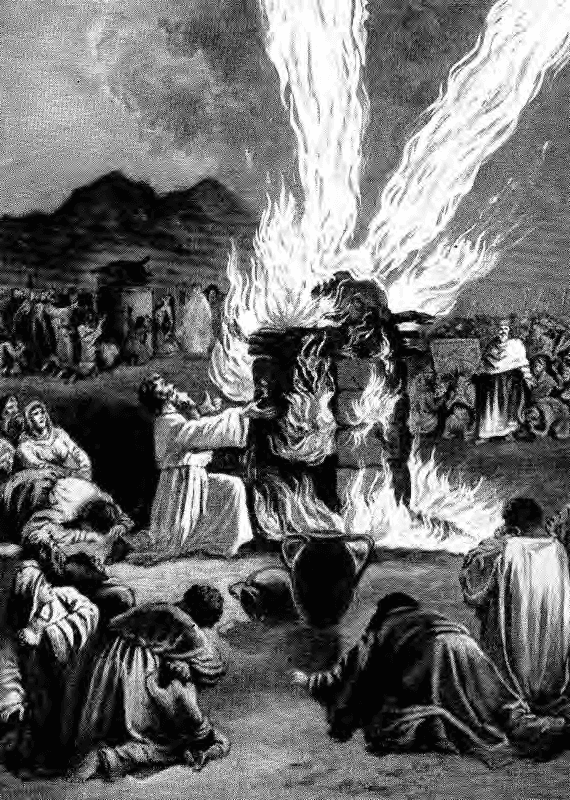
What Elijah did next was in great contrast with the conduct of the priests of Baal. He worshipped an intelligent God who did not need to be shouted at to –attract his attention. He reverently approached the altar and in a calm, clear voice uttered an earnest prayer, which is beautiful in its simplicity and modesty:
“And it came to pass, at the time of the offering of the evening sacrifice, that Elijah the prophet came near, and said, Lord God of Abraham, Isaac and of Israel, let it be known this day that thou art God in Israel and that I am thy servant, and that I have done all these things at thy word. Hear me, O Lord, hear me; that this people may know that thou art the Lord God, and that thou hast turned their heart back again.” 1 Kings 18:36,37
In this prayer the prophet displayed no boastful spirit but humbly recognized that he was merely a servant of the Lord, that his desire was not a personal display of power, but the blessing of his nation and the drawing of their hearts back to the Lord.
No sooner had the prayer ended than there was a blinding flash of lightening. In the language of verse 38, “Then the fire of the Lord fell and consumed the burnt sacrifice, and the wood and the stones and the dust, and licked up the water that was in the trench.” What the Lord does he does thoroughly. Not only was the soaking-wet sacrifice consumed, even the 12 great stones of the altar and the dust upon which they stood were burned up as well. Where the altar had been, there was nothing but bare scorched earth. For a moment there was utter silence. The people were stunned. Then when they realized what had happened, they joyfully reacted and a great shout went up:
“And when all the people saw it, they fell on their faces. And they said, Jehovah, he is God; Jehovah, he is God!” 1 Kings 18:39
Then Elijah ordered the destruction of all the prophets of Baal. This was in strict accordance with the law given to Moses, in Exodus 20:3 and 22:20: “Thou shalt have no other gods before me. He that sacrificeth unto any god, save unto Jehovah only, he shall be utterly destroyed.” Undoubtedly the image and altar of Baal were demolished and the grove of Ashtoreth cut down; Israel returned to the worship of the true God.
Although at first there was no sign of it, Elijah knew that it was now going to rain and rain abundantly. He was so sure of it that he warned King Ahab to quickly harness his horse and ride his heavy iron chariot down the steep road from the top of Mount Carmel, lest it get mired in the mud:
“And he said, . . . Prepare thy chariot, and get thee down, that the rain stop thee not. And it came to pass in the mean while, that the heaven was black with clouds and wind, and there was a great rain. And Ahab rode.” 1 Kings 18:44,45
The thirsty earth drank in the refreshing rain. The brooks and springs began to flow and the wells filled up again. The fields turned green, the flocks and herds grazed, and the people rejoiced. The terrible drought of 3 1/2 years was at last ended.
Jezebel Reacts
Jezebel was furious when she heard what had happened on Carmel. She was angry with God, angry with the prophet Elijah for having shown up the falsity of Baal, and very angry that the priests of Baal had been executed. She was particularly angry with Ahab for having permitted the demonstration which revived the faith of Israel in Jehovah God. We can imagine the bitter railing she poured upon her cowering husband, blaming him for everything. If she had been there, it would have been different! Showing the intensity of her rage, she swore an oath to kill Elijah within 24 hours:
“And Ahab told Jezebel all that Elijah had done, and withal how he had slain all the prophets with the sword. Then Jezebel sent a messenger to Elijah, saying, So let the gods do to me, and more also, if I make not thy life as the life of one of them by tomorrow about this time. And when he saw that, he arose and went for his life.” 1 Kings 19:1-3
It seems strange that the great prophet Elijah he who had so recently faced and defied 450 vicious priests of Baal and who had called down fire from God in a stupendous demonstration of power now fled for his life because a woman had threatened him. But there is an important reason why this was so. The Lord was using Elijah to make a prophetic picture of the Gospel age which is of great significance to us who are living at this end of the age. Elijah was a type of the church. In this type Elijah was persecuted for fidelity to truth and righteousness. In the antitype, the church was persecuted for fidelity to truth and righteousness. In the type, Elijah’s principal persecutor was Jezebel, the wicked queen of Israel, mentioned by name in Revelation 2:20 as the enemy of the saints. In the antitype, the principal persecutor of the church was the apostate Church of Rome which claims to be a “queen” and ruler over spiritual Israel.
We read: “She saith in her heart, I sit a queen.” (Revelation 18:7) In the type, Jezebel’s persecuting power was exercised through her husband Ahab, the king. In the antitype, Papacy’s persecuting power was exercised through the Roman Empire to which she was joined. In the type, Elijah fled the first time from Jezebel and Ahab into the wilderness, to a place prepared of God where he was miraculously nourished. In the antitype, the true Church fled into the symbolic wilderness, or condition of isolation, and was sustained by God:
“And the woman fled into the wilderness, where she hath a place prepared of God, that they should feed her there a thousand two hundred and three-score days.” Revelation 12:6
In the type, Elijah was 3 1/2 years or 1260 days in the wilderness. During that time there was no rain and a great famine was in the land. (James 5:17) In the antitype, the church was 3 1/2 symbolic years a day for a year makes 1260 literal years–in the wilderness condition during which there was a spiritual famine because of the lack of truth, the living waters. This fulfilled a prophecy of Amos:
“Behold, the days come, saith the Lord God, that I will send a famine in the land. Not a famine of bread, nor a thirst for water, but of hearing the words of the Lord.” Amos 8:11
In the type, after the 3 1/2 years or 1260 days when Elijah returned from the wilderness, the errors of Jezebel’s priests were manifested, the true God was honored, and copious rains followed. In the antitype, at the end of the 1260 years beginning AD 1799, the power of the truth and its witnesses were manifested. Since then the truth has flowed at the rate of millions of Bible, books and tracts every year, refreshing the world, and culminating in a fruitful harvest of the true wheat. In the type, the king and the people at first rejoiced, and Elijah and his God were honored. But the spirit of Jezebel was unchanged. She still sought Elijah’s life and he was again compelled to flee into the wilderness. In the antitype, the circulation of the Bible has brought such blessings of enlightenment that the governments and people recognize the Lord’s hand. Yet the principles of Papacy [Jezebel] and the so-called Protestant sects compel the true people of God to again flee into the wilderness condition of separation: “Come out of her my people!” This is the time in which we are now living. But there is a part of the picture still unfulfilled. In the type Elijah’s career ended when he was taken from the earth in a fiery chariot. In the antitype the last member of the Church will be changed from earthly to heavenly conditions at a time of fiery trouble (Studies in the Scriptures, volume 2, page 256).
Other Lessons
Let us consider some of the other lessons contained in this narrative. After 3 1/2 years of drought, the Lord sent Elijah to King Ahab. We read of that meeting:
“And it came to pass, when Ahab saw Elijah, that Ahab said unto him, Art thou he that troubleth Israel?”1 Kings 18:17
It is astonishing how facts can be twisted and rationalized to make wrong appear right and right seem wrong! It was by Ahab’s compliance that Israel had sinned and turned to idolatry. This caused the Lord to withhold rain from the land. All Elijah had done was give them the word of the Lord. He had done no wrong. Now he was greeted as the one who was troubling Israel!
This reminds me of an experience we had in the 1920’s involving the same sort of inverse reasoning. The leadership of a Society, formerly used by the Lord, had begun to alter the Harvest Message, introducing various changes which they termed “new light.” Some of us refused to accept and teach these strange new departures, preferring to hold on to the truth as we had been taught by the Lord through his faithful and wise servant. There was a confrontation.
We were accused of being enemies. “Evil Servant” was the term then used. But we had not changed a bit. We had done no harm to anyone. All we did was hold what we had. But suddenly we were considered enemies of the truth and were cast out.
The same thing is happening today and we are grieved to see it. “Art thou he that troubleth Israel?” Words to this effect are directed to those who still hold to the Harvest Message of present truth, who refuse to accept the changes of so-called “new light” now being promulgated. It is the same inverse reasoning that Ahab used. “You are troubling spiritual Israel,” they now tell us. “By rejecting our new ideas, you are causing divisions in the church. You must adjust to our views and not rock the boat.” So who is actually causing the divisions? Certainly not those who remain staunch in the truth!
Regarding this matter of “adjustment,” a modern philosopher has written:
“Every society has its own approved form of insanity. Ours is called adjustment which is a circular social movement in which each one is adjusting to another one, and no one knows to whom the first is adjusting.” S. J. Harris
Brethren, when we have the truth based soundly upon the unchangeable word of God, we don’t have to “adjust” to anything else!
Another statement made by those advancing doctrinal changes is that one must have “an open mind” and must examine their theories.
That sounds fair, but beware: it is a delusion and a snare! Let me illustrate. When the government trains people to detect the difference between genuine and counterfeit currency, they are never permitted to study counterfeit currency. They concentrate their study on genuine currency until they are familiar with every minute detail and curlicue of the engraving. Then when in the course of their work they should see the counterfeit, they immediately recognize it as such by contrast. Similarly we must not examine and study every new and questionable doctrine some may see fit to advance. On the contrary, once having proven what is the genuine article, “Made plain upon tables” by our returned Lord through his wise and faithful servant, we must concentrate only upon it and become very familiar with every detail of it.
I once had an “open mind.” But that was before I got the truth. When the truth, in all its beauty and harmony, came into my mind, when I found it good and proved it to be true, my mind closed tightly upon it. It is no longer open on that subject! This is how we comply with the instructions of 1 Thessalonians 5:21: “Prove all things; hold fast that which is good.” You cannot “hold fast” to anything with an open mind. It has been well said that if you have a mind that is open enough, anyone who passes by may throw rubbish into it. Let that not happen to us.
The first thing Elijah said to the people of Israel on Mount Carmel was: “How long halt ye between two opinions? If Jehovah be God, follow him; but if Baal, then follow him.” Joshua presented the same ultimatum to Israel:
“Choose you this day whom ye will serve; . . . but as for me and my house, we will serve the Lord.” Joshua 24:15
Make up your mind! There is a great need for this lesson in the world today. People have trouble making up their minds regarding the simplest everyday problems that arise. Because of indecision, they are always in a state of mental distress, torn between two opinions. Even when they have acted in a matter, they agonize over it afterward, wondering if they did the right thing. This is the condition of the world. They are in constant distress and perplexity. This will all be rectified in the kingdom. Then there will be no doubt as to what is the right way, when even “the wayfaring men, though fools, shall not err therein.” (Isaiah 35:8) But the lesson of Elijah and that of Joshua was not given for the world, but for the church now. This was written for our admonition.
Let us combine the messages of Elijah and Joshua as: “How long halt ye between two opinions. Choose you this day whom ye will serve.” What does this mean to us? Today it is not necessary to tell a Christian to choose between Jehovah and some heathen god. We are not tempted to literally worship Baal today. So, what decision must the Christian make? Jesus told us:
“No man can serve two masters; for either he will hate the one and love the other; or else he will hold to the one and despise the other. Ye cannot serve God and mammon.”–Matthew 6:24
Prompt, Positive Decisions
This is the choice that must be made, made promptly and decisively! “Mammon” means not only money but anything of earthly value or conducive to pride. It may be the mammon of wealth, the mammon of ambition, or of worldly education, or the love of display, or the catering to fleshly appetites, or the love of ease, the inordinate love of friends, the excessively doting love of family, or any other love that may detract us from the love of God. We must forsake these things in the sense of pushing them aside, of making them of secondary importance, of subordinating them entirely to the service of God. If we do this, we shall gain the kingdom which is a hundred times more important. This is what Jesus meant when he said:
“Every one that hath forsaken houses, or brethren, or sisters, or father, or mother, or wife, or children, or lands, for my name’s sake, shall receive an hundredfold, and shall inherit everlasting life.” Matthew 19:29
“Choose this day whom ye will serve.” “Ye cannot serve God and mammon.” Is our consecration to God so full and complete that we have no earthly idols?
Today we can make a special application of Elijah’s question to Israel: “How long halt ye between two opinions?” The church is now in a time of decision. There are two opinions today among the Lord’s people; each one must decide what to accept. Do you believe, according to Matthew 24:43-47 and Luke 12:42-44, that our returned Lord appointed a certain faithful and wise servant and made him ruler over all his goods, to give the Lord’s household meat in due season? Do you believe that Brother Russell was that servant and that all the Lord’s “goods,” which are the beautiful and harmonious doctrines of present truth, are scripturally proven and embodied in the six volumes of Studies in the Scriptures, Tabernacle Shadows , and other of his writings? Or on the other hand, do you believe that Brother Russell was mistaken, that his writings are inaccurate and out of date, that the truth is a fluid and changeable thing–this way today, that way tomorrow, and at the whim of many leaders who do not agree among themselves? “How long halt ye between two opinions?”
It is a time of decision. Make up your mind! “He that wavereth is like a wave of the sea, driven with the wind and tossed. For let not that man think that he shall receive anything of the Lord. A double-minded man is unstable in all his ways.” James 1:6-8
Paul tells us of some who are, “Ever learning and never able to come to the knowledge of the truth.” (2 Timothy 3:7)
Regarding decision making, Brother Russell wrote:
“The very fact of coming to a positive decision is a great blessing and a great help in the formation of character. Every time we come to a decision, on any question, it strengthens mind and character, and makes us that much more ready for another test along some other line, perhaps. One decision for the right, prepares the way for others in the same direction, just as hesitancy, indecision, upon one point prepares us for hesitancy upon all points, and more or less stops our Christian progress and character building. . . . Ability to decide quickly, and to decide always on the right side, what the Lord’s will is, requires some experience and discipline. But the sooner we begin, the sooner we will become proficient. The more energetically we set ourselves to know the Lord’s will and to do it, and to show him by our promptness that we delight to do his will, the better and the quicker will we find our characters established on proper lines.” Reprints, page 2930.
The desperate and fruitless antics of the priests of Baal and Elijah’s derision of their efforts reminds us of Psalm 2 which describes present conditions:
“Why do the heathen rage and the people imagine a vain thing? He that sitteth in the heavens shall laugh; the Lord shall have them in derision. Then shall he speak unto them in his sore wrath, and vex them in his sore displeasure. Yet have I set my King upon my holy hill of Zion.” Psalms 2:1,4-6
Modern man is proud and faithless. They have their gods of science, evolution and atheism. The latter day increase of knowledge has made mankind feel confident and self-reliant. As Elijah let the priests of Baal do their utmost, the Lord gives mankind full opportunity to bring about their own salvation, if they can. But all the vaunted wisdom and knowledge of the high priests of science and of heathen philosophies, all their prancing, posturing and agonizing, avail nothing. Their gods do not answer. Mankind still dies. When they have done all they can, when they have reached their extremity, God will manifest His power. The true sacrifice will then be consumed. The work of the ransom sacrifice of Christ will be consummated in a great “restitution of all things.” After a long drought of 6000 years, rain will fall again bringing showers of blessings and truth:
“The earth shall be filled with the knowledge of the glory of the Lord, as the waters cover the sea.” Habakkuk 2:14
Israel’s Reaction
Israel reacted to the great miracle and with one voice joyfully shouted: “Jehovah, he is God, Jehovah, he is God!” The world of mankind together with Israel will say:
“Lo, this is our God, we have waited for him, and he will save us. This is Jehovah, we have waited for him, we will be glad and rejoice in his salvation.” Isaiah 25:9
Then will come true the prophecy of Jeremiah:
“They shall teach no more every man his neighbor and every man his brother, saying, know the Lord, for they shall all know me, from the least of them unto the greatest of them, saith the Lord, for I will forgive their iniquity and I will remember their sin no more.” Jeremiah 31:34-36
Two things are pictured by Elijah’s destruction of the prophets of Baal. It illustrates the ministry of the truth whereby we do a slaying work with “the sword of the spirit, which is the word of God.” (Ephesians 6:17) We utterly expose the religious errors, the doctrines of devils, that dishonor God. It also pictures the final destruction of Satan and all his incorrigible followers at the end of the Millennium:
“And fire came down from heaven and devoured them.” Revelation 20:9
What a joy to be favored with an understanding of the divine plan and our part in it!
Gideon and the Altar of Baal
“And the children of Israel did evil in the sight of the Lord; and the Lord delivered them into the hand of Midian seven years.” Judges 6:1
AT THE time of our lesson Israel was in deep trouble. At an earlier time Midian was friendly to Israel. It was to the land of Midian that Moses .fled after having killed the Egyptian taskmaster. Jethro, priest of Midian, became his father-in-law. Jethro and Hobab his son were good friends to the Israelites during their wanderings in the wilderness. Their descendants, the Kenites, were later united in close union with the Israelites.
Over the years Midian had degenerated into a vicious and warlike nation. They were a nomadic people, living in tents, and shifting from place to place, plundering as they went. They are described as possessing cattle, flocks, and camels as the sand of the seashore in multitude. Through plunder and tribute they became very rich. When Moses was still alive, they began to demoralize the children of Israel and cause them to sin against the Lord by setting examples of immorality and idolatry. Because of this, Moses was commanded to break the power of Midian which he did. The booty the Israelites took on that occasion was tremendous. In Numbers chapter 31 we find that the livestock captured was 675,000 sheep, 72,000 beef cattle, and 61,000 other animals. Besides this there was taken “jewels of gold, chains, and bracelets, rings, earrings, and tablets” (Numbers 31:50-52) which amounted to 16,750 shekels in weight (Moffatt says it was 34,000 pounds). That’s a lot of gold!
This is the nation which, at the time of our lesson, had recovered, had resumed its vicious ways, and was again oppressing Israel. Their method of oppression was particularly frustrating. Rather than open warfare, army against army, they systematically robbed and plundered the Israelites using hit-and-run tactics. They watched and waited until crops were planted, cultivated, brought to maturity and harvested. Then when all the work was done, they swooped down and took the produce. We read, “And so it was, when Israel had sown, that the Midianites came up.” (Judges 6:3) In the spring they waited until the grass of the field was green and high. When they saw the flocks and herds of Israel feeding on the lush grass, they drove down their own tremendous herds to completely eat up, fatten on, and destroy the pasturage. Like locusts they denuded the earth. Afterward they drove off the livestock of the Israelites –together with their own. Thus we read, “And they encamped against them [Israel], and destroyed the increase of the earth . . . and left no sustenance for Israel; neither sheep, nor ox, nor ass. For they came up with their cattle, and their tents and they came as grasshoppers for multitude; for both they and their camels were without number. And they entered into the land to destroy it.” Judges 6:4,5
When the wheat had ripened and had been harvested, the Midianites watched from the hills for the tell-tale signs of threshing and winnowing. In those days the ears of wheat were placed on rock-hard threshing floors and oxen were used to tread out the grains. Then on a windy day the wheat was tossed high into the air so that the wind would blow away the chaff. This was hard work. During the threshing these clouds of chaff were visible from a distance and were observed by the Midianites. As soon as the hard labor of the threshing and winnowing of a particular field was finished, down came the raiders and seized the grain. You can well imagine the frustration of Israel. To have bread to eat they were compelled to do their threshing under great difficulty, in concealed places such as dens and caves where they also hid some of their grain and such produce as they could salvage to provide skimpy rations. This is what is implied in Judges 6:2, “And the hand of Midian prevailed against Israel. And because of the Midianites, the children of Israel made them the dens which are in the mountains and caves and strongholds.”*I wonder if these were some of the caves which were later used for the storage of sacred scrolls!
As a result of all this Israel lived in constant fear and dread. They were a crushed nation.
Israel’s Sin of Idolatry
What was the evil which Israel did in the sight of the Lord and for which they were delivered into the hand of Midian? It was because of their idolatry, specifically Baal worship. All the misfortunes they suffered were in strict accordance with God’s expressed law to Israel. This law was expressed over and over again in their scriptures clearly setting forth the rewards of obedience and the penalties for disobedience. No Israelite could claim ignorance of it. For example, we read of the blessings of obedience:
“Ye shall make you no idols nor graven image, neither rear you up a standing image [margin, pillar], neither shall ye set up any image of stone in your land, to bow down unto it; for I am the Lord your God. Ye shall keep my sabbaths, and reverence my sanctuary. I am the Lord. If ye walk in my statutes, and keep my commandments, and do them, then I will give you rain in due season, and the land shall yield her increase, and the trees of the field shall yield their fruit; and your threshing shall reach unto the vintage, and the vintage shall reach unto the sowing time. And ye shall eat your bread to the full, and dwell in your land safely. And I will give you peace in the land, and ye shall lie down, and none shall make you afraid.” Leviticus 26:1- 6
Because of their idolatry, they were missing all these blessings. Instead they were oppressed and beaten down. They were not able to stand before their enemies. We read further regarding this expressed rule of God:
“There shall no man be able to stand before you; for the Lord your God shall lay the fear of you and the dread of you upon all the land that ye shall tread upon, as he hath said unto you. Behold, I set before you this day, a blessing and a curse. A blessing if ye obey the commandments of the Lord your God, which I command you this day; and a curse, if ye will not obey the commandments of the Lord your God, but turn aside out of the way which I command you this day, to go after other gods, which ye have not known.” Deuteronomy 11:25-28
This is exactly what they had done. They had gone after Baal and had incurred the curse. Now we get to specifics:
“But it shall come to pass, if thou wilt not hearken unto the voice of the Lord thy God, to observe to do all his commandments, and his statutes which I command thee this day; that all these curses shall come upon thee, and overtake thee.” Deuteronomy 28:15,33
Many curses are then listed; one is in verse 33:
“The fruit of thy land, and all thy labours, shall a nation which thou knowest not, eat up; and thou shalt be only oppressed and crushed away.”
Doesn’t that sound familiar? This is an exact prophecy of what had come upon Israel at the time of our lesson.
With this background in mind, we now read the narrative in Judges:
“And Israel was greatly impoverished because of the Midianites. And the children of Israel cried unto the Lord. And it came to pass, when the children of Israel cried unto the Lord because of the Midianites, that the Lord sent a prophet unto the children of Israel.” Judges 6:6-8
This prophet reminded them of their sin of idolatry, the cause of all their trouble, implying that if they returned to the Lord, they would be delivered from the hand of Midian. From what transpired next we know that Israel must have listened to the prophet and indicated a willingness to return to the Lord. But they didn’t know just how to proceed. Baal-worship was too strongly entrenched, and they had no effective leadership. Seeing their willingness, the Lord provided the necessary leadership. We read from the account:
“And there came an angel of the Lord, and sat under an oak which was in Ophrah, that pertained unto Joash the Abiezrite. And his son, Gideon, threshed wheat by the winepress, to hide it from the Midianites.” Judges 6:11
A more accurate translation tells us that Gideon “was beating out some wheat inside the winepress.”
The Jewish winepresses of that time were hewn out of rock, and consisted of two large receptacles or vats at different elevations, one above the other. The upper and more shallow part, usually slightly below ground level, was where the grapes were put and trodden, to press out the juice. The still lower and deeper part was the vat into which the extracted juice overflowed. When the lower vat was full, the new wine was ladled out and put into huge ox skins to ferment. After aging the wine was transferred into smaller skins for use and for storage.
Since the grape harvest did not coincide with the wheat harvest, the winepress was empty at this time. Gideon was inside the winepress, apparently in the lower part, where he would be completely hidden from the view of any Midianites who might be watching from a distance. He was using a flail, a wooden paddle, to beat out the wheat. Then he probably tossed the wheat into the upper part of the winepress to separate the chaff. It is significant that there was an oak tree overspreading the winepress. This would serve to conceal any emanation of chaff that might result from Gideon’s efforts.
The record says that an angel of the Lord came and sat down under the oak tree. From this position the angel was probably able to look down into the winepress. Gideon soon became aware that someone was watching him. Looking up he saw a distinguished looking man in bright clothing sitting under the oak. As Gideon quickly vaulted out of the winepress his visitor stood up and greeted him with the words, “The Lord is with thee, thou mighty man of valour!” This salutation seems a little incongruous. Gideon, in fear of the Midianites, had hidden himself in a winepress to beat out a few grains of wheat to make a little bread for his family. Did this make him a “mighty man of valour?” But I am sure the angel was not mistaken. He did not speak idle words. So this salutation must tell us something regarding Gideon’s previous activities, something which the recorded narrative does not reveal. Who, then, is Gideon?
The Facts About Gideon
We know that he was a mature man and had children because Judges 8:20 refers to his firstborn son. We also know from Judges 8:18 that he was of a princely appearance, that he had a look of nobility, and resembled the child of a king. Although the record is silent on this point, I think we can reasonably conclude that he was already an outstanding man in Israel, that on many occasions he had valorously distinguished himself against roving bands of nomadic robbers who oppressed Israel. It is significant that Gideon did not protest or contradict the angel’s reference to his valor but only questioned the other part of the statement, “The Lord is with thee.” We now read from the account:
“And Gideon said unto him, Oh my Lord, if the Lord be with us, why then is all this befallen us? And where be all his miracles which our fathers told us of, saying, Did not the Lord bring us up from Egypt? But now the Lord hath forsaken us, and delivered us into the hands of the Midianites. And the Lord looked upon him, and said, Go in this thy might, and thou shalt save Israel from the hand of the Midianites. Have not I sent thee?” Judges 6:13,14
When Gideon addressed the angel as “My Lord,” he did not realize it was an angel of the Lord he was talking to but thought it was a man, a prophet sent of God. Now in his response to the angel we see the humility of Gideon and the reason why God had selected him as the one to deliver Israel. We read:
“And he said unto him, Oh my Lord, wherewith shall I save Israel? Behold, my family is poor in Manasseh; and I am the least in my father’s house.” Judges 6:15