
God Uses the Humble
Do you see why the Lord could use him? The Lord has no use for the proud and arrogant who glory in their own strength. He uses as his instruments those who realize their own nothingness; and who, consequently, rely solely upon his strength. We continue with the 16th verse:
“And the Lord said unto him, Surely I will be with thee, and thou shalt smite the Midianites as one man.”
This reiteration of the fact that the Lord would indeed use him in spite of his humble estate interested Gideon very much. He begged the man of God to stay there under the oak until he could go and bring him a present. The man agreed. Gideon then hastened to his tent nearby and prepared a delicious meal of lamb and broth with unleavened bread and brought it in a basket to the man. Today we would call it a picnic basket. But the man did not eat the food.
Instead he told Gideon to put the meat and the bread upon a nearby rock and put the broth over them. Then the man reached out with his staff and touched the food. Instantly fire spurted out of the rock and burned up the meat, bread and broth. When he saw this, Gideon realized that it was an angel of the Lord he had been talking to all the while and he cried, “Alas, O Lord God, for now I have seen the angel of the Lord face to face!” He was terrified. He was familiar with God’s words to Moses: “There shall no man see me and live. . . . My face shall not be seen.” (Exodus 33:20,23) He thought that seeing an angel was equivalent to seeing God. But the angel reassured him saying, “Peace be unto thee. Fear not, Thou shalt not die.” Then the angel disappeared.
Gideon forgot all about his unfinished job of threshing. He immediately set about gathering stones and erected an altar upon the rock which had spurted fire. Because the angel had said “Peace be unto thee,” he called it Jehovah-Shalom meaning “Jehovah’s Peace.”
It appears that Gideon’s father was one of the chief men of his tribe and district. Upon his plantation, high on a hilltop in the midst of a consecrated grove, there had been erected a statue and an altar to Baal. The groves of Baal were not living trees but consisted of huge posts or obelisks, very similar to the totem poles of the Eskimos.
They were elaborately carved with figures and scenes depicting the supposed virtues and accomplishments of the idol. Gideon’s father may have been in charge or was the caretaker of this grove of Baal.
The worship of Baal was obscene and –licentious. It also involved the sacrifice of little children as burnt offerings which was extremely displeasing to God. In 2 Kings we read of one of the wicked kings of Israel: “And he reared up altars for Baal, and made a grove. . . . And he made his son pass through the fire.” (2 Kings 21:3,6) Of other wicked kings it is written:
“They have forsaken me . . . and have filled this place with the blood of innocents. They have built also the high places of Baal, to burn their sons with fire for burnt offerings unto Baal; which I commanded not, nor spake it, neither came it into my mind.”– Jeremiah 19:4,5
In 2 Chronicles we read of wicked king Ahaz who worshipped Baal:
“And (he) burnt his children with fire, after the abominations of the heathen.”–2 Chronicles 28:1,3
That very night the Lord spoke to Gideon again, this time in a dream:
“And it came to pass the same night, that the Lord said unto him, Take thy father’s young bullock, even the second bullock of seven years old, and throw down the altar of Baal that thy father hath, and cut down the grove that is by it. And build an altar unto the Lord thy God upon the top of this rock, in the ordered place. And take the second bullock, and offer a burnt sacrifice with the wood of the grove which thou shalt cut down.”–Judges 6:25,26
It is interesting to note God’s words to Gideon, referring to himself as “the Lord thy God.” This clearly indicates that Baal was not Gideon’s god, that he was not in sympathy with his father’s idolatry. Amidst all of that Baal worship, he had managed to cling to Jehovah, the true God of Israel.
This command to Gideon to “throw down the altar of Baal . . . and cut down the grove,” was in strict accord with the original commandment telling Israel how they must deal with idol worship:
“But thus shall ye deal with them; ye shall destroy their altars, and break down their images, and cut down their groves, and burn their graven images with fire.” Deuteronomy 7:5
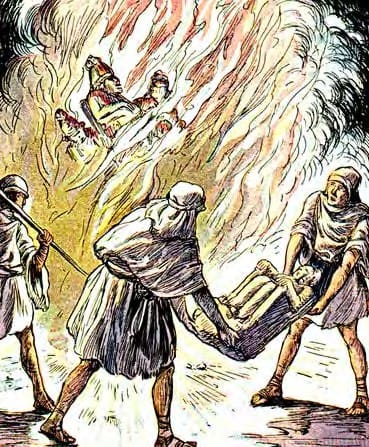
Their altars and images were to be utterly destroyed, and the groves of sacred totems, or poles, upon which were graven the exploits of the idol, were to be cut down and burned. So this was not a new and strange commandment the Lord now gave to Gideon. It was an important part of the original law which Israel had agreed to keep:
“All that the Lord hath spoken, we will do.” (Exodus 19:8) It was simply a reminder to Gideon to carry out his responsibility as a loyal Israelite, something which should have been done by Israel as a matter of course long before, but which had been shirked. It was a forcible reminder of the reason why the Lord had permitted Israel to fall into the hands of Midian to be oppressed by them seven years.
Gideon Places God First
Under the circumstances it was a hard thing to ask Gideon to do this. The altar of Baal was on his father’s property and his father was responsible for it. Defying his father’s authority was bad enough, but he must also consider that the entire surrounding community was solidly composed of Baal worshippers who would certainly resist any tampering with their idol. Obedience to the Lord meant risking his life. Gideon was willing to take that risk, but in doing so, he was as prudent as possible. He knew that if he openly attempted what the Lord had commanded, the priests of Baal and the men of the community would certainly prevent him from carrying it out. So he did his work at night.
“Then Gideon took ten men of his servants, and did as the Lord had said unto him. And so it was, because he feared his father’s household, and the men of the city, that he could not do it by day, that he did it by night.” Judges 6:27
Was this cowardly? Certainly not. He merely did not want his work to be interfered with. But he well knew that, whether done by day or by night, he would still be held responsible for his deed and would have to take the consequences. I am sure it must have crossed Gideon’s mind that they might not only kill him but after that, they might even sacrifice his own children as burnt offerings to Baal.
There was nothing cowardly in what Gideon did. He was indeed, as the angel said, a man of valor.
The fact that Gideon had ten servants who were willing to help him desecrate Baal seems to indicate that his entire household may have consisted of faithful Israelites who still worshipped the true God, that Gideon had been attracting to himself and to his service those in Israel who abhorred Baal and clung to Jehovah.
A seven-year-old bullock is an ox not a calf. At midnight Gideon and his men harnessed this powerful animal and led it up the hill atop of which stood the altar of Baal. The altar consisted of a huge, ugly, brazen image of the god with arms outstretched. It was hollow so that a roaring fire could be built inside it. When superheated, it was customary to sacrifice to it by throwing a little child into its arms to roast alive. The sheer weight of the idol made the ox necessary. It was too heavy to be moved by hand. Gideon quickly climbed the image and tied a rope around its neck. Attaching the other end to the harness of the ox, and assisted by his men, he pulled the idol down from its foundation so that it lay ignominiously upon its face in the dirt. Next they gathered stones and erected an altar to the Lord upon the spot where the idol had stood. Lest the noise of chopping arouse the community, Gideon probably used the ox to topple the grove of totem poles surrounding the idol. We can imagine a man climbing each one of the ornately carved poles and attaching a rope to its top. Then he would harness the ox to it and noiselessly pull it down.
When the entire grove was thus leveled, the ox was probably used further to drag the huge poles to the newly made altar of Jehovah where they were laid. When all was in readiness, the wood was ignited and the bullock offered upon the fire as a sacrifice to the Lord. As the flames fed by the dry poles consumed the sacrifice, Gideon and his men prostrated themselves before it in humble reverence to their God; then they quietly left the hill.
Gideon Fulfills God’s Command
Dawn was just breaking when the fire on the hill leaped skyward, lighting up the countryside. An early riser in the village saw it, and gave the alarm, “Fire comes from the altar of Baal!” he cried, “Our god is speaking to us!” The men gathered themselves and hurried up the hill some distance away to see the miracle. But what they saw when they got there stunned and angered them. The sacred grove was gone. Upon the place where Baal had stood they saw another altar which they recognized as an altar to Jehovah because it was built in austere simplicity, according to the specifications given in Exodus 20:24-26. A brisk fire still burned upon it consuming the last of the sacrifice. Scattered about the altar and still smoldering they saw the charred ends of their totem poles. Before the altar, flat upon its face in the dirt as though doing obeisance to it, was the great brazen image of Baal.
They immediately suspected that Gideon was responsible for this outrage. It was probably well known that he did not worship Baal. They made inquiries to be sure because Gideon’s father, Joash, was one of them and was their chief. They would not want to unjustly accuse his son. At this point a witness must have come forward to say that Gideon and his servants had been absent from home that night and that the second bullock of Joash, to which Gideon had access, was missing. We now read from the account:
“And when the men of the city arose early in the morning, behold, the altar of Baal was cast down, and the grove was cut down that was by it, and the second bullock was offered upon the altar that was built. And they said to one another, Who hath done this thing? And
when they inquired and asked, they said, Gideon, the son of Joash hath done this thing.” Judges 6:28,29
The idolaters armed themselves and went in a body to the house of Joash where Gideon had taken refuge. Meanwhile Joash had talked with his son Gideon regarding his exploits that night and had come to some definite conclusions. Joash now came out and boldly faced the mob. We continue with verses 30 and 31:
“Then the men of the city said unto Joash, Bring out thy son that he may die; because he hath cast down the altar of Baal and because he hath cut down the grove that was by it. And Joash said unto all that stood against him, Will ye plead for Baal? Will ye save him? He that will plead for him, let him be put to death whilst it is yet morning. If he be a god, let him plead for himself, because one hath cast down his altar.”
Do you see what a powerful argument Joash used? There stood the supposedly mighty Baal surrounded by a veritable forest of poles upon which were engraved the scenes of his reputed great accomplishments and virtues. Along comes a puny man with a cow and pulls down the whole business and the mighty Baal is powerless to prevent it! So Joash told them,
“Now if Baal cannot fight for himself, but has to depend upon you to defend him, he isn’t much of a god, is he? Do you still believe in him? If so, perhaps Baal requires a human sacrifice to expiate what has happened to his altar. If you are so eager to plead for him, how about offering yourself to die? Let anyone here who pleads the cause of Baal be put to death this very morning!”
At this the ferocity of the mob quickly cooled. One by one they slunk away. From his performance, I think we can safely assume that Joash had been then and there converted to the worship of Jehovah.
The news of what Gideon had done spread like wildfire throughout Israel. It showed them that Baal was a false god, that he was powerless against the God of Gideon, the God of Abraham, Isaac and Jacob, the true God of their fathers. The people woke up to the fact that their idolatry was really the cause of all their troubles. As a result there was a great conversion in Israel and there was a determination to throw off the yoke of Midian. All they needed now was an effective leader. Gideon became that leader. With only three hundred men, carefully selected according to the Lord’s direction, he put to rout 135,000 of the host of Midian and freed Israel from their yoke. How this was accomplished is another story and may well be the subject of another discourse.
Some Lessons for Us
Let us see what further lessons we can learn from this account. First of all there is a lesson respecting idolatry. As idolatrous natural Israel had its groves of totem poles carved with intricate imaginations, so nominal spiritual Israel today has for its totem poles the various denominational creeds to which men give veneration.
Monstrous “Baal” is still worshipped in nominal Christendom today. Although we do not have a literal Baal of brass heated red-hot with extended arms to receive little children into its fiery embrace, we do have a Baal on a much larger scale: a blasphemous misrepresentation of the only true God. Today we have asuper Baal, not one who is content with an occasional human burnt offering, but a god red-hot with the flames of hell and purgatory, with millions agonizing in his embrace eternally. This Baal, this horrible misconception of a loving and merciful God, will be toppled and laid in the dust by the great antitypical Gideon, Christ Jesus, who will also cut down and destroy the creed totem poles of Christendom.
But there is a more subtle and serious form of idolatry that threatens the Lord’s people, true spiritual Israel. The first commandment of the Decalogue was:
“Thou shalt have no other gods before me. Thou shalt not make unto thee any graven image, or any likeness of any thing that is in heaven above, or that is in the earth beneath, or that is in the water under the earth. Thou shalt not bow down thyself to them, nor serve them; for I, the Lord thy God, am a jealous God.” Exodus 20:3-5
This commandment was amplified in Deuteronomy:
“Hear, O Israel: The Lord our God is one Lord. And thou shalt love the Lord thy God with all thy heart, and with all thy soul, and with all thy might.” Deuteronomy 6:4,5
Of course, none of the Lord’s true people are guilty of idolatry in the sense of worshipping graven images of wood, metal and stone. Yet anything that is loved more than God, which is exalted above God in the mind, is an idol. One’s own self can be an idol. In many respects an idol of self is the most horrible one of all the meanest looking.
But most of the friends do not idolize self, or wealth, ambition and fame, nor do we value highly the possession of beautiful homes, automobiles, expensive jewelry, and fine clothing as the world does. I am sure we know enough not to do that. But there is another danger. Because of the very unselfish love which a Christian life engenders, we may set undue affection upon wife, husband, parent, child, brother or sister. Jesus saw this danger, and said:
“He that loveth father or mother more than me, is not worthy of me; and he that loveth son or daughter more than me, is not worthy of me.” Matthew 10:37
“If any man come to me, and hate not his father and mother and wife, and children and brethren, and sisters; yea and his own life also; he cannot be my disciple.” Luke 14:26
“Hate,” as used here, does not mean to detest. According to other translations it simply means “to love less.” We are indeed to love our families. We are to love them very much. We are told, “Husbands, love your wives, even as Christ also loved the church.” (Ephesians 5:25) Did not Christ love the Church very much? And in Matthew, “Honour thy father and thy mother; and Thou shalt love thy neighbour as thyself.” (Matthew 19:19) We read in 1 John 4:20, “If a man say, I love God, and hateth his brother, he is a liar.” So it is not a matter of ceasing to love our families, or loving them any less than we do, but of loving God and Christ even more than these. As the poet expresses it:
“’Tis written, `keep yourselves from idols.’ How shall I obey? Oh, not by loving less, but by loving more! It is not that we love our precious ones too much, but God too little.”
Increasing Our Faith
But as a practical matter, how can we increase our love for God? How can we attain that ideal given in Mark 12:30 of loving God with all our heart, soul, mind and strength? There is no better way than to contemplate, meditate, and study the Plan of God, and cooperate with it. It is a wonderful and flawless plan. It is the perfect solution to all the problems of humankind. It answers every question, and soothes every fear. It is wise, just, and loving. The more we realize and appreciate its beauty and grandeur, the more we will love the Author of that plan. We will grow in love for God. We are bound to do so. Additionally, we can increase our love for God by reminding ourselves, and tracing, God’s wonderful providences in our lives, how he has drawn us, and called us, and lovingly led us all the way. We can remember all of his “exceeding great and precious promises” to us which are so sure of fulfillment. It is in these ways that our love for God will grow, excel, and surpass all earthly loves.
If you love God, tell him so! Express your longing in every prayer you make. Say to him, “Lord, I love thee!” David, the beloved of God, did this with beauty of expression:
“As the hart panteth after the water brooks, so panteth my soul after thee, O God. My soul thirsteth for God; for the living God. When shall I come and appear before God? Psalms 42:1,2
Our love for God should be so fervent that this cry of David should be also our own longing and aspiration.
Although our love for God is spontaneous, and not for reward, nevertheless, the Lord does abundantly bless those who love him; here and hereafter.
“As it is written, Eye hath not seen, nor ear heard, neither have entered into the heart of man, the things which God hath prepared for them that love him.” 1 Corinthians 2:9
“We know that all things work together for good to them that love God; to them who are the called according to his purpose.” Romans 8:28
We must prove our love for God before we are found worthy. Deuteronomy 13:3 applies to us, “The Lord your God proveth you, to know whether ye love the Lord your God with all your heart and with all your soul.” Let us not forget that there were material blessings promised Israel if they would refrain from idolatry. As spiritual Israel, we are the heirs of the spiritual counterparts of those blessings. The Lord promised them “rain in due season.” We are promised, and have abundantly received, showers of truth, “meat in due season.” Israel was promised that their land would yield her increase and their trees much fruit. We bring forth the fruits and graces of the holy spirit. As Jesus said, “He that reapeth receiveth wages, and gathereth fruit unto life eternal.” (John 4:36) Israel was promised a good vintage and “bread to the full.” We have the wine of the communion of the blood of Christ. (1 Corinthians 10:16) We do indeed eat bread to the full. We partake of Christ; as it is written:
“Jesus said unto them, I am the bread of life. He that cometh to me shall never hunger; and he that believeth on me shall never thirst.” John 6:35
In return for their obedience, the Lord promised Israel peace and safety, and freedom from fear. Spiritual Israel has the “peace of God, which passeth all understanding.” (Philippians 4:7) Our freedom from fear in a troubled world is expressed in Psalm 46:
“God is our refuge and strength, a very present help in trouble. Therefore will not we fear, though the earth be removed, and though the mountains be carried into the midst of the sea; though the waters thereof roar and be troubled, though the mountains shake with the swelling thereof.” Psalms 46:1-3
It was so frustrating and disheartening to Israel when the Midianites laid in wait and then swooped down and took away their produce for which they had worked so hard. They had to start all over again.
Similarly it sometimes seems that when we have managed to make a little headway in developing the fruits and graces of the Christian character, the enemy comes in like a flood and undoes all our work. This can be very discouraging. At such times let us remember,
“Lay not wait, O wicked one, against the dwelling of the righteous. Spoil not his resting place. For a just man falleth seven times, and riseth up again.” Proverbs 24:15,16
It’s not how many times you fall that counts, but how many times you get up. Let us say as it is written in Micah 7:8, “Rejoice not against me, O mine enemy. When I fall, I shall arise!” Let us remember that, in the prize ring, a fighter is counted out only if he stays down.
We note that the Midianites robbed and plundered Israel at their harvest time, depriving them of the food they had so laboriously acquired. I think this is significant. Are there some today who would take away the harvest truths which we have found so satisfying, some who would rob us of our spiritual food and leave us impoverished? Such plundering must be vigorously resisted if we would maintain our spiritual lives.
Gideon didn’t look much like a “mighty man of valour” when he hid himself in the winepress to thresh wheat. But that’s what the angel called him. Let this teach us that it is our potential that God sees when he calls us, not what we are but what we can be. If he has called you to run for the prize of the high calling, he knows that you can do it with his grace to help. As he instructed and guided Gideon in everything, he will do the same for you. His words to Gideon “Surely I will be with thee. . . . Have I not sent thee” apply with equal force to you.
You will remember that the Lord said to Gideon, “Take thy father’s young bullock, even the second bullock of seven years old, and throw down the altar of Baal.” (Judges 6:25) Then the second bullock was to be offered as a sacrifice. This has a wonderful significance. Adam was the Heavenly Father’s first bullock the first perfect man, who forfeited his life through disobedience. Jesus was the Father’s second bullock, the second perfect man, the number seven signifying perfection. The burnt sacrifice of the second bullock corresponds to the sacrifice of the bullock of the tabernacle. The second bullock was also the Ransom sacrifice. Thus we read:
“The first man, Adam, was made a living soul. The last Adam was made a quickening spirit. . . . The first man is of the earth earthy.
The second man is the Lord from heaven.” 1 Corinthians 15:45,47
When the result of this ransom sacrifice is applied to the world during the Millennium, then the antitypical altar of Baal, Satan and the devil who has so long oppressed the world, will be overthrown and the worship of the true God restored. Thus we can see that this account of Gideon, as with so many others in the Bible, contains an outline of the entire Divine Plan from the fall of man to his restoration. Gideon A Type of Christ
Gideon of course was a type of Christ. There are so many correspondencies. The scriptures indicate that Gideon was of a princely appearance, that he had a look of nobility and resembled the child of a king. Of Jesus it was written:
“He shall be great, and shall be called the Son of the Highest. And the Lord God shall give unto him the throne of his father David.” Luke 1:32
Gideon was told, “Thou shalt smite the Midianites as one man.” (Judges 6:16) Similarly, it is through the performance of one man, Jesus Christ, that Satan will be smitten and his oppressive rule over mankind ended. Thus we read:
“As by one man sin entered into the world; and death by sin; and so death passed upon all men, for that all have sinned. For if through the offence of one, many be dead; much more the grace of God and the gift of grace, which is by one man, Jesus Christ, hath abounded unto many. For as by one man’s disobedience many were made sinners, so by the obedience of one shall many be made righteous.” Romans 5:12, 15,19
We find that Gideon promptly obeyed the Lord’s command to destroy the altar of Baal but that he exercised prudence in doing it. He did it at night to prevent interference. We too can be prudent in our service. We can give our witness to the world and demolish false doctrines in such a way as not to unnecessarily antagonize others, thus preventing premature interference with our work. We know according to John 9:4 that “the night cometh when no man can work”; but let us not precipitate that time. Jesus was similarly prudent. Although he was not afraid of the Scribes and Pharisees, he avoided unnecessary confrontation with them until his time had come. We read, “Therefore they sought again to take him; but he escaped out of their hand; and went away beyond Jordan.” (John 10:39,40) This was not cowardly but prudent.
In obeying the call of the Lord, Gideon risked his life, his family, and everything he had. Not knowing how he would be delivered from the wrath of the idolaters or whether he would be delivered at all, he promptly carried out the Lord’s will. When he had removed the altar of Baal, he erected another altar and offered an acceptable sacrifice to God. This is a good picture of consecration. Removing every trace of Baal worship from our hearts, renouncing every earthly idol, and raising God to a supreme position in our lives, we “present our bodies a living sacrifice, holy, acceptable to God.” Romans 12:1
The name Midian means strife or contention. This is what Israel of old suffered. Is there strife and contention in the church today? Israel got into difficulty when they turned away from the true teachings of God. Might the strife in the church today be caused by departures from the truth as the Lord revealed it to us through his wise and faithful servant? This is something to think about.
Beware of “Midian”
There is an intimate and personal lesson to be learned from this account. If the Lord ever seems to have turned his face from you as he did from Israel, if you feel spiritually oppressed and impoverished, if you have lost much of the zestful appreciation of the truth which you once enjoyed perhaps Midian is robbing you, too. Just as Israel was enticed into idolatry and so lost the Lord’s favor for a while, perhaps you have allowed some person or thing to become a stronghold of Baal to you. If this is the case, prompt and vigorous action is necessary. A warfare is required. As God sent Gideon to deliver Israel, he will make his mighty power available to you, through the antitypical Gideon, Jesus Christ. Thus it is written:
“The weapons of our warfare are not carnal, but mighty through God to the pulling down of strong holds; casting down imaginations, and every high thing that exalteth itself against the knowledge of God; and bringing into captivity every thought to the obedience of Christ.” 2 Corinthians 10:4,5
If you will do this, you will be restored to God’s full favor and blessing.
Gideon’s Great Victory
“The Lord delivered [the children of Israel] into the hand of Midian seven years.” Judges 6:1
THE “hand of Midian” was a heavy hand of oppression. Midian systematically plundered and robbed the Israelites of the fruit of their labors. Their situation is described in Judges chapter 6:
“And Israel greatly was impoverished because of the Midianites; and the children of Israel cried unto the Lord. And it came to pass, when the children of Israel cried unto the Lord because of the Midianites, that the Lord sent a prophet unto the children of Israel, which said unto them, Thus saith the Lord God of Israel, I brought you up from Egypt, and brought you forth out of the house of bondage; and I delivered you out of the hand of the Egyptians, and out of the hand of all that oppressed you, and drave them out from before you, and gave you their land. And I said unto you, I am the Lord your God; fear not the gods of the Amorites, in whose land ye dwell; but ye have not obeyed my voice.” Judges 6:6-10
Upon hearing the repentant cry of Israel the Lord raised up Gideon to lead them away from their idolatry and deliver them from its consequences. At the Lord’s command Gideon destroyed the altar and grove of Baal thus demonstrating that the supposedly mighty Baal was no god, that he was powerless to prevent the desecration of his own altar, that he was powerless against the God of Gideon, the true God of their fathers. As a result there was a great conversion in Israel, a determination to return to the worship of Jehovah and to throw off the yoke of Midian. Gideon was acclaimed their leader.
Midianite spies who had been planted in Israel quickly reported this situation to their lords. The enemies of Israel promptly acted to put down the rebellion. Thus we read:
“Then all the Midianites, and the Amalekites, and the children of the east were gathered together, and went over [the Jordan] and pitched in the valley of Jezreel. Judges 6:33 We know from Judges 8:10 that this combined enemy army represented a force of 135,000 men. Realizing that Israel was now committed to war, Gideon did something which shows us that he was familiar with the law which the Lord had given Israel. We read that, “the spirit of the Lord came upon Gideon and he blew a trumpet.” (Judges 6:34) When he blew a trumpet under these circumstances, he obeyed a commandment of the Lord given before. It was not only a commandment but was also an assurance of victory.
“And if ye go to war in your land against the enemy that oppresseth you, then ye shall blow an alarm with the trumpets. And ye shall be remembered before the Lord your God, and ye shall be saved from your enemies.” Numbers 10:9
Gideon claimed this promise. He sent messengers throughout the land, blowing trumpets and rallying the men of Israel to the banner of the Lord.
As the men from the various tribes began to gather under his leadership, Gide–on had second thoughts as to whether the Lord had really appointed him to lead Israel to victory. This seems quite incredible. Had he not previously met and talked with an angel of God who assured him that he was indeed the one selected?
“And the angel of the Lord appeared unto him, and said unto him, The Lord is with thee, thou mighty man of valour. And the Lord looked upon him and said, Go in this thy might and thou shalt save Israel from the hand of the Midianites. Have I not sent thee?” Judges 6:12,14
As if this was not assurance enough, the angel of the Lord brought fire out of the rock to consume Gideon’s offering of lamb and unleavened bread. The account is in Judges 6:21. Then God spoke to him in a dream and commanded him to throw down the altar and grove of Baal. When he had done this in obedience to God’s command, he afterward was saved from almost certain death at the hands of the idolaters. Were not all these evidences assurance enough to Gideon that the Lord would indeed save Israel by his hand as he had said? No. In spite of all this he still had doubts! He felt that he had to put God to the test!
“And Gideon said unto God, If thou wilt save Israel by mine hand, as thou hast said, Behold, I will put a fleece of wool in the floor [that is, the threshing floor]; and if the dew be on the fleece only, and it be dry upon all the earth beside, then shall I know that thou wilt save Israel by mine hand, as thou hast said. And it was so. For he rose up early on the morrow, and thrust the fleece together, and wringed the dew out of the fleece, a bowl full of water.” Judges 6:36-38
Now wasn’t that a wonderful demonstration? But believe it or not, he still was not convinced!
“And Gideon said unto God, let not thine anger be hot against me, and I will speak but this once. Let me prove, I pray thee, but this once [more] with the fleece. Let it now be dry only upon the fleece, and upon all the ground let there be dew. And God did so that night; for it was dry upon the fleece only, and there was dew on all the ground.” Judges 6:39,40 Gideon was finally satisfied.
32,000 men of Israel responded to Gideon’s call to battle. From a human standpoint they were far too few and stood no chance against the 135,000 superbly armed and disciplined enemy force arrayed against them. From God’s standpoint they were too many:
“And the Lord said unto Gideon, The people that are with thee are too many for me to give the Midianites into their hands; lest Israel vaunt themselves against me, saying, Mine own hand hath saved me.” Judges 7:2
So the Lord instructed Gideon to make a proclamation that anyone who was fearful should return home. It is quite understandable that many would be fearful. For seven years they had been oppressed by Midian and every effort to resist had failed. They had lost confidence in themselves. True, the trumpets of Gideon had stirred them up just as today a military brass band stirs up feelings of patriotism. In their momentary enthusiasm they had responded to the call. But now, seeing the huge encampment of Midian in plain sight in the valley below, their courage evaporated. So in response to this new proclamation, 22,000 fearful men left the army and returned home. This left Gideon with only 10,000 men against Midian’s 135,000.
Now we read:
“And the Lord said unto Gideon, The people are yet too many. Bring them down unto the water, and I will try them for thee there.” Judges 7:4