
Joseph and His Brethren
TODAY we are going to consider the story of Joseph which comprises chapters 37 and 39 to 50 of Genesis. It would take too long to read the actual account so we will briefly summarize and paraphrase the story after which we will see what lessons are to be learned from it.
Jacob, the grandson of Abraham who was renamed Israel, especially loved his wife Rachel. Her firstborn son was called Joseph. Then she died in childbirth bearing another son, Benjamin. Jacob greatly grieved Rachel’s death and with her gone, the intensity of his love showered upon her children, especially the firstborn Joseph. Jacob had eleven other sons, but Joseph was his favorite. He showed his favoritism in many ways. For example, he had a special garment made for Joseph, a coat of many colors and of many pieces, a coat such as was worn by nobility. Perhaps he thus indicated to the rest of his family that Joseph would be heir. The ten other brothers were consumed with jealousy. The record says: “They hated him, and could not speak peaceably unto him.”
As if things weren’t bad enough, Joseph dreamed a strange dream one night and in his innocence related it to his brothers. It seems that they were all binding sheaves of wheat in the field and Joseph’s sheaf arose and stood upright, whereupon his brothers’ sheaves stood around in a circle and bowed down to Joseph’s sheaf. As a result of this dream the account says, “They hated him yet more.” Then Joseph dreamed again. This time the sun and the moon and eleven stars bowed down to him. When he told this one, his father remarked, “Shall I, and thy mother, and thy brethren indeed come to bow down ourselves to thee to the earth?” This was the last straw. The hatred of Joseph’s brothers was whipped to a jealous rage. This was their frame of mind when they journeyed from their home to find pasturage for their flocks some distance away. They were gone so long that their father began to worry about them and decided to send Joseph to see how they were and bring him word again. We can imagine that Joseph and his dreams of superiority were thoroughly discussed by his brothers in the field. This airing of mutual grievances would further incite their hatred. They were in just such a frenzy of jealous rage when the one posted as the camp lookout called out, “Here he comes! Here comes that dreamer.”
In the crystal-clear air of that region an approaching person can be seen a long distance away. They easily recognized it was Joseph because of his long coat of many pieces and bright colors. Each brother instantly had the same thought–now he was in their power! His father was not there to protect him. The object of their hatred was in their hands. As Joseph innocently approached, probably waving a happy greeting, they held a hasty conference and the almost unanimous decision was:
“Come now, therefore, and let us slay him, and cast him into some pit; and we will say, some evil beast hath devoured him; and we shall see what will become of his dreams.”
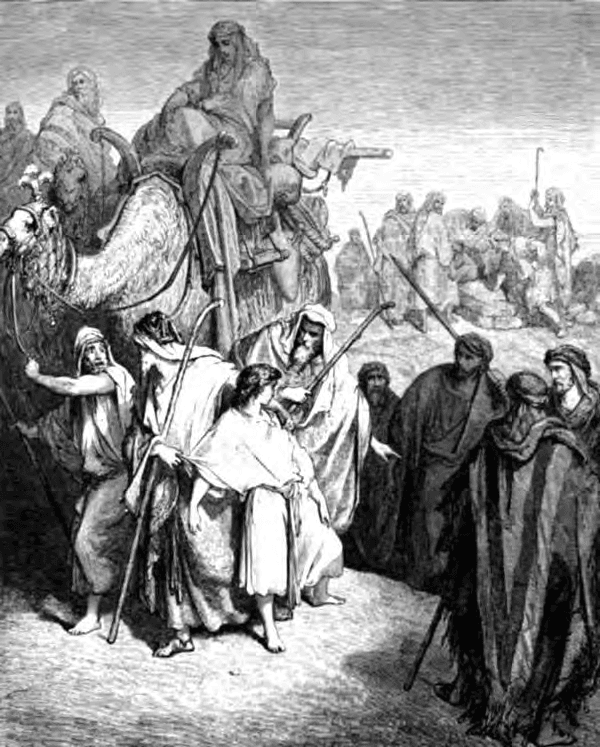
The Hatred of Joseph’s Brothers
So great was their hatred that of the ten there was only one dissenting voice to this decision. It was that of Reuben, the oldest son. He suggested a compromise. “Let us not shed his blood,” he said, “but let us put him into the pit alive.” The record says that it was Reuben’s intention to come back later and release Joseph. It was quickly agreed. When Joseph arrived he was rudely seized, stripped of his colorful coat, and thrown into a deep dry well from which he could not possibly escape unaided. Then, with the anguished cries and pleadings of Joseph ringing in their ears, they sat down to eat.
The fact that they could eat under the circumstances shows the callousness of their hearts.
Reuben, who was more compassionate, must have excused himself at this point to go and tend to his flocks because he was not present when a caravan of camels came in sight on its way to Egypt. Judah proposed an idea. Why not turn the situation to a profit? Why not sell Joseph as a slave instead of letting him die in the pit? So they let down a rope to Joseph who eagerly grasped it thinking his brothers had relented, only to find himself trussed up and sold like an animal to some Midianite slave-traders for twenty pieces of silver. In those days the price of a full-grown slave was thirty pieces of silver. Since Joseph was only seventeen, his price was twenty pieces. Again he cried and appealed to his brothers for mercy as he was dragged away by the traders, but they were too busy dividing the money. There would be two whole pieces of silver for each of them. Then Reuben, circling about, returned to the well to release Joseph. Finding him gone, he was genuinely distressed but it was too late.
Then the brothers did an extremely cruel and callous thing. They took Joseph’s coat of many colors, dipped and spattered it in the blood of a goat and took it to their poor old father who was so anxiously waiting for Joseph’s return, the son he loved so much. “We found this,” the brothers said. “Is it your son’s coat?” Jacob reached the obvious conclusion. Joseph had undoubtedly been torn to pieces by a wild beast. There were lions and bears in that part of the country. His grief was profound. He refused to be comforted, saying, “I will go down to the grave, unto my son, mourning.”
The change in Joseph’s life was drastic and complete. From being a beloved and favorite son, tenderly reared in his father’s house, he suddenly was transported to the position of a slave in a foreign and heathen land. To this was added the bitter experience of witnessing the murderous hatred and cold-blooded cruelty of his own brothers as well as the homesickness and the thought of his father’s grief and loneliness.