
Joseph’s Experiences in Egypt
Upon reaching Egypt he was exposed for sale in the open market as was the custom of the time. The slave buyers were men of position and substance, members of nobility, officers of the king, wealthy merchants and large landowners. Slaves were expensive. We can imagine the slave-master expertly sizing up Joseph so obviously superior to the rest, saying:
“Gentlemen, we have a very special item today. A young Hebrew! This man is from a superior race. He is not only strong, but very intelligent. Just look at his high forehead! He will make some fortunate purchaser an excellent and trustworthy servant. Gentlemen what am I bid?”
That is how Joseph was purchased by Potiphar, an officer of Pharaoh and Captain of the Guard.
Joseph had inherited many fine qualities from his father. He had been reared in an atmosphere of strong faith in the God of Abraham. From infancy he had been imbued with the noblest precepts; he was honest, conscientious, and a faithful young man. Absolute faithfulness was probably rare at the time as it is today. Joseph’s master quickly noted it and gave Joseph more and more responsibility. The record says that, “The Lord made all that he did to prosper in his hand.” This too was noticed by his master. When Joseph was about 22, he was made the manager of Potiphar’s entire estate. He enjoyed Potiphar’s complete trust and confidence. We read, “And he left all that he had in Joseph’s hand.”
Joseph had occupied this position for about five years when calamity came. Unintentionally he caught the eye of Potiphar’s wife. His steadfastness to principle angered her. She falsely accused him and he was cast into prison and made to appear guilty of a heinous crime: disloyalty to his master and benefactor. Shakespeare has described this situation saying, “Hell hath no fury like a woman scorned.” We read: “And Joseph’s master took him, and put him into prison, a place where the king’s prisoners were bound.” I don’t think Potiphar, in his heart, really believed his wife’s accusation against Joseph. If he had, he certainly would have killed Joseph. After all he was an officer of the king and Captain of the Guard; Joseph was only a slave. No one would have questioned him. Instead he imprisoned Joseph.
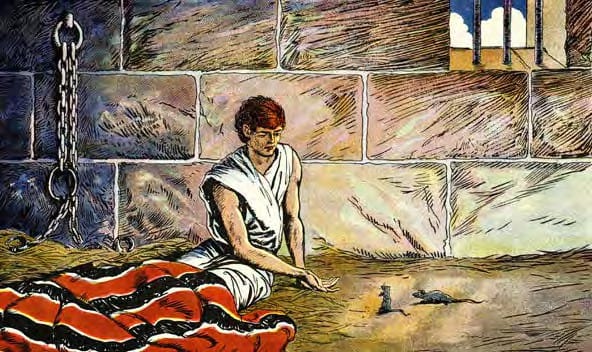
The warden of the prison was happy to have someone with Joseph’s administrative ability and he quickly put his talents to work. In a short time Joseph came to be in complete charge of the prison arrangements although he was himself a prisoner. Once again we read: “The Lord was with him; and that which he did, the Lord made to prosper.”
Since this was the king’s prison, the prisoners were not necessarily criminals. Sometimes they were political prisoners or merely temporary objects of the king’s displeasure. One day, Pharaoh became angry at two of his officers, described as “the chief of the butlers, and the chief of the bakers.” The chief butler or cup-bearer to the king was the highest officer of Pharaoh’s household–a sort of a Royal Secretary. The chief baker was the manager of the culinary department and general steward of the Royal Family with its kitchen and supplies. They were confined in the same prison with Joseph, and Joseph was responsible for them. He therefore became well acquainted with them and learned much of the ways and customs of Pharaoh’s court. This information would stand him in good stead later on.
Joseph Interprets Dreams
One morning Joseph noticed these two prisoners looked particularly unhappy and he tenderly inquired: “Wherefore look ye sad today?” Joseph’s own experiences had made him tender-hearted toward others. He was able to enter into the degradations and sorrows of the other prisoners because of what he himself had been through. He noticed and was genuinely concerned that they were sad that morning.
The chief butler and the chief baker told Joseph they both had dreamed dreams the previous night and were sad and worried because of what the dreams might mean. Joseph encouraged them to tell him their dreams suggesting that God through him might give them the interpretations. The butler told his dream first and God illuminated Joseph’s mind to give him the meaning; he was to be pardoned by Pharaoh and restored to his butler’s office within three days. Then Joseph made a pathetic plea to the butler, showing how much he yearned for his freedom. He said,
“But think on me when it shall be well with thee; and show kindness, I pray thee, unto me, and make mention of me unto Pharaoh; and bring me out of this house. For indeed I was stolen away out of the land of the Hebrews; and here also, have I done nothing that they should put me into the dungeon.”
Then the baker told his dream. Again God illuminated Joseph’s mind with the interpretation. This time it saddened Joseph to tell it. He told the baker that within three days he would be hanged. Within three days both predictions were precisely fulfilled. The butler, restored to his former position, once again gave the cup to Pharaoh’s hand. But he forgot Joseph and his wistful plea. Joseph stayed in prison two years after that. He was now 30 years of age.
Then one night Pharaoh dreamed two dreams in one night. These were not ordinary dreams that one takes as a matter of course. So vivid and impressive were they that Pharaoh knew they had special significance. In the first dream he saw seven fine cattle come up to the river; a little later he saw seven very poor, lean cattle the worst he had ever seen come up. The lean cattle ate up the fat ones and looked none the better. In the second dream Pharaoh saw a fine stalk of corn grow up out of the earth bearing seven full, healthy, ears of corn. Then he saw another stalk come up with seven withered ears, good for nothing. As he watched the withered ears swallowed up the good ears and looked none the better. Pharaoh summoned his wise men and magicians to determine what the dreams meant. But to his great disappointment, not one of them could interpret the dreams for him. Then the chief butler, who was always at Pharaoh’s side, finally remembered Joseph and told the king of the young Hebrew in prison who had so accurately interpreted his dream as well as the dream of the baker.
I like to think that Joseph was praying, asking God for deliverance, when the summons came. The keeper of the prison came in with astonishment on his face. “Joseph! The King is calling for you! The great Pharaoh himself wants to see you!” Joseph was not really surprised. He had been expecting it for so long. With a heart full of thankfulness, he hastily bathed, shaved, and changed his clothes. It was with a calm assurance, born of faith in God, that Joseph faced Pharaoh, the mightiest monarch in the world. “I understand you have the ability to interpret dreams,” Pharaoh said. “This ability is not in me,” Joseph answered modestly. “It is God who shall give you an answer.”
“What a time to be modest!” someone might say. He had been a slave for ten years and in the dungeon for three years. Now when he had a grand opportunity to shine before the king himself, he threw it away. Yet modesty usually denotes greatness of character. This was not lost on the keenly perceptive Pharaoh. He told Joseph his dreams. The Lord again illuminated the mind of Joseph and he explained to Pharaoh that the two dreams referred to the same matter, given twice to emphasize its sureness. The interpretation was that there would be seven years of plenty great plenty in the land of Egypt. Then these would be followed by seven years of famine which would fully consume all the surplus of the plentiful years.
Joseph offered the suggestion that the king appoint a trustworthy agent to buy all the surplus grain in seven years of plenty and to store it for use during the seven years of famine.
Pharaoh was at once struck with the wisdom of this plan. So we read:
“And Pharaoh said unto his servants: Can we find such a one as this is? A man in whom the spirit of God is? And Pharaoh said unto Joseph: Forasmuch as God hath showed thee all this, there is none so discreet, and wise as thou art. Thou shalt be over my house, and according to thy word shall all my people be ruled. Only in the throne will I be greater than thou.”
So it came to pass that Joseph in one day stepped out of the lowest dungeon and was exalted to the rulership of Egypt, the greatest empire of those days. As Brother Russell expressed it: “He had a 14- year contract.”
Famine Touches Joseph’s Family
The famine was general and severe throughout that region of the world. It included Canaan as well as Egypt. The land dried up and successive crops failed until there was not even seed left to plant. Word spread that there was no lack of food in Egypt. So Jacob directed his sons, who were by this time heads of families themselves, to go down to Egypt and buy wheat. But he did not send Benjamin, who was now his favorite son, with them.
The ten sons arrived in Egypt. As aliens they were directed to Joseph who had been expecting them. He had known they would eventually have to come to him for food. That is probably why he had not tried to contact them before this. When brought before Joseph, his ten brothers bowed themselves before him, not recognizing him. To them he was the ruler of Egypt. As they bowed before him Joseph remembered his dreams of the sheaves and the stars. He spoke to them through an interpreter asking if they were not really spies who had come to see how much wheat there was in Egypt so that they might bring an army to steal it. They explained their situation truthfully and upon questioning mentioned their father and their younger brother Benjamin.
How Joseph’s heart must have leaped to learn that after more than 20 years his father and his brother Benjamin were alive and well. But he did not identify himself. He kept his air of severity and finally agreed to sell them grain. But in order to obtain more later, they must first prove their truthfulness by bringing their youngest brother Benjamin along with them. Until that time, Simeon, one of the brothers, would be kept in prison as a hostage. At this point a single thought must have simultaneously passed through the minds of each of the ten brothers. It was the tragic memory of their 17-year-old brother Joseph in his coat of many colors with anguish of heart pleading, begging them for mercy. Then the brothers turned a deaf ear and sold Joseph for silver. The record states:
“And they said, one to another, we are verily guilty concerning our brother; in that we saw the anguish of his soul, when he besought us, and we would not hear. Therefore is this distress come to us. And Reuben answered them saying, Spake I not unto you, saying, do not sin against the child, and ye would not hear? Therefore, behold, also his blood is required.”
The Brothers Experience Remorse They were in the presence of Joseph when they said these things, not knowing that he understood every word. Joseph was so overcome that he withdrew so that he could weep unobserved. His tears were tears of compassion and joy, joy at seeing the remorse of his brethren, to realize that the mellowing of the passing years had brought sincere repentance and change of character. Nevertheless he must try them further. He returned to them, took Simeon hostage, and sent them away.
On the way home, when they opened their sacks to get food, they found the money they had paid for the grain in each of their sacks. When the brothers arrived at home with their wheat, they told their father Jacob the whole story, of their being suspected as spies by the governor, and why Simeon was not with them. Then they told their father that the money they had paid for the grain had been returned to them in their sacks of wheat. They told him that in order to obtain more wheat next time they must take Benjamin with them. To this Jacob protested, saying:
“Me have ye bereaved of my children. Joseph is not, and Simeon is not, and ye will take Benjamin away?”
It must have been a shock to the brothers to hear even their father Jacob echo their fears, that their crime against Joseph was responsible for their predicament, that this was retribution.
When the supply of wheat brought from Egypt began to run low, Jacob urged his sons to go again for more. But they positively refused to do so unless Benjamin went along. Jacob protested strongly. Then Judah spoke up and became surety for Benjamin. Let us remember that it was Judah who many years before had, proposed selling Joseph as a slave. Now he pledged his own life for the safety of Benjamin. What a change had taken place in his heart. Jacob finally consented out of necessity. He sent them to the governor of Egypt with a present of honey, spices, nuts and almonds, and with double the money. He allowed Benjamin to go saying, pitifully, “And God Almighty give you mercy before the man, that he may send away your other brother [Simeon], and Benjamin. If I be bereaved of my children, I am bereaved.”
When they arrived in Egypt, Joseph gave instructions that dinner should be served for them in his house and released Simeon to them. When they were ready to eat, Joseph came in robed as an Egyptian prince and again they bowed down to him. He tenderly inquired for their father. He saw his brother Benjamin, his own mother’s son, and yearned to embrace him. So deep was his emotion that he had to leave them for a while so they would not see his tears of joy. The brothers were shown to their seats at the table and were astonished to see they had been seated in the exact order of age and birthright.
When they were served, they were further astonished to see that Benjamin was served five portions to their one. Did they resent it? Were they jealous as they had been of Joseph so long ago? Not a bit! They loved it. They laughed about it. The record says they “were merry with him.” You may be sure Joseph noted this further evidence of their reformation.
Joseph felt he must test them still further as to their sympathy for their father and for their loving interest in their youngest brother Benjamin. When their sacks were filled with grain, he arranged for his own silver cup to be concealed in Benjamin’s sack. In the morning when the brothers were a short distance on their way home, he sent officers after them, accusing them of stealing his cup. They protested their innocence and invited the officers to search for the cup, saying:
“With whomsoever of thy servants it be found, both let him die, and we also will be my lord’s bondmen, or, slaves.”
The sacks were searched and the cup was found in Benjamin’s sack. What a rude shock it was! They had given their father a pledge of their own lives as surety for Benjamin; now, by their own word, Benjamin should die and they themselves become slaves. The officers magnanimously proposed to take only Benjamin back with them as a slave and allow the others to proceed home. But they would not let Benjamin be separated from them, not for a moment.
They all went back with him, stunned with grief. Were these the same men who had so long ago easily let Joseph go his lonely way a slave? Were these the same men who dipped his coat in blood and used it to break an old man’s heart?
When they got back to the palace, they fell before Joseph on the ground as he accused them. Words seemed useless. What could they say? How could they defend themselves against the evidence? It was hopeless; they knew they were through. Judah became their spokesman.
“And Judah said: What shall we say unto my lord? What shall we speak? Or how shall we clear ourselves: God hath found out the iniquity of thy servants; both we, and he also with whom the cup is found.”
Thus he offered himself and his brothers including Benjamin to Joseph as slaves. Joseph refused saying that only the one who had taken the cup should be his slave. “As for you,” he said, “Get you up in peace, unto your father.” Joseph was applying the final and most severe test on his brothers. As far as they knew Benjamin had stolen the cup. The brothers could reason that Benjamin should suffer the consequences; it was not their fault. They had their own families to think about. They might reason that food must be brought to them or they would starve. As for their father, he’d just have to understand the situation, that’s all. Joseph desired to see if they would reason that way. This was the crucial test.
Judah Heart-felt Plea
Judah, speaking for them all, made one of the most pathetic, touching pleas, ever recorded in history.
“Then Judah came near unto him, and said, O my lord, let thy servant I pray thee speak a word in my lord’s ears; and let not thine anger burn against thy servant; for thou art even as Pharaoh. My lord asked his servants, saying, Have ye a father or a brother? And we said unto my lord, We have a father, an old man, and a child of his old age, a little one, and his brother is dead, and he alone is left of his mother, and his father loveth him. And thou saidst unto thy servants, bring him down unto me, that I may set mine eyes upon him. And we said unto my lord, The lad cannot leave his father, his father would die. And thou saidst unto thy servants, except your youngest brother come down with you, ye shall see my face no more. And it came to pass, when we came up unto thy servant, my father, we told him the words of my lord. And our father said, go again, and buy us a little food. And we said, we cannot go down if our youngest brother be not with us. Then we go down and may see the face of the man when our youngest brother be with us. And thy servant, my father, said unto us, ye know that my wife bare me two sons; and the one went out from me, and I said surely he is torn in pieces, and I saw him not since. And if ye take this also from me, and mischief befall him, ye shall bring down my gray hairs with sorrow to the grave. Now, therefore, when I come to thy servant, my father, and the lad be not with us, seeing that his life is bound up in the lad’s life; it shall come to pass, when he seeth that the lad is not with us, that he will die, and thy servants shall bring down the gray hairs of thy servant, our father, with sorrow to the grave. For thy servant became surety for the lad unto my father, saying, If I bring him not unto thee, then I shall bear the blame to my father for ever. Now, therefore, I pray thee, let thy servant abide instead of the lad, a bondman to my lord, and let the lad go up with his brethren. For how shall I go up to my father, and the lad be not with me? Lest peradventure I see the evil that shall come to my father.”
As Judah talked any lingering doubt in Joseph’s mind melted away. They had indeed changed completely. They were now willing to sacrifice their own lives for their younger brother and to spare their father any anguish of heart.
The time had come for him to identify himself. Sending all others out of the room and with tears streaming down his face, he made himself known to his brethren. Speaking in the Hebrew language he said: “I am Joseph your brother whom you sold into Egypt.” Can you imagine the amazement of his brothers? They felt a stab of guilt for what they had done to Joseph so long ago. They were ill at ease.
Joseph quickly noted this and with what is a classic example of graciousness, he set their heart at ease. He said:
“Now therefore, be not grieved, nor angry with yourselves, that ye sold me hither; for God did send me before you, to preserve life . . . So now, it was not you that sent me hither, but God.”
What largeness of heart Joseph had! What God-like forgiveness! Forgotten were the years of slavery, the years of the dungeon, the days and nights of loneliness yearning for his father’s house. Now everything was all right! Benjamin was the first one he embraced. This was his kid brother he loved so much. Then he embraced all his brethren and kissed them. They all wept tears of joy. Joseph immediately sent for his father and his brother’s families and settled them comfortably in the land of Goshen. We can well imagine the touching tenderness of the reunion of Joseph with his father at long, long last.
That is the story of Joseph, a beautiful, moving story. It is so rich in human emotion that it brings tears to our eyes to read it. It is also rich in prophetic significance. Do you realize what this means? It means that God made his plans in the minutest detail then supervised and overruled Joseph’s every experience to illustrate portions of that plan. It is thrilling to realize how completely God is the Master of every situation, how thoroughly he controls and maneuvers the experiences of those with whom he deals.
Joseph a Type of Jesus
Let us consider some of the prophetic and symbolic pictures God made from the life of Joseph. Joseph typified Jesus. As Joseph was the favorite son and constant companion of Jacob, Jesus was God’s beloved son. Of him it is said that he was one brought up with God and daily his delight. (Proverbs 8:30) As Jacob sent Joseph to his brethren in Dothan, the Heavenly Father sent his beloved son to the nation of Israel. As Jesus himself said, “I am not sent but unto the lost sheep of the house of Israel.” (Matthew 15:24) As Joseph’s brethren hated him without justification, Jesus said of himself: “They hated me without a cause.” (John 15:25) As Joseph’s mission to his brethren was not well received but was rejected, so Jesus came unto his own but his own received him not.” Also, “He was despised and rejected of men.” (Isaiah 53:3)
As Joseph’s brethren were cruelly envious of him, we also read in Matthew 27:18 and Mark 15:10 that Jesus was delivered for envy. Joseph’s brethren said of Joseph: “Come now, therefore, and let us slay him.” In like manner the Jews plotted to kill Jesus, and shouted, “Crucify him! Crucify him!” As Joseph was figuratively killed when cast into the pit by his brethren, Jesus was actually put to death by the Jews. As Joseph was sold in slavery at Judah’s suggestion, so was Jesus sold by Judas for silver, thirty pieces of silver being the price of a slave. Faithful Joseph spent three years in prison; our Lord Jesus, notwithstanding his faithfulness, was three days in the prison-house of death. As Pharaoh raised Joseph up from prison to be next to him the ruler of Egypt, Jesus was on the third day delivered from death and raised up to power and great glory, next to Jehovah God on the throne of the universe. Our Lord Jesus said of himself after his resurrection: “All power is given unto me, in heaven and in earth.” (Matthew 28:18) As Pharaoh decreed that all should bow down to Joseph and do him honor, so God decreed, “All men should honor the Son, even as they honor the Father.” John 5:23
In the case of Joseph, disaster, treachery, and shame prepared the way for glory and honor as ruler of Egypt. So with Jesus: his trying experiences proved him loyal to God and led to his exaltation. As Hebrews states it:
“[He] endured the cross, despising the shame, and is set down at the right hand of the throne of God.” Hebrews 12:2
Joseph gave bread to all, purchasing for Pharaoh the land and the people. Jesus purchased mankind; during the Millennial age Christ will give life (himself his merit) to all who desire it. As there was no life for the people except through Joseph as the representative of Pharaoh, there is no life for anyone in the world except in and through Christ representing the Heavenly Father. As Joseph’s brethren who originally rejected Joseph finally recognized him, the Jewish nation who rejected Jesus and crucified him will, after many humbling experiences and ordeals including “Jacob’s Trouble,” finally recognize and accept Jesus. Joseph’s brethren wept when Joseph revealed himself to them. So also we read: “They shall look upon him whom they have pierced, and they shall mourn for him.” (Zechariah 12:10) As Joseph judged his brethren not according to what they had done to him in the past nor their sins of the past but according to their attitude of heart at the time, so the future judgment of the world will be according to the condition of men’s minds and hearts at the time.
These are some of the typical features of this story. There are many more. Do you think these parallels just happened by chance? You know they did not. This is the finger of God. These things were given for our encouragement and benefit to make us realize that we are not following “cunningly devised fables” (2 Peter 1:16), to know that we really have the truth.
Personal Lessons for Us
Let us consider some of the personal lessons contained in the story of Joseph and his brethren. This is one of the stories my mother used to read to me from her Armenian Bible when I was a small child. I remember vividly how I used to be carried away by its high adventure. As the story unfolded, I imagined myself in every situation of Joseph. I couldn’t quite understand the hatred of Joseph’s brethren since my own brothers were such fine fellows. But I cried when Joseph was cast into the pit and sold as a slave. I wept when his coat was dipped in blood and taken to his father. I alternated between joy and despair as Joseph was in turn favored and degraded. The supreme thrill for me came when Joseph was raised from the dungeon to the rulership of Egypt.
When the story was finished and mother closed her Bible, I sat and mused. I would say to myself: Why couldn’t a thing wonderful like that happen to me? Why couldn’t God pick me for such care and such an exaltation? I didn’t say this complainingly, but wistfully, yearningly; wishing it could be true; wishing with all my heart that I could be Joseph. Years later when the Lord drew me to the truth, the wonderful realization came to me that what happened to Joseph did happen to me. God had indeed selected me and as with Joseph, every incident of my life was noted by God and overruled for my good. I realized that I shall, finally, receive an –exaltation to a rulership far greater than that of Egypt. This is true of each of us who are consecrated and running for the prize of the high calling. It is true of you. The story of Joseph is the story of your life. As a member of the body of Christ Joseph represents you too! His experiences represent your experiences.
As Jacob loved Joseph, God loved Jesus. So also it is written of you: “The Father himself loveth you.” (John 16:27) As Joseph was hated of his brethren and as Jesus was hated by the Jews, Jesus said of you: “If the world hate you, ye know that it hated me before it hated you.” John 15:18
As Joseph was raised up from the dungeon to the throne of Egypt, so was Jesus raised from death to the throne of God. It is written of us: “If we be dead with him, we shall also live with him.” (2 Timothy 2:11,12) As the Lord was with Joseph, supervising all his affairs, making everything come out all right, and as the Heavenly Father was with his son Jesus throughout his earthly ministry and finally glorified him, so we have the assurance “that all things work together for good to them that love God; to them who are the called according to his purpose.” (Romans 8:28) As Joseph’s experiences of adversity rightly exercised him, developing beauty of character, and as Jesus demonstrated his obedience by the things which he suffered, it is written of us:
“Beloved, think it not strange concerning the fiery trial which is to try you, as though some strange thing happened unto you; but rejoice, inasmuch as ye are partakers of Christ’s sufferings; that, when his glory shall be revealed, ye may be glad also with exceeding joy.” 1 Peter 4:12,13
As Joseph distributed food to save lives and as Christ will in his kingdom administer the bread of life to all, we as members of his body will share with him in restoring life to all humanity.
There are some intimate and heart searching lessons to be learned also. The first, and one of the principal lessons, is the effect of envy. We should never be envious. It is extremely disruptive and destructive. Under the evil influence of envy, normal people are led to do and say the most outrageous things. As James expresses it: “Where envying and strife are, there is confusion and every evil work.” (James 3:16) This being true, you may be sure Satan fosters and encourages envy, seeking to disrupt and destroy the church. It is a sad fact that the brethren who are the most widely and effectively used by the Lord arouse the most envy. Let us shun this evil thing.
At the slightest sign of it in our hearts, let us earnestly pray for its eradication. Allowed to grow, envy can destroy the new creature.
A Lesson About Pride
Joseph provides a valuable lesson on pride. We read in the account that “the Lord was with Joseph, and showed him mercy, and gave him favor.” (Genesis 39:21) This fact is expressed several times in the story. Even under adverse conditions he was favored in many ways. Joseph could have permitted these experiences to develop a great deal of personal pride. He might have reasoned to himself that he was merely lucky, or that he was naturally bright, attractive and smart that this was the secret of his success, that this was the reason his father loved him so much. He might have thought this was the reason that when he was sold as a slave he was bought by a good master, that it was his personal brilliance that caused him to rise to eminence in Potiphar’s house. He could have thought that it was his superior abilities that gave him the authority in prison, that it was his keenness of intellect that enabled him to interpret dreams. He might have thought that all these things made him stand head and shoulders above other men and hence he had earned and deserved his success as a matter of right.
Joseph could have reasoned this way. It would have been quite human to do so. But he reflected the attitude of Jesus whom he prefigured. Jesus gave all the credit to God, saying: “I can of mine own self do nothing.” (John 5:30) If Joseph had not taken this attitude, he would not have been exalted, but would have fallen instead. We read, “Pride goeth before destruction, and a haughty spirit before a fall.” (Proverbs 16:18) So let us ascribe to the Lord every good thing we receive remembering: “Every good and every perfect gift is from above, and cometh down from the Father of lights.” (James 1:17) Also: “For promotion cometh neither from the east, nor from the west, nor from the south; but God is the judge; he putteth down one and setteth up another.” Psalms 75:6,7
Then there is the lesson of patient endurance. Sometimes when we are serving the Lord and the brethren to the best of our ability and when apparently we have the Lord’s blessings and favor upon our affairs in a most marked degree, suddenly trouble may arise and adversity come upon us. The powers of darkness seem to triumph. We seem to be forsaken by divine providence. The Lord seems to have abandoned us. These are Joseph’s experiences; Jesus too had such an experience when he cried: “My God, My God, why hast thou forsaken me?” (Matthew 27:46) Anyone can have them. When this happens, let us react as did Joseph, with a quiet, persevering faith, doing the best we can from day to day not only waiting, but working and waiting. Remember that Joseph did his best to effect his own deliverance from prison by asking the butler to mention his case to Pharaoh.
But one of the most outstanding and heart-warming lessons of this story is the graciousness with which Joseph forgave his brethren. Seeing his brethren ill at ease when he revealed himself to them, his first and instant reaction was of pity and mercy. He was gracious in his forgiveness. He almost made them believe that they had done him a favor to sell him as a slave to Egypt! Listen to his loving words:
“Be not grieved, or angry with yourselves, that ye sold me hither; for God did send me before you, to preserve life . . . to preserve you a posterity in the earth, and to save your lives by a great deliverance . So now it was not you that sent me hither, but God!”
Joseph’s Words of Mercy
Aren’t those gracious words? His brethren knew they had been guilty of a great sin, a sin equivalent to murder. Joseph knew it too. But he also knew that the Lord had overruled it for the highest good. So that is the part he mentioned, and only that part. As he talked the guilty terror left their hearts and for the first time in 23 years their minds were at ease concerning Joseph. Let us, like Joseph, be merciful toward those who sin against us. Let us study to always give the gracious answer using loving words.
Had Joseph been a saint of this Gospel age, begotten of the holy spirit and running for the prize of the high calling with all the revelations and admonitions of the Bible available to him, with a knowledge of the divine plan of the ages revealing the character and purpose of God, his conduct would still be compatible with the very highest type of Christian development. But when we think of the circumstances and conditions under which his character was developed in that heathen land and with but a small revelation of God’s character and plan (the Bible not yet written, the law and ordinances not yet given), we are amazed. When we think of this, what manner of persons ought we to be considering our great advantages every way? With all our advantages, would we have proven as noble and generous and gracious as Joseph under the same circumstances and conditions? These are things to ponder.
Does your heart glow when you consider the story of Joseph? Do you live the story? Are you able to identify yourself with Joseph’s experiences, sympathizing with him in his difficulties and rejoicing with him in his successes?
Do you think that what Joseph did was good, and right, and God- like? Does it make you love and praise God the more? If so, this is the finest evidence that you are of the “Joseph” class whom the Lord loves and will exalt.
We thank the Heavenly Father for the example of Joseph and of our Lord Jesus Christ whom he typified. May we be helped to copy the traits and characteristics illustrated so we too may be worthy of exaltation in due time.