
Thus we see that it is the responsibility of shepherds to feed the flock of God.
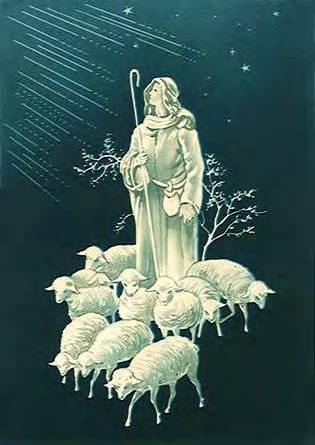
We note that Jesus did not quote Zechariah 13:7 in its entirety. He did not quote the part about “the man that is my fellow,” or as Leeser renders it: “The man whom I have associated with me.” Why not? I think it was because this part referred to someone else, another shepherd at another time, a shepherd who would be feeding the flock at the time of Jesus’ second advent. A definition of “shepherd” given by Dr. Strong is “pastor.” It is of this person we read:
“Who then is the faithful and wise servant, whom his lord hath made ruler over his household, to give them meat in due season? Blessed is that servant, whom his lord, when he cometh, shall find so doing. Verily I say unto you, that he shall make him ruler over all his goods.” Matthew 24:45-47
Brother Russell was a faithful shepherd or pastor, the Lord’s special instrument at the time of his second presence, to restore to his people the doctrines of the early church, “the faith which was once delivered unto the saints.” Beside the basic doctrines he fed the Lord’s sheep with dispensational truths, designated “meat in due season.” His voluminous writings are “meat” to the Lord’s household to this very day. No modern man lived closer to the Lord than he did. The Lord well described him as “the man that is my fellow,” or, “the man I have associated with me.” The Lord’s people depended upon him so much.
I remember the day Pastor Russell died. Our feelings must have closely paralleled those of the early disciples when the Chief Shepherd was smitten. We cried, my brother and I. The prophecy of Zechariah now had a secondary fulfillment. Again the sheep were scattered; they did not know where to turn. Strange shepherds arose each calling the sheep in a different direction with enticing voices. For a while there was confusion and chaos. Powerful leaders led many astray. Many of the sheep isolated themselves. It was the greatest time of testing the harvest church has ever had to endure.
Then the latter part of Zechariah 13:7 began to be fulfilled. “I will turn mine hand upon the little ones.” The sheep began to regroup under the Lord’s hand and his power to protect and lead. As Psalm 37:23,24 expresses it:
“The steps of a good man are ordered by the Lord; and he delighteth in his way. Though he fall, he shall not be utterly cast down; for the Lord upholdeth him with his hand.”
The Lord sought out his true sheep, found them, and brought them together again. That is why we are here today. But there was no successor to Brother Russell nor will there ever be. There can be no improvement on the Divine Plan of the Ages which the Lord revealed to us by the ministry of That Servant.
Lessons from the Feeding
Now let us consider the lessons contained in the feeding of the multitude. First, we can make a personal application. When the disciples reminded Jesus what a large quantity of bread would be required, Jesus asked, “How many loaves have ye? Go and see.” (Mark 6:38) The disciples returned and said to Jesus, “There is a lad here which hath five barley loaves, and two small fishes. But what are they among so many?” (John 6:9) Someone may say, “My talents are so few and so small. What are they among so many? There are so many who have so much more than I have.” But what did Jesus tell his disciples when they reported their meager resources? “Bring them hither to me.” (Matthew 14:18) The Lord wants you. He will accept your small offering of five barley loaves and two small fishes. He can greatly multiply the effects of your small efforts in ways you never dreamed of. “Bring them hither unto me!”
If nothing else give a little word of encouragement to someone, a little smile. Write a little letter of cheer and consolation, a little visit to someone sick or suffering. Give a little witness to a neighbor or relative. Put a tract under someone’s door. Build someone up a little in the truth. Let your light, dim though it be, shine out just a little in the darkness of this world. If you can do nothing else, offer a little prayer for the harvest work. These are small things but they are things the Lord can bless and use. If we cannot do them all, we can do some of them, at least one of them. The Lord can greatly amplify their effect just as he increased the loaves and fishes. Let us bring the Lord all we have whether great or small.
There is another more general application of this incident. Jesus said:
“Ye shall be witnesses unto me, both in Jerusalem, and in all Judea, and in Samaria, and unto the uttermost part of the earth.” Acts 1:8
“This gospel of the kingdom shall be preached in all the world, for a witness unto all nations, and then shall the end come.” Matthew 24:14 “The gospel must first be published among all nations.” Mark 13:10
It seems to me that a mere circulation of the Bible without explanation does not completely fulfill this requirement. It must be the gospel of the Kingdom which Jesus preached because he plainly said, “THIS gospel of the Kingdom.” Have there been any missionaries since the early church who have preached the Millennial Kingdom of Christ beside Brother Russell and those with him? “Gospel” means “good news.” Certainly the hell-fire doctrine preached by nominal church missionaries is not the good news which must be published among all nations. The handful of true Christians today who have the true gospel may say, “Lord, this task is too great for us. What are we among so many? We cannot reach them all. Let others feed them. Let them just take the Bible and find their own spiritual food therein.”
But Jesus says to his people: “Give ye them to eat!” “Others do not have the truth, the gospel of the Kingdom. Others cannot feed them like you can.” We may answer, “But Lord, we are so few, and have very limited resources. We have only five barley loaves and two small fishes! We do not have enough!” “Bring all you have to me,” Jesus answers, “I will bless what you have, and make it do. It will be more than enough. There will even be some left over.”
Miracles of Our Day
In the account Jesus performed a staggering miracle and the multitude ate and were filled. What a magnificent fulfillment of this we now see possible with only a limited expenditure of money aptly comparable to only five barley loaves and two small fishes. By an equally staggering miracle that of radio, television, tapes and mass media, facilities Brother Russell never had–the power to give a tremendous, worldwide public witness is now in our hands! Instead of thousands, millions can be fed with the sound, satisfying message of truth, the true gospel. Many ecclesias are taking full advantage of these opportunities. Although we are not seeking to convert the world but only to garner the wheat, who can say what a powerful effect our sowing of the seed of truth may have in preparing the hearts of men to receive the blessings of the kingdom?
“In the morning sow thy seed, and in the evening withhold not thine hand; for thou knowest not whether shall prosper, either this or that, or whether they both shall be alike good.” Ecclesiastes 11:6
This scripture applies now. We are in the evening of the Gospel age and the morning of the Millennial Age.
Then there is still another application of this event. That multitude that Jesus fed also pictures the world during the Millennial Age. As Jesus gave the bread to his disciples to pass on to the people, those who are now the Lord’s faithful disciples will in the Kingdom be the dispensers of this Bread of eternal life to all the families of the earth. Jesus told the multitude later:
“The bread of God is he which cometh down from heaven, and giveth life unto the world.” John 6:33
The Church glorified will be the channel through which the merit of Jesus’ sacrifice will be applied to the world. As the hungry multitude ate all they wanted and were filled, life will then be freely dispensed to all the willing and obedient. We read of that time:
“The Spirit and the bride say Come. And let him that heareth say, Come. And let him that is athirst come. And whoever will, let him take the water of life freely.” Revelation 22:17
Communing with God
After feeding the multitude Jesus “climbed the hill to pray in solitude. Night came on, and he was there alone.” On some occasions, Jesus prayed in the presence of his disciples. These public prayers were invariably simple and short, and the disciples were able to remember and record his words. But Jesus frequently sought the Father alone and held long communion with him. On one occasion he “continued all night in prayer to God.” (Luke 6:12) We too are encouraged to go the Heavenly Father alone for secret and personal communion with him. Jesus said:
“But thou, when thou prayest, enter into thy closet [or private room], and when thou hast shut thy door, pray to thy Father which is in secret; and thy Father, which seeth in secret, shall reward thee openly.” Matthew 6:6
There are times when we can open out hearts to God alone. Unlike public prayers the words we then use are not important because God listens to our hearts and not our stammering lips. These private and personal prayers may often be long. We may have much counsel and help to seek of the Lord, or much joy to share with him, or much love, and praise and thanks to express to him. But by the example of Jesus, our public prayers should be short.
After Jesus parted from his disciples and went up into a mountain to commune with his Heavenly Father, we see the disciples rowing against a contrary wind, tossed with waves. Nineteen centuries ago Jesus left his church to ascend to his Father. After his departure the Lord’s people embarked upon stormy seas. They were in the world, but not of the world. The winds of life were contrary. They were buffeted by the world, the flesh and the devil. As the Dark Ages closed around them, progress was difficult and for a while impossible. They were driven back and lost ground when “Darkness covered the earth, and gross darkness the people.” But they struggled and toiled on throughout this night of the Gospel age. Then came the dawning of the Millennial morning when, lifting up their weary eyes, they suddenly saw a most wonderful sight! They saw Jesus returning to them walking on the billows of the world’s stormy sea. The Lord’s people discerned Christ’s second presence. Many cried out in disbelief saying it was impossible, that it was a phantom. “Be not afraid!” Then they realized, “The night is far spent, the day is at hand.” Romans 13:12
The account says that when they received Jesus into the ship, the wind ceased. The realization of Christ’s second presence brought a flood of truth to the church. Doubts and conflicts dissolved. The imminence of the Messianic Kingdom was realized and the harvest work was pursued with zeal and vigor. Under the direction of the returned Lord the world’s stormy sea lost its terror. The restless masses could now be viewed with detachment as something prophesied and to be expected. This resulted in a great calmness and serenity of mind among the Lord’s people.
Peter’s desire to walk to the Lord upon the water was admirable. It showed a high degree of faith, and faith is always pleasing to the Lord. We read that “Without faith it is impossible to please God.” (Hebrews 11:6) But we can learn a lesson from Peter’s failure of faith. Looking to Jesus he stepped down from the boat onto the raging sea with superb confidence and, for a moment, actually walked upon the water! But he didn’t keep his eyes upon Jesus! Instead he looked up at the black clouds and down at the wind-tossed waves. He became frightened, his faith failed, and he began to sink! Let us learn from this. In the storms of life let us always look to Jesus and never take our eyes from him. Let us maintain our faith. “Looking unto Jesus, the author and finisher of our faith.” Hebrews 12:2
There is another lesson here also. When Peter began to sink, he cried, “Lord, save me!” Jesus immediately stretched forth his hand and caught him. It is not written that Jesus then carried Peter into the ship. No! He caught his outstretched hand and at that moment, Peter must have again walked on the water side by side with Jesus; they went aboard together. Which one of us does not at times become distracted and frightened in the storms of life and begin to sink in despair? When this happens, let us as Peter did look to Jesus and cry, “Lord, save me!” And he will!
Then the narrative says, “And the boat instantly reached the land they were making for.” What land are you making for? This illustrates something which has not yet happened to us here. This is something we will experience individually. It will be much quicker than jet-travel! We read, “Behold, I show you a mystery. We shall not all sleep, but we shall all be changed. In a moment, in the twinkling of an eye!” 1 Corinthians 15:51,52
Let us be found worthy of experiencing this miracle also!
We thank God for the miracles of Jesus and the lessons they contain for us. We thank Him for the greater miracles to come in which we will have a part and by which all mankind will be restored to life.
May He save us from the contrary winds and overwhelming storms of life, and bring us at last to our desired haven!
More Than Conquerors (Stephen & Paul)
“Be ye followers of me, as I also am of Christ.” 1 Corinthians 11:1
IT WAS shortly after Pentecost and the early church was in its formative stage. Full of the holy spirit bestowed in great abundance, the apostles and disciples preached Christ. We read: “The Lord added to the church daily, such as should be saved.” (Acts 2:47)
“Then there arose certain of the synagogue which is called the synagogue of the Libertines, and Cyrenians, and Alexandrians, and of them of Cilicia, and of Asia, disputing with Stephen.” Acts 6:9 Why did they dispute with Stephen? He was a deacon, not an apostle.
A short time before in the early church, there had been a complaint made to the twelve that service of material things was being neglected. This was important in those days because:
“The multitude of them that believed, were of one heart, and of one soul; neither said any of them, that ought of the things which he possessed was his own; but they had all things common.” Acts 4:32
With thousands added to the church, this posed quite a problem of administration. Impartial distribution of food, clothing, and other materials must be made. Wishing to use their time for the more important spiritual duties, the apostles directed that seven deacons be appointed for serving tables and other such service. The qualifications were that they should be, “Men of honest report [or reputation], full of the spirit of wisdom.” (Acts 6:3) Stephen was one of the seven selected to be a deacon.
Stephen did not limit his service to material things. At every opportunity, he preached Christ.
“And Stephen, full of faith and power, did great wonders and miracles among the people.” Acts 6:8
This was far beyond the scope of a deacon’s duties. It would seem that the Lord recognized Stephen as an elder before the brethren discovered his ability. Like Jesus, he went into the synagogue to preach. According to the law of the synagogue, any Jew may express himself on the scriptures publicly. Those of the synagogue could not prevent this. That is why they attempted to nullify Stephen’s preachings by disputations. But “they were not able to resist the wisdom and the spirit by which he spake.” (Acts 6:10)
How could this young deacon speak with such authority and force of reasoning that the wise ones of the synagogue could not resist him? These were highly educated men who made a career of their religion. But these dignified men, robed and bearded, were not able to resist before their own congregation this young Christian upstart, a deacon! How humiliating! It must have infuriated them. Yet how encouraging to Stephen to realize he was a direct recipient of a promise by Christ: “For I will give you eloquence, and wisdom which all your opponents will not be able to gainsay or resist.” (Luke 21:15, Diaglott)
This was a testimony that he had been with Jesus and learned of him, that he had patterned himself after the Master. Just as the chief priests, elders, scribes and Pharisees, when they failed to gainsay or resist Jesus, sought to destroy him, these of the synagogue employed the same tactics toward Stephen. This identified them as being of “their father, the devil, who was a murderer from the beginning.” (John 8:44) Now we read:
“Then they suborned [or bribed] men, who said, We have heard him speak blasphemous words, against Moses, and against God. And they stirred up the people, and the elders and the scribes; and came upon him, and caught him, and brought him to the council; and set up false witnesses, who said, This man ceaseth not to speak blasphemous words against this holy place, and the law; for we have heard him say that this Jesus of Nazareth shall destroy this place, and shall change the customs which Moses delivered us.” Acts 6:11-14