
Nehemiah Receives a Leave of Absence
It was no short time that Nehemiah set. We know from Nehemiah 5:14 that he asked for and got a twelve-year leave of absence!
It took great courage for Nehemiah to make the request he did. The king could easily have considered the rebuilding of the walls and gates of Jerusalem an act of rebellion against his rule a desire by Nehemiah to set up the nation of Israel as a separate and rival government with himself as king. In fact, we read in the fourth chapter of Ezra that this same king, Artaxerxes, had previously stopped the restoration work of Ezra because of similar accusations. So when Nehemiah asked for what he did, he laid his life on the line. He won, because the Lord had answered his oft-repeated prayer: “Grant me mercy in the sight of this man.”
Nehemiah had complete confidence that his prayer would eventually be answered. He didn’t know just how or when it would be answered, but he knew it would be. He had complete faith. We know this because he had carefully planned in advance just what he would need for the success of his undertaking, just what he would request of the king when the opportunity came. He didn’t have to go away and figure it out, then come back and ask the king for more favors. He struck while the iron was hot without hesitation. This is evident from the next two verses:
“Moreover, I said unto the king, If it please the king, let letters be given me to the governors beyond the river, that they may convey me over, till I come to Judah; and a letter to Asaph, the keeper of the king’s forest, that he may give me timber to make beams for the gates of the palace which appertained to the house, and for the wall of the city, and for the house that I shall enter into. And the king granted me, according to the good hand of my God upon me.” Nehemiah 2:7,8
So we see that Nehemiah had the necessities of the work all laid out in his mind. He had done his homework. This also indicates how closely he had previously questioned his kinsman as to the details of the damage which must be repaired. Such foresight and thoroughness impressed the king with his wisdom. He not only granted Nehemiah’s requests, but gave him what he had not requested. He appointed him Governor of Judea, and gave him a strong military escort of cavalry befitting a governor.
A four-month journey brought them to Jerusalem where Nehemiah was welcomed by the desolate city’s inhabitants. He did not at first reveal the object of his coming, nor the fact that he had been appointed their governor. To them he was simply a visiting dignitary, a wealthy young Hebrew who had attained high office in the Persian government. This they could see from his military escort and the richness of his caravan. He wanted to first make a personal appraisal of the situation. After three days of mingling with the people and becoming well acquainted with them and their tribal rulers, he secretly made his inspection of the ruined city. He waited until everyone was asleep. Then on horseback accompanied by a few trusted servants on foot, he toured the broken walls by moonlight.
We read his own words:
“And I arose in the night, I, and some few men with me; neither told I any man what my God had put in my heart to do at Jerusalem.
Neither was there any beast with me, save the beast that I rode upon. And I went out by night, by the gate of the valley, even before the dragon well, and to the dung port, and viewed the walls of Jerusalem, which were broken down, and the gates thereof were consumed with fire. Then I went on to the gate of the fountain, and to the king’s pool; but there was no place for the beast that was under me to pass. Then I went up, in the night by the brook, and viewed the wall; and turned back, and entered by the gate of the valley, and so returned. And the rulers knew not whither I went, or what I did; neither had I as yet told it to the Jews, nor to the priests, nor to the nobles, nor to the rulers, nor to the rest that did the work.” Nehemiah 2:12-16
This moonlight ride would have been a distressing experience for Nehemiah. If before he had wept when he had merely heard of the plight of Jerusalem, how overwhelmed he must now have been to see it with his own eyes! But now he had firsthand knowledge of the facts. What he had seen confirmed the feasibility of his plan for rebuilding.
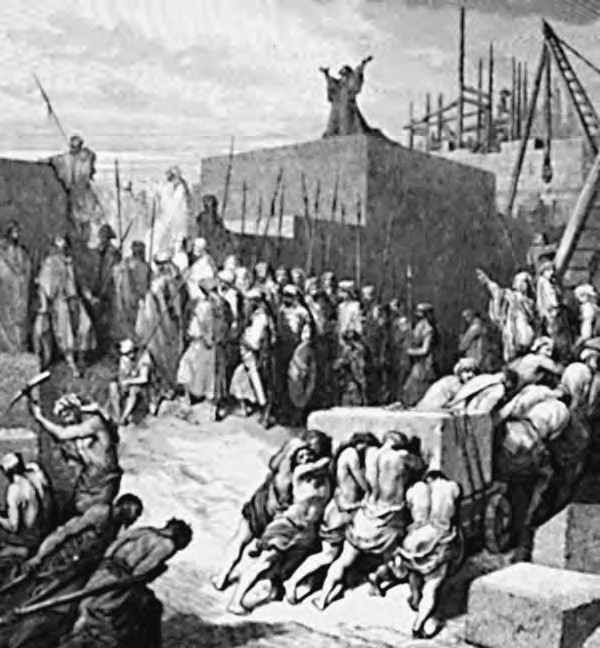
The next morning he called together the elders and prominent representatives of the people and explained to them the real object of his coming. He showed them his authority from the king and told them how God had heard his prayer and how wonderfully he had prospered him in this undertaking. Then he outlined to them a method whereby the repair work could begin immediately. We read his words:
“Then said I unto them, Ye see the distress that we are in; how Jerusalem lieth waste and the gates thereof are burned with fire. Come, let us build up the wall of Jerusalem, that we be no more a reproach. Then I told them of the hand of my God, which was good upon me; as also the king’s words that he had spoken unto me. And they said, Let us rise up and build! So they strengthened their hands for this good work.” Nehemiah 2:17,18
Do you see how Nehemiah was able to inspire the people? He fired them with his own zeal. It was they who said: “Let us rise up and build!” As they went to work, Nehemiah worked with them. He worked as hard as any of them with his hand, with stone, mortar and heavy timbers.
Why was the rebuilding of the walls of Jerusalem considered so important? Was it merely a status symbol? No, it was not just that. There was also a very practical aspect. With the city walls broken down, the enemies of the Jews raided and robbed them regularly. They were at the mercy of every nomadic tribe that chanced to ride that way. But if the walls were repaired, it would be a different story. My Bible dictionary says of the original walled city:
“Jerusalem was an almost impregnable Gibraltar. The steep sides of the ravines on the east, the south, and the west provided bulwarks against siege. The north was the only direction from which a foe could attack the city, under the conditions of ancient warfare.”
No one knows how high the original walls were but as restored in 1542 AD, they ranged from 20 to 60 feet high. It seems likely that the original walls formed an irregular quadrangle a little more than two miles in circuit.
In the third chapter of his book, Nehemiah lists 50 families as participating in the building work. This would mean an average of about 240 linear feet of wall for each family to repair. It was Nehemiah’s plan that each family would work on that portion of the wall nearest its home quarters. This was a wise plan. Each would be specially interested in having the wall strong in his own neighborhood. There would be a certain degree of proper pride of workmanship, each family making their portion of the wall a monument to their skill.
Through many trials, difficulties and discouragements, which could well be the subject of another discourse, the work progressed. Every difficulty was overruled by the Lord and the rebuilding of the walls of Jerusalem, with the original stones, was completed in the incredibly short time of 52 days!
Lessons for Us
Now let us consider some of the valuable lessons to be learned from this account. Although Nehemiah was a very young man, he was held in high esteem by the king as possessing rare ability. This reminds us of Paul’s words to Timothy, in 1 Timothy 4:12, which I will read from the Weymouth translation:
“Let no one think slightingly of you because you are a young man; but in speech, conduct, love, faith and purity, be an example for your fellow Christians to imitate.”
The younger brothers and sisters of our fellowship should not be despised. It must not be presumed that they are “shallow” because they are young. This is a serious mistake. Stephen too was a young man, but in a few months he made his calling and election sure. By contrast, I have been in this narrow way for 67 years. The Lord held young Stephen in such high esteem that he was accounted worthy of the honor of being the first to follow his Master’s footsteps even unto death.
The fact that Nehemiah was so carefully reared in the faith of his fathers has a lesson for those of us who are the parents of young children. Just as Nehemiah was born in Persia and received his formal education in that heathen nation, our children are subject to the influences of this present evil world. But these influences can be counteracted by godly parents. Nehemiah’s intensity of feeling for the welfare of Jerusalem indicated that this had been accomplished in his case. Similarly it is our privilege and duty to imbue our children with the truth, with a feeling for the Lord and his people. As Nehemiah was taught the Hebrew language by his parents, we can teach our children the language of the truth. Who knows if the Lord may not draw them and use them for exalted service as he did Nehemiah? Let us at least prepare them for the Master’s use.
In the World But Not Of It
As Nehemiah was in Persia, but was not a Persian, the Christian is in the world, but not of the world. Jesus said of such: “They are not of the world, even as I am not of the world.” (John 17:16) No matter what our positions in the world, whether high or low, our primary interest should be the welfare of Zion. We should have an intensity of feeling for the truth and its service, praying for opportunities, ready to act when the Lord opens the way.
The thing that particularly distressed Nehemiah was the condition of the walls of Jerusalem. We read in Nehemiah 1:3,4 that they reported to him: “The wall of Jerusalem also is broken down, and the gates thereof are burned with fire.” Then he gives us his reaction to this report, saying: “And it came to pass, when I heard these words, that I sat down and wept.” Without walls, Jerusalem was no city. It had no cohesion, no integrity, no honor. Enemies could invade and rob and plunder at will. It was a by-word and a laughing-stock. In the words of Nehemiah 2:17 it was “a reproach.” The Church, as established by our Lord and the apostles, was a city or community of God. As we read in Hebrews 12:22,23:
“But ye are come unto Mount Zion, and unto the city of the living God, the heavenly Jerusalem, and to an innumerable company of angels; to the general assembly and church of the firstborn, which are written in heaven.”
The primitive church was a city that had walls. It had integrity and cohesion. It was held together by a strong faith in the truth, “the faith which was once delivered unto the saints.” (Jude 3) The great Divine Plan of Salvation was understood. As Isaiah 60:18 expresses it prophetically: “Thou shalt call thy walls Salvation, and thy gates Praise.” This “most holy faith” was its protection against the assaults of the adversary. The walls of sound doctrine kept the church apart and safe. But after the apostles fell asleep, the walls began to be broken down. Paul foresaw this, saying:
“For I know this, that after my departing shall grievous wolves enter in among you, not sparing the flock. Also of your own selves shall men arise, speaking perverse things.” Acts 20:29,30
False doctrines and evil practices began to be introduced into the Church. Paul’s prophecy of 2 Timothy 4:3,4 was also fulfilled:
“For the time will come when they will not endure sound doctrine; but after their own lusts shall they heap to themselves teachers having itching ears; and they shall turn away their ears from the truth, and shall be turned to fables.”
As the great antichrist system developed, the walls of Zion were broken down more and more until, in the Dark Ages, little remained of the original structure of sound doctrine. Even the great foundation stone of the Ransom was lost amid the rubble. Then came the reformation and the walls began to be rebuilt, in spite of great opposition. David’s prayer of Psalm 51:18, echoed by faithful Christians, began to be answered: “Do good in thy good pleasure unto Zion. Build thou the walls of Jerusalem.” Truths long lost sight of were rediscovered and placed in their proper settings. The work of rebuilding accelerated. Then Christ returned and by the hand of a Faithful and Wise Servant, the structure of sound doctrine was rebuilt to completion. Don’t forget that Nehemiah used the same old stones to rebuild the walls of Jerusalem. He did not quarry new ones. Similarly it was the old, old story, “the faith once delivered to the saints,” that was restored.
Rebuilding Spiritual Walls
There is a tendency to disturb the walls of Jerusalem again. Some feel they can improve the walls by substituting new stones for the old ones, by changing the contour, chipping off a little here, and adding a little there. Such feel they know more about how it should be than the original architect and the faithful restorer. I don’t think they do.
Then there is another meaning to a city with broken-down walls. It is a more personal application and is given in Proverbs 25:28: “He that hath no rule over his own spirit is like a city that is broken down and without walls.” The “spirit” referred to here is the spirit or disposition of mind, the thoughts of the mind that control our actions. We must rule our thoughts and imaginations, and cast out and keep out anything unprofitable to us as new creatures. Our warfare is in the mind. The new creature is developed in the mind.
The new creature must use our fleshly mind as its instrument, making it a captive of the new will, the mind of Christ. This is concisely stated in 2 Corinthians 10:5:
“Casting down imaginations, and every high thing that exalteth itself against the knowledge of God; and bringing into captivity every thought to the obedience of Christ.”
This is not something which is easily accomplished. The building of stone walls is not easy. It takes energy and stamina.
Those who come into the truth have their spiritual “walls” in varying stages of disrepair. Some of us have more work to do than others.
But as we learn to exercise self-control, first in little things, and then, persistently and progressively conform our thoughts and words and deeds to the perfect standard, we will gain in strength of character.
This is illustrated by the legend of Milo of Croton. To develop his strength, Milo one day lifted a small calf to his shoulders and carried if for a mile. The next day he did the same thing, and the next day, and the next day. He carried that same animal for a mile every day for four years. As the calf gradually grew, Milo’s muscles developed correspondingly, until at the last he was able to carry a full-grown ox upon his shoulders. Of course our flesh will never be brought under complete control, but the will must be there. The spirit must be ruled. Such a development of character is highly prized by the Lord. He has caused to be written in Proverbs 16:32: “He that ruleth his spirit is better than he that taketh a city.”
Walls also have another significance for the Lord’s people. There are walls between us and the world. We are separated from the world by walls of thought and action. Our thoughts are not their thoughts neither are their ways our ways. Let us keep the walls of separation from the world in good repair. As we are exhorted in 2 Corinthians 6:17: “Come out from among them and be ye separate, saith the Lord.”
As Nehemiah earnestly prayed for the welfare of Jerusalem and of fleshly Israel, our earnest prayers should be in the interests of Zion, for spiritual food: “Pray ye the Lord of the harvest, that he would send forth laborers into his harvest.” In harmony with this, our resolution is:
“Daily will I remember, at the Throne of Heavenly Grace, the general interests of the harvest work, and particularly the share which I myself am privileged to enjoy in that work, and the dear co-laborers everywhere.”
We should, as Nehemiah was, become personally and emotionally involved, thinking of our part in the Lord’s work. We have a work of development in ourselves; we also build up one another in the most holy faith; and we witness to the world, as we have opportunity. As Nehemiah cited and claimed God’s promises to Israel, we should claim and lay hold upon all the “exceeding great and precious promises, that by these we might be partakers of the divine nature.” 2 Peter 1:4
Answers to Prayer May Be Delayed Nehemiah prayed four months before the answer came. That does not mean God had not heard his prayer. There was good reason for the delay. Not only was it a test of Nehemiah’s sincerity and faith, but favorable circumstances were being shaped. In due course there came the occasion of a special banquet at which the queen was present and the king was in an expansive mood. In the meantime Nehemiah’s long, self-imposed, ordeal had altered his appearance so that the king noticed it and made sympathetic inquiry. Thus the stage was perfectly set for Nehemiah’s best interests. So with us. When we have made a request, the Lord often keeps us waiting. We cannot always understand why, but there is always a good reason. In addition to being a test of our sincerity and faith, perhaps it is a shaping of circumstances, so that the outcome may be more glorious. Let us be persistent in our prayers for the right things as Nehemiah was, remembering the precious promise of Romans 8:28 that “all things work together for good to them that love God; to them who are the called according to his purpose.”
Sometimes when things seem to be going the worst, they are really going the best. When the king noticed and commented on his paleness, Nehemiah says: “Then was I very sore afraid.” He thought the worst had happened and that he might lose everything, although it was really the beginning of the answer to his prayer. A good maxim is: “When in doubt, pray.” Another way of saying the same thing is: “When your knees are knocking, kneel on them.” At the time of his greatest fear, Nehemiah prayed. This was his instant and automatic reaction. As we read in Nehemiah 2:4, “The the king said unto me, For what dost thou make request? So I prayed to the God of Heaven.” It was a silent prayer, a prayer of the heart. The answer came instantly. This time it didn’t take four months! So let us never be terrified when everything seems to be going wrong. It may be, as the poet has said: “The clouds ye so much dread, are big with mercy, and shall break, in blessings on your head.” Nehemiah had prayed: “Grant thy servant mercy in the sight of this man.” He got the help he sought. Similarly in the language of Hebrews 4:16,
“Let us therefore come boldly unto the throne of grace, that we may obtain mercy and find grace to help in time of need.”
The king gave Nehemiah more than he requested. He not only approved his mission but, additionally, appointed him governor of Judea and assigned him a military escort. This reminds us of the case of Solomon, related in 1 Kings chapter three. When the Lord said to him, “Ask what I shall give thee,” Solomon simply asked for an understanding heart. The Lord was pleased and granted him not only a wise and understanding heart, but much more than that. He gave him great riches and honor besides. So with us. The Lord is very generous to his people. If we ask in accordance with his will, he will not only grant our request but give us much more than we ask, things that we do not even think to ask for. He has the power to do so. It is written of him: “Now unto him who is able to do exceeding abundantly above all that we ask or think, according to the power that worketh in us.” (Ephesians 3:20)
In Malachi 3:10 he says for us to try him and prove if this is not so:
“Prove me now herewith, saith the Lord of Hosts, if I will not open you the windows of heaven, and pour you out a blessing, that there shall not be room enough to receive it.”
We too have been granted a powerful military escort by our great king. We have the same protection that Elisha had, of whom we read in 2 Kings 6:17, that: “The mountain was full of horses and chariots of fire round about Elisha.” These forces of the Lord encircled him for his protection, and they encircle us. Just as Nehemiah’s escort of cavalry surrounded and protected him on his journey, we read of our heavenly escort in Psalm 34:7, “The angel of the Lord encampeth round about them that fear him, and delivereth them.”
Nehemiah was undoubtedly one of the faithful ones referred to in the 11th chapter of Hebrews who will be “princes in all the earth.” He fits the description. He “wrought righteousness; obtained promises; escaped the edge of the sword; out of weakness was made strong; had trials of cruel mockings; of whom the world was not worthy.” He finally “obtained a good report through faith.”
Nehemiah somehow sensed that the Lord would have use for him at another time, in another age. He wanted so much to continue to serve his God beyond this life. He wanted to be remembered and resurrected, and given more opportunities to serve. So in the last chapter of his book he expresses a certain wistfulness and yearning. It is similar to that of Job who prayed: “O that thou wouldst appoint me a set time and remember me!” In Nehemiah 13:14, h e says, with great earnestness:
“Remember me, O my God, concerning this; and wipe not out my good deeds that I have done for the house of my God.”
Then in Nehemiah 13:22 he refers to his restoring of sabbath observance, and expresses his heart desire: “Remember me, O my God, concerning this also; and spare me according to the greatness of thy mercy.” His last word, in the last verse of his book are: “Remember me, O my God, for good!”
Do you see how Nehemiah casts himself on the mercy of God? We can do this, too. We can pray,
“Remember me for good. I don’t know how faithful I have been. I have tried so hard! I cast myself upon thee. Into thy hands, I commend my spirit. Remember me, O my God, for good!”
Ointment, Very Precious
“Verily I say unto you, Wheresoever this gospel shall be preached in the whole world, there shall also this, that this woman hath done, be told for a memorial of her.” Matthew 26:13
WE ARE told that “God is love.” (1 John 4:8) Love is God’s predominant characteristic. It tempers his every act. Everything he has done, is doing, or will do, is motivated by love. When God created his only begotten son, who became Christ Jesus, he endowed him with his own attributes. Therefore love was the dominant trait of Jesus also. God loved his human creation even when they were sinners:
“But God commendeth his love toward us, in that, while we were yet sinners, Christ died for us.” Romans 5:8 “For God so loved the world, that he gave his only begotten Son, that whosoever believeth in him should not perish, but have everlasting life.” John 3:16
But the love of God did not compel the sacrifice. Not at all. Jesus Christ in his prehuman existence also loved the world with the same intensity as his Father. At one time he told his disciples, “I and my Father are one.” (John 10:30) He told Philip, “He that hath seen me, hath seen the Father.” (John 14:9) When he saw Adam’s race suffering and dying under the heel of Satan, his heart went out to them. He demonstrated his great love by volunteering to be the redeemer, the ransomer. It was the greatest love that could possibly be demonstrated because we read, “Greater love hath no man than this, that a man lay down his life for his friends.” (John 15:13)
When Jesus became a man, his every act was characterized by love and compassion, just like his heavenly Father.
“But when he saw the multitudes, he was moved with compassion on them, because they fainted, and were scattered abroad, as sheep having no shepherd.” Matthew 9:36
He demonstrated his love by giving lavishly of his strength and vitality, healing all their diseases.
But there are different degrees of love. For example, as members of the Little Flock, we love the world of mankind in general. It must be so because we are looking forward to blessing them in the millennial kingdom. We long for those times of restitution to fully come times when we can give life and health to the people of the world. But we love the members of our earthly families more than we love the world, do we not? It is only natural that we should do so. If we are obedient to the command, we also love our enemies. But of course we do not love our enemies as much as we love our brethren in Christ. So although Jesus had compassion on the multitude, the lame, the halt and the blind, and his heart of love went out to them in miracles of healing, yet he loved his disciples more. He prized them highly. He thanked God for them: “Thine they were, and thou gavest them me.” (John 17:6) This, too, is only natural.
Love intensifies love. The multitude had regard for Jesus, but only because of the material benefits they received. As Jesus himself said when they thought to take him by force to make him a king:
“Verily, verily, I say unto you: Ye seek me, not because ye saw the miracles, but because ye did eat of the loaves and were filled.” John 6:26
His disciples were different. They loved him for himself, because of his message, because of his gracious words, because he came from and represented the heavenly Father, and because of his personal goodness. As to material benefits, the disciples left more than they got. As Peter expressed it: “Behold, we have forsaken all, and followed thee.” (Matthew 19:27) So it is natural that Jesus would love them more than the others.
Jesus Could Read the Heart
Let us go one step further. Jesus was extremely perceptive. He could read men’s minds. He knew what they were inside their characters and heart’s desires were an open book to him. He could see and measure their degree of love for him. In regard to their love for him some of his disciples were more noble than others. Jesus knew it and reciprocated. He loved some of his disciples more than others. John, for example, is frequently referred to as “the disciple whom Jesus loved.”
There were other disciples whom Jesus especially loved: “Now Jesus loved Martha, and her sister [who was Mary], and Lazarus.” (John 11:5) Why did Jesus love them especially? Probably because they loved him especially. They loved to have Jesus in their home and he was a frequent guest there. Jesus greatly appreciated their hospitality. He had no home of his own: “Foxes have holes, and birds of the air have nests; but the Son of man hath not where to lay his head.” (Luke 9:58) He wandered from place to place in his ministry, without a home.
Once he had returned to his childhood home in Nazareth. This was the only real earthly home he had known. As he neared it he must have had some feelings as he saw the house he had lived in as a boy. Perhaps he hoped to rest there for a while among old friends, perhaps in the very room he had occupied as a child. But what happened? His home-town people tried to throw him headlong over a cliff! The account is found in Luke 4:16 to 30. That wasn’t much of a home. In other places when he entered into a house, the people crowded in after him so there was no room to move around, much less rest. There is an account in Mark chapter 2 about such an incident. The doorways of the house were so jammed that a man with the palsy could not be brought to Jesus to be healed. They finally removed the roof tiles to let down the bed upon which the sick man lay so Jesus could heal him.
When Jesus was in the vicinity of Jerusalem in the evening after his work was done, he used to slip away from the multitudes and walk about two miles from Jerusalem to the quiet little village of Bethany, to the home of Martha, Mary and Lazarus, where he was assured of a warm and hearty welcome, where he could eat, rest, relax and restore his strength. This was the closest he came to a home of his own on this earth.
On one occasion when Jesus was teaching in Jerusalem, he walked through that part of the temple called Solomon’s Porch.
“Then came the Jews about him and said unto him: How long dost thou make us to doubt [or, hold us in suspense]? If thou be the Christ, tell us plainly.” John 10:24
That sounds like a sincere and innocent question. To the casual reader, the implication is: “Tell us plainly that you are the Christ, the Messiah, and we will accept you, and follow you.” Ah, but there’s something wrong here. Notice that they came “round about” him; they made a ring around him, they surrounded him. If they had come to him with a sincere desire to hear and learn, they would have stood before him. They would have faced him. Jesus immediately sensed that they had violence in mind and that the question they asked was designed to provide an excuse for it. He did not show the slightest fear, but answered them plainly, saying that he was indeed the Son of God. He even said, “I and my Father are one.” (v. 30) This is what they were waiting to hear him say! This was blasphemy! Then, suddenly, an astonishing thing happened: there was a stone in the hand of each Jew who surrounded Jesus.
Let us remember that this was in the temple at Jerusalem, the very center of Jewish worship. It was a revered and holy place. They were in that part of the temple called Solomon’s Porch, a very special place in the temple. We read in 1 Chronicles 28:11 that David himself had designed this porch and had given the pattern to Solomon to incorporate in the temple plan. Do you suppose there were a lot of stones lying around on the floor in such a place as that, stones the Jews could stoop down and pick up? You see what was happening.
This was premeditated murder. Each of those men had brought a stone with him, concealed upon his person, with the express object of killing Jesus. Jesus looked around at them, and what he said next showed his contempt for them. He calmly reiterated that God was his Father:
“Jesus answered them, Many good works have I showed you from my Father. For which of these works do you stone me? The Jews answered him saying: For a good work we stone thee not; but for blasphemy; and because that thou, being a man, makest thyself God.” John 10:32,33
Then Jesus completely exploded their accusation of blasphemy by pointing out that in their law, even their human judges, or rulers of old, are called gods:
“Thou shalt not revile the gods [margin, judges] nor curse the ruler of thy people.” Exodus 22:28
But of course they had not come to reason, they had come to kill. The stones were raised and in the next instant they would have been cast. But something happened. Their arms did not function and they fell back as Jesus calmly walked through their midst. The Diaglott says that “He went forth out of their hand.” (v. 39) Jesus knew they would try again to stone him. Since his time had not yet come, he left Jerusalem to teach elsewhere. He and his disciples journeyed to the far region beyond Jordan where John the Baptist had first preached. The scripture says, “Many believed on him there.” (v. 42)
This is where Jesus was when Lazarus the brother of Martha and Mary took sick. The account is found in John chapter 11. We read: “Therefore his sisters sent unto him, saying, Lord, behold he whom thou lovest is sick.” This was no ordinary sickness. It was serious enough for Mary and Martha to be very worried. They had to be to send someone about two days journey to ask Jesus to interrupt his ministry and return to Bethany. They expected, of course, that Jesus would come immediately because they knew he loved Lazarus very much. But Jesus remained where he was until Lazarus died. When he finally returned to Bethany, Lazarus had been dead four days.
When Jesus approached their home, Martha came out to meet him and said: “Lord, if thou hadst been here, my brother had not died.” Then Mary also came to Jesus, fell down at his feet, and said: “Lord if thou hadst been here, my brother had not died.”
This affected Jesus very deeply, to see those whom he especially loved so sad and stricken. Lazarus was dead, Mary and Martha were weeping, overwhelmed with deepest grief, and he loved them all so dearly. “Jesus wept.” Perhaps this is one of the scenes that Isaiah saw centuries before in prophetic vision when he wrote: “Surely he hath borne our griefs, and carried our sorrows.” (Isaiah 53:4) This was a demonstration that human griefs and sorrows do touch Jesus’ heart. He takes them to heart. He feels them! They become his own. He does something about it. The magnificent display of God’s power with which he then raised Lazarus from the dead, the way he instantly changed the sorrow and weeping of Mary and Martha into joy, illustrates and foretells how he will, in due time, use the merit of his ransom sacrifice in a great resurrection, turning the present night of weeping into a morning of joy. This is what the psalmist saw when he wrote: “Weeping may endure for a night, but joy cometh in the morning.” (Psalms 30:5)
Lessons for Us
There are further lessons we can learn from this incident. When Jesus heard that Lazarus was sick, he did not immediately come; he stayed away until Lazarus died. Sometimes we reach a serious crisis in our lives, something we cannot handle by ourselves. We go to the Lord urgently asking for help just as Mary and Martha who sent for Jesus to come. Sometimes the Lord does not respond as quickly as we think he should. In fact, a response may be withheld until, as far as we can see, it is too late. The damage has been done. Lazarus dies, so to speak, and nothing is more final than death. Then we despair.
Although we may not reproach God, we do say, in effect and with aching heart: “Lord, if only you had done something faster!” It is like Mary and Martha who said, “Lord, if thou hadst been here, my brother had not died!” However, Jesus’ delay in returning to Bethany resulted in a much more glorious demonstration of power than a mere healing. An unheard-of thing happened! The grim finality of death was shattered: “He that was dead, came forth!” So with us. When our prayers are not answered, we sometimes think in our human wisdom that all is lost, that the results are so final, that it is too late for anything to be done. But it is in just such “impossible” situations that God often gives his more glorious demonstrations of power, raising dead hopes to newness of life and turning the deepest sorrow into the greatest joy.
It was after this incident of raising Lazarus from the dead that the chief priests and the Pharisees held a council and condemned Jesus to death in absentia. Their problem was to catch him. We read:
“Jesus therefore walked no more openly among the Jews, but went thence unto a country near to the wilderness, into a city called Ephraim, and there continued with his disciples.” John 11:54
But the chief priests and Pharisees had a plan. The time for the Jewish Passover was near and they knew it was Jesus’ custom to celebrate the feast in Jerusalem with his disciples. So they set out spies in the temple and elsewhere, probably with a promise of reward, to let them know when Jesus appeared:
“Then they sought Jesus, and spake among themselves, as they stood in the temple: What think ye; that he will not come to the feast? Now both the chief priests and the Pharisees had given a commandment, that if any man knew where he was, he should show it, that they might take him.” John 11:56,57
They were right. Jesus did intend to keep the Passover at Jerusalem. After leaving Ephraim, he approached Jerusalem several days before the Passover. He knew he was about to die. He knew the Jews would take him, that he would suffer, that he would be crucified.
Knowing this, where do you suppose he would want to spend some of his last hours on earth? I think you can guess it.
Skirting Jerusalem, Jesus, accompanied by a few disciples, came to Bethany in the evening, to the home of those whom he loved and who loved him to the home of Mary, Martha and Lazarus. What a warm and hearty welcome he must have received! “Master, we have missed you so much. You must be tired and hungry. Here is water for washing the dust of the road. Rest yourself until supper is ready.” The supper was soon prepared and served. We read:
“Then Jesus, six days before the Passover, came to Bethany, where Lazarus was, which had been dead, whom he raised from the dead. There they made him a supper, and Martha served; but Lazarus was one of them that sat at the table with him.” John 12:1,2
Martha was serving, but where was Mary? Jesus must have remembered a similar occasion in the past when he had supped here before. That time also, Martha served but Mary sat at his feet, hearing his every word. Martha had come to him then, saying, somewhat impatiently:
“Dost thou not care, that my sister hath left me to serve alone? Bid her, therefore that she help me. And Jesus answered and said unto her. Martha, Martha; thou art anxious about many things; but one thing is needful, and Mary hath chosen that good part, which shall not be taken away from her.” Luke 10:38-42
Both women loved Jesus, but they manifested their love differently. Jesus did not disapprove of Martha and her carefulness as a cook in providing for his comfort, but he especially appreciated the spirit of Mary, a spirit that drew her to his feet to hear his every word. What gracious words, what wonderful words they were! They were wonderful words of life! What a privilege it was to hear the words of God directly from the mouth of the Son of God! In her fascination with the heavenly conversation of Jesus, Mary had forgotten about the need for the preparation of material food. In this, her spirit reflected that of Jesus after he had fasted for 40 days. He said: “Man shall not live by bread alone, but by every word that proceedeth out of the mouth of God.” (Matthew 4:4) The same thought is expressed by Job: “I have esteemed the words of his mouth, more than my necessary food.” (Job 23:12) Mary was just as hungry for the words of Jesus as a starving man is for bread, and Jesus loved her for it. Jeremiah felt the same way:
“Thy words were found, and I did eat them, and thy word was unto me the joy and rejoicing of mine heart.” Jeremiah 15:16
Jesus must have fondly remembered that previous occasion. Now he was once again at supper in the same home in Bethany. Once again, loving and faithful Martha was serving alone. Where was Mary, the one who loved to sit at his feet and hear his word? Martha must have known where Mary was, that she had gone to get something very special, because this time Martha did not come to Jesus, demanding that Mary help her with the work. Then, as Jesus and his disciples and Lazarus were at the table, Mary quietly entered the room.
Mary Anoints Jesus
Let us try to visualize the scene. It was the custom in those days to eat at a low table in a half-reclining position, with the feet drawn up, on mats or couches arranged around the table. Mary came up behind Jesus holding a beautiful alabaster box in her hands. She quickly broke the seal and poured the contents of very precious perfume, first upon Jesus head, then upon his feet. Kneeling down, she began to wipe Jesus’ feet with her hair. The whole house was filled with the delightful fragrance of the perfume. The account is found in Matthew chapter 26, Mark chapter 14, and John chapter 12. It was not a tiny vial of perfume that Mary poured upon Jesus. John says it was a whole pound of spikenard. Spikenard is an essence derived from a rare and aromatic root. It would take an enormous quantity of this root to yield a pound of essence. Perfume of spikenard was so costly in ancient times that it was reserved for use only by kings, princes and other nobility. It was prepared in a manner similar to attar of roses, which was –another perfume made in ancient times.
My encyclopedia says it took 100,000 roses to produce only 180 grains, or less than half an ounce of attar of roses. 100,000 roses, arranged side by side, would extend almost five miles and would weigh over three tons. Such a quantity of roses after laborious treatment and distillation would yield only half an ounce of perfume. Mary poured a whole pound of spikenard on Jesus. That’s why Matthew and Mark call it “very precious”; John calls it “very costly.”
Now we can better understand the reaction of the disciples to this act of Mary:
“Then said one of his disciples, Judas Iscariot, Simon’s son, which should betray him, Why was not this ointment sold for 300 pence and given to the poor? This was said, not that he cared for the poor,
but because he was a thief and had the bag, and bare what was put therein.” John 12:4-6
Although Judas had an ulterior motive, the others were swayed by him and immediately agreed. Matthew says: “But when his disciples saw it, they had indignation, saying: To what purpose is this waste? For this ointment might have been sold for much, and given to the poor.” Mark reports: “Why was this waste of the ointment made?
For it might have been sold for more than 300 pence, and have been given to the poor. And they murmured against her.”
In those days a penny was a day’s wages for a man. (Matthew 20:2) Ignoring the Sabbaths and other holy days when no work was done, 300 pence was a year’s wages at that time. How much is a year’s wages today? This alabaster box of perfume must have been either an heirloom that had been handed down in Mary’s family, or else the result of Mary’s own labors over a long period of time. It was apparently not purchased for the occasion because if it had, Judas would have deplored spending the money in the first place. Instead he suggested its sale for 300 pence. Judas, the thief, had probably known of its existence and had his eye on it for some time. He undoubtedly expected Mary would eventually sell it and donate the money for Jesus ministry. Then he would have it because Judas had charge of the treasury. The Diaglott says he “stole what things were deposited in it.” He had apparently gone to the trouble of having the alabaster box appraised. How else could he quote an exact figure of 300 pence so readily? He was terribly disappointed when Mary poured out the perfume on Jesus.
We can see what a lavish act of love this represented on Mary’s part. She loved Jesus with her whole heart; nothing was too good for her beloved. She freely poured out to him her most precious possession and then, lest her act be construed as containing any element of pride or vanity, she knelt down and with her hair, her crowning glory, she humbly wiped his feet.
I think we can guess what was going through Jesus’ mind just before Mary did this beautiful thing. During the last few days, Jesus had been trying to tell his disciples that he was going to leave them that he would go to Jerusalem, be delivered into the hands of the Jews, be tormented and crucified, and return to his Father in heaven. But they wouldn’t believe him.
“From that time forth began Jesus to show unto his disciples how he must go into Jerusalem, and suffer many things of the elders and chief priests and scribes, and be killed, and be raised again the third day. Then Peter took him, and began to rebuke him, saying, Be it far from thee, Lord; this shall not be unto thee.” Matthew 16:21,22
They just didn’t understand. Had they understood and believed he would be with them just a few days longer, how different their attitude would be! How they would prize the last few hours of his presence! How lovingly and carefully would they listen to his last words. He had so much to tell then before his death. He yearned to tell them many things. But no. When he referred to his death, they thought he spoke in parables. “Be it far from thee, Lord,” they said. They didn’t understand. There was no one on earth that understood. These must have been the thoughts of Jesus at the supper table there in Bethany that night. They were sad, lonely and disappointed thoughts. It was then that Mary came up behind him with her precious alabaster box of spikenard. So rare was this perfume that emperors and kings used it sparingly. But so full was Mary’s love that she lavished a whole pound on one anointing of Jesus; and, by so doing, proclaimed him to be above all the emperors and kings of the earth to be King of Kings and Lord of Lords! How refreshing it was to the spirit of Jesus! What lift and buoyancy of spirit it gave him! He took it, as well he might, as a sign from heaven that all was well and would be well. Mary’s act was the act of an angel, ministering to him.
Then, suddenly, a clamor broke out all around. Carping, criticizing voices arose. “What a waste!” “Why was not this ointment sold and the money given to the poor?” “This woman has no regard for the poor!” “Lord, rebuke her! She has thrown away 300 pence!” It was the disciples of Jesus, incited by Judas. Instead of commending, they condemned. They spoke as though, by this tender act, Mary had been guilty of a great sin. Mary was hurt and humiliated. Tears came to her eyes and she bowed her head in shame. Jesus turned and laid his hand softly, with a blessing, on Mary’s head. Turning to his disciples he said:
“Why do you criticize her? Let her alone. She has done a wonderful thing for me. Without realizing it, she has poured this ointment on me before my death; but really to prepare my body for burial. The poor ye have always with you; but me ye have not always. I have been telling you of my impending death, but me ye have not understood. She hath done what she could, and this is such a wonderful act of love, and devotion, THAT I WANT ALL AGES AND GENERATIONS to know about it. Verily I say unto you, wheresoever this gospel shall be preached, in the whole world, there shall also this, that this woman hath done, be told for a memorial of her.”
Do you realize what this means, what a wide publication this implies? Jesus said, “This gospel of the kingdom shall be preached in all the world , for a witness unto all nations.” (Matthew 24:14) That is how widely he wanted this incident related.
Thus, Jesus rebuked the attitude of the disciples, impressing on them that there are things far more important than money. They humbly took his rebuke and were ashamed all, that is, except one. In the next verses after this narrative, we read:
“Then one of the twelve, called Judas Iscariot went unto the chief priests, and said unto them: What will ye give me, and I will deliver him unto you? And they covenanted with him, for thirty pieces of silver.” Matthew 26:14,15
This event at Bethany had been the last straw for Judas. He had been following Jesus for his own personal enrichment, systematically stealing from the treasury of the group. Now Jesus was apparently encouraging his followers to dissipate their resources and the money would no longer fall into his hands. Jesus had plainly said he was going to die. Judas knew that the chief priests, scribes and Pharisees had offered a reward for anyone betraying Jesus into their hands. To the perverted and twisted mind of Judas, it was but a natural decision; he may as well have their money as anyone else.
Mary’s act of devotion with the alabaster box had touched Jesus’ heart as nothing else had done, so he commanded that it be brought to the remembrance of all to whom the gospel is preached. But there are other reasons too, for remembering and considering this episode.
There are precious lessons to be learned and much encouragement to be derived from doing so. Let us now consider some of them.
Lessons from Mary’s Act
Whenever Mary was in the presence of Jesus, she forgot everything else except to listen to his words, to learn of Him. When Martha protested that Mary was not helping her serve, Jesus implied that what Mary was doing was good, and was also important. “Mary hath chosen that good part, which shall not be taken away from her,” he said. (Luke 10:42) The lesson is that the Lord does not condemn those who, lacking the ability and opportunity for prominent service, simply sit at the feet of Jesus and hear his word. Neither should we be critical of such. It has been suggested that Martha was not concerned merely with her cooking, but also in the niceties of hospitality which in our Lord’s and Mary’s estimation were not important compared with the words Jesus had to say. This could be implied from what Jesus said to her: “Martha, Martha, thou art careful and troubled about many things.” Luke 10:41
What did the very precious ointment or perfume, which Mary lavishly poured upon the head and feet of Jesus signify? I think the primary significance is love, pure, fervent love. “Ointment and perfume rejoice the heart; so does the sweetness of a man’s friend.” (Proverbs 27:9) “A friend loveth at all times.” (Proverbs 17:17) This is what Mary demonstrated.
In the highly figurative language of the Hebrews, the sensing of an aroma is used to denote the perception of a moral quality in another. Thus, God is said to “smell a sweet odor” from a sacrifice to signify he perceives with pleasure the good disposition which the offerer expressed by such an act of worship. (See Diaglott, page 656) David expresses a similar meaning:
“Let my prayer be set before thee as incense, and the lifting up of my hands as the evening sacrifice.” Psalms 141:2
The fervent, sincere prayer of the heart is to God a sweet savor. This is confirmed in Revelation which speaks of “golden vials, full of odors [or perfume], which are the prayers of saints.” (Revelation 5:8)
Mary first poured the perfume upon the head of Jesus. Our love and adoration is primarily to our head, Christ Jesus, the head of the body of Christ. Our sacrifices which rise as a sweet odor before God are acceptable because of him. Our prayers are heard, because they are made in his name.
Then Mary poured the perfume upon the feet of Jesus. This refers to the “feet members” of the body of Christ mentioned by Isaiah:
“How beautiful upon the mountains are the feet of him, that bringeth good tidings; that publisheth peace; that bringeth good tidings of good; that publisheth salvation; that saith unto Zion, Thy God reigneth!” Isaiah 52:7
These are the ones who today are preaching “good tidings,” good news, happy news; not the news of pointless slaughter nor universal Second Death. These are they who “publish peace” and “bring good tidings of good.” They tell of a time of trouble, but emphasize the enduring peace to follow, the good tidings of God’s kingdom on earth. These are they who “publish salvation,” the pure, unadulterated doctrine of a ransom for all, together with the blessing of all mankind. These are they who “say unto Zion, Thy God reigneth,” who see and preach the presence of Christ, the great King. These are our brethren, those of “like precious faith,” fellow-members of the Body of Christ. Just as Mary poured the very costly perfume upon the feet of Jesus, we should love and serve our brethren lavishly with the same love and service we render our Head, because of this principle:
“As ye have done it unto one of the least of these my brethren, ye have done it unto me.” Matthew 25:40
John says in his account that after Mary anointed the feet of Jesus she wiped his feet with her hair. What was the result? You may be sure that this caused her hair to be thoroughly perfumed. Blessings given bring blessings in return. This is a law of God.
“There is he that scattereth, and yet increaseth. . . . The liberal soul shall be made fat, and he that watereth, shall be watered also himself.” Proverbs 11:24,25
“He that hath pity upon the poor, lendeth unto the Lord; and that which he hath given, will he pay him again.” Proverbs 19:17
Can you imagine lending to the Lord? This means if you do a service to one who cannot repay you, and you do it without any hope or expectation of repayment, the Lord considers it as lending to Him! He will open the windows of heaven to such, pouring out spiritual blessings in return. There is even some evidence that the Lord often makes it up to them in temporal matters as well.
It is written of this act of Mary: “And the house was filled with the odor of the ointment.” The house of God is his Church; and the costly sacrifices of the Mary-like members bring sweet and savory blessings upon all God’s household. For example, there are ecclesias and individuals who produce truth literature such as reprints, volumes, booklets, tracts; others put on radio and television programs, here and abroad, and make audio tapes; others perform other services. Like Mary’s spikenard permeating the house with a delightful fragrance, these efforts permeate the House of God far and wide. There is no competition in the Lord’s service: “Go ye also into the vineyard,” the Lord said.
Devotion to God Is Not a Waste
“What a waste!” they said when Mary’s sacrifice was poured out. “What a waste!” our worldly relatives and friends say when we consecrate our all to God: our time, our talents, our energies, our resources, everything. Ah, but as Jesus said, “The poor ye have always with you; but me ye have not always.” There will always be the poor heathen, and other unbelievers, until the Kingdom has done its work. But the body of Christ will not always be here. “Me ye have not always,” Jesus said. “The last members of my Church will soon be glorified. So lavish your love and service upon these, while you have the opportunity.”
Some of the disciples were critical of Mary’s generous act and some of the Lord’s people today react the same way. They tell the humble Marys of today: “Do not break the seal of your alabaster box. Do not give too generously of your time, talents and means to the friends.
You will only impoverish yourself. You will ruin your health. Hold back.” But Jesus said: “ Let her alone! She hath wrought a good work upon me.” Just as Jesus deeply loved Mary of Bethany, you
may be sure he loves the Marys of today as well. Regarding Mary of Bethany Bro. Russell says:
“Not only was the Lord willing that the matter should be told for a memorial of Mary, but we may safely conclude that in the everlasting future, Mary will be ranked very high amongst the faithful followers of the Lord. She may not be one with the apostles, upon the twelve thrones of Israel, but we may be sure that she will have some grand, some honorable place, near to the one she loved, and for whom she showed her devotion.” Reprints, page 3878.
I think he is absolutely right.
“Our Baptism Into Christ”
THE disciples of Jesus loved him very much, being constantly with him during the three-and-one-half years of his ministry. They had been personal witnesses of his great compassion and loving kindness demonstrated by his many miracles of healing as well as the gracious words which proceeded out of his mouth. They had never seen anyone like this before. They knew he was indeed the Messiah; they adored him. They had given up everything for his sake and in exchange for this, Jesus had made them a wonderful promise. We read:
“Then answered Peter, and said unto him, Behold, we have forsaken all and followed thee. What shall we have therefore? And Jesus said unto them, Verily, I say unto you, that ye which have followed me; in the regeneration, when the Son of man shall sit in the throne of his glory; ye also shall sit upon twelve thrones, judging the twelve tribes of Israel.” Matthew 19:27,28
He thus promised that they would be a part of his glorious kingdom which would regenerate the world, that they would reign with him and inherit everlasting life.
Now the time neared when Jesus must be offered up as a ransom on a fixed date pre-determined by prophecy. So he turned his steps toward Jerusalem for this purpose. When his disciples saw where he was heading, they were surprised and frightened, because they knew of the vicious opposition of the Scribes and Pharisees and the personal physical danger Jesus would be faced with in Jerusalem. Jesus knew their thoughts so he took them aside and talked to them, telling them exactly what was going to happen to him. He was very frank and did not gloss over anything. We read from the account in Mark:
“And they were in the way, going up to Jerusalem; and Jesus went before them; and they were amazed, and as they followed, they were afraid. And he took again the twelve, and began to tell them what things should happen unto him. Saying, behold, we go up to Jerusalem; and the Son of man shall be delivered unto the chief priests, and unto the scribes, and they shall condemn him to death, and shall deliver him to the Gentiles; and they shall mock him, and shall scourge him, and shall spit upon him, and shall kill him, and the third day he shall rise again.” Mark 10:32-34
At this point his disciples, James and John, apparently realized the import of what Jesus told them. If he was going to rise again from the dead, he would be glorified. They presumed he would immediately set up his glorious kingdom so they spoke up and asked him if he would grant them a special favor. We continue the reading:
“And James and John, the sons of Zebedee, came unto him, saying, Master, we would that thou shouldest do for us, whatsoever we shall desire. And he said unto them, what would ye that I should do for you? They said unto him, Grant unto us that we may sit one on thy right hand, and the other on thy left hand in thy glory. But Jesus said unto them, Ye know not what ye ask. Can ye drink of the cup that I drink of? And be baptized with the baptism that I am baptized with? And they said unto him, We can.” Mark 10:35-39
They said this without hesitation. Jesus looked at them. He loved these two disciples so young, impulsive, and enthusiastic, these brothers whom he fondly referred to as “sons of thunder.” (Mark 3:17) As he looked at them, his prophetic mind leaped years ahead, and what he saw saddened him. James would be the first of the apostles to die, hanged against a pillar by Herod Agrippa. His brother John, the disciple whom he especially loved, would not be so fortunate. After a long imprisonment on a stony island of Patmos, he would suffer martyrdom by frightful torture. Jesus’ heart filled with compassion for them: “And Jesus said unto them, Ye shall indeed drink of the cup that I shall drink of; and with the baptism that I am baptized with, shall ye be baptized.”
When James and John said, “We can,” they knew what was involved, that it was some kind of death. Jesus had just been telling them of his coming ordeal of suffering and of death. They understood perfectly that this was the “cup” he referred to, that this was the baptism he was talking about. Yet they unhesitatingly said, in effect, “Yes, Lord, we have a desire to do the entire thing whatever it may be.” They were fully devoted to the Lord to do his will. They would be willing to do anything. Their association with Jesus had given them such an appreciation of the kingdom he preached and such confidence in their Lord that whatever he was about to do, they were willing to do. “We can,” they said. Or, as Matthew has it, “We are able.”
Jesus’ Baptism by John
Consider the circumstances of Jesus’ baptism by John in the river Jordan. Of John it is written:
“The voice of one crying in the wilderness; prepare ye the way of the Lord; make his paths straight. John did baptize in the wilderness and preach the baptism of repentance for the remission of sins. And there went out unto him, all the land of Judea, and they of Jerusalem, and were all baptized of him in the river of Jordan, confessing their sins.” Mark 1:3,5
John prepared the way of the Lord. He said:
“There standeth one among you, whom ye know not. He it is who, coming after me, is preferred before me; whose shoe’s latchet I am not worthy to unloose.” John 1:26,27
John preached that the time for Messiah to appear was at hand. When the invitation to come into the real kingdom of God would be given, he exhorted the people to get ready for this event; otherwise they would not be prepared to receive Messiah.
The people washed away their own sins typically by acknowledging them and repenting of them. John the Baptist did not wash their sins away. Those of Israel who had not been living in harmony with their Law Covenant but heard John gladly and turned from sin, were the very ones to whom the message respecting the coming Messiah appealed. Thus they became “Israelites indeed, in whom there was no guile,” as was Nathanael. (John 1:47) This washing away of sins was not actual cleansing from guilt; only the blood of Jesus, the merit of his ransom sacrifice, could actually take away sin.
Reprints, page 5962. But it “prepared the way of the Lord.” It prepared the minds of the people. It generated a consciousness of sin, and emphasized the need of a Savior. It prepared the people to accept Jesus as their Messiah when he appeared.
One day as John was waist deep in the water of Jordan busily immersing all who came to him, he looked up and saw a strikingly handsome young man striding toward him. Suddenly, by some inner prompting, he knew who it was! Greatly elated he pointed to Jesus and loudly announced for all to hear:
“Behold the Lamb of God, which taketh away the sin of the world! This is he of whom I said, after me cometh a man who is preferred before me; for he was before me. And I knew him not; but that he should be made manifest to Israel! Therefore am I come baptizing with water.” John 1:29-31
John quickly went up to Jesus on the bank. “Why do you come to me?” John asked. “To be baptized,” Jesus answered. “I couldn’t do that,” John said. “My baptism is for the repentance and remission of sins. You have no sin! You are the Son of God, you should baptize me instead.” Then we read, “And Jesus answering said: Suffer it to be so now, for thus it becometh us to fulfill all righteousness.” In other words, “You may not now understand why but my immersion will fulfill a good and righteous purpose.” Then John consented and led Jesus into the water. We can imagine that John omitted his usual exhortation to renounce sin and silently immersed Jesus. As Jesus went down into the water it is entirely possible he prayed to his Heavenly Father with the words of Psalm 40:
“Lo, I come in the volume of the book it is written of me, I delight to do thy will, O my God! Yea, thy law is within my heart!” Psalms 40:7,8
Now what was the special significance of this immersion of Jesus? He had no sins to wash away. He was “holy, harmless, undefiled, separate from sinners.” (Hebrews 7:26) Although immersed by John his immersion was different from the others. What did it signify?
In the case of Jesus, immersion was a symbol, a symbol of his consecration to the will of God. What was the will of God? Jesus knew what it was from the prophecies. He was familiar with the 53rd chapter of Isaiah. He knew the prophet referred to him when he said: “He is brought as a lamb to the slaughter.” Hadn’t John just called him a lamb? He knew that Isaiah had also prophesied of him: “Who shall declare his generation? For he was cut out of the land of the living. For the transgression of my people was he stricken.” He also knew he was the one referred to in the passage: “Yet it pleased the Lord to bruise him, he hath put him to grief; when thou shalt make his soul an offering for sin.” He was very familiar with verses 11 and 12 with which he identified himself:
“He shall see the travail of his soul, and be satisfied. By his knowledge shall my righteous servant justify many; for he shall bear their iniquities. Therefore will I divide the spoil with the strong. Because he hath poured out his soul unto death. And he was numbered with the transgressors; and he bare the sin of many, and made intercession for the transgressors.”
Thus Jesus knew that the will of God for him was death a sacrificial death, the death of his sinless humanity to provide a ransom price for Adam. He knew what was written of him, “In the volume of the book.” So his consecration to the will of God was a consecration unto death. This is what he symbolized when he permitted John to immerse him in water.
Baptism as a Symbol
What an appropriate symbol it was. Going down into the water and being completely covered by it represented death and the grave.
Being raised up out of the water pictured a resurrection from the dead which the prophecies also indicated. So for Jesus this was merely a symbol of the real baptism. His real baptism into death progressed for three and one-half years, from Jordan to Calvary.
When he cried on the cross, “It is finished,” he meant that his baptism into death was completed. This is what he had anticipated when he said, “I have a baptism to be baptized with; and how I am straitened till it be accomplished.” (Luke 12:50) This is what he had referred to when he asked the sons of Zebedee, “Are ye able to drink of the cup that I shall drink of, and be baptized with the baptism what I am baptized with?” (Matthew 20:22) In other words, “Are you willing to follow in my footsteps: to die with me, that you may live with me?” “Yes,” they answered, “we can, we are able, we are willing.”
It was later that Paul echoed their answer: “It is a faithful saying, For if we be dead with him, we shall also live with him.” (2 Timothy 2:11) He also wrote:
“Know ye not, that so many of us as were baptized into Jesus Christ were baptized into his death? Therefore we are buried with him by baptism into death; That like as Christ was raised up from the dead by the glory of the Father, even so we also should walk in newness of life. For if we have been planted together in the likeness of his death, we shall be also in the likeness of his resurrection.” Romans 6:3-5
What did Paul mean when he said, “We also should walk in newness of life”? The Diaglott renders it, “We should walk in a new life.” The answer is very concisely given by Paul:
“Therefore, if any man be in Christ, he is a New Creature. Old things are passed away; behold, all things are become new.” 2 Corinthians 5:17
When John raised Jesus up out of the water, a wonderful thing happened. Matthew’s account reads:
“And Jesus, when he was baptized, went up straightway out of the water: and lo, the heavens were opened unto him; and he saw the spirit of God descending like a dove, and lighting upon him, and lo, a voice from heaven saying: This is my beloved Son, in whom I am well pleased.” Matthew 3:16,17
At that instant Jesus became a new creature. He was consecrated; now he was spirit begotten.
Our Consecration
Let us talk about our consecration of which immersion is only a symbol. First, we might say that consecration has always been proper. It is the normal attitude of all God’s intelligent creatures. They are all under obligation to God for every blessing they enjoy, for life itself. Consecration is only their reasonable service to their creator and benefactor. This is the minimal expectation. The whole world of mankind will be given the opportunity of consecration eventually. It is written that they shall “all call upon the name of the Lord, to serve him with one consent.” Zephaniah 3:9
Without consecration no one will ever gain everlasting life on any plane. Whether angels or man, all should be in this attitude. But the consecration we are talking about today is more than this. It goes immeasurably further than this. Its object is much more sublime. It leads not merely to everlasting life, but to glory, honor, and immortality! It leads to the divine nature. It is an induction into the mystical body of Christ. As Paul tells us:
“For as the body is one, and hath many members, and all the members of that one body, being many are one body, so also is Christ. For by one spirit are we all baptized into one body.” 1 Corinthians 12:12
The holy spirit which descended upon the head of Jesus at Jordan comes down and anoints and imbues each member of his body. As Psalm 133:2 expresses it, “It is like the precious ointment upon the head, that ran down upon the beard, even Aaron’s beard; that went down to the skirts of his garments!”
The ointment covered his body. By this consecration, by this justification, and by spirit-begettal, we become members of the most unique and exclusive group in the history of the universe. This is not a group whose names are known and recorded on earth but a “Church of the firstborn, which are written in heaven.” (Hebrews 12:23) One hundred and forty four thousand kings and priests who together with their head, Christ Jesus, will rule the world for a thousand years, speak peace to the nations, restore health and life, and bring all the willing and obedient into perfect harmony with God. What a tremendous honor it is to be of this group. How do we ever aspire to it? We cannot of ourselves. We do not choose to be of this body. We are chosen! We read, “Ye have not chosen me, but I have chosen you.” (John 15:16) Also, “No man taketh this honor unto himself, but he that is called of God, as was Aaron.” (Hebrews 5:4) This confirms what Jesus said:
“All that the Father giveth me shall come to me, and him that cometh to me, I will in no wise cast out. No man can come to me except the Father who hath sent me, draw him.” John 6:37,44
Do you fully realize what this means? It means that every one of you who have come to Jesus have been personally selected by God himself, for we read: “The eyes of the Lord run to and fro throughout the whole earth, to show himself strong in the behalf of them whose heart is perfect toward him.” 2 Chronicles 16:9
Think of it: the eyes of God the Father move back and forth in the earth, passing by many great, wise, and noble people and fix upon you! He does not look upon your outward appearance but looks at your heart. 1 Samuel 16:7 is a companion text of thought. God likes what he sees. He sees a heart of love and devotion to him and a desire to do his will. He also sees certain potentialities there. He sees that you have the willingness and the ability, with his abundant grace to help, to conform yourself to the likeness of his son, to give up your own desires, aims, and ambitions and follow in the footsteps of Jesus; that you “are able” in the language of James and John. He then draws you to Jesus. He points you out. He tells Jesus about you, that he has selected you as a member of Christ’s body to be sacrificed with him, to die with him that you might reign with him.
Do you see what a wonderful thing this is, to be personally noticed and selected from among so many millions by the great God himself, to be led to Jesus, to be consecrated and justified? What great mercies of God these are!
To those who are so selected of God, the ones who are also drawn of God, Paul says:
“I beseech you therefore, brethren, by the mercies of God, that ye present your bodies a living sacrifice; holy, acceptable unto God, which is your reasonable service.” Romans 12:1
When we present our bodies it means all our human faculties, our wills, our hearts, health, strength, time, talents and possessions: everything. This presentation of our bodies is the right thing to do, it is the reasonable thing to do, and it is a happy and joyful thing to do. It was for Jesus:
“Looking unto Jesus, the author and finisher of our faith; who, for the joy that was set before him, endured the cross, despising the shame, and is set down at the right hand of the throne of God.” Hebrews 12:2
If it was a reasonable and joyful service for Jesus to leave the heavenly glory, to become a man, and to sacrifice himself unto death, then surely ours is most reasonable and joyful. Let us remember that our Heavenly Father did not permit Jesus to sacrifice his life for humanity without any reward of a future life. To have done so would have been a most unreasonable thing. No! The Father set before the Redeemer a great joy to be the recompense of his obedience. And Jesus entered into that joy. “I delight to do thy will, O my God,” he said. So with us. The Lord does not invite us to sacrifice ourselves at the present time without any reward from him, without any incentive. He tells us that if we do this, he will make us joint-heirs with his son, participators with him in all the joys of the kingdom.
After beseeching us to present our bodies living sacrifices, Paul continues:
“And be not conformed to this world, but be ye transformed by the renewing of your mind, that ye may prove what is that good and acceptable, and perfect, will of God.” Romans 12:2
This transformation by the renewing of our minds is the development of the new creature. This is the work of sanctification which follows justification. “For this is the will of God, even your sanctification.” (1 Thessalonians 4:3) How is this sanctification accomplished? The answer is found in a prayer Jesus made on our behalf: “Sanctify them through thy truth, thy word is truth.” (John 17:17)
God’s Word Sanctifies
Everything necessary for the furtherance of our sanctification and development as new creatures is in the inspired scriptures. In 2 Timothy 3:16 Paul writes: “All scripture given by inspiration of God is profitable; for doctrine, for reproof, for correction, for instruction in righteousness.” Then Paul adds: “That the man of God [or new creature] may be perfect [or complete], thoroughly furnished unto all good works.” This is the key as to how this work of sanctification will proceed. We are to be helped onward by the power of the revealed word, by the message of truth. “But,” you may ask, “how will God’s Word sanctify? Has everyone who has ever read the Bible been sanctified? Have the learned scholars who translated the Bible been sanctified? Have the monks, confined in monasteries, who copied the ancient Bible manuscripts been sanctified? Have the printers who set the type for our modern Bibles been sanctified?” Some few of these may have been but I am sure most were not. Why not since Jesus promised sanctification through the word of truth?
There must be a missing ingredient somewhere. There is indeed! Jesus referred to it many times when he gave his parables. He said, “He that hath ears to hear, let him hear.” Then our Lord added when speaking to his disciples: “It is given unto you to know the mysteries of the kingdom of heaven; but to them it is not given.”
What makes the difference between “you” and “them”? What do you have that they do not have? Paul gives us the answer:
“Eye hath not seen, nor ear heard; neither have entered into the heart of man; the things which God hath prepared for them that love him. But God hath revealed them unto us, by His Spirit; for the spirit searcheth all things, yea, the deep things of God.” 1 Corinthians 2:9,10
It is the holy spirit that is what is missing from all others. Without it the scriptures may indeed be valued as an ancient historical record; a compendium of laws and statutes, a collection of fascinating stories, teaching lofty moral precepts. But without the holy spirit it contains no message from God, no revelation. The essence of the scriptures cannot be extracted and appreciated, cannot sanctify us, without the holy spirit.
Things Are Not Necessarily What They Seem
Consider a phonograph record. Given to a savage, a phonograph record may be highly appreciated and greatly prized because it is a disc made of a shiny, black, ebony-like substance. It is perfectly round, beautifully designed with a colorful seal in its center containing characters inscribed upon it. It has mysteriously engraved grooves on either side which give a peculiar sensation to the touch. It has a hole in its center by which it can be strung around one’s neck as a magical charm. This is the limit of a savage’s appreciation of a phonograph record.
Let us suppose he has possessed it for many years. Although it is valuable to him, he has no conception of its full potential. One day a missionary arrives with a phonograph machine. Seeing the record hanging from the neck of the savage, he asks: “Do you know what you have there?” With great pride the savage describes the various unique and ornamental features of the record. Then the missionary takes the record, places it upon the phonograph turntable, puts the needle in the groove and magnificent music fills the air! Beautiful voices, recorded years and years before, come alive and are heard in all their glory Do you see the application of this picture? When the phonograph record was made, a diamond stylus cut those grooves. Similarly the Bible was written long ago by holy men of God as they were moved by the holy spirit. (2 Peter 1:21) All the glorious music of God was recorded by that spirit. The Bible is the original high-fidelity recording of God’s supreme greatness, his mercies, his loving attributes, his magnificent divine plan of the ages. It also has his exceeding great and precious promises, his counsel with his encouragements, and expressions of his love and care. These are all recorded by the spirit in the Bible. But as far as the world is concerned, like the savage with a record in his possession, the deep things hidden in the grooves of the record are inaudible. The world does not have “ears to hear.” But when one has the diamond needle of the holy spirit, the very same holy spirit that moved the writers to make the record, the scriptures come beautifully and magnificently alive. Then are made manifest the deep things of God which Paul describes:
“Even the mystery which hath been hid from ages and from generations, but now is, made manifest to the saints.”–Colossians 1:26
At this end of the age we once again have the truth “which was hid from ages and generations” and which by Satan’s devices, was largely lost during the Dark Ages and the passing generations. It has been made manifest to us, his saints. How was it restored and by what instrumentality? When the due time came at this end of the age, the details of God’s glorious divine plan of the ages, hidden for so long, were made manifest to a saint of the Lord, a saint of God, a faithful and wise servant, Brother Russell. He was consecrated and spirit begotten. He was ready, able and willing to be used of the Lord to revive the old truths. He was faithfully watching, anxious to dispense meat in due season to the household of faith. Jesus said of him, “Blessed is that servant, whom his Lord, when he cometh, shall find so doing.” (Luke 12:43) His mind was, in the language of the prophet:
“I will stand upon my watch, and set me upon the tower; and will watch to see what he will say unto me. . . . And the Lord answered me, and said, write the vision, and make it plain upon tables, that he may run that readeth it [meaning he that reads it may run for the prize of the high calling].” Habakkuk 2:1,2
That is how I got the truth and how you got the truth, the whole truth, entirely and only through the writings of that servant. When we came into the truth, we proved all things and found them sound and good. If you didn’t, you wouldn’t be in the truth now. The apostle in 1 Thessalonians 5:21 tells us to do just that. But he also tells us something else which some are inclined to ignore. Paul first says, “Prove all things.” Then he adds, “Hold fast that which is good.” Once you’ve proven the truth to your thorough satisfaction, hold on to it; never let it go. Don’t keep questioning it and feel that you have to prove it over and over again. Don’t be like those who are “ever learning and never able to come to the knowledge of the truth.” (2 Timothy 3:7) If you have found the truth and found it good, hold it. Keep it. It is the most precious thing in the world. Do not change it. The wise man says, “My son, fear thou the Lord and the King. And meddle not with them that are given to change.” (Proverbs 24:21)
I recommend reading the six volumes of Studies in the Scriptures regularly, so many pages a day. I do. This will keep me in the truth. I agree with Brother Russell when he says in the first paragraph of the first volume:
“We believe the teachings of divine revelation can be seen to be both beautiful and harmonious, from this standpoint and from no other.”
You Have a Personal Relationship with the Father Jesus spoke five words which are precious and thrilling beyond measure: “The Father himself loveth you.” (John 16:27) This ties in with the words: “No man can come to me, except the Father, who hath sent me, draw him.” (John 6:44) This identifies you. So it is to you Jesus spoke when he said, “The Father himself loveth you.” Do you fully realize what this means? It means that the heavenly Father doesn’t just give impersonal orders to his angels to take care of you and then busy himself with more important affairs. He doesn’t delegate your care and well being to others. No, he himself, personally knows you and loves you and has selected you. He takes a continuous and personal interest in all your affairs, even the smallest matters. This is what Jesus meant when he said, “The very hairs of your head are all numbered.” (Matthew 10:30)
The great God of the universe, the Creator of heaven and earth, himself loveth you. So talk to the Lord often. Lay all your problems before him, and also your love and joys. Do not only tell him your troubles, but talk to him when things are going well too. Don’t be stiff and formal in these conversations. He is your Father. Talk to him freely and frankly as you would talk to your earthly father. He understands you far better and loves you far more than any earthly parent. This will please the Lord. By his loving providences he will tell you as he told Jesus, “This is my beloved Son, in whom I am well pleased.” Tell him you love him. He already knows it, of course, but tell him just the same. It will serve to remind you of the wonderful promise: “All things work together for good to them that love God, to them who are the called according to his purpose.” (Romans 8:28) This is a promise that nothing can really hurt you any more; that henceforth everything that happens to you is for your eternal spiritual welfare: everything, even the seeming calamities.
When you consecrate, you say good-by to fear. Jesus speaks to you and says:
“Peace I leave with you; my peace I give unto you. Not as the world giveth, give I unto you. Let not your heart be troubled, neither let it be afraid.” John 14:27
Our Lord also said:
“Take my yoke upon you, and learn of me; for I am meek and lowly of heart; and ye shall find rest unto your souls. For my yoke is easy and my burden is light.” Matthew 11:29
Remember this along your Christian way: Jesus is your yokefellow. A yoke has two sides and you are walking side-by-side with Jesus. You are weak but he is strong. When you stumble, he bears you up. He shares your burden. He makes up for what you cannot perform.
No wonder his yoke is easy and his burden is light. Never leave that yoke. Never take it off. You cannot stand alone. But together with Jesus, you can win the crown of life.
Consecration is not an ending, it is a beginning, the beginning of a new nature, a new creature. It is the beginning of trials and testings, yes, but also the beginning of wondrous joys and blessings.
Eventually it will culminate in pleasures for evermore at God’s right hand. (Psalms 16:11)
Peace Be Still
OUR lesson today centers on the Sea of Galilee, a large fresh water lake in the land of Israel. My Bible dictionary says: “The water of the lake is sweet, cool and transparent, and, as the beach is everywhere pebbly, it has a beautiful, sparkling look. It abounds in fish now, as in ancient times.”
How true this is today I do not know. I imagine that by this time it has been considerably polluted like every other lake.
The Sea of Galilee lies about 700 feet below sea level, surrounded by a high and almost unbroken wall of hills. These hills are pierced by deep canyons and ravines which, under certain atmospheric conditions, act like gigantic funnels to draw down the cold winds from the mountains. Thus the lake is exposed to frequent and sudden violent storms. These would be particularly dangerous to boats propelled by sails or oars because the strong off-shore winds coming from every side would make it almost impossible for such boats to reach land. A traveler who witnessed such a storm on Galilee writes:
“The sun had scarcely set when the wind began to rush down toward the lake; and it continued all night long with constantly increasing violence so that when we reached shore the next morning the face of the lake was like a huge boiling cauldron. The wind hurled down every wady, from the north-east and east, with such fury that no efforts of rowers could have brought a boat to shore at any point along that coast.”
Now let us consider an incident which is related in three of the Gospels: Matthew chapter 8, Mark chapter 4 and Luke chapter 8. It was in the second year of our Lord’s ministry. A multitude had gathered to him on the shore of Galilee. He had been teaching them all day, standing in a boat anchored a few feet from shore. The boat must have belonged to one of his fisherman disciples. This was an ideal position from which to speak to a large audience. The beach sloping down to the water’s edge formed a natural amphitheater and thus all the multitude could see and hear him.
At about three in the afternoon, Jesus ended his teaching and dismissed the multitude. He then asked his disciples who were with him in the boat to take him over to the other side of the lake. Thus we read:
“And the same day, when even was come, he saith unto them, Let us pass over to the other side. And when they had sent away the multitude they took him, even as he was, in the ship.” Mark 4:35,36
Jesus was very tired. Even a perfect man has his physical limitations. Healing in particular depleted his vitality, as we are told in Luke 6:19. So he went to the stern of the ship and lay down on a cushion on a sheltered bunk. He immediately fell into a deep sleep of exhaustion.