
The Search for God’s Counsel
We are counseled and told just what to do as it is written in our text: “Thou shalt guide me with thy counsel, and afterward receive me to glory.” (Psalms 73:24) Someone may say:
“Wonderful! Tell me just where this counsel is found and I will follow it faithfully. I will write it all out in a manual, classify it, and index it. Then I will know the Lord’s counsel in every event of life!”
It’s not as simple as that. We have to search for this counsel. It is a rare and precious thing, “hid from ages and generations.” (Colossians 1:26) But it can be found because Jesus said: “Seek and ye shall find.” (Matthew 7:7) Just as one may follow a treasure map, there are clues in the Bible. It is a fascinating thing to follow them and uncover the precepts of God applying to us. Let us follow one of these clues now and see where it leads us.
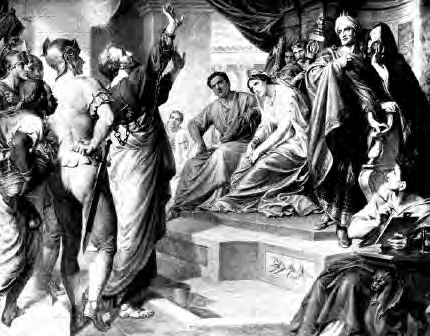
Instead of a pirate’s treasure map we will start with a map of Paul’s missionary journeys. Paul stopped at Ephesus on one of these journeys and preached to the ecclesia there. On his next journey he was again in that vicinity. He sent for the elders of Ephesus to come to him, he had a meeting with them, and gave them the benefit of his advice. On this occasion he spoke these words to them:
“I kept back nothing that was profitable unto you, but have showed you, and have taught you publicly, and in your houses. For I have not shunned to declare unto you all the counsel of God. Take heed therefore unto yourselves, and to all the flock over which the holy Spirit hath made you overseers, to feed the Church of God, which he hath purchased with his own blood.” Acts 20:20,27,28
Here we have a hint as to where “the counsel of God” may be found, the counsel that will lead us to glory. Paul told the Ephesians that he had “kept back nothing.” He told the Ephesians he had declared unto them “all the counsel of God.” He told the Ephesian elders to use this “counsel” to “feed the Church of God.”
“Why that’s fine,” someone may say. “Now all we have to do is to find out what Paul told the Ephesians! Then we’ll have it!” But wait. Paul probably gave many discourses to the brethren at Ephesus.
Some of these discourses may have been several hours in length. He had been known to speak all night. Just exactly what he told them we do not know. A word-for-word transcript of these talks would fill hundreds of pages. But they were never recorded; there were no shorthand writers or tape recorders in those days. Does this mean that all the wonderful things Paul told the Ephesians “all the counsel of God” he had not shunned to declare, all the precious things of which he “kept back nothing” were forever lost except for the memories of those who saw him and heard his voice? It does not seem right that this should be so.
Let us follow another clue in the same direction. Paul is in Rome in bonds and is ready to be offered. The time of his departure is at hand. He has fought a good fight, he has finished his course, and he has kept the faith. There is laid up for him a crown of righteousness as he himself said. (2 Timothy 4:6-8) He knows that he must shortly die and then he will be silent. His personal influence for good on the church will be at an end. Chained and immobilized it is only natural that he would think of his missionary journeys and of the many ecclesias he had served the delights of the service, the dear friends he met, the faith, the zeal, the love, the steadfastness, and the charity he has seen. He looks down at his chains and feels a sudden sorrow: he will never meet these dear ones in the flesh again.
Ah, but though his body is chained, his mind is free! He thinks back. As his thoughts roam from place to place he thinks of the brethren at Ephesus. He wonders if they are still faithful to the counsel of God he had declared to them. He longs to see them, to talk to them again, to remind them of all the precious treasures of truth they have, to stir up their minds and hearts to a keener appreciation of them. Oh if he could only talk to the beloved Ephesian brethren again! Then he realizes there is a way he can talk to them again! He reaches for a piece of parchment and a quill. He begins to write slowly and laboriously with large characters to aid his dimming sight:
Chapter 1
“Paul, an apostle of Jesus Christ by the will of God; to the saints which are at Ephesus,” he writes. He pauses at this point and thinks: “Those at Ephesus will send this letter to the other churches also I must greet those dear ones too. And he adds: And to the faithful in Christ Jesus.” This is his salutation and it is the first verse of the first chapter of Ephesians.
What do you suppose he would want to write in a letter like that? Don’t you suppose he would want to reiterate to them many of the elements of the “counsel of God” by which they may inherit glory, honor and immortality? Of course he had already given it to them verbally in many discourses, but now when his time of departure had come, he would want to leave them a permanent record a record in his own hand, which would not later be changed or distorted. Before his death, which was now so close, he would want to bequeath to them all his spiritual wealth the heavenly treasures, more precious than gold “ALL THE COUNSEL OF GOD.” This is just what he did in his letter to the Ephesians: it contains the essence of the counsel of God. “Blessed be the God and Father of our Lord Jesus Christ, who hath blessed us with all spiritual blessings in heavenly places in Christ,” he wrote. (1:3)
His pen scratched on the rough parchment. He wrote steadily and firmly and out of the fullness of his heart. He started with the predestination of the church class, as a class, before the foundation of the world, their redemption through Christ’s blood, and “the forgiveness of sins according to the riches of his grace.” He spoke of their knowledge of God’s divine plan of the ages in these words:
“Having made known unto us the mystery of his will, according to his good pleasure which he hath purposed in himself.”
He reminded them of the glorious culmination of God’s loving plan for mankind, saying: “That in the dispensation of the fulness of times, he might gather together in one, all things in Christ; both which are in heaven and which are on earth; even in him.” (1:9,10) He told them that this was, “According to the purpose of him who worketh all things after the counsel of his own will.” He beautifully summed up the philosophy of the ransom the buying back and restoration of Adam and his race calling it: “The redemption of the purchased possession, unto the praise of his glory.” (1:14) What a lovely expression that is!
Then he spoke of the treasures he wanted them to have here and hereafter, saying that he ceased not to make mention of them in his prayers:
“That the God of our Lord Jesus Christ, the Father of glory, may give unto you, the spirit of wisdom, and revelation in the knowledge of him; the eyes of your understanding being enlightened; that ye may know what is the hope of his calling, and what the riches of the glory of his inheritance in his saints.”
The Diaglott renders it: “The glorious wealth of his inheritance.” These words apply not only to the Ephesians but to us too–to you and to me. Why? Don’t forget that in his salutation he added the words: “And to the faithful in Christ Jesus.” If you are faithful in Christ Jesus, the apostle Paul has prayed for you personally. He has prayed that God may give you the spirit of wisdom and knowledge of him, for you to know the hope of his calling; for you to receive the “glorious wealth” of his inheritance!
But you may say, “How could Paul have prayed for me before I was ever born?” In the same way that Jesus prayed for you when, after having prayed for his apostles, he said: “Neither pray I for these alone, but for them also who shall believe on me through their word.” (John 17:20) Paul also prayed for the Ephesians and for us that we might know and understand, “The exceeding greatness [of God’s power] which he wrought in Christ, when he raised him from the dead, and set him at his own right hand, in the heavenly places.”
Paul continues with words that are so powerfully descriptive of Christ:
“Far above all principality and power, and might and dominion, and every name that is named; not only in this world but also in that which is to come; and hath put all things under his feet, and gave him to be the head over all things to the church, which is his body, the fulness of him that filleth all in all.” Ephesians 1:21-23
This is all in what we call the first chapter of Ephesians. Of course, the letter was not divided into chapters and verses until much later.
Chapter 2
In the second chapter he reminded the Ephesians and us that:
“In time past ye walked according to the course of this world, according to the prince of the power of the air, the spirit that now worketh in the children of disobedience. But God, who is rich in mercy, for his great love wherewith he loved us; even when we were dead in sins, hath quickened us together with Christ; and hath raised us up together, and made us sit together in heavenly places in Christ Jesus.”
Lest anyone think they sit together with Christ because of personal worth, he adds:
“For by grace are ye saved, through faith; and that not of yourselves; it is the gift of God. Not of works, lest any man should boast.” Ephesians 2:2-9
At the end of the chapter he refers to Jesus as being: “The chief corner stone; in whom all the building, fitly framed together, groweth unto an holy temple in the Lord.” This suggests a pyramid structure a form that has been so useful in the chart of the divine plan of the ages.
Chapter 3
In the third chapter Paul tells how by God’s grace he was made a minister to “Preach among the Gentiles the unsearchable riches of Christ.” (3:8) He says that he has asked God, “That he would grant you, according to the riches of his glory to be strengthened with might by his spirit, in the inner man.” Do you see how many times Paul uses the words “riches” and “glory”? These are what he is seeking to bequeath in this letter. He goes on to say:
“That Christ may dwell in your hearts by faith; that ye, being rooted and grounded in love; may be able to comprehend with all saints what is the breadth, and length, and depth and height; and to know the love of Christ, which passeth knowledge; that ye might be filled with all the fullness of God.” Ephesians 3:16-19
All the fullness of God! That has a familiar ring. Might it be the same, or the result of, ALL THE COUNSEL of God which Paul had not shunned to declare? I think it may.
How does Paul say it is attained? First, he says that we must be “strengthened with might, by his spirit, in the inner man,” or as the Diaglott renders it, “Powerfully strengthened through his spirit in the inner man.” Someone may say:
“That is what I want to attain! Then I shall indeed be victorious! Tell me what sacrifices I must make, what course of study I must pursue, what deep wisdom I must attain, what expensive offerings I must give, what years of service I must render, what elaborate religious ceremonies I must attend before I can attain this powerful influx of the holy Spirit THIS STRENGTHENING OF THE INNER MAN!”
I’m going to answer that by reading Jesus’ words:
“I say unto you, ask and it shall be given you; seek and ye shall find; knock and it shall be opened unto you; for everyone that asketh receiveth; and he that seeketh, findeth; and to him that knocketh it shall be opened. If a son ask bread of any of you that is a father, will he give him a stone? Or, if he ask a fish, will he for a fish give him a serpent? Or, if he shall ask an egg, will he offer him a scorpion? If ye, then, being evil, know how to give good gifts unto your children; how much more shall your heavenly Father give the Holy Spirit to them that ask him?” Luke 11:9-13
The Holy Spirit Yours for the Asking
This is an astonishing thing. The holy Spirit is the most valuable asset of all. It is beyond price. It is the spirit of wisdom which guides us into all truth. It “powerfully strengthens” us in our fight against the world, the flesh and the devil. By the use of it we win the victory and make our calling and election sure. What do we have to do to get it? JUST ASK FOR IT! It is as simple as that. God earnestly wants you to have it just as much as you want your children to have food! That’s what the scripture says!
This is something even the world can understand. This is something even the most degenerate tribes of earth can appreciate. When a child asks for food, the parent will give it to him, gladly and lavishly if he has it. It delights him to give food to his children. This is a strong and intense quality even in fallen man. “How much more shall your heavenly Father give the holy Spirit to them that ask him?” Do you want to be “powerfully strengthened through his spirit in the inner man”? This is the way just ask him! Claim the promise and claim it with faith, expecting to receive it. Make room for it and it shall be given you. Ye shall find and it shall be opened unto you!
Starting with the 17th verse of chapter three Paul gives the Ephesians the reasons for their being strengthened by the spirit in the inner man: “That Christ may dwell in your hearts by faith.” If we claim the promise of the holy Spirit with full faith, Christ will dwell in our hearts. We will even have the Heavenly Father in our hearts through his spirit as Jesus himself said:
“If a man love me, he will keep my words; and my Father will love him; and we will come unto him, and make our abode with him.” John 14:23
This is really an overwhelming thought, is it not? Could all the powers of evil, could Satan and all his demons dare to touch one with whom God and Christ dwell?
Then Paul wrote those sublime words of praise which the angels must have leaned over his shoulder to read:
“Now unto him that is able to do exceeding abundantly above all that we ask or think, according to the power that worketh in us, unto him be glory in the Church by Christ Jesus, throughout all ages, world without end. Amen.”
Chapter 4
In the fourth chapter Paul exhorts to lowliness and meekness and longsuffering. The Diaglott renders this more clearly as humility and gentleness and patience: “sustaining each other in love; endeavoring to keep the unity of the Spirit in the bond of peace.” (4:2,3) Then he gives a bit of the counsel of God which, if heeded, could have preserved many who have strayed from the right way: “Ye are called in one hope of your calling!” he said. No earthly calling, no modern worthies, no Jonadabs, just one hope now: “Christ in you, the hope of glory.” It is glory, honor, and immortality the high calling. There is no other calling now! “Ye are called in one hope of your calling; one Lord, one faith, one baptism.” A baptism unto death:
“Know ye not, that so many of us as were baptized into Jesus Christ were baptized into his death?” Romans 6:3
There is no other baptism now. Even though 7,000 may be immersed in water at a single convention, there is still no other baptism! Let us heed well this counsel of God. Here is verse 14 from the Diaglott:
“So that we may be infants no longer; tossed and whirled about with every wind of that teaching which is in the trickery of men, by cunning craftiness, in systematic deception.” Ephesians 4:14, Diaglott
I don’t think any comment is required except to say that it took a great deal of tossing and turning around and juggling of doctrine by tricky and crafty men to cunningly and systematically undermine the truth and lead thousands away from the right path. Paul foresaw it all as his pen slowly scratched its way over the parchment that day so long ago in Rome. Paul ended the fourth chapter by counseling us to:
“Let all bitterness and wrath and anger and clamour, and evil speaking be put away from you, with all malice; and be kind one to another, tenderhearted, forgiving one another, even as God, for Christ’s sake, hath forgiven you.”–Ephesians 4:31,32
Chapter 5
There are many rare gems in the fifth chapter. Here are some of them: “Let no man deceive you with vain words.” (5:6) “The fruit of the spirit is in all goodness, and righteousness, and truth; proving what is acceptable unto the Lord.” (5:9,10) “Redeeming the time, because the days are evil.” (5:16) “Giving thanks always for all things, unto God the Father, in the name of our Lord Jesus Christ.” (5:20)
Chapter 6
In what is now the sixth chapter of his letter to his beloved Ephesian brethren, Paul starts to write his final bit of counsel, “the counsel of God.” We might imagine at this point that Paul pauses in his writing to look out the window of the house where he is bound as a prisoner. Perhaps he wonders what words he should use as his final exhortation. He looks out. This is Rome the seat of the brutal fourth universal empire, the iron legs of the image of Nebuchadnezzar’s vision, the unspeakable beast of Daniel’s vision. It has the most efficient military organization that has ever existed to that time.
Suddenly Paul hears a heavy tread on the street. As he watches a fully armed and armored Roman soldier strides by a symbol of Rome’s strength and power. Paul picks up his pen. He has found the words he wants:
“Finally, my brethren, be strong in the Lord, and in the power of his might. Put on the whole armour of God, that ye may be able to stand against the wiles of the devil; for we wrestle not against flesh and blood, but against principalities, against powers, against the rulers of the darkness of this world, against spiritual wickedness in high places. Wherefore, take unto you the whole armour of God, that ye may be able to withstand in the evil day; and, having done all, to stand. Stand, therefore; having your loins girt about with truth, and having on the breastplate of righteousness; and your feet shod with the preparation of the gospel of peace; above all, taking the shield of faith, wherewith ye shall be able to quench all the fiery darts of the wicked. And take the helmet of salvation, and the sword of the spirit, which is the word of God.” Ephesians 6:10-17
What part of this defensive armor is most important? Paul identifies it: “Above all, taking the shield of faith.” (6:16) As we read: “This is the victory that overcometh the world, even our faith.” (1 John 5:4) “His truth shall be thy shield and buckler.” (Psalms 91:4) Yes, that is the most important thing to keep our faith in the truth! This is indeed the counsel of God!
All the armor is defensive “that ye may be able to withstand in the evil day.” There is only one offensive weapon mentioned here: “The sword of the spirit, which is the word of God.” This is the same bright and shining sword that Jesus used when Satan attacked him, after his 40 days fasting in the wilderness. Three times he thrust Satan with this sword. Three times he said “It is written!” What happened next? “Then the devil leaveth him, and behold, angels came and ministered unto him.”
If you use this sword faithfully, angels will minister unto you, too!
“For so an entrance shall be ministered unto you abundantly, into the everlasting kingdom of our Lord and Saviour Jesus Christ.” 2 Peter 1:11
The Day of Small Things
“For who hath despised the day of small things?” Zechariah 4:10
TODAY we are going to consider the tremendous importance and influence of small things. Let us first trace back to the cause of all human misery. It all started with such a little thing a single forbidden fruit, a thing you could hold in one hand and scarcely feel the weight of it. What a small thing that was! There were literally tons of other fruit. There were thousands of varieties of fruit-bearing trees in Eden. Genesis tells us how much fruit God had made available in that beautiful garden:
“And God said, Behold, I have given you every herb bearing seed, which is upon the face of all the earth; and every tree, in the which is the fruit of a tree yielding seed. To you it shall be for meat.” Genesis 1:29
This means that every tree in the world bearing wholesome fruit was represented there in Eden. What a wide variety of choice Adam had. If he wanted to, he could eat a different kind of delicious fruit at each meal for a whole year and not have to eat the same fruit twice. So it was indeed a small thing that the fruit of just one tree was prohibited. Thus we read:
“And the Lord God took the man, and put him into the garden of Eden, to dress it and to keep it. And the Lord God commanded the man, saying, of every tree of the garden thou mayest freely eat; but of the tree of the knowledge of good and evil thou shalt not eat of it; for in the day that thou eatest thereof, thou shalt surely die.” Genesis 2:15-17
Although the forbidden fruit was such a small thing, weighing only a few ounces, the penalty for disobedience in this matter was enormous and frightful. Its effect filled the whole earth. Just for eating that small fruit, 6000 years of sickness, sorrow and pain, of viciousness, violence, and cruelty, of ugliness, degradation and depravity, of decrepitude and old age, and, finally, the supreme penalty: death. All this happened to billions of human beings. That one small thing caused a glorious race of beings designed to be the kings of earth, created in the image of God with beauty and dignity only a little lower than the angels, with a magnificent organism designed to live forever in health and happiness to be stricken down in death like a beast after only a few brief years of miserable life.
The earth, too, instead of being made a paradise was polluted and converted into one vast graveyard! The forbidden fruit: a small thing?
Let us digress a little. Although it certainly was not true in the case of Adam, it seems to be a trait of the fallen human nature to especially desire forbidden things. There seems to be a perverse fascination for things forbidden. I remember back on the farm, we had an old cow that always got caught in the barbed-wire fence. She was always trying to reach over and nibble the grass in the next field. It was exactly the same kind of grass, in exactly the same condition. It must have tasted exactly the same. But it seemed more desirable than what she had in her own field because it was fenced off from her. It was forbidden.
Along the same line, former President Herbert Hoover told how he once went fishing but had no luck. On the way home, he met a small boy carrying a fine catch of speckled trout. “Where did you get them?” Hoover asked. “I found the perfect spot,” replied the boy. “Just walk down that lane marked PRIVATE PROPERTY, NO ADMITTANCE until you come to a sign saying TRESPASSERS WILL BE PROSECUTED. Just beyond is a stream marked NO FISHING ALLOWED. That’s the place!”
Mark Twain, somewhat irreverently and quite inaccurately, ascribed this trait also to Adam. He wrote:
“Adam was but human. This explained it all. He did not want the apple for the apple’s sake. He wanted it only because it was forbidden. The mistake was in not forbidding the serpent. Then he would have eaten the serpent.”
If it weren’t so tragic, it would be funny.
This fallen human trait is fostered by Satan to draw men away from the commandments of God to cause them to rebel and go exactly opposite to God’s expressed will. This perverse trait is so evident today. It seems to have come to the full; it is the cause of all the civil disobedience and disorder we see about us. Laws enacted for the common good which have been on the books for centuries are now challenged and an exactly opposite course taken. Open anarchy is the result. It is particularly evident among the young. It seems to be a kind of sickness. It has come to such a point that parents are afraid to lay down prohibitions to their children for fear it will prompt the doing of the very thing prohibited. Indeed, this “disobedience to parents” is one of the signs of the times mentioned in 2 Timothy 3:2.
We now return to our subject, “The Day of Small Things.” The Great and Almighty God, ruler of heaven and earth, respects small things. He loves and honors small people, those who are small in their own eyes. He tells us this:
“For thus saith the high and lofty One, that inhabiteth eternity, whose name is Holy; I dwell in the high and holy place; with him also that is of a contrite and humble spirit; to revive the spirit of the humble, and to revive the heart of the contrite ones.” Isaiah 57:15
“Thus saith the Lord; the heaven is my throne, and the earth is my footstool. . . . For all those things hath mine hand made, and all those things have been, saith the Lord. But to this man will I look, even to him that is poor and of a contrite spirit, and trembleth at my word.” Isaiah 66:1,2
Moffatt renders the last phrase: “What I care for are humble, broken creatures, who stand in awe of all I say.”
Do you fit this description? If you do, the Lord cares for you above all others! It is to such who feel small and childlike that the Lord reveals himself and his truth, ignoring those who are great and wise in their own conceits. Thus we read:
“In that hour Jesus rejoiced in spirit, and said: I thank thee, O Father, Lord of heaven and earth, that thou hast hid these things from the wise and prudent, and hast revealed them unto babes. Even so, Father, for so it seemed good in thy sight.” Luke 10:21