
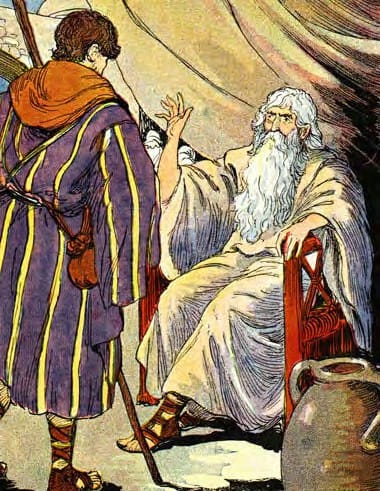
Then we read in the 19th and 20th verses: “And Samuel grew, and the Lord was with him, and did let none of his words fall to the ground. And all Israel, from Dan even to Beersheba, knew that Samuel was established to be a prophet of the Lord.” How very proud his mother must have been of him then!
Hannah and Sarah
Now let us consider some further lessons in the story of the boy Samuel. First of all, there is a striking similarity between the family of Elkanah and that of Abraham. As Hannah was barren, Sarah was barren. As Elkhanah’s second wife, Peninnah, who had children, looked with contempt upon the barren Hannah, Hagar who had Ishmael, looked with contempt upon the barren Sarah. Then in due course, both Hannah and Sarah bore dedicated sons of promise, Hannah bearing Samuel, and Sarah bearing Isaac. I think this is more than merely coincidental, especially since the name Elkanah means “God the Creator.” We can safely conclude that Elkanah’s wives also pictured Covenants, just as Abraham’s wives did.
The inability to have children was a special reproach for the women of Israel. There was a very significant reason for this. Every woman in Israel was familiar with the prophecy of Genesis 3:15, that the seed of the woman would bruise the head of the serpent, Satan. Each was familiar with the often repeated promise to Abraham, that in his seed all the families of the earth would be blessed. So every woman who was a descendant of Abraham had the hope of perhaps being the one through whom the Messiah would be born. This would be the greatest honor possible for womankind. This is confirmed by the fact that centuries later, the angel Gabriel greeted Mary, mother of Jesus, with the words found in Luke 1:28: “Hail, thou that art highly favored, the Lord is with thee. Blessed art thou among women.” So Hannah, too, had this hope. That is why she felt her barrenness so keenly.
To attain her hope, she made it a subject of special prayer, with deep feeling and great fervency, pouring out her heart before the Lord, making a solemn vow, and repeating her prayer and vow over and over again. What can we of spiritual Israel learn from this? We, too, have a hope a “blessed hope” according to Titus 2:13. It is the hope of being members of the Messiah, the Christ Company, the Body of Christ, to be of the Spiritual Seed of Abraham, which is to bruise the serpent’s head, and bless all the families of the earth. It is the hope of glory, honor and immortality. It is a high and rich calling. We read in Ephesians 1:18:
“The eyes of your understanding being enlightened, that ye may know what is the hope of his calling, and what the riches of the glory of his inheritance in the saints.”
It is a hope that is mysterious to all except those who have it, as expressed in Colossians 1:26, 27:
“Even the mystery which hath been hid from ages and from generations, but now is made manifest to the saints, to whom God would make known what is the riches of the glory of this mystery among the Gentiles, which is Christ in you, the hope of glory.”
It is a sure and positive and oathbound hope, of which we are assured in Hebrews 6:17 to 19:
“Wherein God, willing more abundantly to show unto the heirs of promise the immutability of his counsel, confirmed it by an oath, that by two immutable things, in which it was impossible for God to lie, we might have a strong consolation, who have fled for refuge to lay hold upon the hope set before us, which hope we have as an anchor of the soul, both sure and steadfast, and which entereth into that within the vail.”
Hannah’s Vow Is Like Our Vow
As Hannah made a vow consecrating her son, we, too, make a vow of consecration. We should be as earnest and fervent and persistent as Hannah was, pouring out our souls before the Lord, as she did.
Hannah’s prayer was heard, and her barrenness was removed. As for us, after naming the various fruits and graces of character likeness to the Lord, we are to develop, the apostle says, in 2 Peter 1:8:
“If these things be in you, and abound, they make you that ye shall neither be barren nor unfruitful in the knowledge of our Lord Jesus Christ.”
Before Hannah prayed, she was very sad, and in great turmoil of spirit. She could not eat or sleep. Then she laid her problem before the Lord, crying to him, and telling him her inmost feelings. Then what happened? A great peace descended upon her. We read that she “went her way, and did eat, and her countenance was no more sad.” (1 Samuel 1:18) Why the change? Simply because once she placed it in the Lord’s hands, it wasn’t her problem any more. Let us learn from this that, once we leave something to the Lord, and ask him to take care of it, we should stop worrying or grieving over it. This is the counsel of 1 Peter 5:7: “Casting all your care upon him, for he careth for you.” And Psalm 55:22: “Cast thy burden upon the Lord, and he shall sustain thee. He shall never suffer the righteous to be moved.” The most beautiful assurance of all along this line is found in Psalm 37:
“Delight thyself also in the Lord, and he shall give thee the desire of thine heart. Commit thy way unto the Lord, trust also in him, and he shall bring it to pass.” Psalms 37:4,5
This is what Hannah did, and this is what we can do.
Hannah paid her vow unto the Lord in full. She willingly and joyfully gave up the dearest treasure of her heart and never regretted it. This is the way our consecrations should be. In one sense, Hannah never really lost Samuel. Although he was lent to the Lord for life, he was still her son. Only, instead of being at home, her treasure was in Shiloh. This is where her heart was. Similarly, although we have given up every earthly thing in consecration, we have a great treasure in heaven. As Jesus counseled us:
“Lay not up for yourselves treasures upon earth. . . . But lay up for yourselves treasures in heaven. For where your treasure is, there will your heart be also.” Matthew 6:19-21
“Sell all that thou hast . . . and thou shalt have treasure in heaven.” Luke 18:22
After the boy Samuel had been given to the Lord, his mother regularly supplied him with a little coat. The Revised Version calls it a “robe” instead of a coat. This suggests to our minds “the robe of Christ’s righteousness” with which all those who are consecrated to the Lord, and accepted by him, are clothed.
After the boy Samuel entered God’s service, we read that he grew “and was in favor both with the Lord, and also with men.” Similarly, after we commence our consecrated lives, we also should grow. We should: “Grow in grace, and in the knowledge of our Lord and Saviour Jesus Christ.” (2 Peter 3:18) As to our standing among men, we should heed the counsel of Jesus: “Let your light so shine before men, that they may see your good works, and glorify your Father which is in heaven.” (Matthew 5:16)
The wicked sons of Eli, who were unfaithful priests of Israel, who forcibly took and ate the fat of the sacrifices, pictured the corrupt priests and ministers found among the clergy of nominal spiritual Israel. These enrich themselves at the expense of their parishioners without feeding them the spiritual food for which they are starving. I am not suggesting that all the clergy of Christendom are wicked men. I am sure most of them are not, but are sincerely doing the best they know how. But there is a Clergy Class today which is prophetically described in Ezekiel 34:2 to 4:
“Son of man, prophecy against the shepherds of Israel. Prophecy and say unto them, Thus saith the Lord God unto the shepherds: Woe be to the shepherds; Woe be to the shepherds of Israel that do feed themselves! Should not the shepherds feed the flocks? Ye eat the fat, and ye clothe you with the wool, ye kill them that are fed; but ye feed not the flock. The diseased have ye not strengthened, neither have ye healed that which was sick, neither have ye bound up that which was broken, neither have ye brought again that which was driven away, neither have ye sought that which was lost, but with force and with cruelty have ye ruled them.”
As a result of such conditions, many decent and honest persons turn away in disgust from all religion, thinking that such men represent God. The language of 1 Samuel 2:17 is again true, that “men abhor the offering of the Lord.” As the unfaithful sons of Eli died in battle because of their sins, the unfaithful shepherds of Babylon will cease to exist as a class when Babylon is utterly destroyed in “the battle of that great day of God Almighty.” (Revelation 17:14)
Eli’s Inconsistent Character
The character of Eli presents some strange contradictions. Although he himself was completely loyal and faithful to God, he was weak in the discipline of his sons along these very lines. Although he had been a poor and permissive father to his own sons, he had, on the other hand, been an excellent foster-father to the child Samuel. Also, although he had been ready to eject Hannah from the Tabernacle because of her supposed drunkenness, yet he permitted his own sons to steal, extort, and commit gross immoralities in the holy place.
Again, although he thoroughly disapproved the waywardness of his sons, he failed to vigorously denounce their course, and, if need be, remove them from office. God does not approve of such contradictions of character. The Lord prefers characters that are strong, consistent and positive, uncompromisingly for the right, as our great example Jesus was. There must be no contradictions in our characters, if we would make our calling and election sure. If there are, we, too, will be disapproved by God as was Eli.
Now let us further apply the lesson of Eli, by asking and answering to ourselves, some practical and timely questions. Do we have our children in subjection as instructed in 1 Timothy 3:4? Or are we permissive as Eli was? Do we tolerate servants in the Church who walk disorderly, bringing reproach upon the cause of Christ? Paul said in 2 Thessalonians 3:6:
“Now we command you, brethren, in the name of our Lord Jesus Christ, that ye withdraw yourselves from every brother that walketh disorderly, and not after the tradition which he received of us.”
This is not just a suggestion, it is a command, in the name of the Lord Jesus Christ. Paul also said in Titus 1:9 to 11:
“Holding fast the faithful word as he hath been taught. . . . For there are many unruly and vain talkers and deceivers . . . whose mouths must be stopped.”
If unfaithful elders persist in teaching new and strange doctrines, do we content ourselves with mildly remonstrating with them, as Eli did with his sons? Or do we firmly remove them from office, as Eli should have done? We cannot escape responsibility. Remember that Eli, although personally faithful, was condemned because he did not curb his sons who were unfaithful in the priestly office.
Lessons for Us
Now we come to that part of our lesson where the Lord called the boy Samuel in the night. We are impressed by Samuel’s quick and unquestioned obedience. He thought it was Eli calling him. But after the first two times, when Eli denied it was he, it would have been quite natural for young Samuel to think: “There is no one else here.
The poor old man must be calling out in his sleep, without realizing it. No need for me to respond any more.” But when the third call came, Samuel obeyed instantly. He once more left his warm and comfortable bed, and ran to Eli, saying, “Here am I!” That was the time he got the most important instruction of his life resulting in his becoming that very night a prophet of the most High God. That is when he learned to say to the Lord: “Speak, for thy servant heareth!” Let us also learn this lesson. We, too, are called of God.
We are called to a High Calling. Upon hearing the call, our instant response should be: “Speak, for thy servant heareth!” This should be the continual sentiment of every Christian all his life.
God Speaks to Us Through His Word
Although we do not hear the audible voice of the Lord in the night, as Samuel did, the Lord does speak to us in various ways: first of all, he speaks to us through his Word. Studying the Bible, with the helps he has provided, we get to know the Lord. We learn of his glorious attributes of character. We become familiar with his Plan, and his ways. We learn what he approves and what he does not approve.
From all the illustrations and examples found in the Bible, we are able to determine what he wants us to do in any given circumstance. We conform ourselves to his Word. Thus God “speaks,” and we “hear.”
God speaks to us through his providences, by what he permits to happen to us, whether good or evil. Yes, he does sometimes permit evil things to happen to us, but they are always for our good, to teach us needed lessons, to show the direction we should be going. Let us be alert to recognize these providences of the Lord, and “hear” what he says.
He speaks to us through our brethren in Christ. He speaks through the talks of the elders, often giving us the answers to our problems. He speaks through the comments of the brethren in study meetings. Also through the experiences of the brethren related in testimony meetings. In this way the humblest sister can often impart a needed lesson to the most mature elder; without even knowing that she is being thus used of the Lord. We should be ready to “hear,” regardless of the humble instrument it may please the Lord to use.
God speaks to us through private conversations with those of like precious faith. In such conversations, the Lord will often permit a brother or sister, without any prompting on our part, to suggest to us the very answer to our problem that we need. If we would be used of the Lord to help others in this way, we must heed the admonition of Ephesians 4:29:
“Let no corrupt communication proceed out of your mouth, but that which is good to the use of edifying, that it may minister grace unto the hearers.”
The Lord never uses the lips of gossips to edify his people. But by wholesome, spiritual conversation, the humblest brother or sister can be a channel of God Almighty, to bless or help someone.
One wonders how it was that the Lord took a young boy and endowed him with the dignity of a Prophet of the Most High God. If it were suggested to the President of the United States that he appoint a teenager to be his ambassador, I am sure the response would be: “But he’s only a boy!” But God’s reasoning is different.
He says: “What kind of a boy is he?” God looks at the heart, and not at the calendar. Let us learn from this, never to despise the young brethren in our midst. It is the Lord who has selected them.
The message the Lord gave to Samuel was one of condemnation upon Eli and his house. Samuel felt badly about this, because he loved Eli. When morning came, he hesitated to tell Eli what the Lord had said. There is a lesson here, of humility and kindness. Samuel might have felt puffed up that the Lord had spoken to him. He might have felt himself honored above Eli, as indeed he was. Pride might have made him boastful, and inconsiderate of Eli’s feelings, so that he would have taken delight in telling him of the calamities to come. But Samuel didn’t react that way. He was grieved. He would have preferred not to burden old Eli’s heart with the message. Similarly, we should, in humility, be sympathetic toward those whom the Lord has not honored with the privilege of hearing his voice of present truth, and we should prefer not to stress the calamities coming upon the world, but rather, be a comfort to all with whom we come in contact.
At Eli’s urging, Samuel reluctantly told him everything the Lord had said. Then Eli responded with the most beautiful expression of submissiveness, “It is the Lord. Let him do what seemeth him good.” With all of Eli’s contradictions of character, this is one trait we can emulate. Let the Lord do what he pleases with us. He knows best. He has promised that all things shall work together for our good. Let us trust in that promise. In the language of Job 13:15: “Though he slay me, yet will I trust him.”
Hannah’s Prayer
Now let us briefly consider Hannah’s exultant prayer of joy and praise to God, when she gave little Samuel to the Lord. It is found in 1 Samuel 2:1 to 10. Do you realize that verses 6 to 10 of this prayer contain a prophetic outline of the entire Plan of the Ages? Verse 6: “The Lord killeth, and maketh alive. He bringeth down to the grave, and bringeth up.” We know what that means. God condemned Adam to death, and his entire race followed him into the grave. But God provided a Ransom, to make Adam and his race alive again, bringing them up from the grave in a great resurrection. Verse 7: “The Lord maketh poor, and maketh rich. He bringeth low, and lifteth up.” This refers to our Lord Jesus, who, as we read in 2 Corinthians 8:9: “Though he was rich, yet for your sakes he became poor, that ye through his poverty might be rich.” Although he was the Logos, he became a man. God permitted him to be brought low, even to the death of the cross, and then lifted him up to the Divine Nature, giving him a name which is above every name. Verse 8: “He raised the poor out of the dust, and lifteth up the beggar from the dunghill, to set them among princes and to make them inherit the throne of glory.” This describes the Church, the Body of Christ, taken chiefly from the poor of the world. The Lord lifts us up from the “dunghill,” the miry clay, and sets our feet upon a rock. We are set “among princes,” we are to be Kings and Priests, to “inherit the throne of glory,” together with Christ Jesus. Verse 9: “He will keep the feet of his saints, and the wicked shall be silent in darkness.” This brings the prophecy right down to the present day. We are the “feet of the saints,” the feet members of the Body of Christ. We are “kept by the power of God” (1 Peter 1:5) in this evil day, and the wicked institutions of this world will shortly be destroyed. Verse 10: “The adversaries of the Lord shall be broken to pieces, out of heaven shall be thunder upon them.” Is this not a good description of “Jacob’s Trouble,” when the armies from the North are destroyed by the Lord? Next is a prophecy of the Messianic reign of Christ, and the judging of the world in righteousness: “The Lord shall judge the ends of the earth; and he shall give strength unto his King, and exalt the horn of his Anointed.”
There, in a few words, is the entire Plan, from Genesis to Revelation.
The fact that Hannah uttered this prophecy made her one of the prophets. We read in Luke 13:28: “Ye shall see Abraham, Isaac and Jacob, and all the prophets, in the Kingdom of God.” Hebrews 11:32 and 39 speaks of the prophets as “having obtained a good report through faith.” This means that Hannah is one of the Ancient Worthies. She will be a PRINCESS in all the earth, together with her beloved son, Prince Samuel.
Now we can better understand what Hannah meant when she said in 1 Samuel 1:28: “I have lent him to the Lord. As long as he liveth, he shall be lent to the Lord.” I think she knew that the time would come when she would have her son back again, and that they would serve the Lord TOGETHER throughout eternity!
The Burning Fiery Furnace
“In the third year of the reign of Jehoiakim, king of Judah, came Nebuchadnezzar, king of Babylon, unto Jerusalem, and besieged it. And the Lord gave Jehoiakim, king of Judah, into his hand.” Daniel 1:1,2
AT THIS time Nebuchadnezzar took captive to Babylon the very cream of the Jewish nation. Verse six says: “Now among these were of the children of Judah, Daniel, Hananiah, Mishael and Azariah.” In Babylon the names of these four young Hebrew boys were changed. Daniel was now called Belteshazzar; the other three were named Shadrach, Meshach and Abednego.
After an intensive course of study in which they greatly excelled they were assigned as advisors of the royal court. Then came the incident of Nebuchadnezzar’s dream of the great multi-metallic image, which a stone struck upon the feet and demolished–a picture of the kingdom of God supplanting the kingdoms of this world. By the Lord’s intervention, Daniel interpreted the dream which all the wise men of the realm had failed to do. It produced this result:
“Then the king made Daniel a great man, and gave him many great gifts, and made him ruler over the whole province of Babylon, and chief of the governors over all the wise men of Babylon. Then Daniel requested of the king and he set Shadrach, Meshach and Abednego over the affairs of the province of Babylon, but Daniel sat at the gate of the king.” Daniel 2:48,49
Now let us go forward about fifteen years. Daniel has a very high position in the empire and his three companions are magistrates in the provinces of Babylon. Leeser says that Shadrach, Meshach and Abednego were “over the public service of the province of Babylon”; Moffatt says they were “in charge of the business of the province.” These three were evidently not only judges and managers in the civil service but auditors as well, supervising business transactions. The king had wisely set them so. He knew of their absolute integrity and honesty because of his previous experience with them. In such positions as these we can well imagine they made powerful enemies of other government functionaries. Especially in eastern governments, graft was and is almost a way of life. Their interrupting or hindering of –dishonest practices and contracts with the government must have been bitterly resented. This, coupled with jealousy and –rivalry for the king’s favor, would cause their enemies to conspire to destroy Shadrach, Meshach and Abednego. But try as they might, they could find no valid occasion against these men of God whose every act was above reproach. Over the years the frustration of these enemies of the three Hebrews grew and accumulated.
Then King Nebuchadnezzar did something that played right into their hands. He did it with all sincerity and was probably actuated by the highest motives. He still vividly remembered his dream of many years before of the great multi-metallic image and Daniel’s interpretation of it. Daniel had said:
“Thou, O king, art a king of kings; for the God of heaven hath given thee a kingdom, power and strength, and glory. And wheresoever the children of men dwell, the beasts of the field, and the fowls of heaven, hath he given into thine hand, and hath made thee ruler over them all. Thou art this head of gold.” Daniel 2:37,38
After telling him of the arising of other kingdoms inferior to his and how they would all be destroyed, Daniel had said that “the God of heaven shall set up a kingdom which shall never be destroyed.” More than this, Daniel, who was at Nebuchadnezzar’s right hand, had undoubtedly told him of the hope of Israel as embodied in the promise to Abraham, Isaac and Jacob: “In thee, and in thy seed, shall all the nations of the earth be blessed.” Daniel must have related this promise to the kingdom represented by the “stone which smote the image,” and filled the whole earth; embracing and blessing all nations a universal empire lasting forever. These things would start Nebuchadnezzar thinking. Added to his pride as a powerful and absolute monarch, conquer–or of the world, it would cause him to reason thus:
“The great God of heaven himself considers me a `head of gold.’ I am the ornament of the ages. I am the wisest and most capable man in the world. My kingdom is of God. All men, and even the brute creation, have been given into my hands by God. And I already have a universal empire. I am now a king of kings. So why shouldn’t my kingdom last forever? Why shouldn’t I be the agency to bless the world? As for these promises to Israel, have I not conquered Israel by my great power? I have thus succeeded to all their rights. The promises to them are now mine!”
Do you see how natural it would be for such a man to reach such a conclusion?
Establishing a Common Religion
The next logical step for Nebuchadnezzar to take toward his objective would be to unify his empire which extended over all nations and tongues, having a great variety of cultures, customs and religions. He would want to create a “United Nations” organization, subservient to him. To accomplish this he must find a common denominator, something upon which all could agree, a force to draw and hold them together in loyalty to him and his empire. After thinking about it and consulting with his wise men, he undoubtedly reached the conclusion: What greater universal force is there than religion? The faculty of veneration is inculcated in every human being. He must worship something, some god or idol. He cannot help himself in this. It is a compulsion every man has regardless of nation or tongue. This, then, is the force to be harnessed to unify the nations of the world, to give them common ground, to make permanent and peaceful the universal dominion of Babylon.
Nebuchadnezzar decided to establish a common religion throughout his realm. You might call it the original ecumenical movement. But acceptance of this new religion was not to be voluntary. The king was practical enough to know that the hundreds of nations and tribes, with their varying languages, customs and cultures, could not be expected to agree on anything voluntarily. Since he was not one to resort to half-measures, he decided to use force of the most savage kind to impose obedience. After all, had he not conquered the world by brute force? This was a proven method that would work.
First it would be necessary to create a suitable symbol of the new, unifying religion. It must be an imposing and spectacular figure that would fascinate and over-awe all who beheld it. Perhaps Nebuchadnezzar considered making an image of the God of Daniel for this purpose. He remembered how, years before, when Daniel had interpreted his dream and given all the credit to the God of heaven, he, the great Nebuchadnezzar, had fallen on his face and said to Daniel: “Of a truth it is that your God is a god of gods, and a Lord of kings!” But there was no image of Daniel’s God for him to copy. These Hebrews, with their strange customs, did not make a likeness of their God to bow before it as other people did before theirs. Ah, but there was a god of which he did have a likeness, a god he himself venerated. It was the god Bel-Merodach, to which he attributed all his victories. This was a god that would fitly represent him and his irresistible conquering might. This would be a symbol all would fear and bow down to. This would be the god of nations.
So Nebuchadnezzar made a colossal golden statue of his god, a hundred feet high and ten feet broad:
“Nebuchadnezzar, the king, made an image of gold, whose height was threescore, cubits, and the breadth thereof, six cubits. He set it up in the plain of Dura, in the province of Babylon.” Daniel 3:1
This image was about the height of a modern ten-story building. The Statue of Liberty which dominates the New York harbor is about the same size as Nebuchadnezzar’s image. Forty people can stand within its head. But the Statue of Liberty is quite a different symbol, a symbol of enlightenment to the world. I could see it from the window of my room at the Bethel Home many years ago. I used to look at it every evening and see the light of its torch and think how appropriately it had been placed in such plain view of Bethel. Bethel contained Pastor Russell’s study from whence shone the Lord’s enlightening truth to the whole world!
The Incredible Image
Nebuchadnezzar’s idolatrous image was a most imposing one. We are told it was made of gold. It may not have been of solid gold although the historian Herodotus mentions a statue at Babylon of smaller size that was of solid gold and weighed 43,000 pounds.
After all, Nebuchadnezzar the king sent to gather together the “princes, the governors, and the captains, the judges, the treasurers, the counselors, the sheriffs, and all the rulers of the provinces, to come to the dedication of the image which Nebuchadnezzar the king had set up.” All the rulers of his vast empire were summoned to Babylon. What a colorful assembly it must have been! There must have been thousands of them, of all nations, kindreds, and tongues, each one arrayed in his most splendid native robes, to do honor to the great king. The image, so terrible in its dimensions, was probably covered, adding to the air of mystery. This shrouded figure was the first thing they saw when they arrived.
Let us picture the scene. The silent, looming image, draped in black, stood so tall in the center of the parade ground. It dominated everything. Beyond it, against a hillside, an enormous furnace had been constructed. It was burning so furiously that the heat of it could be felt even from that distance. It added a sinister note to the otherwise festive occasion. At the feet of the image a platform had been built upon which was assembled a great orchestra, com posed of performers on every kind of musical instrument and of every nation. Before this stood the nobles, rulers and officials of the realm, row after row, the noblest in front, extending backward in decreasing degrees of importance. At one side, and overlooking the entire assembly, there is an elaborately decorated platform upon which is seated King Nebuchadnezzar surrounded by his court. All eyes are fastened upon the huge draped image. It seems to move and writhe as the breeze stirs its covering. There is an awed hum of anticipation from the multitude. Suddenly a herald of the king mounts the platform before the image, and raises his hand for silence. We now read from the account:
“Then an herald cried aloud, to you it is commanded, O people, nations and languages, that at what time ye hear the sound of the cornet, flute, harp, sackbut, psaltery, dulcimer, and all kinds of music, ye fall down and worship the golden image that Nebuchadnezzar, the king, hath set up.”
At this point we can imagine that some idolaters in that great crowd would say to themselves, “Why should I worship any god but my own? My god may be offended if I do so. I won’t do it!” But then the herald continued:
“And whoso falleth not down and worshippeth shall the same hour be cast into the midst of a burning fiery furnace.”
That did it! All opposition evaporated. Now they understood the significance of the nearby burning furnace.
At a signal from the king, the orchestra played, the drapery fell to the ground, revealing a glorious, glittering golden image, which, as the drapery fell, seemed to soar up to heaven before their eyes. Every man went down before it in a wave, like wheat before a scythe. All, that is, except three men! Shadrach, Meshach and Abednego stood on their feet, heads held high. Actually if all the others had strictly obeyed the king’s command, no one would have noticed that the three Hebrews did not obey. One who is prostrate, with his face to the ground, cannot look about him. But Shadrach, Meshach and Abednego were under constant observation. Their enemies had been spying on them, day and night, to find some occasion against them. You may be sure one of these spies had been assigned to take up a position near the Jews, to watch them on this occasion. Now at last they had the evidence they needed! For this crime the penalty was a fiery death. How they must have hugged themselves with delight at the way things had turned out!
As soon as the ceremony was over and the king had returned to his palace, satisfied with the success of his plan, they made their move. We now read from the Leeser translation:
“Therefore, at the same time, certain Chaldean men came near, and accused the Jews treacherously. They spake, and said to king Nebuchadnezzar, O king, live forever. Thou, O king, hadst made a decree that every man that should hear the sound of the cornet, flute, guitar, harp, psaltery, and bagpipe, and all kinds of music, should fall down and bow himself to the golden image; and that whoso should not fall down and bow himself, should be cast into the midst of a burning fiery furnace. There are –certain Jewish men whom thou hast appointed over the public service of the province of Babylon: Shadrach, Meshach and Abednego. These men, O king, have not paid any regard to thee; thy god they do not worship, and to the golden image which thou hast set up, they do not bow themselves.”