
God Favors the Small and Humble
This favoring of the small and humble is a fixed principle with God. It was demonstrated in the glorious announcement at the birth of Jesus:
“Behold, I bring you good tidings of great joy, which shall be to all people; for unto you is born this day, in the city of David, a Saviour, which is Christ the Lord.” Luke 2:10,11
This announcement was not made to the wise and prudent leaders of Israel the High Priest, the Scribes and Pharisees, the ones who sat in Moses’ seat. They were too wise and too prudent. They would have been skeptical of his word. No, the most important announcement in history was made to poor and humble shepherds who literally trembled at his word, and were “sore afraid.” (Luke 2:9) The Lord had selected a very humble young maid to be the mother of the Holy Child. Although Gabriel had told Mary, “Thou are highly favored, the Lord is with thee, Blessed art thou among women,” yet in her song of exultation she humbly said: “He hath regarded the low estate of his handmaiden.” (Luke 1:48) Then she cited God’s fixed principle of favoring the small and humble, saying: “He hath put down the mighty from their seats, and exalted them of low degree. He hath filled the hungry with good things, and the rich he hath sent empty away!”
This fixed principle of God is incomprehensible to the world. Let us take an illustration from the business world. Suppose there is a seminar for business executives who are studying methods to attain success. The chairman asks each member to give what, in his opinion, are the most important secrets of success. We can imagine the standard replies:
“Show some ambition. Push yourself forward. Assume more and more responsibility, even if you have to usurp it. Milk the brains of those more knowledgeable than yourself. Be quick to take advantage of the neglect of others to enlarge your own sphere of authority. Get people to work for you. Delegate duties but take all the credit for good results. Act as a boss and some day you’ll be boss. Always try to displace the man in the job ahead. Cater and pander to those who are in a position to advance you. Curry favor. Flatter the chief. Play politics, backing the likely winner. Seek social prominence; etc.”
Although not expressed in just so many words, this is the probable sense of their replies. I have attended such seminars. But let us imagine that there is one man who has not replied so the chairman asks him for his secret of success. He gets up and says, “To become the greatest of all, make yourself the smallest of all. Humble yourself.” Can you imagine the scornful laughter that would greet such a reply? Yet this is exactly what the greatest authority in the world taught his disciples. This is the true secret of gaining the highest position in the universe. We read the words of Jesus:
“If any one wishes to be first, he must be last of all and the servant of all.” Mark 9:35, Weymouth Jesus also taught that the inverse of this is true: those who seek to exalt themselves will be brought down. He said:
“But he that is greatest among you shall be your servant; and whosoever shall exalt himself shall be abased; and he that shall humble himself shall be exalted.” Matthew 23:11,12
Jesus illustrated this principle by a parable when he was the guest of honor at a dinner in the home of one of the chief Pharisees. Many other guests, presumably Scribes, Pharisees, and Doctors of the law, were also there. As was the custom, there was a long table. The host and the guest of honor reclined at the head of it; the other guests were seated according to their rank with the most honorable nearest the host. Jesus was a keen observer of human nature and as the guests arrived, he noticed that each one invariably took the highest ranking place available at the table, thus exalting himself above those who might come after him. We now read from the account in Luke:
“And he spoke a parable to those who had been invited, observing how they were choosing out the chief places, saying to them: When thou art invited by any one to a marriage-feast, do not recline in the chief place; lest one more honorable than thou may have been invited by him, and he who invited thee and him should come and say to thee, Give this man a place and then, with shame, thou shouldst begin to occupy the lowest place. But when thou art invited, go and recline in the lowest place; that when he who invited thee comes, he may say to thee, Friend, go up to a higher place. Then thou wilt have honor in the presence of all those reclining with thee.” Luke 14:7- 11, Diaglott
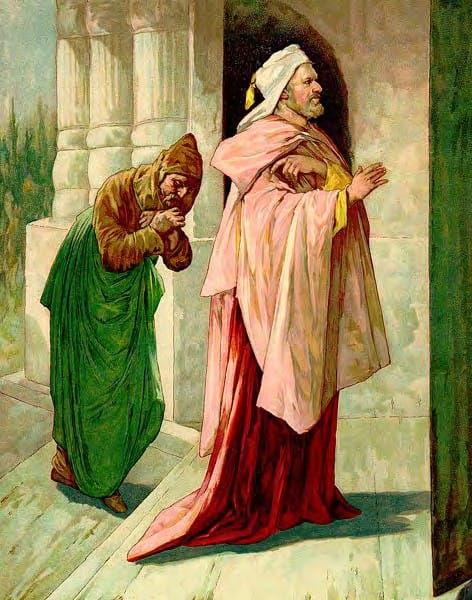
Then Jesus drove home the lesson of the parable with the words: “For every one who exalts himself will be humbled, and he who humbles himself will be exalted.”
Contrasting Satan and Jesus
We have a demonstration of this fixed principle of God in Satan and Jesus. Satan sought to exalt himself as we read:
“For thou hast said in thine heart, I will ascend into heaven. I will exalt my throne above the stars of God. I will ascend above the heights of the clouds. I will be like the Most High. Yet thou shalt be brought down to the sides of the pit.” Isaiah 14:13-15
Contrast this with the career of our Lord Jesus who humbled himself and whom we are to emulate:
“Let this mind be in you, which was also in Christ Jesus; who, being in the form of God, thought it not robbery to be equal with God; but made himself of no reputation, and took upon him the form of a servant, and was made in the likeness of men. And being found in fashion as a man, he humbled himself, and became obedient unto death, even the death of the cross. Wherefore God also hath highly exalted him, and given him a name which is above every name; that at the name of Jesus every knee should bow, of things in heaven and things in earth, and things under the earth; and that every tongue should confess that Jesus is Lord, to the glory of God, the Father.” Philippians 2:5-11
To us, the followers of Jesus, the apostle says:
“Be clothed with humility; for God resisteth the proud, and giveth grace to the humble. Humble yourselves, therefore, under the mighty hand of God, that he may exalt you in due time.” 1 Peter 5:5,6
God Resists the Proud
“God resisteth the proud!” What chance would we have if God would resist us? How wonderful it is to enjoy the grace of God which he shows to the humble. Do any think they do not need this lesson? Bro. Russell wrote:
“No other lesson requires to be so carefully learned by the Lord’s people as this lesson of humility. It has to do with the very humblest of the flock, as well as those who are teachers and elders and pilgrims, etc. But the degree of force that seems to come with the besetment or temptation seems to multiply in proportion to the position and attainments of the individual. Pride and ambition may be in those who have no official position in the Church. Little men, like little ships with broad sails, are in great danger of being capsized if too strong a wind of popularity play upon them.” Reprints, page 3363.
Isn’t that well put? In conformity to his fixed principle, the Lord has always selected for his service men who were small in their own eyes. For example, when the prophet Samuel told Saul that he had been selected to be King of Israel, Saul was very small in his own eyes. We read:
“And Saul answered and said, Am I not a Benjamite, of the smallest of the tribes of Israel: And my family the least of all the families of the tribe of Benjamin? Wherefore then speakest thou so to me?” 1 Samuel 9:21
When Samuel wanted to present him to the people as their first King, Saul in his humility hid himself. Thus when he considered himself small, he was made great. Later he became proud, haughty and disobedient. When Samuel told him of his rejection by the Lord, he reminded Saul of God’s fixed principle:
“And Samuel said, When thou wast little in thine own eyes, wast thou not made the head of the tribes of Israel, and the Lord anointed thee King over Israel?” 1 Samuel 15:17
Let us learn well the tragic lesson of Saul. Let us be alert to detect and promptly resist the slightest beginning of pride. Our very lives depend upon it: “Pride goeth before destruction, and an haughty spirit before a fall.” (Proverbs 16:18)
The one whom the Lord selected to succeed Saul was also small, the smallest son of Jesse. David had seven brothers who were superior to him according to human standards. Even the prophet Samuel thought one of David’s tall and handsome brothers was the better choice. We read:
“But the Lord said unto Samuel, Look not on his countenance, or on the height of his stature; because I have refused him. For the Lord seeth not as man seeth. For man looketh on the outward appearance, but the Lord looketh on the heart.” 1 Samuel 16:7
The next few verses tell us what happened:
“Again Jesse made seven of his sons to pass before Samuel. And Samuel said unto Jesse, The Lord hath not chosen these. And Samuel said unto Jesse, are here all thy children? And he said, there remaineth yet the youngest, and, behold, he keepeth the sheep. . . .
And he sent and brought him in. . . . And the Lord said, arise , anoint him; for this is he.” 1 Samuel 16:10-12
Once again, the smallest was chosen. Unlike Saul, David maintained his humility as reflected in the many beautiful psalms he wrote. The Lord loved him and favored him in a most unique manner. The name of David was highly honored and exalted so much so that when Jesus was born on earth, he was called the Son of David; the glorious Messianic Kingdom authority by which he shall rule the world is called the Throne of David.
Another example of this principle is Gideon. When the Lord told him he had been selected to save Israel from the hand of the Midianites, we read that Gideon, small in his own eyes, modestly answered:
“Oh my Lord, wherewith shall I save Israel? Behold, my family is poor in Manasseh, and I am the least in my father’s house.” Judges 6:15
This was the attitude of mind the Lord could use. One of such a mind would be willing to take instruction, to obey implicitly, to do things the Lord’s way not his own. Is not this the meaning of consecration, the ready and willing acceptance of God’s will in the place of our own?
In the Christian dispensation we have the outstanding example of the apostle Paul. Brilliant of mind, highly educated, a talented logician and teacher, Paul wrote most of the New Testament. He was mightily used of the Lord to instruct and unify the early Church as well as us at this end of the age. Why do you suppose the Lord selected him to do this work? Why not someone who had been a disciple of Jesus during his earthly ministry? Paul himself gives us the secret of why the Lord could and did use him so extensively when he tells us of his small opinion of himself:
“For I am the least of the apostles, that I am not meet to be called an apostle, because I persecuted the Church of God. But by the grace of God, I am what I am. And his grace which was bestowed upon me was not in vain; but I laboured more abundantly than they all. Yet not I, but the grace of God which was with me.” 1 Corinthians 15:9,10
Do you see Paul’s humility of heart? He was really the greatest of them but he considered himself small, the least of the apostles. Then he made himself even smaller than that! He made himself less than the least in the whole Church:
“Unto me who am less than the least of all saints, is this grace given; that I should preach among the Gentiles the unsearchable riches of Christ.” Ephesians 3:8
Let us learn Paul’s secret of how the grace of God may be obtained.
Modern-day Examples
We have a refreshing example of humility in more modern times. George Washington Carver was a brilliant Negro scientist who specialized in research on the lowly peanut. He discovered ways of making more than 300 useful products from the peanut ranging from instant “coffee” to soap and ink, all in addition to its use as food. He made the peanut one of the most important crops in agriculture.
When asked how he was able to accomplish all this, he used to tell this story about himself:
“When I was young I said to God, `Lord, tell me the mystery of the universe.’ But God answered, `That knowledge is reserved for me alone.’ So I said, `Lord, tell me the mystery of the peanut.’ Then God said, `Well, now, George, that’s more nearly your size.’ And he told me.”
Many eminent scientists are humble and God-fearing men. Another such example is Samuel F. B. Morse, inventor of the telegraph, the forerunner of radio and television by means of which the gospel of the kingdom is going forth across the earth in fulfillment of prophecy. Morse wrote of himself:
“When flattering honors came to me from America and Europe on account of the invention which bears my name I never felt I deserved them. I had made a valuable application to electricity, not because I was superior to other men, but solely because God, who meant it for mankind, must reveal it to someone, and was pleased to reveal it to me.”
So it is not surprising that the great inventor’s first telegraphic message was, “WHAT HATH GOD WROUGHT!” Even the great Einstein credited his marvelous discoveries to a Higher Power, admitting that he had been granted only an infinitesimal glimpse of the vast mystery of the universe.
We could cite many other such examples, but these will suffice. What a lesson there is here for the Lord’s people! If worldly men of brilliant scientific achievement find nothing in which to glory, but ascribe their successes to God, how humble we should be of our modest attainments! How mindful we should be of the fact that we have, and are, nothing at all, except by the grace of God. As we read:
“For who maketh thee to differ from another? And what hast thou that thou didst not receive? Now if thou didst receive it, why dost thou glory, as if thou hadst not received it?” 1 Corinthians 4:7
God tells us:
“Thus saith the Lord, let not the wise man glory in his wisdom; neither let the mighty man glory in his might. Let not the rich man glory in his riches. But let him that glorieth glory in this: That he understandeth and knoweth me; that I am the Lord which exercise lovingkindness, judgment and righteousness in the earth. For in these things I delight, saith the Lord.” Jeremiah 9:23,24
Jesus summed up the important lesson of humility pointing out that no one will ever attain to the Heavenly Kingdom without it:
“At the same time came the disciples unto Jesus, saying, Who is the greatest in the Kingdom of heaven? And Jesus called a little child unto him and set him in the midst of them and said, Verily I say unto you, except ye be converted, and become as little children, ye shall not enter into the Kingdom of heaven. Whosoever, therefore, shall humble himself as this little child, the same is greatest in the Kingdom of heaven.” Matthew 18:1-4
Do you want to enter into the Kingdom of heaven? This is the way.
The Truth
The system of belief, Our Most Holy Faith, which we call “The Truth,” is made up of little things, of small fragments of information scattered throughout the Bible. The wonderful Divine Plan of the Ages is not found in the Bible as a consecutively connected narrative. If it were, it would be understood by everyone instead of being a profound mystery to all but the church. This fact is well described in Isaiah:
“For precept must be upon precept, precept upon precept; line upon line, line upon line; here a little, and there a little.” Isaiah 28:10
No human mind, entirely by itself was capable of ferreting out all the small “lines” and “precepts,” arranging them in order and forging them into the beautiful and harmonious structure of truth we enjoy today. Only a mind especially guided and enlightened could do so. The Lord did not reveal the truth to the minds of each one of us separately and individually. He could have done so if he had wanted, but this was not his method. Upon his coming he especially enlightened the mind of one man, a Faithful and Wise Servant; we all learned the truth through him. Here is a test of humility and submission. Are we willing to accept this arrangement of the Lord, or do we think so highly of ourselves that we equate our puny minds with that of the Lord’s specially chosen instrument?
As the truth is made up of many small parts which, when held together, form a glorious structure, so small and seemingly unimportant departures from the truth, if persisted in, can lead to total loss. I quote from the Sermon Book on the subject “There Is a Sin Unto Death”:
“It is our duty, dear brethren and sisters, to warn those who are still holding fast the precious Word, still trusting in the precious blood, still appreciating the grace of God, and still sanctified, that they take heed against insidious sin, insidious errors, lest by these they should be gradually switched out of the way, and gradually find their course leading farther and farther away from harmony with the Lord, and fellowship with those who are His, in the appreciation of His Word. The switch on the railway track has a very small beginning, but it steadily turns the car aside in a very different direction. And so with our minds, our hearts, our attitude toward the Lord a little deflection on some point, seemingly not so important, may lead farther off, eventually to alienation from the Lord.” Sermon Book, page 776.
Bro. Russell ends the sermon with these words, which are especially appropriate today:
“Let us not only be on our guard against the great sins that we have considered, the open enmity against God through wicked works, or through falling away from the doctrines of His grace; but let us remember that it is the little deflections from the Divine Word that lead astray. Let us take heed to our steps lest we be switched off by the great Adversary, who, every here and there along the pathway, is permitted of the Lord to test us, to prove us, and thus if we are faithful to the Lord, to make us more and more strong in faith and in obedience, and more ready for the Kingdom. The least deflections from the teachings of the Word are very sure to bring us into trouble.
Let us therefore, take more and more heed to all the jots and tittles of the Master’s Word, not only for the exhortations, and instructions given us by Himself, but also those given through the apostles, especially appointed to be our guides in the way to the Heavenly Kingdom. He who is faithful in the little things will be faithful in the great. He who is unfaithful in the little things, and inattentive to the Divine messages will, more than likely, fail to make his calling and election sure.”
This warning by Bro. Russell was not heeded by many. Shortly after he died the little deflections from the truth began. We witnessed it.
At first the changes did not amount to much; they weren’t vital. There appeared to be nothing to be alarmed about. But as predicted, small departures led to ever more serious departures, with the result that many lost their crowns. Let us learn from this that even the smallest element of truth is vital.
In 1 Kings we read of events that have already started on the earth, leading to the full establishment of the Messianic Kingdom:
“And, behold, the Lord passed by, and a great and strong wind rent the mountains, and brake in pieces the rocks before the Lord; but the Lord was not in the wind.” 1 Kings 19:11,12
This could refer to the winds of world wars, two of which we have already experienced, rending the mountains or kingdoms of the world. “And after the wind, an earthquake; but the Lord was not in the earthquake.” Earthquake is a symbol of revolution. There are many earthquakes, both literal and symbolic in the world today. “And after the earthquake, a fire; but the Lord was not in the fire.” Fire is very destructive, and aptly symbolizes anarchy. This fire has already been ignited. The Lord was not in any of these things in the sense that the world has brought it on themselves.
The “Still Small Voice”
“And after the fire, a still small voice.” According to Leeser’s translation: “And after the fire, the sound of a soft whisper.” The chastened and humbled world will be ready to grasp at straws. Their extremity will be God’s opportunity. They will eagerly listen to and obey the quiet but firm voice of authority emanating from the Ancient Worthies. The same thought is expressed in Psalm 46:
“Come, behold the works of the Lord; what desolations he hath made in the earth. He maketh wars to cease unto the end of the earth. He breaketh the bow and cutteth the spear in sunder. He burneth the chariot in the fire.” Psalms 46:8-10
This seems to describe Jacob’s trouble. Then we read: “Be still and know that I am God. I will be exalted among the heathen. I will be exalted in the earth.” The fires of the time of trouble must burn out and the world be still before the voice of God is heard.
On the sea of Galilee when Jesus said, “Peace, be still,” he didn’t try to out-shout the storm. He spoke with authority, but quietly. He always spoke that way. It was prophesied of him in Isaiah 42:2, “He shall not cry, nor lift up, nor cause his voice to be heard in the street.” Moffatt renders it, “He shall not be loud and noisy. He shall not shout in public.” We can take an example from this. Quietness is also important in our personal lives. We have to be quiet to hear the voice of God. It is often during periods of quiet meditation that we realize what God’s will is regarding some matter that has been troubling us. Meditation upon God’s word unlocks the door and gives us access to the wisdom of God. It has been said: When we pray, we speak to God; when we meditate, God speaks to us. Let us not only study the word but let us also study to be quiet and listen.
The value of quietness in finding what we are seeking is illustrated by a story. I don’t suppose many of you remember when ice was cut in large blocks from the surface of lakes in the wintertime and stored in thick-walled windowless icehouses for use in summertime. That was the day of pure water. (It would be unthinkable to do this today.) The blocks of ice, piled high in the icehouse, were covered with a thick layer of sawdust to inhibit melting. One day a Vermont farmer was assisting in the seasonal chore of stocking an icehouse when he lost his pocket watch. Loudly bewailing his misfortune, he set about with his lantern and rake, hunting for it in the sawdust on the icehouse floor. His companions joined him in the search, but their clamorous seeking failed to turn up the watch. When the men went away to lunch, a small boy slipped quietly into the icehouse and promptly found the watch! Asked by the astonished owner how he managed to discover it, the youngster explained: “Well, sir, I just lay down on the sawdust, and kept very still; soon I heard the watch ticking.”
“Who hath despised the day of small things?” Today is “the day of small things.” The Lord has been selecting a “little flock,” a small company of little people. Of these there is now only a small number left upon the earth. The harvest workers, still proclaiming the harvest message, are becoming fewer; their efforts seem ineffective and foolish. Thus this “day of small things” is “despised” by Christendom and the world. But, as expressed in 1 Corinthians 1:21, “It pleased God, by the foolishness of preaching, to save them that believe.”
All the wheat will be found and garnered. We are required to be faithful only a little while longer. If we are, we will gain the great prize. Why jeopardize our chances? Why not hold fast to the truth as it was given to us? Why change at this late date? Why risk our crowns? Our glorified Lord, who has gone before, earnestly counsels us, “Hold fast which thou hast; that no man take thy crown.” (Revelation 3:11) Weymouth reads, “Cling to that which you already possess.” It is nothing new; you already have it. This is such a small thing to ask, but if we obey, how very great our reward will be!
The Death and Resurrection of Jesus
“He is risen!” Matthew 28:6
THE three most important events in history are the birth, death and resurrection of Jesus. Two of these events, the death and resurrection of Jesus, occurred within a period of three days of each other. A wider diversity of emotion can scarcely be imagined. At the death of Jesus was experienced the greatest possible sorrow and within three days, at the resurrection of Jesus the greatest possible joy.
Today we are going to consider the events culminating in the resurrection of Jesus, from various viewpoints: as the angels of heaven saw these events, as seen by Satan and the fallen angels, as viewed by the Jewish religionists and as they involved the civil authorities, as experienced by the apostles and disciples of Jesus at his first advent, their significance to us the harvest Church at this end of the age, and, finally as seen from God’s viewpoint.
When the earth was created, we read:
“The morning stars sang together, and all the sons of God shouted for joy.” Job 38:7
This showed an intense interest by the angelic heavenly host in matters pertaining to this earth. There must have been great delight on their part when the earth was clothed with vegetation and the animal creation brought into being. When one sees the beautiful forms and colorations, the symmetry of the fir tree, the breathless tints of flowers, the form of a bird on the wing, the grace of a deer, and the incredible plumage of the peacock, one wonders if the angels did not have a hand in it! If they were interested before, they must have been utterly fascinated when Adam was created!
Here was an earthly being, functionally similar to the animals, but in mentality and nobility only a little lower than the angels themselves. They must have felt a warm attachment to Adam, an attachment such as an older brother has to a younger. After all, did they not have the same Heavenly Father? Their delight further increased when Eve was created, a creature of exquisite beauty, such as the earth had never seen. When the test of obedience was applied, there must have been some sober moments in heaven among the angelic host somewhat like the sobering effect upon one whose younger and less experienced brother is taking an examination, the outcome of which his entire future career depends.
There must have been great sorrow in heaven when Adam failed the test particularly because one of their own angelic number was instrumental in causing it. How do we know there was sorrow in heaven? If “there is joy in heaven over one sinner that repenteth” (Luke 15:7), is there not sorrow over a just one who sins? There must be.
When Jesus was born on earth, the angels knew exactly what was happening. There was no secret about it. It was an angel who said:
“Fear not, for, behold, I bring you good tidings of great joy, which shall be to all people; for unto you is born this day, in the city of David, a Saviour which is Christ the Lord.”
You may be sure that the angel did not say this without knowing what it meant. Knowing as we do from the book of Job that there are days when the angelic sons of God come to present themselves before the Lord, I think we can reasonably suppose that God on the occasion of such a gathering would tell his angelic family all about it, telling them of his wonderful plan of redemption, of the necessity for a redeemer, for someone to take Adam’s place in death, someone perfectly equivalent to Adam before he sinned, to die as a ransom or corresponding price to release Adam and his race from death. We can imagine the angels looking at one another asking, “Who is able to do this? How?” Then God would tell them that the mighty Logos, the “bright and morning star” (Revelation 22:16), his only begotten son, his instrument in all creation including the angels themselves their companion and chief whom they knew and loved had volunteered to be the one to redeem man, to relinquish his high position as the Logos of God, to leave the courts of heaven, to be out of intelligent existence for nine months, to be born as a human baby upon the earth, to there grow up as a perfect man, “holy, harmless, undefiled, separate from sinners” (Hebrews 7:26), to become an exact counterpart of the perfect Adam, maintaining a perfectly holy and sinless life. Then he would lay down his perfect human life for Adam’s forfeited life, die without deserving to die in the place of Adam who did deserve to die, redeeming the dead Adam and through him his dying race, bringing the entire human family to life again. Then he would make the earth a glorious garden as Eden was!
Can you imagine the joy of the angels at this good news, these “good tidings of great joy”? They must have been bubbling over with happiness and praise of God. They would want a part in it! They would want to announce it! They would want to tell the world about it! That is how it was on that wonderful night near Bethlehem that “suddenly there was with the angel a multitude of the heavenly host, praising God, and saying, Glory to God in the highest, and on earth peace, good will toward men.”
This was a spontaneous thing with the angels. They weren’t just carrying out orders. You may be sure they really felt every word of joy and praise they uttered. They knew exactly what they were saying too when they said: “On earth peace.” That word peace, according to Dr. Strong, means “to set at one again” which is of course atonement or ATONEMENT.
You may be sure the angels watched every incident of Jesus’ career. If we, the Church, are “made a spectacle unto angels” (1 Corinthians 4:9), I am sure Jesus was. The angels intimately followed Jesus’ life especially after the start of his ministry. We know that 12 legions of angels, which would comprise 60,000 angels, stood ready to come to his aid. Jesus himself said so in Matthew 26:53. It is also written of Jesus, “He shall give his angels charge over thee, to keep thee in all thy ways.” (Psalms 91:11) We often read that the “angels ministered unto him.” They certainly must have been his ready instruments in the performance of his many miracles.
The Appointed Time Arrives
As long as Jesus had this angelic protection, his enemies could not harm him. But the time finally came when Jesus must be offered up. His “hour had come,” as he himself expressed it. His angelic protection was removed. It was only then that his enemies were able to take him and have power over him. This fact is shown by an incident when Jesus was before Pilate for judgment. Jesus refused to defend himself. He refused to make any statement, “He opened not his mouth,” as had been prophesied of him in Isaiah 53:7. We read:
“Then saith Pilate unto him, speakest thou not unto me? Knowest thou not that I have power to crucify thee, and have power to release thee? Jesus answered, Thou couldst have no power at all against me, except it were given thee from above.” John 19:10,11
You may be sure the angels felt and sorrowed over every scourging and indignity that Jesus suffered. Seeing him brutally crucified must have moved them deeply. When about the ninth hour he cried with a loud voice, “My God, my God, why hast thou forsaken me?” how they must have longed to reassure him and minister unto him as they had done so often before, to say to him: “It’s all right! It’s really all right!” Then Jesus cried out again with a loud voice and a great light went out the “bright and shining star” was extinguished. We read that “there was a darkness over all the earth.” Jesus was dead. His body was laid in a tomb. He was out of existence.
The angelic host waited for parts of three days. They knew he would rise again. God had told them. They were familiar with the prophesies and Jesus himself had said so to his disciples. Then, on the morning of the third day, they witnessed the most magnificent display of power by the Heavenly Father up to that time. Out of darkness a great light burst forth. Jesus Christ arose with a glorious, immortal divine body, an “express image of the Father’s person.” (Hebrews 1:3)
What a grand reunion there must have been, what mutual rejoicing that the ransom had been provided, that Adam had been redeemed and with him his race, that the “restitution of all things” was now possible! We read:
“In the end of the sabbath, as it began to dawn toward the first day of the week, came Mary Magdalene, and the other Mary, to see the sepulchre. And behold there was a great earthquake; for the angel of the Lord descended from heaven, and came and rolled back the stone from the door, and sat upon it. His countenance was like lightning, and his raiment white as snow. And for fear of him the guards did shake and became as dead men. And the angel answered and said unto the women: Fear not ye, for I know that ye seek Jesus, who was crucified. He is not here, for HE IS RISEN, as he said.” Matthew 28:1-6
The Viewpoint of Satan
By way of contrast let us consider these events from the viewpoint of Satan and the fallen angels. When Satan deflected from the favor of God and seduced Adam into sin, he made himself the mortal enemy of the Logos, Jesus in his prehuman existence. Very early in his sinful career Satan deduced from the prophecies that someone sent from God, born of a woman, would be his downfall. When the time came that men were in expectation of the Messiah, the Christ, Satan was on the alert. I think he was astonished when he learned
that it was the mighty Logos who was to be born a babe in Bethlehem and become the Savior which is Christ the Lord. “What a foolish thing to do!” he must have said to himself, “to give up such a lofty nature and position and come to earth as a mere man!” But what an opportunity it presented to Satan! The earth was his area of operation. To have Jesus come down to earth as a man would give him the chance he wanted, like a man walking into a lion’s den. He had handled men before. They were all alike. He would destroy Jesus and thwart God’s plan of redemption, both at once.
First he suggested to Joseph to put Mary away because, being a virgin, she was with child. But that didn’t work. After Jesus had been born, the wise men from the East arrived inquiring: “Where is he that is born King of the Jews?” Satan now suggested to Herod that a “King of the Jews” would be a threat to the Roman rule over the Jews and he had better do something about it. Herod did. Informing himself from the prophecies that Christ should be born in Bethlehem of Judea he “slew all the children that were in Bethlehem, and in all the coasts thereof, from two years old and under.” (Matthew 2:16) That was one of the most Satanic acts ever heard of, but it didn’t work either. Joseph and Mary had been warned and had taken the babe to Egypt.
When Jesus came up out of the baptismal of water of Jordan, Satan was there. When he heard the voice from heaven saying, “This is my beloved son, in whom I am well pleased” (Matthew 3:17), he decided to handle the matter personally. After Jesus had fasted for 40 days, Satan suggested to Jesus that he turn stones into bread and satisfy his hunger. Satan had always been able to corrupt men through their fleshly appetites. It was sure-fire. Jesus did have the power to change stones to bread if he wanted to. He later turn water into wine at Cana. But Jesus refused and quoted scripture. His powers were consecrated and not to be used selfishly. Satan suggested that since God had given the angels charge of his welfare, he ought to test the arrangement by jumping off the pinnacle of the temple. Just try it out, you know! It would also be a spectacular demonstration and draw men to him. But Jesus refused to tempt the Lord quoting scripture again. Then Satan applied his final temptation, which had always succeeded in the past with men: the offer of unlimited wealth and power. He offered Jesus all the kingdoms of the world and the glory of them if Jesus would worship him. Jesus again refused without the slightest hesitation and Satan left him.
Satan sought to destroy Jesus through the scribes and Pharisees and others, inciting and whipping up their jealous rage. But when they tried to stone him, Jesus evaded them. When they tried to push him over a cliff, he passed through the midst of them.
Satan finally found his perfect foil, a man described as “the son of perdition,” one of Jesus’ own disciples. Did you know that Satan sat at the table with Jesus and the others at the last supper? It’s true because we read in Luke 22:3 that “Satan entered into Judas,” whereupon he arranged to betray Jesus just before the passover supper which he attended. Yes, this was a job Satan wanted to do personally and not leave to his demons. You may be sure he remained in Judas during the most foul betrayal in history. I think the kiss by which Judas identified Jesus to his enemies was Satan’s own idea a personal touch. It is so much like him!
When Jesus was before Pilate, Satan was worried for a while. He thought the old fool was going to actually release Jesus. But he made Pilate think again by a quick inciting of the mob at just the right moment: “Crucify him, crucify him! If you let him go, you are no friend of Caesar’s!” Jesus was soon condemned.
When Jesus on the cross cried out “My God, my God, why hast thou forsaken me?” Satan was convinced he had triumphed. The Father himself had now abandoned Jesus. Jesus had probably been unfaithful in some respect, Satan thought, and would stay dead. One thing worried him. If after Jesus was entombed his disciples stole his body and then claimed he had been resurrected, as he said he would be, it could be troublesome. So through the chief priests and Pharisees, he arranged to have the tomb sealed and guards posted.
Now everything was safe or SO HE THOUGHT! He probably stayed around the tomb just to be sure. Suddenly on Sunday morning there was a blinding flash of light, the guards fainted dead away, and a strong angel descended and rolled away the stone from the door of the sepulchre. Satan, with his powers of a spirit being, undoubtedly saw with dismay THE GLORIOUS RESURRECTED JESUS: and he fled!
Others had seen the resurrected Jesus as well the fallen angels imprisoned in the atmosphere of this earth. They too had been following Jesus’ career on earth with great interest. When they observed Jesus’ complete obedience to the Heavenly Father’s will, they remembered their own disobedience. When they saw the humiliation of Jesus even to the death of the cross, then saw his glorious resurrection and high exaltation, they wondered about Satan’s philosophy of seeking to exalt himself. Thus the life, death and resurrection of Jesus was a powerful sermon to them.
Undoubtedly some of them repented. We read in confirmation:
“For Christ also hath once suffered for sins, the just for the unjust, that he might bring us to God; being put to death flesh, but quickened spirit; by which also he preached unto the spirits in prison; who sometime were disobedient, when once the longsuffering of God waited in the days of Noah, while the ark was preparing.” 1 Peter 3:18-20