
Daniel Ignores the Decree
Why did he do that? He could have said to himself, “Prayer is a private matter between me and the Lord. In view of the decree, all I have to do now is shut the door and close the windows.” But he didn’t reason that way.
One might wonder why Daniel had adopted the custom of worshipping in such a public manner in the first place, a manner so different from that which our Lord Jesus enjoined upon us:
“But thou, when thou prayest, enter into thy closet [or secret apartment], and when thou hast shut thy door, pray to thy Father which is in secret; and thy Father which seeth in secret, shall reward thee openly.” Matthew 6:6
There was a good reason. Daniel was among idolaters, each one of whom publicly worshipped the image of his god. Daniel was looked upon as an example of the Hebrew captives in Babylon. The Hebrews did not have an image of their God. So for Daniel to have worshipped in secret would have been misunderstood to mean that he did not worship at all. Under the circumstances this would have been a reproach to the true God. So he worshipped openly with his face toward Jerusalem, the typical city of God the great king of the universe, and toward the temple, the typical habitation of God. Three times a day he made confession of the only true God before the various nationalities of Babylon. By so doing he was also an inspiration to his own people, the captive Jews in Babylon. He encouraged faithfulness to God and a separation from idolatry.
These were valid reasons for Daniel’s public worship. To discontinue the custom because of this new law would be an act of cowardice. It did not even enter his mind. He went to his upper chamber, opened the windows wide, knelt down in full view facing Jerusalem, and prayed aloud, addressing himself to the God of Israel. How well his enemies knew his schedule! A representative group was there under his windows listening, to witness Daniel’s violation of the king’s decree.
“Then these men assembled and found Daniel praying and making supplication before his God.” Daniel 6:11
Too bad they didn’t have a tape recorder! It would be wonderful to know what Daniel said in that prayer. We can guess that after laying his problem before the Lord and resigning himself completely to the Lord’s will, he would pray for the restoration of Israel, calling to mind God’s gracious promises respecting the Holy Land toward which he was facing, that it would yet be the center of the whole earth and of God’s holy people, that eventually and through these, divine blessings would be extended to every nation, people, kindred and tongue.
Having obtained the evidence they needed, Daniel’s enemies lost no time in reporting it to the king. It is interesting to note that this new law was invoked against no one but Daniel, although there must have been numerous other violators among the idolaters of Babylon. Many would bow before their images through sheer force of habit and be guilty; but only Daniel was cited.
“Then they came near and spake before the king concerning the king’s decree: Hast thou not signed a decree that every man that shall ask a petition of any god or man within thirty days, save of thee, O king, shall be cast into the den of lions? The king answered and said, The thing is true, according to the law of the Medes and Persians, which altereth not. Then answered they, and said before the king, that Daniel, which is of the children of the captivity of Judah, regardeth not thee, O king, nor the decree that thou hast signed, but maketh his petition three times a day. Then the king, when he heard these words, was sore displeased with himself, and set his heart on Daniel, to deliver him, and he laboured till the going down of the sun to deliver him.” Daniel 6:12-14
The king saw the trap into which he had been deliberately led for the very purpose of destroying his most trusted and valued counselor. The rule of the kingdom was that a sentence must be executed before sundown of the same day it was incurred, but the king tried every way to have the penalty upon Daniel rescinded or suspended. Ordinarily when kings desired to be released from some decree, they called upon their wise men and magicians who usually were skillful in suggesting a way out of the dilemma by some technicality. So the king earnestly sought their counsel, telling them of his desire that Daniel be saved from the den of lions in spite of the law he had made. But in this case, there was an alliance of all the wise men of Babylon against Daniel:
“Then these men assembled unto the king, and said unto the king, Know, O king, that the law of the Medes and Persians is that no decree nor statute which the king established may be changed.” Daniel 6:15
The king continued his efforts until the last minute, but finally the sun went down and he could delay no longer. The sentence must now be carried out. He called Daniel and talked to him, telling him how he had been ensnared and that he could find no way out. Then he made a statement that was strange for a heathen king to make. He said: “Thy God whom thou servest continually, he will deliver thee!” How this must have warmed Daniel’s heart! Daniel had already resigned himself to the Lord’s will and that perhaps the Lord would permit the lions to kill him. After all, he was old in the Lord’s service. Perhaps his career should now be terminated. But through the lips of a heathen king and just when he needed it most, he received a message of divine assurance. Today when a judge pronounces the death sentence he says: “And may God have mercy on your soul.” But this statement of Darius was positive: “Thy God … will deliver thee!”
“Then the king commanded, and they brought Daniel, and cast him into the den of lions.” Daniel 6:16
The den of lions of king Darius was a sunken pit similar to those found in modern zoos, except that it was arched over with masonry. There was a large hole at the top through which the lions were fed and from which they could be observed without danger. There were many lions in the den, perhaps fifty, and all were exceptional specimens, large and strong, suitable for the king’s menagerie. “And a stone was brought and laid upon the mouth of the den; and the king sealed it with his own signet, and the signet of his lords, that the purpose might not be changed concerning Daniel.”–Daniel 6:17 I think it was Daniel’s enemies who insisted on this sealing procedure because there was a technicality by which Daniel might still be saved. The penalty was simply that he be cast into the den. Suppose the king would then have him immediately drawn out before the lions devoured him? This would frustrate their purpose.
So they insisted on the sealing “that the purpose might not be changed concerning Daniel.” THEY WANTED HIM DEAD.
Let us try to picture what transpired in the den of lions when Daniel dropped through the opening. Suppose Adam, when he was still in Eden, walked into a den of lions. Would they have hurt him? Of course not. He was their king and benefactor. He had power over them. He was their master. They would have loved his visit. I think it is very likely that God endowed his servant Daniel with this attribute of a perfect man that of dominion over brute beasts. If so, those enormous cats must have come to him purring with delight! They must have rolled on the ground, playing at his feet like kittens. Daniel immediately realized that something most unusual was happening, that the angel of the Lord was present with him. Daniel must have at that moment lifted his voice in thanks to God. Later we can imagine that Daniel went to sleep, his head pillowed on the flank of an erstwhile man-eater, his feet warmed against the back of another, and lulled by the soft purring of them all!
It is greatly to the king’s credit that he could not eat nor sleep that night, for worrying about Daniel. He got up early in the morning and hastened to the den of lions.
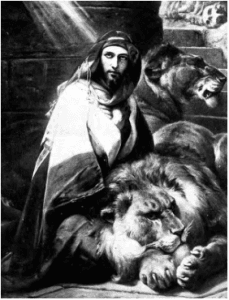
“And when he came to the den, he cried with alamentable voice unto Daniel. And the king spake and said to Daniel, O Daniel, servant of the living God, is thy God, whom thou servest continually, able to deliver thee from the lions? Then said Daniel unto the king, O king, live for ever. My God hath sent his angel, and hath shut the lions’ mouths, that they have not hurt me; forasmuch as before him innocency was found in me. And also before thee, O king, have I done no hurt. Then was the king exceedingly glad for him, and commanded that they should take Daniel up, out of the den. So Daniel was taken up, out of the den, and no manner of hurt was found upon him, because he believed in his God.”–Daniel 6:19-23 Daniel was now a free man. The sentence had been carried out and he had not been harmed. But so great was their hatred of Daniel that his enemies would not give up even then. Josephus tells us something from tradition which may be true. He says that when Daniel was delivered from the lions’ den, the conspirators wanted him thrown in again, claiming that someone had fed the lions before he was first cast to them and that they had not hurt Daniel because they were not hungry. This gave the king just the opportunity he wanted. He had bitterly resented their trickery in using him against his most loyal and trusted officer, so he said to them, “Very well, if the lions are not hungry, they won’t harm you either,” and he had them all thrown into the den! Now it was a different story. As the enemies of Daniel dropped in, one by one, they didn’t even touch the ground alive. The lions leaped up, and with savage blows of their powerful paws, broke their bones to pieces, and devoured them.
The remaining verses of the chapter show what a powerful witness for the true God was given to the entire world by this event in the life of Daniel. King Darius wrote a “tract.”
“Then king Darius wrote unto all people, nations and languages, that dwell in all the earth: Peace be multiplied unto you. I make a decree, That in every dominion of my kingdom, men tremble and fear before the God of Daniel; for he is the living God, and stedfast for ever.” Daniel 6:25,26
Then he wrote something that shows Daniel had told him of the future Messianic kingdom of God and that Darius believed in it. He said, in his letter to all the world:
“And his kingdom is that which shall not be destroyed, and his dominion shall be even unto the end. He delivereth and rescueth and he worketh signs and wonders in heaven and in earth; who hath delivered Daniel from the power of the lions.” Daniel 6:26,27 That “tract” had quite a circulation. It was translated into every language of the world. So you see worldwide broadcasts of the truth are not entirely new. The account ends with the words, “So this Daniel prospered in the reign of Darius, and in the reign of Cyrus, the Persian.”
Lessons for Us
Let us consider some of the valuable lessons taught by this inspiring experience of Daniel. The fact that righteous Daniel was hated by his unrighteous colleagues reminds us of the apostle’s testimony:
“Yea, and all that will live godly in Christ Jesus shall suffer persecution.”2 Timothy 3:12
Our Lord said:
“If ye were of the world, the world would love its own; but because ye are not of the world, but I have chosen you out of the world, therefore the world hateth you.” John 15:19
Evil men dislike the company of the pure in heart because it continually condemns them. Someone has truly said:
“Whosoever does well, and is faithful and true, while others are dishonest and false, must expect to be opposed and hated. Every effort will be made to injure his character; to drag him into the mire; and to make it appear that he is not better than those who assail him. Envy is sharper than a serpent’s tooth, and deadlier than the poison of asps.”
This was exemplified in the case of our Lord. Mark tells us that it was for envy that the Jews delivered him to be crucified. (Mark 15:10) Jesus said he was “hated without a cause.” (John 15:25) This is just what Daniel experienced.
Envy and hatred are set down in the word of God as works of the flesh and of the devi extremely evil and antagonistic to everything that is good, right and approved by the Lord. Envy must be rooted out of our hearts if we would ever be of the kingdom class. The spirit of envy and hatred cannot abide in a heart in which the spirit of the Lord abides. The two are opposite in every way. You either have one or the other you cannot have both. The spirit of the Lord is the spirit of love, which thinketh no evil, is not envious, has no hatred. (1 Corinthians 13:4-6)
To implement their scheme to destroy faithful Daniel, his enemies used flattery on King Darius. In effect they said: “You are the most wonderful man in the world. You are a veritable god. Let no one ask anything of any god or any other man, except you, O king!” Flattery is an insidious thing and is often used by the devil for the destruction of the Lord’s people. Consider an incident in Acts chapter 14. Paul and Barnabas went to Lystra and Paul began to preach. In the audience was a man who was a hopeless cripple, who had been born so, and had never stood upon his feet nor walked in his life. As Paul preached Christ, this man gave very careful and rapt attention. He seemed to be eating every word. Noticing his faith, Paul paused and pointing to him said in a loud voice: “Stand upright on thy feet!” The man immediately did so and walked, even leaped. The idolaters who composed the audience were astonished at the miracle. “The gods have come down to visit us,” they shouted. According to their tradition, the gods Jupiter and Mercury, whom they worshipped, had visited Lystra many years before, in the form of men. In mythology Jupiter was the supreme god of heaven; Mercury was the god of eloquence and the herald of Jupiter. In fact a statue of Jupiter had been erected at the gate of the city. So since Barnabas was the larger of the two men, they concluded he was Jupiter; since Paul was the orator, they took him for Mercury. They enthusiastically spread the word and a large crowd gathered. Soon the high priest of Jupiter appeared with oxen and other paraphernalia, prepared to lead the people in offering worship and sacrifice to Barnabas and Paul. The people crowded around and bowed to them, shouting with joy and praise.
Paul could have been affected by this flattery. He could have reasoned: “Why not let them, for the moment, think we are gods. What harm will it do? In fact they will listen to us and respect our message the more. And in a sense, we are gods! Isn’t it written in Psalm 82:6, I have said, ye are gods; and all of you are children of the Most High? Our Lord Jesus himself quoted this scripture (in John 10:34). Did any such thought cross Paul’s mind? Let us read the account:
“And they called Barnabas, Jupiter, and Paul, Mercury, because he was the chief speaker. Then the priest of Jupiter, which was before their city, brought oxen and garlands unto the gates, and would have done sacrifice with the people; which, when the apostles Barnabas and Paul heard of, they rent their clothes, and ran among the people, crying out, and saying, Sirs, why do ye these things? We also are men of like passions with you, and preach unto you, that ye should turn from these vanities unto the living God, who made heaven and earth and the sea, and all things that are therein.” Acts 14:12-15
The Lord’s people can draw an important lesson from this incident, especially those who are, to any extent, prominent as representatives and teachers of the truth. The truth itself, as the Lord has revealed it to us, is so wonderful, so brilliant, that it naturally reflects some of its brilliancy upon those who represent it. This causes men to marvel and say of such, as they said of Jesus: “Whence hath this man this wisdom, and these mighty works?” (Matthew 13:54) In some instances it might lead to an undue deference to such, to an ascribing of undue honor, to a subservience that would not be proper for them to receive. “One is your Master … and all ye are brethren.” (Matthew 23:8) Any put to this test should repudiate and refuse undue honors as promptly and emphatically as Paul and Barnabas did, and not be influenced by flattery, not accept it, nor rationalize that it can be turned to the glory of the Lord. Even more importantly, the brethren should not subject their teachers and leaders to such temptations. There is an entirely proper respect for elders (see 1 Timothy 5:17,18). Everyone needs sincere encouragement and reassurance at times. But undue honor and insincere flattery should be shunned as instruments of the devil which can develop pride, vanity and destroy the new creature.
When Daniel learned that King Darius had signed the decree designed to kill him, he may have momentarily felt a pang of fear. After all, he was human. But I am sure he was not terrified, like Belshazzar when he saw the mysterious hand upon the wall. Belshazzar was really scared: “The joints of his loins were loosed and his knees smote one against the other.” (Daniel 5:6) As someone once advised, “If your knees are knocking, kneel on them.” Daniel lost no time in going to the Lord in prayer even though by so doing he gave his enemies just the evidence they needed against him. The lesson is that we should never allow anything to keep us from the throne of grace. Prayer should become a fixed habit with us as it was with Daniel, a frequent and joyful interlude when we talk to our heavenly Father, sharing our joys and sorrows; the windows of our hearts open toward Zion, the heavenly Jerusalem; our hopes centered on the kingdom of God to which we aspire.
When Daniel dropped into the den of lions, he was fully reconciled to death. But he was not hurt. As for us, our worst fears often never happen. What a waste of time to worry once you have entrusted a matter to the Lord! There is an old saying: “Fear knocked at the door. Faith answered. No one was there!” God is able to deliver us from every evil. If he permits evil to come upon us, it will be overruled for our good. He has promised this. Faith can firmly trust him, come what may.
Not many of the Lord’s people have been cast into dens of literal lions. Yet, at times, quite a good many of them have had experiences that strongly resemble this. Paul, in recounting his experiences, mentions a variety of perils and then ends by specifying “perils among false brethren.” (2Corinthians 11:26) It is possible for human mouths to do more harm than the mouths of lions. The apostle James points this out:
“How great a forest is set ablaze by a small fire! And the tongue is a fire. The tongue is an unrighteous world among our members, staining the whole body, setting on fire the cycle of nature, and set on fire by hell [Gehenna]. For every kind of beast, and bird, of reptile and sea creature, can be tamed, and has been tamed by humankind; but no human being can tame the tongue; a restless evil, full of deadly poison. With it we bless the Lord and Father, and with it we curse men, who are made in the likeness of God. From the same mouth come blessing and cursing. My brethren, this ought not to be so!” James 3:5-10, Revised Version
I have grown old in the truth. I have been in the narrow way since 1914. During this time I have seen many strange things. I have even seen men of God cast to lions and devoured. I have seen faithful elders deprived of their ministries by vicious gossip. As James said: “My brethren, this ought not to be so!” Gossip is never innocent. It is always vicious and reprehensible. We know that the tongue cannot be entirely tamed. We read, “If any man offend not in word, the same is a perfect man.” (James 3:2) But the tongue can and must be bridled, it must be restrained; control must be exercised. If it is not, we will lose the high calling because James says:
“If any man among you seem to be religious, and bridleth not his tongue, but deceiveth his own heart, this man’s religion is vain.” James 1:26
The fact that Daniel was not injured by the lions reminds us of Psalm 34:7: “The angel of the Lord encampeth round about them that fear him and delivereth them.” It is significant that the Lord did not keep Daniel from being cast into the den of lions. God does not always protect us from a threatening disaster. He may allow us to be cast to the “lions,” so to speak, but as with Daniel, his angel will be there. No real injury to the new creature will result. We are assured that whatever we experience, no matter how tragic it may seem at the time, will be for our highest, best and eternal spiritual welfare. Those who have the faith to claim this promise will have the “peace of God.” (Philippians 4:7)
In the account we find that those who conspired to have Daniel cast to the lions were themselves cast into the same den. This principle is enunciated in the psalms:
“He made a pit and digged it, and is fallen into the ditch which he made. His mischief shall return upon his own head, and his violent dealing shall come down upon his own pate.” Psalms 7:15,16
“In the net which they hid, is their own foot taken. The Lord is known by the judgment which he executeth: the wicked is snared in the work of his own hands.” Psalms 9:15,16
It is not for us to think of having our enemies devoured when we are delivered. It is not for us to rejoice over their fall. The Lord has said, “Vengeance is mine; I will repay.” (Romans 12:19) Instead of wishing our enemies devoured, we are told: “If thine enemy hunger, feed him; if he thirst, give him drink.” (Romans 12:20) Our attitude should be love and sympathy toward all the world of mankind including those who persecute us, injure us and say all manner of evil against us. Stephen gave a wonderful example of this Christian attitude. While his enemies were killing him, he prayed for them saying, “Lord, lay not this sin to their charge.” (Acts 7:60) All judgment and vengeance must be left to the Lord.
In Hebrews chapter 11 Paul tells of worthy men of ancient times, men of great faith, who pleased God. They suffered and endured many things that they might obtain a better resurrection. Verse 33 describes Daniel: “Who, through faith, subdued kingdoms.” He arose to a position of rulership, first in Babylon, then in Medo-Persia. “Wrought righteousness,” or as Moffatt says, “Administered justice.” It was Daniel’s just administration that enraged his enemies. “Obtained promises.” By his steadfast faithfulness, Daniel obtained the promise God made to Israel:
“The Lord shall cause thine enemies, that rise up against thee, to be smitten before thy face. They shall come out against thee one way, and flee before thee seven ways.” Deuteronomy 28:7
“Stopped the mouths of lions.” What a thrill to think of those great beasts rendered harmless before Daniel, and to realize that the same God is watching over us!
We read, “Instead of thy fathers, shall be thy children, whom thou mayest make princes in all the earth.” (Psalms 45:16) What a wonderful “prince” Daniel will make, with his wisdom, integrity and experience in rulership! Together with other ancient worthies, he will continue to administer justice in that glorious Messianic kingdom for which he looked and told Darius about, and of which it is written:
“Behold the days come, saith the Lord, that I will raise unto David a righteous Branch; and a king shall reign, and prosper, and shall execute judgment and justice in the earth.” Jeremiah 23:5
Daniel will feel very much at home in that kingdom!
The Displeasures of Jesus
“When Jesus saw it, he was much displeased.” Mark 10:14 JESUS has picked some very ordinary men of humble origins and occupations to be his disciples. Now Jesus’ great popularity had suddenly thrust these men into positions of prominence. Before Jesus became “despised and rejected of men” there was a period of time when he was immensely popular. It was the result of his mighty miracles. We read:
“His fame went throughout all Syria. … And there followed him great multitudes of people, from Galilee, and from Decapolis, and from Jerusalem, and from Judaea, and from beyond Jordan.” Matthew 4:24,25
There are numerous other texts that tell of the multitudes that followed him everywhere he went. On one occasion the tremendous crowd pressed upon him so closely that he went on a boat and pushed off from the shore to escape for a little while. On another occasion after he had miraculously fed 5,000 persons with five barley loaves and two small fishes, he attained such tremendous popularity they wanted to take him by force to make him a king! (John 6:15)
These humble disciples suddenly became important men. They were now the personal aides and intimate associates of a man recognized by the people as a great prophet, teacher and healer: Messiah, the King of Israel, the most famous personage in the land. The disciples had not yet received the holy spirit. So what was the result of this popularity? It went to their heads. With probably the best of motives they began to assume authority, to decide who should see Jesus and who should not. “After all,” they reasoned, “he is a very busy man; his time and energy should be rationed.” So they presumed to judge certain things as unworthy of Jesus’ time and attention. This included the children.
It didn’t take the mothers long to realize Jesus loved children. They brought their young children for him to caress and bless. But this seemed highly improper and wasteful of time in the disciples’ eyes. In their self-importance they rebuked the mothers and attempted to forbid the children to come to Jesus. The record says “when Jesus saw it, he was much displeased.” (Mark 10:14) He insisted that the children be allowed to come to him. He took that occasion to point out to his disciples that they would do well to emulate the humble, unassuming spirit of little children. It didn’t do much good. Feeling more and more important they even tried to decide who should be healed and who should not be healed.
Once a poor blind beggar on the Jericho Road heard Jesus passing by, accompanied by the usual multitude. He realized that this was the only chance he would ever have to regain his sight. There was no one to help him, to lead him to Jesus. So with every ounce of energy in his being, he cried out, over and over again: “Jesus, Jesus, thou Son of David, have mercy on me!” Those who went before Jesus, presumably his disciples, immediately pounced on him, commanding him to be silent. Couldn’t he see that the Master was deep in thought? Who was he to interrupt? “Keep still, blind man! Get back where you belong!” But frantic hope knows no reserve. It was the poor fellow’s one possible chance. He cared no more for their rebuke than they for his need. Again the shrill, insistent voice: “Jesus, thou Son of David, have mercy on me!” Jesus stopped. “Who called my name?” “Nobody, Master; only a poor blind beggar; a worthless fellow; nobody at all.” “Bring him here!” Jesus commanded. Trembling with hope, he was guided forward. The deep, rich eyes of the Master looked into those sightless eyes.
“And Jesus said unto him, Receive thy sight; thy faith hath saved thee. And immediately he received his sight, and followed him, glorifying God. And all the people, when they saw it, gave praise unto God.” Luke 18:35-43
Thus the poor, useless blind beggar became a follower of Jesus, and started a chain reaction that caused many other people to praise God. This was the one they tried to keep from seeing Jesus, though with the best of motives and the greatest zeal, I am sure.
Pride Displeases Jesus
Pride feeds on itself. The disciples felt they were great men indeed. Now the time came when they began to squabble about who should be greatest in the kingdom. Two brothers, James and John, sought from Jesus the positions of greatest prominence, saying: “Grant unto us, that we may sit, one on thy right hand, and the other on thy left hand, in thy glory.” Jesus patiently explained to them, that there were difficult qualifications to be met and that even then, such an honor was not his to give. Then we read:
“And when the ten heard it, they began to be much displeased with James and John.” Mark 10:37,40,41
Here they were, fighting and bickering over personal advantage when the harvest was so great, there was so much to do, and there was so little time! How sorely it must have tried Jesus’ patience!
Then there was the incident that aggravated Jesus the most of all. The disciples now tried to exercise authority over him personally, to deter him from his prime objective. He had come to provide a ransom and this necessarily meant his death. As the time approached, he began to prepare his disciples for the event so they would not be taken completely by surprise. We read:
“From that time forth, began Jesus to show unto his disciples how that he must go into Jerusalem, and suffer many things of the elders and chief priests and scribes and be killed, and be raised again the third day.” Matthew 16:21
This was a rude shock to the disciples; they just couldn’t believe it. Their Master had built up great popularity; he had but to give the word to be proclaimed king. With his miraculous powers he could release Israel from Roman rule and re-establish the throne of David in power and glory. They confidently trusted that this was he, which should redeem Israel. (Luke 24:21)
They expected to reign with him. Had he not said that they should sit with him on his throne? So they didn’t like hearing what Jesus now told them. He should stop this foolish talk of dying when he had so much to live for! They probably talked it over and made Peter, the boldest among them, their spokesman. He was to take Jesus aside and “straighten him out,” to talk some sense into him! We read: “Then Peter took him, and began to rebuke him, saying, Be it far from thee, Lord. This shall not be unto thee. But he turned and said unto Peter, Get thee behind me, Satan; thou art an offence unto me; for thou savorest not the things that be of God, but those things that be of men.”–Matthew 16:22,23
This seemed to be a drastic thing for Jesus to say, to call Peter by the name Satan. Satan is the greatest enemy of God. Peter was his beloved disciple. Why did Jesus use such an expression? I’ll tell you why. When Peter tried to deter Jesus from his prime objective of redeeming the world by his death through the suggestion that he could reign without dying, he sounded exactly like Satan, who, we read:
“… taketh him up into an exceeding high mountain, and showeth him all the kingdoms of the world, and the glory of them; and saith unto him; all these things will I give thee, if thou wilt fall down, and worship me.” Matthew 4:8,9
Jesus saw that Satan was now using Peter to apply the same temptation: “You don’t have to die. You can establish your kingdom here and now.” Do you see the similarity, do you see the sameness of the temptation? Jesus did. On that first occasion of his temptation in the wilderness, Jesus had replied: “Get thee hence Satan.” (Matthew 4:10) Now when Peter voiced exactly the same temptation, Jesus saw that it was really the voice of Satan subtly operating through the fleshly minds of his disciples. So when he said, “Get thee behind me, Satan,” he was addressing himself not so much to the innocently motivated Peter, as to the real villain behind the scenes: Satan the devil, the great adversary. He called him by name.
Then Jesus used this occasion to teach his disciples one of those divine principles which the world can never understand because it is exactly contrary to the spirit of the world. He said:
“For whosoever will save his life, shall lose it; and whosoever shall lose his life, for my sake, shall find it.”–Matthew 16:25 Although this is illogical and a contradiction of terms to the world, we know how beautifully true it is.
Lessons from these Incidents
These are several occasions where the disciples displeased Jesus. We do not relate these incidents to hold the disciples and early followers of Jesus up to ridicule. We know that the holy spirit had not as yet transformed their minds. Their thought processes were still those of natural men of good will. Considering their backgrounds and the situation in which they found themselves, their reactions are quite understandable. I am sure we would not have done better. But there are lessons to be learned from these accounts. That’s why they were recorded and preserved for us; they were written for our admonition. By considering the things which were displeasing to the Lord, perhaps we can learn how to be more pleasing to him. I am sure that is what we all want.
Underlying these displeasing acts was a disposition to take things into their own hands. Without asking Jesus if he wanted to see the little children, they rebuked the mothers who brought them. Knowing that Jesus healed all who asked him, they told the blind beggar to hold his peace. Having been promised thrones by Jesus, they tried to force a decision as to who would occupy the most important ones. When Jesus said that he must die, they attempted to dissuade him from the very purpose for which he came to earth. In other words, instead of following they tried to lead. How short their memories were! What had Jesus said to them when he called them to be his disciples? Only two words, but in each case it brought from them an instant response. The words were FOLLOW ME! Just “Follow me.” And they did, leaving everything. They left their net, their ships, their homes: everything! As Peter said to Jesus: “Lo, we have left all and have followed thee.” (Mark 10:28) Then they were humble and willing to follow. Now they were important, they were somebody, they wanted to lead. That is why Jesus rebuked them so severely; he knew that to be faithful unto death, they must continue to follow. That is why, in the very next verse, after he had called Peter “Satan,” he said, “If any man will come after me, let him deny himself, and take up his cross and follow me.” Matthew 16:24
After his glorification he caused the Revelator to write regarding the overcomers: “These are they which follow the Lamb whithersoever he goeth.” (Revelation 14:4) That is what we must do. Jesus himself said, “Narrow is the way which leadeth unto life.” (Matthew 7:14) It is indeed a narrow way, narrow in the sense that straying, even a little, to one side or the other, takes us off the path. The only safe way is to walk right down the middle in the footsteps of Jesus, to follow in his steps.
There is another lesson. Just as the early disciples sometimes reacted improperly in their association with Jesus, some associated with the truth today begin to have “original” ideas. We all do, to a certain extent; and it may be all right to present these ideas as interesting thoughts on a take-it-or-leave-it basis. But some try to lead with these new, and supposedly original ideas, revelations and flashes of new light. Let us learn to follow. Did any of you get the truth by yourself? No! Our Lord revealed the truth to us through his faithful and wise servant whom he made ruler over all his goods, and this means all the beautiful doctrines of the Divine Plan of the Ages. We cannot improve on the Divine Plan of the Ages as that servant saw and taught it. The only things we see more clearly as time goes on, are the fulfillment of prophecies as they occur.
What further lessons can we derive from these incidents that displeased Jesus? In the first incident the disciples, in their misplaced zeal, forbade the children to come to Jesus. These children were drawn to Jesus, they loved him, but they were told they may not come to him: “When Jesus saw it, he was much displeased.” Don’t you think he is just as much displeased today when some of God’s children are drawn to Jesus, want to come to him, follow in his footsteps, lay down their lives and die with him, and then are told that the door is shut to the high calling? I think he is very displeased! When the blind beggar on the road to Jericho heard Jesus was near, he tried earnestly to reach him. Being blind, he cried out, and tried to grope his way toward Jesus. Paul perfectly described this scene in his sermon to the Athenians on Mars Hill, when he said of some: “That they should seek the Lord, if haply they might feel after him, and find him, though he be not far from every one of us.” Acts 17:27
“If haply they might feel after him, and find him” does describe the blind man, does it not? There are some today who are blind to God’s plans and purposes, blind to his loving provision for the restoration of mankind, blind to the high calling of God in Christ Jesus, but who are longing to have their eyes opened; hungering and thirsting after righteousness, who drift from one denomination to another, from one church to another, never completely satisfied. They realize their own blindness but are always searching, groping, crying out in prayer, feeling after the Lord if haply they might find him! Many of the friends in present truth have testified that this was their condition before they found the truth, before their eyes were opened.
Now what happened back there on the road to Jericho, when the poor blind man tried to reach Jesus, when he cried out for mercy? “And they which went before, rebuked him, that he should hold his peace!” (Luke 18:39) Think of it! They repelled him, they pushed him aside, they tried to dash his last hope, to close the door to him! Are there some who are closing the door today, who say to the groping blind man: “You are too late, you may not have your eyes opened, you may not see the deep things of God, you may not run for the prize of the high calling?”
Ah, but there were others there also, other disciples, that day on the Jericho Road. When Jesus heard the blind man, and stood still, and commanded the blind man to be brought to him, these others said to the poor man: “Be of good cheer; rise; he calleth thee.” They led him to Jesus! Jesus asked him, “What wilt thou that I shall do unto thee?” (As if he didn’t know!) The Lord knows we are blind before we are called but we have to admit our blindness to ourselves and to the Lord before we can be healed of it; we must realize that we are blind and must earnestly want our eyes to be opened. So the blind man answered, “Lord, that I may receive my sight. And Jesus said unto him, receive thy sight; thy faith hath saved thee; and immediately he received his sight, and followed after him.” Thus was demonstrated the verity of Jesus’ words which still apply today: “Him that cometh to me, I will in no wise cast out.” (John 6:37) Let us by God’s grace be ready to lead the earnestly inquiring blind ones to Jesus, saying as they did so long ago on the Jericho Road, “Be of good cheer! Rise up! He calleth thee!”
Ambition Displeases Jesus
Consider the incident when the two sons of Zebedee sought the honor of sitting one on the right hand and one on the left hand of Jesus in his glory. These two disciples exhibited an ambitious desire to be more important than their brethren, to exercise authority over their brethren. When the ten others heard it, they were much displeased. Jesus must have been displeased, too, and disappointed. But he was very patient and used the occasion to teach them all an important lesson:
“Jesus called them unto him, and said, Ye know that the princes of the Gentiles exercise dominion over them; and they that are great, exercise authority upon them. But it shall not be so among you!” Matthew 20:25-27
In other words, earthly rulers do exercise authority over their subjects; they do exalt men to sit at their right and left hands and to compel obedience. BUT IT SHALL NOT BE SO AMONG YOU. A church system may have a Pope, with Cardinals, and Bishops seated on his right and left. He may arbitrarily dictate the beliefs and ceremonials of their adherents. “But it shall not be so among you.”
Another complicated organization or society may assume similar dictatorial powers, with some established in positions of superior authority, dictating what its members must believe and teach, what meetings they shall attend, how they shall serve, what hours they must spend in that service, and how they must report their service. Such exercise total spiritual control. “But it shall not be so among you.”
Self-aggrandizement Displeases Jesus
Jesus went on to say, “But whosoever will be great among you, let him be your minister; and whosoever will be chief among you, let him be your servant.” It is one thing to be called a Company Servant, but in reality be the administrator of the arbitrary rules of a distant headquarters. It is quite another thing to be a servant of an ecclesia and follow the Lord’s leading as expressed by the holy spirit through God’s word and the members of the ecclesia. There is no excuse for spiritual domination. If any should dominate your faith, wouldn’t the apostles be the most appropriate? Paul himself said, “Not for that we have dominion over your faith, but are helpers of your joy.”–2 Corinthians 1:24
Then there is the time when Peter sought to dissuade Jesus from going to Jerusalem to die. “Be it far from thee, Lord,” he said. Jesus saw the hand of Satan in it. The disciples wanted Jesus to establish his kingdom then and there, and, of course, they expected to reign with him. That’s what Satan wanted as well. Satan had openly suggested to Jesus, “Why wait?” After showing him all the kingdoms of the world, Satan had said, “All this power will I give thee, and the glory of them.” (Luke 4:6) Why wait? Why suffer? Why die? Let’s get on with the kingdom! Let’s start blessing the world! Surely everybody is in favor of blessing the world! Nobody could object to that! That’s an old trick of Satan’s; he tried it in Paul’s time, on the Corinthian brethren. Some of them were already grasping honor and power, imagining that somehow they were reigning with Christ then. How do we know? Because it was necessary for Paul to rebuke them for it. He said:
“Now ye are full, now ye are rich, ye have reigned as kings without us, and I would to God ye did reign, that we also might reign with you!” 1 Corinthians 4:8
Satan tried the same old trick again after the apostles fell asleep. Ambitious leaders of the early church became impatient.
The last words from Jesus, speaking through John the Revelator had been, “Surely I come quickly.” John eagerly responded, “Even so come, Lord Jesus!” (Revelation 22:20) But he didn’t come quickly enough to suit them. What did they do? They hurried things up! They forced the issue. They set up Christ’s kingdom for him–an imitation kingdom that became a wicked anti-Christ system. Thus they claimed and received Satan’s promise which Jesus had indignantly spurned: “All this power will I give thee, and the glory ofthem.” They got their power, and their glory; but the earth ran red with the blood of their victims.
Then finally came the end of the age and the joyful message went out that Christ had at last returned and had begun to set up his kingdom. Surely the kingdom must now appear in power and glory! Great expectation centered on the date 1914. But 1914 came and went, and still no visible kingdom. Other dates were set–1918 and then 1925. I know, I was there. Still no visible kingdom. Once again ambitious leaders became impatient. It was the perfect setting for that old trick of Satan’s to be repeated. Why wait? Let’s get on with the kingdom; let’s set up a ruling organization now! I think the lesson is obvious. Just asPeter was mistaken when he thought Christ’s kingdom could be established without the necessity of Jesus’ death and resurrection, so these are mistaken when they think the Messianic kingdom on earth can be manifest in power and glory before the death and resurrection of the last member of the Body of Christ. Just as Jesus rebuked Peter then, I believe his words of rebuke are applicable now: “Thou art an offence unto me.”
Calling Down Fire from Heaven
Let us consider one more occasion when Jesus was displeased (Luke 9:51-56). I am going to amplify and paraphrase the account. Jesus was on his way to Jerusalem for the last time. He knew that the end of his ministry was near, that he must suffer many things, that he must be offered up. He and his disciples had been walking all day over dusty roads. It was late in the afternoon and they were hot and tired. They saw a village from the top of a hill and it was a welcome sight. They would get food and rest there and continue their journey the next day. Jesus sent two disciples ahead to arrange accommodations for the night. They sat down to wait. Soon the messengers were seen returning. Even at a distance, it was plain that something was wrong. The two disciples approached with cheeks flushed and voices angry, each anxious to be the first to explode the bad news: the people in the village had refused to receive them!
The indignation of the messengers communicated itself to the others. They could hardly believe their ears! This backwoods Samaritan village refused to entertain the Master? Unthinkable! Jesus was a famous public character, a teacher of renown. He healed the sick, he raised the dead, he fed the multitudes. He was the Messiah, the king of Israel! Such large crowds followed him that even they, his disciples, had become men of importance. Now to have this country village deny them shelter! “Lord, these people are insufferable,” one of them cried. “Let us call down fire from heaven, and consume them!” The others joined in with enthusiasm! Fire from heaven! That was the idea! Make them smart! We’ll show them! Come Lord, the fire!
Jesus’ face showed the strain of the preceding weeks and in his eyes was a foreshadowing of the more bitter weeks to come. He needed that night’s rest more than any of them. “But he turned and rebuked them and said, Ye know not what manner of spirit ye are of. For the Son of Man is not come to destroy men’s lives, but to save them.” Then he quietly gathered up his garments and started on, his outraged disciples following. It is easy to imagine his disappointment. He had been working with them for three years, teaching and demonstrating the principles of love and mercy. His time with them was so short. He had come to save mankind yet they wanted him to gratify their personal resentments by burning up a village!
“And they went to another village,” says the narrative. Nothing more than that. Simple isn’t it? They just went to another village. The village that had refused to admit them required no fire. That village was already dealt with. How? I’ll tell you how. No miracles were performed in that village, no sick were healed there, no hungry were fed there, no gospel was preached there, no gracious words were spoken there, no children were blessed there. That was the penalty for its lack of hospitality, and it was quite enough. No fire was needed!
What lesson can we learn from this incident? Of course, in this case the disciples reacted with their fleshly minds in a way typical of the spirit of the world: retaliation and revenge for any offence, leave me alone, and I’ll leave you alone, tread on my corns and I’ll stamp on yours, enter my gate at your peril, beware of the dog, no trespassing! How different is the spirit of Christ, the spirit of patience, of forgiveness, of making allowance, giving the benefit of the doubt.
The spirit of Christ is the spirit of charity and love, love that suffereth long, that is kind, that envieth not, that vaunteth not itself, that is not puffed up, that is not easily provoked, that does not seek vengeance!
Later the apostle Paul would beautifully summarize it: “Recompense to no man evil for evil. … Dearly beloved, avenge not yourselves … for it is written, vengeance is mine, I will repay, saith the Lord. Therefore, if thine enemy hunger, feed him; if he thirst, give him drink, for in so doing thou shalt heap coals of fire on his head.”–Romans 12:17,19,20
Coals of fire! That’s quite another kind of fire, different from what the disciples wanted to call down from heaven upon that village. When you do something good to someone who has injured you, it has an astonishing effect, a powerful, soul-searching effect. You might say that it stops the mouths of lions! Paul knew this principle which is so foreign to the spirit of the world that it is a virtual secret. He said, “Being reviled, we bless.” (1 Corinthi ans 4:12) And we forgive.
Once there were two houses in the same block, adjoining one another. Both had beautiful lawns and gardens. The man of the world who owned one of the houses put up a sign reading:
“Trespassers will be prosecuted.”
The Christian who owned the other house also put up a sign. It read:
“Trespassers will be forgiven.”
That is the difference between the spirit of the world and the spirit of Christ. The Christian prays, “Forgive us our trespasses as we forgive those who trespass against us.” He practices it to the best of his ability. “If thine enemy hunger, feed him; if he thirst, give him drink.” “Being reviled, we bless.” The one who is now your enemy may be hungering and thirsting for the truth. You may bless him by feeding him with the word of life and giving him the water of life to drink.
Calling Down “Fire” Today
There is another lesson we can learn from this incident that displeased Jesus. It is a sadder lesson but yet one that cannot be ignored. There are some today, naming the name of Christ and Jehovah God, who, when they “enter a village” so to speak and are not accepted, call down “fire from heaven” upon those who do not accept their message. Those who do not believe their witness are condemned to the eternal fires of the Second Death. This is not to be taken lightly. This is a serious and terrifying thing. The Second Death is the greatest punishment that God will inflict upon anyone. To use it lightly as a threat is extremely presumptuous. To threaten millions with it shows a callousness of heart beyond belief. In the scriptures the Second Death is called “a fearful thing.” It is called “the blackness of darkness forever.” It is far worse to condemn one to such a fate than to call down literal fire to terminate one’s present existence as the early disciples sought to do. If Jesus rebuked those disciples for what they proposed, saying, “Ye know not what manner of spirit ye are of,” does not this rebuke apply with more force to these today?
We know the spirit Jesus was referring to. It is the spirit of Satan, the devil, and it is in opposition to the spirit of Christ. “For the Son of Man is not come to destroy men’s lives, but to save them.” Let us do what Jesus did when that village did not accept him. “And they went to another village.” All those who do not accept the truth in this age will have a full and complete opportunity to do so under ideal conditions in the next age. That will be the day of their visitation.
“Whereas they speak against you as evil doers, they may by your good works, which they shall behold, glorify God in the day of their visitation.” 1 Peter 2:12
We can learn from the things that displeased Jesus how we may please him.
Summary
Instead of imposing our wills in opposition to his, instead of trying to lead, we should learn to follow in his steps. We should never attempt to forbid God’s little ones from coming to Jesus by closing the door. We should tenderly lead to Jesus the spiritually blind who are “feeling after God, if haply they might find him.” We should not assume authority over one another nor seek to assume or assign positions of power in the kingdom. We should have respect for God’s “times and seasons” and wait patiently for the Messianic kingdom to be manifested. Let us not attempt to assume rulership ahead of time. Let our witness to the truth be given humbly, and lovingly, and in the spirit of good will toward all, honoring God. Only the “hearing ears” will hear now; but eventually God “will have all men to be saved, and to come unto the knowledge of the truth.” 1 Timothy 2:4
The Fall of Jericho
“By faith the walls of Jericho fell down, after they were compassed about seven days.” Hebrews 11:30
ONE DAY, when Moses was 120 years old, he heard the voice of the Lord. He eagerly responded because conversing with God was the greatest joy of his life. “Here am I!” he said. “Meet me at the top of the mountain,” the familiar and beloved voice of the Lord said. “I want to show you something.”
“And Moses went up from the plains of Moab unto the mountain of Nebo, to the top of Pisgah, that is over against Jericho. And the Lord showed him all the land of Gilead unto Dan, and all Naphtali, and the land of Ephraim, and Manasseh, and all the land of Judah; unto the utmost sea; and the south, and the plain of the valley of Jericho, the city of palm trees, unto Zoar. And the Lord said unto him, This is the land which I sware unto Abraham, unto Isaac and unto Jacob, saying, I will give it unto thy seed. I have caused thee to see it with thine eyes; but thou shalt not go over thither. So Moses, the servant of the Lord, died there in the land of Moab, according to the word of the Lord. And he buried him in a valley in the land of Moab, over against Bethpeor; but no man knoweth of his sepulchre unto this day.” Deuteronomy 34:1-6
Next we read from Joshua 1:1,2, “Now after the death of Moses, the servant of the Lord, it came to pass that the Lord spake unto Joshua, the son of Nun, Moses’ minister, saying, Moses my servant is dead. Now therefore arise, go over this Jordan, thou and all this people, unto the land which I do give to them, even to the children of Israel.”
When God used the expression “all this people,” he indicated a very large number. We learn from Exodus 12:37 that the Israelites who left Egypt forty years before had numbered 600,000 men, besides children. It has been suggested that this number is too great; that instead of 600 thousand, this scripture should read 600 families. But this interpretation does not seem to be correct because the scripture says “beside children” which Moffatt renders “beside women and children.” If families were meant, women and children would be included and not mentioned separately. Also, in the first two chapters of Numbers a breakdown by tribes is given. The precise total of adult males is shown in Numbers 2:32 as 603,550 excluding Levites. If we calculate five to a family, a not unreasonable assumption for so prolific a people, this would indicate a population of over three million! During their forty years sojourn in the inhospitable wilderness perhaps births did not greatly exceed deaths and there was no significant increase in the overall total. Nevertheless, we are safe to assume that, at the time of our lesson, Israel numbered at least three million. To better comprehend such a vast number, let us remember that the population of San Francisco is only about 700,000; the Israelites numbered more than four times as much! Now we have a better appreciation of the greatness of Israel and the tremendous area their encampment must have covered. Now we realize the problems involved in supplying and distributing their necessities and what an awesome responsibility of command Joshua was asked to assume when God told him: “Arise, go over this Jordan; thou and all this people.”
Lest Joshua be overwhelmed by this great responsibility placed upon him, God gave him a wonderful assurance:
“There shall not any man be able to stand before thee all the days of thy life. As I was with Moses, so I will be with thee. I will not fail thee nor forsake thee. Have I not commanded thee? Be strong and of good courage. Be not afraid, neither be thou dismayed; for the Lord thy God is with thee, withersoever thou goest.” Joshua 1:5,9