
Where Is the Lamb?
Then Abraham took a knife and the urn of live coals saved from their last campfire and they started out. They would walk the last few steps alone together. But Isaac had a question to ask his father. (It seems that boys are always asking questions of their fathers.) “Father,” he said, “Here am I, my son,” Abraham answered. Then Isaac said, “Behold the fire, and the wood; but where is the lamb, for a burnt offering?” (Genesis 22:7) Then, with what sounded like an evasive answer, but was really a grand prophecy, Abraham replied, “My son, God will provide himself a lamb for a burnt offering.” (Genesis 22:8) “So they went, both of them together, and they came to the place that God had told him of.” What was so special about this particular place? Why had the Lord required them to journey three weary days to this wild and remote spot? The answer shows how perfectly God has laid his plans, with what minute detail. He knows the end from the beginning. Long centuries afterwards, in the time of Solomon, this spot became the site of the temple Reprints, page 5180. and this very rock upon which Isaac was bound became the exact location of the brazen altar!
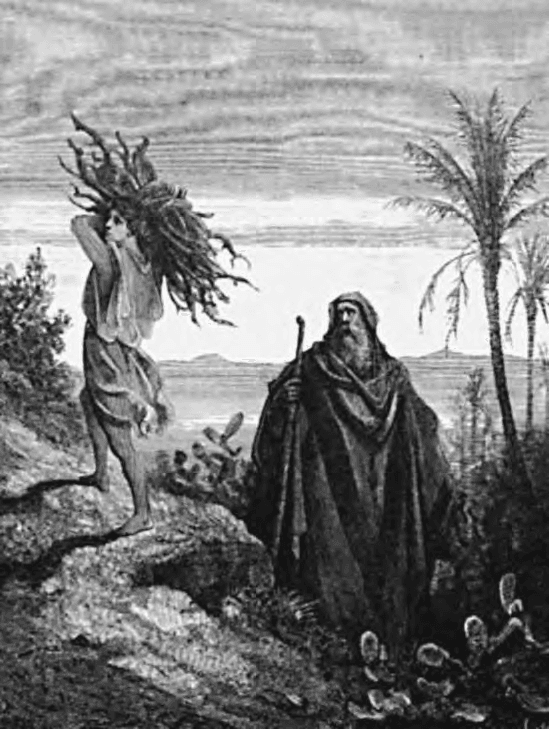
Then we read, (Genesis 22:9) “And Abraham built an altar there, and laid the wood in order, and bound Isaac his son, and laid him on the altar, upon the wood.” “Abraham bound Isaac, his son.” At this point Abraham could no longer keep his burdensome secret from Isaac.
Why? Because Isaac could not be bound against his will! Let us remember that at this time Abraham was about 125 years old and Isaac was a vigorous young man in his twenties.* But in any event, Abraham would not want to bind Isaac against his will even if he had been physically able to do so. So we see that this was a trial not only of Abraham’s faith, but of Isaac’s as well. This was Isaac’s first recorded opportunity to make a decision for God, to demonstrate his worthiness to inherit the great promises of God, by his submission to the will of God.
So Abraham undoubtedly revealed to Isaac the commandment he had received to offer him up as a burnt offering, and of course he would also tell Isaac of the wonderful conclusion he had come to, of his unshakable faith that Isaac would be raised from the dead. As a loving, humble, dutiful son, Isaac completely submitted himself to his father’s will and allowed himself to be bound upon the wood of the altar. How extremely rare today is such an attitude of submission of under-age children to the will of their parents! Indeed, the lack of it is one of the “signs of the times.” Paul said, “This know also, that in the last days perilous times shall come.” (2 Timothy 3:1,2) He cites “disobedience to parents” as one of the obnoxious traits exhibited at this time. Isaac’s act of complete submission to his father, even unto death, stands as a brilliant jewel in recorded human experience, a jewel that grows in luster as conditions in this time of the end deteriorate.