
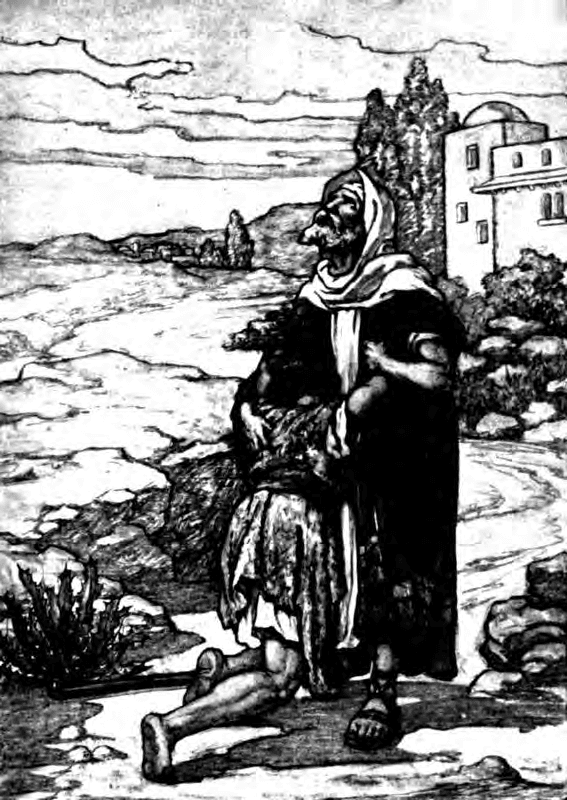
The way back must have been long and hard. On foot, without shoes, with tattered clothing, he begged his way from that far country. He finally reached his native land and as he approached his father’s fields, he probably rehearsed in his mind what he would say to soften the anger he expected from his father. Then we read in the parable: “But when he was yet a great way off, his father saw him.” Do you realize the full import of this? It means that his father was watching for him. It means more than that! It means that since the father did not know when his son would return or whether he would return at all that he had been watching for his son all the time every day longing for him, wondering where he was, whether he was well, how he was doing, if he was happy. He had been loving him, yearning for him, watching for him. No, it was no accident that he saw him when he was yet a great way off. There was something familiar about that plodding, ragged figure in the distance, and he had been watching for so long! How his heart must have leaped with joy as he recognized his son COMING HOME AT LAST! He did not wait for his son to approach, but ran to meet him. He threw his arms around him and kissed him over and over again. The long nightmare was over. The boy clung to his father and with tears streaming down his face he made his carefully prepared speech: “Father, I have sinned against heaven, and in thy sight; and am no more worthy to be called thy son.” But that’s as far as he got. He didn’t get the chance to say the rest–“Make me as one of thy hired servants.” His father silenced him by saying: “Bring forth the best robe, and put it on him; and put a ring on his hand, and shoes on his feet; and bring hither the fatted calf, and kill it; and let us eat, and be merry; for this, my son, was dead, and is alive again; he was lost and is found.”
The Parable’s Significance
That is the story. Let us consider the typical significance of the parable. Because of the circumstances under which the parable was given being addressed to the scribes and Pharisees and overheard by the publicans and sinners–we can expect that it primarily related to these two classes. The father who had two sons evidently represents Jehovah God. The two sons here represented the two general classes into which the Jewish nation had divided itself at that time. The elder brother who stayed at home represented the Pharisees and doctors of the law who outwardly and theoretically were in harmony with God.
Many of these were very conscientious. Paul had been one of this class. He declares that with all good conscience he had served the God of his fathers as a Pharisee. (Acts 26:5; Philippians 3:5) Doubtless there were others of this class whose intentions and desires were to remain loyal and obedient to the Heavenly Father, who sought daily by obedience to the law to remain “at home” with God. Jesus said of these, “The scribes and the Pharisees sit in Moses’ seat.” (Matthew 23:2) As a class they remained loyal to God in their outward profession at least, and in their endeavors, outwardly, to keep the law.
As the elder son in the parable was the heir of his father and to whom his father said, “All that I have is thine,” these Jews endeavoring to keep the law were, up to that time, “the seed of promise.” They were heirs of the promise, “In thee, and in thy seed shall all the families of the earth be blessed.”
The younger son represented the common people of the Jews those not so religiously strict as their ideals. This class misused and abandoned their privileges and opportunities as members of the nation of Israel, as beneficiaries of the divine promises. They wandered “afar off” into the ways of sin as publicans and sinners. They wasted their opportunities in self-gratification. They began to lose their identity as Israelites and became more and more like the pagan Gentiles around them. They thus wasted their inheritance. In the language of the parable they “wasted their substance with riotous living.” As the younger son of the parable, having wasted his substance, was degraded to the feeding of swine, being hungry and ragged, this younger-son class of publicans and sinners felt their degradation just as described in the parable. They were spiritually hungry, they were morally ragged, they were discontented and unhappy, they were despised and repudiated by the Pharisees and doctors of the law who considered them as having forever forfeited the promises, as being dead to the promises, regarding them as prodigals and sinners, worse than the Gentiles. They would not eat with them nor have any dealings with them. They would not greet them on the street. When they saw them coming, they crossed over to the other side. When they met them, they looked right through them. On the other hand, the publicans and sinners realized in large measure their own unworthiness.
These two attitudes are illustrated by another parable of Jesus:
“And he spake this parable unto certain which trusted in themselves that they were righteous, and despised others. Two men went up into the temple to pray; the one a Pharisee, and the other a publican. The Pharisee stood and prayed thus: God, I thank thee that I am not as other men are; extortioners, unjust, adulterers, or even as this publican. I fast twice in the week; I give tithes of all I possess. And the publican, standing afar off, would not lift up so much as his eyes unto heaven; but smote upon his breast, saying, God be merciful to me, a sinner. [Then Jesus gave the moral of the parable.] I tell you, this man went down to his house justified, rather than the other; for every one that exalteth himself, shall be abased; and he that humbleth himself, shall be exalted.” Luke 18:9-14
Just as the younger son in the parable of the Two Sons said, “I will arise, and go to my father,” these publicans and sinners felt a longing to be back in God’s favor–they were restless in their alienation from God. They felt it. They longed for rest in their father’s house, but it was hard for them to find their way back. They needed help to return; they needed direction.
When John came preaching repentance and a cleansing by water immersion, they flocked to hear him. Many were baptized of John. They were powerfully attracted to Jesus who unlike the scribes and Pharisees noticed them, preached to them, talked to them, and ate with them. He encouraged the publicans and sinners to come to him, laden with sins as they were. It was especially to such he addressed these words:
“Come unto me, all ye that labor, and are heavy laden, and I will give you rest. Take my yoke upon you, and learn of me; for I am meek, and lowly of heart; and ye shall find rest unto your souls.” Matthew 11:28,29
When Jesus ate with the publicans and sinners, the Pharisees criticized him:
“And when the Pharisees saw it, they said unto his disciples: Why eateth your Master with publicans and sinners? But when Jesus heard that, he said unto them, they that be whole need not a physician, but they that are sick.” Matthew 9:11,12
The Pharisees were theoretically whole. Outwardly they kept the law. They felt no lack, no need of a savior. But Jesus was sent to these who had strayed, to the prodigals, to the lost sheep. As he himself said, “I am not sent, but unto the lost sheep of the house of Israel.” (Matthew 15:24)
He did this as a representative of the Heavenly Father. He told them of the Father’s love for them. He revived their hopes. The Father himself had sent him to do this. It was, thus, an act of the Father, welcoming the prodigals of Israel back to his house. Many came to Jesus, repented of their sins, were welcomed back to the household of Israel to the Father’s house and were once again in line for the promises given to Israel: “In thee and in thy seed shall all the families of the earth be blessed.” Now we can understand what the parable means when it says:
“And he arose, and came to his father. But when he was yet a great way off, his father saw him, and had compassion, and ran, and fell on his neck, and kissed him. And the son said unto him: Father, I have sinned against heaven, and in thy sight; and am no more worthy to be called thy son. But the father said to his servants: bring forth the best robe, and put it on him; and put a ring on his hand, and shoes on his feet; and bring hither the fatted calf, and kill it; and let us eat, and be merry; for this, my son, was dead, and is alive again; he was lost and is found!”
This was the high calling of God offered to the humble and contrite Jews, the truly repentant ones, those who yearned for their Father’s house, who longed for the Messiah to come. This was the invitation to be transformed from fleshly Israelites to spiritual Israelites.
“He came unto his own, and his own received him not. But as many as received him, to them gave he power, to become the sons of God.” John 1:11,12
“The best robe” was nothing else but that wonderful Robe of Christ’s righteousness: JUSTIFICATION, a covering for their sins and imperfections through Jesus Christ to enable them to run for “the prize of the high calling,” to become the spiritual “seed of Abraham.” This was the “best” robe. It was the best thing that could possibly be offered to anyone.
“And put a ring on his hand,” the Father said. Do you remember when Pharaoh made Joseph ruler over all the land of Egypt? “And Pharaoh took off his ring from his hand, and put it upon Joseph’s hand.” (Genesis 41:42) When the king of Medo-Persia would honor Mordecai, we read that he “took off his ring … and gave it unto Mordecai.” (Esther 8:2) The ring was the symbol of investiture to office as heirs of God. Being of gold would signify a begetting to the divine nature. It was also a signet of the Father’s everlasting mercy, forgiveness and love.
“And put … shoes on his feet,” the Father said. This is a symbol of peace with God offered by Jesus Christ. As a part of the armor of God Paul says: “And your feet shod with the preparation of the gospel of peace.” (Ephesians 6:15) Peter described Jesus’ ministry as: “The word which God sent unto the children of Israel, preaching peace by Christ Jesus.” (Acts 10:36) Jesus himself said:
“Peace I leave with you; my peace I give unto you. Not as the world giveth, give I unto you. Let not your heart be troubled, neither let it be afraid.” John 14:27
The fatted calf was killed and a feast prepared for the prodigal. For the humble and repentant Jews who accepted Jesus as their Messiah, there was a “feast of fat things.” The majority of our Lord’s followers at his first advent and shortly thereafter were of this class. This was the early church. What a rich spiritual feast they received! The Holy Spirit poured out at Pentecost and flowing on to those who followed, opened their minds to all the beauties of God’s plan. Let us not forget that a fatted calf is the same as a bullock. The bullock was killed for them Christ died for them; they partook of Christ. Jesus himself said:
“Verily, verily, I say unto you, except ye eat the flesh of the Son of man, and drink his blood, ye have no life in you.” John 6:53
Now we come to that part of the parable where the elder son, looking in from the outside, sees the feast his father had given to his brother and is offended. We read: “And he was angry, and would not go in. Therefore came his father out, and entreated him.” When the scribes and Pharisees and chief priests saw Jesus extending the Father’s favor to “the lost sheep of the house of Israel,” they objected vigorously. They did not recognize the publicans and sinners as Jews at all. They felt that they and only they should be the favored ones.
Just as the elder son of the parable “said to his father, Lo these many years do I serve thee; neither transgressed I, at any time thy commandments,” they felt that their outward keeping of the law should be recognized and rewarded. They overlooked this admonition: “The Lord seeth not as man seeth; for man looketh on the outward appearance, but the Lord looketh on the heart.” (1 Samuel 16:7) They had no heart, no pity, no forgiveness for their erring brethren, and they resented the Father’s mercy and forgiveness offered to them through Jesus Christ. They were consumed with jealousy. We read: “Jealousy is cruel as the grave.” (Canticles 8:6) It was this jealousy-inspired cruelty that made them want to kill Jesus. This jealousy hardened their hearts to Jesus’ message and kept them from accepting their Messiah. As the parable says, they “would not go in.” But the humble, penitent, and contrite ones of the publicans and sinners accepted the Father’s invitation with joy and went in to the feast.
As the father in the parable rebuked the elder son, saying: “It was proper that we should rejoice and be glad; for this, thy brother, was dead, and is alive again; and was lost, and is found,” the scribes and Pharisees were rebuked by Jesus:
“Woe unto you, scribes and Pharisees, hypocrites! For ye shut up the kingdom of heaven against men; for ye neither go in yourselves, neither suffer ye them that are entering to go in.” Matthew 23:13
As the scribes and Pharisees were not in the right attitude of heart to receive their repentant brethren, neither would they have been in the right attitude of heart to be the Lord’s instruments of blessing in his kingdom. He selects for joint-heirs not the self-righteous who despise others but such as are of an humble heart, who love to dispense to others the mercies and favors they themselves have received.
Because the scribes and Pharisees, the leaders of Israel who sat in Moses’ seat, rejected Jesus and his message, THE LORDREJECTED ISRAEL, casting them off as his spiritual house or nation. Jesus proclaimed this fact when he said:
“Oh Jerusalem, Jerusalem … how often would I have gathered thy children together, even as a hen gathered her chickens under her wings, and ye would not! Behold, your house is left unto you desolate!” Matthew 23:37,38
Only the earthly promises were left to them.
Other Lessons
This is the primary significance of the parable. But there are many other lessons to be learned from it also. It contains principles which are of general application. Like a window to heaven, it gives us glimpses of our Heavenly Father’s glorious character and his mercies to men. Let us consider some of these lessons.
First there is a general outline of the Divine Plan contained in this parable. When the younger son of the parable wanted to leave his father’s house, he was permitted to do so he was a free moral agent. Similarly, Adam was permitted to take the wrong course without coercion by God. As the younger son “wasted his substance with riotous living,” Adam, in leaving the garden, dissipated his prospects of living forever. Satan may be said to be the master of the “far country” to which the son went, far from God, his love, protection and care. Satan has degraded men to the level of swine. They are on the level of beasts. As the wise man wrote:
“I said in mine heart, concerning the estate of the sons of men … that they themselves are beasts. For that which be falleth the sons of men be falleth beasts … As the one dieth, so dieth the other.” Ecclesiastes 3:18,19
Yes, they have become swine under Satan’s rule and in his service they starve for any really satisfying portion. They are physically destitute, morally filthy, ragged, spiritually hungry, and facing death. They long for better conditions to somehow return to their father’s house. Paul describes this: “that they should seek the Lord, if haply they might feel after him, and find him.” (Acts 17:27) In the millennial kingdom they do come home! They come from the “far country.” They come back from death and the grave.
“They shall come again from the land of the enemy … Thy children shall come again to their own border.” Jeremiah 31:16,17
As the father welcomed his son, the repentant ones shall be joyfully received, fully and completely forgiven provided a “feast of fat things” and restored to earthly sonship. Then will the Heavenly Father say in the words of the parable: “For this, my son [Adam] was dead, and is alive again; he was lost, and is found.”
There is another important application to be made of this parable. Fleshly Israel was a type or foreshadowing of spiritual Israel; the harvest of the Jewish Age was a pattern or foreview of the harvest of this Gospel Age. This suggests that the parable may be applied to nominal Christendom and the manifestation of the wheat and tare classes at the harvest time. For instance, there are many noble characters in the world who love to do right: people who are well- born, and well-environed after birth, well educated, honest and sincere in all their dealings, prosperous. Many are faithful church members given to charitable works, workers for peace and to raise the standards of the people. It would seem that these should be the very first ones who would be chosen of God for the high calling to be joint-heirs with his son in the kingdom that is to bless mankind. It would seem that they are already half-trained for such work. But the scriptures make clear that not many of this kind may be expected to be of the kingdom class. Not that God is unwilling to have them because of their education, wealth, and good morals. But it is these very qualities and the pride they generate that make them less ready to accept God’s terms. All are sinners whether they know it or not. All are unworthy. All should be honest enough to confess the fact just as the younger son of the parable said to his father: “I have sinned against heaven, and in thy sight; and am no more worthy to be called thy son.” God requires this very honesty, this very confession of our need, before that “best robe,” the merit of Christ, can be imputed to us, as covering our blemishes.
But the members of this “better” class, represented in the elder brother of the parable, feel important. Like the scribes and Pharisees of old they feel that in contrast with the lower strata of society they are perfection itself, that God would be sure to desire them above others. But what did he say? “Not many wise men after the flesh; not many mighty; not many noble, are called.” (1 Corinthians 1:26) Then he describes the ones he has called and chosen. See how closely this description fits the younger son of the parable, the one who foolishly wasted his substance: “But God hath chosen the foolish things of the world.” The younger son weakly followed evil ways: “And God hath chosen the weak things of the world.” He was debased to the level of the swine and despised himself: “and base things of the world, and things which are despised, hath God chosen.” He was finally brought down to nothing and he had nothing: “Yea, and things which are not, to bring to nought the things that are; that no flesh should glory in his presence.” It is these humble, repentant younger sons that the Father draws to himself and heartily welcomes and clothes with the “best robe” of justification, grants the gold ring of begettal to the divine nature, shods with peace, and serves them a bountiful feast of spiritual food.
God’s Glorious Character
Now we come to the lesson of the parable which I think is the most precious of all because it gives us a glimpse of God’s glorious character and his loving and merciful ways. Jesus knew his Father intimately and he skillfully wove into his parable an inspiring insight of the very emotions of God! He conveyed to his hearers what the Heavenly Father is really like using illustrations they could understand. No other scripture than this has been so helpful and encouraging to the poor and needy, the sinful and the weak, the degraded and debased who, realizing their undone condition, desire to return from the ways of sin, who reach out for something to grasp, to lift them up, to help them return to God and to their Father’s house. Reading this parable, such identify themselves with the condition of the younger son–in a far country, his substance wasted, friends unfaithful, hopes lost, brought down to the level of swine, his highest hopes turned to husks, and denied even these with which to fill his belly. They see themselves in this son! When they read of the son’s return and that, “when he was yet a great way off, his father saw him, and had compassion, and ran, and fell on his neck, and kissed him” they say, “Oh, if God is like that, if he is as loving and kind and merciful and forgiving as that, there is hope for me too!” They say, as the prodigal did: “I will arise, and go to my father!” They start back.
Just before Jesus gave this parable, he gave two others. From the parable of the hundred sheep one of which was lost and then found, he drew the lesson: “Likewise joy shall be in heaven over one sinner that repenteth, more than over ninety and nine just persons, which need no repentance.” From the parable of the ten pieces of silver one of which was lost and then found, he drew the lesson: “Likewise I say unto you, there is joy in the presence of the angels of God over one sinner that repenteth.” These are positive statements. How did Jesus know this? He had been there! He had seen it! He had participated in it! This “joy in heaven” and “joy in the presence of the angels of God,” is the joy of God himself! Think of that! God personally rejoices over each sinner that repents. The parable of the two sons confirms this most emphatically.
More than this, as the father in the parable missed his son and longed for him, watched for him so continuously that “when he was yet a great way off” he saw him, the Heavenly Father feels the alienation of the human family he created and greatly desires their return to him. As Job said: “Thou shalt call, and I will answer thee; thou wilt have a desire to the work of thine hands.” (Job 14:15) As the prodigal’s sin had not destroyed the father’s love for him but rather intensified it, God will love and prize his repentant and returned human family just as the father of the parable embraced and kissed his son who had been lost and was found. Think of this: if there is joy in heaven in the presence of the angels of God, over one sinner that repenteth, just think of the tremendous fullness of joy there will be when in the kingdom billions of sinners repent and return to their Father’s house!