
Confrontation on Mount Carmel
There is an important reason why Elijah requested they be gathered to Mount Carmel. Carmel is a prominent mountain in Israel. It is only about 1700 feet high. It has steep sides, but flattens out at the top into a large level area. In the west we call it a mesa, or –table- mountain. Carmel had –become a stronghold of Baal worship because it was the custom of the priests of Baal to erect their images, altars and groves on prominent hilltops. This gave a sense of dominance and dignity to their idols. Thus we read regarding idolatrous Israel: “And they set them up images and groves in every high hill.” (2 Kings 17:10) “[The nations] served their gods upon the high mountains, and upon the hills.” (Deuteronomy 12:2)
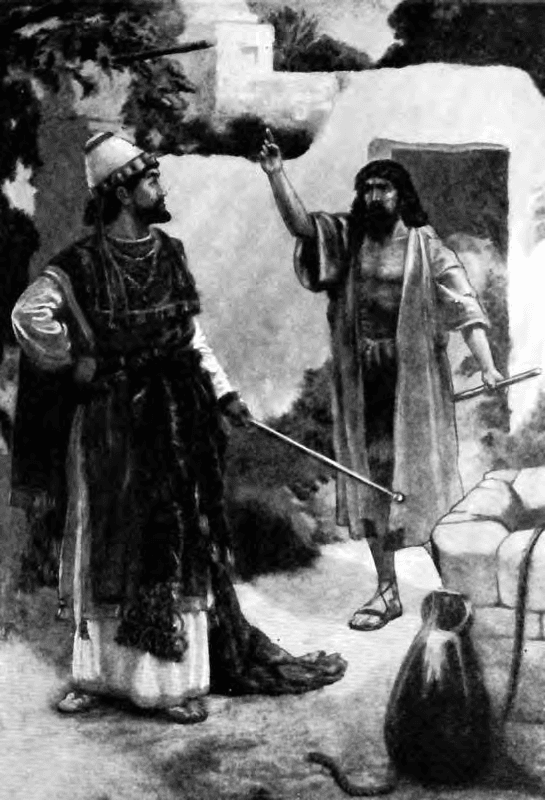
Elijah requested that the people and the prophets of Baal be gathered to Mount Carmel because it had become the center of Baal worship. His object was to give a demonstration before them all showing Jehovah God to be the only true God. He wanted the priests of Baal to be in their own familiar place of worship with their established images, altars, groves and other paraphernalia so it could not be claimed that they had been at a disadvantage in the test. Another reason to select Mount Carmel was that in ancient times an altar to Jehovah had been erected there, but its stones had since been scattered by the idolaters. This altar was to be vindicated.
So anxious was Ahab for rain to be restored to the land that he complied with Elijah’s request:
“So Ahab sent unto all the children of Israel, and gathered the prophets together unto Mount Carmel.” 1 Kings 18:20
The place of meeting atop Carmel was about 17 miles from the palace at Jezreel. At the command of the king and in anticipation of getting relief from the drought, the people arrived early in the morning by the tens of thousands. They made their way up the steep road of the mountain and gathered on the broad flat top. The king also came in his chariot, but Queen Jezebel sullenly remained at the palace. Row upon row the people formed a huge circle. In the center of the circle in an open area stood the image and altar of Baal surrounded by the sacred grove. Before this had gathered the 450 priests of Baal and 400 of Ashtoreth, all elaborately dressed in their colorful ceremonial robes. Facing them on one side, dressed in a plain leather garment, stood Elijah the prophet of God all alone. The odds were 850 to one! What do you think of those odds? Were they unfair? Not at all! It is a true saying that one man, with the Lord, is a majority.
We can imagine that there was a great hub-bub of voices as thousands of people excitedly talked to one another, wondering at the significance of the gathering and surprised to see that Elijah, a prophet of Jehovah, had been allowed to live in the presence of all those prophets of Baal. Then Elijah raised his hand, and the commotion ceased:
“And Elijah came unto all the people, and said, How long halt ye between two opinions? If Jehovah be God, follow him; but if Baal, then follow him. And the people answered him not a word.” 1 Kings 18:21
Of course “the people answered him not a word”! They didn’t know what to say. No doubt the great majority yearned to return to the worship of Jehovah and receive the return of his blessings. But now, right in front of them, were 850 vicious, idolatrous priests. All were supported in the royal palace by the king’s consent with full power and permission to take vengeance on any worshippers of the true God. These priests had a stranglehold on the people. They could take note of any who opposed them and perhaps seize their little children for burnt offerings to Baal. The people could not, they dared not, answer Elijah.
Elijah fully realized the situation. He knew that the only way the people could be released from their bondage to Baal was to expose and eliminate the priests of Baal. He had to do it single-handedly, as the Lord had directed him.
“Then said Elijah unto the people, I, even I only, remain a prophet of Jehovah; but Baal’s prophets are four hundred and fifty men.” (1 Kings 18:22) Then he told the people why they had been gathered there. He proposed a test that would demonstrate, beyond the shadow of a doubt, who the true God was. This would enable them to make a definite decision on the proposition: “If Jehovah be God, follow him; but if Baal, then follow him.” It was an eminently fair test which Elijah proposed:
“Let them therefore give us two bullocks; and let them choose one bullock for themselves, and cut it in pieces, and lay it on wood, and put no fire under. And I will dress the other bullock, and lay it on the wood, and put no fire under. And call ye on the name of your gods, and I will call on the name of Jehovah; and the God that answereth by fire, let him be God. And all the people answered and said, It is well spoken. And Elijah said unto the prophets of Baal, Choose you one bullock for yourselves and dress it first; for ye are many. And call on the name of your gods, but put no fire under.” 1 Kings 18:23,24
A Test of the True God
What could be fairer than that? The priests of Baal accepted the conditions of the test without protest. They thought it was a good idea because they would be using their regular altar on Mount Carmel, and that altar was rigged! The proposed test involved nothing new for them. It was their regular custom to deceive the people in this very manner! Tradition says that the altar of Baal was so constructed that one of the priests could hide inside and, at the proper moment, speak out a sepulchral voice and set fire to the wood under the sacrifice to make it appear to be a miraculous acceptance of the offering to Baal. (See Reprints, page 3406.) When Elijah proposed what he did, the priests of Baal must have laughed to themselves and eagerly accepted the terms. He was playing right into their hands, or so they thought.
“And they took the bullock which was given them, and they dressed it, and called on the name of Baal, from morning even until noon, saying, O Baal, hear us! But there was no voice, nor any that answered. And they leaped upon the altar which was made.” 1 Kings 18:26
When they shouted, “O Baal, hear us!” that was the cue. The priest hidden in the altar was then supposed to answer them and light the fire. But nothing happened. So they leaped upon the altar itself to punctuate their shouting. Still nothing!
Elijah was enjoying all this. He knew something they did not know. He knew that the man inside the altar was dead. Legend tells us that he was later found suffocated. Elijah began to taunt the prophets of Baal:
“And it came to pass at noon that Elijah mocked them, and said, Cry aloud; for he is a god. Either he is talking [on the phone, perhaps?], or he is pursuing, or he is in a journey, or peradventure he sleepeth and must be awaked. And they cried aloud, and cut themselves, after their manner, with knives and lancets till their blood gushed out upon them.” q1 Kings 18:27,28
That must have been a terrible sight: 850 frenzied men, prancing, leaping, and shouting with blood spurting out from self-inflicted wounds, staining their clothes and covering the ground.
“After noon, they raved on, till the hour of the evening sacrifices; but not a sound came. There was no one to answer them; no one to heed them.” 1 Kings 18:29, Moffatt
The hour of the evening sacrifice was three o’clock. If the test began at nine in the morning, they had been summoning Baal in vain for six hours. It was enough. They had failed and they knew it; Elijah stopped their performance. The priests of Baal fell to the ground in various stages of exhaustion.
Now Elijah beckoned to the people to come near him and the people responded. They had now lost their fear of Baal and the prophets of Baal. It had been demonstrated to them that the idol had no power so they came eagerly to Elijah. Elijah set them to work, helping rebuild the altar of Jehovah which had been so long neglected and fallen into disrepair. In contrast with the elaborately carved altar of Baal, it was severely plain: 12 natural stones, unshaped by human hands, arranged to form a table-like structure. We now read, starting with 1 Kings 18:30:
“And Elijah said unto all the people, Come near unto me. And all the people came near unto him. And he repaired the altar of the Lord that was broken down. And Elijah took twelve stones, according to the number of the tribes of the sons of Jacob, . . . And with the stones he built an altar in the name of Jehovah. And he made a trench about the altar, as great as would contain two measures of seed.” 1 Kings 18:30-32
This was not a small trench that Elijah dug. According to Young’s Concordance, a “measure” of grain or seed was equivalent to 10 ephahs of 7 1/2 gallons each. Therefore “two measures of seed” would equal 150 gallons. That was the capacity of the trench Elijah dug around the altar.
“And he put the wood in order and cut the bullock in pieces, and laid it on the wood, and said, Fill four barrels with water and pour it on the sacrifice, and on the wood.” 1 Kings 18:33
In those days they did not have wooden barrels such as we do today. What is here meant by the word “barrel” is an amphora, a large earthenware jar with two handles containing about ten gallons. At Elijah’s command, four of these were quickly filled at a nearby spring, the only one in the land still flowing, and forty gallons of water were poured on the altar.
“And he said, Do it the second time; and they did it the second time. And he said, Do it the third time; and they did it the third time. And the water ran round about the altar, and he filled the trench also with water.” 1 Kings 18:34,35
120 gallons were poured over the sacrifice thoroughly soaking it and the wood and overflowing into the trench. Then even more water was brought and the trench around the altar was filled to the brim.