
Stephen Is Executed
As the stoning began, Stephen again demonstrated how very much like his Master he had become. Hanging on the cross just before his death, Jesus had cried: “Father, into thy hands, I commend my spirit.” (Luke 23:46) Stephen now said: “Lord Jesus, receive my spirit.” Then Stephen kneeled down, giving his murderers a more compact target. As the heavy stones thudded against his body, he cried out: “Lord, lay not this sin to their charge. And when he had said this, he fell asleep.” (Acts 7:60) He just fell asleep. There is something so serene and comforting in this expression–a peacefulness and rest. It describes a child, tired at the end of the day, who falls asleep in its mother’s arms. I like to believe that the Lord tempered Stephen’s suffering at the end, that he died peacefully and gently, not in agony. He just fell asleep!
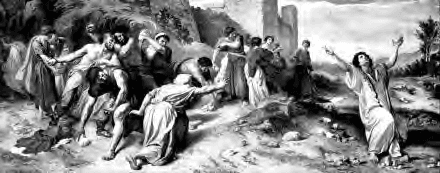
The word “sleeping” indicates a future awakening. Stephen’s Christian career had been intense and brief; now it was complete. God gave him rest until the first resurrection when he would be awakened to the glorious divine nature.
The flame of mob violence went out as suddenly as it had been kindled. Sheepishly, and hardly looking at one another, the mob dispersed, stopping only to pick up their garments over which a young man, named Saul was watching. This Saul was a member of the Sanhedrin that condemned and killed Stephen and he was fully in sympathy with the acts of that council. We read:
“And Saul was consenting unto his death. And at that time there was a great persecution against the church which was at Jerusalem; and they were all scattered abroad, throughout the regions of Judea, and Samaria, except the apostles. As for Saul, he made havoc of the church; entering into every house, and, haling men and women, committed them to prison. Therefore they that were scattered abroad, went everywhere, preaching the word.” Acts 8:1,3,4
Here is another example of how God uses the wrath of men to praise him. The brutal stoning of Stephen and the persecutions of Saul caused many of the church to flee from Jerusalem. Wherever they went, they preached Christ and the gospel spread! Thus what first appeared to be a triumph of Satan was transformed into a victory for Christ. How often we see this principle illustrated in the Bible. It is so encouraging to see that our Lord is always the complete master of every situation.
Saul Becomes the Apostle Paul
“And Saul, yet breathing out threatenings, and slaughter against the disciples of the Lord, went unto the high priest; and desired of him letters to Damascus, to the synagogue, that if he found any of this way, whether they were men or women, he might bring them bound unto Jerusalem.” Acts 9:1,2
This Saul had fully consented to what we would today call a lynching. Stoning a man to death is a brutal and bloody affair. Not only did this stoning of Stephen leave Saul unmoved by pity, it appears to have actually encouraged him. Now he wanted authority to capture other Christians and bring them bound, like criminals, to Jerusalem, to be tried by the same kangaroo court that tried Stephen, and to probably meet the same fate as Stephen. He wanted it expressly understood that Christian women would be similarly treated.
What opinion would you form of a man like that? Human judgment would say:
“Here is a cruel sadist; a monster, without natural pity; delighting to inflict pain and suffering; even willing to see women publicly stoned. Here is a depraved character, thoroughly worthless, to be shunned like a mad dog.”
God Selects Saul
Would you select such a one for God’s service, to be a leader and foremost instructor to the Church, to become the great apostle Paul? Human wisdom would indignantly rebel at the thought. But see what happened:
“And as he journeyed, he came near Damascus; and suddenly there shined, round about him a light from heaven; and he fell to the earth; and’ heard a voice saying unto him, Saul, Saul, why persecutest thou me? And he said, Who art thou, Lord? And the Lord said, I am Jesus, whom thou persecutest. Arise, and go into the city, and it shall be told thee, what thou must do.” Acts 9:3-6
In what sense did Saul persecute Jesus? Jesus was then glorified and quite safe from all his enemies. As far as we know, Saul had never harmed Jesus when Jesus was on earth. But Jesus considered every act against his followers, his little ones, his sheep, as a personal act against himself. Do you get the full implication of this? It means that he loves us as himself, his own body. He knows what we are going through from day to day, what we are up against every day. He watched Saul persecuting his church, and he cared. He watches over us, every one of us, individually. He cares, and, when necessary he intervenes.
In a vision the Lord instructed a disciple named Ananias to meet Saul and accept him into the brotherhood. But Ananias had misgivings:
“Then Ananias answered, Lord, I have heard . . . of this man; how much evil he hath done to thy saints at Jerusalem. And here he hath authority from the chief priests to bind all that call on Thy name. But the Lord said unto him, Go thy way; for he is a chosen vessel unto me, to bear my name before the Gentiles, and kings, and the children of Israel; for I will show him how great things he must suffer for my name’s sake.” Acts 9:13-16
You and I would never have selected Saul for such a service, for a ministry of such scope. Here is a prime example of the fact that “The Lord seeth not as man seeth; for man looketh on the outward appearance, but the Lord looketh on the heart.” (1 Samuel 16:7) Also: “The Lord searcheth all hearts, and understandeth all the imaginations of the thoughts.” (1 Chronicles 28:9) The Lord looked into Paul’s heart and saw he could use this man. He has looked into every one of our hearts before he called us to his truth. What did he see in Paul’s heart? He must have seen a consuming dedication of purpose, that Saul was sincerely and conscientiously doing what he thought was right.
But how could a man with such sincerity of purpose be so wrong? Consider Paul’s background. He said:
“I am a Pharisee, the son of a Pharisee.” Acts 23:6
“My manner of life from my youth, which was at the first among mine own nation at Jerusalem, know all the Jews; which knew me from the beginning, if they would testify, that after the most strictest sect of our religion, I lived a Pharisee.” Acts 26:4,5
There’s the clue: “the strictest sect of our religion.” He was from childhood thoroughly imbued and saturated with the customs, traditions, and distorted doctrines of the Jewish religion of that time, what Jesus called “doctrines of men.” Because he was so conscientious, he hated with all his heart anything that seemed to threaten that religion. Remember, it was a Pharisee who asked Jesus: “Why do thy disciples transgress the tradition of the elders?” (Matthew 15:2) This is what they resented.
Many today have had a strict religious upbringing, but their hearts are closed and sealed to the truth. These are those to whom the gospel is hid, whose minds the god of this world has blinded, lest the glorious gospel of Christ should shine unto them. (2 Corinthians 4:3,4)
In the case of Saul, it would take a light and a voice from heaven to convert him. Yet there are some today who think they can simply witness to such as these and, by so witnessing, fix their eternal destiny, that if they refuse to hear, they are doomed to the second death. This is obviously absurd. A blind man cannot see, it is not to be expected. But these blinded ones shall indeed have a light and a voice from heaven in due time:
“And the city had no need of the sun, neither of the moon, to shine in it; for the glory of God did lighten it, and the Lamb is the light thereof. And the nations shall walk in the light of it.” Revelation 21:23,24
“And I heard a great voice out of heaven, saying, Behold, the tabernacle of God is with men, and he will dwell with them; and they shall be his people, and God himself shall be with them, and be their God.” Revelation 21:3
In the kingdom, these presently blinded ones will have a real opportunity to accept God and they will know where the light and voice originate. They will accept or reject God and Christ with complete knowledge. Then, and only then, can they be completely responsible.
Jesus Saw Saul’s True Character
So Jesus saw in Saul a man willing to leave his home, suffer personal hardship, and travel about the country pursuing with great energy and determination what he thought was right. He also saw that after being converted and shown the true way, he would be just as energetic in following the right course. “I will show him, how great things he must suffer for my name’s sake,” he said.
And Paul did suffer! He said about himself:
“In stripes above measure; in prisons more frequent; in deaths oft. Of the Jews, five times received I forty stripes save one. Thrice was I beaten with rods; once was I stoned. [Now he knew how Stephen had felt!] Thrice I suffered shipwreck; a night and a day have I been in the deep. In journeyings often; in perils of waters; in perils of robbers; in perils by mine own countrymen; in perils by the heathen; in perils in the city; in perils in the wilderness; in perils in the sea; in perils among false brethren. In weariness and painfulness; in watchings often; in hunger; and thirst; in fastings often; in cold and nakedness.” 2 Corinthians 11:23-27
He bore it all with great joy as he said: “I am exceedingly joyful, in all our tribulation.” (2 Corinthians 7:4) How glad we are that God reads our hearts, that he “seeth not as man seeth; but looketh on the heart.” Our fallen humanities are so imperfect. We cannot express ourselves as we would like, even to God in prayer! We must use imperfect language to express ourselves. We even think with imperfect language. How can we adequately express to God the longings of our innermost hearts, our sorrows, our disappointments, our hungers and our thirsts? With our miserable human limitations, we cannot even adequately express to the Lord how much we love him! This would be most frustrating if we did not know that while we are expressing ourselves, haltingly, as best we can, he reads our hearts; he sees and understands what we would like to express but cannot. It is like a little hurt child who needs only to run to its mother with tears and without a word to be completely understood and comforted. What a wonderful manifestation of God’s power or spirit, this is!
“The spirit also helpeth our infirmities; for we know not what we should pray for, as we ought, but the spirit itself maketh intercession, with groanings which cannot be uttered; and he that searcheth the hearts, knoweth what is in the mind of the spirit.” Romans 8:26,27
What of the blood guilt Paul incurred when he became an accessory in the stoning to death of Stephen? Stephen’s last prayer was, “Lord, lay not this sin to their charge.” This prayer was heard and granted in the case of Paul. As Paul himself said, “I am pure from the blood of all men.” (Acts 20:26) Yet this was not quite enough. He always remembered the bloody scene of the stoning to the end of his life.
When the sword of Nero’s executioner flashed in an arc to cut his head from his body, his last earthly thought must have been one of satisfaction and joy to finally expiate by his own martyrdom the martyrdom of Stephen.
The instantaneous conversion of Paul “puts us on the spot” so to speak. How can we hate an enemy, no matter how evil he appears to be, when there is a possibility the Lord may almost instantly show him the light? How can we judge a man to be truly an enemy since we cannot read his heart? An enemy’s ugly exterior may, as in the case of Paul, hide a gem of rare and transcendent beauty and worth. How humble, and tolerant of others, this should make us!
The Disciples Feared Paul
After his sudden conversion, the disciples were naturally, afraid of Paul. They were suspicious of the sincerity of his conversion.
Perhaps it was only a scheme to gain admittance to their meetings to complete a list of names which would be followed by wholesale arrests. But when Paul preached Christ in the synagogues and the Jewish leaders turned on him and tried to kill him, the disciples were convinced.
Paul had much to learn but the Lord arranged that Luke should become associated with him. In his writings, Paul calls Luke “the beloved physician” (Colossians 4:14), and “fellow-worker” (Philemon 24). He wrote: “Luke alone is with me.” (2 Timothy 4:11)
Those originally called by Jesus himself were a most favored group. For more than three years they were his constant companions. Let us remember that aside from his spiritual powers, Jesus was a perfect man with a vital and magnetic personality. He could and did impress his mind upon those so constantly under his influence–even before they received the holy spirit. Dr. Luke was one of these. As a physician, Luke was trained to be logical and methodical, and he had a retentive mind. In the prelude to the gospel which bears his name, Luke wrote:
“It seemed good to me also, having had perfect understanding of all things, from the very first, to write unto thee.” Luke 1:3
Though Paul lacked the personal association with Jesus, Luke supplied what Paul lacked. Under the guidance of the holy spirit, Paul absorbed the mind and spirit of Jesus to a remarkable degree. A striking similarity of thought runs throughout Paul’s writings. Here are a few examples:
Jesus: “Whosoever exalteth himself, shall be abased; and he that humbleth himself, shall be exalted.” Luke 14:11
Paul: “Mind not high things, but condescend to men of low estate.” Romans 12:16
Jesus: “Inasmuch as ye have done it unto one of the least of these, my brethren, ye have done it unto me.” Matthew 25:40
Paul: “Who is weak, and I am not weak? Who is offended, and I burn not?” 2 Corinthians 11:29
Jesus: “Blessed are they, which are persecuted for righteousness’ sake.” Matthew 5:10
Paul: “I take pleasure in infirmities, in reproaches, in necessities, in persecutions, in distresses, for Christ’s sake.” 2 Corinthians 12:10
Jesus: “Take no thought for your life, what ye shall eat; nor yet for your body, what ye shall put on.” Matthew 6:25
Paul: “Be not anxious about anything.” Philippians 4:6, Diaglott
Jesus: “There is nothing from without a man, that entering into him, can defile him.” Mark 7:15
Paul: “There is nothing unclean of itself.” Romans 14:14
Jesus: “Judge not, that ye be not judged.” Matthew 7:1
Paul: “Let us not, therefore, judge one another any more.” Romans 14:13
Jesus: “Love your enemies; and pray for them which despitefully use you, and persecute you.” Matthew 5:44
Paul: “Bless them which persecute you; bless and curse not. Recompense to no man, evil for evil.” Romans 12:14,17
Jesus: “Thou shalt love the Lord thy God with all thy heart, and with all thy soul, and with all thy mind, and with all thy strength. This is the first commandment.” Mark 12:30
Paul: “Love is the fulfilling of the law.” Romans 13:10
Do you see the beautiful similarity and harmony between these two minds although they never met in the flesh? Some have said:
“If only I could have lived while Jesus was on earth to sit and learn at his feet! To have through him, direct access to the fountainhead of all knowledge! To ask any questions, and receive exactly the right answer! To hear his encouragements, and precious promises, and expressions of love, while looking into his eyes!”
Of course it would be wonderful! But Paul did not have such a personal contact with Jesus, and yet, in the Lord’s providence, he surpassed those who did. He wrote more than half the New Testament. He was used mightily by the Lord. He was able to develop the mind of Christ. As he wrote, “But we have the mind of Christ.” (1 Corinthians 2:16) He also wrote, “Let this mind be in you, which was also in Christ.” (Philippians 2:5)
The Bible Provides Everything
In the Bible the Lord has furnished to us everything we need, and he has given us helps to understand the Bible. As Paul himself said to Timothy:
“From a child thou hast known the holy scriptures, which are able to make thee wise unto salvation, through faith which is in Christ Jesus. All scripture given by inspiration of God, is profitable: for doctrine, for reproof, for correction, for instruction in righteousness; that the man of God may be perfect [or complete], thoroughly furnished unto all good works.” 2 Timothy 3:15-17
Is your faith strong enough? If it is, you can, here and now, sit and learn at Jesus’ feet. You can, here and now, have access to the fountainhead of knowledge. You can, here and now, receive the answers to your questions. You can, here and now, feel his nearness, receive his encouragements, and claim his precious promises.
Paul’s faith was so strong that he spoke of Jesus as an old familiar friend and Master. To him Jesus was a real and living presence. It can be the same with us, too if our faith is strong enough. Paul said:
“I shall speak to you either by revelations, or by knowledge, or by prophesying, or by doctrine.” 1 Corinthians 14:6
Sometimes he spoke by his own knowledge. For example, on the subject of marriage relationships he wrote: “But I speak this by permission, and not of commandment.” (1 Corinthians 7:6) Again he said: “But to the rest, speak I, not the Lord.” (1 Corinthians 7:12) Again: “I have no commandment of the Lord, yet I give my judgment.” (1 Corinthians 7:25) He speaks of women’s conduct in the church and adds: “But, if any man seem to be contentious, we have no such custom; neither the churches of God.” (1 Corinthians 11:16) Some have concluded that they may or may not take Paul’s advice as they choose. But as for me, I’ll take Paul’s opinion any time. He had the mind of Christ to a superlative degree. Therefore the conclusions reached by that mind must be correct. He invited us to follow him as he followed Christ. Let us be willing to do that.
Even though he gave some advice as his own personal opinion, I believe his entire –writings were under divine inspiration whether he himself realized it or not.
When one consecrates, he determines to do God’s will at all times with all his might. But very early in our Christian careers, we discover that there is an opposing force to contend with, and we sometimes lose to this opposing force. Our new, consecrated minds, do not always fully control our old, imperfect human bodies. This would be very discouraging to us if we did not realize that all the Lord’s people have had the same problem including the great apostle Paul who had the mind of Christ. We know because he wrote:
“For the good that I would, I do not; but the evil which I would not, that I do. Now, if I do that I would not; it is no more I that do it, but the sin that dwelleth in me. I find, then a law; that, when I would do good, evil is present with me. For I delight in the law of God, after the inward man; but I see another law in my members, warring against the law of my mind, and bringing me into captivity to the law of sin which is in my members. Oh, wretched man that I am! Who shall deliver me from the body of this death?” Romans 7:19-24
What did he mean by “the body of this death,” or “this dead body”? He referred to an ancient and horrible Roman cruelty practiced on condemned prisoners. It was a method of execution worthy of Satan himself, a method of slowly tormenting a man to death. They bound a dead body to a living man, obliging him to carry it about until the contagion from the putrid mass took away his own life.
This is the thing to which Paul likens our fallen natures. “Who shall deliver me from this dead body?” he asks in seeming desperation. Then he answers his own question, reassuringly and confidently:
“I thank God, through Jesus Christ our Lord. There is, therefore,
now no condemnation to them which are in Christ Jesus; who walk not after the flesh, but after the spirit. For the law of the spirit of life in Christ Jesus hath made me free from the law of sin and death.” Romans 7:25; 8:1,2
In succeeding verses Paul gives us some of the most encouraging and heartwarming words, ever written:
“Who shall lay anything to the charge of God’s elect? It is God that justifieth. Who is he that condemneth? It is Christ that died; yea rather, that is risen again; who is even at the right hand of God; who also maketh intercession for us. Who shall separate us from the love of Christ? Shall tribulation, or distress, or persecution, or famine, or nakedness, or peril, or sword? Nay! in all these things, we are more than conquerors, through him that loved us. For I am persuaded that neither death, nor life, nor angels, nor principalities, nor powers, nor things present, nor things to come; nor height, nor depth, nor any other creature, shall be able to separate us from the love of God, which is in Christ Jesus our Lord.” Romans 8:33-39
Naaman, the Syrian
“And many lepers were in Israel in the time of Elisha the prophet. And none of them was cleansed, saving Naaman, the Syrian.” Luke 4:27
TODAY we are going to consider the account of the healing of Naaman, the Syrian, as found in chapter 5 of 2 Kings. The kingdom of Syria bordered the land of Israel on the north and east. At the time of our lesson, about 840 BC, it was quite influential among the nations of the earth.
Naaman was commander-in-chief of the army of Syria, under King BenHadad II. He was noted for his personal ability as a soldier and strategist. We are told that, “By him the Lord had given deliverance unto Syria.” (2 Kings 5:1) He is also called a “mighty man in valour.”
But Naaman was a leper. Although this disease can now be controlled, in those days leprosy was incurable. It was synonymous with a horrible, lingering, certain death. There was absolutely no hope. It usually began with little specks on the eyelids and on the palms of the hands, and gradually spread over different parts of the body, bleaching the hair white wherever it showed itself, crusting the affected parts with shining white scales. From the skin, it slowly ate its ways through the tissues, to the bones and joints, and even to the marrow, rotting the whole body piecemeal. Fingers and toes, and eventually the hands and feet, dropped off. It dulled the nerves as it progressed and was comparatively painless until the final stages when the vital organs were attacked. The process often took many years, but death was inevitable.
So we can imagine Naaman’s consternation and frustration in having this disease. A human enemy he could face in battle, fearlessly, and with “valour.” But this was something else! This was something he could not cope with. It is probable that, under the circumstances, a man of his character would contemplate suicide.
But in Naaman’s darkest and most desperate hour, a ray of hope appeared. It seems that some time before this incident, the Syrians had conducted raids across the border into Israel. On one of these forays they had captured a young girl, called in the account “a little maid.” She had been sold as a slave to the household of General Naaman and became his wife’s personal maid. She had apparently been treated kindly and therefore felt kindly toward Naaman. When this little Hebrew girl heard that Naaman had contracted leprosy, she was concerned.
“And she said unto her mistress, Would God my lord were with the prophet that is in Samaria! For he would recover him of his leprosy.” 2 Kings 5:3
She referred to Elisha, who was then prophet in Israel, and who was living in the capital city of Samaria. When this girl was in Israel, she had undoubtedly heard of the miracles Elisha had performed: the dividing of Jordan; the waters of Jericho sweetened; the widow’s oil increased; the Shunammite’s son raised from the dead; the deadly pottage rectified; 100 men fed with 20 loaves; plus other wonderful things. Reports of these miracles of Elisha were current in Israel.
Because she knew that Elisha was an instrument of God’s power, she reasoned, correctly, that even leprosy could be cured by that power.
Her remark to her mistress was immediately communicated to Naaman. Ordinarily, Naaman would have entirely discounted the possibility of miracles. As a military man, he was a realist. He believed in physical force, not ethereal power. He was not one to be swayed by superstition or vague rumor.
But Naaman was at the point of desperation. He was ready to grasp at straws. He must investigate even the seemingly idle words of a little Hebrew slave girl. It was now the only hope he had. So he went to the king of Syria and asked for a leave of absence, telling him of his intention to go to Israel where there was a prophet who supposedly had the power to heal him of his leprosy. The king who had been worrying about losing his most able general, was enthusiastic at the prospect that he might be healed. “Go, by all means,” he told Naaman. “I’ll give you a letter of introduction to the king of Israel. A prophet who can perform such miracles must be well known to the king. No doubt he is a high official and a member of the royal court. Out of courtesy to me, the king of Israel will see that you receive the very best attention from this miracle-worker.” Naaman gladly accepted the letter and lost no time in leaving for Israel. We read in verse 5: “And he departed and took with him ten talents of silver, and six thousand pieces of gold, and ten changes of raiment.” This was a great fortune in those days and even in these days! This probably represented all his wealth. Naaman was a rich man and was prepared to pay richly for his healing. To convey such a treasure safely over dangerous, robber-ridden roads, all the way to Israel, Naaman’s chariot was probably accompanied by a strong troop of cavalry.
Naaman Meets Israel’s King
In due time, Naaman arrived and presented to the king of Israel the letter from the king of Syria. It was brief and to the point. After the usual formalities of greeting, it simply said:
“Now, when this letter is come unto thee, behold, I have therewith sent Naaman, my servant, to thee, that thou mayest recover him of his leprosy.” 2 Kings 5:6
Notice that there was not a word about the Prophet Elisha in the letter. It was presumed that the king of Israel would know where to direct Naaman.
To better understand his reaction to the letter, let us remember who the king of Israel was at this time. It was Jehoram, the son of Ahab, of whom it is written:
“And he wrought evil in the sight of the Lord . . . He cleaved unto the sins of Jeroboam, the son of Nebat, which made Israel to sin.” 2 Kings 3:2,3
While professedly making some acknowledgment of Jehovah, Jehoram was really an idolater. He had no dealings with the Prophet Elisha nor scarcely any knowledge of him. The result was that he completely misconstrued this sincere and courteous letter. He thought that the king of Syria, by asking him for something impossible, was trying to provoke a quarrel with him, to provide an excuse for invasion. And the fact that Naaman was a Syrian general, accompanied by a strong detachment of cavalry, contributed to this erroneous conclusion. Accordingly, we read in verse 7:
“And it came to pass, when the king of Israel had read the letter, that he rent his clothes and said, Am I God, to kill and to make alive, that this man doth send unto me, to recover a man of his leprosy?
Wherefore consider, I pray you, and see how he seeketh a quarrel against me.”
Of course he did not say this in the presence of Naaman. He had undoubtedly withdrawn and called a hasty counsel of his advisors to determine what to do.
Perhaps it was one of these advisors, secretly sympathetic to Elisha, who informed the prophet of the situation, or it may be that the Lord told Elisha. In any event, Elisha knew it and sent a servant with a message to the king. We read in verse 8:
“When Elisha, the man of God, had heard that the king of Israel had rent his clothes, that he sent to the king, saying, Wherefore hast thou rent thy clothes? Let him come now to me, and he shall know that there is a prophet in Israel.”
In those days, people were more demonstrative of their emotions. The tearing of one’s outer garment was a sign of sorrow and despair, denoting a hopeless situation. So Elisha’s message to the king was:
“Why do you despair? Why do you not consult God, through his prophet, regarding your problem? Don’t you know God has a prophet in Israel? If you don’t know, Naaman will soon know. Let him come now to me, and he shall know that there is a prophet in Israel.”
This was a rebuke to Jehoram, the idolater. But the king was happy to be so easily rid of Naaman and his problem, and he gladly directed him to follow the servant of Elisha.
Elisha lived very simply, in a small, plain house. We know this because “the sons of the prophets said unto Elisha, Behold now, the place where we dwell with thee is too strait for us.” (2 Kings 6:1) “Strait” means narrow, difficult, distressful. So we can imagine Naaman’s surprise, and disappointment when his chariots and horsemen arrived at the home of Elisha. He expected a splendid palace, befitting a person with supernatural powers. Here was a hovel. Is it possible that a miracle worker would live in such a lowly place? Naaman dismounted from his chariot, and Elisha’s servant, who had guided him there, disappeared into the house.