
The Temple of God
“And what agreement hath the temple of God with idols? For ye are the temple of the living God; as God hath said, I will dwell in them, and walk in them; and I will be their God, and they shall be my people.” 2 Corinthians 6:16
“Know ye not that ye are the temple of God, and that the spirit of God dwelleth in you? If any man defile the temple of God, him will God destroy; for the temple of God is holy, which temple ye are.” 1Corinthians 3:16,17
THROUGHOUT the centuries of the Gospel age, many artists and painters have attempted to show what Jesus looked like. Some have claimed to have seen him in visions, whereupon they have risen from their beds and made their sketches while the features were fresh in their minds. Others have patterned their portraits after old mosaics allegedly dating back to the first centuries of the early church. Still others, after reading about him in the scriptures and in the writings of the Early Fathers, have simply used their imaginations. The general result has been that they have pictured Jesus as a thin, pale young man with a tired, discouraged look.
So conditioned are people to this image of Jesus that it seems to them almost irreverent to suggest that he was physically strong. I believe he was. Why do I think so? The fact that he was the physical equivalent of the perfect man, Adam, is enough for me. But there is much other evidence also. Let us look at his first 30 years.
There was no soft bed for his mother on the night he entered this world. He was brought forth in a stable amid animals and the rough men who tended them. When he was still an infant, the incredibly cruel Herod ordered him killed and the family hurried away into Egypt to escape. This was a long and arduous trip. Some years later when Herod was dead, they made the same exhausting trip back.
This time he was probably judged old enough to walk and must have trudged, day after day, beside the pack animals. Such things develop hardihood.
Early in his boyhood Jesus worked in the family carpenter shop. Carpentry was not easy in those days. A man who took a contract for a house did the whole job. He had to dig, with primitive hand tools, in the rocky ground for the foundations. There were no modern lumberyards. To get his timbers he went to the forest, felled trees, and shaped them by hand with an adz. Propping them up, he laboriously sawed them with a hand saw to produce his beams. The finished timbers had to be dragged or carried to the building site.
Instead of nails, holes were drilled into which wooden pegs, whittled round by hand, were driven. Joints were secured by mortise and tendon, laboriously carved out. In all these things Jesus participated. It was hard work!
Years later Jesus preached in Galilee from his experience when he spoke of “a wise man who built his house upon a rock,” and “a foolish man, who built his house upon the sand.” (Matthew 7:24,26) It was from his experience the people heard him say, as a building contractor would:
“Which of you intending to build a tower, sitteth not down first, and counteth the cost, whether he have sufficient to finish it? Lest haply, after he hath laid the foundation, and is not able to finish it, all that behold it begin to mock him; saying, This man began to build, and was not able to finish.” Luke 14:28-30
You may be sure his words carried conviction because they knew he had been reared as a carpenter’s son and knew what he was talking about. To be a carpenter, you had to be physically strong.
So we read of Jesus as a boy: “And the child grew, and waxed strong.” (Luke 2:40) The King James says “strong in spirit,” but the words “in the spirit” are spurious and not in the Diaglott. Even here, we see an effort to make him appear puny, but he grew physically strong. He did not receive the strong spirit until he was baptized by John in the Jordan and it came upon him like a dove.
The disciples, when first called, did not have the holy spirit. This is not what primarily attracted them to Jesus. They were attracted and held largely by the sheer strength, personality and magnetism of the man Christ Jesus. He was physically a leader. If they believed and they did that he was the one to overthrow the mighty Roman Empire and re-establish the Jewish Nation, it was largely because he looked the part. Prophecy described him as: “Chief est among ten thousand,” and “Altogether lovely.” (Cant. 5:10,16) David says of him, “Thou art fairer than the children of men.” (Psalms 45:2)
But this is not to imply Jesus was not meek. He was. He said of himself, “I am meek and lowly in heart.” (Matthew 11:29) He told his disciples on the mount that to receive the blessed rewards of the kingdom, they must be “poor in spirit” [humble-minded and meek].
These are attributes which we, as his footstep followers, must develop and maintain. We must emulate our master in meekness. But meekness is not weakness. For example, we read that Moses “was very meek, above all the men which were upon the face of the earth.” (Numbers 12:3) He was the meekest man in the world, but was it a weak man who killed the Egyptian taskmaster? Was it a weak man who faced and defied the mighty Pharaoh of Egypt? Was it a weak man who led the children of Israel through the sea, who shepherded them in the wilderness for so many years, who faced God himself on the mount and pleaded for Israel, when God would have destroyed them? There was no weakness here; but with his meekness, there was a tremendous strength of purpose and a dedicated will, conformed to God’s will.
This is what Jesus had. In fact he was like Moses in this respect because Moses himself said prophetically of Jesus:
“The Lord thy God will raise up unto thee a prophet, from the midst of thee, of thy brethren, like unto me; unto him ye shall hearken.” Deuteronomy 18:15 “LIKE UNTO ME“ meek but strong, courageous, and absolutely devoted to God.
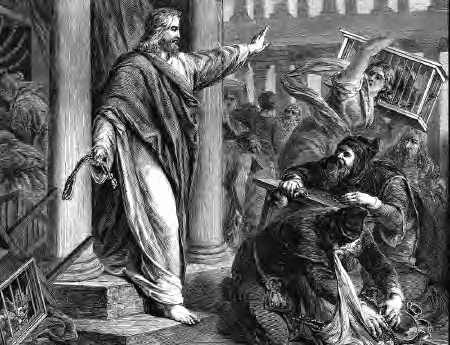
The Cleansing of the Temple
There is an incident related in each of the four gospels that powerfully illustrates Jesus’ courage, strength and fidelity to God’s law. It is the account of Jesus cleansing the temple. Because the different narratives vary in some respects, I will combine and paraphrase these accounts. But first let us consider some of the conditions that Jesus found in Jerusalem that day.
The Israelites had always been surrounded by heathen nations, some quite depraved. In fact some of these nations were so depraved God used Israel as his instrument to remove them from the earth before they should become totally depraved and beyond the possibility of redemption in the Millennial Age.
The heathen gods these nations worshipped were demons. They were by nature vindictive, cruel, and vengeful. They had to be appeased by horrible often obscene ceremonies which sometimes involved torture and even human sacrifice. Molech, for example, was represented by a huge, hollow, brazen image, of frightful countenance, with arms extended. A fire was built inside the idol and stoked until the image glowed with incandescent heat. Then a little child was hurled into the idol’s arms to roast alive, it’s agonizing screams drowned out by the chants of the priests. Baal was similarly worshipped:
“They have built also the high places of Baal, to burn their sons with fire for burnt offerings unto Baal; which I commanded not, nor spake it, neither came it into my mind.” Jeremiah 19:5
No! Torture by fire never came into Jehovah God’s mind. He is not a torment deity, as are Molech, Baal, and others. But there were times the Jews had fallen into idolatry and had actually participated in such abominable ceremonies. As a result, a terrible thing had happened.
Led and abetted by Satan, and because of these degrading heathen influences, their true worship of Jehovah God had become tainted. Their temple sacrifices of animals took on a wrong significance.
These Jewish sacrifices were originally designed by God to show the necessity for the shedding of blood for the remission of sins prefiguring the ransom sacrifice which Jesus provided. These Jewish sacrifices provided a typical cleansing from sin and a restoration to favor by a loving God. But under Satan’s subtle influence, many Jews sacrificed in the temple not with contrition of heart, but as though appeasing a vengeful God to save their skins, to buy him off! Thus it became just like the heathen sacrifices. It corrupted and debased the motive of the act; it became unacceptable to God. It became hateful to him:
“To what purpose is the multitude of your sacrifices unto me? saith the Lord. I am full of the burnt offering of rams, and the fat of fat beasts; and I delight not in the blood of bullocks, or of lambs, or of the goats.” Isaiah 1:11
Why was this? The purpose was wrong; the motive was wrong!
What was the result of this debased motive, this compulsion to offer sacrifices to appease a vengeful God? It inevitably brought corruption and commercialization to the temple and to the priesthood. It could have no other effect because it set a price on God’s favor and placed the dispensing of it in fallen human hands. This was the situation at the time of Jesus’ ministry.
When Jesus visited the temple at the time of the annual sacrifices, it was crowded with Jews from all parts of the world. Many made long pilgrimages to be in the temple at Jerusalem at this particular time.
Let us picture the scene. It is a confusing scene, totally unlike what one would expect on the occasion of the most solemn sacrifices to the Most High God. The air was foul with the smell of animals and humans herded together. At one side of the court were the pens of the cattle; thedove cages were at the other. In the foreground, hard- faced priests and money changers sat behind long tables exacting the utmost price from those who came to buy. All currency, even the local Roman money, had to be changed to the special temple coinage before anything could be purchased. That’s why there were money changers. The exchange was at robbers’ rates so a poor Jew could lose month’s savings to purchase his simple offering. But you might wonder why they didn’t they bring their own animals to sacrifice.
Sometimes they did. A farmer might bring his own lamb, especially raised with tenderness and devotion for the purpose of sacrifice, only to have it scornfully rejected by the priests as unsound; he had to buy from the dealers. The dealers of course were there by the invitation of the priests. They were essentially concessionaires. So were the money changers. It may safely be assumed that certain priests had an interest in the profits of these operations. Today we would call it a “racket.”
One would never imagine that this was a place of worship; yet it was the temple at Jerusalem, the very center of the religious life of the nation. Jesus watched the confused scene with amazement which gradually deepened to anger. As he watched, he picked up a handful of cords from the pavement, and braided them into a stout little whip. He knew what he must do. A woman’s shrill voice pierced the air; he turned to see a peasant mother protesting vainly against a ruthless overcharge. “But this is not right!” she cried. “You are taking all I have!” An unruly bullock threatened to break through the bars and the crowd fell back with cries of terror. Clamor and confusion held sway. A money changer, with the face of a pig, leaned gloatingly over his hoard of coins! Jesus could stand it no longer! Suddenly, without a word of warning, he strode to the table where the fat money changer sat and hurled it violently across the court. The startled robber lurched forward, grasped for his coins, lost his balance, and fell sprawling to the ground. Another step, and a second table was overturned; then another, and another. The crowd melted back out of his way, stunned. He strode on looking neither to the right or to the left. He reached the counters where the cages of doves stood. With quick, sure movements, the cages were opened and the birds released. Brushing aside the group of dealers who had taken their stand in front of the cattle pens, he threw down the bars and drove the bellowing animals through the crowd and into the street, striking vigorous blows with his whip!
The whole thing happened so quickly that the priests were swept off their feet. Now they collected themselves and bore down upon him in a body. Who was he that dared this act of defiance? Where had he come from? By what authority did he presume to interrupt their business? The crowds which only a few hours before had shouted Hosannahs when Jesus rode triumphantly into Jerusalem, now watched with astonished delight. They heartily disliked the corrupt priests and crooked money changers. Jesus stood firmly before the priests, the whip still in his hand. His serene glance swept over their faces, distorted by anger, hate and greed. “This is my authority,” he cried. “It is written, My house shall be called the house of prayer, but ye have made it a den of thieves!” (Matthew 21:13; Luke 19:45; John 2:15) They were infuriated but dared do nothing because of the people. But after this, the narrative says, “the chief priests and scribes … sought how they might destroy him.” Jesus used no supernatural power in this act. There was in his eyes a flaming moral purpose, a look of majestic authority, which they could not withstand. There was also, in my opinion, still another factor. As his right arm rose and fell, striking blows with that little whip, his sleeve must have dropped back to reveal muscles as hard as iron! No flabby priest or money changer cared to challenge this perfect man!
Lessons from Cleansing the Temple
What lessons can we learn from the cleansing of the temple? First, let us consider and apply the circumstances that led to the polluted condition of the temple which Jesus found. The pollution came from the wrong motives and attitudes fostered by contact with idolaters. We too, emancipated as we are, were once influenced by the doctrines of devils. Many of us, before we got the truth, believed God to be a fiend, capable of inflicting eternal torture upon millions of his human creatures. In a sense we, too, served Molech and bowed to Baal. Many of us maintained our religion simply because we feared a vindictive god of torment! Now we see God as he truly is a God of love; a God that is love. “There is no fear in love … because fear hath torment.” (1 John 4:18)
We have left the fear of torment behind. But have we? Is there still a vestige of the fear of torment within us? Do we render our sacrifices to God with a pure motive because we love him with all our hearts, minds and souls, and because of our desire to “fill up that which is behind of the afflictions of Christ?” (Colossians 1:24) Is our fear a holy fear, the kind Paul spoke of when he said: “Let us therefore fear, lest a promise being left us, of entering into his rest, any of you should seem to come short of it”? (Hebrews 4:1) Are our sacrifices colored to any degree with the thought of placating God to avoid punishment? Do we ever say, I must not do this or that because if I do, God may punish me for it? Or, I must do this or that service because if I do not, God will punish me? Are we like those of the Society who go out into the service bearing witness to the truth because we fear the everlasting punishment of Second Death? If we do, we are offering a polluted sacrifice.
When we are sick or are experiencing some misfortune which God has permitted for our polishing, do we conclude that God is punishing us for something we have done, that we must perform some special sacrifice so that he may be pacified and desist?
These are searching questions. Our conception of God and our motives for serving him should be much higher than that. If we refrain from sinful acts and from injuring our brothers or neighbors, it should be because we love God and his law is within our hearts. If we do with our might what our hands find to do in God’s service, it should be with the pure motive: “What shall I render unto the Lord, for all his benefits toward me?” (Psalms 116:12) When some misfortune is permitted to come into our lives, our reaction should be: “This is for my good, because he has promised that all things shall work together for good; so I will learn from this, whatever lesson he has for me.” If it is a chastening we experience, we should only take it as an evidence of our heavenly Father’s love:
“For whom the Lord loveth, he chasteneth … If ye endure chastening, God dealeth with you as with sons; for what son is he, whom the father chasteneth not?” Hebrews 12:6,7
We Are the Temple of God
Some of the Lord’s most faithful and beloved children suffer the most painful afflictions. Let us fully realize that extraordinary afflictions are not always the punishment of extraordinary sins but are rather the trial of extraordinary graces. “Ye are the temple of God,” the apostle says. Let the motives, for worshipping God in this, our temple, be pure and holy. “Let the words of my mouth, and the meditation of my heart, be acceptable in thy sight, O Lord, my strength and my redeemer.” (Psalms 19:14) Let us not, by word, deed orthought, place God in the position of a vengeful deity to be placated as did Israel of old.
What lessons we can learn from the act of Jesus cleansing the temple? Are we authorized to arm ourselves with whips and invade the temples of today’s false religions? Must we make a special point of attacking the commercialism in religion today thus inciting their leaders to violent retaliation? Some have taken and are taking this
course, although we are told to “Follow peace with all men.” (Hebrews 12:14) No! The lesson is much deeper and more sublime than that. Let us read our text again:
“Know ye not, that ye are the temple of God, and that the spirit of God dwelleth in you? If any man defile the temple of God, him shall God destroy; for the temple of God is holy, which temple ye are.” 1 Corinthians 3:16,17
This scripture has a collective as well as an individual application. The spirit begotten ones, collectively, are the temple class. In confirmation we read:
“Ye also, as living stones, are built up a spiritual house, an holy priesthood, to offer up sacrifices acceptable to God by Jesus Christ.” 1 Peter 2:5
The consecrated ones are built up together as a temple of God. When Christ returned in 1874, he provided his consecrated people such brilliant revelation of “present truth” that a great cleansing occurred. There was a cleansing of doctrines, of motives, of attitudes. The eternal torment doctrine was recognized for what it was a blasphemy of a loving God and was thrown out. Tracts were free and sermons were “seats free, no collection.” There was no paid clergy no money changers. The futility of saying masses for departed souls was exposed no dealers in merchandise. The temple class was cleansed.
This is the primary application but it is not the entire lesson. There is also a more personal application. Each consecrated, spirit begotten person is a temple of God; each of us must cleanse the temple which is himself. What is the pattern laid down by Jesus in our lesson?
Jesus drove out the animals with his whip. This means the forceful elimination of selfish and carnal motives, and the spirit of worldliness. As Paul said, “I keep my body under, and bring it into subjection.” (1 Corinthians 9:27) This implies force, a whip.
Jesus opened the cages, and released the birds. We read that Babylon was “a cage of every unclean and hateful bird.” (Revelation 18:2) We eliminate impure principles and doctrines. We abandon the spirit of Babylon completely and refuse to entertain strange new doctrines that fly at us through the air. Lately it seems that the air is full of them. Some even come by airmail! I like Paul’s advice to Timothy:
“But evil men, and seducers, shall wax worse, and worse, deceiving and being deceived. But continue thou in the things which thou hast learned, and hast been assured of, knowing of whom thou hast learned them.” 2 Timothy 3:13,14
Of whom have we learned present truth, by whose hand was it revealed? Who wrote the vision and made “it plain upon tables, that he may run that readeth it.” (Habakkuk 2:2) Whom did the Lord use to teach us his Divine Plan of the Ages? “Continue thou in the things which thou hast learned, and hast been assured of, knowing of whom thou hast learned them!” This is excellent advice.
Jesus drove out the money changers and the sellers. We must subordinate all ambition for worldly gain to the main purpose which is the spiritual development of ourselves and others. All our assets belong to God. We have consecrated everything and he has made us the stewards of our own goods. All desire for money for its own sake must be vigorously subdued:
“For the love of money is a root of all kind of evil; which while some coveted after, they have erred from the faith, and pierced themselves through with many sorrows. But thou, O man of God, flee these things.” 1 Timothy 6:10,11
In this regard Paul says of himself:
“But what things were gain to me, those I counted loss for Christ. Yea doubtless, and I count all things but loss, for the excellency of the knowledge of Christ Jesus my Lord; for Whom I have suffered the loss of all things, and do count them but vile refuse, that I may win Christ.” Philippians 3:7,8
Robbing God
When he had cleansed the temple, Jesus said: “My house shall be called the house of prayer, but ye have made it a den of thieves!” (Matthew 21:13) Is it possible that the temple, which we are, can be a den of thieves? Can God be robbed? Yes!
“Will a man rob God? Yet ye have robbed me. But ye say, Wherein have we robbed thee? In tithes and offerings.” Malachi 3:8
These words were addressed to ancient Israel. They had agreed to give a tenth of all their substance to God. This was a part of the law that they had agreed to keep. “All these things will we do,” they said. But they failed to keep it. They did not bring the Lord the tenth, or tithe, as they had promised. So the prophet Malachi brought this neglect to their attention and told them of the tremendous blessing they were missing, the blessings they would receive if they would comply with this part of the law:
“Bring ye all the tithes into the storehouse, that there may be meat in mine house; and prove me now herewith, saith the Lord of hosts, if I will not open you the windows of heaven, and pour you out a blessing, that there shall not be room enough to receive it.” Malachi 3:10
Do you see how foolish the Israelites were? In their greed they withheld even the tenth of their substance which they had promised to God. But if they had they given it, God would have increased their material wealth beyond their wildest imagination! “The windows of heaven” would have been opened to them, to shower blessings upon them. Do you remember what happened the last time “the windows of heaven” were opened? It rained forty days and forty nights. “And the waters prevailed exceedingly upon theearth; and all the high hills that were under the whole heaven, were covered!” That’s the sort of outpouring God was talking about when he referred to “the windows of heaven” being opened; but there would have been the outpouring of blessings instead of water. Oceans of blessings is what they missed! Do you think God really needed their tenth? Would he have gone hungry without it? He says in Psalm 50:
“For every beast of the forest is mine; and the cattle upon a thousand hills. I know all the fowls of the mountains; and the wild beasts of the field are mine. If I were hungry, I would not tell thee; for the world is mine, and the fulness thereof. Offer unto God thanksgiving; and pay thy vows unto the Most High.” Psalms 50:10-12,14
Let us apply this to ourselves as consecrated children of God. Although the Jews had agreed to give a tenth of their substance, we have agreed to give all of ours. We have consecrated everything we have and are to the Lord’s service; not just a tenth, but all. Although the Jews annually brought their tithes to a storehouse and relinquished control over them, we are appointed stewards over our own substance. We retain control and administer it with our responsibility to God. This becomes a part of our test, our training, our polishing, our being fitted for the kingdom. Of course the Lord recognizes our own material needs and also the necessity to provide decently for those dependent upon us.
It may even be prudent to lay something aside in the event of job insecurity or failure of health. After that, how wise is our stewardship for God? Do you think for a minute that God really needs our money and our poor talents? Of course not! But how we use them as a steward is an accurate indication of the sincerity of our consecration, our love for God, and our thankfulness to him for all his benefits toward us. As the psalmist says: “Offer unto God thanksgiving; and pay thy vows unto the Most High.” (Psalms 50:14) If God, for Israel’s fleshly tenth, was willing to open “the windows of heaven” in material blessings in “basket and in store” how much more will he pour upon spiritual Israel his heavenly blessings! “Prove me now herewith, saith the Lord!” Try me! See if I won’t do it! What enormous blessings some of us miss by not taking God at his word! We should not think to rob God but should bring everything to the altar and keep everything on the altar in full consecration.
Jesus said: “My house, or temple, shall be called the house of prayer.” If we are the temples of God, how appropriate that we should constantly maintain an attitude of prayer within us. We are told: “Pray without ceasing.” (1 Thessalonians 5:17) Jesus gave a parable on this subject:
“He spake a parable unto them, that men ought always to pray, and not to faint; saying, There was, in a city, a judge who feared not God, neither regarded man; and there was a widow in that city; and she came unto him, saying, Avenge me of mine adversary. And he would not, for a while; but afterward he said within himself: though I fear not God, nor regard man; yet because this widow troubleth me, I will avenge her, lest by her continual coming, she weary me. And the Lord said, Hear what the unjust judge saith. And shall not God avenge his own elect, which cry day and night unto Him, though he bear long with them? I tell you he will avenge them speedily.” Luke 18:1-8
Is it possible that this parable teaches us that simply because we make nuisances of ourselves that our prayers, regardless of merit, will be heard and answered? Certainly not! It was not only the importunity of the widow, her persistence, that caused the judge to grant her request; the widow had a just cause. Instead of saying, “Avenge me of mine adversary,” the Diaglott renders it, “Obtain justice for me from my opponent.”
In our continual attitude of prayer before God we should ask for the right things, things we know are in accordance with God’s will just things. We should ask for them with persistency. “Men ought always to pray, and not to faint,” the parable says, or, as the Diaglott has it: “They ought to pray continually, and not be weary.” This means that if our prayers are not immediately answered, we should not grow weary of asking and relapse into a hopeless and faithless condition. Rather, let us joyfully and hopefully claim the promise of Jesus: “I tell you that he will avenge them speedily!” Let the temple of God, which we are, be indeed “a house of prayer.” These are some of the lessons Jesus taught us when he cleansed the temple at Jerusalem that day so long ago.
Defiling the Temple of God
The latter part of our text contains a grave warning: “If any man defile the temple of God, him shall God destroy.” The Diaglott uses the word “destroy” instead of “defile.” This would make it read: “If any man destroy the temple of God, him shall God destroy; for the temple of God is holy, which temple ye are.” Does this refer to suicides? Not necessarily, although I can think of one suicide whom God destroyed: Judas “went and hanged himself.” (Matthew 27:5)
But I believe most suicides are done under such physical and mental stress that the person is not responsible and cannot be held accountable. No, there is a more profound meaning.
How are we constituted the temple of God in the first place? Our text says it is because “the spirit of God dwelleth in you.” This is the essential ingredient of the temples, which we are. If one has been made a partaker of the holy spirit and through the enlightening and guiding influences of that spirit has tasted the good word of God and the powers (the privileges, the divine instruction) of the coming age, and if, after all this, he should stifle all these blessed influences, refusing to be further led of the spirit of God and turn again either suddenly or gradually to the spirit of the world, such an one is destroying his spiritual life he is destroying the temple of God which is holy and consecrated to God. As Paul says:
“For it is impossible for those who were once enlightened, and have tasted of the heavenly gift, and were made partakers of the Holy Spirit; and have tasted the good word of God, and the powers of the world to come; if they shall fall away; to renew them again unto repentance; seeing they crucify to themselves, the Son of God afresh, and put him to an open shame.” Hebrews 6:4-6
But Paul is quick to add in verse 8: “But, beloved, we are persuaded better things of you, and things that accompany salvation.” He says further: “We are not of them who draw back unto perdition, but of them that believe, to the saving of the soul.” (Hebrews 10:39) We certainly cannot judge who will go into second death. Some of the Lord’s people are naturally worried about dear ones who have once run well, but seem to have temporarily cooled to the truth. They have not openly repudiated the Lord but seem to be sidetracked. What is the Lord’s attitude toward these? What are their prospects? Are they in line for the second death?
To obtain the consolation and hope of the scriptures, let us consider these facts: first, we know that the Lord is very compassionate and merciful. “The Lord is gracious, and full of compassion; slow to anger and of great mercy.” (Psalms 145:8) Let us never forget that. The wonderful words of Psalm 103 are also given for our encouragement and reassurance:
“The Lord is merciful and gracious; slow to anger, and plenteous in mercy. He will not always chide, neither will he keep his anger for ever. He hath not dealt with us after our sins, nor rewarded us according to our iniquities. For as the heaven is high above the earth, so great is his mercy toward them that fear him. As far as the east is from the west, so far hath he removed our transgressions from us.” Psalms 103:8-12
If you are concerned about and pity your children, will the Lord do less? If you know the lapses, weaknesses, and shortcomings of your children and love them just the same, does not the Lord? Is not the Lord more compassionate, more loving, more merciful, that you are as the heaven is high above the earth, and as far as the east is from the west?
Let us reason together. Jesus said, “No man can come unto me, except the Father, who hath sent me, draw him.” (John 6:44) Would a loving and merciful Father draw someone to Jesus, enlighten him with his truth, accept his consecration, endow him with his holy spirit and beget him to a new nature if he did not see in such a one the potentialities of success in making his calling and election sure?
I don’t think God draws anyone to the heavenly calling unless they have an excellent chance of success–an abundant chance. Poor and weak as they may be, God is prepared to supply all the helps and providences required. He doesn’t want anyone to go into the second death. He is not careless or slack in this regard:
“The Lord is not slack concerning his promise, as some men count slackness; but is longsuffering to us-ward, not willing that any should perish.” 2 Peter 3:9
What is our hope for those who, for a time, ran well, but appear to have cooled to the truth, who appeared to have strayed? A beautiful parable of Jesus gives us the answer:
“How think ye? If a man have an hundred sheep, and one of them go astray, doth he not leave the ninety and nine, and goeth and seeketh that which is gone astray? And if it be so that he find it, verily I say unto you, he rejoiceth more of that sheep, than of the ninety and nine which went not astray. Even so, it is not the will of your Father which is in heaven, that one of these little ones should perish.” Matthew 18:12-14
This means that if one of his little ones has strayed, the Lord will seek him out! He will not simply wait for the strayed one to return to him. No! He will make the move. He will go out, seek him, find him, and bring him back! That is what the Lord is like. So let us leave it in the Lord’s hands. If we ask in faith, he will do it. When we learn to leave it to the Lord, we will see results.
Let us cleanse the temple of God, which temple we are, offering our sacrifices to God with a pure motive, being enlightened, tasting of the heavenly gifts and the good word of God, and the powers of the world to come, knowing that: “He that endureth to the end shall be saved.” (Matthew 10:22) Let us be of those described in Revelation:
“Blessed and holy is he, that hath part in the first resurrection; on such the second death hath no power; but they shall be priests of God, and of Christ, and shall reign with him a thousand years.” Revelation 20:6
“The mind grows by what it feeds on.” J. G. Holland
The Three Ways
THE Bible tells us of three different paths a person may take, three ways in which he may go. Each leads to a different destination.
There is a broad way leading to destruction, a narrow way leading to life, and a highway of holiness. We read of these “ways” in Matthew and Isaiah:
“Wide is the gate, and broad is the way that leadeth to destruction, and many there be which go in thereat. Because strait is the gate, and narrow is the way which leadeth unto life; and few there be that find it.” Matthew 7:13,14
“And a highway shall be there, and a way; and it shall be called the way of holiness.” Isaiah 35:8
Six thousand years ago in Eden, when Adam disobeyed God and was condemned to death, he started upon this downward road. After 930 years, Adam reached its end destruction, death. All of Adam’s race were born upon this road leading to death and share in Adam’s sentence, “Thou shalt surely die.” (Genesis 2:17) As years and centuries have rolled on, the downward path has become more and more smoothly worn, causing the race to speed more rapidly to destruction; daily the way becomes more glazed and slippery with sin. Not only does the way grow more slippery, but mankind daily loses the power of resistance. Today’s average length of human life
is only a small fraction of Adam’s. Men reach the end of the road destruction much quicker than the first man.
Cannot one resist the downward, sinful tendency and, by determined effort, escape from this way leading to destruction? Some have tried. During the past six thousand years a comparatively few have tried to change their course and retrace their steps. Though their efforts have been commendable, they have not been successful. It is like a man swimming against a current too swift for him; he is carried downstream in spite of his best efforts. Sin and death have reigned relentlessly over mankind, and driven them down this broad road to destruction.
If no one can escape this way of death by his best efforts, it would seem that the situation is hopeless; all must go to destruction. But this is not so because a new way has been opened, the “narrow way” that leads to life instead of death. This way has been open for nearly two thousand years, but comparatively few have found it. It is a very exclusive path because a person does not enter it based upon his own worthiness, but by special invitation. This is why it is described as “narrow” or limited, having a “strait” or difficult “gate” which few find and enter.
We are not to think that all except the few who walk the “narrow way” are condemned to everlasting destruction. There is another “way” called “the way of holiness.” (Isaiah 35:8) This is the “highway,” an easier way that all the rest of mankind will eventually take. It also leads to life and will be open to all at a time still future.
Let us consider the very special “narrow way” to which some are now invited, called “a new and living way.” (Hebrews 10:20) Although the “narrow way” and the “highway” both lead to life, the “narrow way” leads to a stupendously higher form of life than the “highway.” The invitation to walk in this way is the most wonderful gift ever offered to anyone. It is to those who are so walking, to the true Christian, that Peter refers when he says that there “are given unto us exceeding great and precious promises, that by these ye might be partakers of the divine nature, having escaped the corruption that is in the world.” (2 Peter 1:4) Those who walk this “way” are promised the highest form of life, a spirit life, with immortal divine bodies of the same nature as their Lord. Such are described as those who “seek for glory, and honor, and immortality.” (Romans 2:7) How high an honor this is! We are told, “No man taketh this honor unto himself, but he that is called of God.” (Hebrews 5:4)
Is an invitationto walk the way leading to this great reward given only to the wisest, the most important and high-ranking people of the world? Not at all. On the contrary, the apostle Paul tells us:
“Not many wise men after the flesh, not many mighty, not many noble, are called. But God hath chosen the foolish things of the world, to confound the wise.” 1 Corinthians 1:26,27
Consideration is not given to race or nationality. Those who attain the divine nature are selected “out of every kindred, and tongue, and people, and nation.” (Revelation 5:9)
The basis of any approach to life is Jesus Christ and this applies to the “narrow way.” Jesus said, “I am the way, and the truth, and the life.” (John 14:6) When Adam disobeyed God and caused the whole race to enter the broad, downward road to destruction, God did not abandon mankind. Although he permitted evil conditions to prevail for a time to teach valuable lessons, he still loved his human creation. He loved mankind so much that he provided a redeemer from death.
“For God so loved the world, that he gave his only begotten Son, that whosoever believeth in him should not perish, but have everlasting life.” John 3:16
By God’s arrangement, Jesus came to earth as a man and gave his life as the ransom price for Adam and his race. This guarantees “that there shall be a resurrection of the dead, both of the just and unjust.” (Acts 24:15)
Those who walk the “narrow way” receive the merit of Jesus’ ransom sacrifice beforehand so they may be justified in God’s sight. They consecrate to God and become acceptable sacrifices themselves.
These are said to walk in the footsteps of Jesus. As we read, “It is a faithful saying; For if we be dead with him, we shall also live with him. If we suffer, we shall also reign with him.” 2 Timothy 2:11,12
The promise to these is, “Be thou faithful unto death, and I will give thee a crown of life.” (Revelation 2:10) When this special church class is complete, the merit of Jesus ransom sacrifice will be applied to all others. Then that third way, the wonderful “highway of holiness,” will be opened. (See Isaiah 35:8-10)
What will that “highway” will be like? We read that “it shall be called the way of holiness.” It is a way that leads to righteousness. It is God’s kingdom under Christ, soon to be fully established on earth, that will lead the people to righteousness and human perfection.
Then it says, “The unclean shall not pass over it, but it shall be for those.” This means that it is the purpose of God’s kingdom to cleanse the unclean, to take away their sins. When the kingdom has done its work, there will be no more sin. No person who remains unclean will pass completely through that kingdom.
Then it says, “The wayfaring men, though fools, shall not err therein.” Under Christ’s benevolent government, the way to righteousness will be made so plain and simple that even those who are foolish and inclined to stray will make no mistake. “No lion shall be there, nor any ravenous beast shall go up thereon.” We read that now “your adversary the devil, as a roaring lion, walketh about, seeking whom he may devour.” (1 Peter 5:8) In that kingdom this will no longer be the case. Satan will be restrained. His evil influence will not be felt on that “highway.” Neither will the “ravenous beasts” of tyranny, injustice, violence and oppression be found there. Instead there will be peace and tranquility, security and love.
“But the redeemed shall walk there; and the ransomed of the Lord shall return, and come to Zion, with songs and everlasting joy upon their heads.”
The “ransomed” are those for whom Christ died, and Christ “tasted death for every man.” These are “the ransomed of the Lord” who shall return from the dead in a great resurrection. They will come to “Zion,” which means the heavenly kingdom that will then rule the world. What a time of singing and joy it will be! Families parted by death will be reunited; pain, sickness, sin and death will be no more; happiness will fill the earth. “They shall obtain joy and gladness, and sorrow and sighing shall flee away!”
The Three Worlds
THE “three worlds” are the ones specified in the Bible. They are not different planets; they are three distinct epochs or periods of time in our own earth’s history. The first of these “worlds” or epochs is in the past, the second is in the present, and the third is in the future. In each of these “worlds” certain conditions prevail that differ from those of the other “worlds” or periods of time.
Here are the words describing the first “world”: “The world that then was, being overflowed with water, perished.” (2 Peter 3:6) Thus we see that the first “world” extended from the creation of man to the great flood of Noah’s day, at which time it perished. The flood brought about a definite end of an age or era in human history. We are told of the devastating result of that flood in these words:
“Every living substance was destroyed which was upon the face of the ground; both man and cattle, and the creeping things, and the fowl of the heaven; and they were destroyed from the earth. And Noah only remained alive, and they that were with him in the ark.” Genesis 7:23
The population of earth perished and with it that evil dispensation, that corrupt system regulating human affairs as it existed prior to the flood. This was the “world” that ended.
Some may wonder why that “world” was dealt with so severely and why it was necessary to destroy the entire population. The reason is given in Genesis:
“It came to pass, when men began to multiply on the face of the earth, and daughters were born unto them, that the sons of God saw the daughters of men that they were fair; and they took them wives of all which they chose. There were giants in the earth in those days; and also after that, when the sons of God came in unto the daughters
of men, and they bare children to them, the same became mighty men, which were of old; men of renown.” Genesis 6:1-4
We are told in Hebrews 2:5, by implication, that the first “world” was under the rulership or supervision of God’s angels. These spirit sons of God apparently assumed human form and associated with humankind in their efforts to help the fallen race. But many of these angels, influenced by Satan, fell into a snare. Seeing the beauty of the “daughters of men,” they were enticed and entered into marriage relationships which they had not been authorized to do. The children resulting from these marriages, having angelic fathers, became “giants,” physically stronger than those of purely Adamic stock.
They proved to be violent and morally degenerate characters. They quickly gained control of, and tyrannized the human race. They debauched and corrupted humankind until, in the days of Noah, evil had thoroughly saturated the earth.
“The earth was corrupt before God, and the earth was filled with violence. And God said unto Noah, the end of all flesh is come before me; for the earth is filled with violence through them. And, behold, I will destroy them with the earth.” Genesis 6:11,13
Noah and his family were the only humans saved in the flood that destroyed the first “world.” We read of him:
“Noah found grace in the eyes of the Lord. Noah was a just man, and perfect in his generation; and Noah walked with God.” Genesis 6:8,9
It would seem that by this time all the families of the earth except Noah’s had been contaminated by illicit intermarriage with angelic stock. That is what is implied by the statement that Noah was “perfect inhis generation.” Beside this, he was a Godly man. With only Noah and his family being carried over the flood, the earth was repopulated solely with Adamic stock.
After the flood the second “world” began, in which we are now living. Because we are in it, we have first-hand information about what it is like. Although there is much good in it, we all know that evil predominates. Reading history, or even the daily newspaper, indicates this. Crime, injustice and oppression flourish. War, anarchy and violence of every kind abound. Evil men and institutions seem to prosper. That is why it is called, “this present evil world.” (Galatians 1:4) Malachi says of this period:
“Now we call the proud happy; yea, they that work wickedness are set up; yea, they that tempt God are even delivered.” Malachi 3:15
After the flood Satan again gained control of the world.
This present evil “world” is about to end. The Bible, after saying of the first world that it was overflowed with water and perished, describes the second “world” in which we are now living:
“The heavens and the earth which are now, by the same word are kept in store, reserved unto fire against the day of judgment.” 2 Peter 3:7
That sounds ominous, but it really is not. Those who understand it will not fear it. Many symbols are used in the Bible. The “heavens and the earth” spoken of are the spiritual and earthly elements of Satan’s rulership; “fire” means utter destruction. Thus the scripture simply means that Satan’s evil dominion is to come to an end. “Now is the judgment of this world. Now shall the prince of this world be cast out.” (John 12:31) As to the “day of judgment,” it is not something to be feared, but rather to be anticipated with gladness.
God’s judgment is benevolent and is something to rejoice over. This judgment day will establish God’s kingdom on earth which is the third “world.” The psalmist describes it in poetic language:
“Say among the heathen that the Lord reigneth. The world also shall be established that it shall not be moved. He shall judge the people righteously. Let the heavens rejoice, and let the earth be glad. Let the sea roar, and the fulness thereof. Let the field be joyful, and all that is therein. Then shall all the trees of the wood rejoice before the Lord; for he cometh to judge the earth. He shall judge the world with righteousness, and the people with his truth.”–Psalms 96:10-13
This is confirmed by the apostle: “He hath appointed a day in the which he will judge the world in righteousness by that man whom he hath ordained,” Jesus Christ. (Acts 17:31) Does that sound like something to fear?
The third “world,” which will soon be fully established, will be a wonderful time for mankind. It is Christ’s kingdom. It is the time of which Jesus spoke:
“Marvel not at this, for the hour is coming in the which all that are in the graves shall hear his voice, and shall come forth.” John 5:28,29
Isaiah speaks of that happy time: “When thy judgments are in the earth, the inhabitants of the world will learn righteousness.” (Isaiah 26:9) In contrast with “the present evil world” under Satan in which the wicked prosper, we read that, “In his days shall the righteous flourish.” (Psalms 72:7) This is the new “world,” or world-wide government under Christ, that God has promised and for which we look.
“Nevertheless we, according to his promise, look for new heavens and a new earth, wherein dwelleth righteousness.” 2 Peter 3:13
Unlike the first two “worlds,” the third will never end. We are told that when the God of heaven sets up his kingdom, it shall never be destroyed, but it shall stand for ever. (Daniel 2:44) In that glorious “world” the dead will be raised to life again. Families, parted by death, will be happily reunited. Every man, woman and child will have the opportunity of attaining human perfection without illness, ache or pain. Isaiah says of that time:
“Then the eyes of the blind shall be opened, and the ears of the deaf shall be unstopped. Then shall the lame man leap as an hart, and the tongue of the dumb sing.” Isaiah 35:5,6
Those who are old will become young again: “His flesh shall be fresher than a child’s. He shall return to the days of his youth.” (Job 33:25) All the willing and obedient shall live forever upon the earth.
In that third “world” every human problem will be solved. Even the physical earth will be cleansed and perfected, and made into a world- wide Garden of Eden for the eternal enjoyment of mankind. That grand day is already dawning!
The Traditions and Commandments of Men
(The Parable of the Good Samaritan)
“This people draweth nigh unto me with their mouth, and honoreth me with their lips; but their heart is far from me. But in vain they do worship me, teaching for doctrines, the commandments of men.” Matthew 15:8,9
THE Pharisees were a powerful Jewish sect in Jesus’ day. The name Pharisee means “separatist” or “one apart.” Thus they were considered “The Holy People,” superior to ordinary Jews, publicans and sinners. At least this is how they considered themselves.
The fundamental principle of the Pharisees was that there existed an oral law that completed and explained the written law. They believed that Moses received this unwritten law at Sinai, that he delivered it orally to Joshua, that Joshua delivered it to the elders of Israel, that the elders delivered it to the prophets, and the prophets to the men of the Great Synagogue. TheGreat Synagogue was an assembly or council of 120 members said to have been founded and presided over by Ezra after the return from captivity. Their duties are supposed to have been the collecting and preserving of sacred traditions. All this was done orally and committed to memory so it can well be imagined that the result was of doubtful origin from the beginning.
The traditions became further burdened with inaccuracies and spurious material as time went on.
It was not until the second century after Christ that this collection or digest of Jewish traditions and explanations of scripture, known as the Mishna, was finally reduced to writing. The Pharisees of Jesus’ day esteemed these “traditions of the elders” to be of equal dignity and authority with the scriptures. In fact, since they purported to be explanations of scripture, they were counted as superior. These traditions are what the Pharisees taught the people in those days.
They sought to impose on the people all the nonsensical andburdensome requirements accumulated by centuries of oral handing-down, affected by the additions, detractions, prejudices, and poor memories of each succeeding generation.
It is no wonder Jesus so frequently disagreed with the Pharisees. He warned his disciples about them:
“Then Jesus said unto them; take heed, and beware of the leaven of the Pharisees and of the Sadducees … Then understood they, how that he bade them not beware of the leaven of bread, but of the doctrine of the Pharisees and of the Sadducees.” Matthew 16:6,12
Leaven is putrefaction, rottenness. That was Jesus’ opinion of these rambling traditions and commandments of the elders, so laboriously and ceremoniously handed down for centuries by word of mouth, and esteemed more important than scripture.
“Then came to Jesus Scribes and Pharisees, which were of Jerusalem, saying: Why do thy disciples transgress the tradition of the elders? For they wash not their hands when they eat bread. But he answered and said unto them: Why do ye also transgress the commandment of God by your tradition? Ye hypocrites! Well did Isaiah prophesy of you, saying: This people draweth nigh unto me with their mouth, and honoreth me with their lips, but their heart is far from me. But in vain they do worship me, teaching for doctrines the commandments of men. And he called the multitude, and said unto them, Hear, and understand; not that which goeth into the mouth defileth a man; but that which cometh out of the mouth, this defileth a man. Then came his disciples, and said unto him, Knowest thou that the Pharisees were offended, after they heard this saying?” Matthew 15:1-3,7-12
Well, now, that’s too bad isn’t it? Jesus had offended their tender sensibilities! But Jesus saw the seriousness of substituting rubbish for the word of God. He accused them of “making the word of God of none effect through your tradition.” (Mark 7:13) He saw the hand of Satan in it, the discrediting of the holy scriptures, and he condemned it in no uncertain terms.
May We Call Others Hypocrites?
Let us pause for a moment to consider a lesson. Jesus addressed the Scribes and Pharisees as “Ye hypocrites!” Since Jesus is our example, does that give us the right or the obligation to address the religious leaders of Christendom this way? Certainly not! There is a vast difference between Jesus and ourselves. He could read their hearts and their thoughts. For example in the matter of giving tribute to Caesar, we read, “But Jesus perceived their wickedness, and said: Why tempt ye me, ye hypocrites?” (Matthew 22:18) We read of another time: “But when Jesus perceived their thoughts, he answering, said unto them: What reason ye in your hearts?” (Luke 5:22) That’s the criterion. If you have the ability to read another man’s thoughts and heart, and you see hypocrisy there, then and only then may you call him a hypocrite.
Why do you suppose the Pharisees made such a point of Jesus’ disciples eating without washing their hands? Let me quote one of the commandments of men from the traditions of the elders which the Pharisees revered as scripture: “He that eateth with unwashed hands, is guilty of death.” This is given in a footnote on page 63 of the Diaglott. Although this wasn’t in the written law of Moses, it was supposedly handed down orally at Sinai to Moses, to Joshua, to the elders, to the prophets, and to the men of the Great Synagogue.
Although it involved the death penalty, not one of these eminent persons had seen fit to write it down! Does that make sense to you? Well, it didn’t make sense to Jesus either. As a matter of fact it irked him so much he decided to put it to the test.
Up until now, only his disciples had been accused of the breach of this traditional commandment of men. Now Jesus would involve himself personally and by doing so, teach a valuable lesson to his disciples and others:
“As he spake a certain Pharisee besought him to dine with him; and he went in and sat down at meat. And when the Pharisee saw it, he marvelled that he had not first washed before dinner.” Luke 11:37
The Diaglott renders it: “And the Pharisee noticing it, wondered that he did not first immerse before dinner.” This was a real fanatic! He believed in total immersion before eating! That’s the way he’d heard it. Remember, these traditional commandments were not written but were passed by word of mouth. Like gossip, it grows every time it is repeated. The tradition may have started as a simple requirement to wet the fingertips before eating, then it grew to the washing of the hands, then washing up to the elbows, then the entire arm, then the face also, then, after a few centuries of repetition, total immersion before eating. This was a most impractical and unworkable requirement in a dry region where water was scarce and had to be purchased by measure. The Pharisee wondered why the Lord did not ceremoniously bathe before dinner. This gave Jesus the opportunity he wanted. In fact, he had foreseen this situation. That is why he had accepted the Pharisee’s invitation to dine with him. Continuing the account from the Diaglott:
“And the Lord said to him: Now you Pharisees cleanse the outside of the cup and platter; but your inside is full of extortion and wickedness.”
In other words, you Pharisees are ever so particular about washing the outside; but what are you like inside? What are you really like? What is your character? Your inside is full of extortion and wickedness, he said. Do you know what “extortion” means? It means to obtain money or advantage by force, torture, threat or the like.
With all their outward show of holiness, this is what the Pharisees did!
Jesus said that they “devoured widows’ houses.” (Matthew 23:14; Mark 12:40; Luke 20:47) When a man died, they systematically robbed his widow and her children in various seemingly legal ways.
This was a most serious offense according to the true written law of Moses:
“Ye shall not afflict any widow, or fatherless child. If thou afflict them in any wise, and they cry at all unto me, I will surely hear their cry; and my wrath shall wax hot, and I will kill you.” Exodus 22:22-24
That’s pretty strong! Jesus said that they had “omitted the weightier matters of the law.” (Matthew 23:23) These champions of the traditions of the elders were guilty of extortion, one of the meanest and wickedest of crimes.
Then Jesus said, “Senseless men! Did not he who made the outside, make the inside also?” In other words: “Do you think that by bathing, and merely cleansing yourself on the outside, you will deceive God? He made you and he knows you inside-out!”
Then he said, “But give in alms the things within; and behold, all things are pure to you.” In other words, “If you really want to be clean, instead of extortion, instead of robbery by force, torture, or threat, instead of taking, give! Give alms to the widows and orphans, and give from within! Give from the heart!” As we would say today, “have a heart.” “If you Pharisees do this, you will really be clean!”
“But woe to you, Pharisees! Because you tithe of mint, and rue, and every potherb, but disregard justice and the love of God; these things you ought to practice, and not to omit those.”
Outward Appearance vs. Inward Virtue
These paragons of virtue very carefully observed the outward regulations of the Jewish law, things that showed like tithing. Tithing was a matter of record. It was entered on the books, very much as the income tax is today. They were painfully particular in observing this law. They went to ridiculous extremes to do so, even to paying a tenth of the herbs they grew in their small kitchen gardens. If they drew a pound of mint for flavoring their food, they carefully weighed out exactly one and six-tenths ounces of the tithe. They might actually count the number of cloves and peppercorns, setting aside exactly one in ten, doing them up in little bags, and ceremoniously paying them over for all to see expecting them to say: “How wonderful these Pharisees are; how pious, and faithful, and good”–not knowing that, at the same time, these men were watching the obituaries to see if, perchance, they might have an opportunity to rob a man’s widow and orphans. This was total disregard for justice and the love of God. You may be sure they did not disclose and pay a tenth of their loot!
“Woe to you, Pharisees! Because you love the chief seats in the synagogues, and salutations in the public places. Woe to you! Because you are like those concealed tombs, which men, walking over, know not.”
These men considered themselves superior and expected to be so treated. They did not go to the synagogue as equal members of the congregation, sinners in God’s sight. They insisted upon special seats, elevated above the others, where everyone could see them:
“How wonderful these men are! How Godlike!” When they went out in public, they loved to have the common people bow and greet them reverently, calling them Rabbi or Master. Jesus likened the Pharisees to concealed tombs meaning, if men really knew what they were like inside, others would have no contact with them. These were strong words indeed because the Jews had some very strong prejudices about the touching of graves.
This saying of Jesus was the last straw for a certain lawyer who was present that day. Some of the Pharisees, especially educated, talented and well-versed in the teachings of the law and the prophets, as well as the traditions of the elders were called lawyers. It was one of these who now spoke up: “Then one of the lawyers, answering, said to him: Teacher, in saying these things, thou reproachest us also.”
(Luke 11:45) In other words: “We lawyers are Pharisees, too, but we’re a superior type of Pharisee. We are highly skilled in the law and traditions. Surely you can’t mean us!”
Jesus turned and looked at him, looked into him. He saw a heart of stone. The manfelt that look and he suddenly wished he had not spoken. “Woe to you, lawyers!” Jesus said, “for you impose oppressive burdens on men; and yet, you yourselves touch not the burdens with one of your fingers.”
These lawyers had a way of mixing oral tradition with the written law so as to impose heavy financial burdens on the people to enriched themselves. Who was in a position to contradict them? Were they not the experts, the final authorities? They also gave such hard and exacting interpretations of God’s laws of conduct and dictated such ceremonials as to discourage the common people. They set before the publicans and sinners standards of excellence and perfection that they themselves would not even think of trying to keep. When their legalistic interpretations caused acute hardship and the oppressed pleaded for relief, the lawyers haughtily refused to lift the burdens in the slightest degree.
Jesus went on to thoroughly expose these Pharisee lawyers, pointing out that they had murder in their hearts as their fathers before them:
“Woe to you! For you build the sepulchres of the prophets, and your fathers killed them. Thus you testify that you approve the acts of your fathers, for they indeed killed them and you build.”
It was on this occasion, during the course of his accusation of the lawyers, that Jesus gave that fearsome prophecy of carnage, the destruction of Jerusalem. He said, “The blood of all the prophets being shed, from the formation of the world, may be required of this generation; from the blood of Abel, to the blood of Zechariah who will perish between the altar and the House. Yes, I tell you, it will be required of this generation.” Within that generation, in AD 70, during the siege of Jerusalem, more than 1,100,000 Jews perished; the lawyer that Jesus addressed that day was probably one of them. Josephus, the Jewish historian, says of this event:
“The misfortunes of all men, from the beginning of the world, if they be compared to those of the Jews, are not so terrible as theirs were.” Reprints, page 1883.
Thus was this prophecy of Jesus fulfilled.
The “Key of Knowledge”
Then Jesus said to the lawyer: “Woe to you, lawyers! Because you have taken away the key of knowledge, you entered not yourselves, and those approaching you hindered.” What did Jesus mean by that? What was the “key of knowledge” and how had the lawyers taken it away? Paul wrote:
“Wherefore the law was our schoolmaster to bring us unto Christ; that we might be justified by faith.” Galatians 3:24
Paul was speaking to the Jewish brethren at Galatia when he said this. How was the law a schoolmaster to bring them to Christ?
Primarily it showed them they needed a Saviour. Failing to keep its perfect standards, they were dying. It forcibly taught them that they needed help. But in still another important way, the law was designed to lead them to Christ, to reveal Christ to them. It provided an infallible method for their recognizing the true Christ when they saw him! How? Because anyone who could keep the law perfectly, was the Christ, the Saviour! Up to that time many false Christs had arisen. Some had even done miracles and mighty works. But look at them closely. Did they keep the law perfectly in every minute detail? That was the test. That was the key of knowledge of Christ, of recognizing Christ. That was the key the lawyers had taken away.
They had so befuddled, befouled and adulterated the genuine written law with their spurious traditions of men, that it could not be used for the purpose intended!
The common people, the publicans and sinners, most of whom could not read, were unable to differentiate between the true and the false law. They thus were deprived of the standard by which they might measure and recognize Christ when they saw him! For example, if they believed, as the Pharisees taught, that washing the hands before meals was a requirement of the law, and they saw that Jesus did not wash his hands, would they not conclude he was not the Christ? Do you see how the mixing of the traditions of men with the law could and did take away the “key of knowledge,” the knowledge of Christ? What a serious thing this was. That is why Jesus condemned it so severely, pointing out the difference between the commandments of God and the commandments of men. “Woe to you, lawyers! Because you have taken away the key of knowledge, you entered not yourselves and those approaching, you hindered.”
“You know better, you lawyers! You know the real law of God. You are in a position to recognize Christ. In fact, you do recognize him. But you won’t accept him yourselves, and by your adulteration of the law with your traditions, you hinder those who would come to Christ and accept him.”
All these things have a parallel and for good reason. When a scheme of Satan has worked once, he tries it again and again. By fostering the traditions and commandments of men back then, he prevented countless numbers in Israel from recognizing and accepting their Messiah. As Paul so well expressed it:
“The God of this world hath blinded the minds of them which believe not, lest the light of the glorious gospel of Christ, who is the image of God, should shine unto them.” 2 Corinthians 4:4
After the apostles fell asleep in death, the early church began developing their own traditions of men. For example, there were the ridiculous and fantastic traditions regarding the childhood of Jesus, and the miracles he is supposed to have performed as a boy. Instead of a humble fisherman, called to be a fisher of men, tradition made Peter the first pope. Jesus was supposed to have instituted the ceremony of the Mass. Monastic orders were formed, ruled and disciplined by severe commandments of men. Traditional creeds were formulated, including such unscriptural things as the trinity, immortal soul, hell of torment, and purgatory. The sayings and writings of the so-called “Early Fathers” were made equal with the inspired scriptures. Once again, “The god of this world, had blinded their minds.”
After a few generations, “darkness covered the earth, and gross darkness the people.” With few exceptions this general blindness of mind prevailed until the end of the age. When at the end of the age Christ returned and the brilliant light of the truth began to shine forth “The light of the glorious Gospel of Christ,” the same truth the early church had known–it was these same traditions and commandments of men that prevented acceptance by nominal Christians. Although without scriptural foundation, these traditions had become so ingrained, so important, that people actually preferred to believe in eternal torment, angrily rejecting God’s loving Plan of the Ages that offers salvation to all through the ransom of Jesus Christ. Satan had once again blinded their minds by perverting the scriptures with the traditions of men.
“And having gone out thence the Scribes and Pharisees began to be extremely angry, and to press him to speak unguardedly on many things; trying to entrap him, and to catch something from his mouth that they might accuse him.” Luke 11:53,54, Diaglott
The Pharisees Set a Trap
Jesus did not expose the Scribes, Pharisees and lawyers before the people for ridicule. He was too gentle a character for that. But it was his inescapable duty to point out their misdeeds. Why? Because he was offering himself to Israel as their Messiah. He had come to give fleshly Israel the opportunity to become spiritual Israel. The law given back at Sinai was designed as a “key of knowledge” to point him out unmistakably to the people. But the Scribes, Pharisees and lawyers had taken this key away. It was Jesus’ duty to restore it to the common people, the publicans and sinners–to give them a chance to accept the Messiah. That is why he had to warn them against “the leaven of the Pharisees.” However, the Scribes, Pharisees and lawyers considered it a personal affront. They had been humiliated before the people. So they became “extremely angry … trying to entrap him … that they might accuse him.”
They prepared their trap carefully and cleverly to catch Jesus off his guard, “to press him to speak unguardedly,” as the Diaglott says.
How highly they esteemed themselves, thinking they could catch off-guard one who could read their very thoughts! But they tried. Since it was a lawyer who had been stung before, they would use a lawyer to get their revenge on Jesus. They probably selected, with great care, the most brilliant legal mind among them. The question he would ask Jesus would be a most innocuous one, calculated to throw him completely off his guard:
“And behold a certain lawyer stood up, and tempted him saying: Master what shall I do to inherit eternal life?” Luke 10:25
Now, isn’t that an innocent and pious question? Who could find fault with it? “What a fine, sincere man,” a hearer mightsay. “He realizes his sinful and dying condition, he comes to Jesus, and humbly askswhat he should do in order to live. How wonderful!”
But Jesus knew exactly what was going on. He knew beforehand when and where the plot was hatched, what it consisted of, and who had been selected to implement it. He knew the “catch” in that question. He saw the trap perfectly and it was this: to his question, “What shall I do to inherit eternal life?” the lawyer expected Jesus to answer: “You must believe that I am the son of God, the promised Messiah. You must accept me as your Saviour. It is only in this way that you can inherit eternal life.” They were certain Jesus would give such an answer and their entire strategy was based upon it.
How could they be so sure? They had been spying on Jesus. They had been taking note of his words to find occasion against him, “To catch something from his mouth,” as the Diaglott puts it. What had they heard? They might have heard him say, “He that believeth on the son hath everlasting life.” (John 3:36) He once said, “For as the Father raiseth up the dead, and quickeneth them, even so the Son quickeneth whom he will.” (John 5:21) He said on another occasion, “For the bread of God is he which cometh down from heaven, and giveth life unto the world.” (John 6:33) He also said, “I am the bread of life.” (John 6:35) “Verily, verily I say unto you, He that believeth on me hath everlasting life.” (John 6:47) They might have heard him say, “I am come that they might have life, and that they might have it more abundantly.” (John 10:10) “Whosoever liveth and believeth in me shall never die.” (John 11:26) Jesus had said all these things, so they had no doubt what Jesus’ answer would be on this occasion. If he answered as they expected, they would have him! They would immediately accuse him before the people of repudiating the law.
They knew, and the people knew, that it is written in the law that the man that doeth the things contained therein shall live by them. (Leviticus 18:5; Nehemiah 9:29; Ezekiel 20:11,13,21) They would loudly announce, “Here is a man who claims to be the Messiah, but he repudiates the law and makes it of none effect! He says he is greater than the law, that he is able to give life which the law has failed to give! He is a false Messiah! Stone him!”
Do you see how cleverly the trap was laid? So the lawyer stood up and, with a voice quavering with false sincerity, asked: “Master, what shall I do to inherit eternal life?” Then he and his confederates eagerly waited for the expected answer from Jesus.
Jesus Gives the Unexpected Answer
But Jesus didn’t answer as they expected. He knew their evil intentions. He knew they intended to accuse him about the law, so he neatly turned the question back to the lawyer on the basis of the law. He said unto him, “What is written in the law? How readest thou?” In other words, “You’re a lawyer. What does the law say the written
law, the real law?” The lawyer had an uneasy feeling that he was up against a superior intellect, a premonition that things weren’t going quite right with his little scheme. He had not announced himself as a lawyer, yet Jesus seemed to know he was one. He had to answer the question. Everyone was looking at him, waiting for his answer.
“And he answering said: Thou shalt love the Lord thy God with all thy heart, and with all thy soul, and with all thy strength, and with all thy mind, and thy neighbor as thyself.”
This was a correct quotation from Deuter onomy 6:5 and Leviticus 19:18.
“And Jesus said unto him: Thou hast answered right. This do and thou shalt live.”
As usual, Jesus had given the perfect answer, and given it out of the lawyer’s own mouth. At this point, the carefully laid plan of the Pharisees collapsed. Even though Jesus had come to open up “a new and living way,” the high calling to glory, honor and immortality, it was still true that anyone perfectly keeping the provisions of the law would live by them. This is what Jesus reiterated.
Many years before David had prophetically said, “In the net which they hid, is their own foot taken.” (Psalms 9:15) The lawyer was caught before he knew it. He knew, and everybody knew, that the people of Israel had been dying for centuries, notwithstanding the law. Yet the Scribes, Pharisees and lawyers were outwardly claiming they were keeping the law. Jesus showed the lawyer out of his own testimony that he was not keeping the law as he pretended to do.
No imperfect, fallen human being can keep the perfect law of God. This put the lawyer in a very uncomfortable position before the people that day. He was probably well known by many there.
Perhaps some of them knew of shady practices on his part of his “devouring widows’ houses” without mercy but all quite legally of course. Now he tried to justify himself by intimating that when the law said, “Thou shalt love thy neighbor as thyself,” it didn’t mean just anybody, but had some mysterious restricted meaning, a meaning that would permit him to engage in legal robbery without violating the law. So we read, “But he, willing to justify himself said unto Jesus: And who is my neighbor?” He raised a technical point, as lawyers often will. As a matter of fact, there was a difference of opinion among the learned Jews on this question. Some claimed that “neighbor” in the law meant all Jews, and only Jews (certainly not Gentiles and Samaritans). Others claimed that the word meant only those Jews who lived holy lives such as the Scribes and Pharisees.
Applying the latter interpretation, they would have plenty of leeway. They could cheat and plunder whoever they pleased, without pity or mercy, so long as it wasn’t a Scribe or Pharisee, and still be keeping the law!
The people were listening to this encounter between the lawyer and Jesus with intense interest. They had resented the superior attitude and oppressive tactics of the Scribes, Pharisees and lawyers, and were delighted to see someone stand up to them as Jesus did. They hung on every gracious word that proceeded out of his mouth (Luke 4:22), realizing that “never man spake like this man.” (John 7:46)